CBSE vs ICSE – Why CBSE Is
Better Than ICSE
CBSE vs ICSE – Choosing the right educational board is a critical decision for both
parents and students, as it lays the foundation for a child’s academic journey. Among
the various boards available in India, the Central Board of Secondary Education (CBSE)
stands as a popular choice for many. Its widespread recognition, comprehensive
curriculum, and structured evaluation system make it a preferred option for numerous
students across the country. In the following blog, we’ll explore why CBSE is often
favored over the Indian Certificate of Secondary Education (ICSE) and why Broad
Vision World School, affiliated with CBSE, could be a commendable choice for your
child’s education.
Unveiling CBSE: Why It
Outshines ICSE
The Central Board of Secondary Education (CBSE) shines brighter than the Indian
Certificate of Secondary Education (ICSE) due to its structured curriculum, standardized
assessment methods, and broader recognition. CBSE’s focused approach on core
subjects like Science and Mathematics, alongside its streamlined learning methodology,
appeals to students aspiring for competitive exams. Its Cumulative Grade Point Average
(CGPA) evaluation system enables comprehensive assessment, facilitating easy
comparison and acceptance in various institutions, nationally and globally. Moreover,
CBSE’s well-rounded curriculum attracts parents and students seeking a
comprehensive educational experience.
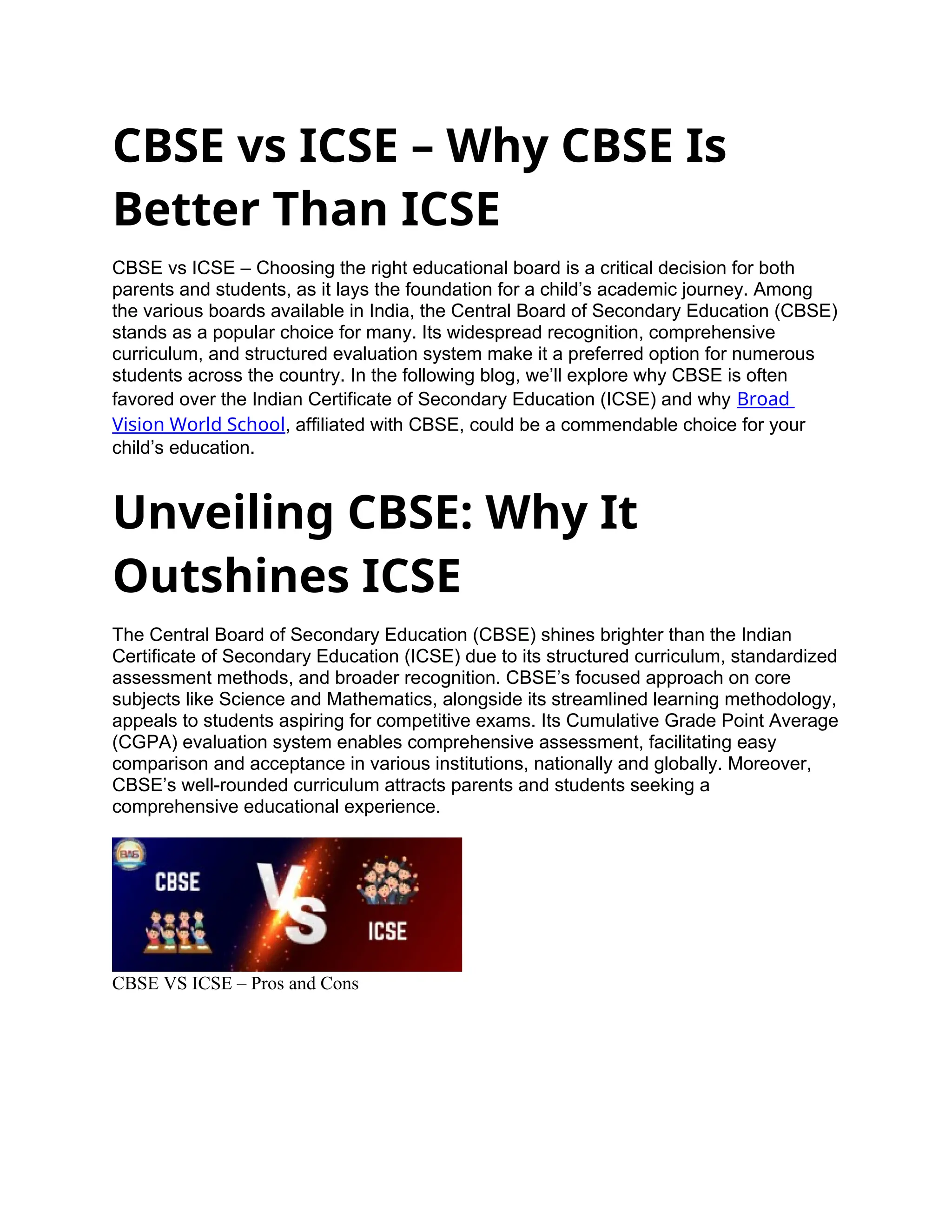
CBSE VS ICSE – Pros and Cons
Advantages and
Dissadvantages (CBSE Vs ICSE)
CBSE (Central Board of Secondary
Education)
The Central Board of Secondary Education (CBSE) is a national-level board of
education in India that operates under the Union Government of India. It follows a
standardized curriculum across its affiliated schools, ensuring uniformity in education
while allowing for regional flexibility.
Advantages
1. Standardized Curriculum: CBSE follows a centralized curriculum recognized
across India, making transfers easier and simplifying preparation for national-
level exams.
2. Focus on Competitive Exams: The syllabus aligns well with competitive exams
like JEE and NEET, making it ideal for students planning to pursue careers in
engineering or medicine.
3. Objective Exam Pattern: CBSE exams often emphasize objective questions,
multiple-choice, and practical applications, reducing the burden of subjective
answering.
4. Manageable Syllabus: The curriculum is often less intense than ICSE, focusing
on core subjects and making it easier to balance academics with extracurricular
activities.
Disadvantages
1. Less Emphasis on Language and Arts: CBSE has a strong focus on Science
and Math, but less emphasis on subjects like arts, humanities, and literature
compared to ICSE.
2. Rote Learning: CBSE’s emphasis on standardized testing may sometimes
encourage memorization rather than deep understanding.
3. Limited International Recognition: While recognized in India, CBSE may not
be as widely recognized internationally as ICSE in some regions.
ICSE (Indian Certificate of
Secondary Education)
The ICSE (Indian Certificate of Secondary Education) board is controlled by
the Council for the Indian School Certificate Examinations (CISCE). CISCE is a
private, non-governmental education board in India that sets the curriculum, conducts
examinations, and manages the standards for ICSE and ISC (Indian School Certificate
for Grade 12) exams. Established in 1958, CISCE is recognized by many educational
authorities in India and internationally.
Advantages
1. Broad and Detailed Curriculum: ICSE provides an in-depth syllabus with an
emphasis on language, arts, science, and humanities, creating well-rounded
students.
2. Focus on Analytical Skills: ICSE emphasizes analytical and critical thinking,
which can help in developing problem-solving skills across subjects.
3. Strong English Proficiency: With a rigorous language component, ICSE
students often excel in English, making it advantageous for studies abroad.
4. International Recognition: ICSE is widely recognized internationally, which can
benefit students who may want to pursue higher studies outside India.
Disadvantages
1. Intensive Syllabus: The ICSE curriculum is extensive, which may be
overwhelming for some students and require significant study time.
2. Fewer Schools Offering ICSE: CBSE is more widely available across India,
while ICSE schools are fewer, making transfers difficult.
3. Higher Academic Pressure: The detailed nature of the ICSE syllabus can
sometimes lead to high academic pressure, especially with its heavy focus on
assessments.
In Summary
 CBSE is ideal for students who want a straightforward syllabus with national
recognition, especially for competitive exams in India.
 ICSE suits students looking for a comprehensive, globally-recognized education
that builds strong language and analytical skills, though it may involve more
academic rigor.
CBSE vs ICSE : Find Out The
Difference
CBSE (Central Board of Secondary Education) and ICSE (Indian Certificate of
Secondary Education) are two prominent education boards in India, each with its own
distinct characteristics.
1. Curriculum
 CBSE (Central Board of Secondary Education): CBSE follows a national
curriculum designed by NCERT (National Council of Educational Research and
Training). It’s structured to focus on Science and Mathematics and prepares
students for national-level entrance exams, like JEE (for engineering) and NEET
(for medicine).
 ICSE (Indian Certificate of Secondary Education): ICSE has a
more comprehensive and diverse curriculum that includes a wider range of
subjects, especially a strong focus on English language and literature. It’s
often viewed as more in-depth and challenging compared to CBSE, covering
topics in greater detail.
2. Exam Structure
 CBSE: Students take board exams at the end of Grade 10 (AISSE) and Grade
12 (AISSCE). CBSE exam questions are generally designed to test students’
understanding of concepts and how to apply them practically.
 ICSE: ICSE board exams are conducted at the end of Grade 10 (ICSE). ICSE
exams are known for their detailed and comprehensive questions, often testing
students’ analytical skills and a deeper understanding of each topic.
3. Grading System
 CBSE: CBSE uses a 9-point grading system, which means students are
evaluated based on grades rather than specific marks. This system reduces
competition and stress by focusing less on exact scores.
 ICSE: ICSE traditionally uses a percentage-based grading system, giving
precise marks for students’ performance, which can encourage competition but
also gives a clearer picture of performance.
4. Medium of Instruction
 CBSE: CBSE schools usually offer classes in both English and Hindi, so
students can choose their preferred language for instruction.
 ICSE: ICSE schools mainly use English as the medium of instruction. This focus
on English often helps students develop strong language skills, useful for further
education and careers globally.
5. Recognition
 CBSE: CBSE is highly recognized across India. Its curriculum is aligned
with national competitive exams like JEE and NEET, making it a popular
choice for students who want to pursue higher studies within India.
 ICSE: ICSE is also recognized in India but is less widespread than CBSE.
However, it’s known for its detailed curriculum and is often highly regarded in
international education settings.
6. Teaching Methodologies
 CBSE: The CBSE approach is mostly theoretical and structured, with a focus
on application-based learning. Students learn concepts and how to use them in
real-life situations.
 ICSE: ICSE encourages a holistic approach, emphasizing interactive and
engaging methods that help students understand subjects in depth. This board
encourages independent thinking, creativity, and problem-solving.
7. Flexibility and Diversity
 CBSE: CBSE’s curriculum is flexible and suitable for students aiming to
pursue professional courses in engineering, medicine, and similar fields. It’s
structured to focus more on subjects like Science and Mathematics, which are
common in competitive exams in India.
 ICSE: ICSE’s curriculum is diverse, covering a variety of subjects in great detail.
It’s a good option for students interested in the humanities, arts, and
languages or those planning to study abroad, as it promotes well-rounded
learning.
In Summary:
 CBSE is more streamlined, practical, and well-suited for students aiming at
Indian competitive exams.
 ICSE provides a broader and more detailed education, promoting language skills
and a deep understanding of various subjects, which is useful for international
studies and career options.
Choosing Between CBSE and ICSE often depends on various factors like a student’s
learning style, career aspirations, and the availability of schools in the area. Both boards
have their advantages, and the choice ultimately depends on what suits the student’s
needs and preferences the best.
CBSE Vs ICSE : Grading System
CBSE Grading System:
 9-Point Scale: CBSE uses a 9-point grading scale from A1 to E, with each grade
representing a specific range of marks.
 No Exact Marks Shown: Instead of showing exact marks, students receive a
grade based on their score range, reducing stress and competition.
 Grade Points: Each grade corresponds to a grade point that can be used to
calculate the Cumulative Grade Point Average (CGPA).
Grade Marks Range (%) Grade P
A1 91-100 10
A2 81-90 9
B1 71-80 8
B2 61-70 7
C1 51-60 6
Grade Marks Range (%) Grade P
C2 41-50 5
D 33-40 4
E1 21-32 N/A (Fail)
E2 0-20 N/A (Fail)
 Focus: The CBSE grading system is designed to focus on overall performance
without exact marks, which can reduce competition and pressure.
ICSE Grading System:
 Percentage-Based: ICSE provides exact percentage marks in each subject,
making it a precise reflection of student performance.
 Grades with Percentage Bands: Although ICSE also has grades, they’re based
on exact scores, and each percentage is directly shown on the report card.
 Transparency: This system can increase competitiveness but also gives a
clearer picture of how each student performs.
Percentage Range (%) Grade
90-100 Very Good (A)
80-89 Good (B)
70-79 Fair (C)
Below 35 Fail
Percentage Range (%) Grade
 Focus: The ICSE system emphasizes academic precision, providing a specific
score that reflects a student’s exact performance. This approach can be helpful
for students who need detailed feedback but might lead to more academic
pressure.
Key Differences:
 CBSE uses grades instead of exact marks, focusing on reducing competition
and emphasizing a broader picture of performance.
 ICSE provides exact percentages and a grade, giving students a clearer view of
their specific scores but potentially creating a more competitive environment.
Both systems have their strengths, so your choice should reflect your child’s learning
style and comfort with competition or detailed feedback.
CBSE VS ICSE
Why Choose Broad Vision
World School (CBSE Board)?
Broad Vision World School, affiliated with the CBSE board, prides itself on offering a
comprehensive educational experience that goes beyond traditional academics. Here
are more detailed insights into what sets this institution apart:
1. Holistic Education Approach: At Broad Vision World School, education
transcends textbooks. The curriculum is designed to not only impart knowledge
but also install values, ethics, and a sense of global citizenship. The school
believes in nurturing every aspect of a student’s personality, fostering intellectual,
emotional, social, and physical development. By integrating sports, arts, and
extracurricular activities into the curriculum, students get a well-rounded
education that prepares them for life beyond the classroom.
2. Highly Qualified Faculty: The backbone of any educational institution is its
faculty. Broad Vision World School prides itself on a team of educators who are
not just highly qualified in their respective fields but also passionate about
teaching. They provide personalized attention to each student, catering to their
individual learning needs. This creates an environment conducive to effective
learning and encourages students to excel academically.
3. Modern Infrastructure and Facilities: The school understands the importance
of a conducive environment for learning. It boasts state-of-the-art facilities,
including spacious classrooms equipped with modern teaching aids, well-stocked
libraries, advanced laboratories for practical learning, and sports amenities that
encourage physical fitness and sportsmanship. Moreover, the integration of
technology in the learning process enhances the overall educational experience,
preparing students for the digital age.
4. Focus on Skill Development: Beyond academic excellence, Broad Vision
World School places a strong emphasis on developing essential skills. The
curriculum is designed to nurture critical thinking, problem-solving abilities,
effective communication, creativity, and leadership qualities. Various workshops,
seminars, and extracurricular activities are conducted to hone these skills,
ensuring that students are well-prepared to face challenges and excel in their
future endeavors.
5. Parental Involvement and Community Engagement: The school believes in
the importance of collaboration between parents, teachers, and the community.
There are avenues for parents to actively engage in their child’s educational
journey, fostering a supportive environment that enhances the overall learning
experience. Additionally, the school encourages community engagement,
instilling a sense of responsibility and empathy in students by involving them in
various social initiatives and community service programs.
Broad Vision World School’s commitment to providing a holistic education that goes
beyond academics sets it apart as an institution dedicated to nurturing well-rounded
individuals equipped to thrive in an ever-evolving world.
Conclusion
Choosing the right educational board and school is pivotal in shaping a child’s academic
and overall development. CBSE, known for its structured curriculum, national
recognition, and emphasis on holistic learning, combined with a reputed institution like
Broad Vision World School, can provide a conducive environment for students to thrive
academically and personally.
FAQs About Broad Vision World
School:
 Which board is better for competitive exams like JEE and NEET?
CBSE is often preferred for competitive exams in India, as the curriculum is aligned with
the syllabus for entrance exams like JEE (for engineering) and NEET (for medicine). Its
focus on Science and Math gives students a solid foundation for these tests.
 Is ICSE better for students who want to study abroad?
Yes, ICSE is generally more recognized internationally and offers a curriculum that
emphasizes English language skills, making it ideal for students considering higher
education abroad.
 Which board has a more challenging syllabus?
ICSE is typically considered more detailed and challenging because of its
comprehensive curriculum, which covers subjects in depth. CBSE has a more concise
syllabus, which is often viewed as less intensive.
 What are the key differences in the grading systems of CBSE and ICSE?
CBSE uses a 9-point grading scale with grades like A1, A2, B1, etc., based on ranges
of marks, while ICSE follows a percentage-based system showing exact scores.
CBSE’s grading can reduce pressure, while ICSE’s exact marks can offer detailed
feedback.
 Which board is better for overall development, including extracurriculars?
ICSE is known for its holistic approach, encouraging a balanced focus on arts,
language, and analytical skills, which can support well-rounded development. CBSE is
more structured around Science and Math, though many schools still offer a range of
extracurricular activities.
 Should I put my child in CBSE or ICSE?
CBSE is often suited for students aiming for Indian competitive exams,
while ICSE might be ideal for those looking for an international outlook or a broader
curriculum. Both boards are excellent; it’s about what aligns best with your child’s
aspirations and strengths.
CBSE Vs ICSE

CBSE vs ICSE – Why CBSE Is Better Than ICSE

  • 1.
    CBSE vs ICSE– Why CBSE Is Better Than ICSE CBSE vs ICSE – Choosing the right educational board is a critical decision for both parents and students, as it lays the foundation for a child’s academic journey. Among the various boards available in India, the Central Board of Secondary Education (CBSE) stands as a popular choice for many. Its widespread recognition, comprehensive curriculum, and structured evaluation system make it a preferred option for numerous students across the country. In the following blog, we’ll explore why CBSE is often favored over the Indian Certificate of Secondary Education (ICSE) and why Broad Vision World School, affiliated with CBSE, could be a commendable choice for your child’s education. Unveiling CBSE: Why It Outshines ICSE The Central Board of Secondary Education (CBSE) shines brighter than the Indian Certificate of Secondary Education (ICSE) due to its structured curriculum, standardized assessment methods, and broader recognition. CBSE’s focused approach on core subjects like Science and Mathematics, alongside its streamlined learning methodology, appeals to students aspiring for competitive exams. Its Cumulative Grade Point Average (CGPA) evaluation system enables comprehensive assessment, facilitating easy comparison and acceptance in various institutions, nationally and globally. Moreover, CBSE’s well-rounded curriculum attracts parents and students seeking a comprehensive educational experience. CBSE VS ICSE – Pros and Cons
  • 2.
    Advantages and Dissadvantages (CBSEVs ICSE) CBSE (Central Board of Secondary Education) The Central Board of Secondary Education (CBSE) is a national-level board of education in India that operates under the Union Government of India. It follows a standardized curriculum across its affiliated schools, ensuring uniformity in education while allowing for regional flexibility. Advantages 1. Standardized Curriculum: CBSE follows a centralized curriculum recognized across India, making transfers easier and simplifying preparation for national- level exams. 2. Focus on Competitive Exams: The syllabus aligns well with competitive exams like JEE and NEET, making it ideal for students planning to pursue careers in engineering or medicine. 3. Objective Exam Pattern: CBSE exams often emphasize objective questions, multiple-choice, and practical applications, reducing the burden of subjective answering. 4. Manageable Syllabus: The curriculum is often less intense than ICSE, focusing on core subjects and making it easier to balance academics with extracurricular activities. Disadvantages 1. Less Emphasis on Language and Arts: CBSE has a strong focus on Science and Math, but less emphasis on subjects like arts, humanities, and literature compared to ICSE. 2. Rote Learning: CBSE’s emphasis on standardized testing may sometimes encourage memorization rather than deep understanding. 3. Limited International Recognition: While recognized in India, CBSE may not be as widely recognized internationally as ICSE in some regions.
  • 3.
    ICSE (Indian Certificateof Secondary Education) The ICSE (Indian Certificate of Secondary Education) board is controlled by the Council for the Indian School Certificate Examinations (CISCE). CISCE is a private, non-governmental education board in India that sets the curriculum, conducts examinations, and manages the standards for ICSE and ISC (Indian School Certificate for Grade 12) exams. Established in 1958, CISCE is recognized by many educational authorities in India and internationally. Advantages 1. Broad and Detailed Curriculum: ICSE provides an in-depth syllabus with an emphasis on language, arts, science, and humanities, creating well-rounded students. 2. Focus on Analytical Skills: ICSE emphasizes analytical and critical thinking, which can help in developing problem-solving skills across subjects. 3. Strong English Proficiency: With a rigorous language component, ICSE students often excel in English, making it advantageous for studies abroad. 4. International Recognition: ICSE is widely recognized internationally, which can benefit students who may want to pursue higher studies outside India. Disadvantages 1. Intensive Syllabus: The ICSE curriculum is extensive, which may be overwhelming for some students and require significant study time. 2. Fewer Schools Offering ICSE: CBSE is more widely available across India, while ICSE schools are fewer, making transfers difficult. 3. Higher Academic Pressure: The detailed nature of the ICSE syllabus can sometimes lead to high academic pressure, especially with its heavy focus on assessments. In Summary  CBSE is ideal for students who want a straightforward syllabus with national recognition, especially for competitive exams in India.  ICSE suits students looking for a comprehensive, globally-recognized education that builds strong language and analytical skills, though it may involve more academic rigor.
  • 4.
    CBSE vs ICSE: Find Out The Difference CBSE (Central Board of Secondary Education) and ICSE (Indian Certificate of Secondary Education) are two prominent education boards in India, each with its own distinct characteristics. 1. Curriculum  CBSE (Central Board of Secondary Education): CBSE follows a national curriculum designed by NCERT (National Council of Educational Research and Training). It’s structured to focus on Science and Mathematics and prepares students for national-level entrance exams, like JEE (for engineering) and NEET (for medicine).  ICSE (Indian Certificate of Secondary Education): ICSE has a more comprehensive and diverse curriculum that includes a wider range of subjects, especially a strong focus on English language and literature. It’s often viewed as more in-depth and challenging compared to CBSE, covering topics in greater detail. 2. Exam Structure  CBSE: Students take board exams at the end of Grade 10 (AISSE) and Grade 12 (AISSCE). CBSE exam questions are generally designed to test students’ understanding of concepts and how to apply them practically.  ICSE: ICSE board exams are conducted at the end of Grade 10 (ICSE). ICSE exams are known for their detailed and comprehensive questions, often testing students’ analytical skills and a deeper understanding of each topic. 3. Grading System  CBSE: CBSE uses a 9-point grading system, which means students are evaluated based on grades rather than specific marks. This system reduces competition and stress by focusing less on exact scores.  ICSE: ICSE traditionally uses a percentage-based grading system, giving precise marks for students’ performance, which can encourage competition but also gives a clearer picture of performance.
  • 5.
    4. Medium ofInstruction  CBSE: CBSE schools usually offer classes in both English and Hindi, so students can choose their preferred language for instruction.  ICSE: ICSE schools mainly use English as the medium of instruction. This focus on English often helps students develop strong language skills, useful for further education and careers globally. 5. Recognition  CBSE: CBSE is highly recognized across India. Its curriculum is aligned with national competitive exams like JEE and NEET, making it a popular choice for students who want to pursue higher studies within India.  ICSE: ICSE is also recognized in India but is less widespread than CBSE. However, it’s known for its detailed curriculum and is often highly regarded in international education settings. 6. Teaching Methodologies  CBSE: The CBSE approach is mostly theoretical and structured, with a focus on application-based learning. Students learn concepts and how to use them in real-life situations.  ICSE: ICSE encourages a holistic approach, emphasizing interactive and engaging methods that help students understand subjects in depth. This board encourages independent thinking, creativity, and problem-solving. 7. Flexibility and Diversity  CBSE: CBSE’s curriculum is flexible and suitable for students aiming to pursue professional courses in engineering, medicine, and similar fields. It’s structured to focus more on subjects like Science and Mathematics, which are common in competitive exams in India.  ICSE: ICSE’s curriculum is diverse, covering a variety of subjects in great detail. It’s a good option for students interested in the humanities, arts, and languages or those planning to study abroad, as it promotes well-rounded learning. In Summary:
  • 6.
     CBSE ismore streamlined, practical, and well-suited for students aiming at Indian competitive exams.  ICSE provides a broader and more detailed education, promoting language skills and a deep understanding of various subjects, which is useful for international studies and career options. Choosing Between CBSE and ICSE often depends on various factors like a student’s learning style, career aspirations, and the availability of schools in the area. Both boards have their advantages, and the choice ultimately depends on what suits the student’s needs and preferences the best. CBSE Vs ICSE : Grading System CBSE Grading System:  9-Point Scale: CBSE uses a 9-point grading scale from A1 to E, with each grade representing a specific range of marks.  No Exact Marks Shown: Instead of showing exact marks, students receive a grade based on their score range, reducing stress and competition.  Grade Points: Each grade corresponds to a grade point that can be used to calculate the Cumulative Grade Point Average (CGPA). Grade Marks Range (%) Grade P A1 91-100 10 A2 81-90 9 B1 71-80 8 B2 61-70 7 C1 51-60 6
  • 7.
    Grade Marks Range(%) Grade P C2 41-50 5 D 33-40 4 E1 21-32 N/A (Fail) E2 0-20 N/A (Fail)  Focus: The CBSE grading system is designed to focus on overall performance without exact marks, which can reduce competition and pressure. ICSE Grading System:  Percentage-Based: ICSE provides exact percentage marks in each subject, making it a precise reflection of student performance.  Grades with Percentage Bands: Although ICSE also has grades, they’re based on exact scores, and each percentage is directly shown on the report card.  Transparency: This system can increase competitiveness but also gives a clearer picture of how each student performs. Percentage Range (%) Grade 90-100 Very Good (A) 80-89 Good (B) 70-79 Fair (C) Below 35 Fail
  • 8.
    Percentage Range (%)Grade  Focus: The ICSE system emphasizes academic precision, providing a specific score that reflects a student’s exact performance. This approach can be helpful for students who need detailed feedback but might lead to more academic pressure. Key Differences:  CBSE uses grades instead of exact marks, focusing on reducing competition and emphasizing a broader picture of performance.  ICSE provides exact percentages and a grade, giving students a clearer view of their specific scores but potentially creating a more competitive environment. Both systems have their strengths, so your choice should reflect your child’s learning style and comfort with competition or detailed feedback. CBSE VS ICSE Why Choose Broad Vision World School (CBSE Board)? Broad Vision World School, affiliated with the CBSE board, prides itself on offering a comprehensive educational experience that goes beyond traditional academics. Here are more detailed insights into what sets this institution apart: 1. Holistic Education Approach: At Broad Vision World School, education transcends textbooks. The curriculum is designed to not only impart knowledge but also install values, ethics, and a sense of global citizenship. The school believes in nurturing every aspect of a student’s personality, fostering intellectual, emotional, social, and physical development. By integrating sports, arts, and
  • 9.
    extracurricular activities intothe curriculum, students get a well-rounded education that prepares them for life beyond the classroom. 2. Highly Qualified Faculty: The backbone of any educational institution is its faculty. Broad Vision World School prides itself on a team of educators who are not just highly qualified in their respective fields but also passionate about teaching. They provide personalized attention to each student, catering to their individual learning needs. This creates an environment conducive to effective learning and encourages students to excel academically. 3. Modern Infrastructure and Facilities: The school understands the importance of a conducive environment for learning. It boasts state-of-the-art facilities, including spacious classrooms equipped with modern teaching aids, well-stocked libraries, advanced laboratories for practical learning, and sports amenities that encourage physical fitness and sportsmanship. Moreover, the integration of technology in the learning process enhances the overall educational experience, preparing students for the digital age. 4. Focus on Skill Development: Beyond academic excellence, Broad Vision World School places a strong emphasis on developing essential skills. The curriculum is designed to nurture critical thinking, problem-solving abilities, effective communication, creativity, and leadership qualities. Various workshops, seminars, and extracurricular activities are conducted to hone these skills, ensuring that students are well-prepared to face challenges and excel in their future endeavors. 5. Parental Involvement and Community Engagement: The school believes in the importance of collaboration between parents, teachers, and the community. There are avenues for parents to actively engage in their child’s educational journey, fostering a supportive environment that enhances the overall learning experience. Additionally, the school encourages community engagement, instilling a sense of responsibility and empathy in students by involving them in various social initiatives and community service programs. Broad Vision World School’s commitment to providing a holistic education that goes beyond academics sets it apart as an institution dedicated to nurturing well-rounded individuals equipped to thrive in an ever-evolving world. Conclusion Choosing the right educational board and school is pivotal in shaping a child’s academic and overall development. CBSE, known for its structured curriculum, national recognition, and emphasis on holistic learning, combined with a reputed institution like Broad Vision World School, can provide a conducive environment for students to thrive academically and personally.
  • 10.
    FAQs About BroadVision World School:  Which board is better for competitive exams like JEE and NEET? CBSE is often preferred for competitive exams in India, as the curriculum is aligned with the syllabus for entrance exams like JEE (for engineering) and NEET (for medicine). Its focus on Science and Math gives students a solid foundation for these tests.  Is ICSE better for students who want to study abroad? Yes, ICSE is generally more recognized internationally and offers a curriculum that emphasizes English language skills, making it ideal for students considering higher education abroad.  Which board has a more challenging syllabus? ICSE is typically considered more detailed and challenging because of its comprehensive curriculum, which covers subjects in depth. CBSE has a more concise syllabus, which is often viewed as less intensive.  What are the key differences in the grading systems of CBSE and ICSE? CBSE uses a 9-point grading scale with grades like A1, A2, B1, etc., based on ranges of marks, while ICSE follows a percentage-based system showing exact scores. CBSE’s grading can reduce pressure, while ICSE’s exact marks can offer detailed feedback.  Which board is better for overall development, including extracurriculars? ICSE is known for its holistic approach, encouraging a balanced focus on arts, language, and analytical skills, which can support well-rounded development. CBSE is more structured around Science and Math, though many schools still offer a range of extracurricular activities.  Should I put my child in CBSE or ICSE? CBSE is often suited for students aiming for Indian competitive exams, while ICSE might be ideal for those looking for an international outlook or a broader curriculum. Both boards are excellent; it’s about what aligns best with your child’s aspirations and strengths.
  • 11.