Beginning Teacher Support Program
Differentiation
Do Now
For each example on the handout, put a (+) if the activity
is an example of differentiation and a (-) if it is not an
example of differentiation.
Essential Question
How can I ensure that I am effectively differentiating instruction for students in
my class?
I will be able to differentiate content, processes, and products for my
students.
Objective
Agenda
• Do Now
• The Research
• What is Differentiation?
• Differentiation Best Practices
• Guided Practice
• Procedures for Differentiated Instruction
• Follow-Up Activity
• Exit Ticket
The Research
Researchers at the National Center on Accessing the General Curriculum
define differentiated instruction as…
a process to approach teaching and learning for students of differing
abilities in the same class. The intent is to maximize each student's growth
and individual success by meeting each student where he or she is . . . rather
than expecting students to modify themselves for the curriculum.
(Hall, 2002)
What is Differentiation?
• A teacher’s response to learner needs
• The recognition of students’ varying background knowledge
and preferences
• Instruction that addresses students’ differences
What can I differentiate?
• Content
• Process
• Product
Differentiation should not be…
Student choice without guidelines
Overly complex for the teacher or students
Challenging to track
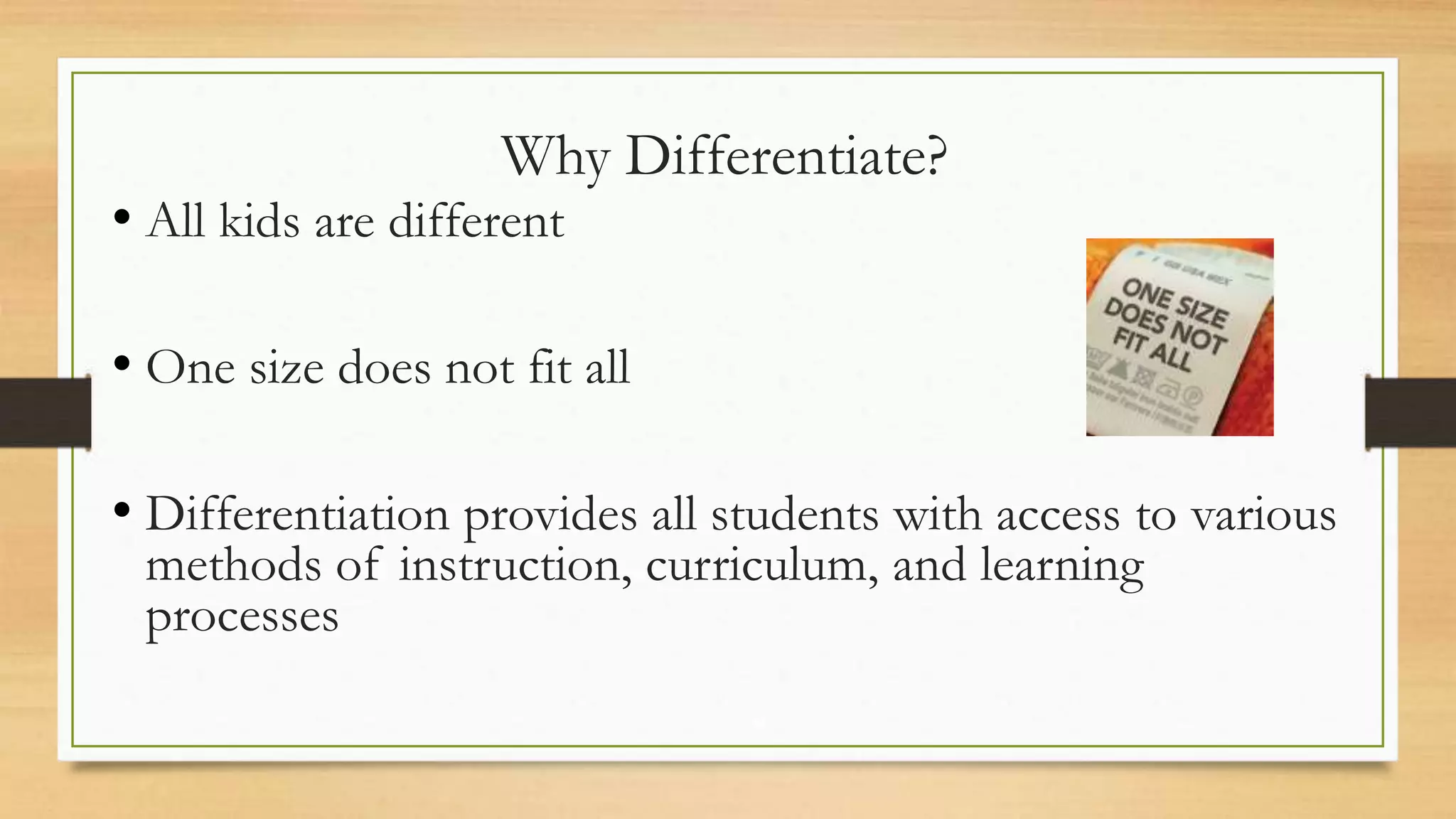
Why Differentiate?
• All kids are different
• One size does not fit all
• Differentiation provides all students with access to various
methods of instruction, curriculum, and learning
processes
Differentiate Content
Why would I differentiate content?
 Turn and Talk
When we need to vary what we teach to different
students.
Differentiate Process
Why would I differentiate process?
 Turn and Talk
When we need to vary how we teach the content to the
students.
Differentiate Product
Why would I differentiate product?
 Turn and Talk
When we need to vary how the students demonstrate
mastery of a standard.
Best Practices
• Focus on the standard for the content area when varying activities. The activities are different, but the
objective for each activity is the same.
• When developing lesson plans, address various individual student differences (such as learning style,
prior knowledge, interests, and level of engagement).
• Group students differently depending on the activity.
• Integrate formative assessments throughout instruction.
• Continually assess; reflect; and adjust content, process, and product to meet student needs.
Put it into Practice
Imagine that you are teaching the following standard: Compare and
contrast the overall structure (e.g., chronology, comparison, cause/effect,
problem/solution) of events, ideas, concepts, or information in two or
more texts.
You want to start with the following objective:
Compare and contrast the ideas in two non-fiction articles.
Now, create three variations of one activity where the students will
accomplish the same goal at the end. You can choose to vary content,
process, or product.
Essential Question
How can I ensure that I am effectively differentiating instruction for students in
my class?
I will be able to differentiate content, processes, and products for my
students.
Objective
Follow-Up Activity
Choose one objective from your lesson plans next
week. Develop three examples of differentiation for the
objective. One example should differentiate content,
one should differentiate process, and one should
differentiate product.
Q & A

Differentiation

  • 1.
  • 2.
  • 3.
    Do Now For eachexample on the handout, put a (+) if the activity is an example of differentiation and a (-) if it is not an example of differentiation.
  • 4.
    Essential Question How canI ensure that I am effectively differentiating instruction for students in my class? I will be able to differentiate content, processes, and products for my students. Objective
  • 5.
    Agenda • Do Now •The Research • What is Differentiation? • Differentiation Best Practices • Guided Practice • Procedures for Differentiated Instruction • Follow-Up Activity • Exit Ticket
  • 6.
    The Research Researchers atthe National Center on Accessing the General Curriculum define differentiated instruction as… a process to approach teaching and learning for students of differing abilities in the same class. The intent is to maximize each student's growth and individual success by meeting each student where he or she is . . . rather than expecting students to modify themselves for the curriculum. (Hall, 2002)
  • 7.
    What is Differentiation? •A teacher’s response to learner needs • The recognition of students’ varying background knowledge and preferences • Instruction that addresses students’ differences
  • 8.
    What can Idifferentiate? • Content • Process • Product
  • 9.
    Differentiation should notbe… Student choice without guidelines Overly complex for the teacher or students Challenging to track
  • 10.
    Why Differentiate? • Allkids are different • One size does not fit all • Differentiation provides all students with access to various methods of instruction, curriculum, and learning processes
  • 11.
    Differentiate Content Why wouldI differentiate content?  Turn and Talk When we need to vary what we teach to different students.
  • 12.
    Differentiate Process Why wouldI differentiate process?  Turn and Talk When we need to vary how we teach the content to the students.
  • 13.
    Differentiate Product Why wouldI differentiate product?  Turn and Talk When we need to vary how the students demonstrate mastery of a standard.
  • 14.
    Best Practices • Focuson the standard for the content area when varying activities. The activities are different, but the objective for each activity is the same. • When developing lesson plans, address various individual student differences (such as learning style, prior knowledge, interests, and level of engagement). • Group students differently depending on the activity. • Integrate formative assessments throughout instruction. • Continually assess; reflect; and adjust content, process, and product to meet student needs.
  • 15.
    Put it intoPractice Imagine that you are teaching the following standard: Compare and contrast the overall structure (e.g., chronology, comparison, cause/effect, problem/solution) of events, ideas, concepts, or information in two or more texts. You want to start with the following objective: Compare and contrast the ideas in two non-fiction articles. Now, create three variations of one activity where the students will accomplish the same goal at the end. You can choose to vary content, process, or product.
  • 16.
    Essential Question How canI ensure that I am effectively differentiating instruction for students in my class? I will be able to differentiate content, processes, and products for my students. Objective
  • 17.
    Follow-Up Activity Choose oneobjective from your lesson plans next week. Develop three examples of differentiation for the objective. One example should differentiate content, one should differentiate process, and one should differentiate product.
  • 18.