SLIDESMANIA
INTRODUCTION
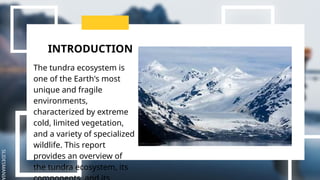
The tundra ecosystemis
one of the Earth's most
unique and fragile
environments,
characterized by extreme
cold, limited vegetation,
and a variety of specialized
wildlife. This report
provides an overview of
the tundra ecosystem, its
3.
SLIDESMANIA
Tundra Ecosystem
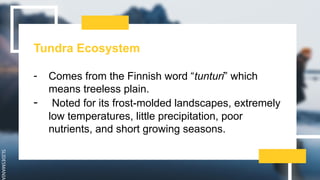
- Comesfrom the Finnish word “tunturi” which
means treeless plain.
- Noted for its frost-molded landscapes, extremely
low temperatures, little precipitation, poor
nutrients, and short growing seasons.
4.
SLIDESMANIA
Characteristics
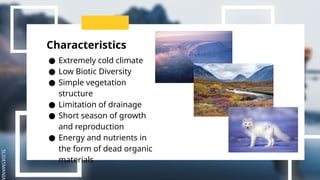
● Extremely coldclimate
● Low Biotic Diversity
● Simple vegetation
structure
● Limitation of drainage
● Short season of growth
and reproduction
● Energy and nutrients in
the form of dead organic
materials
SLIDESMANIA
Arctic tundra
Location :Northern hemisphere, encircling the
North Pole and extending to the taiga forests
further south.
Climate: Harsh, cold conditions with a short
growing season (50-60 days). Average winter
temperature: -34°C (-30°F), while summer
temperatures range from 3-12°C (37-54°F).
8.
SLIDESMANIA
Arctic tundra
Precipitation: Yearlyprecipitation, including
snowmelt, ranges from 15 to 25 cm (6-10 inches).
Soil: Slow soil formation; permafrost (permanently
frozen subsoil) predominates. Bogs and ponds
form when water saturates the upper surface,
providing moisture for plants.
9.
SLIDESMANIA
Arctic tundra
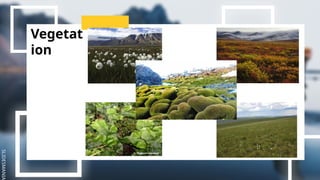
Vegetation: Lowshrubs, sedges, mosses,
liverworts, grasses, and around 400 flower
varieties. Lichens are common.
Plant Adaptations: Short stature, clustering for
warmth, and resistance to cold. Photosynthesis
occurs at low temperatures and light intensities.
Reproduction is often asexual.
10.
SLIDESMANIA
Arctic tundra
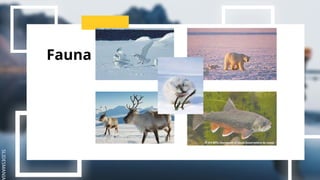
Fauna: Diverseherbivores (lemmings, caribou),
carnivores (arctic foxes, polar bears), migratory
birds, insects (including mosquitoes), and fish (cod,
salmon).
Animal Adaptations: Adapted to harsh winters,
fast breeding in summer, and often well-insulated
with fat. Hibernation and migration are common
strategies.
SLIDESMANIA
Alpine tundra
Location: Highmountain regions worldwide,
above the tree line due to extreme altitude.
Growing Season: Approximately 180 days, with
nighttime temperatures often below freezing.
Temperature: ranges from 10°C to 20°C (50°F to
68°F) during the daytime. At night time often drop
below freezing with averages ranging from -1°C to
5°C (30°F to 41°F).
13.
SLIDESMANIA
Alpine tundra
Soil: Well-drainedcompared to arctic tundra.
Vegetation: Similar to arctic tundra with tussock
grasses, dwarf trees, small-leafed shrubs, and
heaths.
Fauna: Well-adapted animals include mammals
(pikas, marmots, mountain goats, elk), grouselike
birds, and various insects (springtails, beetles,
grasshoppers, butterflies).
SLIDESMANIA
Biodiversity:
Tundra support a
uniqueset of plant
and animal species
that have adapted
to extreme
conditions. This
biodiversity
contributes to
genetic diversity
and may have
implications for
scientific research
and potential
Carbon Storage:
Tundra regions
store vast amounts
of carbon in the
form of organic
matter within their
frozen soils. This
carbon storage
helps mitigate the
release of
greenhouse gases
into the
atmosphere,
Climate
Regulation:
Tundra regions
act as a natural
"cooling system"
for the Earth.
Their highly
reflective
surfaces,
especially when
covered in snow
and ice, help
reflect sunlight,
16.
SLIDESMANIA
Water Supply:
Tundra playa role
in maintaining
freshwater
resources. The
slow release of
water from
melting
permafrost
contributes to
streamflow and
helps feed rivers
that provide
Migration
Routes: Tundra
regions are often
critical stopover
points for
migratory birds
and other wildlife
species during
their long-
distance journeys.
These areas are
essential for
resting, feeding,
Cultural
Significance:
Indigenous
peoples in tundra
regions have
deep cultural
connections to
the land, relying
on its resources
for their way of
life. Traditional
knowledge of
these ecosystems
17.
SLIDESMANIA
Tourism and
Education: Tundra
ecosystemsattract
tourists interested
in experiencing
unique and
pristine
landscapes. This
tourism can
provide economic
benefits to local
communities and
raise awareness
Global
Connectivity:
Tundra
ecosystems are
part of the global
ecological
network. Changes
in these regions,
whether from
climate change or
human activities,
can have far-
reaching
SLIDESMANIA
conclusion
In conclusion, thetundra ecosystem is characterized by
extreme cold, a short growing season, low biodiversity,
and simple vegetation structure. The two primary types
of tundra are Arctic tundra and Alpine tundra. Arctic
tundra is found in the northern hemisphere, encircling
the north pole, with a cold, desert-like environment,
while Alpine tundra occurs at high altitudes on
mountains where trees cannot grow. Both tundra types
are home to unique plants and animals adapted to
survive in harsh, cold conditions. The tundra's ecosystem
plays a vital role as it serves as a stopover point for
migratory species and regulate global climate.
21.
SLIDESMANIA
References
Bliss, L. C.,& Hu, F. S. (2023, September 21). Tundra | Definition,
Climate, Animals, & Facts. Encyclopedia Britannica.
https://www.britannica.com/science/tundra
NASA Earth Observatory. (n.d.). Tundra: Mission: Biomes.
https://www.earthobservatory.nasa.gov/biome/biotundra.php
Nunez, C. (2021, May 4). What are tundras? Environment.
https://www.nationalgeographic.com/environment/article/tundra-b
iome
Spencer, J. (2022). Tundra Biome - Facts, Climate & Information.
Animal Corner. https://animalcorner.org/biomes/tundra/
The tundra biome. (n.d.).
https://ucmp.berkeley.edu/exhibits/biomes/tundra.phpTundra