PRESENTATION ON
DIFFERENT
FEATURES
OF
WHAT IS COMPUTER?
A computer is an electronic
device for storing and
processing data, typically in
binary form, according to
instructions given to it in a
variable program.
FEATURESFEATURES
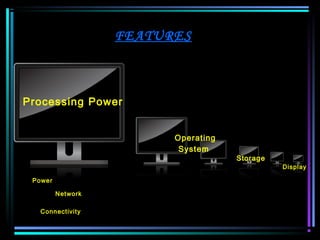
Processing Power
Operating
System
Storage
Display
Power
Network
Connectivity
Processing Power
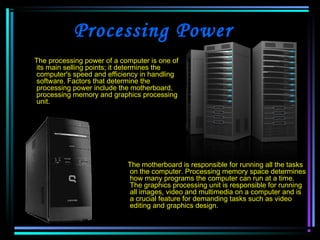
The processing power of a computer is one of
its main selling points; it determines the
computer's speed and efficiency in handling
software. Factors that determine the
processing power include the motherboard,
processing memory and graphics processing
unit.
The motherboard is responsible for running all the tasks
on the computer. Processing memory space determines
how many programs the computer can run at a time.
The graphics processing unit is responsible for running
all images, video and multimedia on a computer and is
a crucial feature for demanding tasks such as video
editing and graphics design.
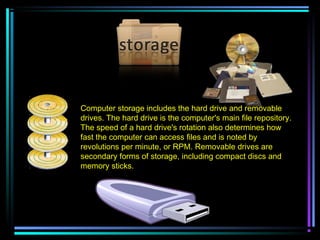
Computer storage includes the hard drive and removable
drives. The hard drive is the computer's main file repository.
The speed of a hard drive's rotation also determines how
fast the computer can access files and is noted by
revolutions per minute, or RPM. Removable drives are
secondary forms of storage, including compact discs and
memory sticks.
Display
The display is generally separate
with desktops and integrated
with laptops. Differences in
display include size and
resolution; higher-end devices
usually have a bigger screen size
and greater contrast ratio for
high definition displays.
Operating System
The operating system is a distinct computer interface. Different
operating systems can offer completely different sets of software
and program compatibility. For example, the native Internet
browser for Windows is Internet Explorer; Safari is the standard for
Mac-based computers. Despite having the same basic
functionality, each program differs in user interface and task
efficiency.
Network Connectivity
Most computers have built-inMost computers have built-in
network connectivity, althoughnetwork connectivity, although
some require external devices.some require external devices.
Computers can connectComputers can connect
through a wireless network,through a wireless network,
through a hard-wired networkthrough a hard-wired network
cable or bothcable or both..
Powe
r
Laptop computers are largely dependent on the
battery for power. The battery differs in the
number of cell packs; a greater number of cell
packs usually means that the laptop can last on
the battery alone for a longer period of time. For
desktop computers, the power source typically
has to be connected to an outlet at all times.
Different features of computer

Different features of computer

  • 1.
  • 2.
    WHAT IS COMPUTER? Acomputer is an electronic device for storing and processing data, typically in binary form, according to instructions given to it in a variable program.
  • 3.
  • 4.
    Processing Power The processingpower of a computer is one of its main selling points; it determines the computer's speed and efficiency in handling software. Factors that determine the processing power include the motherboard, processing memory and graphics processing unit. The motherboard is responsible for running all the tasks on the computer. Processing memory space determines how many programs the computer can run at a time. The graphics processing unit is responsible for running all images, video and multimedia on a computer and is a crucial feature for demanding tasks such as video editing and graphics design.
  • 5.
    Computer storage includesthe hard drive and removable drives. The hard drive is the computer's main file repository. The speed of a hard drive's rotation also determines how fast the computer can access files and is noted by revolutions per minute, or RPM. Removable drives are secondary forms of storage, including compact discs and memory sticks.
  • 6.
    Display The display isgenerally separate with desktops and integrated with laptops. Differences in display include size and resolution; higher-end devices usually have a bigger screen size and greater contrast ratio for high definition displays.
  • 7.
    Operating System The operatingsystem is a distinct computer interface. Different operating systems can offer completely different sets of software and program compatibility. For example, the native Internet browser for Windows is Internet Explorer; Safari is the standard for Mac-based computers. Despite having the same basic functionality, each program differs in user interface and task efficiency.
  • 8.
    Network Connectivity Most computershave built-inMost computers have built-in network connectivity, althoughnetwork connectivity, although some require external devices.some require external devices. Computers can connectComputers can connect through a wireless network,through a wireless network, through a hard-wired networkthrough a hard-wired network cable or bothcable or both..
  • 9.
    Powe r Laptop computers arelargely dependent on the battery for power. The battery differs in the number of cell packs; a greater number of cell packs usually means that the laptop can last on the battery alone for a longer period of time. For desktop computers, the power source typically has to be connected to an outlet at all times.