Copyright © 2006 Pearson Education, Inc., publishing as Benjamin Cummings
PowerPoint® Slides prepared by
Jay Withgott and Heidi Marcum
Copyright © 2008 Pearson Education, Inc., publishing as Pearson Benjamin Cummings
Ch 9
Soil and Agriculture
Part 2: Environmental Issues
and the Search for Solutions
Copyright © 2008 Pearson Education, Inc., publishing as Pearson Benjamin Cummings
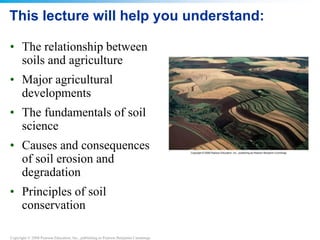
This lecture will help you understand:
• The relationship between
soils and agriculture
• Major agricultural
developments
• The fundamentals of soil
science
• Causes and consequences
of soil erosion and
degradation
• Principles of soil
conservation
Copyright © 2008 Pearson Education, Inc., publishing as Pearson Benjamin Cummings
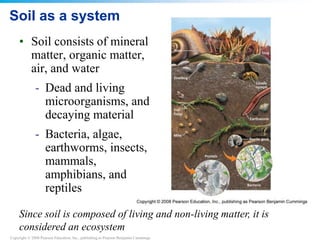
Soil as a system
• Soil consists of mineral
matter, organic matter,
air, and water
- Dead and living
microorganisms, and
decaying material
- Bacteria, algae,
earthworms, insects,
mammals,
amphibians, and
reptiles
Since soil is composed of living and non-living matter, it is
considered an ecosystem
Copyright © 2008 Pearson Education, Inc., publishing as Pearson Benjamin Cummings
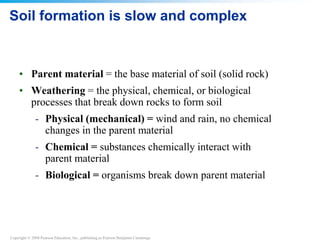
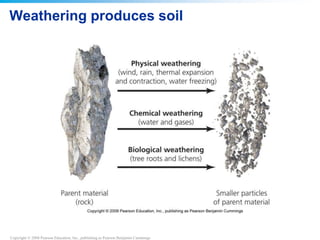
Soil formation is slow and complex
• Parent material = the base material of soil (solid rock)
• Weathering = the physical, chemical, or biological
processes that break down rocks to form soil
- Physical (mechanical) = wind and rain, no chemical
changes in the parent material
- Chemical = substances chemically interact with
parent material
- Biological = organisms break down parent material
Copyright © 2008 Pearson Education, Inc., publishing as Pearson Benjamin Cummings
Weathering produces soil
Copyright © 2008 Pearson Education, Inc., publishing as Pearson Benjamin Cummings
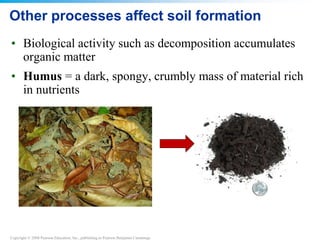
Other processes affect soil formation
• Biological activity such as decomposition accumulates
organic matter
• Humus = a dark, spongy, crumbly mass of material rich
in nutrients
Copyright © 2008 Pearson Education, Inc., publishing as Pearson Benjamin Cummings
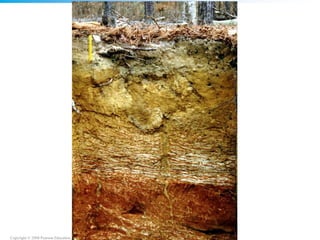
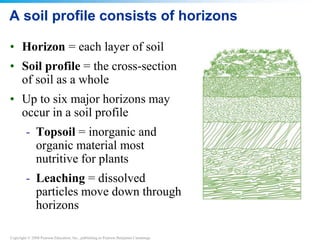
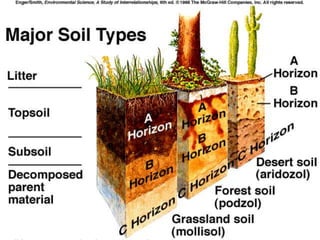
A soil profile consists of horizons
• Horizon = each layer of soil
• Soil profile = the cross-section
of soil as a whole
• Up to six major horizons may
occur in a soil profile
- Topsoil = inorganic and
organic material most
nutritive for plants
- Leaching = dissolved
particles move down through
horizons
Copyright © 2008 Pearson Education, Inc., publishing as Pearson Benjamin Cummings
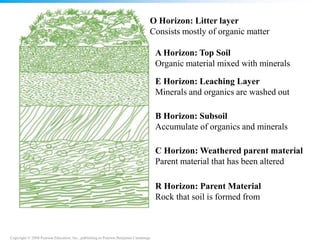
O Horizon: Litter layer
Consists mostly of organic matter
A Horizon: Top Soil
Organic material mixed with minerals
E Horizon: Leaching Layer
Minerals and organics are washed out
B Horizon: Subsoil
Accumulate of organics and minerals
C Horizon: Weathered parent material
Parent material that has been altered
R Horizon: Parent Material
Rock that soil is formed from
Copyright © 2008 Pearson Education, Inc., publishing as Pearson Benjamin Cummings
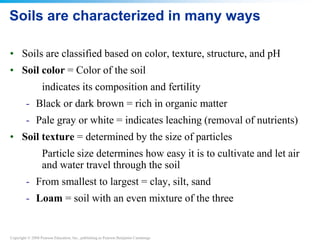
Soils are characterized in many ways
• Soils are classified based on color, texture, structure, and pH
• Soil color = Color of the soil
indicates its composition and fertility
- Black or dark brown = rich in organic matter
- Pale gray or white = indicates leaching (removal of nutrients)
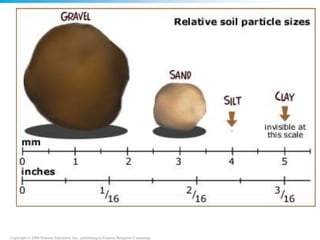
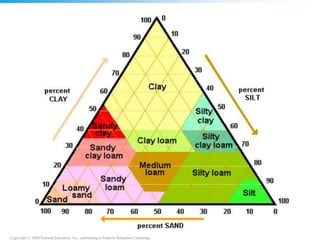
• Soil texture = determined by the size of particles
Particle size determines how easy it is to cultivate and let air
and water travel through the soil
- From smallest to largest = clay, silt, sand
- Loam = soil with an even mixture of the three
Copyright © 2008 Pearson Education, Inc., publishing as Pearson Benjamin Cummings
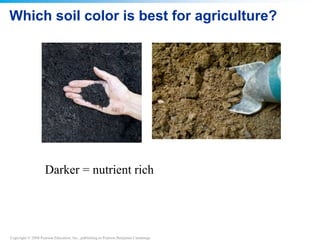
Which soil color is best for agriculture?
Darker = nutrient rich
What particles make up the BEST soil
Clay, Silt, or Sand?
Copyright © 2008 Pearson Education, Inc., publishing as Pearson Benjamin Cummings
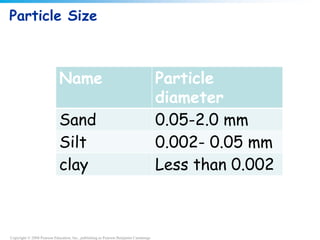
Particle Size
Name Particle
diameter
Sand 0.05-2.0 mm
Silt 0.002- 0.05 mm
clay Less than 0.002
Copyright © 2008 Pearson Education, Inc., publishing as Pearson Benjamin Cummings
Water Holding Capacity
• Should retain water for plant growth
• During heavy rains, if water is not absorbed
water can pool and take a long time to drain or
run off resulting in flooding
• Most important factor: Spaces of air between
the soil particles
• Water Holding Capacity depends on infiltration
rate and capillary action
Copyright © 2008 Pearson Education, Inc., publishing as Pearson Benjamin Cummings
Infiltration Rate
• Gravitational flow through soil
• Soils with high infiltration rate are easily leached
(removing nutrients)
Copyright © 2008 Pearson Education, Inc., publishing as Pearson Benjamin Cummings
Capillary Action
• Strong attraction between water molecules and soil
causes water to be drawn upward from the water
table.
• Capillary action increases when soil is packed close
enough to provide a continuous film of surface
• Soils with high rate of capillary action lose water
more quickly through evaporation than soil where
capillary action is slower.
Copyright © 2008 Pearson Education, Inc., publishing as Pearson Benjamin Cummings
Ions
What do ions do for plants?
• Nitrogen: gives plants green color
• Phosphorous: helps seed production
• Potassium: gives fruit color, helps with fruit
production
Copyright © 2008 Pearson Education, Inc., publishing as Pearson Benjamin Cummings
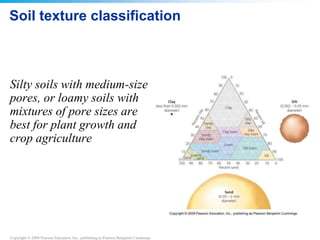
Soil texture classification
Silty soils with medium-size
pores, or loamy soils with
mixtures of pore sizes are
best for plant growth and
crop agriculture
Copyright © 2008 Pearson Education, Inc., publishing as Pearson Benjamin Cummings
pH Scale
Copyright © 2008 Pearson Education, Inc., publishing as Pearson Benjamin Cummings
Soil pH
• Soil pH = influences a soil’s ability to support plant
growth (plants grow best at pH of 7)
- Soils that are too acidic or basic can kill plants
- When pH gets too low, soil can not bond to nutrients
Copyright © 2008 Pearson Education, Inc., publishing as Pearson Benjamin Cummings
Soil structure
• Soil structure = a measure of soil’s “clumpiness”
- Large clumps can discourage plant roots
Copyright © 2008 Pearson Education, Inc., publishing as Pearson Benjamin Cummings
Population and consumption degrades soil
• Feeding the world’s rising human population requires
changing our diet or increasing agricultural production
• Land suitable for farming is running out
• We must find ways to improve the efficiency of food
production
• Mismanaged agriculture turns grasslands into deserts;
removes forests; diminishes biodiversity; and pollutes
soil, air, and water
- Fertile soil is blown and washed away
Copyright © 2008 Pearson Education, Inc., publishing as Pearson Benjamin Cummings
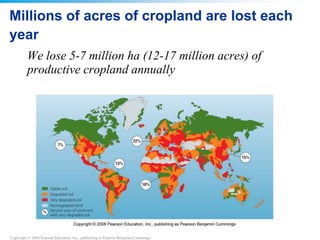
Millions of acres of cropland are lost each
year
We lose 5-7 million ha (12-17 million acres) of
productive cropland annually
Copyright © 2008 Pearson Education, Inc., publishing as Pearson Benjamin Cummings
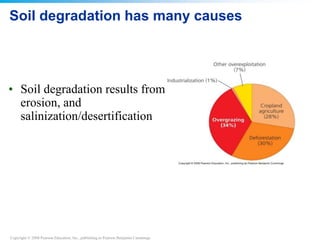
Soil degradation has many causes
• Soil degradation results from
erosion, and
salinization/desertification
Copyright © 2008 Pearson Education, Inc., publishing as Pearson Benjamin Cummings
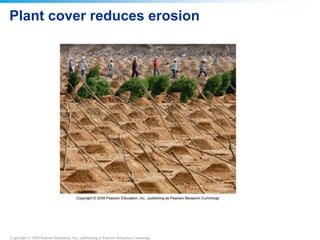
Plant cover reduces erosion
Copyright © 2008 Pearson Education, Inc., publishing as Pearson Benjamin Cummings
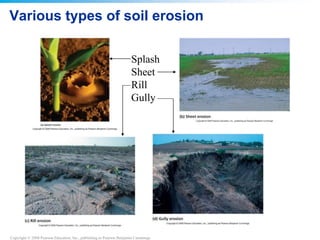
Types of erosion
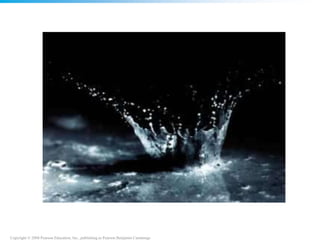
1. Splash erosion: water impacts surface loosening and
breaking up soil particles
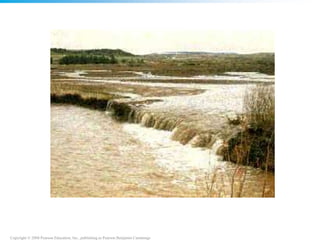
2. Sheet Erosion: rainfall intensity of a storm exceeds the
infiltration capacity of the soil
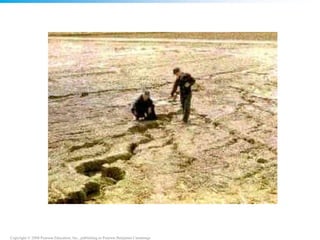
3. Rill Erosion: is caused by water concentrating into
closely closely-spaced areas forming small channels
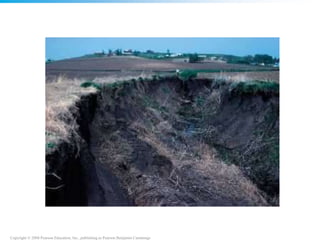
4. Gully Erosion: steep-sided trenches formed by rill
erosion
Copyright © 2008 Pearson Education, Inc., publishing as Pearson Benjamin Cummings
Various types of soil erosion
Splash
Sheet
Rill
Gully
Copyright © 2008 Pearson Education, Inc., publishing as Pearson Benjamin Cummings
Soil erodes by several methods
• Rill erosion moves the most topsoil, followed by sheet
and splash forms of erosion
Despite conservation measures, the U.S. still loses 6 tons of soil
for every ton of grain harvested
Copyright © 2008 Pearson Education, Inc., publishing as Pearson Benjamin Cummings
Erosion degrades ecosystems and
agriculture
• Deposition = the arrival of eroded material at its new
location
• Flowing water deposits sediment in river valleys and
deltas
• But, erosion is a problem because it occurs faster than
new soil is formed
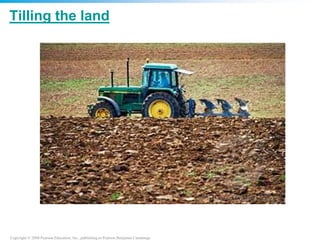
• Erosion increases through: excessive tilling, overgrazing,
and clearing forests
Copyright © 2008 Pearson Education, Inc., publishing as Pearson Benjamin Cummings
Overgrazing causes soil degradation
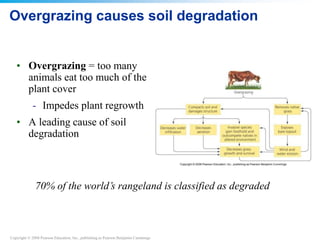
• Overgrazing = too many
animals eat too much of the
plant cover
- Impedes plant regrowth
• A leading cause of soil
degradation
70% of the world’s rangeland is classified as degraded
Copyright © 2008 Pearson Education, Inc., publishing as Pearson Benjamin Cummings
Effects of overgrazing can be striking
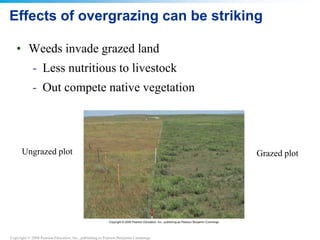
• Weeds invade grazed land
- Less nutritious to livestock
- Out compete native vegetation
Ungrazed plot Grazed plot
Copyright © 2008 Pearson Education, Inc., publishing as Pearson Benjamin Cummings
Forestry impacts soil
• Clear-cutting = the removal of
all trees from an area at once
- Leads to soil erosion,
especially on steep slopes
Copyright © 2008 Pearson Education, Inc., publishing as Pearson Benjamin Cummings
Tilling the land
Copyright © 2008 Pearson Education, Inc., publishing as Pearson Benjamin Cummings
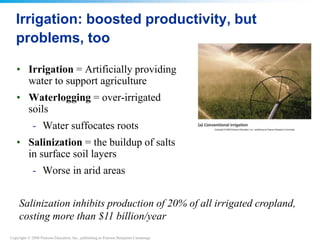
Irrigation: boosted productivity, but
problems, too
• Irrigation = Artificially providing
water to support agriculture
• Waterlogging = over-irrigated
soils
- Water suffocates roots
• Salinization = the buildup of salts
in surface soil layers
- Worse in arid areas
Salinization inhibits production of 20% of all irrigated cropland,
costing more than $11 billion/year
Copyright © 2008 Pearson Education, Inc., publishing as Pearson Benjamin Cummings
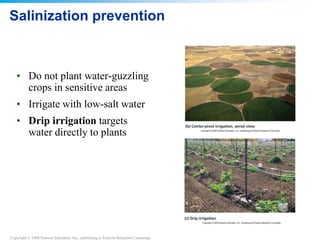
Salinization prevention
• Do not plant water-guzzling
crops in sensitive areas
• Irrigate with low-salt water
• Drip irrigation targets
water directly to plants
Copyright © 2008 Pearson Education, Inc., publishing as Pearson Benjamin Cummings
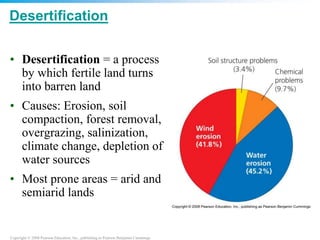
Desertification
• Desertification = a process
by which fertile land turns
into barren land
• Causes: Erosion, soil
compaction, forest removal,
overgrazing, salinization,
climate change, depletion of
water sources
• Most prone areas = arid and
semiarid lands
Copyright © 2008 Pearson Education, Inc., publishing as Pearson Benjamin Cummings
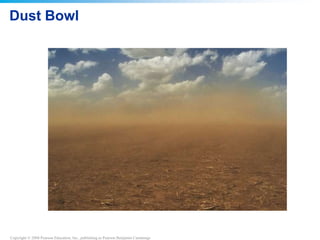
Dust Bowl
Copyright © 2008 Pearson Education, Inc., publishing as Pearson Benjamin Cummings
Fertilizers boost yields but cause problems
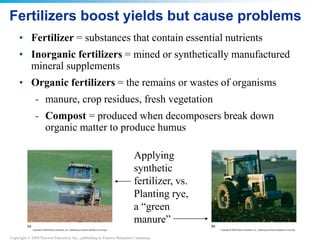
• Fertilizer = substances that contain essential nutrients
• Inorganic fertilizers = mined or synthetically manufactured
mineral supplements
• Organic fertilizers = the remains or wastes of organisms
- manure, crop residues, fresh vegetation
- Compost = produced when decomposers break down
organic matter to produce humus
Applying
synthetic
fertilizer, vs.
Planting rye,
a “green
manure”
Copyright © 2008 Pearson Education, Inc., publishing as Pearson Benjamin Cummings
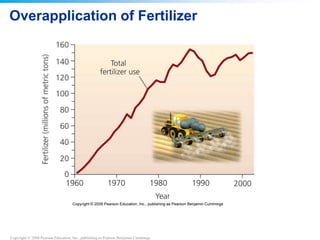
Overapplication of Fertilizer
Copyright © 2008 Pearson Education, Inc., publishing as Pearson Benjamin Cummings
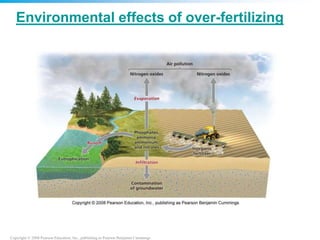
Environmental effects of over-fertilizing
Copyright © 2008 Pearson Education, Inc., publishing as Pearson Benjamin Cummings
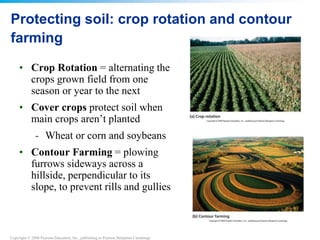
Protecting soil: crop rotation and contour
farming
• Crop Rotation = alternating the
crops grown field from one
season or year to the next
• Cover crops protect soil when
main crops aren’t planted
- Wheat or corn and soybeans
• Contour Farming = plowing
furrows sideways across a
hillside, perpendicular to its
slope, to prevent rills and gullies
Copyright © 2008 Pearson Education, Inc., publishing as Pearson Benjamin Cummings
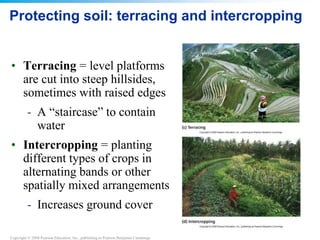
Protecting soil: terracing and intercropping
• Terracing = level platforms
are cut into steep hillsides,
sometimes with raised edges
- A “staircase” to contain
water
• Intercropping = planting
different types of crops in
alternating bands or other
spatially mixed arrangements
- Increases ground cover
Copyright © 2008 Pearson Education, Inc., publishing as Pearson Benjamin Cummings
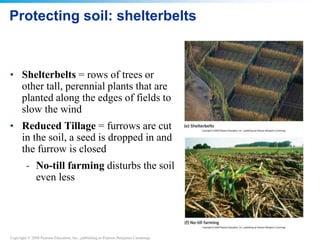
Protecting soil: shelterbelts
• Shelterbelts = rows of trees or
other tall, perennial plants that are
planted along the edges of fields to
slow the wind
• Reduced Tillage = furrows are cut
in the soil, a seed is dropped in and
the furrow is closed
- No-till farming disturbs the soil
even less
Copyright © 2008 Pearson Education, Inc., publishing as Pearson Benjamin Cummings
QUESTION: Review
Traditional subsistence agriculture uses all of the following,
except:
a) Animal power
b) Irrigation
c) Irrigation water
d) Fossil fuels
Copyright © 2008 Pearson Education, Inc., publishing as Pearson Benjamin Cummings
QUESTION: Review
Physical weathering is characterized by:
a) The chemical interaction of water with parent
material
b) Organisms breaking down parent material
c) Wind or rain breaking down parent material
d) The dislodging or movement of soil by wind
Copyright © 2008 Pearson Education, Inc., publishing as Pearson Benjamin Cummings
QUESTION: Review
Which horizon is the most valuable for agriculture?
a) Topsoil (A horizon)
b) E horizon
c) B horizon
d) R horizon
Copyright © 2008 Pearson Education, Inc., publishing as Pearson Benjamin Cummings
QUESTION: Review
Erosion increases through all of the following, except:
a) Excessive tilling
b) Overgrazing
c) Clearing forests
d) All of the above increase erosion
Copyright © 2008 Pearson Education, Inc., publishing as Pearson Benjamin Cummings
QUESTION: Review
Which sustainable farming method involves planting rows
of trees along field edges to slow the wind?
a) Terracing
b) Crop rotation
c) Shelterbelts
d) Contour farming
Copyright © 2008 Pearson Education, Inc., publishing as Pearson Benjamin Cummings
QUESTION: Weighing the Issues
Should developed nations fund reforestation projects in
developing nations to combat erosion and deforestation?
a) Absolutely, developing nations are facing a crisis
b) No, not with money, but developed nations could
give advice
c) No, developed nations had to solve their problems,
let the others solve their own problems
d) I don’t care, it doesn’t really affect me
Copyright © 2008 Pearson Education, Inc., publishing as Pearson Benjamin Cummings
QUESTION: Weighing the Issues
Should the U.S. government provide farmers with financial
incentives to use technologies such as no-till farming
and crop rotation?
a) Absolutely, farmers may be more likely to switch to
these techniques
b) Yes, but farmers must put any money received into
the farm
c) No, it’s not the government’s job to interfere with
farming practices
d) I don’t care, it doesn’t really affect me
Copyright © 2008 Pearson Education, Inc., publishing as Pearson Benjamin Cummings
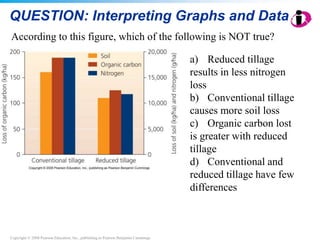
QUESTION: Interpreting Graphs and Data
According to this figure, which of the following is NOT true?
a) Reduced tillage
results in less nitrogen
loss
b) Conventional tillage
causes more soil loss
c) Organic carbon lost
is greater with reduced
tillage
d) Conventional and
reduced tillage have few
differences

protecting soil from erosion project.ppt

  • 1.
    Copyright © 2006Pearson Education, Inc., publishing as Benjamin Cummings PowerPoint® Slides prepared by Jay Withgott and Heidi Marcum Copyright © 2008 Pearson Education, Inc., publishing as Pearson Benjamin Cummings Ch 9 Soil and Agriculture Part 2: Environmental Issues and the Search for Solutions
  • 2.
    Copyright © 2008Pearson Education, Inc., publishing as Pearson Benjamin Cummings This lecture will help you understand: • The relationship between soils and agriculture • Major agricultural developments • The fundamentals of soil science • Causes and consequences of soil erosion and degradation • Principles of soil conservation
  • 3.
    Copyright © 2008Pearson Education, Inc., publishing as Pearson Benjamin Cummings Soil as a system • Soil consists of mineral matter, organic matter, air, and water - Dead and living microorganisms, and decaying material - Bacteria, algae, earthworms, insects, mammals, amphibians, and reptiles Since soil is composed of living and non-living matter, it is considered an ecosystem
  • 4.
    Copyright © 2008Pearson Education, Inc., publishing as Pearson Benjamin Cummings Soil formation is slow and complex • Parent material = the base material of soil (solid rock) • Weathering = the physical, chemical, or biological processes that break down rocks to form soil - Physical (mechanical) = wind and rain, no chemical changes in the parent material - Chemical = substances chemically interact with parent material - Biological = organisms break down parent material
  • 5.
    Copyright © 2008Pearson Education, Inc., publishing as Pearson Benjamin Cummings Weathering produces soil
  • 6.
    Copyright © 2008Pearson Education, Inc., publishing as Pearson Benjamin Cummings Other processes affect soil formation • Biological activity such as decomposition accumulates organic matter • Humus = a dark, spongy, crumbly mass of material rich in nutrients
  • 7.
    Copyright © 2008Pearson Education, Inc., publishing as Pearson Benjamin Cummings
  • 8.
    Copyright © 2008Pearson Education, Inc., publishing as Pearson Benjamin Cummings A soil profile consists of horizons • Horizon = each layer of soil • Soil profile = the cross-section of soil as a whole • Up to six major horizons may occur in a soil profile - Topsoil = inorganic and organic material most nutritive for plants - Leaching = dissolved particles move down through horizons
  • 9.
    Copyright © 2008Pearson Education, Inc., publishing as Pearson Benjamin Cummings O Horizon: Litter layer Consists mostly of organic matter A Horizon: Top Soil Organic material mixed with minerals E Horizon: Leaching Layer Minerals and organics are washed out B Horizon: Subsoil Accumulate of organics and minerals C Horizon: Weathered parent material Parent material that has been altered R Horizon: Parent Material Rock that soil is formed from
  • 10.
    Copyright © 2008Pearson Education, Inc., publishing as Pearson Benjamin Cummings
  • 11.
    Copyright © 2008Pearson Education, Inc., publishing as Pearson Benjamin Cummings Soils are characterized in many ways • Soils are classified based on color, texture, structure, and pH • Soil color = Color of the soil indicates its composition and fertility - Black or dark brown = rich in organic matter - Pale gray or white = indicates leaching (removal of nutrients) • Soil texture = determined by the size of particles Particle size determines how easy it is to cultivate and let air and water travel through the soil - From smallest to largest = clay, silt, sand - Loam = soil with an even mixture of the three
  • 12.
    Copyright © 2008Pearson Education, Inc., publishing as Pearson Benjamin Cummings Which soil color is best for agriculture? Darker = nutrient rich
  • 13.
    What particles makeup the BEST soil Clay, Silt, or Sand?
  • 14.
    Copyright © 2008Pearson Education, Inc., publishing as Pearson Benjamin Cummings
  • 15.
    Copyright © 2008Pearson Education, Inc., publishing as Pearson Benjamin Cummings Particle Size Name Particle diameter Sand 0.05-2.0 mm Silt 0.002- 0.05 mm clay Less than 0.002
  • 16.
    Copyright © 2008Pearson Education, Inc., publishing as Pearson Benjamin Cummings Water Holding Capacity • Should retain water for plant growth • During heavy rains, if water is not absorbed water can pool and take a long time to drain or run off resulting in flooding • Most important factor: Spaces of air between the soil particles • Water Holding Capacity depends on infiltration rate and capillary action
  • 17.
    Copyright © 2008Pearson Education, Inc., publishing as Pearson Benjamin Cummings
  • 18.
    Copyright © 2008Pearson Education, Inc., publishing as Pearson Benjamin Cummings Infiltration Rate • Gravitational flow through soil • Soils with high infiltration rate are easily leached (removing nutrients)
  • 19.
    Copyright © 2008Pearson Education, Inc., publishing as Pearson Benjamin Cummings
  • 20.
    Copyright © 2008Pearson Education, Inc., publishing as Pearson Benjamin Cummings Capillary Action • Strong attraction between water molecules and soil causes water to be drawn upward from the water table. • Capillary action increases when soil is packed close enough to provide a continuous film of surface • Soils with high rate of capillary action lose water more quickly through evaporation than soil where capillary action is slower.
  • 21.
    Copyright © 2008Pearson Education, Inc., publishing as Pearson Benjamin Cummings Ions What do ions do for plants? • Nitrogen: gives plants green color • Phosphorous: helps seed production • Potassium: gives fruit color, helps with fruit production
  • 22.
    Copyright © 2008Pearson Education, Inc., publishing as Pearson Benjamin Cummings Soil texture classification Silty soils with medium-size pores, or loamy soils with mixtures of pore sizes are best for plant growth and crop agriculture
  • 23.
    Copyright © 2008Pearson Education, Inc., publishing as Pearson Benjamin Cummings
  • 24.
    Copyright © 2008Pearson Education, Inc., publishing as Pearson Benjamin Cummings pH Scale
  • 25.
    Copyright © 2008Pearson Education, Inc., publishing as Pearson Benjamin Cummings Soil pH • Soil pH = influences a soil’s ability to support plant growth (plants grow best at pH of 7) - Soils that are too acidic or basic can kill plants - When pH gets too low, soil can not bond to nutrients
  • 26.
    Copyright © 2008Pearson Education, Inc., publishing as Pearson Benjamin Cummings
  • 27.
    Copyright © 2008Pearson Education, Inc., publishing as Pearson Benjamin Cummings Soil structure • Soil structure = a measure of soil’s “clumpiness” - Large clumps can discourage plant roots
  • 28.
    Copyright © 2008Pearson Education, Inc., publishing as Pearson Benjamin Cummings Population and consumption degrades soil • Feeding the world’s rising human population requires changing our diet or increasing agricultural production • Land suitable for farming is running out • We must find ways to improve the efficiency of food production • Mismanaged agriculture turns grasslands into deserts; removes forests; diminishes biodiversity; and pollutes soil, air, and water - Fertile soil is blown and washed away
  • 29.
    Copyright © 2008Pearson Education, Inc., publishing as Pearson Benjamin Cummings Millions of acres of cropland are lost each year We lose 5-7 million ha (12-17 million acres) of productive cropland annually
  • 30.
    Copyright © 2008Pearson Education, Inc., publishing as Pearson Benjamin Cummings Soil degradation has many causes • Soil degradation results from erosion, and salinization/desertification
  • 31.
    Copyright © 2008Pearson Education, Inc., publishing as Pearson Benjamin Cummings Plant cover reduces erosion
  • 32.
    Copyright © 2008Pearson Education, Inc., publishing as Pearson Benjamin Cummings Types of erosion 1. Splash erosion: water impacts surface loosening and breaking up soil particles 2. Sheet Erosion: rainfall intensity of a storm exceeds the infiltration capacity of the soil 3. Rill Erosion: is caused by water concentrating into closely closely-spaced areas forming small channels 4. Gully Erosion: steep-sided trenches formed by rill erosion
  • 33.
    Copyright © 2008Pearson Education, Inc., publishing as Pearson Benjamin Cummings Various types of soil erosion Splash Sheet Rill Gully
  • 34.
    Copyright © 2008Pearson Education, Inc., publishing as Pearson Benjamin Cummings Soil erodes by several methods • Rill erosion moves the most topsoil, followed by sheet and splash forms of erosion Despite conservation measures, the U.S. still loses 6 tons of soil for every ton of grain harvested
  • 35.
    Copyright © 2008Pearson Education, Inc., publishing as Pearson Benjamin Cummings
  • 36.
    Copyright © 2008Pearson Education, Inc., publishing as Pearson Benjamin Cummings
  • 37.
    Copyright © 2008Pearson Education, Inc., publishing as Pearson Benjamin Cummings
  • 38.
    Copyright © 2008Pearson Education, Inc., publishing as Pearson Benjamin Cummings
  • 39.
    Copyright © 2008Pearson Education, Inc., publishing as Pearson Benjamin Cummings Erosion degrades ecosystems and agriculture • Deposition = the arrival of eroded material at its new location • Flowing water deposits sediment in river valleys and deltas • But, erosion is a problem because it occurs faster than new soil is formed • Erosion increases through: excessive tilling, overgrazing, and clearing forests
  • 40.
    Copyright © 2008Pearson Education, Inc., publishing as Pearson Benjamin Cummings Overgrazing causes soil degradation • Overgrazing = too many animals eat too much of the plant cover - Impedes plant regrowth • A leading cause of soil degradation 70% of the world’s rangeland is classified as degraded
  • 41.
    Copyright © 2008Pearson Education, Inc., publishing as Pearson Benjamin Cummings Effects of overgrazing can be striking • Weeds invade grazed land - Less nutritious to livestock - Out compete native vegetation Ungrazed plot Grazed plot
  • 42.
    Copyright © 2008Pearson Education, Inc., publishing as Pearson Benjamin Cummings Forestry impacts soil • Clear-cutting = the removal of all trees from an area at once - Leads to soil erosion, especially on steep slopes
  • 43.
    Copyright © 2008Pearson Education, Inc., publishing as Pearson Benjamin Cummings Tilling the land
  • 44.
    Copyright © 2008Pearson Education, Inc., publishing as Pearson Benjamin Cummings Irrigation: boosted productivity, but problems, too • Irrigation = Artificially providing water to support agriculture • Waterlogging = over-irrigated soils - Water suffocates roots • Salinization = the buildup of salts in surface soil layers - Worse in arid areas Salinization inhibits production of 20% of all irrigated cropland, costing more than $11 billion/year
  • 45.
    Copyright © 2008Pearson Education, Inc., publishing as Pearson Benjamin Cummings Salinization prevention • Do not plant water-guzzling crops in sensitive areas • Irrigate with low-salt water • Drip irrigation targets water directly to plants
  • 46.
    Copyright © 2008Pearson Education, Inc., publishing as Pearson Benjamin Cummings Desertification • Desertification = a process by which fertile land turns into barren land • Causes: Erosion, soil compaction, forest removal, overgrazing, salinization, climate change, depletion of water sources • Most prone areas = arid and semiarid lands
  • 47.
    Copyright © 2008Pearson Education, Inc., publishing as Pearson Benjamin Cummings
  • 48.
    Copyright © 2008Pearson Education, Inc., publishing as Pearson Benjamin Cummings Dust Bowl
  • 49.
    Copyright © 2008Pearson Education, Inc., publishing as Pearson Benjamin Cummings Fertilizers boost yields but cause problems • Fertilizer = substances that contain essential nutrients • Inorganic fertilizers = mined or synthetically manufactured mineral supplements • Organic fertilizers = the remains or wastes of organisms - manure, crop residues, fresh vegetation - Compost = produced when decomposers break down organic matter to produce humus Applying synthetic fertilizer, vs. Planting rye, a “green manure”
  • 50.
    Copyright © 2008Pearson Education, Inc., publishing as Pearson Benjamin Cummings Overapplication of Fertilizer
  • 51.
    Copyright © 2008Pearson Education, Inc., publishing as Pearson Benjamin Cummings Environmental effects of over-fertilizing
  • 52.
    Copyright © 2008Pearson Education, Inc., publishing as Pearson Benjamin Cummings Protecting soil: crop rotation and contour farming • Crop Rotation = alternating the crops grown field from one season or year to the next • Cover crops protect soil when main crops aren’t planted - Wheat or corn and soybeans • Contour Farming = plowing furrows sideways across a hillside, perpendicular to its slope, to prevent rills and gullies
  • 53.
    Copyright © 2008Pearson Education, Inc., publishing as Pearson Benjamin Cummings Protecting soil: terracing and intercropping • Terracing = level platforms are cut into steep hillsides, sometimes with raised edges - A “staircase” to contain water • Intercropping = planting different types of crops in alternating bands or other spatially mixed arrangements - Increases ground cover
  • 54.
    Copyright © 2008Pearson Education, Inc., publishing as Pearson Benjamin Cummings Protecting soil: shelterbelts • Shelterbelts = rows of trees or other tall, perennial plants that are planted along the edges of fields to slow the wind • Reduced Tillage = furrows are cut in the soil, a seed is dropped in and the furrow is closed - No-till farming disturbs the soil even less
  • 55.
    Copyright © 2008Pearson Education, Inc., publishing as Pearson Benjamin Cummings QUESTION: Review Traditional subsistence agriculture uses all of the following, except: a) Animal power b) Irrigation c) Irrigation water d) Fossil fuels
  • 56.
    Copyright © 2008Pearson Education, Inc., publishing as Pearson Benjamin Cummings QUESTION: Review Physical weathering is characterized by: a) The chemical interaction of water with parent material b) Organisms breaking down parent material c) Wind or rain breaking down parent material d) The dislodging or movement of soil by wind
  • 57.
    Copyright © 2008Pearson Education, Inc., publishing as Pearson Benjamin Cummings QUESTION: Review Which horizon is the most valuable for agriculture? a) Topsoil (A horizon) b) E horizon c) B horizon d) R horizon
  • 58.
    Copyright © 2008Pearson Education, Inc., publishing as Pearson Benjamin Cummings QUESTION: Review Erosion increases through all of the following, except: a) Excessive tilling b) Overgrazing c) Clearing forests d) All of the above increase erosion
  • 59.
    Copyright © 2008Pearson Education, Inc., publishing as Pearson Benjamin Cummings QUESTION: Review Which sustainable farming method involves planting rows of trees along field edges to slow the wind? a) Terracing b) Crop rotation c) Shelterbelts d) Contour farming
  • 60.
    Copyright © 2008Pearson Education, Inc., publishing as Pearson Benjamin Cummings QUESTION: Weighing the Issues Should developed nations fund reforestation projects in developing nations to combat erosion and deforestation? a) Absolutely, developing nations are facing a crisis b) No, not with money, but developed nations could give advice c) No, developed nations had to solve their problems, let the others solve their own problems d) I don’t care, it doesn’t really affect me
  • 61.
    Copyright © 2008Pearson Education, Inc., publishing as Pearson Benjamin Cummings QUESTION: Weighing the Issues Should the U.S. government provide farmers with financial incentives to use technologies such as no-till farming and crop rotation? a) Absolutely, farmers may be more likely to switch to these techniques b) Yes, but farmers must put any money received into the farm c) No, it’s not the government’s job to interfere with farming practices d) I don’t care, it doesn’t really affect me
  • 62.
    Copyright © 2008Pearson Education, Inc., publishing as Pearson Benjamin Cummings QUESTION: Interpreting Graphs and Data According to this figure, which of the following is NOT true? a) Reduced tillage results in less nitrogen loss b) Conventional tillage causes more soil loss c) Organic carbon lost is greater with reduced tillage d) Conventional and reduced tillage have few differences