Different Channel pattern
Dr.Prasamita Sarkar
Assistant Professor
ICV College
Definition of a Channel
• The term channel is used in context of defining path of a water body that is narrow
such as a river or a strait. Thus, in Physical Geography, Channel can be defined as the
path of a river or a stream outlined by it’s bed and banks.
• In the words of Leopold (1957) “Channel pattern is used to describe the plan view of a
reach of river as seen from an airplane, and includes meandering, braiding, or relatively
straight channels.Natural channels characteristically exhibit alternating pools or deep
reaches and riffles or shallow reaches, regardless of the type of pattern.”
Channel development is controlled by two factors:
a. water flow or discharge (in terms of Volume and velocity) and
b. Sediment movement
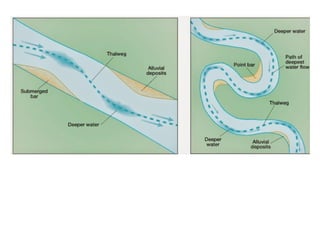
Channel Structure: Channel Structure consists of channel banks, channel bed and Thalweg
Channel Bed: the main path taken by the river through which it flows, is called the channel
bed.
Channel Banks: the two sides of the river bed are called channel banks.
Thalweg: It is continuous line joining the lowest points in a stream channel
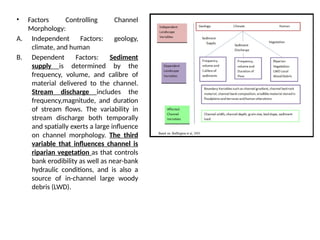
• Factors Controlling Channel
Morphology:
A. Independent Factors: geology,
climate, and human
B. Dependent Factors: Sediment
supply is determined by the
frequency, volume, and calibre of
material delivered to the channel.
Stream discharge includes the
frequency,magnitude, and duration
of stream flows. The variability in
stream discharge both temporally
and spatially exerts a large influence
on channel morphology. The third
variable that influences channel is
riparian vegetation as that controls
bank erodibility as well as near-bank
hydraulic conditions, and is also a
source of in-channel large woody
debris (LWD).
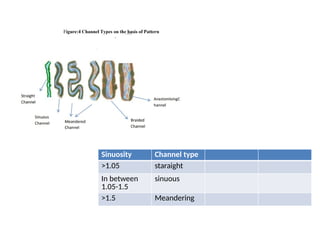
• Channel patterns: The shape of the channel is largely decided by the sinuosity of the river.
Sinuosity refers to the ratio of the measured channel distance divided by the straight-line
distance of the valley from the beginning of the channel reach to the end of the channel reach.
• 1. Straight River Channel: For channels with moderate-sized bed material (such as gravel-bed
streams), channels with moderate sediment supply usually have a “straight river channel”.
• 2. Sinuous River Channel: As the channel bends slightly with the increase in the sediment
load, the channel is called “sinuous river channel.
• 3. Meandering River Channel: As the supply of sediments exceeds the channel’s capacity to
transport the additional sediment, the channel may take a zig-zag shape called as “meandering
channel”. When the channel is not too active it can divide and recombine around stable,
vegetated islands; these are called wandering channels.
• 4. Braided River Channel: In other situations, the channel becomes too active for stable
vegetated islands to develop, and the system divides into numerous individual channels that
divide and recombine around unstable gravel bars; these are called “braided channels.”
• 5. Anastomosing rivers or streams are similar to braided rivers in that they consist of multiple
interweaving channels but they typically consist of a network of low-gradient, narrow, deep
channels with stable bank
Sinuosity Channel type
>1.05 staraight
In between
1.05-1.5
sinuous
>1.5 Meandering

Different Channel patterns and their descriptions .pptx

  • 1.
    Different Channel pattern Dr.PrasamitaSarkar Assistant Professor ICV College
  • 2.
    Definition of aChannel • The term channel is used in context of defining path of a water body that is narrow such as a river or a strait. Thus, in Physical Geography, Channel can be defined as the path of a river or a stream outlined by it’s bed and banks. • In the words of Leopold (1957) “Channel pattern is used to describe the plan view of a reach of river as seen from an airplane, and includes meandering, braiding, or relatively straight channels.Natural channels characteristically exhibit alternating pools or deep reaches and riffles or shallow reaches, regardless of the type of pattern.” Channel development is controlled by two factors: a. water flow or discharge (in terms of Volume and velocity) and b. Sediment movement Channel Structure: Channel Structure consists of channel banks, channel bed and Thalweg Channel Bed: the main path taken by the river through which it flows, is called the channel bed. Channel Banks: the two sides of the river bed are called channel banks. Thalweg: It is continuous line joining the lowest points in a stream channel
  • 4.
    • Factors ControllingChannel Morphology: A. Independent Factors: geology, climate, and human B. Dependent Factors: Sediment supply is determined by the frequency, volume, and calibre of material delivered to the channel. Stream discharge includes the frequency,magnitude, and duration of stream flows. The variability in stream discharge both temporally and spatially exerts a large influence on channel morphology. The third variable that influences channel is riparian vegetation as that controls bank erodibility as well as near-bank hydraulic conditions, and is also a source of in-channel large woody debris (LWD).
  • 5.
    • Channel patterns:The shape of the channel is largely decided by the sinuosity of the river. Sinuosity refers to the ratio of the measured channel distance divided by the straight-line distance of the valley from the beginning of the channel reach to the end of the channel reach. • 1. Straight River Channel: For channels with moderate-sized bed material (such as gravel-bed streams), channels with moderate sediment supply usually have a “straight river channel”. • 2. Sinuous River Channel: As the channel bends slightly with the increase in the sediment load, the channel is called “sinuous river channel. • 3. Meandering River Channel: As the supply of sediments exceeds the channel’s capacity to transport the additional sediment, the channel may take a zig-zag shape called as “meandering channel”. When the channel is not too active it can divide and recombine around stable, vegetated islands; these are called wandering channels. • 4. Braided River Channel: In other situations, the channel becomes too active for stable vegetated islands to develop, and the system divides into numerous individual channels that divide and recombine around unstable gravel bars; these are called “braided channels.” • 5. Anastomosing rivers or streams are similar to braided rivers in that they consist of multiple interweaving channels but they typically consist of a network of low-gradient, narrow, deep channels with stable bank
  • 6.
    Sinuosity Channel type >1.05staraight In between 1.05-1.5 sinuous >1.5 Meandering