Difference between Parallel
and Sequential Computing
 What is Parallel and Sequential in simple
meaning?
 As adjectives the difference between sequential
and parallel is that
• sequential is succeeding or following in order
while
• parallel is equally distant from one another at all
points.
Comparison between Parallel and
Sequential Computing
Parallel Computing
• Parallel computing is a programming
method that harnesses the power of
multiple processors at once. Once of
concern only to programmers of large
supercomputers, modern computers
now almost always have multi-core
processors.
• Parallel computing is the
simultaneous execution of the same
task, split into subtasks, on multiple
processors in order to obtain results
faster.
Sequential Computing
• Typical programming
assumes that computers
execute one operation at a
time in the sequence
specified by your program
code. At any time step, the
computer’s Central
Processing Unit (CPU)
core will be working on
one particular operation
from the sequence. We will
call this traditional style of
sequential computing.
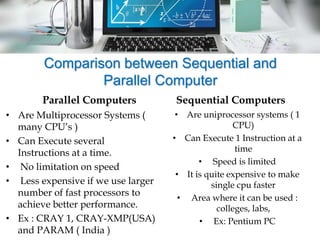
Comparison between Sequential and
Parallel Computer
Parallel Computers
• Are Multiprocessor Systems (
many CPU’s )
• Can Execute several
Instructions at a time.
• No limitation on speed
• Less expensive if we use larger
number of fast processors to
achieve better performance.
• Ex : CRAY 1, CRAY-XMP(USA)
and PARAM ( India )
Sequential Computers
• Are uniprocessor systems ( 1
CPU)
• Can Execute 1 Instruction at a
time
• Speed is limited
• It is quite expensive to make
single cpu faster
• Area where it can be used :
colleges, labs,
• Ex: Pentium PC
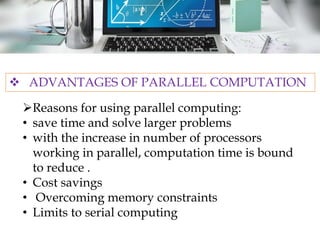
 ADVANTAGES OF PARALLEL COMPUTATION
Reasons for using parallel computing:
• save time and solve larger problems
• with the increase in number of processors
working in parallel, computation time is bound
to reduce .
• Cost savings
• Overcoming memory constraints
• Limits to serial computing

Difference between parallel and sequential computing

  • 1.
    Difference between Parallel andSequential Computing
  • 2.
     What isParallel and Sequential in simple meaning?  As adjectives the difference between sequential and parallel is that • sequential is succeeding or following in order while • parallel is equally distant from one another at all points.
  • 3.
    Comparison between Paralleland Sequential Computing Parallel Computing • Parallel computing is a programming method that harnesses the power of multiple processors at once. Once of concern only to programmers of large supercomputers, modern computers now almost always have multi-core processors. • Parallel computing is the simultaneous execution of the same task, split into subtasks, on multiple processors in order to obtain results faster. Sequential Computing • Typical programming assumes that computers execute one operation at a time in the sequence specified by your program code. At any time step, the computer’s Central Processing Unit (CPU) core will be working on one particular operation from the sequence. We will call this traditional style of sequential computing.
  • 4.
    Comparison between Sequentialand Parallel Computer Parallel Computers • Are Multiprocessor Systems ( many CPU’s ) • Can Execute several Instructions at a time. • No limitation on speed • Less expensive if we use larger number of fast processors to achieve better performance. • Ex : CRAY 1, CRAY-XMP(USA) and PARAM ( India ) Sequential Computers • Are uniprocessor systems ( 1 CPU) • Can Execute 1 Instruction at a time • Speed is limited • It is quite expensive to make single cpu faster • Area where it can be used : colleges, labs, • Ex: Pentium PC
  • 5.
     ADVANTAGES OFPARALLEL COMPUTATION Reasons for using parallel computing: • save time and solve larger problems • with the increase in number of processors working in parallel, computation time is bound to reduce . • Cost savings • Overcoming memory constraints • Limits to serial computing