Diego Rivera  Spanish Project
Diego Rivera Facts Diego Rivera was born on December 8 th , 1886, in Guanajuato City, Guanajuato.  From the age of ten, Rivera studied art at the Academy of San Carlos in Mexico City.  Diego Rivera was inspired by the birth of cubism in Paris, France.  From 1913-1917, Rivera embraced this school of art.
Diego Rivera Facts . Around 1917, inspired by Paul Cezanne’s paintings, Rivera shifted toward Post-Impressionism with simple forms and large patches of vivid colors. His paintings began to attract attention, and he was able to display them at several exhibitions.
Historical Period Inspired by the political ideals of the Mexican Revolution (1914-15) and the Russian Revolution (1917), Rivera wanted to make art that reflected the lives of the working class and native peoples of Mexico.  Rivera joined the Mexican Communist Party, but he was later kicked out of it for engaging in anti-Soviet politics.
Pictorial Movement Rivera spent about four years devoted to Cubism.  Rivera then began to paint for public buildings in Mexico, in what become known as the Mexican Mural Renaissance . Diego Rivera was also a political activist who incited debate not only in Mexico, but also in the USA and Soviet Union.
Important Artworks “The Flower Carrier”
Important Artworks “Man at the Crossroads”
Important Artworks “Day of the Dead”
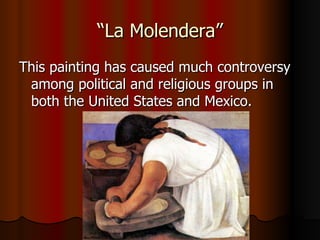
“ La Molendera” This painting has caused much controversy among political and religious groups in both the United States and Mexico.
“ La Molendera”  It features a woman grinding maize, and it is a representational painting. Diego Rivera painted it in 1924. It is a flat surface. The predominant colors are brown, white and blue.  The main element is the body of a woman.
“Man at the Crossroads”
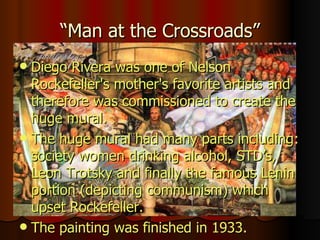
“Man at the Crossroads” Diego Rivera was one of Nelson Rockefeller's mother's favorite artists and therefore was commissioned to create the huge mural.  The huge mural had many parts including: society women drinking alcohol, STD’s, Leon Trotsky and finally the famous Lenin portion (depicting communism) which upset Rockefeller.   The painting was finished in 1933.
“Man at the Crossroads” People protested but it remained covered until the early weeks of 1934, when it was smashed by workers and hauled away in wheelbarrows. It is a representational painting, depicting the workers movement. It is a flat surface. It has mostly dark predominant colors.  It includes bodies and circular shapes.

Diego Rivera by Jay

  • 1.
    Diego Rivera Spanish Project
  • 2.
    Diego Rivera FactsDiego Rivera was born on December 8 th , 1886, in Guanajuato City, Guanajuato. From the age of ten, Rivera studied art at the Academy of San Carlos in Mexico City. Diego Rivera was inspired by the birth of cubism in Paris, France. From 1913-1917, Rivera embraced this school of art.
  • 3.
    Diego Rivera Facts. Around 1917, inspired by Paul Cezanne’s paintings, Rivera shifted toward Post-Impressionism with simple forms and large patches of vivid colors. His paintings began to attract attention, and he was able to display them at several exhibitions.
  • 4.
    Historical Period Inspiredby the political ideals of the Mexican Revolution (1914-15) and the Russian Revolution (1917), Rivera wanted to make art that reflected the lives of the working class and native peoples of Mexico. Rivera joined the Mexican Communist Party, but he was later kicked out of it for engaging in anti-Soviet politics.
  • 5.
    Pictorial Movement Riveraspent about four years devoted to Cubism. Rivera then began to paint for public buildings in Mexico, in what become known as the Mexican Mural Renaissance . Diego Rivera was also a political activist who incited debate not only in Mexico, but also in the USA and Soviet Union.
  • 6.
    Important Artworks “TheFlower Carrier”
  • 7.
    Important Artworks “Manat the Crossroads”
  • 8.
  • 9.
    “ La Molendera”This painting has caused much controversy among political and religious groups in both the United States and Mexico.
  • 10.
    “ La Molendera” It features a woman grinding maize, and it is a representational painting. Diego Rivera painted it in 1924. It is a flat surface. The predominant colors are brown, white and blue. The main element is the body of a woman.
  • 11.
    “Man at theCrossroads”
  • 12.
    “Man at theCrossroads” Diego Rivera was one of Nelson Rockefeller's mother's favorite artists and therefore was commissioned to create the huge mural. The huge mural had many parts including: society women drinking alcohol, STD’s, Leon Trotsky and finally the famous Lenin portion (depicting communism) which upset Rockefeller. The painting was finished in 1933.
  • 13.
    “Man at theCrossroads” People protested but it remained covered until the early weeks of 1934, when it was smashed by workers and hauled away in wheelbarrows. It is a representational painting, depicting the workers movement. It is a flat surface. It has mostly dark predominant colors. It includes bodies and circular shapes.