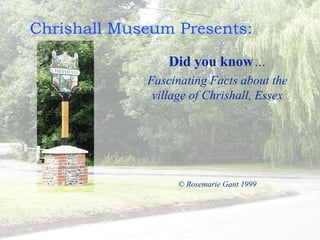
Chrishall Museum Presents:
Did you know...
Fascinating Facts about the
village of Chrishall, Essex
© Rosemarie Gant 1999
Chrishall Museum: Summer 1999
Local Names
• Before the Norman Conquest the
lower part of the village was occupied
by Billa. It was Billa’s Denn - hence
the name, Bilden End.
• In 1832 a ‘chain gang’ of
wheelbarrows transferred chalk from
the parish pit to make a hard surface
for “Chalky Lane”. .....
Chrishall Museum: Summer 1999
Before 1066...
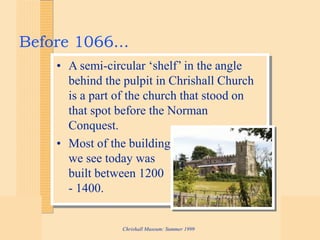
• A semi-circular ‘shelf’ in the angle
behind the pulpit in Chrishall Church
is a part of the church that stood on
that spot before the Norman
Conquest.
• Most of the building
we see today was
built between 1200
- 1400.
Chrishall Museum: Summer 1999
After the Norman Conquest...
• Eustace de Bologne was rewarded for
his loyalty to King William by gifts of
lands - in Essex, Derbyshire and in the
West Country.
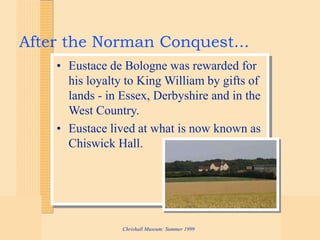
• Eustace lived at what is now known as
Chiswick Hall.
Chrishall Museum: Summer 1999
Royal Patronage
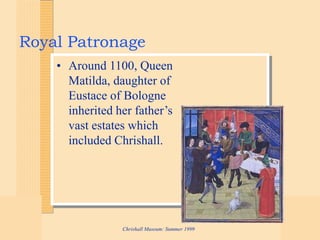
• Around 1100, Queen
Matilda, daughter of
Eustace of Bologne
inherited her father’s
vast estates which
included Chrishall.
Chrishall Museum: Summer 1999
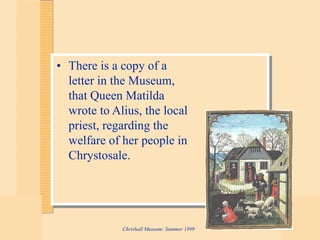
• There is a copy of a
letter in the Museum,
that Queen Matilda
wrote to Alius, the local
priest, regarding the
welfare of her people in
Chrystosale.
Chrishall Museum: Summer 1999
Park Lane
• In the 13th Century Le Perke, a
Norman nobleman, lived at the
junction of Park Lane and the Elmdon
Road.
• By 1600 a larger house stood almost
on the same spot, and housed Sir Cane
James - the path by the wood leading
to Dark Lane is still known as Cane’s
Walk.
Chrishall Museum: Summer 1999
Park House, Church Road ...
• is built on the site of a farm known as
Cane’s Farm - which was possibly the
‘home-farm’ that supplied food for the
‘Big House’.
Chrishall Museum: Summer 1999
More local names
• In the 13th century a large house was
occupied by a noble, one Radelonde.
All traces have now disappeared -
only the name lingers - Redlands.
• Hog’s Lane - or Hogsden’s Lane - is
named after Hogsden who ran the Red
Cow in the 1700s. Hogsden’s Close,
facing Church Road, was also owned
by this gentleman.
Chrishall Museum: Summer 1999
Inflation?
• In the 13th Century Chiswick Hall
paid to the Crown “3 arrows yearly at
the price of 6 pence”.
• A few years later it was “a pair of gilt
spurs”.
• In the early 1400s Henry de Uphook
of Crowley Bury paid to the King, for
rent, “one rose to be plukt on the eve
of St John’s Day” (June 24).
Chrishall Museum: Summer 1999
Troubled times?
• In 1309 the Lady Alice Beaumont
from Chrishall led 26 men in a ‘war’
against Michael Cherene of Elmdon.
• This lady was known to be very
argumentative - part of the reason for
the ‘war’ was that some deer had been
chased into her property and broken
down fences...
Chrishall Museum: Summer 1999
The Original Sealed Knot
• In 1655 Penruddock, a founder-
member of the Sealed Knot, led an
uprising against Cromwell and in
support of Charles II.
• Penruddock lived in Chrishall Bury -
a manor house below the church.
• He was captured during a foray in the
West Country and executed at Exeter
in 1657.
Chrishall Museum: Summer 1999
The Village Green
• Broad Green once stretched from the
present hamlet to Moat (or Parsonage)
Farm. It was the village green and
lost to the village in the Enclosure Act
1806.
• This green was originally 39 acres.
Chrishall Windmill
• Until the mid-1800s a windmill stood
in the corner of the garden at Mill
House.
• It was used by villagers and farmers
for grinding the flour produced
locally.
• Mill Causeway was then known as
‘Castey’ from ‘Causeway’, a raised
path.
Chrishall Museum: Summer 1999
The Slate-roofed Cottage ...
• Prior to a parish council, an overseer
and surveyor for the village met on
Thursdays to dole out a quartern loaf
and one shilling to needy villagers.
• They met at the slated cottage, at the
top of Church Road, on the green.
• This cottage was also used as a
surgery by the doctor, who, weekly,
came from Newport on horseback.
Chrishall Museum: Summer 1999
Water, water everywhere
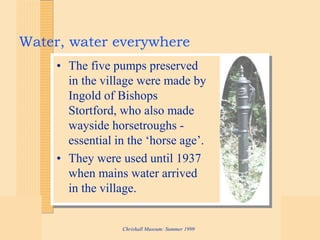
• The five pumps preserved
in the village were made by
Ingold of Bishops
Stortford, who also made
wayside horsetroughs -
essential in the ‘horse age’.
• They were used until 1937
when mains water arrived
in the village.
Chrishall Museum: Summer 1999
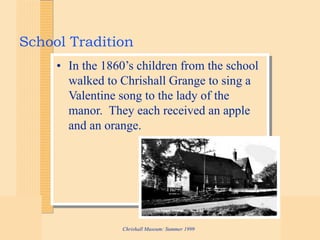
School Tradition
• In the 1860’s children from the school
walked to Chrishall Grange to sing a
Valentine song to the lady of the
manor. They each received an apple
and an orange.
Chrishall Museum: Summer 1999
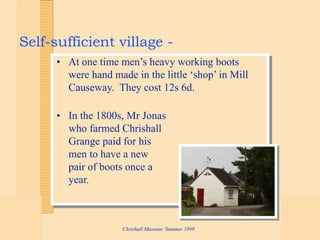
Self-sufficient village -
• At one time men’s heavy working boots
were hand made in the little ‘shop’ in Mill
Causeway. They cost 12s 6d.
• In the 1800s, Mr Jonas
who farmed Chrishall
Grange paid for his
men to have a new
pair of boots once a
year.
Chrishall Museum: Summer 1999
Ring-ring, ring-ring
• The first telephone exchange was
situated in Stanmore Place, Church
Road in the 1920s. It was operated by
Mr and Mrs Walter Loveday.
• The second was in Palmers Lane -
now a private house.
• The third was a modern one in the
high street.
Chrishall Museum: Summer 1999
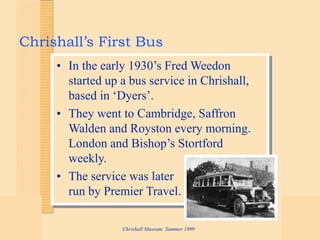
Chrishall’s First Bus
• In the early 1930’s Fred Weedon
started up a bus service in Chrishall,
based in ‘Dyers’.
• They went to Cambridge, Saffron
Walden and Royston every morning.
London and Bishop’s Stortford
weekly.
• The service was later
run by Premier Travel.
Chrishall Museum: Summer 1999
Utilities arrive
• 1937- piped water
• 1947 - electricity
• 1973 - main drainage
Chrishall Museum: Summer 1999
Steam
• For many decades Chrishall was noted
for steam power. Powerful engines
worked over a wide area, providing
work for many men.
• Steam engines were first worked from
Chrishall by Philip Downham. He
built Park House in Church Road.
Chrishall Museum: Summer 1999
And more steam
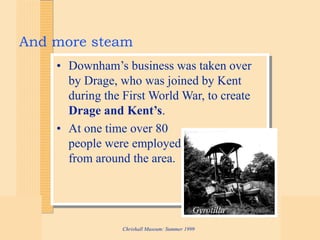
• Downham’s business was taken over
by Drage, who was joined by Kent
during the First World War, to create
Drage and Kent’s.
• At one time over 80
people were employed
from around the area.
Gyrotilla
Chrishall Museum: Summer 1999
The men and their engines
• Drage and Kent’s started with
ploughing and threshing engines.
They moved on to long and short
wheel-base vehicles and Foden
Wagons. Eventually to Sentinels and
a Gyrotilla.
Chrishall Museum: Summer 1999
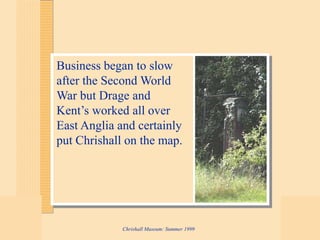
Business began to slow
after the Second World
War but Drage and
Kent’s worked all over
East Anglia and certainly
put Chrishall on the map.
Chrishall Museum: Summer 1999
Chrishall in the War
• During the 1939-45 war a prisoner of
war camp was opened at Chrishall
Grange holding first Italian and then
later German soldiers.
• The men from the camp were sent to
work for the farmers in the village.
Two men were assigned to each farm.
Chrishall Museum: Summer 1999
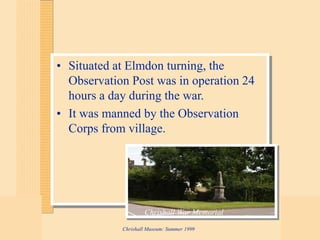
• Situated at Elmdon turning, the
Observation Post was in operation 24
hours a day during the war.
• It was manned by the Observation
Corps from village.
Chrishall War Memorial
Chrishall Museum: Summer 1999
Chrishall on air
• On July 18th 1997 Radio
Cambridgeshire broadcast a 3 hour
programme from the Chrishall
Museum - presented by Mandy
Morton.
• In June 1999 Chrishall Museum was
featured on “Craven’s Collectables”
on Anglia Television.
Chrishall Museum: Summer 1999
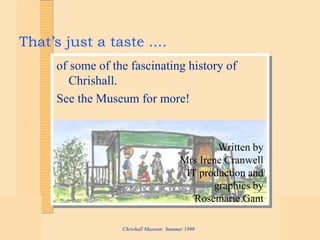
That’s just a taste ....
of some of the fascinating history of
Chrishall.
See the Museum for more!
Written by
Mrs Irene Cranwell
IT production and
graphics by
Rosemarie Gant
The End
See more at www.chrishallessex.co.uk

Didyou know newv

  • 1.
    Chrishall Museum Presents: Didyou know... Fascinating Facts about the village of Chrishall, Essex © Rosemarie Gant 1999
  • 2.
    Chrishall Museum: Summer1999 Local Names • Before the Norman Conquest the lower part of the village was occupied by Billa. It was Billa’s Denn - hence the name, Bilden End. • In 1832 a ‘chain gang’ of wheelbarrows transferred chalk from the parish pit to make a hard surface for “Chalky Lane”. .....
  • 3.
    Chrishall Museum: Summer1999 Before 1066... • A semi-circular ‘shelf’ in the angle behind the pulpit in Chrishall Church is a part of the church that stood on that spot before the Norman Conquest. • Most of the building we see today was built between 1200 - 1400.
  • 4.
    Chrishall Museum: Summer1999 After the Norman Conquest... • Eustace de Bologne was rewarded for his loyalty to King William by gifts of lands - in Essex, Derbyshire and in the West Country. • Eustace lived at what is now known as Chiswick Hall.
  • 5.
    Chrishall Museum: Summer1999 Royal Patronage • Around 1100, Queen Matilda, daughter of Eustace of Bologne inherited her father’s vast estates which included Chrishall.
  • 6.
    Chrishall Museum: Summer1999 • There is a copy of a letter in the Museum, that Queen Matilda wrote to Alius, the local priest, regarding the welfare of her people in Chrystosale.
  • 7.
    Chrishall Museum: Summer1999 Park Lane • In the 13th Century Le Perke, a Norman nobleman, lived at the junction of Park Lane and the Elmdon Road. • By 1600 a larger house stood almost on the same spot, and housed Sir Cane James - the path by the wood leading to Dark Lane is still known as Cane’s Walk.
  • 8.
    Chrishall Museum: Summer1999 Park House, Church Road ... • is built on the site of a farm known as Cane’s Farm - which was possibly the ‘home-farm’ that supplied food for the ‘Big House’.
  • 9.
    Chrishall Museum: Summer1999 More local names • In the 13th century a large house was occupied by a noble, one Radelonde. All traces have now disappeared - only the name lingers - Redlands. • Hog’s Lane - or Hogsden’s Lane - is named after Hogsden who ran the Red Cow in the 1700s. Hogsden’s Close, facing Church Road, was also owned by this gentleman.
  • 10.
    Chrishall Museum: Summer1999 Inflation? • In the 13th Century Chiswick Hall paid to the Crown “3 arrows yearly at the price of 6 pence”. • A few years later it was “a pair of gilt spurs”. • In the early 1400s Henry de Uphook of Crowley Bury paid to the King, for rent, “one rose to be plukt on the eve of St John’s Day” (June 24).
  • 11.
    Chrishall Museum: Summer1999 Troubled times? • In 1309 the Lady Alice Beaumont from Chrishall led 26 men in a ‘war’ against Michael Cherene of Elmdon. • This lady was known to be very argumentative - part of the reason for the ‘war’ was that some deer had been chased into her property and broken down fences...
  • 12.
    Chrishall Museum: Summer1999 The Original Sealed Knot • In 1655 Penruddock, a founder- member of the Sealed Knot, led an uprising against Cromwell and in support of Charles II. • Penruddock lived in Chrishall Bury - a manor house below the church. • He was captured during a foray in the West Country and executed at Exeter in 1657.
  • 13.
    Chrishall Museum: Summer1999 The Village Green • Broad Green once stretched from the present hamlet to Moat (or Parsonage) Farm. It was the village green and lost to the village in the Enclosure Act 1806. • This green was originally 39 acres.
  • 14.
    Chrishall Windmill • Untilthe mid-1800s a windmill stood in the corner of the garden at Mill House. • It was used by villagers and farmers for grinding the flour produced locally. • Mill Causeway was then known as ‘Castey’ from ‘Causeway’, a raised path.
  • 15.
    Chrishall Museum: Summer1999 The Slate-roofed Cottage ... • Prior to a parish council, an overseer and surveyor for the village met on Thursdays to dole out a quartern loaf and one shilling to needy villagers. • They met at the slated cottage, at the top of Church Road, on the green. • This cottage was also used as a surgery by the doctor, who, weekly, came from Newport on horseback.
  • 16.
    Chrishall Museum: Summer1999 Water, water everywhere • The five pumps preserved in the village were made by Ingold of Bishops Stortford, who also made wayside horsetroughs - essential in the ‘horse age’. • They were used until 1937 when mains water arrived in the village.
  • 17.
    Chrishall Museum: Summer1999 School Tradition • In the 1860’s children from the school walked to Chrishall Grange to sing a Valentine song to the lady of the manor. They each received an apple and an orange.
  • 18.
    Chrishall Museum: Summer1999 Self-sufficient village - • At one time men’s heavy working boots were hand made in the little ‘shop’ in Mill Causeway. They cost 12s 6d. • In the 1800s, Mr Jonas who farmed Chrishall Grange paid for his men to have a new pair of boots once a year.
  • 19.
    Chrishall Museum: Summer1999 Ring-ring, ring-ring • The first telephone exchange was situated in Stanmore Place, Church Road in the 1920s. It was operated by Mr and Mrs Walter Loveday. • The second was in Palmers Lane - now a private house. • The third was a modern one in the high street.
  • 20.
    Chrishall Museum: Summer1999 Chrishall’s First Bus • In the early 1930’s Fred Weedon started up a bus service in Chrishall, based in ‘Dyers’. • They went to Cambridge, Saffron Walden and Royston every morning. London and Bishop’s Stortford weekly. • The service was later run by Premier Travel.
  • 21.
    Chrishall Museum: Summer1999 Utilities arrive • 1937- piped water • 1947 - electricity • 1973 - main drainage
  • 22.
    Chrishall Museum: Summer1999 Steam • For many decades Chrishall was noted for steam power. Powerful engines worked over a wide area, providing work for many men. • Steam engines were first worked from Chrishall by Philip Downham. He built Park House in Church Road.
  • 23.
    Chrishall Museum: Summer1999 And more steam • Downham’s business was taken over by Drage, who was joined by Kent during the First World War, to create Drage and Kent’s. • At one time over 80 people were employed from around the area. Gyrotilla
  • 24.
    Chrishall Museum: Summer1999 The men and their engines • Drage and Kent’s started with ploughing and threshing engines. They moved on to long and short wheel-base vehicles and Foden Wagons. Eventually to Sentinels and a Gyrotilla.
  • 25.
    Chrishall Museum: Summer1999 Business began to slow after the Second World War but Drage and Kent’s worked all over East Anglia and certainly put Chrishall on the map.
  • 26.
    Chrishall Museum: Summer1999 Chrishall in the War • During the 1939-45 war a prisoner of war camp was opened at Chrishall Grange holding first Italian and then later German soldiers. • The men from the camp were sent to work for the farmers in the village. Two men were assigned to each farm.
  • 27.
    Chrishall Museum: Summer1999 • Situated at Elmdon turning, the Observation Post was in operation 24 hours a day during the war. • It was manned by the Observation Corps from village. Chrishall War Memorial
  • 28.
    Chrishall Museum: Summer1999 Chrishall on air • On July 18th 1997 Radio Cambridgeshire broadcast a 3 hour programme from the Chrishall Museum - presented by Mandy Morton. • In June 1999 Chrishall Museum was featured on “Craven’s Collectables” on Anglia Television.
  • 29.
    Chrishall Museum: Summer1999 That’s just a taste .... of some of the fascinating history of Chrishall. See the Museum for more! Written by Mrs Irene Cranwell IT production and graphics by Rosemarie Gant
  • 30.
    The End See moreat www.chrishallessex.co.uk