Tealby –Lords of the Manor, 1066-1086 October 29, 2013 
Researched by: John Downs 
1 
TEALBY- LORDS OF THE MANOR, 1066-1086 
Domesday Book entries for Tealby 
Total village population in 1086: 52.5 households 
Total tax assessed in 1086: 5.0 geld units 
INTRODUCTION 
Prior to the Norman Conquest the land in Tealby was owned by a number of Anglo-Saxon and Anglo- 
Scandinavian thanes. According to http://www.domesdaybook.net/helpfiles/hs2780.htm : “In 
origin, the meaning of thane was 'one who serves'; but by the late Anglo-Saxon period the word was 
often used as a synonym for a free man of almost any rank. Royal thanes were among the richest 
and most powerful men in the kingdom, and median - middling - thanes were prosperous 
landholders of local or even regional importance. Even lesser thanes were considered noble and 
their service was honourable: they paid taxes and performed military service. A lesser landowner 
who 'prospered so that he possessed fully five hides of his own' might attain this status. But there 
were also very large numbers of thanes before the Conquest who held tiny holdings, so modest that 
they were almost indistinguishable from those of the more prosperous peasants, and might even be 
smaller. A thane was a free man, a noble man, but often one of limited resources” 
When William the Conqueror became King of England in 1066 he confiscated the holdings of these 
landowners and allocated them to members of his own family and the Norman lords who had 
helped him conquer the country. These people were known as Tenants-in-Chief. Unlike the older 
Anglo-Saxon form of feudalism these people did not own the land because the ownership remained 
with William the Conqueror himself. The land allocated to a Tenants-in-Chief was known as a Manor 
or fief. Often the Tenant-in-Chiefs would appoint a steward or Lord of the Manor to manage and 
administer their individual Manors. 
The Anglo-Saxon Chronicle records that: "While spending the Christmas time of 1085 in Gloucester, 
William had deep speech with his counsellors and sent men all over England to each shire to find out 
what or how much each landholder had in land and livestock, and what it was worth.” The main 
purposes of the survey in 1085, which became known as the Domesday survey, were to record: 
 The identities of the previous landowners and what they had held in terms of land, livestock 
and other sources of revenue (mills, salt pans, etc) 
 What taxes (e.g. land taxes or geld) had been liable to the crown during the reign of the 
previous king, Edward the Confessor 
 the names of the new holders of lands, and the assessments on which their tax was to be 
paid in the future 
The following is a collection of extracts from the Domesday survey that relate to Tealby. I have used 
three translations of the original shorthand Latin text: one from 1809 1, another from 1924 2 and the 
last from an on-line database 3. I have started to include some biographical details of the Tealby 
landowners at that time, as provided by Professor John Palmer in his Domesday Dataset4.
Tealby –Lords of the Manor, 1066-1086 October 29, 2013 
Researched by: John Downs 
2 
1. MERLESWEIN (1066)  RALPH PEYNEL (1086) 
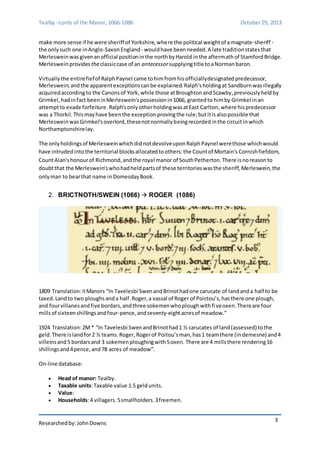
1809 Translation: Manor “In Tavelesbi (Tealby) Merlesuen had 14 oxgangs of land to be taxed. Land 
to 2 ploughs and a half. Ralph has there 10 sokemen with 3 oxgangs, and 10 villanes with 1 plough, 
and 3 mills of 12 shillings, and 89 acres of meadow, and the sites of 3 mil ls. Value in King Edward’s 
time was 12 pounds, now 50 shillings. Tallaged at nine shillings” 
1924 Translation: M. “In Tauelesbi Merlosuen had 14 bovates of land [assessed] to the geld. There is 
land for 2 and half teams. Ralf has 10 sokemen there on {de) 3 bovates, and 10 villeins with 1 team, 
and 3 mills rendering 12 shillings, and 89 acres of meadow, and 3 sites of mills. T. R. E. it was worth 
12 pounds; now 50 shillings; tallage 9 shillings” 
On-line database: 
 Head of manor: Tealby. 
 Taxable units: Taxable value 1.8 geld units. 
 Value: Value to lord in 1066 £12. Value to lord in 1086 £2.5. 
 Households: 10 villagers. 10 freemen. 
 Plough land: 2.5 plough lands (land for). 1 men's plough team. 
 Other resources: Meadow 89 acres. 3 mills, value 0.6. 
 Lord in 1066: Merleswein the sheriff. 
 Lord in 1086: Ralph Paynel. 
 Tenant-in-chief in 1086: Ralph Paynel. 
 Phillimore reference: 35,9 
MERLESWEIN THE SHERIFF may be the important English thane in King Edward's reign who was 
sheriff of Lincolnshire at some stage during King William's reign until he joined the Danes in 1069 in 
their attack on York. All of Ralph Paynel's lands in Devon, Somerset and Yorkshire and almost all his 
others in Gloucestershire and Lincolnshire had been held by Merleswein in 1066. Of this thane's 
other estates, four in Somerset passed to Walter of Douai and one to the king and one in Yorkshire 
passed to Count Alan. In Cornwall all the lands held by a Merleswein in 1066 were held in 1086 by 
the Count of Mortain, three in lordship, six from his men, but although there is no definite proof that 
this was the same Merleswein and that he was the sherif f of Lincolnshire it is likely. Frequently in 
Domesday all the lands of an Anglo-Saxon in a given area passed to one Norman, as with 
Merleswein's lands in Devon, Gloucestershire and Lincolnshire. 
Identified as sheriff and official predecessor of Ralph Paynel in the Clamores for Lincolnshire , 
Merleswein was among the ten wealthiest Anglo-Saxon magnates after the great earls. He is usually 
described as sheriff of Lincolnshire, being named as a sheriff in the Lincolnshire folios; but it would
Tealby –Lords of the Manor, 1066-1086 October 29, 2013 
make more sense if he were sheriff of Yorkshire, where the political weight of a magnate-sheriff - 
the only such one in Anglo-Saxon England - would have been needed. A late tradition states that 
Merleswein was given an official position in the north by Harold in the aftermath of Stamford Bridge. 
Merleswein provides the classic case of an antecessor supplying title to a Norman baron. 
Virtually the entire fief of Ralph Paynel came to him from his officially designated predecessor, 
Merleswein; and the apparent exceptions can be explained. Ralph's holding at Sandburn was illegally 
acquired according to the Canons of York, while those at Broughton and Scawby, previously held by 
Grimkel, had in fact been in Merleswein's possession in 1066, granted to him by Grimkel in an 
attempt to evade forfeiture. Ralph's only other holding was at East Carlton, where his predecessor 
was a Thorkil. This may have been the exception proving the rule; but it is also possible that 
Merleswein was Grimkel's overlord, these not normally being recorded in the circuit in which 
Northamptonshire lay. 
The only holdings of Merleswein which did not devolve upon Ralph Paynel were those which would 
have intruded into the territorial blocks allocated to others: the Count of Mortain's Cornish fiefdom, 
Count Alan's honour of Richmond, and the royal manor of South Petherton. There is no reason to 
doubt that the Merleswein's who had held parts of these territories was the sheriff, Merleswein, the 
only man to bear that name in Domesday Book. 
Researched by: John Downs 
3 
2. BRICTNOTH/SWEIN (1066)  ROGER (1086) 
1809 Translation: II Manors “In Tavelesbi Swen and Brinot had one carucate of land and a half to be 
taxed. Land to two ploughs and a half. Roger, a vassal of Roger of Poictou’s, has there one plough, 
and four villanes and five bordars, and three sokemen who plough with fi ve oxen. There are four 
mills of sixteen shillings and four-pence, and seventy-eight acres of meadow.” 
1924 Translation: 2M * “In Tavelesbi Swen and Brinot had 1 ½ carucates of land (assessed) to the 
geld. There is land for 2 ½ teams. Roger, Roger of Poitou’s man, has 1 team there (in demesne) and 4 
villeins and 5 bordars and 3 sokemen ploughing with 5 oxen. There are 4 mills there rendering 16 
shillings and 4 pence, and 78 acres of meadow”. 
On-line database: 
 Head of manor: Tealby. 
 Taxable units: Taxable value 1.5 geld units. 
 Value: 
 Households: 4 villagers. 5 smallholders. 3 freemen.
Tealby –Lords of the Manor, 1066-1086 October 29, 2013 
Researched by: John Downs 
4 
 Plough land: 2.5 plough lands (land for). 1 lord's plough teams. 0.6 men's plough teams. 
 Other resources: Meadow 78 acres. 4 mills, value 0.81. 
 Lords in 1066: Brictnoth; Swein. 
 Lord in 1086: Roger. 
 Tenant-in-chief in 1086: Roger of Poitou. 
 Phillimore reference: 16,10 
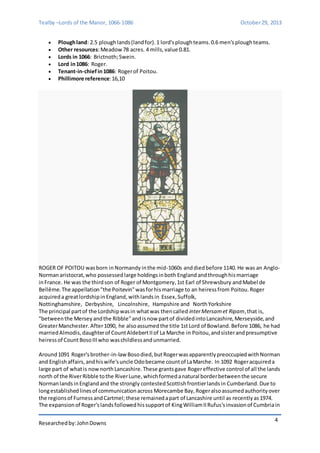
ROGER OF POITOU was born in Normandy in the mid-1060s and died before 1140. He was an Anglo- 
Norman aristocrat, who possessed large holdings in both England and through his marriage 
in France. He was the third son of Roger of Montgomery, 1st Earl of Shrewsbury and Mabel de 
Bellême. The appellation "the Poitevin" was for his marriage to an heiress from Poitou. Roger 
acquired a great lordship in England, with lands in Essex, Suffolk, 
Nottinghamshire, Derbyshire, Lincolnshire, Hampshire and North Yorkshire 
The principal part of the Lordship was in what was then called inter Mersam et Ripam, that is, 
"between the Mersey and the Ribble" and is now part of divided into Lancashire, Merseyside, and 
Greater Manchester. After 1090, he also assumed the title 1st Lord of Bowland. Before 1086, he had 
married Almodis, daughter of Count Aldebert II of La Marche in Poitou, and sister and presumptive 
heiress of Count Boso III who was childless and unmarried. 
Around 1091 Roger's brother-in-law Boso died, but Roger was apparently preoccupied with Norman 
and English affairs, and his wife's uncle Odo became count of La Marche. In 1092 Roger acquired a 
large part of what is now north Lancashire. These grants gave Roger effective control of all the lands 
north of the River Ribble to the River Lune, which formed a natural border between the secure 
Norman lands in England and the strongly contested Scottish frontier lands in Cumberland. Due to 
long established lines of communication across Morecambe Bay, Roger also assumed authority over 
the regions of Furness and Cartmel; these remained a part of Lancashire until as recently as 1974. 
The expansion of Roger's lands followed his support of King William II Rufus's invasion of Cumbria in
Tealby –Lords of the Manor, 1066-1086 October 29, 2013 
Researched by: John Downs 
5 
AD1092, where Dolfin of Dunbar probably ruled as a vassal of Scottish King Malcolm Canmore. 
Dolfin was driven out and the Anglo-Scottish border was established north of Carlisle. 
Roger also acquired the great honour of Eye centered in Suffolk 
In 1088 he led a military force against William de St-Calais, bishop of Durham, at the request of 
William Rufus when the bishop was implicated in a revolt against the king; Roger also negotiated 
with the bishop on the king's behalf before the bishop went to trial. Roger's father Roger de 
Montgomery died in 1094. In 1094 Rufus sent Roger to hold the castle at Argentan in Normandy, but 
Roger surrendered it to Philip I of France on the first day of the siege; Roger and his men were held 
for ransom and purchased their freedom. Though Philip I was an ally of Curthose, it is thought that 
this action was less a betrayal of Rufus and more a result of Roger's dual vassalage between the King 
of England and the King of France. Roger did not lose his English lands as a result of this action but 
held no position in Rufus' government from this point. Roger continued to be loyal to Rufus but in 
1102 joined his brothers' failed rebellion against Henry I of England in favor of Robert Curthose. As a 
result Roger de Poitou lost his English holdings. The King put those in Craven into the governance 
of Robert de Romille. 
Roger then went to his wife's holdings in Poitou. Almodis's uncle Odo was ousted as count of La 
Marche in 1104, and subsequently the sons of Roger and Almodis are styled as count. In 1109 Roger 
was permitted to briefly return to England to the court of Henry I though did not recover his earlier 
English holdings. After ca. 1109, Roger appears to have either lost interest in governing in La Marche 
or lost the political power itself as he is only seen once in the documents of La Marche as his wife 
and sons held the authority in the region. 
3. ERIK, BROTHER OF TOSTI (1066)  GODARD (1086) 
1809 Translation: Manor “In Tavelesbi Edric had one carucate of land to be taxed. Land to 12 oxen. 
Godard, a vassal of Gozelin’s, has there one plough and four sokemen with one oxgang of this land, 
and ten villanes with one plough and a half, and three mills of fi fteen shillings, and sixty-one acres of 
meadow. Value in King Edward’s time sixty shillings, now one hundred. Tallaged at sixty shillings” 
1924 Translation: M “In Tavelesbi Edric had 1 carucate of land [assessed] to the geld. There is land 
for 12 oxen. Godard, Gocelin's man, has 1 team there [in demesne], and 4 sokemen on (de) 1 
bovate of this land, and 10 villeins with 1 1/2 teams, and 3 mills rendering 16 shillings, and 61 acres 
of meadow. T. R. E. it was worth 60 shillings; now 100 shillings; tallage 60 shillings” 
On-line database:
Tealby –Lords of the Manor, 1066-1086 October 29, 2013 
Researched by: John Downs 
6 
 Head of manor: Tealby. 
 Taxable units: Taxable value 1 geld units. 
 Value: Value to lord in 1066 - £3. Value to lord in 1086 - £5. 
 Households: 10 villagers. 4 freemen. 
 Plough land: 1.5 plough land (land for). 1 lord's plough teams. 1.5 men's plough teams. 
 Other resources: Meadow 61 acres. 3 mills, value 0.8. 
 Lord in 1066: Erik brother of Tosti. 
 Lord in 1086: Godard. 
 Tenant-in-chief in 1086: Jocelyn son of Lambert. 
 Phillimore reference: 28,20 
ERIK OF TEALBY 3 - The name Erik occurs on ten holdings in Domesday Book. There are sufficient 
links between them to suggest that they refer to a single individual, despite being spread between 
three counties and devolving upon several tenants-in-chief. The present entry and its dependencies, 
held by Swein, Erik and Tosti, is connected to another group held by Erik centred on Tealby by the 
intermediate tenure of one Rainer the deacon, the Tealby group in turn being connected to another 
holding of Erik by soke in Willingham. Keelby, the final holding in Lincolnshire held by Erik, is just a 
few miles away from the main group of his properties. Thistleton, by contrast, is some distance from 
the Lincolnshire holdings; and Catworth and Sawtry in Huntingdonshire even more so. But Sawtry 
provides a possible link between the three counties. The claims for Huntingdonshire state that the 
Tosti who had held Sawtry was the brother of Erik, a claim confirmed by the Ramsey Chronicle ( Early 
Charters of Eastern England, p. 235 no. 323). As already noted, the main group of Erik's holdings in 
Lincolnshire were entered under the names of Erik, Tosti and Swein. It seems probable that this Erik 
and Tosti were the same men as the Huntingdonshire brothers. Their extensive properties (and this 
Tosti may have been the Tosti holding several other Lincolnshire holdings) makes the Ramsey 
Chronicle's description of Tosti as unus ex baronibus regis Edwardi ('one of King Edward's barons') 
comprehensible. Thistleton is almost midway between the Huntingdonshire and Lincolnshire 
holdings and would have provided a useful staging point. 
4. ROLF, SON OF SKJALDVOR (1066)  LOSOARD OF ROLLESTON (1086) 
Land of Bishop of Baieux 
1809 Translation, page 446: “In Tavelesbi Rolf had half a carucate of land to be taxed. Land to one 
plough. Losoard, a vassal of the Bishop’s, has there 1 plough, and 3 villans with 3 draft oxen, and 
one mill of two shillings, and another mill which belongs to Grosbi (Grasby). Value in King Edward’s 
time twenty shillings, the same now.” 
1924 Translation: M “In Tavelesbi Rolf had half a carucate of land [assessed] to the geld. There is 
land for 1 team. Losoard, the Bishop's man, has 1 team there [in demesne], and 3 villeins ploughing
Tealby –Lords of the Manor, 1066-1086 October 29, 2013 
with 3 oxen, and 1 mill rendering 2 shillings, and another mill which belongs to Grosbi . T. R. E. it was 
worth 20 shillings; now the like amount”. 
Researched by: John Downs 
7 
On-line database: 
 Head of manor: Tealby. 
 Taxable units: Taxable value 0.5 geld units. 
 Value: Value to lord in 1066 £1. Value to lord in 1086 £1. 
 Households: 3 villagers. 
 Plough land: 1 plough land (land for). 1 lord's plough teams. 0.4 men's plough teams. 
 Other resources: 2 mills, value 0.1. 
 Lord in 1066: Rolf son of Skjaldvor. 
 Lord in 1086: Losoard of Rolleston. 
 Tenant-in-chief in 1086: Bishop Odo of Bayeux. 
 Phillimore reference: 4,41 
5. HUGH (1066)  IVO TALLBOYS OR TAILLEBOISE (1086) 
1809 Translation: “In Osgotebi and Tauelebi inland 2 oxgangs, and one oxgang soke of this manor, 3 
oxgangs of land to be taxed. Land to 6 oxen. There are 4 sokemen and one villane who plough with 6 
oxen, and there is one mill of three shillings, and 3 acres of meadow”. 
1924 Translation, page 485: “In Osgotebi and Tauelebi there is inland [2 bovates] and sokeland [1 
bovate] of this manor, 3 bovates of land [assessed] to the geld. There is land for 6 oxen. 4 sokemen 
and 1 villein plough there with 6 oxen, and there is 1 mill there rendering 3 shillings, and 3 acres of 
meadow”. 
On-line database: 
 Head of manor: Claxby & Normanby le Wold. 
 Taxable units: Taxable value 0.4 geld units. 
 Value: 
 Households: 1 villager. 4 freemen. 
 Plough land: 0.8 plough lands (land for). 0.8 men's plough teams. 
 Other resources: Meadow 3 acres. 1 mill. 
 Lord in 1086: Hugh. 
 Tenant-in-chief in 1086: Ivo Tallboys. 
 Places mentioned in this entry: Osgodby; Tealby. 
 Phillimore reference: 14,10
Tealby –Lords of the Manor, 1066-1086 October 29, 2013 
IVO TAILLEBOIS - a powerful Norman nobleman, sheriff and Tenant-in-chief in 11th century England. 
Ivo Taillebois was most probably from Taillebois, a small hamlet in Saint-Gervais de Briouze, 
Calvados. He sold land at Villers to the Abbey of Saint-Étienne, Caen and donated a church of 
Christot in Calvados. The latter diploma was attested by his brother Robert. Another brother, Ralph 
Taillebois, was High Sheriff of Bedfordshire and Ivo succeeded him as sheriff after Ralph's death 
shortly before 1086. 
Ivo was among the followers of Duke William of Normandy who invaded England in 1066 and is 
listed on the Battle Abbey Roll. He shared in the distribution of lands among the Norman Barons, 
and received the lordship of Kendal as his allotment of the spoils. It consisted of a large portion of 
Northern Lancashire and Southern Westmorland. His centre of power, however, appears to have 
been in Lincolnshire, where he probably became High Sheriff of Lincolnshire after the downfall of 
Merleswein in 1068. He married Lucy, probable daughter of Turold, the Sheriff of Lincolnshire before 
the conquest and subsequently Countess of Chester, from whom he received all her ancient family 
domains, thus making him one of the most influential nobles in England in his day. In 1071, King 
William, with Ivo leading his army, besieged the Isle of Ely where the rebel leader Hereward the 
Wake was based. Later, after Hereward, who had escaped capture during the siege, was caught and 
imprisoned, Ivo dissuaded William from freeing him. 
In the Domesday Book he appears as a tenant-in-chief also holding Bourne and many of its manors. 
William Rufus further endowed him with the lands of Ribblesdale and Lonsdale in Cumbria on the 
border with Scotland, possibly for his service as a royal steward. He was also granted the Barony of 
Kendal by William Rufus, consisting of a sizable portion of Westmorland. Ivo attested several 
charters for William the Conqueror before 1086, including the abbey of St. Armand and the abbey of 
St. Peter, Ghent, and several for William II Rufus including the abbey of St. Florent, Saumur and the 
abbey of St. Mary, La Sauve Majeure. 
Ivo had at least two daughters. Lucy who married the Earl of Chester, Ranulph le Meschin and 
Beatrix, who married Ribald of Middleham, son of Eudo of Penthièvre, and was probably his only 
legitimate child. According to the analyst Peter of Blois, Ivo and Lucy's "only daughter, who had been 
nobly espoused, died before her father; for that evil shoots should not fix deep roots in the world, 
the accursed lineage of that wicked man perished by the axe of the Almighty, which cut off all his 
issue." Peter did not like Ivo. 
Researched by: John Downs 
8 
6. JAULFR (1066)  RAINER OF BRIMEAUX (1086) 
1809 Translation: “In Tavelesbi Rayner has one mill and four acres of land, and one villan who 
belongs to Sisse (Sixhill).” 
1924 Translation: “ In Tauelesbi Rayner has 1 mill and 4 acres of land, and 1 villein who belongs to 
{tacet in) Sisse [Sixle]”
Tealby –Lords of the Manor, 1066-1086 October 29, 2013 
Researched by: John Downs 
9 
On-line database: 
 Head of manor: Sixhills. 
 Taxable units: Taxable value 0.0 geld units. 
 Value: 
 Households: 1 villager. 
 Other resources: 1 mill. 
 Lord in 1066: Jaulfr. 
 Lord in 1086: Rainer of Brimeux. 
 Tenant-in-chief in 1086: Rainer of Brimeux. 
 Phillimore reference: 40,14 
7. ROLF, SON OF SKJALDVOR (1066)  ALFRED OF LINCOLN (1086) 
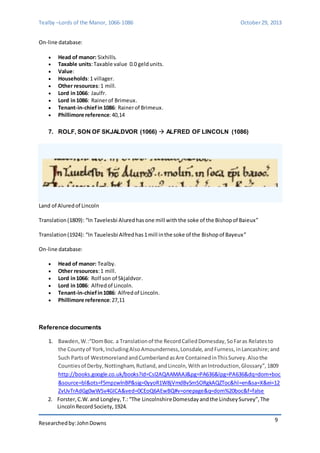
Land of Alured of Lincoln 
Translation (1809): “In Tavelesbi Alured has one mill with the soke of the Bishop of Baieux” 
Translation (1924): “In Tauelesbi Alfred has 1 mill in the soke of the Bishop of Bayeux” 
On-line database: 
 Head of manor: Tealby. 
 Other resources: 1 mill. 
 Lord in 1066: Rolf son of Skjaldvor. 
 Lord in 1086: Alfred of Lincoln. 
 Tenant-in-chief in 1086: Alfred of Lincoln. 
 Phillimore reference: 27,11 
Reference documents 
1. Bawden, W.:“Dom Boc. a Translation of the Record Called Domesday, So Far as Relates to 
the County of York, Including Also Amounderness, Lonsdale, and Furness, in Lancashire; and 
Such Parts of Westmoreland and Cumberland as Are Contained in This Survey. Also the 
Counties of Derby, Nottingham, Rutland, and Lincoln, With an Introduction, Glossary”, 1809 
http://books.google.co.uk/books?id=CsI2AQAAMAAJ&pg=PA636&lpg=PA636&dq=dom+boc 
&source=bl&ots=f5mpzwlnBP&sig=0yyoR1W8jVmdBvSmSORgkAQZToc&hl=en&sa=X&ei=12 
ZvUvTrAdGg0wWSv4GICA&ved=0CEoQ6AEwBQ#v=onepage&q=dom%20boc&f=false 
2. Forster, C.W. and Longley, T.: “The Lincolnshire Domesday and the Lindsey Survey”, The 
Lincoln Record Society, 1924.
Tealby –Lords of the Manor, 1066-1086 October 29, 2013 
3. “Open Domesday – the first free on-line copy of the Domesday Book”. Site created by Anna 
Powell-Smith. Domesday data created by Professor J.J.N. Palmer of the University of Hull 
http://domesdaymap.co.uk/place/TF1590/tealby/ 
4. Palmer, J.: “Domesday DataSet- A collection of data about and around the 1086 Domesday 
book. The dataset was originally lodged in the repository by Professor John Palmer in 2008”. 
https://hydra.hull.ac.uk/resources/hull:domesdayDisplaySet 
Researched by: John Downs 
10

Tealby - Lords of the Manor: 1066 to 1086

  • 1.
    Tealby –Lords ofthe Manor, 1066-1086 October 29, 2013 Researched by: John Downs 1 TEALBY- LORDS OF THE MANOR, 1066-1086 Domesday Book entries for Tealby Total village population in 1086: 52.5 households Total tax assessed in 1086: 5.0 geld units INTRODUCTION Prior to the Norman Conquest the land in Tealby was owned by a number of Anglo-Saxon and Anglo- Scandinavian thanes. According to http://www.domesdaybook.net/helpfiles/hs2780.htm : “In origin, the meaning of thane was 'one who serves'; but by the late Anglo-Saxon period the word was often used as a synonym for a free man of almost any rank. Royal thanes were among the richest and most powerful men in the kingdom, and median - middling - thanes were prosperous landholders of local or even regional importance. Even lesser thanes were considered noble and their service was honourable: they paid taxes and performed military service. A lesser landowner who 'prospered so that he possessed fully five hides of his own' might attain this status. But there were also very large numbers of thanes before the Conquest who held tiny holdings, so modest that they were almost indistinguishable from those of the more prosperous peasants, and might even be smaller. A thane was a free man, a noble man, but often one of limited resources” When William the Conqueror became King of England in 1066 he confiscated the holdings of these landowners and allocated them to members of his own family and the Norman lords who had helped him conquer the country. These people were known as Tenants-in-Chief. Unlike the older Anglo-Saxon form of feudalism these people did not own the land because the ownership remained with William the Conqueror himself. The land allocated to a Tenants-in-Chief was known as a Manor or fief. Often the Tenant-in-Chiefs would appoint a steward or Lord of the Manor to manage and administer their individual Manors. The Anglo-Saxon Chronicle records that: "While spending the Christmas time of 1085 in Gloucester, William had deep speech with his counsellors and sent men all over England to each shire to find out what or how much each landholder had in land and livestock, and what it was worth.” The main purposes of the survey in 1085, which became known as the Domesday survey, were to record:  The identities of the previous landowners and what they had held in terms of land, livestock and other sources of revenue (mills, salt pans, etc)  What taxes (e.g. land taxes or geld) had been liable to the crown during the reign of the previous king, Edward the Confessor  the names of the new holders of lands, and the assessments on which their tax was to be paid in the future The following is a collection of extracts from the Domesday survey that relate to Tealby. I have used three translations of the original shorthand Latin text: one from 1809 1, another from 1924 2 and the last from an on-line database 3. I have started to include some biographical details of the Tealby landowners at that time, as provided by Professor John Palmer in his Domesday Dataset4.
  • 2.
    Tealby –Lords ofthe Manor, 1066-1086 October 29, 2013 Researched by: John Downs 2 1. MERLESWEIN (1066)  RALPH PEYNEL (1086) 1809 Translation: Manor “In Tavelesbi (Tealby) Merlesuen had 14 oxgangs of land to be taxed. Land to 2 ploughs and a half. Ralph has there 10 sokemen with 3 oxgangs, and 10 villanes with 1 plough, and 3 mills of 12 shillings, and 89 acres of meadow, and the sites of 3 mil ls. Value in King Edward’s time was 12 pounds, now 50 shillings. Tallaged at nine shillings” 1924 Translation: M. “In Tauelesbi Merlosuen had 14 bovates of land [assessed] to the geld. There is land for 2 and half teams. Ralf has 10 sokemen there on {de) 3 bovates, and 10 villeins with 1 team, and 3 mills rendering 12 shillings, and 89 acres of meadow, and 3 sites of mills. T. R. E. it was worth 12 pounds; now 50 shillings; tallage 9 shillings” On-line database:  Head of manor: Tealby.  Taxable units: Taxable value 1.8 geld units.  Value: Value to lord in 1066 £12. Value to lord in 1086 £2.5.  Households: 10 villagers. 10 freemen.  Plough land: 2.5 plough lands (land for). 1 men's plough team.  Other resources: Meadow 89 acres. 3 mills, value 0.6.  Lord in 1066: Merleswein the sheriff.  Lord in 1086: Ralph Paynel.  Tenant-in-chief in 1086: Ralph Paynel.  Phillimore reference: 35,9 MERLESWEIN THE SHERIFF may be the important English thane in King Edward's reign who was sheriff of Lincolnshire at some stage during King William's reign until he joined the Danes in 1069 in their attack on York. All of Ralph Paynel's lands in Devon, Somerset and Yorkshire and almost all his others in Gloucestershire and Lincolnshire had been held by Merleswein in 1066. Of this thane's other estates, four in Somerset passed to Walter of Douai and one to the king and one in Yorkshire passed to Count Alan. In Cornwall all the lands held by a Merleswein in 1066 were held in 1086 by the Count of Mortain, three in lordship, six from his men, but although there is no definite proof that this was the same Merleswein and that he was the sherif f of Lincolnshire it is likely. Frequently in Domesday all the lands of an Anglo-Saxon in a given area passed to one Norman, as with Merleswein's lands in Devon, Gloucestershire and Lincolnshire. Identified as sheriff and official predecessor of Ralph Paynel in the Clamores for Lincolnshire , Merleswein was among the ten wealthiest Anglo-Saxon magnates after the great earls. He is usually described as sheriff of Lincolnshire, being named as a sheriff in the Lincolnshire folios; but it would
  • 3.
    Tealby –Lords ofthe Manor, 1066-1086 October 29, 2013 make more sense if he were sheriff of Yorkshire, where the political weight of a magnate-sheriff - the only such one in Anglo-Saxon England - would have been needed. A late tradition states that Merleswein was given an official position in the north by Harold in the aftermath of Stamford Bridge. Merleswein provides the classic case of an antecessor supplying title to a Norman baron. Virtually the entire fief of Ralph Paynel came to him from his officially designated predecessor, Merleswein; and the apparent exceptions can be explained. Ralph's holding at Sandburn was illegally acquired according to the Canons of York, while those at Broughton and Scawby, previously held by Grimkel, had in fact been in Merleswein's possession in 1066, granted to him by Grimkel in an attempt to evade forfeiture. Ralph's only other holding was at East Carlton, where his predecessor was a Thorkil. This may have been the exception proving the rule; but it is also possible that Merleswein was Grimkel's overlord, these not normally being recorded in the circuit in which Northamptonshire lay. The only holdings of Merleswein which did not devolve upon Ralph Paynel were those which would have intruded into the territorial blocks allocated to others: the Count of Mortain's Cornish fiefdom, Count Alan's honour of Richmond, and the royal manor of South Petherton. There is no reason to doubt that the Merleswein's who had held parts of these territories was the sheriff, Merleswein, the only man to bear that name in Domesday Book. Researched by: John Downs 3 2. BRICTNOTH/SWEIN (1066)  ROGER (1086) 1809 Translation: II Manors “In Tavelesbi Swen and Brinot had one carucate of land and a half to be taxed. Land to two ploughs and a half. Roger, a vassal of Roger of Poictou’s, has there one plough, and four villanes and five bordars, and three sokemen who plough with fi ve oxen. There are four mills of sixteen shillings and four-pence, and seventy-eight acres of meadow.” 1924 Translation: 2M * “In Tavelesbi Swen and Brinot had 1 ½ carucates of land (assessed) to the geld. There is land for 2 ½ teams. Roger, Roger of Poitou’s man, has 1 team there (in demesne) and 4 villeins and 5 bordars and 3 sokemen ploughing with 5 oxen. There are 4 mills there rendering 16 shillings and 4 pence, and 78 acres of meadow”. On-line database:  Head of manor: Tealby.  Taxable units: Taxable value 1.5 geld units.  Value:  Households: 4 villagers. 5 smallholders. 3 freemen.
  • 4.
    Tealby –Lords ofthe Manor, 1066-1086 October 29, 2013 Researched by: John Downs 4  Plough land: 2.5 plough lands (land for). 1 lord's plough teams. 0.6 men's plough teams.  Other resources: Meadow 78 acres. 4 mills, value 0.81.  Lords in 1066: Brictnoth; Swein.  Lord in 1086: Roger.  Tenant-in-chief in 1086: Roger of Poitou.  Phillimore reference: 16,10 ROGER OF POITOU was born in Normandy in the mid-1060s and died before 1140. He was an Anglo- Norman aristocrat, who possessed large holdings in both England and through his marriage in France. He was the third son of Roger of Montgomery, 1st Earl of Shrewsbury and Mabel de Bellême. The appellation "the Poitevin" was for his marriage to an heiress from Poitou. Roger acquired a great lordship in England, with lands in Essex, Suffolk, Nottinghamshire, Derbyshire, Lincolnshire, Hampshire and North Yorkshire The principal part of the Lordship was in what was then called inter Mersam et Ripam, that is, "between the Mersey and the Ribble" and is now part of divided into Lancashire, Merseyside, and Greater Manchester. After 1090, he also assumed the title 1st Lord of Bowland. Before 1086, he had married Almodis, daughter of Count Aldebert II of La Marche in Poitou, and sister and presumptive heiress of Count Boso III who was childless and unmarried. Around 1091 Roger's brother-in-law Boso died, but Roger was apparently preoccupied with Norman and English affairs, and his wife's uncle Odo became count of La Marche. In 1092 Roger acquired a large part of what is now north Lancashire. These grants gave Roger effective control of all the lands north of the River Ribble to the River Lune, which formed a natural border between the secure Norman lands in England and the strongly contested Scottish frontier lands in Cumberland. Due to long established lines of communication across Morecambe Bay, Roger also assumed authority over the regions of Furness and Cartmel; these remained a part of Lancashire until as recently as 1974. The expansion of Roger's lands followed his support of King William II Rufus's invasion of Cumbria in
  • 5.
    Tealby –Lords ofthe Manor, 1066-1086 October 29, 2013 Researched by: John Downs 5 AD1092, where Dolfin of Dunbar probably ruled as a vassal of Scottish King Malcolm Canmore. Dolfin was driven out and the Anglo-Scottish border was established north of Carlisle. Roger also acquired the great honour of Eye centered in Suffolk In 1088 he led a military force against William de St-Calais, bishop of Durham, at the request of William Rufus when the bishop was implicated in a revolt against the king; Roger also negotiated with the bishop on the king's behalf before the bishop went to trial. Roger's father Roger de Montgomery died in 1094. In 1094 Rufus sent Roger to hold the castle at Argentan in Normandy, but Roger surrendered it to Philip I of France on the first day of the siege; Roger and his men were held for ransom and purchased their freedom. Though Philip I was an ally of Curthose, it is thought that this action was less a betrayal of Rufus and more a result of Roger's dual vassalage between the King of England and the King of France. Roger did not lose his English lands as a result of this action but held no position in Rufus' government from this point. Roger continued to be loyal to Rufus but in 1102 joined his brothers' failed rebellion against Henry I of England in favor of Robert Curthose. As a result Roger de Poitou lost his English holdings. The King put those in Craven into the governance of Robert de Romille. Roger then went to his wife's holdings in Poitou. Almodis's uncle Odo was ousted as count of La Marche in 1104, and subsequently the sons of Roger and Almodis are styled as count. In 1109 Roger was permitted to briefly return to England to the court of Henry I though did not recover his earlier English holdings. After ca. 1109, Roger appears to have either lost interest in governing in La Marche or lost the political power itself as he is only seen once in the documents of La Marche as his wife and sons held the authority in the region. 3. ERIK, BROTHER OF TOSTI (1066)  GODARD (1086) 1809 Translation: Manor “In Tavelesbi Edric had one carucate of land to be taxed. Land to 12 oxen. Godard, a vassal of Gozelin’s, has there one plough and four sokemen with one oxgang of this land, and ten villanes with one plough and a half, and three mills of fi fteen shillings, and sixty-one acres of meadow. Value in King Edward’s time sixty shillings, now one hundred. Tallaged at sixty shillings” 1924 Translation: M “In Tavelesbi Edric had 1 carucate of land [assessed] to the geld. There is land for 12 oxen. Godard, Gocelin's man, has 1 team there [in demesne], and 4 sokemen on (de) 1 bovate of this land, and 10 villeins with 1 1/2 teams, and 3 mills rendering 16 shillings, and 61 acres of meadow. T. R. E. it was worth 60 shillings; now 100 shillings; tallage 60 shillings” On-line database:
  • 6.
    Tealby –Lords ofthe Manor, 1066-1086 October 29, 2013 Researched by: John Downs 6  Head of manor: Tealby.  Taxable units: Taxable value 1 geld units.  Value: Value to lord in 1066 - £3. Value to lord in 1086 - £5.  Households: 10 villagers. 4 freemen.  Plough land: 1.5 plough land (land for). 1 lord's plough teams. 1.5 men's plough teams.  Other resources: Meadow 61 acres. 3 mills, value 0.8.  Lord in 1066: Erik brother of Tosti.  Lord in 1086: Godard.  Tenant-in-chief in 1086: Jocelyn son of Lambert.  Phillimore reference: 28,20 ERIK OF TEALBY 3 - The name Erik occurs on ten holdings in Domesday Book. There are sufficient links between them to suggest that they refer to a single individual, despite being spread between three counties and devolving upon several tenants-in-chief. The present entry and its dependencies, held by Swein, Erik and Tosti, is connected to another group held by Erik centred on Tealby by the intermediate tenure of one Rainer the deacon, the Tealby group in turn being connected to another holding of Erik by soke in Willingham. Keelby, the final holding in Lincolnshire held by Erik, is just a few miles away from the main group of his properties. Thistleton, by contrast, is some distance from the Lincolnshire holdings; and Catworth and Sawtry in Huntingdonshire even more so. But Sawtry provides a possible link between the three counties. The claims for Huntingdonshire state that the Tosti who had held Sawtry was the brother of Erik, a claim confirmed by the Ramsey Chronicle ( Early Charters of Eastern England, p. 235 no. 323). As already noted, the main group of Erik's holdings in Lincolnshire were entered under the names of Erik, Tosti and Swein. It seems probable that this Erik and Tosti were the same men as the Huntingdonshire brothers. Their extensive properties (and this Tosti may have been the Tosti holding several other Lincolnshire holdings) makes the Ramsey Chronicle's description of Tosti as unus ex baronibus regis Edwardi ('one of King Edward's barons') comprehensible. Thistleton is almost midway between the Huntingdonshire and Lincolnshire holdings and would have provided a useful staging point. 4. ROLF, SON OF SKJALDVOR (1066)  LOSOARD OF ROLLESTON (1086) Land of Bishop of Baieux 1809 Translation, page 446: “In Tavelesbi Rolf had half a carucate of land to be taxed. Land to one plough. Losoard, a vassal of the Bishop’s, has there 1 plough, and 3 villans with 3 draft oxen, and one mill of two shillings, and another mill which belongs to Grosbi (Grasby). Value in King Edward’s time twenty shillings, the same now.” 1924 Translation: M “In Tavelesbi Rolf had half a carucate of land [assessed] to the geld. There is land for 1 team. Losoard, the Bishop's man, has 1 team there [in demesne], and 3 villeins ploughing
  • 7.
    Tealby –Lords ofthe Manor, 1066-1086 October 29, 2013 with 3 oxen, and 1 mill rendering 2 shillings, and another mill which belongs to Grosbi . T. R. E. it was worth 20 shillings; now the like amount”. Researched by: John Downs 7 On-line database:  Head of manor: Tealby.  Taxable units: Taxable value 0.5 geld units.  Value: Value to lord in 1066 £1. Value to lord in 1086 £1.  Households: 3 villagers.  Plough land: 1 plough land (land for). 1 lord's plough teams. 0.4 men's plough teams.  Other resources: 2 mills, value 0.1.  Lord in 1066: Rolf son of Skjaldvor.  Lord in 1086: Losoard of Rolleston.  Tenant-in-chief in 1086: Bishop Odo of Bayeux.  Phillimore reference: 4,41 5. HUGH (1066)  IVO TALLBOYS OR TAILLEBOISE (1086) 1809 Translation: “In Osgotebi and Tauelebi inland 2 oxgangs, and one oxgang soke of this manor, 3 oxgangs of land to be taxed. Land to 6 oxen. There are 4 sokemen and one villane who plough with 6 oxen, and there is one mill of three shillings, and 3 acres of meadow”. 1924 Translation, page 485: “In Osgotebi and Tauelebi there is inland [2 bovates] and sokeland [1 bovate] of this manor, 3 bovates of land [assessed] to the geld. There is land for 6 oxen. 4 sokemen and 1 villein plough there with 6 oxen, and there is 1 mill there rendering 3 shillings, and 3 acres of meadow”. On-line database:  Head of manor: Claxby & Normanby le Wold.  Taxable units: Taxable value 0.4 geld units.  Value:  Households: 1 villager. 4 freemen.  Plough land: 0.8 plough lands (land for). 0.8 men's plough teams.  Other resources: Meadow 3 acres. 1 mill.  Lord in 1086: Hugh.  Tenant-in-chief in 1086: Ivo Tallboys.  Places mentioned in this entry: Osgodby; Tealby.  Phillimore reference: 14,10
  • 8.
    Tealby –Lords ofthe Manor, 1066-1086 October 29, 2013 IVO TAILLEBOIS - a powerful Norman nobleman, sheriff and Tenant-in-chief in 11th century England. Ivo Taillebois was most probably from Taillebois, a small hamlet in Saint-Gervais de Briouze, Calvados. He sold land at Villers to the Abbey of Saint-Étienne, Caen and donated a church of Christot in Calvados. The latter diploma was attested by his brother Robert. Another brother, Ralph Taillebois, was High Sheriff of Bedfordshire and Ivo succeeded him as sheriff after Ralph's death shortly before 1086. Ivo was among the followers of Duke William of Normandy who invaded England in 1066 and is listed on the Battle Abbey Roll. He shared in the distribution of lands among the Norman Barons, and received the lordship of Kendal as his allotment of the spoils. It consisted of a large portion of Northern Lancashire and Southern Westmorland. His centre of power, however, appears to have been in Lincolnshire, where he probably became High Sheriff of Lincolnshire after the downfall of Merleswein in 1068. He married Lucy, probable daughter of Turold, the Sheriff of Lincolnshire before the conquest and subsequently Countess of Chester, from whom he received all her ancient family domains, thus making him one of the most influential nobles in England in his day. In 1071, King William, with Ivo leading his army, besieged the Isle of Ely where the rebel leader Hereward the Wake was based. Later, after Hereward, who had escaped capture during the siege, was caught and imprisoned, Ivo dissuaded William from freeing him. In the Domesday Book he appears as a tenant-in-chief also holding Bourne and many of its manors. William Rufus further endowed him with the lands of Ribblesdale and Lonsdale in Cumbria on the border with Scotland, possibly for his service as a royal steward. He was also granted the Barony of Kendal by William Rufus, consisting of a sizable portion of Westmorland. Ivo attested several charters for William the Conqueror before 1086, including the abbey of St. Armand and the abbey of St. Peter, Ghent, and several for William II Rufus including the abbey of St. Florent, Saumur and the abbey of St. Mary, La Sauve Majeure. Ivo had at least two daughters. Lucy who married the Earl of Chester, Ranulph le Meschin and Beatrix, who married Ribald of Middleham, son of Eudo of Penthièvre, and was probably his only legitimate child. According to the analyst Peter of Blois, Ivo and Lucy's "only daughter, who had been nobly espoused, died before her father; for that evil shoots should not fix deep roots in the world, the accursed lineage of that wicked man perished by the axe of the Almighty, which cut off all his issue." Peter did not like Ivo. Researched by: John Downs 8 6. JAULFR (1066)  RAINER OF BRIMEAUX (1086) 1809 Translation: “In Tavelesbi Rayner has one mill and four acres of land, and one villan who belongs to Sisse (Sixhill).” 1924 Translation: “ In Tauelesbi Rayner has 1 mill and 4 acres of land, and 1 villein who belongs to {tacet in) Sisse [Sixle]”
  • 9.
    Tealby –Lords ofthe Manor, 1066-1086 October 29, 2013 Researched by: John Downs 9 On-line database:  Head of manor: Sixhills.  Taxable units: Taxable value 0.0 geld units.  Value:  Households: 1 villager.  Other resources: 1 mill.  Lord in 1066: Jaulfr.  Lord in 1086: Rainer of Brimeux.  Tenant-in-chief in 1086: Rainer of Brimeux.  Phillimore reference: 40,14 7. ROLF, SON OF SKJALDVOR (1066)  ALFRED OF LINCOLN (1086) Land of Alured of Lincoln Translation (1809): “In Tavelesbi Alured has one mill with the soke of the Bishop of Baieux” Translation (1924): “In Tauelesbi Alfred has 1 mill in the soke of the Bishop of Bayeux” On-line database:  Head of manor: Tealby.  Other resources: 1 mill.  Lord in 1066: Rolf son of Skjaldvor.  Lord in 1086: Alfred of Lincoln.  Tenant-in-chief in 1086: Alfred of Lincoln.  Phillimore reference: 27,11 Reference documents 1. Bawden, W.:“Dom Boc. a Translation of the Record Called Domesday, So Far as Relates to the County of York, Including Also Amounderness, Lonsdale, and Furness, in Lancashire; and Such Parts of Westmoreland and Cumberland as Are Contained in This Survey. Also the Counties of Derby, Nottingham, Rutland, and Lincoln, With an Introduction, Glossary”, 1809 http://books.google.co.uk/books?id=CsI2AQAAMAAJ&pg=PA636&lpg=PA636&dq=dom+boc &source=bl&ots=f5mpzwlnBP&sig=0yyoR1W8jVmdBvSmSORgkAQZToc&hl=en&sa=X&ei=12 ZvUvTrAdGg0wWSv4GICA&ved=0CEoQ6AEwBQ#v=onepage&q=dom%20boc&f=false 2. Forster, C.W. and Longley, T.: “The Lincolnshire Domesday and the Lindsey Survey”, The Lincoln Record Society, 1924.
  • 10.
    Tealby –Lords ofthe Manor, 1066-1086 October 29, 2013 3. “Open Domesday – the first free on-line copy of the Domesday Book”. Site created by Anna Powell-Smith. Domesday data created by Professor J.J.N. Palmer of the University of Hull http://domesdaymap.co.uk/place/TF1590/tealby/ 4. Palmer, J.: “Domesday DataSet- A collection of data about and around the 1086 Domesday book. The dataset was originally lodged in the repository by Professor John Palmer in 2008”. https://hydra.hull.ac.uk/resources/hull:domesdayDisplaySet Researched by: John Downs 10