Description
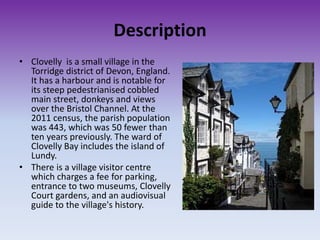
• Clovelly is a small village in the
Torridge district of Devon, England.
It has a harbour and is notable for
its steep pedestrianised cobbled
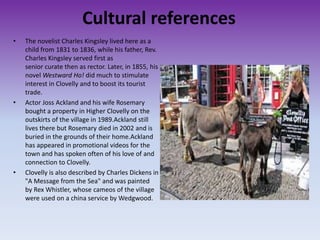
main street, donkeys and views
over the Bristol Channel. At the
2011 census, the parish population
was 443, which was 50 fewer than
ten years previously. The ward of
Clovelly Bay includes the island of
Lundy.
• There is a village visitor centre
which charges a fee for parking,
entrance to two museums, Clovelly
Court gardens, and an audiovisual
guide to the village's history.
History
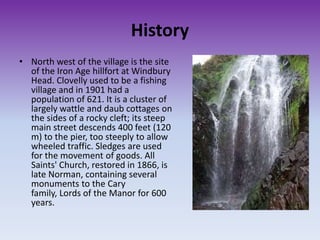
• North west of the village is the site
of the Iron Age hillfort at Windbury
Head. Clovelly used to be a fishing
village and in 1901 had a
population of 621. It is a cluster of
largely wattle and daub cottages on
the sides of a rocky cleft; its steep
main street descends 400 feet (120
m) to the pier, too steeply to allow
wheeled traffic. Sledges are used
for the movement of goods. All
Saints' Church, restored in 1866, is
late Norman, containing several
monuments to the Cary
family, Lords of the Manor for 600
years.
Buildings
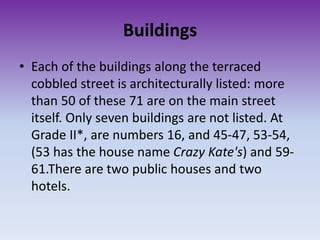
• Each of the buildings along the terraced
cobbled street is architecturally listed: more
than 50 of these 71 are on the main street
itself. Only seven buildings are not listed. At
Grade II*, are numbers 16, and 45-47, 53-54,
(53 has the house name Crazy Kate's) and 59-
61.There are two public houses and two
hotels.
Access
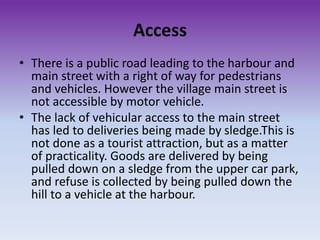
• There is a public road leading to the harbour and
main street with a right of way for pedestrians
and vehicles. However the village main street is
not accessible by motor vehicle.
• The lack of vehicular access to the main street
has led to deliveries being made by sledge.This is
not done as a tourist attraction, but as a matter
of practicality. Goods are delivered by being
pulled down on a sledge from the upper car park,
and refuse is collected by being pulled down the
hill to a vehicle at the harbour.
Cultural references
• The novelist Charles Kingsley lived here as a
child from 1831 to 1836, while his father, Rev.
Charles Kingsley served first as
senior curate then as rector. Later, in 1855, his
novel Westward Ho! did much to stimulate
interest in Clovelly and to boost its tourist
trade.
• Actor Joss Ackland and his wife Rosemary
bought a property in Higher Clovelly on the
outskirts of the village in 1989.Ackland still
lives there but Rosemary died in 2002 and is
buried in the grounds of their home.Ackland
has appeared in promotional videos for the
town and has spoken often of his love of and
connection to Clovelly.
• Clovelly is also described by Charles Dickens in
"A Message from the Sea" and was painted
by Rex Whistler, whose cameos of the village
were used on a china service by Wedgwood.
Cultural tradition
• An 18th century chapbook entitled The History of John
Gregg and his Family of Robbers and
Murderers explains that "Chovaley" (i.e. Clovelly) was
once the home of a tribe of cannibalistic bandits. It is
alleged that Gregg and his extended family of dozens
were eventually tracked down by bloodhounds and
were burnt alive in three fires. They were said to have
lived in "a cave near the sea-side" and had committed
some 1,000 murders. Although the story is fiction,
writer Daniel Codd observes that a stretch of Clovelly
Bay is called "the Devil's Kitchen"—"an apt name
indeed if there is any truth in the ghoulish story of the
Gregg family"

Village clovelly

  • 2.
    Description • Clovelly isa small village in the Torridge district of Devon, England. It has a harbour and is notable for its steep pedestrianised cobbled main street, donkeys and views over the Bristol Channel. At the 2011 census, the parish population was 443, which was 50 fewer than ten years previously. The ward of Clovelly Bay includes the island of Lundy. • There is a village visitor centre which charges a fee for parking, entrance to two museums, Clovelly Court gardens, and an audiovisual guide to the village's history.
  • 3.
    History • North westof the village is the site of the Iron Age hillfort at Windbury Head. Clovelly used to be a fishing village and in 1901 had a population of 621. It is a cluster of largely wattle and daub cottages on the sides of a rocky cleft; its steep main street descends 400 feet (120 m) to the pier, too steeply to allow wheeled traffic. Sledges are used for the movement of goods. All Saints' Church, restored in 1866, is late Norman, containing several monuments to the Cary family, Lords of the Manor for 600 years.
  • 4.
    Buildings • Each ofthe buildings along the terraced cobbled street is architecturally listed: more than 50 of these 71 are on the main street itself. Only seven buildings are not listed. At Grade II*, are numbers 16, and 45-47, 53-54, (53 has the house name Crazy Kate's) and 59- 61.There are two public houses and two hotels.
  • 5.
    Access • There isa public road leading to the harbour and main street with a right of way for pedestrians and vehicles. However the village main street is not accessible by motor vehicle. • The lack of vehicular access to the main street has led to deliveries being made by sledge.This is not done as a tourist attraction, but as a matter of practicality. Goods are delivered by being pulled down on a sledge from the upper car park, and refuse is collected by being pulled down the hill to a vehicle at the harbour.
  • 6.
    Cultural references • Thenovelist Charles Kingsley lived here as a child from 1831 to 1836, while his father, Rev. Charles Kingsley served first as senior curate then as rector. Later, in 1855, his novel Westward Ho! did much to stimulate interest in Clovelly and to boost its tourist trade. • Actor Joss Ackland and his wife Rosemary bought a property in Higher Clovelly on the outskirts of the village in 1989.Ackland still lives there but Rosemary died in 2002 and is buried in the grounds of their home.Ackland has appeared in promotional videos for the town and has spoken often of his love of and connection to Clovelly. • Clovelly is also described by Charles Dickens in "A Message from the Sea" and was painted by Rex Whistler, whose cameos of the village were used on a china service by Wedgwood.
  • 7.
    Cultural tradition • An18th century chapbook entitled The History of John Gregg and his Family of Robbers and Murderers explains that "Chovaley" (i.e. Clovelly) was once the home of a tribe of cannibalistic bandits. It is alleged that Gregg and his extended family of dozens were eventually tracked down by bloodhounds and were burnt alive in three fires. They were said to have lived in "a cave near the sea-side" and had committed some 1,000 murders. Although the story is fiction, writer Daniel Codd observes that a stretch of Clovelly Bay is called "the Devil's Kitchen"—"an apt name indeed if there is any truth in the ghoulish story of the Gregg family"