Diagnosis and Medical
Management of
Management of
Post-Polio Syndrome
Post-Polio Syndrome
Dr Michael Watt
Dr Michael Watt
Consultant Neurologist
RVH, Belfast
RVH, Belfast
How easy it is to Forget
 What is PPS?
What is PPS?
 Have I got it or have I got something else?
Have I got it or have I got something else?
 What can I do about it?
What can I do about it?
History of PPS
History of PPS
 First case described in 1875 (Raymond, 1875)
First case described in 1875 (Raymond, 1875)
 Zilkha (1962) described 11 cases occurring 17-43 years post
Zilkha (1962) described 11 cases occurring 17-43 years post
acute illness.
acute illness.
 Halstead (1985) – “post polio syndrome”, (PPS), then, re-
Halstead (1985) – “post polio syndrome”, (PPS), then, re-
defined it in 1991.
defined it in 1991.
 Dalakas (1995) defined post polio muscular atrophy (PPMA)
Dalakas (1995) defined post polio muscular atrophy (PPMA)
 Berg(1996) “Post Polio Muscular dysfunction” (PPMD)
Berg(1996) “Post Polio Muscular dysfunction” (PPMD)
 Howard (1988,2003)) Post-polio functional deterioration
Howard (1988,2003)) Post-polio functional deterioration
(PPFD)
(PPFD)
Halstead’s 1985 Definition
 Confirmed history of polio
Confirmed history of polio
 Partial or fairly complete neurological and functional recovery
Partial or fairly complete neurological and functional recovery
after the acute episode.
 Period of at least 15 years with neurological and functional
Period of at least 15 years with neurological and functional
stability
stability
 Two or more of the following health problems occurring after
Two or more of the following health problems occurring after
the stable period:
the stable period:
 Extensive fatigue
Extensive fatigue
 Muscle and or joint pain
Muscle and or joint pain
 New weakness in muscles previously affected or unaffected
New weakness in muscles previously affected or unaffected
 New muscle atrophy
New muscle atrophy
 Functional loss
Functional loss
 Cold intolerance
Cold intolerance
 No other medical explanation found
No other medical explanation found
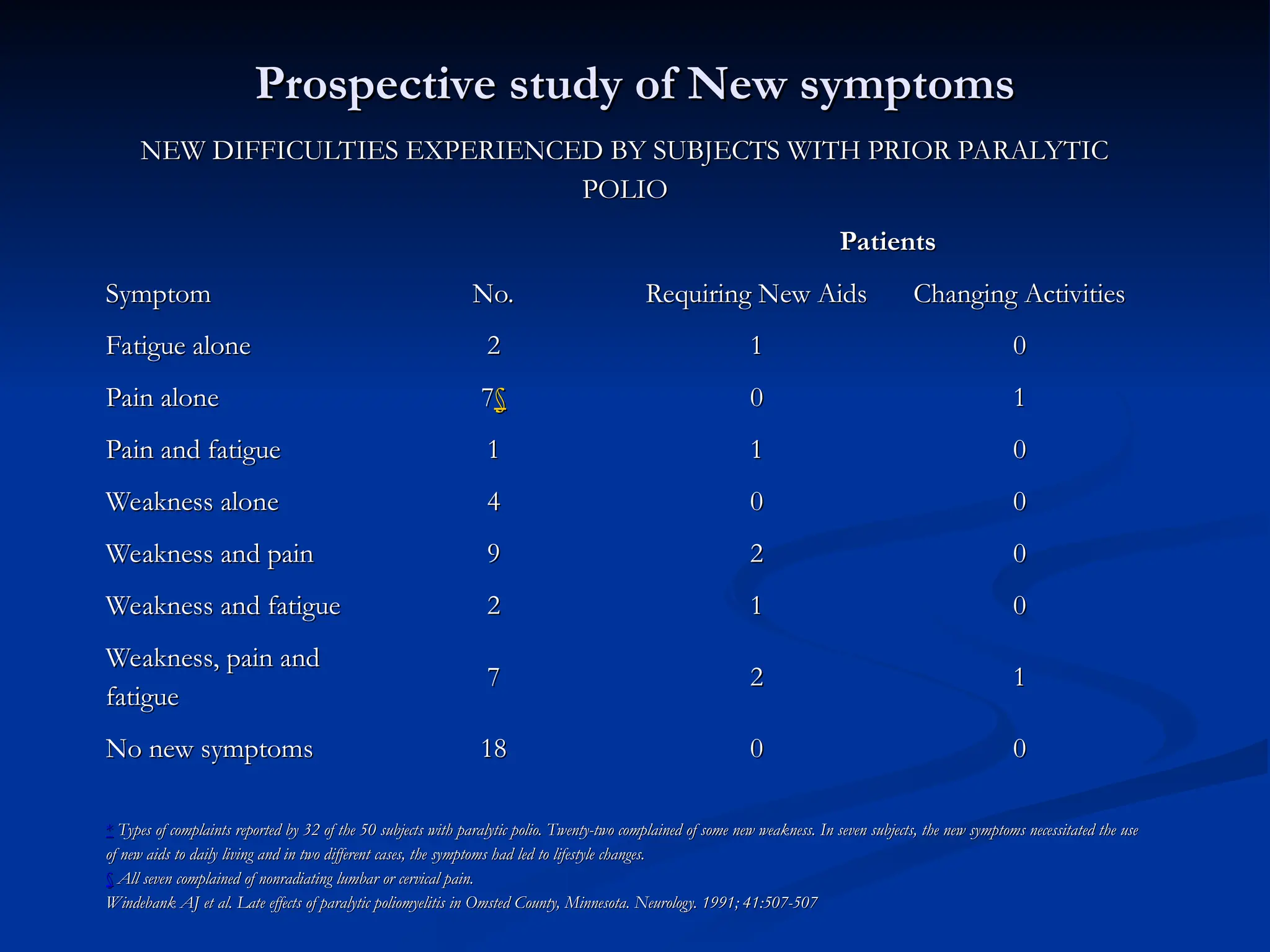
Prospective study of New symptoms
NEW DIFFICULTIES EXPERIENCED BY SUBJECTS WITH PRIOR PARALYTIC
POLIO
POLIO
Patients
Patients
Symptom
Symptom No.
No. Requiring New Aids
Requiring New Aids Changing Activities
Changing Activities
Fatigue alone
Fatigue alone 2
2 1
1 0
0
Pain alone
Pain alone 7
7§
§ 0
0 1
1
Pain and fatigue
Pain and fatigue 1
1 1
1 0
0
Weakness alone
Weakness alone 4
4 0
0 0
0
Weakness and pain
Weakness and pain 9
9 2
2 0
0
Weakness and fatigue
Weakness and fatigue 2
2 1
1 0
0
Weakness, pain and
Weakness, pain and
fatigue
fatigue
7
7 2
2 1
1
No new symptoms
No new symptoms 18
18 0
0 0
0
*
* Types of complaints reported by 32 of the 50 subjects with paralytic polio. Twenty-two complained of some new weakness. In seven subjects, the new symptoms necessitated the use
Types of complaints reported by 32 of the 50 subjects with paralytic polio. Twenty-two complained of some new weakness. In seven subjects, the new symptoms necessitated the use
of new aids to daily living and in two different cases, the symptoms had led to lifestyle changes.
§
§ All seven complained of nonradiating lumbar or cervical pain.
All seven complained of nonradiating lumbar or cervical pain.
Windebank AJ et al. Late effects of paralytic poliomyelitis in Omsted County, Minnesota. Neurology. 1991; 41:507-507
MOST COMMON NEW HEALTH AND FUNCTIONAL PROBLEMS OF PATIENTS WITH
CONFIRMED POLIO EVALUATED IN TWO POST-POLIO CLINICS
Texas
Texas
(N = 132)
(N = 132)
Wisconsin
Wisconsin§
§
(N = 79)
(N = 79)
N
N %
% N
N %
%
HEALTH PROBLEMS
HEALTH PROBLEMS
Fatigue
Fatigue 117
117 89
89 68
68 86
86
Muscle pain
Muscle pain 93
93 71
71 68
68 86
86
Joint pain
Joint pain 93
93 71
71 61
61 77
77
Weakness:
Weakness:
Affected muscles
Affected muscles 91
91 69
69 63
63 80
80
Unaffected
Unaffected
muscles
muscles
66
66 50
50 42
42 53
53
Atrophy
Atrophy 37
37 28
28 31
31 39
39
FUNCTIONAL
FUNCTIONAL
PROBLEMS
PROBLEMS
Walking
Walking 84
84 64
64 --
-- --
--
Climbing stairs
Climbing stairs 80
80 61
61 53
53 67
67
Dressing
Dressing 23
23 17
17 13
13 16
16
Epidemiology of PPS
Epidemiology of PPS
 The frequency of PPS ranges between 15%-
The frequency of PPS ranges between 15%-
80%, depending which population are studied,
and which criteria are applied.
 In European populations a prevalence of
In European populations a prevalence of
between 46% (Holland) and 60% (Edinburgh,
Norway, Denmark) is seen in the literature.
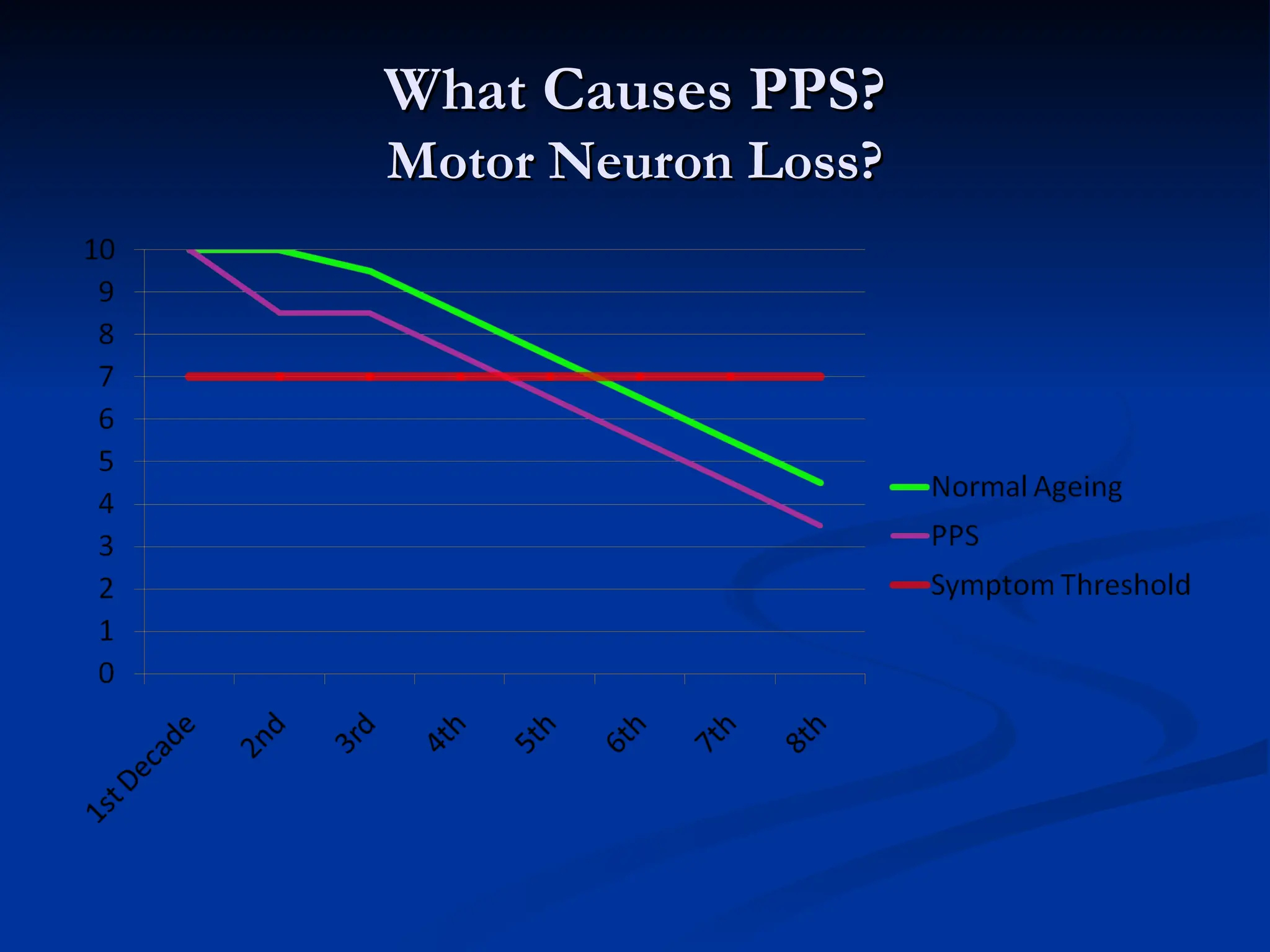
What Causes PPS?
What Causes PPS?
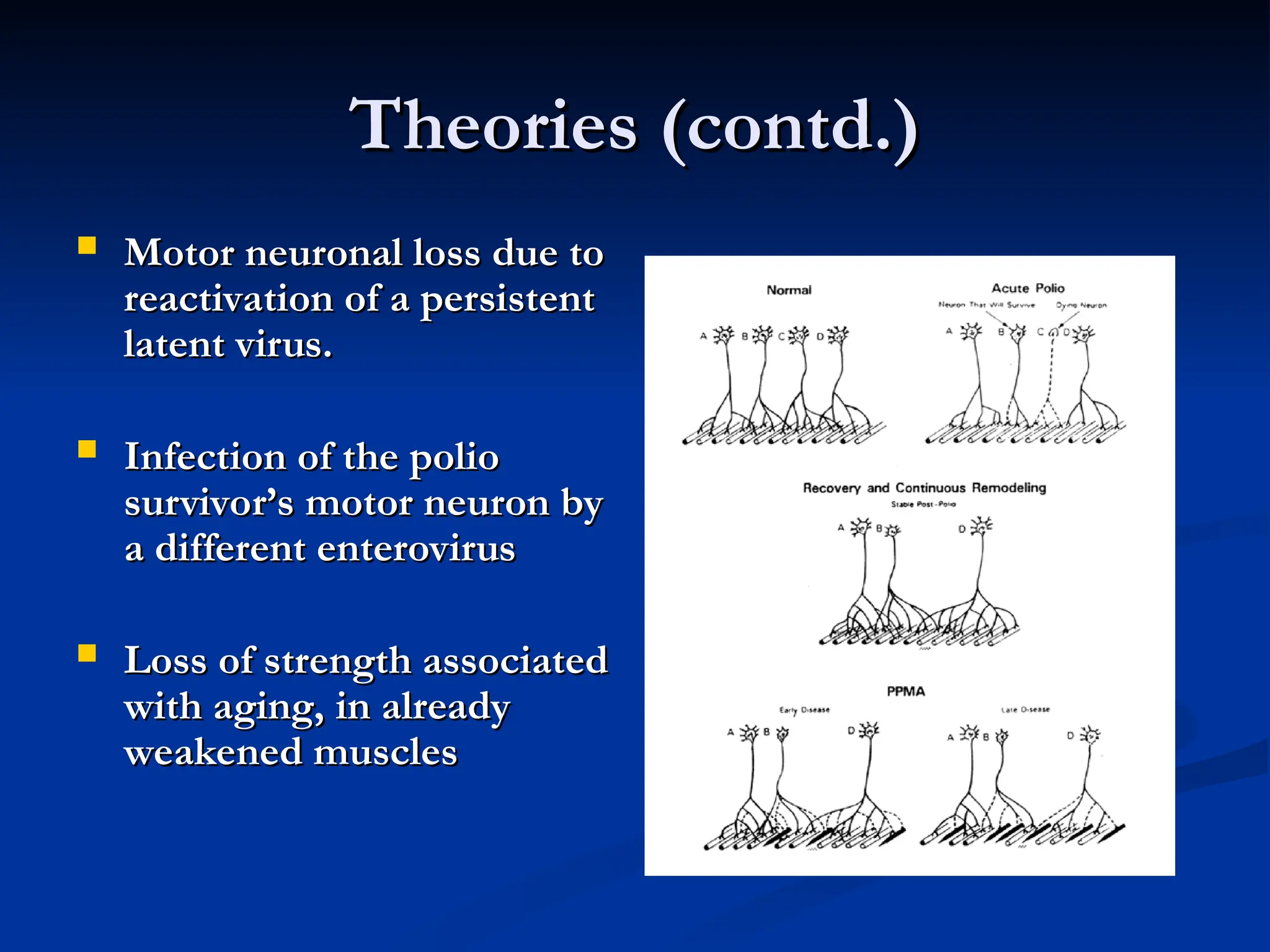
Motor Neuron Loss?
Motor Neuron Loss?
CNS
CNS
Normal:
One nerve/motor muscle unit
PPS:
multiple motor units /nerve
Pathophysiology
Pathophysiology
Theories
Theories:
:
 Remaining healthy motor
Remaining healthy motor
neurons can no longer
maintain new sprouts
 Decompensation / chronic
Decompensation / chronic
denervation and
denervation and
reinervation process.
 Denervation exceeds
Denervation exceeds
reinervation
reinervation
Theories (contd.)
Theories (contd.)
 Motor neuronal loss due to
Motor neuronal loss due to
reactivation of a persistent
latent virus.
latent virus.
 Infection of the polio
Infection of the polio
survivor’s motor neuron by
a different enterovirus
 Loss of strength associated
Loss of strength associated
with aging, in already
weakened muscles
weakened muscles
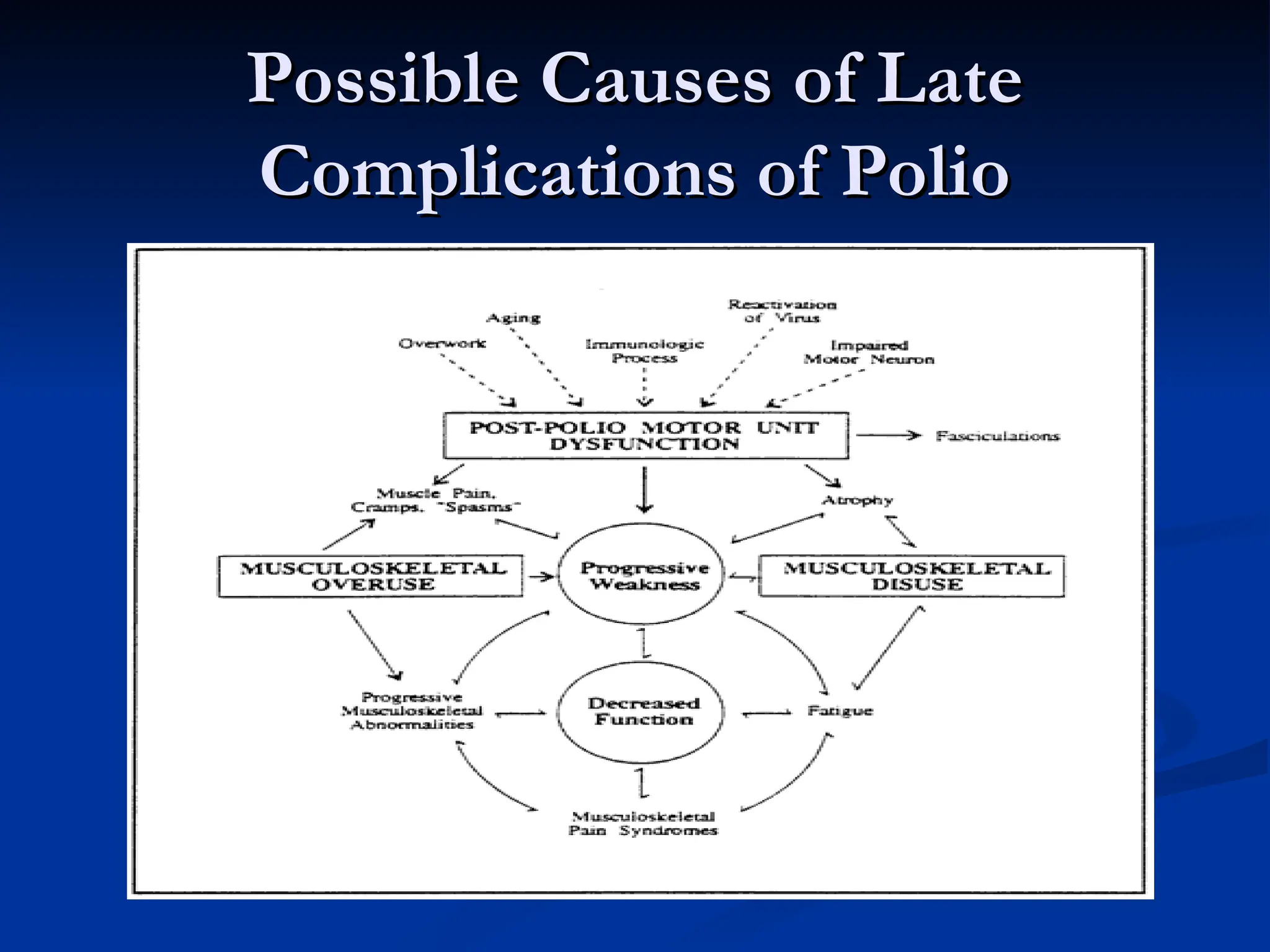
Possible Causes of Late
Complications of Polio
What Causes PPS?
What Causes PPS?
 Accelerated natural ageing
Accelerated natural ageing
 Falling nerve to muscle motor unit ratio
Falling nerve to muscle motor unit ratio
 Inflammation and active immune response
Inflammation and active immune response
 Co-morbidity:
Co-morbidity:
 Orthopaedic problems
Orthopaedic problems
 Radiculopathy and entrapment neuropathy
Radiculopathy and entrapment neuropathy
 Respiratory failure
Respiratory failure
 General medical problems
General medical problems
 PPS is more likely with
PPS is more likely with
 increasing age;
increasing age;
 the more severe the initial weakness was
the more severe the initial weakness was
 The more time that elapses after the attack of polio
The more time that elapses after the attack of polio
Non-paralytic polio and PPS?
 For non-paralytic polio it is impossible to
For non-paralytic polio it is impossible to
exclude a scaled down version of the same
processes.
processes.
 Such a diagnosis however is presumptive and
Such a diagnosis however is presumptive and
cannot be categorically confirmed.
 When we have further knowledge about the
When we have further knowledge about the
specificity and sensitivity of EMG, muscle
biopsy and immunological tests it should be
possible to give more definite diagnoses
Main Clinical Features of PPS
 Fatigue (Commonest)
Fatigue (Commonest)
 Weakness
Weakness
 Muscle pain
Muscle pain
 Gait disturbance
Gait disturbance
 Respiratory problems
Respiratory problems
 Swallowing problems
Swallowing problems
 Cold intolerance
Cold intolerance
 Sleep apnoea
Sleep apnoea
Fatigue
Fatigue
 Prominent in the early hours of the afternoon
Prominent in the early hours of the afternoon
 Decreases with rest
Decreases with rest
 Pathogenesis:Chronic pain / Muscle pain
Pathogenesis:Chronic pain / Muscle pain
 Sleep disorders/ respiratory dysfunction
Sleep disorders/ respiratory dysfunction
 Difficulty in remembering/ concentrating
Difficulty in remembering/ concentrating
 Decreased muscular endurance / Increased muscular
Decreased muscular endurance / Increased muscular
fatigability
fatigability
 “
“Polio wall”
Polio wall”
 Generalized or muscular
Generalized or muscular
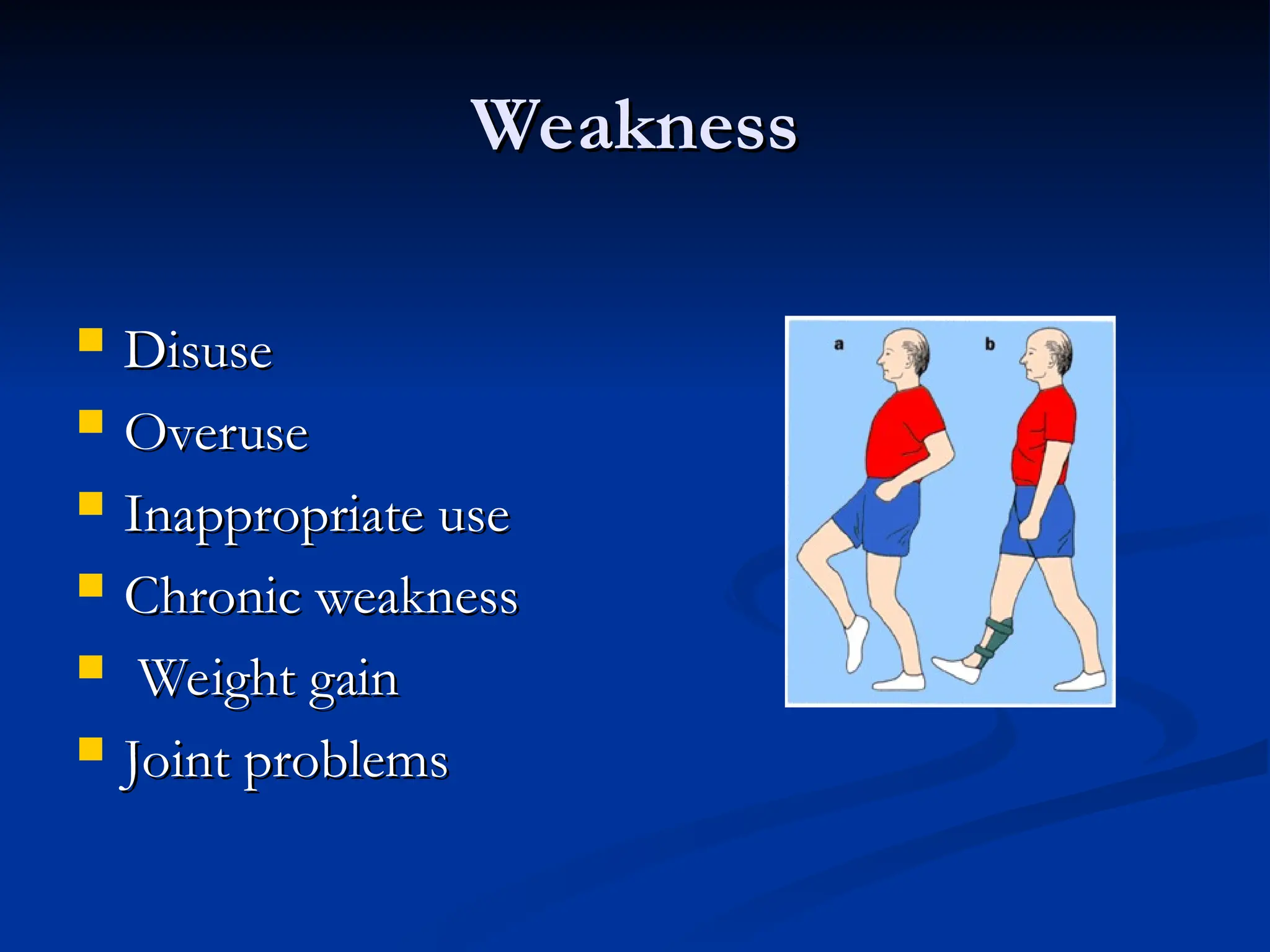
Weakness
Weakness
 Disuse
Disuse
 Overuse
Overuse
 Inappropriate use
Inappropriate use
 Chronic weakness
Chronic weakness
 Weight gain
Weight gain
 Joint problems
Joint problems
Muscle Pain
Muscle Pain
 Extremely prevalent in PPS
Extremely prevalent in PPS
 Deep aching pain
Deep aching pain
 Myofascial pain syndrome / Fibromyalgia
Myofascial pain syndrome / Fibromyalgia
 Small number of patients have muscle tenderness on
Small number of patients have muscle tenderness on
palpation
palpation
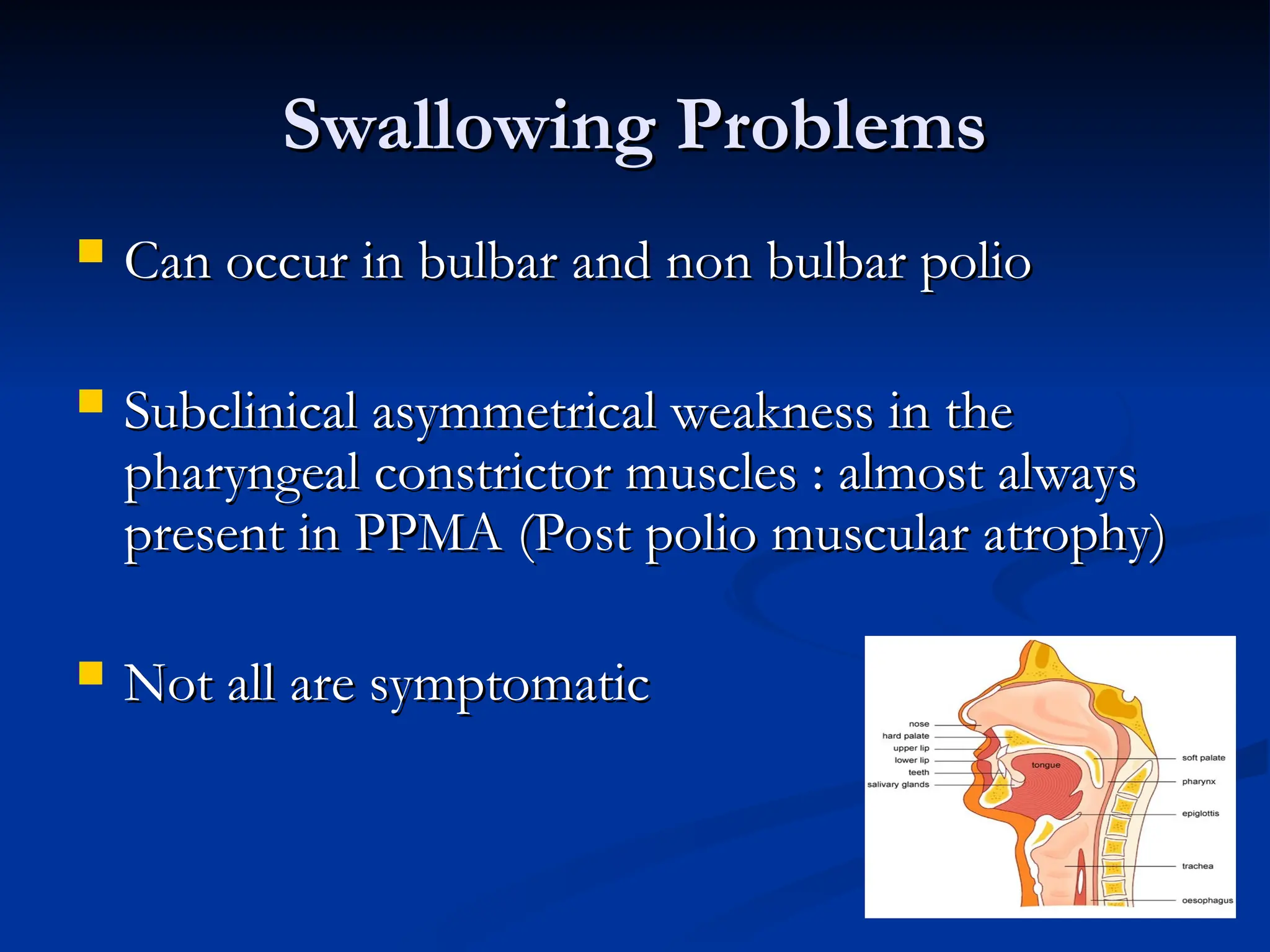
Swallowing Problems
Swallowing Problems
 Can occur in bulbar and non bulbar polio
Can occur in bulbar and non bulbar polio
 Subclinical asymmetrical weakness in the
Subclinical asymmetrical weakness in the
pharyngeal constrictor muscles : almost always
present in PPMA (Post polio muscular atrophy)
 Not all are symptomatic
Not all are symptomatic
Cold Intolerance
Cold Intolerance
Autonomic nervous system dysfunction?
May relate to sympathetic intermediolateral
column damage during acute poliomyelitis
Peripheral component may include muscular
atrophy leading to reduced heat production
Sleep Apnoea
Sleep Apnoea
 Combination of the following:
Combination of the following:
 Central: residual dysfunction of surviving bulbar
Central: residual dysfunction of surviving bulbar
reticular neurons
reticular neurons
 Obstructive: pharyngeal weakness and increased
Obstructive: pharyngeal weakness and increased
musculoskeletal deformities from scoliosis or
emphysema
emphysema
 PPMA, diminished muscle strength of
PPMA, diminished muscle strength of
respiratory,intercostal & abdominal muscle groups
Risk Factors for Sleep Apnoea
 Age of onset (More severe disease in
Age of onset (More severe disease in
adolescents and adults)
 Severity of original paralysis
Severity of original paralysis
 Managed with BiPAP
Managed with BiPAP
Is it PPS?
Is it PPS?
Other
Other
neuromuscular
neuromuscular
diseases
diseases
Nerve entrapment
Nerve entrapment
Is it PPS?
Is it PPS?
Spinal cord and
Spinal cord and
nerve root problems
nerve root problems
Scoliosis
Scoliosis
Is it PPS? – Other things to think of
 Other rheumatological disorders: rheumatoid
Other rheumatological disorders: rheumatoid
arthritis, lupus, Sjorgren’s syndrome or just
osteoarthritis
osteoarthritis
 Endocrine disorders: hypothyroidism, adrenal
Endocrine disorders: hypothyroidism, adrenal
failure, rarely pituitary failure
 Orthopaedic problems: shoulder rotator cuff tears
Orthopaedic problems: shoulder rotator cuff tears
and impingement syndrome, spondylosis, bursitis,
metatarsalgia.
metatarsalgia.
 Breathing disorders: restrictive problems with
Breathing disorders: restrictive problems with
scoliosis, obstructive sleep apnoea
 General medical problems: heart failure, diabetes
General medical problems: heart failure, diabetes
How is it Investigated?
 MRI scans
MRI scans
 Blood tests
Blood tests
 EMG and nerve conduction studies
EMG and nerve conduction studies
 X-rays
X-rays
 Overnight oximetry
Overnight oximetry
 Sleep studies
Sleep studies
 Pulmonary function tests
Pulmonary function tests
What can be done about PPS?
 Firstly, drugs don’t work, at least not the one’s
Firstly, drugs don’t work, at least not the one’s
we have at the moment.
 Modafanil and pyridostigmine, steroids and ivIg
Modafanil and pyridostigmine, steroids and ivIg
are all proven not to have any benefit.
What can be Done for PPS?
Treat Co-Morbidities
 If you rely on your shoulders,
If you rely on your shoulders,
 protect them and seek early advice for shoulder symptoms.
protect them and seek early advice for shoulder symptoms.
e.g.. “Save Our Shoulders”
 Insist on proper evaluation of the shoulder e.g. USS or MRI
Insist on proper evaluation of the shoulder e.g. USS or MRI
 Ensure the surgeon has experience of PPS.
Ensure the surgeon has experience of PPS.
 Treat general medical and endocrine problems.
Treat general medical and endocrine problems.
 Treat carpal tunnel syndrome
Treat carpal tunnel syndrome
 Look at posture to prevent progressive deformities e.g..
Look at posture to prevent progressive deformities e.g..
Profiling bed, trunk support when sitting.
 Make every effort to treat and avoid rising BMI: diet,
Make every effort to treat and avoid rising BMI: diet,
Orlistat, Sibutramine.
Treat
Treat
Co-morbidities
Co-morbidities
Get orthoses to off
Get orthoses to off
load and support joints
that are failing
that are failing
Use lightweight
Use lightweight
modern materials for
orthoses e.g. carbon
fibre, titanium
fibre, titanium
Treat
Treat
Co-Morbidities
Co-Morbidities
Use strategies to
Use strategies to
avoid over stressing
systems that are
systems that are
already challenged
already challenged
e.g. powered wheel
e.g. powered wheel
chair, PAPAW.
chair, PAPAW.
Treat
Treat
Co-Morbidities
Co-Morbidities
Night time
Night time
hypoventilation can
hypoventilation can
be easily treated
be easily treated
with NIPPV
with NIPPV
Active Management of PPS
 Start an exercise program:
Start an exercise program:
 Aerobic, i.e.. Within the limits of the muscles’ glucose
Aerobic, i.e.. Within the limits of the muscles’ glucose
and oxygen supplies. In practice this means 2-3 minutes
exercise, 1-3 minutes rest.
 Within your limit (Avoid “boom and bust”). Do not
Within your limit (Avoid “boom and bust”). Do not
exercise until it hurts the muscles. If your muscles ache
and are stiff the next day you over did it.
 Use pacing and graded exercise goals: small increments
Use pacing and graded exercise goals: small increments
in your limit are achievable e.g.. 5-10% every 1-2 weeks.
Exercise for PPS
Exercise for PPS
Where possible try
Where possible try
and use water based
and use water based
activities: you are 30%
lighter in the water and
will off load joints that
might be struggling
might be struggling
with gravity based
with gravity based
exercises.
exercises.
Be consistent.
Be consistent.
Exercise reverses
Exercise reverses
DECONDITIONING
DECONDITIONING
Active Management of PPS
 Get good pain control: non-steroidal anti-
Get good pain control: non-steroidal anti-
inflammatory drugs, medium grade opiates e.g..
codeine, but use non-pharmacological means e.g..
Counter stimulation TENS, rubifacients
 Keep warm, where possible, spend time in a warm
Keep warm, where possible, spend time in a warm
climate (Nordby 2007)
 Keep respiratory difficulties under review and take
Keep respiratory difficulties under review and take
advice about the need for night time ventilation
support, stop smoking, and ask for advice about
respiratory muscle training
Active Management
Active Management
of PPS
of PPS
Make environmental
Make environmental
adaptations and use
adaptations and use
assistive technology:
e.g.. Door entry
e.g.. Door entry
systems, remote
systems, remote
switches,
switches,
environmental control
systems, level access
bathroom facilities
bathroom facilities
Join a group or start
Join a group or start
one.
one.
Conclusion
Conclusion
People with PPS get
People with PPS get
more out of their
more out of their
muscles and joints than
would have been
would have been
expected.
expected.
They seem to remain
They seem to remain
independent in the long
term to a degree that is
contrary to
contrary to
expectations.
expectations.
The symptoms are
The symptoms are
manageable and with
manageable and with
proper measures quality
of life can remain good.

Diagnosis and Medical Management of PPS.PPT

  • 1.
    Diagnosis and Medical Diagnosisand Medical Management of Management of Post-Polio Syndrome Post-Polio Syndrome Dr Michael Watt Dr Michael Watt Consultant Neurologist Consultant Neurologist RVH, Belfast RVH, Belfast
  • 2.
    How easy itis to Forget How easy it is to Forget
  • 3.
     What isPPS? What is PPS?  Have I got it or have I got something else? Have I got it or have I got something else?  What can I do about it? What can I do about it?
  • 4.
    History of PPS Historyof PPS  First case described in 1875 (Raymond, 1875) First case described in 1875 (Raymond, 1875)  Zilkha (1962) described 11 cases occurring 17-43 years post Zilkha (1962) described 11 cases occurring 17-43 years post acute illness. acute illness.  Halstead (1985) – “post polio syndrome”, (PPS), then, re- Halstead (1985) – “post polio syndrome”, (PPS), then, re- defined it in 1991. defined it in 1991.  Dalakas (1995) defined post polio muscular atrophy (PPMA) Dalakas (1995) defined post polio muscular atrophy (PPMA)  Berg(1996) “Post Polio Muscular dysfunction” (PPMD) Berg(1996) “Post Polio Muscular dysfunction” (PPMD)  Howard (1988,2003)) Post-polio functional deterioration Howard (1988,2003)) Post-polio functional deterioration (PPFD) (PPFD)
  • 5.
    Halstead’s 1985 Definition Halstead’s1985 Definition  Confirmed history of polio Confirmed history of polio  Partial or fairly complete neurological and functional recovery Partial or fairly complete neurological and functional recovery after the acute episode. after the acute episode.  Period of at least 15 years with neurological and functional Period of at least 15 years with neurological and functional stability stability  Two or more of the following health problems occurring after Two or more of the following health problems occurring after the stable period: the stable period:  Extensive fatigue Extensive fatigue  Muscle and or joint pain Muscle and or joint pain  New weakness in muscles previously affected or unaffected New weakness in muscles previously affected or unaffected  New muscle atrophy New muscle atrophy  Functional loss Functional loss  Cold intolerance Cold intolerance  No other medical explanation found No other medical explanation found
  • 6.
    Prospective study ofNew symptoms Prospective study of New symptoms NEW DIFFICULTIES EXPERIENCED BY SUBJECTS WITH PRIOR PARALYTIC NEW DIFFICULTIES EXPERIENCED BY SUBJECTS WITH PRIOR PARALYTIC POLIO POLIO Patients Patients Symptom Symptom No. No. Requiring New Aids Requiring New Aids Changing Activities Changing Activities Fatigue alone Fatigue alone 2 2 1 1 0 0 Pain alone Pain alone 7 7§ § 0 0 1 1 Pain and fatigue Pain and fatigue 1 1 1 1 0 0 Weakness alone Weakness alone 4 4 0 0 0 0 Weakness and pain Weakness and pain 9 9 2 2 0 0 Weakness and fatigue Weakness and fatigue 2 2 1 1 0 0 Weakness, pain and Weakness, pain and fatigue fatigue 7 7 2 2 1 1 No new symptoms No new symptoms 18 18 0 0 0 0 * * Types of complaints reported by 32 of the 50 subjects with paralytic polio. Twenty-two complained of some new weakness. In seven subjects, the new symptoms necessitated the use Types of complaints reported by 32 of the 50 subjects with paralytic polio. Twenty-two complained of some new weakness. In seven subjects, the new symptoms necessitated the use of new aids to daily living and in two different cases, the symptoms had led to lifestyle changes. of new aids to daily living and in two different cases, the symptoms had led to lifestyle changes. § § All seven complained of nonradiating lumbar or cervical pain. All seven complained of nonradiating lumbar or cervical pain. Windebank AJ et al. Late effects of paralytic poliomyelitis in Omsted County, Minnesota. Neurology. 1991; 41:507-507 Windebank AJ et al. Late effects of paralytic poliomyelitis in Omsted County, Minnesota. Neurology. 1991; 41:507-507
  • 7.
    MOST COMMON NEWHEALTH AND FUNCTIONAL PROBLEMS OF PATIENTS WITH MOST COMMON NEW HEALTH AND FUNCTIONAL PROBLEMS OF PATIENTS WITH CONFIRMED POLIO EVALUATED IN TWO POST-POLIO CLINICS CONFIRMED POLIO EVALUATED IN TWO POST-POLIO CLINICS Texas Texas (N = 132) (N = 132) Wisconsin Wisconsin§ § (N = 79) (N = 79) N N % % N N % % HEALTH PROBLEMS HEALTH PROBLEMS Fatigue Fatigue 117 117 89 89 68 68 86 86 Muscle pain Muscle pain 93 93 71 71 68 68 86 86 Joint pain Joint pain 93 93 71 71 61 61 77 77 Weakness: Weakness: Affected muscles Affected muscles 91 91 69 69 63 63 80 80 Unaffected Unaffected muscles muscles 66 66 50 50 42 42 53 53 Atrophy Atrophy 37 37 28 28 31 31 39 39 FUNCTIONAL FUNCTIONAL PROBLEMS PROBLEMS Walking Walking 84 84 64 64 -- -- -- -- Climbing stairs Climbing stairs 80 80 61 61 53 53 67 67 Dressing Dressing 23 23 17 17 13 13 16 16
  • 8.
    Epidemiology of PPS Epidemiologyof PPS  The frequency of PPS ranges between 15%- The frequency of PPS ranges between 15%- 80%, depending which population are studied, 80%, depending which population are studied, and which criteria are applied. and which criteria are applied.  In European populations a prevalence of In European populations a prevalence of between 46% (Holland) and 60% (Edinburgh, between 46% (Holland) and 60% (Edinburgh, Norway, Denmark) is seen in the literature. Norway, Denmark) is seen in the literature.
  • 9.
    What Causes PPS? WhatCauses PPS? Motor Neuron Loss? Motor Neuron Loss?
  • 10.
    CNS CNS Normal: One nerve/motor muscleunit PPS: multiple motor units /nerve
  • 11.
    Pathophysiology Pathophysiology Theories Theories: :  Remaining healthymotor Remaining healthy motor neurons can no longer neurons can no longer maintain new sprouts maintain new sprouts  Decompensation / chronic Decompensation / chronic denervation and denervation and reinervation process. reinervation process.  Denervation exceeds Denervation exceeds reinervation reinervation
  • 12.
    Theories (contd.) Theories (contd.) Motor neuronal loss due to Motor neuronal loss due to reactivation of a persistent reactivation of a persistent latent virus. latent virus.  Infection of the polio Infection of the polio survivor’s motor neuron by survivor’s motor neuron by a different enterovirus a different enterovirus  Loss of strength associated Loss of strength associated with aging, in already with aging, in already weakened muscles weakened muscles
  • 13.
    Possible Causes ofLate Possible Causes of Late Complications of Polio Complications of Polio
  • 14.
    What Causes PPS? WhatCauses PPS?  Accelerated natural ageing Accelerated natural ageing  Falling nerve to muscle motor unit ratio Falling nerve to muscle motor unit ratio  Inflammation and active immune response Inflammation and active immune response  Co-morbidity: Co-morbidity:  Orthopaedic problems Orthopaedic problems  Radiculopathy and entrapment neuropathy Radiculopathy and entrapment neuropathy  Respiratory failure Respiratory failure  General medical problems General medical problems  PPS is more likely with PPS is more likely with  increasing age; increasing age;  the more severe the initial weakness was the more severe the initial weakness was  The more time that elapses after the attack of polio The more time that elapses after the attack of polio
  • 15.
    Non-paralytic polio andPPS? Non-paralytic polio and PPS?  For non-paralytic polio it is impossible to For non-paralytic polio it is impossible to exclude a scaled down version of the same exclude a scaled down version of the same processes. processes.  Such a diagnosis however is presumptive and Such a diagnosis however is presumptive and cannot be categorically confirmed. cannot be categorically confirmed.  When we have further knowledge about the When we have further knowledge about the specificity and sensitivity of EMG, muscle specificity and sensitivity of EMG, muscle biopsy and immunological tests it should be biopsy and immunological tests it should be possible to give more definite diagnoses possible to give more definite diagnoses
  • 16.
    Main Clinical Featuresof PPS Main Clinical Features of PPS  Fatigue (Commonest) Fatigue (Commonest)  Weakness Weakness  Muscle pain Muscle pain  Gait disturbance Gait disturbance  Respiratory problems Respiratory problems  Swallowing problems Swallowing problems  Cold intolerance Cold intolerance  Sleep apnoea Sleep apnoea
  • 17.
    Fatigue Fatigue  Prominent inthe early hours of the afternoon Prominent in the early hours of the afternoon  Decreases with rest Decreases with rest  Pathogenesis:Chronic pain / Muscle pain Pathogenesis:Chronic pain / Muscle pain  Sleep disorders/ respiratory dysfunction Sleep disorders/ respiratory dysfunction  Difficulty in remembering/ concentrating Difficulty in remembering/ concentrating  Decreased muscular endurance / Increased muscular Decreased muscular endurance / Increased muscular fatigability fatigability  “ “Polio wall” Polio wall”  Generalized or muscular Generalized or muscular
  • 18.
    Weakness Weakness  Disuse Disuse  Overuse Overuse Inappropriate use Inappropriate use  Chronic weakness Chronic weakness  Weight gain Weight gain  Joint problems Joint problems
  • 19.
    Muscle Pain Muscle Pain Extremely prevalent in PPS Extremely prevalent in PPS  Deep aching pain Deep aching pain  Myofascial pain syndrome / Fibromyalgia Myofascial pain syndrome / Fibromyalgia  Small number of patients have muscle tenderness on Small number of patients have muscle tenderness on palpation palpation
  • 20.
    Swallowing Problems Swallowing Problems Can occur in bulbar and non bulbar polio Can occur in bulbar and non bulbar polio  Subclinical asymmetrical weakness in the Subclinical asymmetrical weakness in the pharyngeal constrictor muscles : almost always pharyngeal constrictor muscles : almost always present in PPMA (Post polio muscular atrophy) present in PPMA (Post polio muscular atrophy)  Not all are symptomatic Not all are symptomatic
  • 21.
    Cold Intolerance Cold Intolerance Autonomicnervous system dysfunction? Autonomic nervous system dysfunction? May relate to sympathetic intermediolateral May relate to sympathetic intermediolateral column damage during acute poliomyelitis column damage during acute poliomyelitis Peripheral component may include muscular Peripheral component may include muscular atrophy leading to reduced heat production atrophy leading to reduced heat production
  • 22.
    Sleep Apnoea Sleep Apnoea Combination of the following: Combination of the following:  Central: residual dysfunction of surviving bulbar Central: residual dysfunction of surviving bulbar reticular neurons reticular neurons  Obstructive: pharyngeal weakness and increased Obstructive: pharyngeal weakness and increased musculoskeletal deformities from scoliosis or musculoskeletal deformities from scoliosis or emphysema emphysema  PPMA, diminished muscle strength of PPMA, diminished muscle strength of respiratory,intercostal & abdominal muscle groups respiratory,intercostal & abdominal muscle groups
  • 23.
    Risk Factors forSleep Apnoea Risk Factors for Sleep Apnoea  Age of onset (More severe disease in Age of onset (More severe disease in adolescents and adults) adolescents and adults)  Severity of original paralysis Severity of original paralysis  Managed with BiPAP Managed with BiPAP
  • 24.
    Is it PPS? Isit PPS? Other Other neuromuscular neuromuscular diseases diseases Nerve entrapment Nerve entrapment
  • 25.
    Is it PPS? Isit PPS? Spinal cord and Spinal cord and nerve root problems nerve root problems Scoliosis Scoliosis
  • 26.
    Is it PPS?– Other things to think of Is it PPS? – Other things to think of  Other rheumatological disorders: rheumatoid Other rheumatological disorders: rheumatoid arthritis, lupus, Sjorgren’s syndrome or just arthritis, lupus, Sjorgren’s syndrome or just osteoarthritis osteoarthritis  Endocrine disorders: hypothyroidism, adrenal Endocrine disorders: hypothyroidism, adrenal failure, rarely pituitary failure failure, rarely pituitary failure  Orthopaedic problems: shoulder rotator cuff tears Orthopaedic problems: shoulder rotator cuff tears and impingement syndrome, spondylosis, bursitis, and impingement syndrome, spondylosis, bursitis, metatarsalgia. metatarsalgia.  Breathing disorders: restrictive problems with Breathing disorders: restrictive problems with scoliosis, obstructive sleep apnoea scoliosis, obstructive sleep apnoea  General medical problems: heart failure, diabetes General medical problems: heart failure, diabetes
  • 27.
    How is itInvestigated? How is it Investigated?  MRI scans MRI scans  Blood tests Blood tests  EMG and nerve conduction studies EMG and nerve conduction studies  X-rays X-rays  Overnight oximetry Overnight oximetry  Sleep studies Sleep studies  Pulmonary function tests Pulmonary function tests
  • 28.
    What can bedone about PPS? What can be done about PPS?  Firstly, drugs don’t work, at least not the one’s Firstly, drugs don’t work, at least not the one’s we have at the moment. we have at the moment.  Modafanil and pyridostigmine, steroids and ivIg Modafanil and pyridostigmine, steroids and ivIg are all proven not to have any benefit. are all proven not to have any benefit.
  • 29.
    What can beDone for PPS? What can be Done for PPS? Treat Co-Morbidities Treat Co-Morbidities  If you rely on your shoulders, If you rely on your shoulders,  protect them and seek early advice for shoulder symptoms. protect them and seek early advice for shoulder symptoms. e.g.. “Save Our Shoulders” e.g.. “Save Our Shoulders”  Insist on proper evaluation of the shoulder e.g. USS or MRI Insist on proper evaluation of the shoulder e.g. USS or MRI  Ensure the surgeon has experience of PPS. Ensure the surgeon has experience of PPS.  Treat general medical and endocrine problems. Treat general medical and endocrine problems.  Treat carpal tunnel syndrome Treat carpal tunnel syndrome  Look at posture to prevent progressive deformities e.g.. Look at posture to prevent progressive deformities e.g.. Profiling bed, trunk support when sitting. Profiling bed, trunk support when sitting.  Make every effort to treat and avoid rising BMI: diet, Make every effort to treat and avoid rising BMI: diet, Orlistat, Sibutramine. Orlistat, Sibutramine.
  • 30.
    Treat Treat Co-morbidities Co-morbidities Get orthoses tooff Get orthoses to off load and support joints load and support joints that are failing that are failing Use lightweight Use lightweight modern materials for modern materials for orthoses e.g. carbon orthoses e.g. carbon fibre, titanium fibre, titanium
  • 31.
    Treat Treat Co-Morbidities Co-Morbidities Use strategies to Usestrategies to avoid over stressing avoid over stressing systems that are systems that are already challenged already challenged e.g. powered wheel e.g. powered wheel chair, PAPAW. chair, PAPAW.
  • 32.
    Treat Treat Co-Morbidities Co-Morbidities Night time Night time hypoventilationcan hypoventilation can be easily treated be easily treated with NIPPV with NIPPV
  • 33.
    Active Management ofPPS Active Management of PPS  Start an exercise program: Start an exercise program:  Aerobic, i.e.. Within the limits of the muscles’ glucose Aerobic, i.e.. Within the limits of the muscles’ glucose and oxygen supplies. In practice this means 2-3 minutes and oxygen supplies. In practice this means 2-3 minutes exercise, 1-3 minutes rest. exercise, 1-3 minutes rest.  Within your limit (Avoid “boom and bust”). Do not Within your limit (Avoid “boom and bust”). Do not exercise until it hurts the muscles. If your muscles ache exercise until it hurts the muscles. If your muscles ache and are stiff the next day you over did it. and are stiff the next day you over did it.  Use pacing and graded exercise goals: small increments Use pacing and graded exercise goals: small increments in your limit are achievable e.g.. 5-10% every 1-2 weeks. in your limit are achievable e.g.. 5-10% every 1-2 weeks.
  • 34.
    Exercise for PPS Exercisefor PPS Where possible try Where possible try and use water based and use water based activities: you are 30% activities: you are 30% lighter in the water and lighter in the water and will off load joints that will off load joints that might be struggling might be struggling with gravity based with gravity based exercises. exercises. Be consistent. Be consistent. Exercise reverses Exercise reverses DECONDITIONING DECONDITIONING
  • 35.
    Active Management ofPPS Active Management of PPS  Get good pain control: non-steroidal anti- Get good pain control: non-steroidal anti- inflammatory drugs, medium grade opiates e.g.. inflammatory drugs, medium grade opiates e.g.. codeine, but use non-pharmacological means e.g.. codeine, but use non-pharmacological means e.g.. Counter stimulation TENS, rubifacients Counter stimulation TENS, rubifacients  Keep warm, where possible, spend time in a warm Keep warm, where possible, spend time in a warm climate (Nordby 2007) climate (Nordby 2007)  Keep respiratory difficulties under review and take Keep respiratory difficulties under review and take advice about the need for night time ventilation advice about the need for night time ventilation support, stop smoking, and ask for advice about support, stop smoking, and ask for advice about respiratory muscle training respiratory muscle training
  • 36.
    Active Management Active Management ofPPS of PPS Make environmental Make environmental adaptations and use adaptations and use assistive technology: assistive technology: e.g.. Door entry e.g.. Door entry systems, remote systems, remote switches, switches, environmental control environmental control systems, level access systems, level access bathroom facilities bathroom facilities Join a group or start Join a group or start one. one.
  • 37.
    Conclusion Conclusion People with PPSget People with PPS get more out of their more out of their muscles and joints than muscles and joints than would have been would have been expected. expected. They seem to remain They seem to remain independent in the long independent in the long term to a degree that is term to a degree that is contrary to contrary to expectations. expectations. The symptoms are The symptoms are manageable and with manageable and with proper measures quality proper measures quality of life can remain good. of life can remain good.