DIABETES
MELLITUS
S A R A N A D G I R I
OBJECTIVES:
BRIEF INTRODUCTION
A metabolic disorder of Multiple aetiology characterized by chronic hyperglycemia with
disturbances of carbohydrate, fat and protein metabolism resulting from defects in
Insulin secretion, insulin action or both.
PREDISPOSING FACTORS
1.Heredity is the most common
predisposing factor.
2.Obesity, where adipose tissues are more
resistant to actions of insulin as compared
to normal (non- obese).
TYPES AND STAGES OF DIABETES
MELLITUS
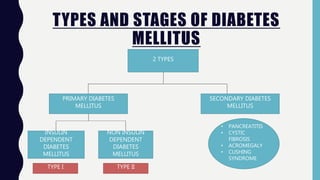
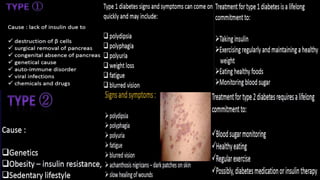
PRIMARY DIABETES
MELLITUS
2 TYPES
SECONDARY DIABETES
MELLITUS
INSULIN
DEPENDENT
DIABETES
MELLITUS
NON INSULIN
DEPENDENT
DIABETES
MELLITUS
• PANCREATITIS
• CYSTIC
FIBROSIS
• ACROMEGALY
• CUSHING
SYNDROME
TYPE I TYPE II
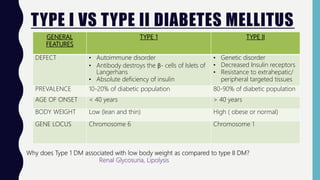
TYPE I VS TYPE II DIABETES MELLITUS
GENERAL
FEATURES
TYPE 1 TYPE II
DEFECT • Autoimmune disorder
• Antibody destroys the β- cells of Islets of
Langerhans
• Absolute deficiency of insulin
• Genetic disorder
• Decreased Insulin receptors
• Resistance to extrahepatic/
peripheral targeted tissues
PREVALENCE 10-20% of diabetic population 80-90% of diabetic population
AGE OF ONSET < 40 years > 40 years
BODY WEIGHT Low (lean and thin) High ( obese or normal)
GENE LOCUS Chromosome 6 Chromosome 1
• Why does Type 1 DM associated with low body weight as compared to type II DM?
Renal Glycosuria, Lipolysis
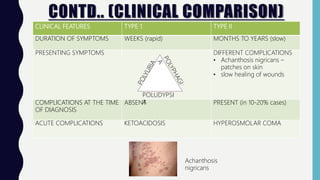
CONTD.. (CLINICAL COMPARISON)
CLINICAL FEATURES TYPE 1 TYPE II
DURATION OF SYMPTOMS WEEKS (rapid) MONTHS TO YEARS (slow)
PRESENTING SYMPTOMS DIFFERENT COMPLICATIONS
• Achanthosis nigricans –
patches on skin
• slow healing of wounds
COMPLICATIONS AT THE TIME
OF DIAGNOSIS
ABSENT PRESENT (in 10-20% cases)
ACUTE COMPLICATIONS KETOACIDOSIS HYPEROSMOLAR COMA
POLUDYPSI
A
Achanthosis
nigricans
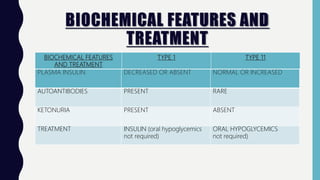
BIOCHEMICAL FEATURES AND
TREATMENT
BIOCHEMICAL FEATURES
AND TREATMENT
TYPE 1 TYPE 11
PLASMA INSULIN DECREASED OR ABSENT NORMAL OR INCREASED
AUTOANTIBODIES PRESENT RARE
KETONURIA PRESENT ABSENT
TREATMENT INSULIN (oral hypoglycemics
not required)
ORAL HYPOGLYCEMICS
not required)
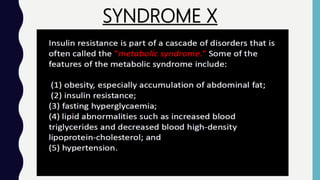
SYNDROME X
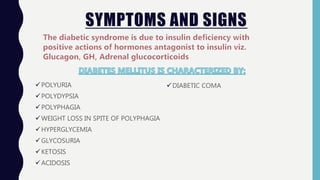
SYMPTOMS AND SIGNS
POLYURIA
POLYDYPSIA
POLYPHAGIA
WEIGHT LOSS IN SPITE OF POLYPHAGIA
HYPERGLYCEMIA
GLYCOSURIA
KETOSIS
ACIDOSIS
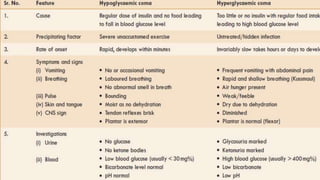
DIABETIC COMA
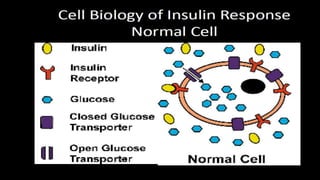
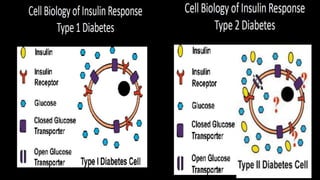
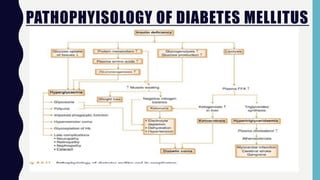
PATHOPHYISOLOGY OF DIABETES MELLITUS
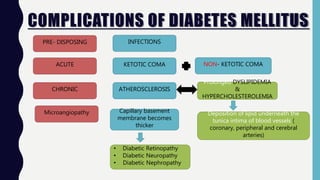
COMPLICATIONS OF DIABETES MELLITUS
INFECTIONS
NON- KETOTIC COMAACUTE KETOTIC COMA
ATHEROSCLEROSISCHRONIC
PRE- DISPOSING
Prolonged DYSLIPIDEMIA
&
HYPERCHOLESTEROLEMIA
Deposition of lipid underneath the
tunica intima of blood vessels (
coronary, peripheral and cerebral
arteries)
Microangiopathy Capillary basement
membrane becomes
thicker
• Diabetic Retinopathy
• Diabetic Neuropathy
• Diabetic Nephropathy
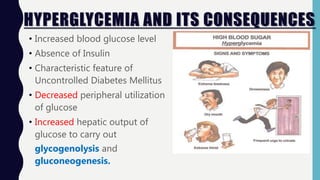
HYPERGLYCEMIA AND ITS CONSEQUENCES
• Increased blood glucose level
• Absence of Insulin
• Characteristic feature of
Uncontrolled Diabetes Mellitus
• Decreased peripheral utilization
of glucose
• Increased hepatic output of
glucose to carry out
glycogenolysis and
gluconeogenesis.
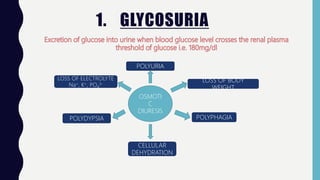
1. GLYCOSURIA
OSMOTI
C
DIURESIS
POLYURIA
POLYDYPSIA
LOSS OF ELECTROLYTE
Na+, K+, PO4
3-
LOSS OF BODY
WEIGHT
POLYPHAGIA
CELLULAR
DEHYDRATION
2. IMPAIRED PHAGOCYTOSIS
Hyperglycaemia impairs
all aspects of leucocytic phagocytic function, i.e.
adherence,
diapedesis, phagocytosis and intracellular killing.
Because of
impaired phagocytic function, the diabetics are more
prone
to infections as compared to the non-diabetics.
3. GLYCOSYLATION OF PROTEINS
Glycosylation of tissue proteins
Occurs when the blood glucose levels
remain elevated for a prolonged duration
(years). Glycosylation leads to irreversible
changes in the chemical structure of tissue
proteins. These chemical changes have
been implicated in producing long-term
complications of diabetes mellitus, such as:
• Diabetic nephropathy,
• Diabetic retinopathy,
• Diabetic neuropathy and so on.
Glycosylation of haemoglobin.
Glycosylated haemoglobin refers to the
glucose-derived products of normal
hemoglobin(HbA).
• Among the glycosylated hemoglobins, the
most abundant form is HbA1C, which is
produced by condensation of glucose with N-
terminal valine of each β chain of hemoglobin
A (HbA).
• Normally, HbA1C concentration is about 3–
5% of the
total haemoglobin.
• During sustained hyperglycemia, as in
diabetes mellitus, the concentration of
HbA1C may be elevated to 10–20% of the
total hemoglobin.
• Determination of HbA1C has become an
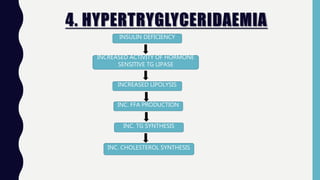
4. HYPERTRYGLYCERIDAEMIA
INSULIN DEFICIENCY
INCREASED ACTIVITY OF HORMONE
SENSITIVE TG LIPASE
INC. FFA PRODUCTION
INCREASED LIPOLYSIS
INC. TG SYNTHESIS
INC. CHOLESTEROL SYNTHESIS
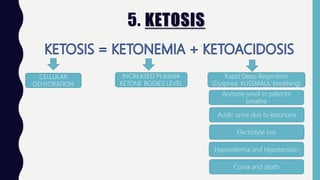
5. KETOSIS
INCREASED PLASMA
KETONE BODIES LEVEL
CELLULAR
DEHYDRATION
Rapid Deep Respiration
(Dyspnea, KUSSMAUL breathing)
Electrolyte loss
Acidic urine due to ketonuria
Acetone smell in patient’s
breathe
Coma and death
Hypovolemia and Hypotension
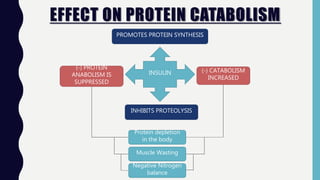
EFFECT ON PROTEIN CATABOLISM
INSULIN
PROMOTES PROTEIN SYNTHESIS
INHIBITS PROTEOLYSIS
(-) PROTEIN
ANABOLISM IS
SUPPRESSED
(-) CATABOLISM
INCREASED
Protein depletion
in the body
Muscle Wasting
Negative Nitrogen
balance
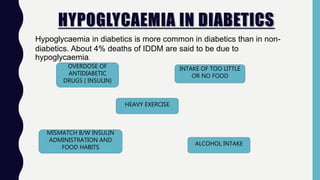
HYPOGLYCAEMIA IN DIABETICS
Hypoglycaemia in diabetics is more common in diabetics than in non-
diabetics. About 4% deaths of IDDM are said to be due to
hypoglycaemia.
OVERDOSE OF
ANTIDIABETIC
DRUGS ( INSULIN)
MISMATCH B/W INSULIN
ADMINISTRATION AND
FOOD HABITS
HEAVY EXERCISE
ALCOHOL INTAKE
INTAKE OF TOO LITTLE
OR NO FOOD
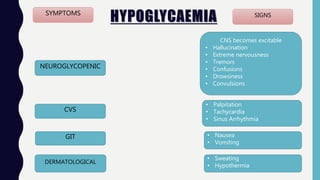
HYPOGLYCAEMIA
NEUROGLYCOPENIC
DERMATOLOGICAL
GIT
CVS
• Palpitation
• Tachycardia
• Sinus Arrhythmia
SIGNS
• Nausea
• Vomiting
• Sweating
• Hypothermia
CNS becomes excitable
• Hallucination
• Extreme nervousness
• Tremors
• Confusions
• Drowsiness
• Convulsions
SYMPTOMS
Diabetes mellitus
Diabetes mellitus

Diabetes mellitus

  • 1.
    DIABETES MELLITUS S A RA N A D G I R I
  • 2.
  • 3.
    BRIEF INTRODUCTION A metabolicdisorder of Multiple aetiology characterized by chronic hyperglycemia with disturbances of carbohydrate, fat and protein metabolism resulting from defects in Insulin secretion, insulin action or both.
  • 4.
    PREDISPOSING FACTORS 1.Heredity isthe most common predisposing factor. 2.Obesity, where adipose tissues are more resistant to actions of insulin as compared to normal (non- obese).
  • 5.
    TYPES AND STAGESOF DIABETES MELLITUS PRIMARY DIABETES MELLITUS 2 TYPES SECONDARY DIABETES MELLITUS INSULIN DEPENDENT DIABETES MELLITUS NON INSULIN DEPENDENT DIABETES MELLITUS • PANCREATITIS • CYSTIC FIBROSIS • ACROMEGALY • CUSHING SYNDROME TYPE I TYPE II
  • 7.
    TYPE I VSTYPE II DIABETES MELLITUS GENERAL FEATURES TYPE 1 TYPE II DEFECT • Autoimmune disorder • Antibody destroys the β- cells of Islets of Langerhans • Absolute deficiency of insulin • Genetic disorder • Decreased Insulin receptors • Resistance to extrahepatic/ peripheral targeted tissues PREVALENCE 10-20% of diabetic population 80-90% of diabetic population AGE OF ONSET < 40 years > 40 years BODY WEIGHT Low (lean and thin) High ( obese or normal) GENE LOCUS Chromosome 6 Chromosome 1 • Why does Type 1 DM associated with low body weight as compared to type II DM? Renal Glycosuria, Lipolysis
  • 8.
    CONTD.. (CLINICAL COMPARISON) CLINICALFEATURES TYPE 1 TYPE II DURATION OF SYMPTOMS WEEKS (rapid) MONTHS TO YEARS (slow) PRESENTING SYMPTOMS DIFFERENT COMPLICATIONS • Achanthosis nigricans – patches on skin • slow healing of wounds COMPLICATIONS AT THE TIME OF DIAGNOSIS ABSENT PRESENT (in 10-20% cases) ACUTE COMPLICATIONS KETOACIDOSIS HYPEROSMOLAR COMA POLUDYPSI A Achanthosis nigricans
  • 9.
    BIOCHEMICAL FEATURES AND TREATMENT BIOCHEMICALFEATURES AND TREATMENT TYPE 1 TYPE 11 PLASMA INSULIN DECREASED OR ABSENT NORMAL OR INCREASED AUTOANTIBODIES PRESENT RARE KETONURIA PRESENT ABSENT TREATMENT INSULIN (oral hypoglycemics not required) ORAL HYPOGLYCEMICS not required)
  • 12.
  • 13.
    SYMPTOMS AND SIGNS POLYURIA POLYDYPSIA POLYPHAGIA WEIGHTLOSS IN SPITE OF POLYPHAGIA HYPERGLYCEMIA GLYCOSURIA KETOSIS ACIDOSIS DIABETIC COMA
  • 14.
  • 15.
    COMPLICATIONS OF DIABETESMELLITUS INFECTIONS NON- KETOTIC COMAACUTE KETOTIC COMA ATHEROSCLEROSISCHRONIC PRE- DISPOSING Prolonged DYSLIPIDEMIA & HYPERCHOLESTEROLEMIA Deposition of lipid underneath the tunica intima of blood vessels ( coronary, peripheral and cerebral arteries) Microangiopathy Capillary basement membrane becomes thicker • Diabetic Retinopathy • Diabetic Neuropathy • Diabetic Nephropathy
  • 16.
    HYPERGLYCEMIA AND ITSCONSEQUENCES • Increased blood glucose level • Absence of Insulin • Characteristic feature of Uncontrolled Diabetes Mellitus • Decreased peripheral utilization of glucose • Increased hepatic output of glucose to carry out glycogenolysis and gluconeogenesis.
  • 17.
    1. GLYCOSURIA OSMOTI C DIURESIS POLYURIA POLYDYPSIA LOSS OFELECTROLYTE Na+, K+, PO4 3- LOSS OF BODY WEIGHT POLYPHAGIA CELLULAR DEHYDRATION
  • 18.
    2. IMPAIRED PHAGOCYTOSIS Hyperglycaemiaimpairs all aspects of leucocytic phagocytic function, i.e. adherence, diapedesis, phagocytosis and intracellular killing. Because of impaired phagocytic function, the diabetics are more prone to infections as compared to the non-diabetics.
  • 19.
    3. GLYCOSYLATION OFPROTEINS Glycosylation of tissue proteins Occurs when the blood glucose levels remain elevated for a prolonged duration (years). Glycosylation leads to irreversible changes in the chemical structure of tissue proteins. These chemical changes have been implicated in producing long-term complications of diabetes mellitus, such as: • Diabetic nephropathy, • Diabetic retinopathy, • Diabetic neuropathy and so on. Glycosylation of haemoglobin. Glycosylated haemoglobin refers to the glucose-derived products of normal hemoglobin(HbA). • Among the glycosylated hemoglobins, the most abundant form is HbA1C, which is produced by condensation of glucose with N- terminal valine of each β chain of hemoglobin A (HbA). • Normally, HbA1C concentration is about 3– 5% of the total haemoglobin. • During sustained hyperglycemia, as in diabetes mellitus, the concentration of HbA1C may be elevated to 10–20% of the total hemoglobin. • Determination of HbA1C has become an
  • 20.
    4. HYPERTRYGLYCERIDAEMIA INSULIN DEFICIENCY INCREASEDACTIVITY OF HORMONE SENSITIVE TG LIPASE INC. FFA PRODUCTION INCREASED LIPOLYSIS INC. TG SYNTHESIS INC. CHOLESTEROL SYNTHESIS
  • 21.
    5. KETOSIS INCREASED PLASMA KETONEBODIES LEVEL CELLULAR DEHYDRATION Rapid Deep Respiration (Dyspnea, KUSSMAUL breathing) Electrolyte loss Acidic urine due to ketonuria Acetone smell in patient’s breathe Coma and death Hypovolemia and Hypotension
  • 22.
    EFFECT ON PROTEINCATABOLISM INSULIN PROMOTES PROTEIN SYNTHESIS INHIBITS PROTEOLYSIS (-) PROTEIN ANABOLISM IS SUPPRESSED (-) CATABOLISM INCREASED Protein depletion in the body Muscle Wasting Negative Nitrogen balance
  • 23.
    HYPOGLYCAEMIA IN DIABETICS Hypoglycaemiain diabetics is more common in diabetics than in non- diabetics. About 4% deaths of IDDM are said to be due to hypoglycaemia. OVERDOSE OF ANTIDIABETIC DRUGS ( INSULIN) MISMATCH B/W INSULIN ADMINISTRATION AND FOOD HABITS HEAVY EXERCISE ALCOHOL INTAKE INTAKE OF TOO LITTLE OR NO FOOD
  • 24.
    HYPOGLYCAEMIA NEUROGLYCOPENIC DERMATOLOGICAL GIT CVS • Palpitation • Tachycardia •Sinus Arrhythmia SIGNS • Nausea • Vomiting • Sweating • Hypothermia CNS becomes excitable • Hallucination • Extreme nervousness • Tremors • Confusions • Drowsiness • Convulsions SYMPTOMS