E-Governance in the offices of Director
General for Foreign Trade (DGFT)
NALIN ADHIKARI
BSc. CSIT
nalin.com.np
Contents
• Introduction
• Role of DGFT
• Major Objectives of Computerization
• Computerization – 1st Phase
• Computerization – 2nd Phase
• Objectives of Computerization
• DGFT Functions
• Official Site
• References
E-GOV | DGFT
Slide No. 2
Introduction
• DGFT is an office under the Ministry of Commerce in India
• a key player in promoting of Foreign Trade
• Recently, especially, in it’s port offices, computerization was
introduced with the help of NIC
• this started e-governance, including digital signature
[ NIC : National Informatics Center]
E-GOV | DGFT
Slide No. 3
Introduction (cont…)
• The EXIM Policy used computerization process
• to reduce the physical interface
• bring in transparency in various activities related to exports and EDI
• ensure clearance of electronically received applications within 24 hours
[ EXIM : Export-Import Policy (of Government of India)]
[ EDI : Electronic Data Interchange ]
E-GOV | DGFT
Slide No. 4
Role of DGFT
(in Implementation of EXIM Policy)
• The Government of India may appoint any person as Director
General of Foreign Trade
• for the purpose of Foreign Trade Development and Regulation (FTDR)
• The Director General
• advice the Central Government in the formulation of export and import
policy
• responsible for carrying out that policy
• Principle objectives is to promote trade in goods and services
E-GOV | DGFT
Slide No. 5
Major Objectives of Computerization
• Reduce physical interface (through Electronic Transactions)
• Monitor and control (both online)
• Reduce paper work
• Increase the speed of transactions, make them transparent and
secure
• Develop Integrated Database to help the decision makers
• Assist in policy making and evaluation
• Assist exporters to reduce transaction time and costs and
eliminate intermediaries
E-GOV | DGFT
Slide No. 6
Computerization – 1st Phase
• A comprehensive software package was developed
• To computerize
• Receipt
• Issue Counter
• Importer Exporter Code Section
• Advance Licensing
• Export Promotion Capital Goods Scheme (EPCGS)
• Duty Exemption Pass Book (DEPB)
• System Used
• Pentium system with Unix OS with Printers and Terminals
• Unix RDBMS was provided and later Oracle 7.3 was also provided
E-GOV | DGFT
Slide No. 7
Computerization – 2nd Phase
• A web enabled LEMIS (Licensing, e-Commerce, Monitoring,
Information System) was implemented
• System used
• Windows NT 4.0/DB2 UDB 5.0/JDK 1.1.5
• LAN (established by NIC)
• Powerful database servers
• Ink jet/laser printers
• UPS in all port offices
E-GOV | DGFT
Slide No. 8
Objectives of Computerization
• E-filing of applications and E-commerce
• Exporters can file application electronically
• The application gets processed in local DGFT office and license is issued
• DGFT has enabled digital signature
• Exporter can access and print license at his end
• Electronic approval of licensing authority
• LEMIS software has developed
• The authorized person can access to the application through his computer
and printing of license by clicking approval button
E-GOV | DGFT
Slide No. 9
Objectives of Computerization (cont…)
• Importer-Exporter Code (IEC) and Binary Identification Number (BIN)
• Every exporter has to obtain IEC number and BIN for import/export any items
• Getting information for IECs registered other ports
• If branch office is located in the jurisdiction of local DGFT and has applied for a
license for a particular scheme then local DGFT office has to download IEC
details registered
• Licensing information at the disposal of DGFT
• DGFT server, gets details of license issued at various port offices in the country
through NICNET for further statistical analysis and dissemination
E-GOV | DGFT
Slide No. 10
DGFT Functions
• Implementation of EIM Policy objectives
• Item wise EXIM Policy notification
• Interpretation of Policy
• Specify Procedures
• Principles of Restriction
• DGFT may enforce any measure necessary for protection of public morals,
human/animal/plant life/health, trademarks and copyright
• To refuse granting or renewing a license/certificate/permission
E-GOV | DGFT
Slide No. 11
DGFT Functions (cont…)
• Export obligation monitoring
• Granting to exclusive or special privileges granting to State
Training Enterprise(s)
• Granting IEC (Importer-Exporter Code) number
• To promote Trade with neighboring countries
• Permitting Transit facility
• Permission for free exports
E-GOV | DGFT
Slide No. 12
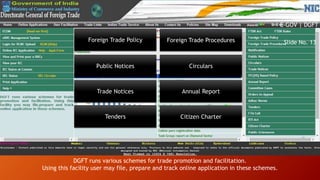
Official Site
( Government of India
Ministry of Commerce and Industry
Directorate General of Foreign Trade )
DGFT runs various schemes for trade promotion and facilitation.
Using this facility user may file, prepare and track online application in these schemes.
E-GOV | DGFT
Slide No. 13Foreign Trade Policy Foreign Trade Procedures
Public Notices Circulars
Trade Notices Annual Report
Tenders Citizen Charter
References
• C.S.R. Prabhu, E-Governance Concept and Case Studies, Second
Edition, February 2012
• http://dgft.gov.in/
E-GOV | DGFT
Slide No. 14
Thank you !

E-Governance in the offices of Director General for Foreign Trade (DGFT)

  • 1.
    E-Governance in theoffices of Director General for Foreign Trade (DGFT) NALIN ADHIKARI BSc. CSIT nalin.com.np
  • 2.
    Contents • Introduction • Roleof DGFT • Major Objectives of Computerization • Computerization – 1st Phase • Computerization – 2nd Phase • Objectives of Computerization • DGFT Functions • Official Site • References E-GOV | DGFT Slide No. 2
  • 3.
    Introduction • DGFT isan office under the Ministry of Commerce in India • a key player in promoting of Foreign Trade • Recently, especially, in it’s port offices, computerization was introduced with the help of NIC • this started e-governance, including digital signature [ NIC : National Informatics Center] E-GOV | DGFT Slide No. 3
  • 4.
    Introduction (cont…) • TheEXIM Policy used computerization process • to reduce the physical interface • bring in transparency in various activities related to exports and EDI • ensure clearance of electronically received applications within 24 hours [ EXIM : Export-Import Policy (of Government of India)] [ EDI : Electronic Data Interchange ] E-GOV | DGFT Slide No. 4
  • 5.
    Role of DGFT (inImplementation of EXIM Policy) • The Government of India may appoint any person as Director General of Foreign Trade • for the purpose of Foreign Trade Development and Regulation (FTDR) • The Director General • advice the Central Government in the formulation of export and import policy • responsible for carrying out that policy • Principle objectives is to promote trade in goods and services E-GOV | DGFT Slide No. 5
  • 6.
    Major Objectives ofComputerization • Reduce physical interface (through Electronic Transactions) • Monitor and control (both online) • Reduce paper work • Increase the speed of transactions, make them transparent and secure • Develop Integrated Database to help the decision makers • Assist in policy making and evaluation • Assist exporters to reduce transaction time and costs and eliminate intermediaries E-GOV | DGFT Slide No. 6
  • 7.
    Computerization – 1stPhase • A comprehensive software package was developed • To computerize • Receipt • Issue Counter • Importer Exporter Code Section • Advance Licensing • Export Promotion Capital Goods Scheme (EPCGS) • Duty Exemption Pass Book (DEPB) • System Used • Pentium system with Unix OS with Printers and Terminals • Unix RDBMS was provided and later Oracle 7.3 was also provided E-GOV | DGFT Slide No. 7
  • 8.
    Computerization – 2ndPhase • A web enabled LEMIS (Licensing, e-Commerce, Monitoring, Information System) was implemented • System used • Windows NT 4.0/DB2 UDB 5.0/JDK 1.1.5 • LAN (established by NIC) • Powerful database servers • Ink jet/laser printers • UPS in all port offices E-GOV | DGFT Slide No. 8
  • 9.
    Objectives of Computerization •E-filing of applications and E-commerce • Exporters can file application electronically • The application gets processed in local DGFT office and license is issued • DGFT has enabled digital signature • Exporter can access and print license at his end • Electronic approval of licensing authority • LEMIS software has developed • The authorized person can access to the application through his computer and printing of license by clicking approval button E-GOV | DGFT Slide No. 9
  • 10.
    Objectives of Computerization(cont…) • Importer-Exporter Code (IEC) and Binary Identification Number (BIN) • Every exporter has to obtain IEC number and BIN for import/export any items • Getting information for IECs registered other ports • If branch office is located in the jurisdiction of local DGFT and has applied for a license for a particular scheme then local DGFT office has to download IEC details registered • Licensing information at the disposal of DGFT • DGFT server, gets details of license issued at various port offices in the country through NICNET for further statistical analysis and dissemination E-GOV | DGFT Slide No. 10
  • 11.
    DGFT Functions • Implementationof EIM Policy objectives • Item wise EXIM Policy notification • Interpretation of Policy • Specify Procedures • Principles of Restriction • DGFT may enforce any measure necessary for protection of public morals, human/animal/plant life/health, trademarks and copyright • To refuse granting or renewing a license/certificate/permission E-GOV | DGFT Slide No. 11
  • 12.
    DGFT Functions (cont…) •Export obligation monitoring • Granting to exclusive or special privileges granting to State Training Enterprise(s) • Granting IEC (Importer-Exporter Code) number • To promote Trade with neighboring countries • Permitting Transit facility • Permission for free exports E-GOV | DGFT Slide No. 12
  • 13.
    Official Site ( Governmentof India Ministry of Commerce and Industry Directorate General of Foreign Trade ) DGFT runs various schemes for trade promotion and facilitation. Using this facility user may file, prepare and track online application in these schemes. E-GOV | DGFT Slide No. 13Foreign Trade Policy Foreign Trade Procedures Public Notices Circulars Trade Notices Annual Report Tenders Citizen Charter
  • 14.
    References • C.S.R. Prabhu,E-Governance Concept and Case Studies, Second Edition, February 2012 • http://dgft.gov.in/ E-GOV | DGFT Slide No. 14
  • 15.

Editor's Notes

  • #8 Comprehensive : including or dealing with all or nearly all elements or aspects of something
  • #11 Jurisdiction : geographical area or subject-matter to which government/political authority applies