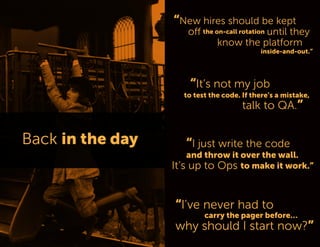
“New hires should be kept off the on-call rotation until they 
know the platform 
inside-and-out.” 
“I just write the code 
and throw it over the wall. 
It’s up to Ops to make it work.” 
“It’s not my job 
to test the code. If there’s a mistake, 
talk to QA.” 
“I’ve never had to 
carry the pager before… 
why should I start now?”
Ideally, companies work out a system in which whoever makes the mistake pays the price. The reason Ops is so often scared of Dev deploying is that Dev doesn't really care how secure their apps are, how hard they are to deploy, how hard they are to keep running or how many times you have to restart it, because Ops pays the price for those mistakes, not Dev. 
In most organizations the mandate of a developer is merely to produce a piece of software that worked on a workstation -- if it worked on your workstation and you can't make it work in production, it's Operations' fault if they can't get that to thousands of machines all around the world. 
http://readwrite.com/2011/08/23/devops-what-it-is-why-it-exist
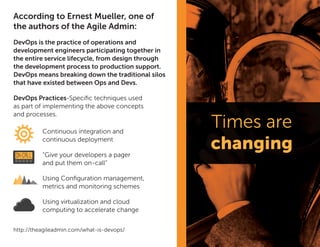
According to Ernest Mueller, one of 
the authors of the Agile Admin: 
DevOps is the practice of operations and development engineers participating together in the entire service lifecycle, from design through the development process to production support. DevOps means breaking down the traditional silos that have existed between Ops and Devs. 
DevOps Practices-Specific techniques used 
as part of implementing the above concepts 
and processes. 
Continuous integration and 
continuous deployment 
“Give your developers a pager 
and put them on-call” 
Using Configuration management, 
metrics and monitoring schemes 
Using virtualization and cloud 
computing to accelerate change 
http://theagileadmin.com/what-is-devops/
Devs can win instant good will by helping to carry one of Ops’ biggest burdens: the pager. Developers tend to bring more craftsmanship into their work knowing that they, or their pals, might suffer the consequences of half-baked code. Being waist-deep in the immediate resolution and accompanying troubleshooting efforts also provides a valuable perspective on how the application’s architecture interacts with the infrastructure it sits on. 
Clearly define (and yes: document) escalation paths for emergencies and make sure devs have access to the tools and data they’ll need for troubleshooting. Then include the development team in on-call rotation. 
https://www.atlassian.com/devops/culture#!shared-responsibilities
http://www.slideshare.net/mrtazz/goto-amsterdam2014depolyment1024 
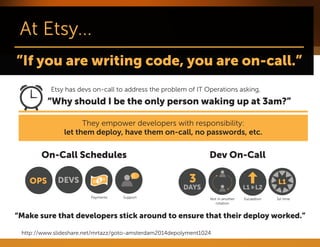
Etsy has devs on-call to address the problem of IT Operations asking, 
“Why should I be the only person waking up at 3am?” 
They empower developers with responsibility: 
let them deploy, have them on-call, no passwords, etc. 
Payments 
SupportEscalationNot in another rotation1st time 
On-Call Schedules 
PaymentsSupportEscalationNot in another rotation1st time 
Dev On-Call 
“Make sure that developers stick around to ensure that their deploy worked.”
What if you’re not Etsy and you want to get buy-in from your devs… is there a way to make it easier for devs to be included in the on-call process? 
Read on to see how these 4 companies did it…
Production systems used to be a black box to most people on our team. 
Only a few developers had any insight whatsoever. 
Now that the entire team is on-call (be it in a very flexible way), our front-end devs are really excited when an alert goes off because they want to be the first one to ack it. 
And it is making our devs better devs because they have a holistic view of our system. 
I’ve built on-call systems myself before, and I’m a firm believer in the developers being on-call. A lot of companies aren’t big enough to have dedicated on-call teams of 10 
or 20 people, and devs are smart and very capable of doing the work. 
Bunchball is an agile development shop, so all teams are self-managed. The trick 
was convincing everyone that putting devs on-call was the right idea. 
Our devs now have an understanding of how the system functions on a day-to-day basis. It feels like everyone is more engaged in the ongoing success of our product. 
Nick Goodman, 
Director of Platform Engineering, Bunchball
Before our developers were on-call, I usually had to deal 
with their deploy that they broke on a Friday night. 
Now each of our 13 applications has 2 people in rotation for 
on-call–and one of those is always a dev. It has created a completely different mindset for our dev team. Now that they know they can be woken up at 4 in the morning, they deploy when they know they can be available to fix things. 
There are fewer production issues now that our devs fully understand what it means to push to production. 
Michael D’Auria, 
Infrastructure Lead at CrowdTap
Most of our devs come from writing desktop applications. We wanted to get them into our on-call rotation so they have that shift in mindset to a more holistic view. There was trepidation and a little bit of grumpiness at first because they’ve never done it before. 
Now, we have a paired on-call rotation with our techops and dev team. Each can manage their on-call schedules independently, and each person can manage their notification policies independently. 
If the first tier people don’t respond to alerts in a certain amount of time, it defaults to a secondary. Then the third tier is me, and the fourth tier is management. 
Paul Beltrani, 
TechOps at Onshape
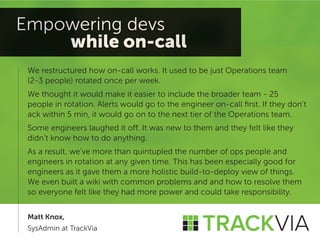
We restructured how on-call works. It used to be just Operations team 
(2-3 people) rotated once per week. 
We thought it would make it easier to include the broader team - 25 
people in rotation. Alerts would go to the engineer on-call first. If they don’t ack within 5 min, it would go on to the next tier of the Operations team. 
Some engineers laughed it off. It was new to them and they felt like they didn’t know how to do anything. 
As a result, we’ve more than quintupled the number of ops people and engineers in rotation at any given time. This has been especially good for engineers as it gave them a more holistic build-to-deploy view of things. 
We even built a wiki with common problems and and how to resolve them so everyone felt like they had more power and could take responsibility. 
Matt Knox, 
SysAdmin at TrackVia
http://victorops.com/blog/onshape-case-study/ 
http://victorops.com/blog/bunchball-case-study/ 
http://victorops.com/blog/trackvia-case-study-victorops-improved-ttr/ 
http://www.confreaks.com/videos/2358-mwrc2013-you-should-be-on-call-too 
http://www.javacodegeeks.com/2014/01/developers-working-in- 
production-of-course-maybe-sometimes-what-are-younuts.html 
http://www.thoughtworks.com/insights/blog/n%C3%A3o-existe-equipe-de-devops 
http://www.paperplanes.de/2013/1/2/on-pager-duty.html

Putting Devs On-Call: How to Empower Your Team

  • 2.
    “New hires shouldbe kept off the on-call rotation until they know the platform inside-and-out.” “I just write the code and throw it over the wall. It’s up to Ops to make it work.” “It’s not my job to test the code. If there’s a mistake, talk to QA.” “I’ve never had to carry the pager before… why should I start now?”
  • 3.
    Ideally, companies workout a system in which whoever makes the mistake pays the price. The reason Ops is so often scared of Dev deploying is that Dev doesn't really care how secure their apps are, how hard they are to deploy, how hard they are to keep running or how many times you have to restart it, because Ops pays the price for those mistakes, not Dev. In most organizations the mandate of a developer is merely to produce a piece of software that worked on a workstation -- if it worked on your workstation and you can't make it work in production, it's Operations' fault if they can't get that to thousands of machines all around the world. http://readwrite.com/2011/08/23/devops-what-it-is-why-it-exist
  • 4.
    According to ErnestMueller, one of the authors of the Agile Admin: DevOps is the practice of operations and development engineers participating together in the entire service lifecycle, from design through the development process to production support. DevOps means breaking down the traditional silos that have existed between Ops and Devs. DevOps Practices-Specific techniques used as part of implementing the above concepts and processes. Continuous integration and continuous deployment “Give your developers a pager and put them on-call” Using Configuration management, metrics and monitoring schemes Using virtualization and cloud computing to accelerate change http://theagileadmin.com/what-is-devops/
  • 5.
    Devs can wininstant good will by helping to carry one of Ops’ biggest burdens: the pager. Developers tend to bring more craftsmanship into their work knowing that they, or their pals, might suffer the consequences of half-baked code. Being waist-deep in the immediate resolution and accompanying troubleshooting efforts also provides a valuable perspective on how the application’s architecture interacts with the infrastructure it sits on. Clearly define (and yes: document) escalation paths for emergencies and make sure devs have access to the tools and data they’ll need for troubleshooting. Then include the development team in on-call rotation. https://www.atlassian.com/devops/culture#!shared-responsibilities
  • 6.
    http://www.slideshare.net/mrtazz/goto-amsterdam2014depolyment1024 Etsy hasdevs on-call to address the problem of IT Operations asking, “Why should I be the only person waking up at 3am?” They empower developers with responsibility: let them deploy, have them on-call, no passwords, etc. Payments SupportEscalationNot in another rotation1st time On-Call Schedules PaymentsSupportEscalationNot in another rotation1st time Dev On-Call “Make sure that developers stick around to ensure that their deploy worked.”
  • 7.
    What if you’renot Etsy and you want to get buy-in from your devs… is there a way to make it easier for devs to be included in the on-call process? Read on to see how these 4 companies did it…
  • 8.
    Production systems usedto be a black box to most people on our team. Only a few developers had any insight whatsoever. Now that the entire team is on-call (be it in a very flexible way), our front-end devs are really excited when an alert goes off because they want to be the first one to ack it. And it is making our devs better devs because they have a holistic view of our system. I’ve built on-call systems myself before, and I’m a firm believer in the developers being on-call. A lot of companies aren’t big enough to have dedicated on-call teams of 10 or 20 people, and devs are smart and very capable of doing the work. Bunchball is an agile development shop, so all teams are self-managed. The trick was convincing everyone that putting devs on-call was the right idea. Our devs now have an understanding of how the system functions on a day-to-day basis. It feels like everyone is more engaged in the ongoing success of our product. Nick Goodman, Director of Platform Engineering, Bunchball
  • 9.
    Before our developerswere on-call, I usually had to deal with their deploy that they broke on a Friday night. Now each of our 13 applications has 2 people in rotation for on-call–and one of those is always a dev. It has created a completely different mindset for our dev team. Now that they know they can be woken up at 4 in the morning, they deploy when they know they can be available to fix things. There are fewer production issues now that our devs fully understand what it means to push to production. Michael D’Auria, Infrastructure Lead at CrowdTap
  • 10.
    Most of ourdevs come from writing desktop applications. We wanted to get them into our on-call rotation so they have that shift in mindset to a more holistic view. There was trepidation and a little bit of grumpiness at first because they’ve never done it before. Now, we have a paired on-call rotation with our techops and dev team. Each can manage their on-call schedules independently, and each person can manage their notification policies independently. If the first tier people don’t respond to alerts in a certain amount of time, it defaults to a secondary. Then the third tier is me, and the fourth tier is management. Paul Beltrani, TechOps at Onshape
  • 11.
    We restructured howon-call works. It used to be just Operations team (2-3 people) rotated once per week. We thought it would make it easier to include the broader team - 25 people in rotation. Alerts would go to the engineer on-call first. If they don’t ack within 5 min, it would go on to the next tier of the Operations team. Some engineers laughed it off. It was new to them and they felt like they didn’t know how to do anything. As a result, we’ve more than quintupled the number of ops people and engineers in rotation at any given time. This has been especially good for engineers as it gave them a more holistic build-to-deploy view of things. We even built a wiki with common problems and and how to resolve them so everyone felt like they had more power and could take responsibility. Matt Knox, SysAdmin at TrackVia
  • 12.
    http://victorops.com/blog/onshape-case-study/ http://victorops.com/blog/bunchball-case-study/ http://victorops.com/blog/trackvia-case-study-victorops-improved-ttr/ http://www.confreaks.com/videos/2358-mwrc2013-you-should-be-on-call-too http://www.javacodegeeks.com/2014/01/developers-working-in- production-of-course-maybe-sometimes-what-are-younuts.html http://www.thoughtworks.com/insights/blog/n%C3%A3o-existe-equipe-de-devops http://www.paperplanes.de/2013/1/2/on-pager-duty.html