DEVELOPMENTS IN ONLINE
LANGUAGE LEARNING
BY NICKY HOCKLY
MEHRNAZ DARBAN
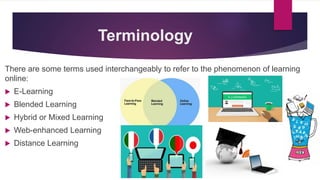
Terminology
There are some terms used interchangeably to refer to the phenomenon of learning
online:
 E-Learning
 Blended Learning
 Hybrid or Mixed Learning
 Web-enhanced Learning
 Distance Learning
Definition
 E-learning : A learning system based on formalized teaching but with the help of electronic
resources.
 Blended learning is the term used to describe the instructional method that involves both face-
to-face classroom style instruction as well as the use of online methods. It is also called hybrid
learning or mixed-mode learning.
 A Web Enhanced Learning Environment is an educational setting where online educational
tools are used to enhance what is taught in a traditional classroom situation.
 Distance education or distance learning is the education of students who may not always be
physically present at a school.
Aim of study
To distinguish between “blended learning”(that is, language
learning that includes both face-to-face and online learning
experiences),
and fully “online learning”(that is, language learning that takes
place 100 per cent online).
Research areas in online
language learning
(White,2006) highlighted the ‘evident shifts from a concern with
structural and organizational issues to a focus on transactional
issues associated with teaching/learning opportunities within
emerging models for distance language learning’.
She identified four key ‘pedagogical’
themes that emerged from research:
1. Course Development
2. Course Evaluation
3. Teaching Roles
4. Learner Support
In addition, White reviewed research into the technologies used to
deliver online language learning and into ‘learner contributions’, that is,
what distance learners bring to the online learning experience .
 Lamy (2014) reviews more recent research studies in online and
blended language learning (what she refers to as ‘DCALL’:
Distance Computer Assisted Language Learning).
 Lamy pointed out that the effects of multimodality (the different
‘modes’ used for meaning-making in digital communication, for
example via audio, visual, linguistic, or textual means) have been
explored in online language learning research within the last ten
years.
The rise of online learning
 Online learning via networked computers has been available since
the early 1990s, according with increased access to hardware and
to the internet.
 A meta-study published in 2010 (Means, Yoyama, Murphy, Bakia,
and Jones), found that a blended approach was most effective in
terms of improved learning outcomes.
The rise of online learning
 The discussion (and research) has afterward moved away from the
direct comparison between face-to-face and online versions of a
course—what Blake (2009) calls ‘the wrong research question’—
towards research into the specific affordances of online (and blended)
learning in specific contexts, in other words, how to make online
learning courses more effective.
The rise of online learning
 Another factor that has helped online learning become mainstream
is ‘the economic imperative’.
(many institutions viewed online courses as the ‘cheap option’, in
which large numbers of students can be exposed to the same content
with minimal teacher support, and little or no investment in teacher
training. )
Formats for learning language
online
 Frequently offered by schools or universities.
 Students are likely to be formally assessed for credits or a qualification.
 Usually include a focus on all four language skills (reading, writing, listening,
and speaking), as well as on grammar and vocabulary.
 Students work fully online and mainly in asynchronous mode (that is, not in
real time).
Formats for learning language online
virtual worlds
 Computer-based online environments, such as Second Life, or three-
dimensional MMORPGs (Massively Multiplayer Online Role-Playing Games)
 Provide online spaces for formal and informal language learning courses.
 Learners who regularly took part in MMORPGs in English outside of school
improved their linguistic competence, particularly in the acquisition of
vocabulary, in comparison to non-gamers. Sundqvist and Sylvén (2012).
Formats for learning language online
Massive open online Courses
 (MOOCs) for English language learning are relatively recent phenomena.
 2014 study found that a total of only 26 languages learning MOOCs had been
offered via a range of universities and higher education institutions.
 English and Spanish are the most popular languages.
 MOOCs can attract large numbers of registrations.
Formats for learning language online
Massive open online Courses
 One of the main challenges for MOOCs is that of evaluating
learning outcomes. At present, because of the sheer numbers
involved, most MOOCs rely on peer or self-evaluation, which
raises issues of reliability in terms of assessing outcomes.
Formats for learning language online
Online language learning communities
Known as “Marketplaces”.
 Provide online spaces for freelance teachers to offer live language classes to a
global audience. (Based on a recommender system). Because of the
recommender system; ‘good’ teachers are definitely rated by students, and less
competent teachers receive less positive reviews.
Formats for learning language online
online language learning communities
 The kind of teaching offered by such marketplace websites has been
criticized on a number of counts. For example, teachers offering their
services online may have no qualifications or experience, and the personal
recommender system can be a thinly disguised popularity contest.
 Language marketplaces online do provide a space for students to access
teachers when and where it suits them.
 Can also enable the study of less common languages
Mobile apps for language learning
 Use adaptive learning to take learners though pre-packaged content.
(often in the form of dictation, multiple choice, and translation exercises, and
primarily aimed at memorization.)
 Adaptive learning uses computer-generated algorithms to identify individual
learner ‘needs’, and to serve up individually focused content.
 Adaptive learning provides the learner with more practice on that particular
language area.
Mobile apps for language learning
 Mobile apps for language learning were criticized by Kerr (2014: 8).
 It is reasonable to conclude that course providers such as these have
invested more time and money in their technology than educational expertise.
Yet despite their limitations, products such as these are proving extremely
popular—and there is some evidence to suggest that language learning can
result. (ibid.)
Current and future research trends
White (2014) suggests that online language learning research might
focus on ‘theory, pedagogy, technology use, learner contributions,
innovation and less commonly taught languages’, and within this include
‘the distinctive features and practices of distance language teaching,
task design for contemporary settings, mentoring, multimodal learning
environments, the transfer of speaking skills, and learners’ affective
experiences’ (2014: 124).
Current and future research trends
 There are some areas that are of particular interest suggested by Lamy (op.cit.)
and White (2014), such as learner engagement and interaction, student self-
organization, instructor presence (or lack of it), course design, and particularly, the
issue of assessment and evaluation.
 Informal language learning ‘in the wild’— particularly via mobile apps and social
technologies. Suggested by Kukulska-Hulme 2010; Thorne 2010).
Developments in online language learning

Developments in online language learning

  • 1.
    DEVELOPMENTS IN ONLINE LANGUAGELEARNING BY NICKY HOCKLY MEHRNAZ DARBAN
  • 2.
    Terminology There are someterms used interchangeably to refer to the phenomenon of learning online:  E-Learning  Blended Learning  Hybrid or Mixed Learning  Web-enhanced Learning  Distance Learning
  • 3.
    Definition  E-learning :A learning system based on formalized teaching but with the help of electronic resources.  Blended learning is the term used to describe the instructional method that involves both face- to-face classroom style instruction as well as the use of online methods. It is also called hybrid learning or mixed-mode learning.  A Web Enhanced Learning Environment is an educational setting where online educational tools are used to enhance what is taught in a traditional classroom situation.  Distance education or distance learning is the education of students who may not always be physically present at a school.
  • 4.
    Aim of study Todistinguish between “blended learning”(that is, language learning that includes both face-to-face and online learning experiences), and fully “online learning”(that is, language learning that takes place 100 per cent online).
  • 5.
    Research areas inonline language learning (White,2006) highlighted the ‘evident shifts from a concern with structural and organizational issues to a focus on transactional issues associated with teaching/learning opportunities within emerging models for distance language learning’.
  • 6.
    She identified fourkey ‘pedagogical’ themes that emerged from research: 1. Course Development 2. Course Evaluation 3. Teaching Roles 4. Learner Support In addition, White reviewed research into the technologies used to deliver online language learning and into ‘learner contributions’, that is, what distance learners bring to the online learning experience .
  • 7.
     Lamy (2014)reviews more recent research studies in online and blended language learning (what she refers to as ‘DCALL’: Distance Computer Assisted Language Learning).  Lamy pointed out that the effects of multimodality (the different ‘modes’ used for meaning-making in digital communication, for example via audio, visual, linguistic, or textual means) have been explored in online language learning research within the last ten years.
  • 8.
    The rise ofonline learning  Online learning via networked computers has been available since the early 1990s, according with increased access to hardware and to the internet.  A meta-study published in 2010 (Means, Yoyama, Murphy, Bakia, and Jones), found that a blended approach was most effective in terms of improved learning outcomes.
  • 9.
    The rise ofonline learning  The discussion (and research) has afterward moved away from the direct comparison between face-to-face and online versions of a course—what Blake (2009) calls ‘the wrong research question’— towards research into the specific affordances of online (and blended) learning in specific contexts, in other words, how to make online learning courses more effective.
  • 10.
    The rise ofonline learning  Another factor that has helped online learning become mainstream is ‘the economic imperative’. (many institutions viewed online courses as the ‘cheap option’, in which large numbers of students can be exposed to the same content with minimal teacher support, and little or no investment in teacher training. )
  • 12.
    Formats for learninglanguage online  Frequently offered by schools or universities.  Students are likely to be formally assessed for credits or a qualification.  Usually include a focus on all four language skills (reading, writing, listening, and speaking), as well as on grammar and vocabulary.  Students work fully online and mainly in asynchronous mode (that is, not in real time).
  • 13.
    Formats for learninglanguage online virtual worlds  Computer-based online environments, such as Second Life, or three- dimensional MMORPGs (Massively Multiplayer Online Role-Playing Games)  Provide online spaces for formal and informal language learning courses.  Learners who regularly took part in MMORPGs in English outside of school improved their linguistic competence, particularly in the acquisition of vocabulary, in comparison to non-gamers. Sundqvist and Sylvén (2012).
  • 14.
    Formats for learninglanguage online Massive open online Courses  (MOOCs) for English language learning are relatively recent phenomena.  2014 study found that a total of only 26 languages learning MOOCs had been offered via a range of universities and higher education institutions.  English and Spanish are the most popular languages.  MOOCs can attract large numbers of registrations.
  • 15.
    Formats for learninglanguage online Massive open online Courses  One of the main challenges for MOOCs is that of evaluating learning outcomes. At present, because of the sheer numbers involved, most MOOCs rely on peer or self-evaluation, which raises issues of reliability in terms of assessing outcomes.
  • 16.
    Formats for learninglanguage online Online language learning communities Known as “Marketplaces”.  Provide online spaces for freelance teachers to offer live language classes to a global audience. (Based on a recommender system). Because of the recommender system; ‘good’ teachers are definitely rated by students, and less competent teachers receive less positive reviews.
  • 17.
    Formats for learninglanguage online online language learning communities  The kind of teaching offered by such marketplace websites has been criticized on a number of counts. For example, teachers offering their services online may have no qualifications or experience, and the personal recommender system can be a thinly disguised popularity contest.  Language marketplaces online do provide a space for students to access teachers when and where it suits them.  Can also enable the study of less common languages
  • 18.
    Mobile apps forlanguage learning  Use adaptive learning to take learners though pre-packaged content. (often in the form of dictation, multiple choice, and translation exercises, and primarily aimed at memorization.)  Adaptive learning uses computer-generated algorithms to identify individual learner ‘needs’, and to serve up individually focused content.  Adaptive learning provides the learner with more practice on that particular language area.
  • 19.
    Mobile apps forlanguage learning  Mobile apps for language learning were criticized by Kerr (2014: 8).  It is reasonable to conclude that course providers such as these have invested more time and money in their technology than educational expertise. Yet despite their limitations, products such as these are proving extremely popular—and there is some evidence to suggest that language learning can result. (ibid.)
  • 20.
    Current and futureresearch trends White (2014) suggests that online language learning research might focus on ‘theory, pedagogy, technology use, learner contributions, innovation and less commonly taught languages’, and within this include ‘the distinctive features and practices of distance language teaching, task design for contemporary settings, mentoring, multimodal learning environments, the transfer of speaking skills, and learners’ affective experiences’ (2014: 124).
  • 21.
    Current and futureresearch trends  There are some areas that are of particular interest suggested by Lamy (op.cit.) and White (2014), such as learner engagement and interaction, student self- organization, instructor presence (or lack of it), course design, and particularly, the issue of assessment and evaluation.  Informal language learning ‘in the wild’— particularly via mobile apps and social technologies. Suggested by Kukulska-Hulme 2010; Thorne 2010).