Running head: DEVELOPMENTAL CHART 1
Developmental Chart
Emily Honeybone
University of Georgia
HDFS 4810
DEVELOPMENTAL CHART 2
Developmental Chart
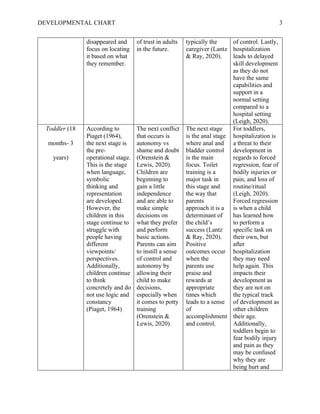
Developmental
Group
Theory #1:
Piaget’s Theory
of Cognitive
Development
Theory #2:
Erikson’s Stages
of Psychosocial
Development
Theory #3:
Freud’s
Psychosexual
Theory
Impact of
Hospitalization
Infant (Birth-18
months)
In Piaget’s
(1964) theory of
cognitive
development,
infants are in the
sensorimotor
stage up to 18
months of age.
During this stage,
infants are
developing their
schema of a
permanent,
existing object,
or in other
words, object
permanence
(Piaget, 1964).
Prior to
establishing
object
permanence, the
infant does not
understand that
when it
disappears from
their sight, it
continues to
exist. However,
as the infant
progresses
through this
stage, he/she will
begin to attempt
to find the object
once it has
In Erik Erikson’s
psychosocial
development
theory, infants
are experiencing
the conflict of
trust vs mistrust.
According to
Orenstein &
Lewis (2020),
who described
Erikson’s eight
stages in their
book, trust is
developed based
on the
dependability
and quality of
the child’s
caregiver. The
caregiver has to
ensure to provide
a secure and
adequate
environment for
the infant, with
regular access to
affection and
food (Orenstein
& Lewis, 2020).
If this does not
occur, then the
child will
struggle to
develop a sense
Sigmund
Freud’s theory
of psychosexual
development
focuses on the
development of
a person’s
personality.
Lantz & Ray
(2020)
described each
of Freud’s
stages in their
book. Infants
are in the oral
stage. The
infant’s primary
source of
interaction
during this stage
is through the
mouth (Lantz &
Ray, 2020). The
infant receives
pleasure from
the mouth
through oral
stimulation such
as tasting and
sucking. The
infant’s
attachment is to
the one that
provides him
his oral needs,
which is
When infants are
hospitalized, it
poses as a threat
to their
development.
Specifically, it
affects their
development of
trust in their
caregivers and
hospital workers
as they are being
put in a
vulnerable
situation and do
not understand
that it is not their
parents faults.
Additionally,
being hospitalized
is a threat to their
ability to explore
themselves and
their environment
(Leigh, 2020).
They are being
placed in an
environment that
is unusual and
therefore, may not
have the same
level of comfort
there as they
would at home
leading to a
decreased sense
DEVELOPMENTAL CHART 3
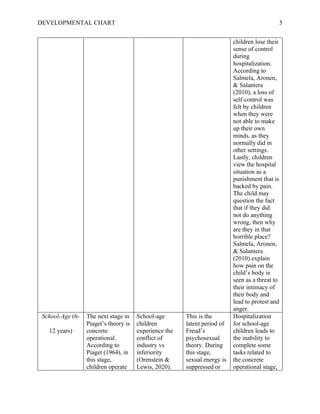
disappeared and
focus on locating
it based on what
they remember.
of trust in adults
in the future.
typically the
caregiver (Lantz
& Ray, 2020).
of control. Lastly,
hospitalization
leads to delayed
skill development
as they do not
have the same
capabilities and
support in a
normal setting
compared to a
hospital setting
(Leigh, 2020).
Toddler (18
months- 3
years)
According to
Piaget (1964),
the next stage is
the pre-
operational stage.
This is the stage
when language,
symbolic
thinking and
representation
are developed.
However, the
children in this
stage continue to
struggle with
people having
different
viewpoints/
perspectives.
Additionally,
children continue
to think
concretely and do
not use logic and
constancy
(Piaget, 1964)
The next conflict
that occurs is
autonomy vs
shame and doubt
(Orenstein &
Lewis, 2020).
Children are
beginning to
gain a little
independence
and are able to
make simple
decisions on
what they prefer
and perform
basic actions.
Parents can aim
to instill a sense
of control and
autonomy by
allowing their
child to make
decisions,
especially when
it comes to potty
training
(Orenstein &
Lewis, 2020).
The next stage
is the anal stage
where anal and
bladder control
is the main
focus. Toilet
training is a
major task in
this stage and
the way that
parents
approach it is a
determinant of
the child’s
success (Lantz
& Ray, 2020).
Positive
outcomes occur
when the
parents use
praise and
rewards at
appropriate
times which
leads to a sense
of
accomplishment
and control.
For toddlers,
hospitalization is
a threat to their
development in
regards to forced
regression, fear of
bodily injuries or
pain, and loss of
routine/ritual
(Leigh, 2020).
Forced regression
is when a child
has learned how
to perform a
specific task on
their own, but
after
hospitalization
they may need
help again. This
impacts their
development as
they are not on
the typical track
of development as
other children
their age.
Additionally,
toddlers begin to
fear bodily injury
and pain as they
may be confused
why they are
being hurt and
DEVELOPMENTAL CHART 4
why they have no
control. This is a
threat to their
established sense
of control as they
cannot choose if
they want the shot
or not. Lastly, the
loss of
routine/rituals is
confusing to the
toddler and can
lead to resistance
and
uncooperativeness
as this is not
something they
want to do.
Preschool (3-5
years)
Children in their
preschool years
are still in the
preoperational
stage. As stated
above, children
tend to have an
egocentric
mindset and
understand the
world in concrete
terms. Although
they do become
engaged in
pretend play
during this stage,
a child would not
be able to
understand that if
you poured water
from one glass
into a different
shaped glass, that
it is still the same
amount of water
(Piaget, 1964).
Initiative vs guilt
is the conflict
that occurs in the
preschool years
(Orenstein &
Lewis, 2020).
During this
stage, children
are beginning to
assert their
power and
control on their
environment
through play and
social
interactions. This
can lead to the
child having a
sense of purpose
if accomplished,
however, if a
child struggles
with this then it
could lead to a
sense of guilt or
disapproval
(Orenstein &
Lewis, 2020).
The preschool
age stage is
called the
phallic stage
(Lantz & Ray,
2020). The
primary focus is
on the genitals
and the pleasure
associated with
it. Children also
begin to
recognize the
gender
differences
between males
and females
(Lantz & Ray,
2020).
For children in
the preschool
range ages,
hospitalization
affects their
magical thinking
(creativeness),
sense of control,
and view it as a
form of
punishment. A
child’s magical
thinking is
negatively
impacted by
hospitalization as
the child will use
their sense of fear
to develop their
imaginary thought
(Leigh, 2020).
The child will
make up their
own stories based
on what they
believe is going to
happen to them.
Additionally,
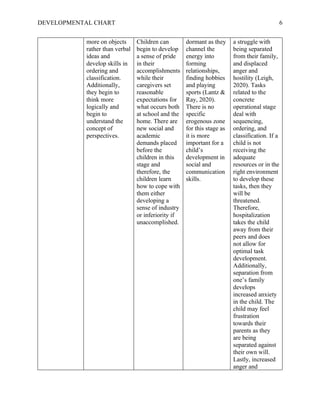
DEVELOPMENTAL CHART 5
children lose their
sense of control
during
hospitalization.
According to
Salmela, Aronen,
& Salantera
(2010), a loss of
self-control was
felt by children
when they were
not able to make
up their own
minds, as they
normally did in
other settings.
Lastly, children
view the hospital
situation as a
punishment that is
backed by pain.
The child may
question the fact
that if they did
not do anything
wrong, then why
are they in that
horrible place?
Salmela, Aronen,
& Salantera
(2010) explain
how pain on the
child’s body is
seen as a threat to
their intimacy of
their body and
lead to protest and
anger.
School-Age (6-
12 years)
The next stage in
Piaget’s theory is
concrete
operational.
According to
Piaget (1964), in
this stage,
children operate
School-age
children
experience the
conflict of
industry vs
inferiority
(Orenstein &
Lewis, 2020).
This is the
latent period of
Freud’s
psychosexual
theory. During
this stage,
sexual energy is
suppressed or
Hospitalization
for school-age
children leads to
the inability to
complete some
tasks related to
the concrete
operational stage,
DEVELOPMENTAL CHART 6
more on objects
rather than verbal
ideas and
develop skills in
ordering and
classification.
Additionally,
they begin to
think more
logically and
begin to
understand the
concept of
perspectives.
Children can
begin to develop
a sense of pride
in their
accomplishments
while their
caregivers set
reasonable
expectations for
what occurs both
at school and the
home. There are
new social and
academic
demands placed
before the
children in this
stage and
therefore, the
children learn
how to cope with
them either
developing a
sense of industry
or inferiority if
unaccomplished.
dormant as they
channel the
energy into
forming
relationships,
finding hobbies
and playing
sports (Lantz &
Ray, 2020).
There is no
specific
erogenous zone
for this stage as
it is more
important for a
child’s
development in
social and
communication
skills.
a struggle with
being separated
from their family,
and displaced
anger and
hostility (Leigh,
2020). Tasks
related to the
concrete
operational stage
deal with
sequencing,
ordering, and
classification. If a
child is not
receiving the
adequate
resources or in the
right environment
to develop these
tasks, then they
will be
threatened.
Therefore,
hospitalization
takes the child
away from their
peers and does
not allow for
optimal task
development.
Additionally,
separation from
one’s family
develops
increased anxiety
in the child. The
child may feel
frustration
towards their
parents as they
are being
separated against
their own will.
Lastly, increased
anger and
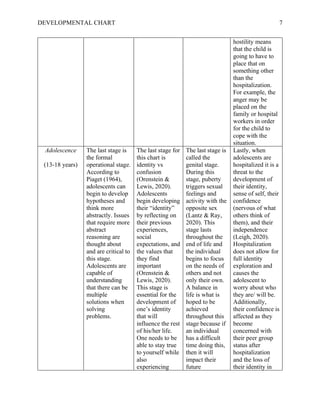
DEVELOPMENTAL CHART 7
hostility means
that the child is
going to have to
place that on
something other
than the
hospitalization.
For example, the
anger may be
placed on the
family or hospital
workers in order
for the child to
cope with the
situation.
Adolescence
(13-18 years)
The last stage is
the formal
operational stage.
According to
Piaget (1964),
adolescents can
begin to develop
hypotheses and
think more
abstractly. Issues
that require more
abstract
reasoning are
thought about
and are critical to
this stage.
Adolescents are
capable of
understanding
that there can be
multiple
solutions when
solving
problems.
The last stage for
this chart is
identity vs
confusion
(Orenstein &
Lewis, 2020).
Adolescents
begin developing
their “identity”
by reflecting on
their previous
experiences,
social
expectations, and
the values that
they find
important
(Orenstein &
Lewis, 2020).
This stage is
essential for the
development of
one’s identity
that will
influence the rest
of his/her life.
One needs to be
able to stay true
to yourself while
also
experiencing
The last stage is
called the
genital stage.
During this
stage, puberty
triggers sexual
feelings and
activity with the
opposite sex
(Lantz & Ray,
2020). This
stage lasts
throughout the
end of life and
the individual
begins to focus
on the needs of
others and not
only their own.
A balance in
life is what is
hoped to be
achieved
throughout this
stage because if
an individual
has a difficult
time doing this,
then it will
impact their
future
Lastly, when
adolescents are
hospitalized it is a
threat to the
development of
their identity,
sense of self, their
confidence
(nervous of what
others think of
them), and their
independence
(Leigh, 2020).
Hospitalization
does not allow for
full identity
exploration and
causes the
adolescent to
worry about who
they are/ will be.
Additionally,
their confidence is
affected as they
become
concerned with
their peer group
status after
hospitalization
and the loss of
their identity in
DEVELOPMENTAL CHART 8
personal
exploration.
relationships
(Lantz & Ray,
2020).
the vulnerable
setting. Lastly,
their
independence is
threatened as they
have to become
dependent on
adults for their
basic survival
needs. They have
to depend on
doctors and their
families in order
to survive and this
makes them feel
out of control.
DEVELOPMENTAL CHART 9
References
Lantz, S. E., & Ray, S. (2020). Freud Developmental Theory. In StatPearls. StatPearls
Publishing.
Leigh, K. (2020, September 21) Infant and toddler response to hospital [PowerPoint slides].
PowerPoint.
https://uga.view.usg.edu/d2l/le/content/2068286/viewContent/32230527/View
Leigh, K. (2020, September 28) Preschool and school age responses to hospitalization
[PowerPoint slides]. PowerPoint.
https://uga.view.usg.edu/d2l/le/content/2068286/viewContent/32294867/View
Leigh, K. (2020, October 5) Adolescent and emerging adult responses [PowerPoint slides].
PowerPoint.
https://uga.view.usg.edu/d2l/le/content/2068286/viewContent/32371980/View
Orenstein, G. A., & Lewis, L. (2020). Erikson’s Stages of Psychosocial Development. In
StatPearls. StatPearls Publishing.
Piaget, J. (1964). Cognitive development in children: Piaget, development and learning. Journal
of Research in Science Teaching. 2(1), 176-186. doi:
https://doi.org/10.1002/tea.3660020306
Salmela, M., Aronen, E. T., & Salantera, S. (2010). The experience of hospital related fears of 4
to 6 year old children. Child: Care, Health & Development, 37(5), 719-726.
doi:10.1111/j.1365-2214.2010.01171.x

Developmental Chart

  • 1.
    Running head: DEVELOPMENTALCHART 1 Developmental Chart Emily Honeybone University of Georgia HDFS 4810
  • 2.
    DEVELOPMENTAL CHART 2 DevelopmentalChart Developmental Group Theory #1: Piaget’s Theory of Cognitive Development Theory #2: Erikson’s Stages of Psychosocial Development Theory #3: Freud’s Psychosexual Theory Impact of Hospitalization Infant (Birth-18 months) In Piaget’s (1964) theory of cognitive development, infants are in the sensorimotor stage up to 18 months of age. During this stage, infants are developing their schema of a permanent, existing object, or in other words, object permanence (Piaget, 1964). Prior to establishing object permanence, the infant does not understand that when it disappears from their sight, it continues to exist. However, as the infant progresses through this stage, he/she will begin to attempt to find the object once it has In Erik Erikson’s psychosocial development theory, infants are experiencing the conflict of trust vs mistrust. According to Orenstein & Lewis (2020), who described Erikson’s eight stages in their book, trust is developed based on the dependability and quality of the child’s caregiver. The caregiver has to ensure to provide a secure and adequate environment for the infant, with regular access to affection and food (Orenstein & Lewis, 2020). If this does not occur, then the child will struggle to develop a sense Sigmund Freud’s theory of psychosexual development focuses on the development of a person’s personality. Lantz & Ray (2020) described each of Freud’s stages in their book. Infants are in the oral stage. The infant’s primary source of interaction during this stage is through the mouth (Lantz & Ray, 2020). The infant receives pleasure from the mouth through oral stimulation such as tasting and sucking. The infant’s attachment is to the one that provides him his oral needs, which is When infants are hospitalized, it poses as a threat to their development. Specifically, it affects their development of trust in their caregivers and hospital workers as they are being put in a vulnerable situation and do not understand that it is not their parents faults. Additionally, being hospitalized is a threat to their ability to explore themselves and their environment (Leigh, 2020). They are being placed in an environment that is unusual and therefore, may not have the same level of comfort there as they would at home leading to a decreased sense
  • 3.
    DEVELOPMENTAL CHART 3 disappearedand focus on locating it based on what they remember. of trust in adults in the future. typically the caregiver (Lantz & Ray, 2020). of control. Lastly, hospitalization leads to delayed skill development as they do not have the same capabilities and support in a normal setting compared to a hospital setting (Leigh, 2020). Toddler (18 months- 3 years) According to Piaget (1964), the next stage is the pre- operational stage. This is the stage when language, symbolic thinking and representation are developed. However, the children in this stage continue to struggle with people having different viewpoints/ perspectives. Additionally, children continue to think concretely and do not use logic and constancy (Piaget, 1964) The next conflict that occurs is autonomy vs shame and doubt (Orenstein & Lewis, 2020). Children are beginning to gain a little independence and are able to make simple decisions on what they prefer and perform basic actions. Parents can aim to instill a sense of control and autonomy by allowing their child to make decisions, especially when it comes to potty training (Orenstein & Lewis, 2020). The next stage is the anal stage where anal and bladder control is the main focus. Toilet training is a major task in this stage and the way that parents approach it is a determinant of the child’s success (Lantz & Ray, 2020). Positive outcomes occur when the parents use praise and rewards at appropriate times which leads to a sense of accomplishment and control. For toddlers, hospitalization is a threat to their development in regards to forced regression, fear of bodily injuries or pain, and loss of routine/ritual (Leigh, 2020). Forced regression is when a child has learned how to perform a specific task on their own, but after hospitalization they may need help again. This impacts their development as they are not on the typical track of development as other children their age. Additionally, toddlers begin to fear bodily injury and pain as they may be confused why they are being hurt and
  • 4.
    DEVELOPMENTAL CHART 4 whythey have no control. This is a threat to their established sense of control as they cannot choose if they want the shot or not. Lastly, the loss of routine/rituals is confusing to the toddler and can lead to resistance and uncooperativeness as this is not something they want to do. Preschool (3-5 years) Children in their preschool years are still in the preoperational stage. As stated above, children tend to have an egocentric mindset and understand the world in concrete terms. Although they do become engaged in pretend play during this stage, a child would not be able to understand that if you poured water from one glass into a different shaped glass, that it is still the same amount of water (Piaget, 1964). Initiative vs guilt is the conflict that occurs in the preschool years (Orenstein & Lewis, 2020). During this stage, children are beginning to assert their power and control on their environment through play and social interactions. This can lead to the child having a sense of purpose if accomplished, however, if a child struggles with this then it could lead to a sense of guilt or disapproval (Orenstein & Lewis, 2020). The preschool age stage is called the phallic stage (Lantz & Ray, 2020). The primary focus is on the genitals and the pleasure associated with it. Children also begin to recognize the gender differences between males and females (Lantz & Ray, 2020). For children in the preschool range ages, hospitalization affects their magical thinking (creativeness), sense of control, and view it as a form of punishment. A child’s magical thinking is negatively impacted by hospitalization as the child will use their sense of fear to develop their imaginary thought (Leigh, 2020). The child will make up their own stories based on what they believe is going to happen to them. Additionally,
  • 5.
    DEVELOPMENTAL CHART 5 childrenlose their sense of control during hospitalization. According to Salmela, Aronen, & Salantera (2010), a loss of self-control was felt by children when they were not able to make up their own minds, as they normally did in other settings. Lastly, children view the hospital situation as a punishment that is backed by pain. The child may question the fact that if they did not do anything wrong, then why are they in that horrible place? Salmela, Aronen, & Salantera (2010) explain how pain on the child’s body is seen as a threat to their intimacy of their body and lead to protest and anger. School-Age (6- 12 years) The next stage in Piaget’s theory is concrete operational. According to Piaget (1964), in this stage, children operate School-age children experience the conflict of industry vs inferiority (Orenstein & Lewis, 2020). This is the latent period of Freud’s psychosexual theory. During this stage, sexual energy is suppressed or Hospitalization for school-age children leads to the inability to complete some tasks related to the concrete operational stage,
  • 6.
    DEVELOPMENTAL CHART 6 moreon objects rather than verbal ideas and develop skills in ordering and classification. Additionally, they begin to think more logically and begin to understand the concept of perspectives. Children can begin to develop a sense of pride in their accomplishments while their caregivers set reasonable expectations for what occurs both at school and the home. There are new social and academic demands placed before the children in this stage and therefore, the children learn how to cope with them either developing a sense of industry or inferiority if unaccomplished. dormant as they channel the energy into forming relationships, finding hobbies and playing sports (Lantz & Ray, 2020). There is no specific erogenous zone for this stage as it is more important for a child’s development in social and communication skills. a struggle with being separated from their family, and displaced anger and hostility (Leigh, 2020). Tasks related to the concrete operational stage deal with sequencing, ordering, and classification. If a child is not receiving the adequate resources or in the right environment to develop these tasks, then they will be threatened. Therefore, hospitalization takes the child away from their peers and does not allow for optimal task development. Additionally, separation from one’s family develops increased anxiety in the child. The child may feel frustration towards their parents as they are being separated against their own will. Lastly, increased anger and
  • 7.
    DEVELOPMENTAL CHART 7 hostilitymeans that the child is going to have to place that on something other than the hospitalization. For example, the anger may be placed on the family or hospital workers in order for the child to cope with the situation. Adolescence (13-18 years) The last stage is the formal operational stage. According to Piaget (1964), adolescents can begin to develop hypotheses and think more abstractly. Issues that require more abstract reasoning are thought about and are critical to this stage. Adolescents are capable of understanding that there can be multiple solutions when solving problems. The last stage for this chart is identity vs confusion (Orenstein & Lewis, 2020). Adolescents begin developing their “identity” by reflecting on their previous experiences, social expectations, and the values that they find important (Orenstein & Lewis, 2020). This stage is essential for the development of one’s identity that will influence the rest of his/her life. One needs to be able to stay true to yourself while also experiencing The last stage is called the genital stage. During this stage, puberty triggers sexual feelings and activity with the opposite sex (Lantz & Ray, 2020). This stage lasts throughout the end of life and the individual begins to focus on the needs of others and not only their own. A balance in life is what is hoped to be achieved throughout this stage because if an individual has a difficult time doing this, then it will impact their future Lastly, when adolescents are hospitalized it is a threat to the development of their identity, sense of self, their confidence (nervous of what others think of them), and their independence (Leigh, 2020). Hospitalization does not allow for full identity exploration and causes the adolescent to worry about who they are/ will be. Additionally, their confidence is affected as they become concerned with their peer group status after hospitalization and the loss of their identity in
  • 8.
    DEVELOPMENTAL CHART 8 personal exploration. relationships (Lantz& Ray, 2020). the vulnerable setting. Lastly, their independence is threatened as they have to become dependent on adults for their basic survival needs. They have to depend on doctors and their families in order to survive and this makes them feel out of control.
  • 9.
    DEVELOPMENTAL CHART 9 References Lantz,S. E., & Ray, S. (2020). Freud Developmental Theory. In StatPearls. StatPearls Publishing. Leigh, K. (2020, September 21) Infant and toddler response to hospital [PowerPoint slides]. PowerPoint. https://uga.view.usg.edu/d2l/le/content/2068286/viewContent/32230527/View Leigh, K. (2020, September 28) Preschool and school age responses to hospitalization [PowerPoint slides]. PowerPoint. https://uga.view.usg.edu/d2l/le/content/2068286/viewContent/32294867/View Leigh, K. (2020, October 5) Adolescent and emerging adult responses [PowerPoint slides]. PowerPoint. https://uga.view.usg.edu/d2l/le/content/2068286/viewContent/32371980/View Orenstein, G. A., & Lewis, L. (2020). Erikson’s Stages of Psychosocial Development. In StatPearls. StatPearls Publishing. Piaget, J. (1964). Cognitive development in children: Piaget, development and learning. Journal of Research in Science Teaching. 2(1), 176-186. doi: https://doi.org/10.1002/tea.3660020306 Salmela, M., Aronen, E. T., & Salantera, S. (2010). The experience of hospital related fears of 4 to 6 year old children. Child: Care, Health & Development, 37(5), 719-726. doi:10.1111/j.1365-2214.2010.01171.x