Developmental Autobiography
Amber Patrick
Three Major Developmental
Stages
o Early Childhood
o Adolescence
o Emerging and Young Adulthood
This Photo by Unknown Author is licensed under CC BY
Vocabulary
 Gross motor skills-
 Pretend play-
 Authoritative parenting-
 Conventional morality-
 Adolescent growth spurt-
 Sleep deprivation-
 Postformal thought-
 Ego-resilient-
 What most individuals do not understand is the connection between the detrimental moments one goes
throughout during their life and how it shapes them into the individual they are today.
 Throughout this presentation, I will be going over three developmental stages I have gone through within my
almost 25 years of living.
Gross Motor Skills
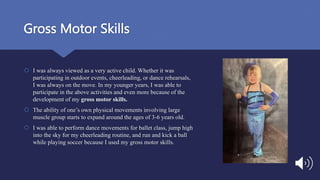
 I was always viewed as a very active child. Whether it was
participating in outdoor events, cheerleading, or dance rehearsals,
I was always on the move. In my younger years, I was able to
participate in the above activities and even more because of the
development of my gross motor skills.
 The ability of one’s own physical movements involving large
muscle group starts to expand around the ages of 3-6 years old.
 I was able to perform dance movements for ballet class, jump high
into the sky for my cheerleading routine, and run and kick a ball
while playing soccer because I used my gross motor skills.
Pretend Play
 I was cognitively just as lively as I was physically during that point in my life.
 A lot of times, when my friends wanted to play outside, I would want to create my own world indoors and
create my own fun with imaginary figures and places and engage in pretend play.
 My parents always knew since I was a little girl that I’ve loved playing dress up and participating in anything
girly, so it is not a surprise that I would create my own imaginary friends as “princesses” and pretended I
lived in a giant castle, which was just my Disney themed bedroom.
Authoritative
Parenting
 My parents made sure I was always able to
express myself through my interests in animals,
princesses, and all things glitter, they always
made sure I maintained the family’s values
through each activity I did and followed a
complete set of rules my brother and I needed
to follow and maintain.
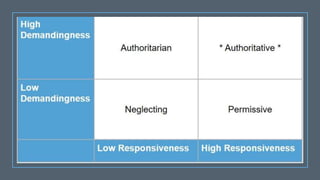
 My parents had bestowed upon me a very
authoritative parenting style, in Baumrind’s
technology, it would be sees as the parent
respecting the child’s individuality but placing
an effort upon them to instill social values.
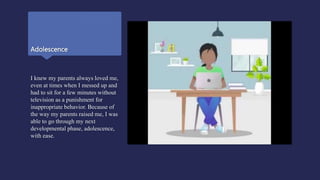
Adolescence
I knew my parents always loved me,
even at times when I messed up and
had to sit for a few minutes without
television as a punishment for
inappropriate behavior. Because of
the way my parents raised me, I was
able to go through my next
developmental phase, adolescence,
with ease.
Conventional Morality
 Because of the given rules and standards set for me and my brother to follow, I had a strong sense of
conventional morality.
 In human development, we learned this was the second level in Kohlberg’s theory of moral reasoning, in
which standards of authoritative figures are heavily internalized.
 This comes in two parts: the child wanting to please others and evaluate acts accordingly, and concern for
doing their duty and maintaining the social order. Since I was a child, I have been told “the rules have been
set for a reason” so going passed a stop sign without halting my vehicle and looking both ways before
crossing is not only a violation of the law, but also seen as a negligent act on my character.
Commitment
 I think if I look back, my favorite part of adolescence was
getting and purchasing my first car, which was not only a
major milestone, but a huge commitment.
 Not only was I purchasing the vehicle to have to drive the
next few years of my life, that car was also a commitment I
made to always drive safely and look out for other drivers.
 In your younger years, there are a lot of things we seemed
pressured into forming a commitment with: weather it’s
picking an after-school sport to participate in, picking your
own car, or choosing the college you plan to base your career
out of: there’s always a choice and the consequences that
come from it.
Adolescent Growth Spurt
 All children when they’re around the years 11 and 12, they
always have a far-fetched wish they could grow up quicker
and be older to do “adult things,” such as driving, well,, in a
way I got my wish.
 I went through an adolescent growth spurt.
 I’ve always been a tall child compared to others my age, and
to be fully honest, that has not changed in the first quarter of
my life so far.
 Within this period of my life, my heigh shot up earlier than
children of my age.
Sleep Deprivation
While being an adult does have its perks such as driving and becoming more independent, there are
some drawbacks.
As I’ve gotten older and past my late-teen years, I have been hit with waves of sleep deprivation.
While going to school full-time, throwing a full-time job in the mix, still wanting a social life, and
wanting to maintain relationships with my family does not allow for much sleep for a girl my age.
 Sleep deprivation can not only make you feel fatigued, sick, and irritable, but can affect your
cognitive thoughts and how you react to other things around you.
Postformal Thought
 I think when an individual is extremely tired, they have a hard time being able to process a thought.
 During this current portion in my life, I can say my postformal thought has been accelerated greatly. A huge
part of going through life as a young adult is having a mature train-of-thought and having reasonable ideas
that are able to back it up, even if not every one seems perfect.
 Everyone is able to know life will never be perfect, while at times it can be great, one needs to have enough
sense to leave room for uncertainty and imperfection. For me, this was choosing my original career path as a
veterinarian, but along the way made pit stops as a physical therapist, and now on the road to becoming a
future registered nurse.
Obviously as seen in this presentation, my life changes from day to day and
while many of these changes are positive, I have had times where they have
been negative, such as getting into a car accident, losing a pet, or getting a
bad grade in school and you learn to pick yourself up and respond to the
situation accordingly.
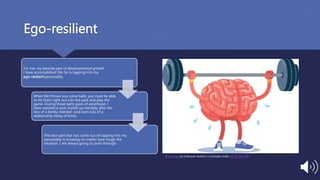
Ego-resilient
For me, my favorite part of developmental growth
I have accomplished this far is tapping into my
ego-resilient personality.
When life throws you curve balls, you must be able
to hit them right out into the park and play the
game. During these early years of adulthood, I
have needed to pick myself up mentally after the
loss of a family member, and even loss of a
relationship many of times.
The best part that has come out of tapping into my
personality is knowing no matter how tough the
situation, I am always going to push through.
This Photo by Unknown Author is licensed under CC BY-NC-ND
Vocabulary Definitions
 Gross motor skills- abilities usually acquired during childhood as part of a child's motor learning, often
involving large muscle groups
 Pretend play-form of symbolic play where children use objects, actions or ideas to represent other forms
 Authoritative parenting- parents are showing love, responsive, and supportive, yet set firm boundaries for
their children
 Conventional morality- characterized by an acceptance of society's conventions concerning right and
wrong
 Adolescent growth spurt- increase in the growth, height, and weight deriving through the adolescent
stage of human development
 Sleep deprivation- condition that occurs if you don’t get enough sleep
 Postformal thought- the individuals gains the ability to synthesize differing ideas or feelings into a fuller,
complete understanding
 Ego-resilient- enables someone to adapt to constant changes and environmental demands
References
 Farkas, D., & Orosz, G. (2015). Ego-Resiliency Reloaded: A Three-Component Model of General
Resiliency. PLOS ONE, 10(3), e0120883. https://doi.org/10.1371/journal.pone.0120883
 Martorell, G. (2022). Chapter 7 to Chapter 13. In Life: The essentials of human development (pp. 159–339).
essay, McGraw-Hill.
 U.S. Department of Health and Human Services. (n.d.). What are sleep deprivation and deficiency? National
Heart Lung and Blood Institute. Retrieved April 8, 2023, from https://www.nhlbi.nih.gov/health/sleep-
deprivation
 (2021). YouTube. Retrieved April 13, 2023, from https://youtu.be/wr4N-SdekqY.

Developmental Autobiography Presentation.pptx

  • 1.
  • 2.
    Three Major Developmental Stages oEarly Childhood o Adolescence o Emerging and Young Adulthood This Photo by Unknown Author is licensed under CC BY
  • 3.
    Vocabulary  Gross motorskills-  Pretend play-  Authoritative parenting-  Conventional morality-  Adolescent growth spurt-  Sleep deprivation-  Postformal thought-  Ego-resilient-
  • 4.
     What mostindividuals do not understand is the connection between the detrimental moments one goes throughout during their life and how it shapes them into the individual they are today.  Throughout this presentation, I will be going over three developmental stages I have gone through within my almost 25 years of living.
  • 5.
    Gross Motor Skills I was always viewed as a very active child. Whether it was participating in outdoor events, cheerleading, or dance rehearsals, I was always on the move. In my younger years, I was able to participate in the above activities and even more because of the development of my gross motor skills.  The ability of one’s own physical movements involving large muscle group starts to expand around the ages of 3-6 years old.  I was able to perform dance movements for ballet class, jump high into the sky for my cheerleading routine, and run and kick a ball while playing soccer because I used my gross motor skills.
  • 6.
    Pretend Play  Iwas cognitively just as lively as I was physically during that point in my life.  A lot of times, when my friends wanted to play outside, I would want to create my own world indoors and create my own fun with imaginary figures and places and engage in pretend play.  My parents always knew since I was a little girl that I’ve loved playing dress up and participating in anything girly, so it is not a surprise that I would create my own imaginary friends as “princesses” and pretended I lived in a giant castle, which was just my Disney themed bedroom.
  • 7.
    Authoritative Parenting  My parentsmade sure I was always able to express myself through my interests in animals, princesses, and all things glitter, they always made sure I maintained the family’s values through each activity I did and followed a complete set of rules my brother and I needed to follow and maintain.  My parents had bestowed upon me a very authoritative parenting style, in Baumrind’s technology, it would be sees as the parent respecting the child’s individuality but placing an effort upon them to instill social values.
  • 9.
    Adolescence I knew myparents always loved me, even at times when I messed up and had to sit for a few minutes without television as a punishment for inappropriate behavior. Because of the way my parents raised me, I was able to go through my next developmental phase, adolescence, with ease.
  • 10.
    Conventional Morality  Becauseof the given rules and standards set for me and my brother to follow, I had a strong sense of conventional morality.  In human development, we learned this was the second level in Kohlberg’s theory of moral reasoning, in which standards of authoritative figures are heavily internalized.  This comes in two parts: the child wanting to please others and evaluate acts accordingly, and concern for doing their duty and maintaining the social order. Since I was a child, I have been told “the rules have been set for a reason” so going passed a stop sign without halting my vehicle and looking both ways before crossing is not only a violation of the law, but also seen as a negligent act on my character.
  • 11.
    Commitment  I thinkif I look back, my favorite part of adolescence was getting and purchasing my first car, which was not only a major milestone, but a huge commitment.  Not only was I purchasing the vehicle to have to drive the next few years of my life, that car was also a commitment I made to always drive safely and look out for other drivers.  In your younger years, there are a lot of things we seemed pressured into forming a commitment with: weather it’s picking an after-school sport to participate in, picking your own car, or choosing the college you plan to base your career out of: there’s always a choice and the consequences that come from it.
  • 12.
    Adolescent Growth Spurt All children when they’re around the years 11 and 12, they always have a far-fetched wish they could grow up quicker and be older to do “adult things,” such as driving, well,, in a way I got my wish.  I went through an adolescent growth spurt.  I’ve always been a tall child compared to others my age, and to be fully honest, that has not changed in the first quarter of my life so far.  Within this period of my life, my heigh shot up earlier than children of my age.
  • 13.
    Sleep Deprivation While beingan adult does have its perks such as driving and becoming more independent, there are some drawbacks. As I’ve gotten older and past my late-teen years, I have been hit with waves of sleep deprivation. While going to school full-time, throwing a full-time job in the mix, still wanting a social life, and wanting to maintain relationships with my family does not allow for much sleep for a girl my age.  Sleep deprivation can not only make you feel fatigued, sick, and irritable, but can affect your cognitive thoughts and how you react to other things around you.
  • 14.
    Postformal Thought  Ithink when an individual is extremely tired, they have a hard time being able to process a thought.  During this current portion in my life, I can say my postformal thought has been accelerated greatly. A huge part of going through life as a young adult is having a mature train-of-thought and having reasonable ideas that are able to back it up, even if not every one seems perfect.  Everyone is able to know life will never be perfect, while at times it can be great, one needs to have enough sense to leave room for uncertainty and imperfection. For me, this was choosing my original career path as a veterinarian, but along the way made pit stops as a physical therapist, and now on the road to becoming a future registered nurse.
  • 15.
    Obviously as seenin this presentation, my life changes from day to day and while many of these changes are positive, I have had times where they have been negative, such as getting into a car accident, losing a pet, or getting a bad grade in school and you learn to pick yourself up and respond to the situation accordingly.
  • 16.
    Ego-resilient For me, myfavorite part of developmental growth I have accomplished this far is tapping into my ego-resilient personality. When life throws you curve balls, you must be able to hit them right out into the park and play the game. During these early years of adulthood, I have needed to pick myself up mentally after the loss of a family member, and even loss of a relationship many of times. The best part that has come out of tapping into my personality is knowing no matter how tough the situation, I am always going to push through. This Photo by Unknown Author is licensed under CC BY-NC-ND
  • 17.
    Vocabulary Definitions  Grossmotor skills- abilities usually acquired during childhood as part of a child's motor learning, often involving large muscle groups  Pretend play-form of symbolic play where children use objects, actions or ideas to represent other forms  Authoritative parenting- parents are showing love, responsive, and supportive, yet set firm boundaries for their children  Conventional morality- characterized by an acceptance of society's conventions concerning right and wrong  Adolescent growth spurt- increase in the growth, height, and weight deriving through the adolescent stage of human development  Sleep deprivation- condition that occurs if you don’t get enough sleep  Postformal thought- the individuals gains the ability to synthesize differing ideas or feelings into a fuller, complete understanding  Ego-resilient- enables someone to adapt to constant changes and environmental demands
  • 18.
    References  Farkas, D.,& Orosz, G. (2015). Ego-Resiliency Reloaded: A Three-Component Model of General Resiliency. PLOS ONE, 10(3), e0120883. https://doi.org/10.1371/journal.pone.0120883  Martorell, G. (2022). Chapter 7 to Chapter 13. In Life: The essentials of human development (pp. 159–339). essay, McGraw-Hill.  U.S. Department of Health and Human Services. (n.d.). What are sleep deprivation and deficiency? National Heart Lung and Blood Institute. Retrieved April 8, 2023, from https://www.nhlbi.nih.gov/health/sleep- deprivation  (2021). YouTube. Retrieved April 13, 2023, from https://youtu.be/wr4N-SdekqY.