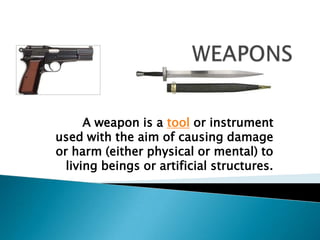
A weapon is a tool or instrument
used with the aim of causing damage
or harm (either physical or mental) to
  living beings or artificial structures.
   People used clubs, axes and
    spears.
   Weapons were made from wood,
    stones and metal.
   Used for protection and hunting.
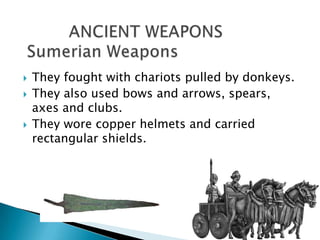
   They fought with chariots pulled by donkeys.
   They also used bows and arrows, spears,
    axes and clubs.
   They wore copper helmets and carried
    rectangular shields.
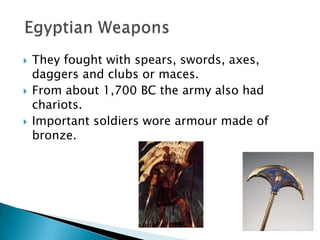
   They fought with spears, swords, axes,
    daggers and clubs or maces.
   From about 1,700 BC the army also had
    chariots.
   Important soldiers wore armour made of
    bronze.
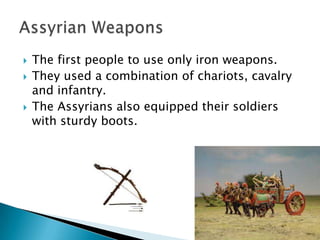
   The first people to use only iron weapons.
   They used a combination of chariots, cavalry
    and infantry.
   The Assyrians also equipped their soldiers
    with sturdy boots.
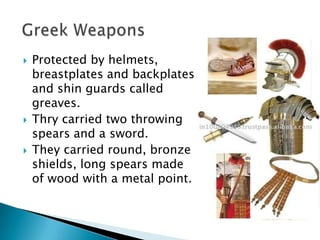
   Protected by helmets,
    breastplates and backplates
    and shin guards called
    greaves.
   Thry carried two throwing
    spears and a sword.
   They carried round, bronze
    shields, long spears made
    of wood with a metal point.
   A Roman legionary wore a helmet, segmented
    armour, a curved shield made of layers of
    wood covered in leather.
   He carried a throwing spear called a pilum but
    his main weapon was a short sword called a
    gladius.
   Saxon tactic was to form a 'shield wall' by
    standing side-by-side holding their shields in
    a line.
   The Vikings fought with spears, axes and
    swords.they use to built forts also.
   Castles were built of stone. In the centre was a
    stone tower.
    Surrounding it was a curtain wall.
   The weakest part of a castle was its gate.
   Around the curtain wall were arrow slits and
    openings through which boiling liquids could be
    poured or stones could be dropped.
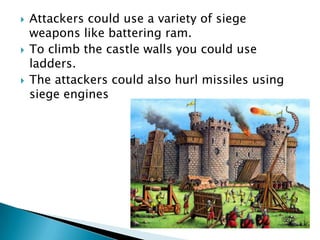
   Attackers could use a variety of siege
    weapons like battering ram.
   To climb the castle walls you could use
    ladders.
   The attackers could also hurl missiles using
    siege engines
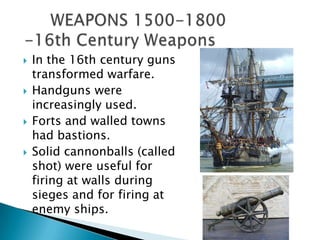
   In the 16th century guns
    transformed warfare.
   Handguns were
    increasingly used.
   Forts and walled towns
    had bastions.
   Solid cannonballs (called
    shot) were useful for
    firing at walls during
    sieges and for firing at
    enemy ships.
   In the early 16th century the Aztecs were
    fearsome warriors.
    They fought with slings and spears made of
    wood with blades edged with pieces of sharp
    obsidian
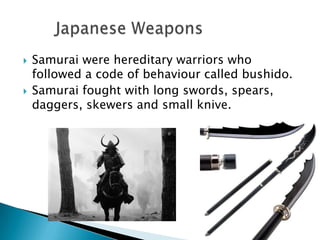
   Samurai were hereditary warriors who
    followed a code of behaviour called bushido.
   Samurai fought with long swords, spears,
    daggers, skewers and small knive.
   Indian soldiers fought
    with a curved sword
    called tulwar.
   Indian warriors carried a
    round shield called a
    dhal made of steel.
   Indians also fought with
    matchlock muskets,
    which they called
    bandukh toradas.
   In the early 17th century firearms were either
    matchlocks or wheel locks.
   In 17th century the cartridge was invented.
   About 1680 the ring bayonet was invented
   19th Century Weapons The industrial
    revolution transformed warfare.
   Railways meant armies could be transported
    much faster than before.
   Sir William Congreve (1772-1828) developed
    the Congreve rocket.
   1807 a Scot named Alexander Forsyth
    patented the percussion cap.
   In 1837 Johann von Dreyse invented the first
    breech loading firearm, the needle-gun.
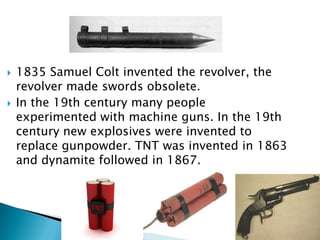
   1835 Samuel Colt invented the revolver, the
    revolver made swords obsolete.
   In the 19th century many people
    experimented with machine guns. In the 19th
    century new explosives were invented to
    replace gunpowder. TNT was invented in 1863
    and dynamite followed in 1867.
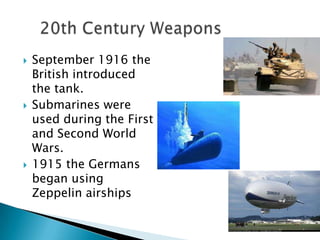
   September 1916 the
    British introduced
    the tank.
   Submarines were
    used during the First
    and Second World
    Wars.
   1915 the Germans
    began using
    Zeppelin airships
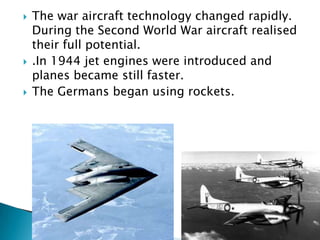
   The war aircraft technology changed rapidly.
    During the Second World War aircraft realised
    their full potential.
   .In 1944 jet engines were introduced and
    planes became still faster.
   The Germans began using rockets.
   The other development was the
    atomic bomb.
   In 1952 American scientists
    invented the much more
    powerful hydrogen bomb. The
    USSR expl
   During the Vietnam War the
    Americans experimented with
    laser guided missiles.

development of weapons

  • 2.
    A weapon isa tool or instrument used with the aim of causing damage or harm (either physical or mental) to living beings or artificial structures.
  • 5.
    People used clubs, axes and spears.  Weapons were made from wood, stones and metal.  Used for protection and hunting.
  • 6.
    They fought with chariots pulled by donkeys.  They also used bows and arrows, spears, axes and clubs.  They wore copper helmets and carried rectangular shields.
  • 7.
    They fought with spears, swords, axes, daggers and clubs or maces.  From about 1,700 BC the army also had chariots.  Important soldiers wore armour made of bronze.
  • 8.
    The first people to use only iron weapons.  They used a combination of chariots, cavalry and infantry.  The Assyrians also equipped their soldiers with sturdy boots.
  • 9.
    Protected by helmets, breastplates and backplates and shin guards called greaves.  Thry carried two throwing spears and a sword.  They carried round, bronze shields, long spears made of wood with a metal point.
  • 10.
    A Roman legionary wore a helmet, segmented armour, a curved shield made of layers of wood covered in leather.  He carried a throwing spear called a pilum but his main weapon was a short sword called a gladius.
  • 11.
    Saxon tactic was to form a 'shield wall' by standing side-by-side holding their shields in a line.  The Vikings fought with spears, axes and swords.they use to built forts also.
  • 12.
    Castles were built of stone. In the centre was a stone tower.  Surrounding it was a curtain wall.  The weakest part of a castle was its gate.  Around the curtain wall were arrow slits and openings through which boiling liquids could be poured or stones could be dropped.
  • 13.
    Attackers could use a variety of siege weapons like battering ram.  To climb the castle walls you could use ladders.  The attackers could also hurl missiles using siege engines
  • 14.
    In the 16th century guns transformed warfare.  Handguns were increasingly used.  Forts and walled towns had bastions.  Solid cannonballs (called shot) were useful for firing at walls during sieges and for firing at enemy ships.
  • 15.
    In the early 16th century the Aztecs were fearsome warriors.  They fought with slings and spears made of wood with blades edged with pieces of sharp obsidian
  • 16.
    Samurai were hereditary warriors who followed a code of behaviour called bushido.  Samurai fought with long swords, spears, daggers, skewers and small knive.
  • 17.
    Indian soldiers fought with a curved sword called tulwar.  Indian warriors carried a round shield called a dhal made of steel.  Indians also fought with matchlock muskets, which they called bandukh toradas.
  • 18.
    In the early 17th century firearms were either matchlocks or wheel locks.  In 17th century the cartridge was invented.  About 1680 the ring bayonet was invented
  • 19.
    19th Century Weapons The industrial revolution transformed warfare.  Railways meant armies could be transported much faster than before.  Sir William Congreve (1772-1828) developed the Congreve rocket.  1807 a Scot named Alexander Forsyth patented the percussion cap.  In 1837 Johann von Dreyse invented the first breech loading firearm, the needle-gun.
  • 20.
    1835 Samuel Colt invented the revolver, the revolver made swords obsolete.  In the 19th century many people experimented with machine guns. In the 19th century new explosives were invented to replace gunpowder. TNT was invented in 1863 and dynamite followed in 1867.
  • 21.
    September 1916 the British introduced the tank.  Submarines were used during the First and Second World Wars.  1915 the Germans began using Zeppelin airships
  • 22.
    The war aircraft technology changed rapidly. During the Second World War aircraft realised their full potential.  .In 1944 jet engines were introduced and planes became still faster.  The Germans began using rockets.
  • 23.
    The other development was the atomic bomb.  In 1952 American scientists invented the much more powerful hydrogen bomb. The USSR expl  During the Vietnam War the Americans experimented with laser guided missiles.