SCOTTINGWOOD MANORBy: Maria Sugar, Sophia Callanan, and Kelly Privet
Weapons
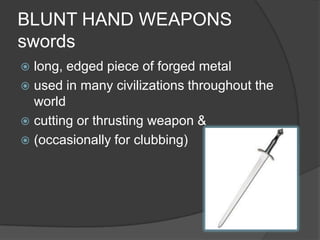
BLUNT HAND WEAPONSswordslong, edged piece of forged metalused in many civilizations throughout the worldcutting or thrusting weapon & (occasionally for clubbing)
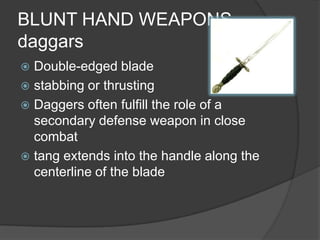
BLUNT HAND WEAPONS daggarsDouble-edged bladestabbing or thrustingDaggers often fulfill the role of a secondary defense weapon in close combattang extends into the handle along the centerline of the blade
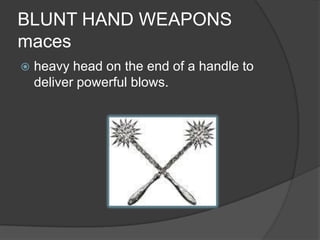
BLUNT HAND WEAPONSmacesheavy head on the end of a handle to deliver powerful blows.
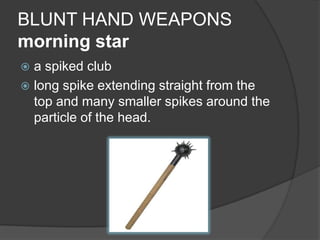
BLUNT HAND WEAPONSmorning stara spiked clublong spike extending straight from the top and many smaller spikes around the particle of the head.
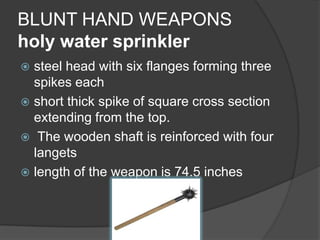
BLUNT HAND WEAPONSholy water sprinklersteel head with six flanges forming three spikes eachshort thick spike of square cross section extending from the top. The wooden shaft is reinforced with four langets length of the weapon is 74.5 inches
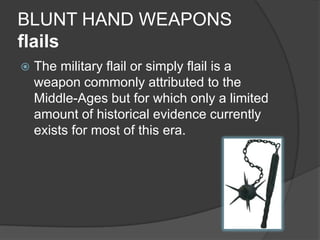
BLUNT HAND WEAPONSflailsThe military flail or simply flail is a weapon commonly attributed to the Middle-Ages but for which only a limited amount of historical evidence currently exists for most of this era.
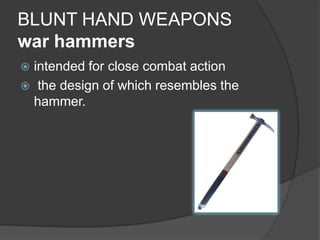
BLUNT HAND WEAPONSwar hammersintended for close combat action the design of which resembles the hammer.
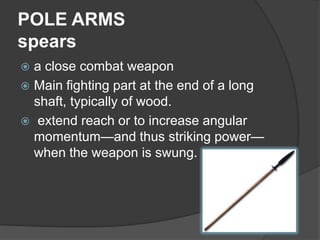
POLE ARMSspearsa close combat weaponMain fighting part at the end of a long shaft, typically of wood.  extend reach or to increase angular momentum—and thus striking power—when the weapon is swung.
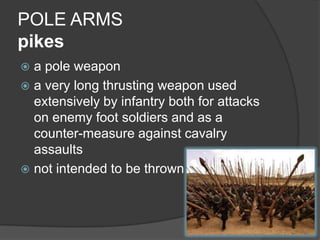
POLE ARMSpikesa pole weapona very long thrusting weapon used extensively by infantry both for attacks on enemy foot soldiers and as a counter-measure against cavalry assaults not intended to be thrown
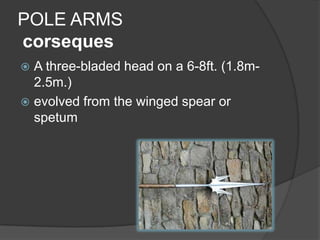
POLE ARMS corsequesA three-bladed head on a 6-8ft. (1.8m-2.5m.) evolved from the winged spear or spetum
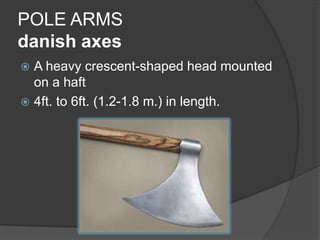
POLE ARMSdanish axesA heavy crescent-shaped head mounted on a haft 4ft. to 6ft. (1.2-1.8 m.) in length.
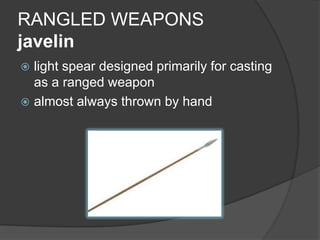
RANGLED WEAPONSjavelinlight spear designed primarily for casting as a ranged weapon almost always thrown by hand
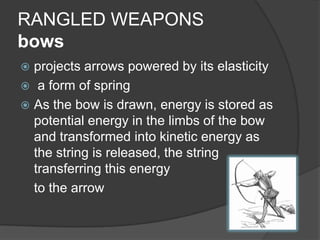
RANGLED WEAPONSbowsprojects arrows powered by its elasticity  a form of springAs the bow is drawn, energy is stored as potential energy in the limbs of the bow and transformed into kinetic energy as the string is released, the string transferring this energy 	to the arrow
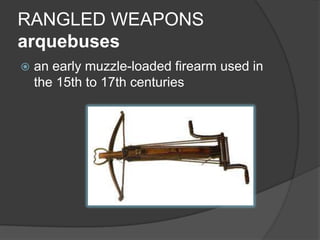
RANGLED WEAPONSarquebusesan early muzzle-loaded firearm used in the 15th to 17th centuries
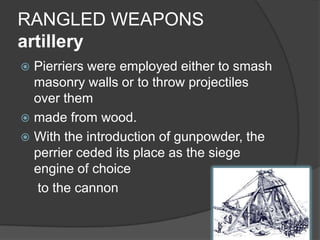
RANGLED WEAPONSartilleryPierriers were employed either to smash masonry walls or to throw projectiles over themmade from wood.With the introduction of gunpowder, the perrier ceded its place as the siege engine of choice	 to the cannon
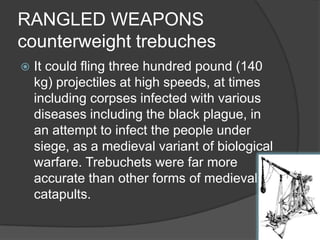
RANGLED WEAPONScounterweight trebuchesIt could fling three hundred pound (140 kg) projectiles at high speeds, at times including corpses infected with various diseases including the black plague, in an attempt to infect the people under siege, as a medieval variant of biological warfare. Trebuchets were far more accurate than other forms of medieval catapults.
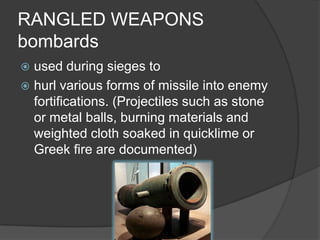
RANGLED WEAPONSbombardsused during sieges to hurl various forms of missile into enemy fortifications. (Projectiles such as stone or metal balls, burning materials and weighted cloth soaked in quicklime or Greek fire are documented)
SUPPLIES
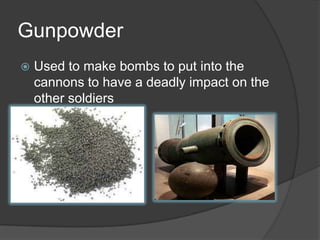
GunpowderUsed to make bombs to put into the cannons to have a deadly impact on the other soldiers
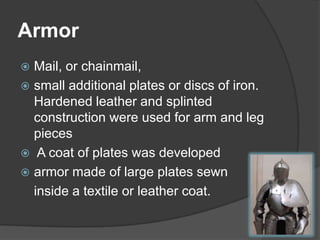
ArmorMail, or chainmail,small additional plates or discs of iron. Hardened leather and splinted construction were used for arm and leg pieces A coat of plates was developedarmor made of large plates sewn	inside a textile or leather coat.
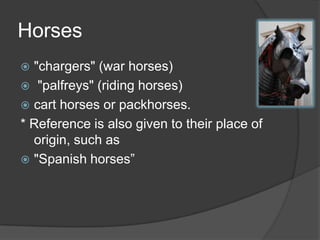
Horses"chargers" (war horses) "palfreys" (riding horses)cart horses or packhorses.* Reference is also given to their place of origin, such as "Spanish horses”
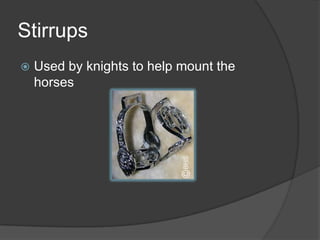
StirrupsUsed by knights to help mount the horses
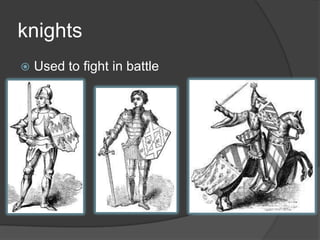
knightsUsed to fight in battle
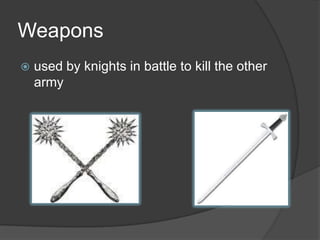
Weaponsused by knights in battle to kill the other army
LOGISTICS
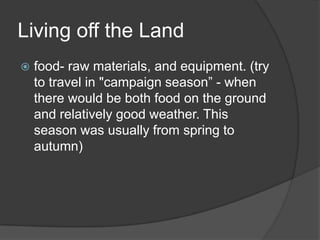
Living off the Landfood- raw materials, and equipment. (try to travel in "campaign season” - when there would be both food on the ground and relatively good weather. This season was usually from spring to autumn)
Baggage traincarry supplies- large battles (the supplies had to be carried with the army and/or transported to it while under guard. alternative supply method that was not dependent on access to a water-way. To refill its supply train, an army would forage extensively as well as re-supply itself in cities or supply points - border castles were frequently stocked with supplies for this purpose.)
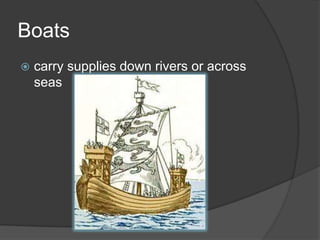
Boatscarry supplies down rivers or across seas
Fighting Strategies &Fighters
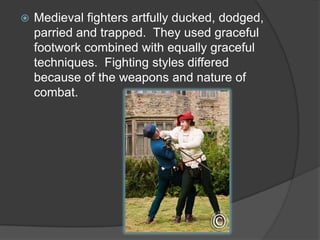
Medieval fighters artfully ducked, dodged, parried and trapped.  They used graceful footwork combined with equally graceful techniques.  Fighting styles differed because of the weapons and nature of combat.
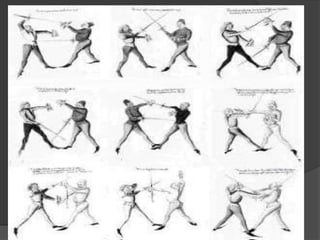
FechtbuchsFechtbuchs illustrate a host of  weapons and tricks.  Among them are several manuals of unarmed combat, as well.Medieval fighters strive for powerful attacks.The Fechtbuchs show techniques that deflect the weapon and inflict damage to the other person in the same motion.
Use of WeaponsThe shield could be used to jam, block, trap and strike. A man might throw his sword, and then wrestle his opponent to the ground. He may use his weapon to trap, pin or hold his opponent.  
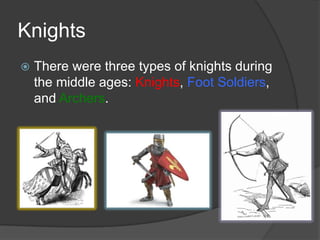
KnightsThere were three types of knights during the middle ages: Knights, Foot Soldiers, and Archers.
Death’sIn most medieval battles, more soldiers were killed during the retreat than in battle, this is because mounted knights could quickly and easily take out the archers and infantry who were no longer protected by a line of pikes as they had been during the previous fighting.
FormationGenerals formed their troops by dividing them in the vanguard, the center and the rearguard.The vanguard consisted of archers and long-range attackersThe center consisted mainly of heavy horses and heavy infantry (such as pike men and sword men).In the rearguard, faster horses were employed since they would be mainly used either for killing retreating units or for giving additional backup.
Formation cont.The vanguard was normally formed to the right while the center and the rearguard to the left. They constituted the main striking force that was supposed to either form a triangle and kill pike men or make a long line to kill other forms of infantry (such as sword men).If all of this failed, normally the remaining horses would be sent.
RetreatingOn a calm retreat, very few people died.More people died when retreating than on the actual battle.When an army retreated, the opposite army's horses could easily kill the archers, pike men and infantry.
Castle fortifications
Castle FortificationsMoat- a deep trench usually filled with water that surrounded a castleDrawbridge- the only means of getting over a moat and into the castleArrow slits/murder holes- thin slits/holes in the walls gave archers protection Round walls- round walls were harder to penetrate than flat walls
Castle Fortifications Cont.Gatehouses- held soldiers that were always ready for an attackTowers- high towers gave good views of the surrounding land and possible attackersPortcullis- heavy gate used to block entry to the castle
armor
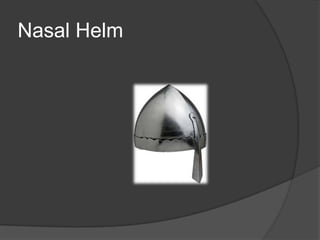
Nasal Helm
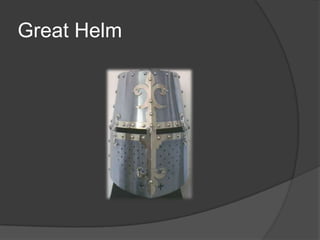
Great Helm
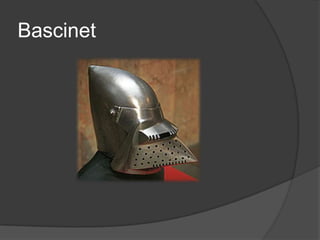
Bascinet
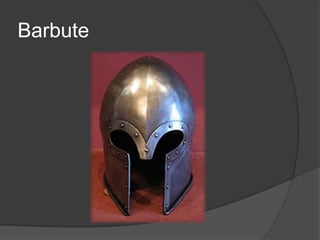
Barbute
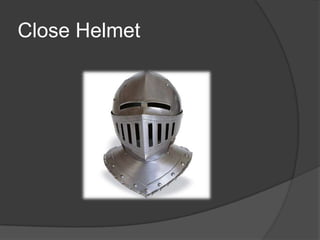
Close Helmet
DefenseTools are expensive to make in large quantitiesKnights take years to trainHorses must me trained and armoredThe supplies takes a while to acquire and is expensiveBoats are expensive and have to be made well – labor and time
Defense cont.Armor is expensiveTakes a while for the knights to learn the formations and patternsCastle walls can be torn downLiving off the land can prove futile and knights could be in need of food and other supplies

Scottingwood Manor Battle Plans

  • 1.
    SCOTTINGWOOD MANORBy: MariaSugar, Sophia Callanan, and Kelly Privet
  • 2.
  • 3.
    BLUNT HAND WEAPONSswordslong,edged piece of forged metalused in many civilizations throughout the worldcutting or thrusting weapon & (occasionally for clubbing)
  • 4.
    BLUNT HAND WEAPONSdaggarsDouble-edged bladestabbing or thrustingDaggers often fulfill the role of a secondary defense weapon in close combattang extends into the handle along the centerline of the blade
  • 5.
    BLUNT HAND WEAPONSmacesheavyhead on the end of a handle to deliver powerful blows.
  • 6.
    BLUNT HAND WEAPONSmorningstara spiked clublong spike extending straight from the top and many smaller spikes around the particle of the head.
  • 7.
    BLUNT HAND WEAPONSholywater sprinklersteel head with six flanges forming three spikes eachshort thick spike of square cross section extending from the top. The wooden shaft is reinforced with four langets length of the weapon is 74.5 inches
  • 8.
    BLUNT HAND WEAPONSflailsThemilitary flail or simply flail is a weapon commonly attributed to the Middle-Ages but for which only a limited amount of historical evidence currently exists for most of this era.
  • 9.
    BLUNT HAND WEAPONSwarhammersintended for close combat action the design of which resembles the hammer.
  • 10.
    POLE ARMSspearsa closecombat weaponMain fighting part at the end of a long shaft, typically of wood. extend reach or to increase angular momentum—and thus striking power—when the weapon is swung.
  • 11.
    POLE ARMSpikesa poleweapona very long thrusting weapon used extensively by infantry both for attacks on enemy foot soldiers and as a counter-measure against cavalry assaults not intended to be thrown
  • 12.
    POLE ARMS corsequesAthree-bladed head on a 6-8ft. (1.8m-2.5m.) evolved from the winged spear or spetum
  • 13.
    POLE ARMSdanish axesAheavy crescent-shaped head mounted on a haft 4ft. to 6ft. (1.2-1.8 m.) in length.
  • 14.
    RANGLED WEAPONSjavelinlight speardesigned primarily for casting as a ranged weapon almost always thrown by hand
  • 15.
    RANGLED WEAPONSbowsprojects arrowspowered by its elasticity a form of springAs the bow is drawn, energy is stored as potential energy in the limbs of the bow and transformed into kinetic energy as the string is released, the string transferring this energy to the arrow
  • 16.
    RANGLED WEAPONSarquebusesan earlymuzzle-loaded firearm used in the 15th to 17th centuries
  • 17.
    RANGLED WEAPONSartilleryPierriers wereemployed either to smash masonry walls or to throw projectiles over themmade from wood.With the introduction of gunpowder, the perrier ceded its place as the siege engine of choice to the cannon
  • 18.
    RANGLED WEAPONScounterweight trebuchesItcould fling three hundred pound (140 kg) projectiles at high speeds, at times including corpses infected with various diseases including the black plague, in an attempt to infect the people under siege, as a medieval variant of biological warfare. Trebuchets were far more accurate than other forms of medieval catapults.
  • 19.
    RANGLED WEAPONSbombardsused duringsieges to hurl various forms of missile into enemy fortifications. (Projectiles such as stone or metal balls, burning materials and weighted cloth soaked in quicklime or Greek fire are documented)
  • 20.
  • 21.
    GunpowderUsed to makebombs to put into the cannons to have a deadly impact on the other soldiers
  • 22.
    ArmorMail, or chainmail,smalladditional plates or discs of iron. Hardened leather and splinted construction were used for arm and leg pieces A coat of plates was developedarmor made of large plates sewn inside a textile or leather coat.
  • 23.
    Horses"chargers" (war horses)"palfreys" (riding horses)cart horses or packhorses.* Reference is also given to their place of origin, such as "Spanish horses”
  • 24.
    StirrupsUsed by knightsto help mount the horses
  • 25.
  • 26.
    Weaponsused by knightsin battle to kill the other army
  • 27.
  • 28.
    Living off theLandfood- raw materials, and equipment. (try to travel in "campaign season” - when there would be both food on the ground and relatively good weather. This season was usually from spring to autumn)
  • 29.
    Baggage traincarry supplies-large battles (the supplies had to be carried with the army and/or transported to it while under guard. alternative supply method that was not dependent on access to a water-way. To refill its supply train, an army would forage extensively as well as re-supply itself in cities or supply points - border castles were frequently stocked with supplies for this purpose.)
  • 30.
    Boatscarry supplies downrivers or across seas
  • 31.
  • 32.
    Medieval fighters artfullyducked, dodged, parried and trapped.  They used graceful footwork combined with equally graceful techniques.  Fighting styles differed because of the weapons and nature of combat.
  • 33.
    FechtbuchsFechtbuchs illustrate ahost of  weapons and tricks.  Among them are several manuals of unarmed combat, as well.Medieval fighters strive for powerful attacks.The Fechtbuchs show techniques that deflect the weapon and inflict damage to the other person in the same motion.
  • 35.
    Use of WeaponsTheshield could be used to jam, block, trap and strike. A man might throw his sword, and then wrestle his opponent to the ground. He may use his weapon to trap, pin or hold his opponent.  
  • 36.
    KnightsThere were threetypes of knights during the middle ages: Knights, Foot Soldiers, and Archers.
  • 37.
    Death’sIn most medievalbattles, more soldiers were killed during the retreat than in battle, this is because mounted knights could quickly and easily take out the archers and infantry who were no longer protected by a line of pikes as they had been during the previous fighting.
  • 38.
    FormationGenerals formed theirtroops by dividing them in the vanguard, the center and the rearguard.The vanguard consisted of archers and long-range attackersThe center consisted mainly of heavy horses and heavy infantry (such as pike men and sword men).In the rearguard, faster horses were employed since they would be mainly used either for killing retreating units or for giving additional backup.
  • 39.
    Formation cont.The vanguardwas normally formed to the right while the center and the rearguard to the left. They constituted the main striking force that was supposed to either form a triangle and kill pike men or make a long line to kill other forms of infantry (such as sword men).If all of this failed, normally the remaining horses would be sent.
  • 40.
    RetreatingOn a calmretreat, very few people died.More people died when retreating than on the actual battle.When an army retreated, the opposite army's horses could easily kill the archers, pike men and infantry.
  • 41.
  • 42.
    Castle FortificationsMoat- adeep trench usually filled with water that surrounded a castleDrawbridge- the only means of getting over a moat and into the castleArrow slits/murder holes- thin slits/holes in the walls gave archers protection Round walls- round walls were harder to penetrate than flat walls
  • 43.
    Castle Fortifications Cont.Gatehouses-held soldiers that were always ready for an attackTowers- high towers gave good views of the surrounding land and possible attackersPortcullis- heavy gate used to block entry to the castle
  • 44.
  • 45.
  • 46.
  • 47.
  • 48.
  • 49.
  • 50.
    DefenseTools are expensiveto make in large quantitiesKnights take years to trainHorses must me trained and armoredThe supplies takes a while to acquire and is expensiveBoats are expensive and have to be made well – labor and time
  • 51.
    Defense cont.Armor isexpensiveTakes a while for the knights to learn the formations and patternsCastle walls can be torn downLiving off the land can prove futile and knights could be in need of food and other supplies