Image-guided vitreoretinal robots:
Micro-precise systems for retinal therapy delivery
Christos Bergeles
Robotics and Vision in Medicine Lab
School of Biomedical Engineering and Imaging Sciences
King’s College London
In collaboration with Moorfields Eye Hospital and UCL Institute of Ophthalmology
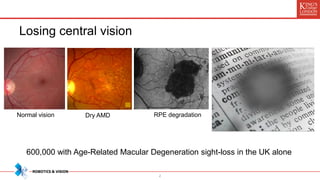
Losing central vision
2
600,000 with Age-Related Macular Degeneration sight-loss in the UK alone
Normal vision Dry AMD RPE degradation
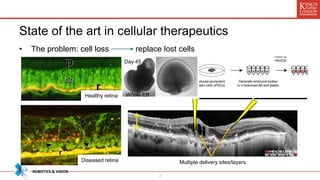
State of the art in cellular therapeutics
• The problem: cell loss replace lost cells
3
Day 45
Whole EB
Multiple delivery sites/layers
Healthy retina
Diseased retina
Challenge in manually delivering therapies
4
6
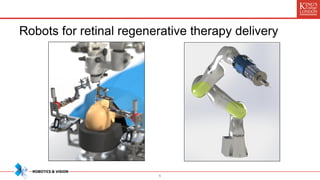
Robots for retinal regenerative therapy delivery
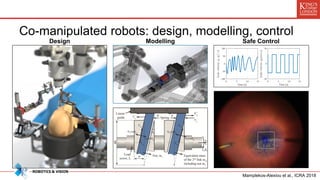
Modelling
Co-manipulated robots: design, modelling, control
Design Safe Control
Mamplekos-Alexiou et al., ICRA 2018
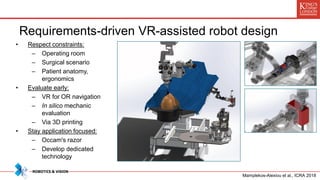
Requirements-driven VR-assisted robot design
• Respect constraints:
– Operating room
– Surgical scenario
– Patient anatomy,
ergonomics
• Evaluate early:
– VR for OR navigation
– In silico mechanic
evaluation
– Via 3D printing
• Stay application focused:
– Occam's razor
– Develop dedicated
technology
Mamplekos-Alexiou et al., ICRA 2018
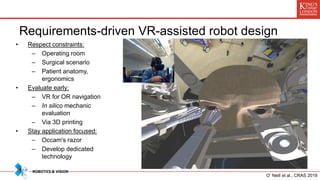
Requirements-driven VR-assisted robot design
• Respect constraints:
– Operating room
– Surgical scenario
– Patient anatomy,
ergonomics
• Evaluate early:
– VR for OR navigation
– In silico mechanic
evaluation
– Via 3D printing
• Stay application focused:
– Occam's razor
– Develop dedicated
technology
O’ Neill et al., CRAS 2019
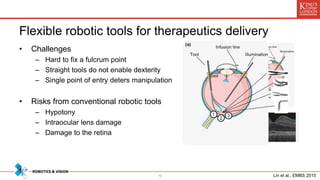
Flexible robotic tools for therapeutics delivery
• Challenges
– Hard to fix a fulcrum point
– Straight tools do not enable dexterity
– Single point of entry deters manipulation
• Risks from conventional robotic tools
– Hypotony
– Intraocular lens damage
– Damage to the retina
10 Lin et al., EMBS 2015
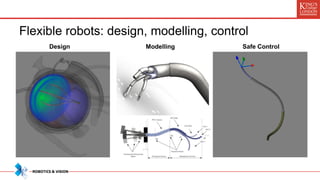
Modelling
Flexible robots: design, modelling, control
Design Safe Control
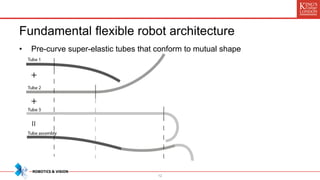
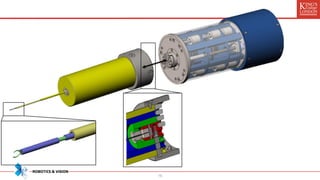
Fundamental flexible robot architecture
• Pre-curve super-elastic tubes that conform to mutual shape
12
Robot control via manipulability shaping
• Maximizing manipulability as a secondary task in robot control
13
With manipulability control Without manipulability control
Khadem et al. ICRA 2019, submitted
Katie Test Slides
15
16
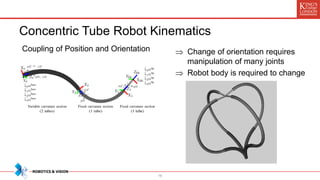
Concentric Tube Robot Kinematics
Coupling of Position and Orientation  Change of orientation requires
manipulation of many joints
 Robot body is required to change
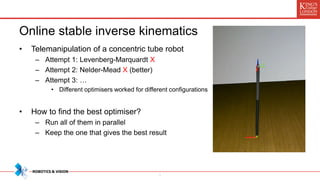
Online stable inverse kinematics
• Telemanipulation of a concentric tube robot
– Attempt 1: Levenberg-Marquardt X
– Attempt 2: Nelder-Mead X (better)
– Attempt 3: …
• Different optimisers worked for different configurations
• How to find the best optimiser?
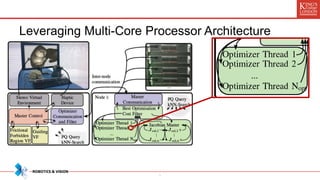
– Run all of them in parallel
– Keep the one that gives the best result
*
Leveraging Multi-Core Processor Architecture
*
21
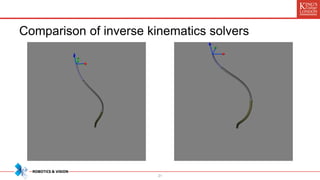
Comparison of inverse kinematics solvers
22
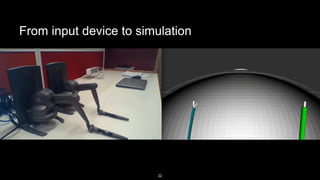
From input device to simulation
23
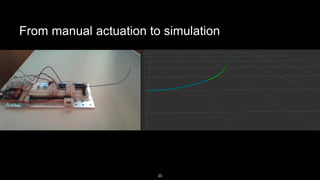
From manual actuation to simulation
25
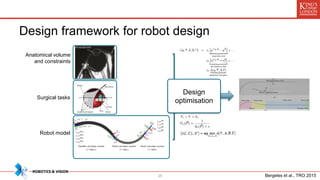
Design framework for robot design
Robot model
Design
optimisation
Surgical tasks
Anatomical volume
and constraints
Bergeles et al., TRO 2015
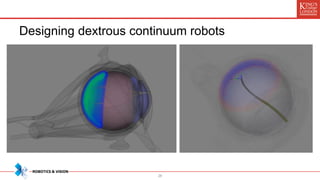
Designing dextrous continuum robots
26
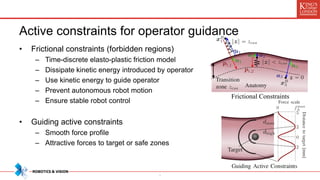
Active constraints for operator guidance
*
• Frictional constraints (forbidden regions)
– Time-discrete elasto-plastic friction model
– Dissipate kinetic energy introduced by operator
– Use kinetic energy to guide operator
– Prevent autonomous robot motion
– Ensure stable robot control
• Guiding active constraints
– Smooth force profile
– Attractive forces to target or safe zones
Frictional Constraints
Summary
• Development of systems each with different advantages
– Co-manipulated system
• Ease of integration in clinical workflow
• Direct clinical supervision
• Enhances dexterity but still constrained by remote centre of motion
– Single arm flexible system
• Dexterity akin to a micro-sized wrist
• Increased capacity for challenging interventions
• Counterintuitive control
28
Image-guided vitreoretinal robots:
Micro-precise systems for retinal therapy delivery
@rvimlab
www.rvim.online

Development of micro precise robotic systems for retinal therapy delivery

  • 1.
    Image-guided vitreoretinal robots: Micro-precisesystems for retinal therapy delivery Christos Bergeles Robotics and Vision in Medicine Lab School of Biomedical Engineering and Imaging Sciences King’s College London In collaboration with Moorfields Eye Hospital and UCL Institute of Ophthalmology
  • 2.
    Losing central vision 2 600,000with Age-Related Macular Degeneration sight-loss in the UK alone Normal vision Dry AMD RPE degradation
  • 3.
    State of theart in cellular therapeutics • The problem: cell loss replace lost cells 3 Day 45 Whole EB Multiple delivery sites/layers Healthy retina Diseased retina
  • 4.
    Challenge in manuallydelivering therapies 4
  • 5.
    6 Robots for retinalregenerative therapy delivery
  • 6.
    Modelling Co-manipulated robots: design,modelling, control Design Safe Control Mamplekos-Alexiou et al., ICRA 2018
  • 7.
    Requirements-driven VR-assisted robotdesign • Respect constraints: – Operating room – Surgical scenario – Patient anatomy, ergonomics • Evaluate early: – VR for OR navigation – In silico mechanic evaluation – Via 3D printing • Stay application focused: – Occam's razor – Develop dedicated technology Mamplekos-Alexiou et al., ICRA 2018
  • 8.
    Requirements-driven VR-assisted robotdesign • Respect constraints: – Operating room – Surgical scenario – Patient anatomy, ergonomics • Evaluate early: – VR for OR navigation – In silico mechanic evaluation – Via 3D printing • Stay application focused: – Occam's razor – Develop dedicated technology O’ Neill et al., CRAS 2019
  • 9.
    Flexible robotic toolsfor therapeutics delivery • Challenges – Hard to fix a fulcrum point – Straight tools do not enable dexterity – Single point of entry deters manipulation • Risks from conventional robotic tools – Hypotony – Intraocular lens damage – Damage to the retina 10 Lin et al., EMBS 2015
  • 10.
    Modelling Flexible robots: design,modelling, control Design Safe Control
  • 11.
    Fundamental flexible robotarchitecture • Pre-curve super-elastic tubes that conform to mutual shape 12
  • 12.
    Robot control viamanipulability shaping • Maximizing manipulability as a secondary task in robot control 13 With manipulability control Without manipulability control Khadem et al. ICRA 2019, submitted
  • 13.
  • 14.
  • 15.
    16 Concentric Tube RobotKinematics Coupling of Position and Orientation  Change of orientation requires manipulation of many joints  Robot body is required to change
  • 16.
    Online stable inversekinematics • Telemanipulation of a concentric tube robot – Attempt 1: Levenberg-Marquardt X – Attempt 2: Nelder-Mead X (better) – Attempt 3: … • Different optimisers worked for different configurations • How to find the best optimiser? – Run all of them in parallel – Keep the one that gives the best result *
  • 17.
  • 18.
    21 Comparison of inversekinematics solvers
  • 19.
    22 From input deviceto simulation
  • 20.
  • 22.
    25 Design framework forrobot design Robot model Design optimisation Surgical tasks Anatomical volume and constraints Bergeles et al., TRO 2015
  • 23.
  • 24.
    Active constraints foroperator guidance * • Frictional constraints (forbidden regions) – Time-discrete elasto-plastic friction model – Dissipate kinetic energy introduced by operator – Use kinetic energy to guide operator – Prevent autonomous robot motion – Ensure stable robot control • Guiding active constraints – Smooth force profile – Attractive forces to target or safe zones Frictional Constraints
  • 25.
    Summary • Development ofsystems each with different advantages – Co-manipulated system • Ease of integration in clinical workflow • Direct clinical supervision • Enhances dexterity but still constrained by remote centre of motion – Single arm flexible system • Dexterity akin to a micro-sized wrist • Increased capacity for challenging interventions • Counterintuitive control 28
  • 26.
    Image-guided vitreoretinal robots: Micro-precisesystems for retinal therapy delivery @rvimlab www.rvim.online