I
r
I
I
UNITeO NATIONS EDUCATIONAL, SCIENTIFIC AND CULTURAL ORGANIZATION
Development
of Educational Technology
in Central
and Eastern Europe
Studies
Division of Structures, Content, Methods
and Techniques of Education
Section of Methods, P_1 terials and Techniques
ED-77/WS/133
Paris, November 1977
Original: English
MRsre~2'
r
i
(THIS IS A UNITED NATIONS
UNESCO PROJECT . U .N .
EDUCATIONAL, SCIENCE,
AND CULTURAL ORGANIZA-
TION, WHICH DIRECTS
AMERICAN EDUCATION
DUE TO OUR MEMBERSHIP
IN THE UNITED NATIONS .)
M tvy 1 Wkp~ a~j
	
E:).77f fs/1i i - pa!-," ,
,Qr-,
	
'1"
	
) S
	
Paris, November 1-77
or,*_V
kv
	
,
	
?nalish I
e-
+, o C ,
	
'"'
	
r"
Sat vv
	
t
•
	
D IQ'1G ~-`~ r 1 ~ It Q ~4 r- Ic~ ~ C
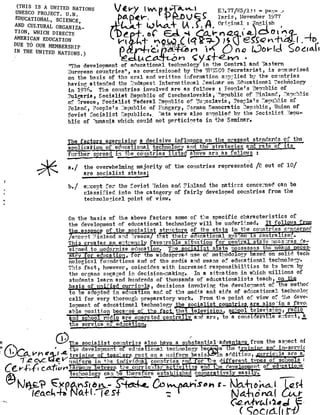
"The development of educational technology in the Central and ;astern
European countries", as cor~r°_issioned by the U1T3SCO Secretariat, is wimn .arised
on the basis of the oral and written information s p •-1ied b• the countries
having attended the ~,'udapes,. International Ceminar on dgcational Technology
in 1975. The countries involved are as follows t People's ?en..blic of
^ulgaria , Socialist Republic of Czechoslovakia, "'enublic of `'inland, "e' t blic
or reece, Socialist Federal Perltblie o!' `..ru .;oslavie, ?eo;.le's ."ient.t1 is of
Poland, People's _e zblic of -:ngary, "•srnan Democratic ;'enablic, Union of
Soviet Socialist em blics. . ;rata were also *,oplied by the Socialist . :_eru-
blic of -.mania which could not particin?te in the Seminar.
T, a gulm exercising a decisive influence on the present strndarc':s o" the
application of ed,tca iona7. ec no pair and the strategies a :i ra a o_ z s
£rrther spread in rFe countries
	
s ed a •ove ara as followws
a ./ the overwhelming majority of the countries represented /H out of 10/
are socialist states ;,
b ./ eL:ceot for the Soviet 'Jnion and Finland the naticrs concerned can be
classi:"ied into -the category of fairly developed countries from the
technological point of view.
On the basis of the above factors some of t:--e specific characteristics of
the development of educational technology will be underlined . It f011 s from
e of the socialist s+r~ctt+re of the state in tine countries c'nrerned.
e-tcent inland an d Greece f__a'~ tth r 67, ?ca tona l s,r7 em i.s cep ra ize,: .
Thi creates an e::t•e_i_ly favo-arable si_tuatio fn	or centra state ncas. :res d.e-
'~'~let~s ed to z.odorrize education. T,'"osooc„ „s ate possesses the means neces ,
.
say
	
e pica ion or a widespra ,i use of meteiodology based on solid tech,
nolopica1 fo md?tions and of the media and means or edl.tcational technology.
This fact, however, coir_c •ides with increased responsibilities to 1e born by
the organs 3zngaged in ciecision-raking . In a sitration in which millions of
students learn and hundreds of thousands of educationalists teach, on
bag is of =i_ igd eurrivila , decisions involving the d.evelo-:ment of the method
o be adopted in e6?ca+.ion and of the media and aids of educational technoloE
call for very thorough preparatory work. From the point of view of the dcve-
he soclopment of educational technology
v .on, ratioable Vva_ti.on bWVse
	
'^
	
tha
	
s : of telr
n3 sc:001 x4dio are o erated contra
	
and ar-, to aaccc side ra _e e:..t
	
't a'er ,
t . a serv? ce o~ ed:tca won..
The socialist countries also have a substantial •advai arr from the aspect of
'
	
~',e develonmeh o ed:_ca 3 onal technology 'e
	
e ~e t
	
r -tc' ? n-sex •i('
VP) ,~'
	
training o
	
re^t on a unifona basis
	
_n addition, ,curric~1a are
T .~ ~G We- V +uniform in the individual coun rtes
	
e d' f rent t-1 as of scr.ools <
etze on t:^e ctirric•alar a t? vies an
	
':e ee e opnient of edui a ; o-la '
ec' y can bellshed co~;narativel ease • . ~_
.? ~C X
	
1St
	
_
	
~{x~c,-~,~t. (it s
	
c~.Nt s' a +n s - ~A+i D ~~.a.. I
	
Q S4
N +~
	
~
CW-r-+vc_( 44A .0 d
	
.40.
t Soc( ..(t
in
Kn
ve .r 1_r'L' rtant be. . t
n
them b long to the same a,", .-o-•t
for _nstai.ce, t_-.e National Centre ._or
:--acaUona_ ..ec:hno ogy, !e Tatiorial Pedagogical lnst(tute, t 1 le Teaching Aid
Producing and ;ales Comtany and the Textbook Publishhing _souse are all subor-
dira-`ed to the 1(inistry of 1 ducation/ i
	
much easier to estab sh coopera-
tion among t're- Yost of the rroblems arise
	
age
	
Production be-
cause« there are overlap-:'ngsgsi
	
iat are d=t 'f c:t.1t -to eliminate	ti_t .•. se the an-
te ris e-var% d w •--h roduction are s.•bord_n?ted to Ch..ffere"1t ministries .
or e:_ample, each of . the ilm s ios run v the differen m nictr:tes mare
their own e& cational :"ilm.s and so it may occur that several films are made
sim;ltaneo usly a' :ova one p~.rticu".ar su:b-act or theme. in an -effort to solve
or eliminate s~.+_c l and similar robleii_s t1--a
	
::ci°r_ti-''
Coordinating o Mcil for Maca •t Toleci,
In all t'•- e forms of activities th •ro
E7.77/{JS/li3 - rage 79
P:ris, November. 1977
Cr'.ninal : :.nglish
The organizational set tip of the a:: Ply of audio-v*.s:.al aids and materials
of vocational training is also easy to c'esc i:.e . ?elevar_t recearc.:: and plan-
ning are' the resnons bilities of the ?esearch Institute of Vocational Training
while production and distribution are in the hands of the Centre Supplying
Vocational Echools with Teaching Aids.
"Long distance" education is a comparatively new field and is the responsibi-
lity, in the first -ilace, of school radio and school television, h .:t t' a Na-
tio_nal Centre for : ducat osial '.ethnology is also engaged with relevant research : .
The activities carried on by most institutes are of several direction . The
National centre ''or :]dt;cational Technology is restponsible, for instance, for
designing and nrcdaci'ng the audio-visual Materials, while the Centre Supplying
Vocational Schools with Teaching :ids is zn charge of teir prod :L .tion and dis-
tritbution. In the case of school radio and school television both planning,
prod:•.;ticn and distr .uuzti on are in one hand . In the case of z;7 .1:~-•_o-visual ma-
terials and aids designed for Public education, more than one e1t?r? ri.se s en-
gaged with production, since -the •?rodi:ction of the zero series is the respon-
sibility of t: .e National Centre :'or Cducationl ^eclmoloa,r and serial Produc-
tion i s i n •"__e hands of the Teaching Aid Producing and Sales Corn-any. In t1he
field of vocz.'tiona training the Centre Supplying Vocational Schools with Tea-
ching Aids 's in charge of producing, distributing and borrowing, teaming aids .
f
The schools are given credit centrally by the hini stry of education for making
their purchases o n. the basis of the list of teaching aids compiled by the
1cini stry o 73duca -don; they can also borrow audio-visual materials and aids
rom the '?:~cTanest Pedagogical Institute, tae County ;Film Archives which are
stbord .nate3. to the local municipal council .
s o:. Tt 1 n a7 eme w _th the other ministers . The ?-rational
Centre for sducatio:.a._ ' echnology is in otach with all t~e" m""` stries and a
number of national i;:1s'tat..tioro throagiI Ii ::w' Mah-_irg 't possible to coordi-U
nate t:-!e prodvtc Yo of oftware not only within %esp_i"'"'Ere` '_ a E"^orz y o: t'_~.e
sni.stry of ,ducation but also within that c•T the other ministries.
l~(aSfR
(aPgrrni
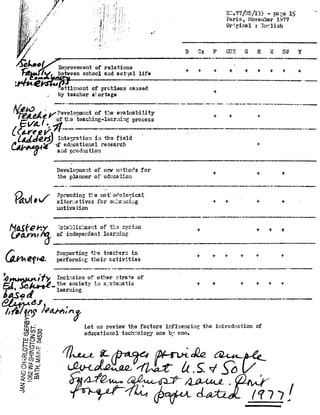
Improvement of relations
between school and act .a l life
17
ett1:a?iant of problems caused
by teacher s' .prtage
PeveIoq moat of the evaluuabi'!ity
reAaer V +1 (1
teacU-t nv-1e4rai:zg process
C Integration i:2 the field
d' educational research
and nrodnctio_i
Develot ia :2t of neiq
	
tso :'s for
Spreading t` e meet' oc'olo?ical
altcr_:ativcs for
motivation
;s•ta:1is :ice__t of th ayct3m
of independent learning
Sup-porting +:'.-e teac''.ero in
fi4 performing their Giivitiss
+
+
+
+
~.77i1S/l33 - pace 15
Paris , 1•Iovetaber 1977
Or;.ginal : ar_r-1ish
+
	
+
	
+
+
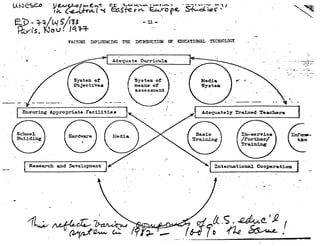
Let us review the factors influencing the ir~trockiction of
educational technology one b;r one,
G H 3 S(1 Y
+ +
	
+
	
+
	
+ + + +
	
+
+
	
+
	
+
+ + +
the planner ofeducation
fy Inclusion o;' other .^.tra+a of
L,
	
,Q_ the society in s_: stemstic
1ear~zing
a.Sg c~
M 0'
,
CI)
m
o _ GY C!! S
~714~nm~
	
l`f77~
~"" ~
	
~( _~-~o p {"~.~ ~*
	
L.
fir p%
	
o
LZ (.t /:-i4. T 4 U-616- 1
	
s
	
-~+
	
r
- -~-/w/i ;5C' t
91
FACTORS INFLUENCING TAE D
	
UCTION OF EDUCATIOAL TECHNOIAGT
I
ensuring appropriate Facilities
Reseascc $ad Development
Adea_uately T_-ained Teachers
I
I	
Interaatlonal Cooperation
	 I

Development of educational_technology_in_central_and_eastern_europe-un_study-1977-5pgs-edu

  • 1.
    I r I I UNITeO NATIONS EDUCATIONAL,SCIENTIFIC AND CULTURAL ORGANIZATION Development of Educational Technology in Central and Eastern Europe Studies Division of Structures, Content, Methods and Techniques of Education Section of Methods, P_1 terials and Techniques ED-77/WS/133 Paris, November 1977 Original: English MRsre~2' r
  • 2.
    i (THIS IS AUNITED NATIONS UNESCO PROJECT . U .N . EDUCATIONAL, SCIENCE, AND CULTURAL ORGANIZA- TION, WHICH DIRECTS AMERICAN EDUCATION DUE TO OUR MEMBERSHIP IN THE UNITED NATIONS .) M tvy 1 Wkp~ a~j E:).77f fs/1i i - pa!-," , ,Qr-, '1" ) S Paris, November 1-77 or,*_V kv , ?nalish I e- +, o C , '"' r" Sat vv t • D IQ'1G ~-`~ r 1 ~ It Q ~4 r- Ic~ ~ C "The development of educational technology in the Central and ;astern European countries", as cor~r°_issioned by the U1T3SCO Secretariat, is wimn .arised on the basis of the oral and written information s p •-1ied b• the countries having attended the ~,'udapes,. International Ceminar on dgcational Technology in 1975. The countries involved are as follows t People's ?en..blic of ^ulgaria , Socialist Republic of Czechoslovakia, "'enublic of `'inland, "e' t blic or reece, Socialist Federal Perltblie o!' `..ru .;oslavie, ?eo;.le's ."ient.t1 is of Poland, People's _e zblic of -:ngary, "•srnan Democratic ;'enablic, Union of Soviet Socialist em blics. . ;rata were also *,oplied by the Socialist . :_eru- blic of -.mania which could not particin?te in the Seminar. T, a gulm exercising a decisive influence on the present strndarc':s o" the application of ed,tca iona7. ec no pair and the strategies a :i ra a o_ z s £rrther spread in rFe countries s ed a •ove ara as followws a ./ the overwhelming majority of the countries represented /H out of 10/ are socialist states ;, b ./ eL:ceot for the Soviet 'Jnion and Finland the naticrs concerned can be classi:"ied into -the category of fairly developed countries from the technological point of view. On the basis of the above factors some of t:--e specific characteristics of the development of educational technology will be underlined . It f011 s from e of the socialist s+r~ctt+re of the state in tine countries c'nrerned. e-tcent inland an d Greece f__a'~ tth r 67, ?ca tona l s,r7 em i.s cep ra ize,: . Thi creates an e::t•e_i_ly favo-arable si_tuatio fn or centra state ncas. :res d.e- '~'~let~s ed to z.odorrize education. T,'"osooc„ „s ate possesses the means neces , . say e pica ion or a widespra ,i use of meteiodology based on solid tech, nolopica1 fo md?tions and of the media and means or edl.tcational technology. This fact, however, coir_c •ides with increased responsibilities to 1e born by the organs 3zngaged in ciecision-raking . In a sitration in which millions of students learn and hundreds of thousands of educationalists teach, on bag is of =i_ igd eurrivila , decisions involving the d.evelo-:ment of the method o be adopted in e6?ca+.ion and of the media and aids of educational technoloE call for very thorough preparatory work. From the point of view of the dcve- he soclopment of educational technology v .on, ratioable Vva_ti.on bWVse '^ tha s : of telr n3 sc:001 x4dio are o erated contra and ar-, to aaccc side ra _e e:..t 't a'er , t . a serv? ce o~ ed:tca won.. The socialist countries also have a substantial •advai arr from the aspect of ' ~',e develonmeh o ed:_ca 3 onal technology 'e e ~e t r -tc' ? n-sex •i(' VP) ,~' training o re^t on a unifona basis _n addition, ,curric~1a are T .~ ~G We- V +uniform in the individual coun rtes e d' f rent t-1 as of scr.ools < etze on t:^e ctirric•alar a t? vies an ':e ee e opnient of edui a ; o-la ' ec' y can bellshed co~;narativel ease • . ~_ .? ~C X 1St _ ~{x~c,-~,~t. (it s c~.Nt s' a +n s - ~A+i D ~~.a.. I Q S4 N +~ ~ CW-r-+vc_( 44A .0 d .40. t Soc( ..(t
  • 3.
    in Kn ve .r 1_r'L'rtant be. . t n them b long to the same a,", .-o-•t for _nstai.ce, t_-.e National Centre ._or :--acaUona_ ..ec:hno ogy, !e Tatiorial Pedagogical lnst(tute, t 1 le Teaching Aid Producing and ;ales Comtany and the Textbook Publishhing _souse are all subor- dira-`ed to the 1(inistry of 1 ducation/ i much easier to estab sh coopera- tion among t're- Yost of the rroblems arise age Production be- cause« there are overlap-:'ngsgsi iat are d=t 'f c:t.1t -to eliminate ti_t .•. se the an- te ris e-var% d w •--h roduction are s.•bord_n?ted to Ch..ffere"1t ministries . or e:_ample, each of . the ilm s ios run v the differen m nictr:tes mare their own e& cational :"ilm.s and so it may occur that several films are made sim;ltaneo usly a' :ova one p~.rticu".ar su:b-act or theme. in an -effort to solve or eliminate s~.+_c l and similar robleii_s t1--a ::ci°r_ti-'' Coordinating o Mcil for Maca •t Toleci, In all t'•- e forms of activities th •ro E7.77/{JS/li3 - rage 79 P:ris, November. 1977 Cr'.ninal : :.nglish The organizational set tip of the a:: Ply of audio-v*.s:.al aids and materials of vocational training is also easy to c'esc i:.e . ?elevar_t recearc.:: and plan- ning are' the resnons bilities of the ?esearch Institute of Vocational Training while production and distribution are in the hands of the Centre Supplying Vocational Echools with Teaching Aids. "Long distance" education is a comparatively new field and is the responsibi- lity, in the first -ilace, of school radio and school television, h .:t t' a Na- tio_nal Centre for : ducat osial '.ethnology is also engaged with relevant research : . The activities carried on by most institutes are of several direction . The National centre ''or :]dt;cational Technology is restponsible, for instance, for designing and nrcdaci'ng the audio-visual Materials, while the Centre Supplying Vocational Schools with Teaching :ids is zn charge of teir prod :L .tion and dis- tritbution. In the case of school radio and school television both planning, prod:•.;ticn and distr .uuzti on are in one hand . In the case of z;7 .1:~-•_o-visual ma- terials and aids designed for Public education, more than one e1t?r? ri.se s en- gaged with production, since -the •?rodi:ction of the zero series is the respon- sibility of t: .e National Centre :'or Cducationl ^eclmoloa,r and serial Produc- tion i s i n •"__e hands of the Teaching Aid Producing and Sales Corn-any. In t1he field of vocz.'tiona training the Centre Supplying Vocational Schools with Tea- ching Aids 's in charge of producing, distributing and borrowing, teaming aids . f The schools are given credit centrally by the hini stry of education for making their purchases o n. the basis of the list of teaching aids compiled by the 1cini stry o 73duca -don; they can also borrow audio-visual materials and aids rom the '?:~cTanest Pedagogical Institute, tae County ;Film Archives which are stbord .nate3. to the local municipal council . s o:. Tt 1 n a7 eme w _th the other ministers . The ?-rational Centre for sducatio:.a._ ' echnology is in otach with all t~e" m""` stries and a number of national i;:1s'tat..tioro throagiI Ii ::w' Mah-_irg 't possible to coordi-U nate t:-!e prodvtc Yo of oftware not only within %esp_i"'"'Ere` '_ a E"^orz y o: t'_~.e sni.stry of ,ducation but also within that c•T the other ministries.
  • 4.
    l~(aSfR (aPgrrni Improvement of relations betweenschool and act .a l life 17 ett1:a?iant of problems caused by teacher s' .prtage PeveIoq moat of the evaluuabi'!ity reAaer V +1 (1 teacU-t nv-1e4rai:zg process C Integration i:2 the field d' educational research and nrodnctio_i Develot ia :2t of neiq tso :'s for Spreading t` e meet' oc'olo?ical altcr_:ativcs for motivation ;s•ta:1is :ice__t of th ayct3m of independent learning Sup-porting +:'.-e teac''.ero in fi4 performing their Giivitiss + + + + ~.77i1S/l33 - pace 15 Paris , 1•Iovetaber 1977 Or;.ginal : ar_r-1ish + + + + Let us review the factors influencing the ir~trockiction of educational technology one b;r one, G H 3 S(1 Y + + + + + + + + + + + + + + + the planner ofeducation fy Inclusion o;' other .^.tra+a of L, ,Q_ the society in s_: stemstic 1ear~zing a.Sg c~ M 0' , CI) m o _ GY C!! S ~714~nm~ l`f77~
  • 5.
    ~"" ~ ~( _~-~op {"~.~ ~* L. fir p% o LZ (.t /:-i4. T 4 U-616- 1 s -~+ r - -~-/w/i ;5C' t 91 FACTORS INFLUENCING TAE D UCTION OF EDUCATIOAL TECHNOIAGT I ensuring appropriate Facilities Reseascc $ad Development Adea_uately T_-ained Teachers I I Interaatlonal Cooperation I