Development of Diaphragm
AN. 52.5
Diaphragm
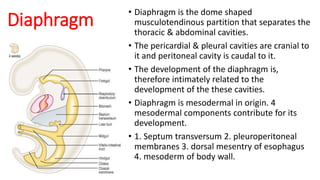
• Diaphragm is the dome shaped
musculotendinous partition that separates the
thoracic & abdominal cavities.
• The pericardial & pleural cavities are cranial to
it and peritoneal cavity is caudal to it.
• The development of the diaphragm is,
therefore intimately related to the
development of the these cavities.
• Diaphragm is mesodermal in origin. 4
mesodermal components contribute for its
development.
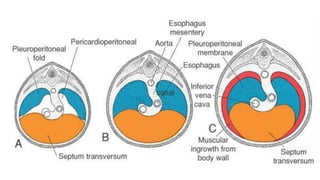
• 1. Septum transversum 2. pleuroperitoneal
membranes 3. dorsal mesentry of esophagus
4. mesoderm of body wall.
Component of
Diaphragm
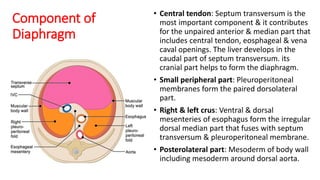
• Central tendon: Septum transversum is the
most important component & it contributes
for the unpaired anterior & median part that
includes central tendon, eosphageal & vena
caval openings. The liver develops in the
caudal part of septum transversum. its
cranial part helps to form the diaphragm.
• Small peripheral part: Pleuroperitoneal
membranes form the paired dorsolateral
part.
• Right & left crus: Ventral & dorsal
mesenteries of esophagus form the irregular
dorsal median part that fuses with septum
transversum & pleuroperitoneal membrane.
• Posterolateral part: Mesoderm of body wall
including mesoderm around dorsal aorta.
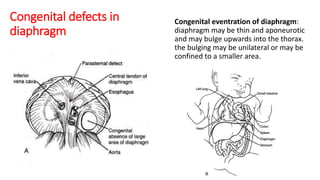
Congenital defects
in diaphragm
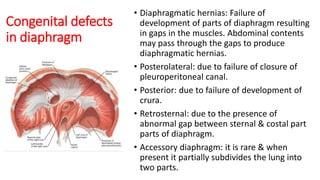
• Diaphragmatic hernias: Failure of
development of parts of diaphragm resulting
in gaps in the muscles. Abdominal contents
may pass through the gaps to produce
diaphragmatic hernias.
• Posterolateral: due to failure of closure of
pleuroperitoneal canal.
• Posterior: due to failure of development of
crura.
• Retrosternal: due to the presence of
abnormal gap between sternal & costal part
parts of diaphragm.
• Accessory diaphragm: it is rare & when
present it partially subdivides the lung into
two parts.
Congenital defects in
diaphragm
Congenital eventration of diaphragm:
diaphragm may be thin and aponeurotic
and may bulge upwards into the thorax.
the bulging may be unilateral or may be
confined to a smaller area.
Development of Diaphragm.pptx

Development of Diaphragm.pptx

  • 1.
  • 2.
    Diaphragm • Diaphragm isthe dome shaped musculotendinous partition that separates the thoracic & abdominal cavities. • The pericardial & pleural cavities are cranial to it and peritoneal cavity is caudal to it. • The development of the diaphragm is, therefore intimately related to the development of the these cavities. • Diaphragm is mesodermal in origin. 4 mesodermal components contribute for its development. • 1. Septum transversum 2. pleuroperitoneal membranes 3. dorsal mesentry of esophagus 4. mesoderm of body wall.
  • 3.
    Component of Diaphragm • Centraltendon: Septum transversum is the most important component & it contributes for the unpaired anterior & median part that includes central tendon, eosphageal & vena caval openings. The liver develops in the caudal part of septum transversum. its cranial part helps to form the diaphragm. • Small peripheral part: Pleuroperitoneal membranes form the paired dorsolateral part. • Right & left crus: Ventral & dorsal mesenteries of esophagus form the irregular dorsal median part that fuses with septum transversum & pleuroperitoneal membrane. • Posterolateral part: Mesoderm of body wall including mesoderm around dorsal aorta.
  • 4.
    Congenital defects in diaphragm •Diaphragmatic hernias: Failure of development of parts of diaphragm resulting in gaps in the muscles. Abdominal contents may pass through the gaps to produce diaphragmatic hernias. • Posterolateral: due to failure of closure of pleuroperitoneal canal. • Posterior: due to failure of development of crura. • Retrosternal: due to the presence of abnormal gap between sternal & costal part parts of diaphragm. • Accessory diaphragm: it is rare & when present it partially subdivides the lung into two parts.
  • 5.
    Congenital defects in diaphragm Congenitaleventration of diaphragm: diaphragm may be thin and aponeurotic and may bulge upwards into the thorax. the bulging may be unilateral or may be confined to a smaller area.