











IEEE 3rd Latin-American Conference on
Communications – LATINCOM 2011

Development and Evaluation of
Energy-Efficient and Adaptive Protocols
for Wireless Sensor Networks

Torsten Braun, Universität Bern, Switzerland
braun@iam.unibe.ch, rvs.unibe.ch

joint work with many other persons, see publications
Torsten Braun: Development and Evaluation of Energy-Efficient and Adaptive Protocols for Wireless Sensor Networks


       Overview


      >      Introduction
              — Wireless Sensor Network Applications and Application Requirements
              — Design, Implementation, Evaluation of WSN Protocols
      >      Experimentation Platform for WSN Research
              — Wireless Sensor Network Testbed
              — Software-Based Estimation of Energy Consumption
      >      WSN Research Experiments
              — Traffic-Adaptive and Energy-Efficient WSN MAC Protocol
              — Adaptive Forward Error Control in WSNs
      >      Conclusions
      >      Outlook: Mobility Support


       Belém, October 24, 2011                                                                                      2
Torsten Braun: Development and Evaluation of Energy-Efficient and Adaptive Protocols for Wireless Sensor Networks


       Wireless Sensor Network Applications


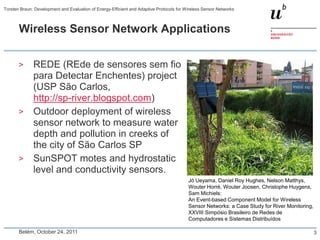
       >      REDE (REde de sensores sem fio
              para Detectar Enchentes) project
              (USP São Carlos,
              http://sp-river.blogspot.com)
       >      Outdoor deployment of wireless
              sensor network to measure water
              depth and pollution in creeks of
              the city of São Carlos SP
       >      SunSPOT motes and hydrostatic
              level and conductivity sensors.
                                                                                          Jó Ueyama, Daniel Roy Hughes, Nelson Matthys,
                                                                                          Wouter Horré, Wouter Joosen, Christophe Huygens,
                                                                                          Sam Michiels:
                                                                                          An Event-based Component Model for Wireless
                                                                                          Sensor Networks: a Case Study for River Monitoring,
                                                                                          XXVIII Simpósio Brasileiro de Redes de
                                                                                          Computadores e Sistemas Distribuídos

       Belém, October 24, 2011                                                                                                                  3
Torsten Braun: Development and Evaluation of Energy-Efficient and Adaptive Protocols for Wireless Sensor Networks


       Wireless Sensor Network Applications


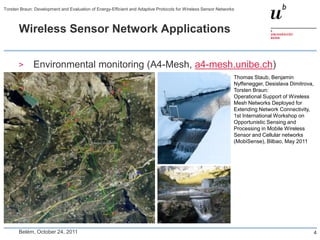
       >      Environmental monitoring (A4-Mesh, a4-mesh.unibe.ch)
                                                                                                                Thomas Staub, Benjamin
                                                                                                                Nyffenegger, Desislava Dimitrova,
                                                                                                                Torsten Braun:
                                                                                                                Operational Support of Wireless
                                                                                                                Mesh Networks Deployed for
                                                                                                                Extending Network Connectivity,
                                                                                                                1st International Workshop on
                                                                                                                Opportunistic Sensing and
                                                                                                                Processing in Mobile Wireless
                                                                                                                Sensor and Cellular networks
                                                                                                                (MobiSense), Bilbao, May 2011


       Belém, October 24, 2011                                                                                                                  4
Torsten Braun: Development and Evaluation of Energy-Efficient and Adaptive Protocols for Wireless Sensor Networks


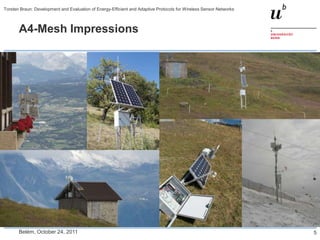
       A4-Mesh Impressions


       Belém, October 24, 2011                                                                                      5
Torsten Braun: Development and Evaluation of Energy-Efficient and Adaptive Protocols for Wireless Sensor Networks


       Wireless Sensor Network Applications

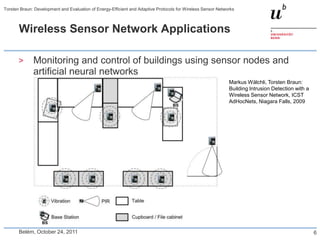
       >      Monitoring and control of buildings using sensor nodes and
              artificial neural networks
                                                                                                              Markus Wälchli, Torsten Braun:
                                                                                                              Building Intrusion Detection with a
                                                                                                              Wireless Sensor Network, ICST
                                                                                                              AdHocNets, Niagara Falls, 2009


       Belém, October 24, 2011                                                                                                                      6
Torsten Braun: Development and Evaluation of Energy-Efficient and Adaptive Protocols for Wireless Sensor Networks


       Application Requirements


       >      Energy-efficient operation
       >      Low delays
       >      Reliability
       >      Adaptivity to varying link characteristics and traffic load


       Belém, October 24, 2011                                                                                      7
Torsten Braun: Development and Evaluation of Energy-Efficient and Adaptive Protocols for Wireless Sensor Networks


       Design, Implementation, and Evaluation
       of Wireless Sensor Network Protocols
       >      Simulations are only meaningful with accurate calibration of
              parameters, e.g., energy consumption, transmission
              characteristics, traffic models.
       >      Experiments in testbeds give insights about protocol behaviour
              in more realistic scenarios and system-related issues,
              but face several problems
               —     Experiment control
               —     Scalability
               —     Reproducability
               —     Energy measurements
               —     Mobility


       Belém, October 24, 2011                                                                                      8
Wireless Sensor Network Testbed
Torsten Braun: Development and Evaluation of Energy-Efficient and Adaptive Protocols for Wireless Sensor Networks


       Wireless Sensor Network Testbed
       (WISEBED)
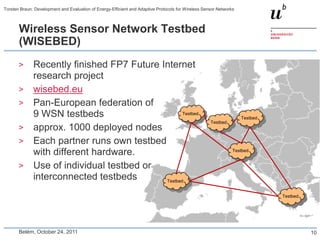
       >      Recently finished FP7 Future Internet
              research project
       >      wisebed.eu
       >      Pan-European federation of
              9 WSN testbeds                       Testbed
                                                                                                                    Testbed
                                                                                                     Testbed
       >      approx. 1000 deployed nodes
       >      Each partner runs own testbed
              with different hardware.                                                                          Testbed


       >      Use of individual testbed or
              interconnected testbeds       Testbed


                                                                                                                              Testbed


       Belém, October 24, 2011                                                                                                          10
Torsten Braun: Development and Evaluation of Energy-Efficient and Adaptive Protocols for Wireless Sensor Networks


       General Testbed Infrastructure


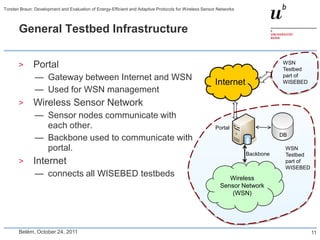
       >      Portal                                                                                                           WSN
                                                                                                                               Testbed
               — Gateway between Internet and WSN                                                                              part of
                                                                                                       Internet                WISEBED
               — Used for WSN management
       >      Wireless Sensor Network
               — Sensor nodes communicate with
                 each other.                                                                           Portal

               — Backbone used to communicate with                                                                             DB

                 portal.                                                                                                        WSN
                                                                                                                    Backbone    Testbed
       >      Internet                                                                                                          part of
                                                                                                                                WISEBED
               — connects all WISEBED testbeds                                                               Wireless
                                                                                                          Sensor Network
                                                                                                              (WSN)


       Belém, October 24, 2011                                                                                                            11
Torsten Braun: Development and Evaluation of Energy-Efficient and Adaptive Protocols for Wireless Sensor Networks


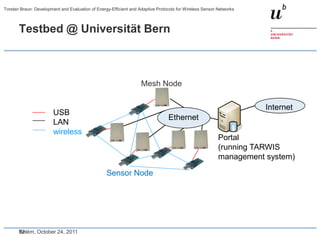
       Testbed @ Universität Bern


                                                                   Mesh Node

                                                                                                                    Internet
                        USB
                                                                                Ethernet
                        LAN
                        wireless
                                                                                                         Portal
                                                                                                         (running TARWIS
                                                                                                         management system)

                                                  Sensor Node


       Belém, October 24, 2011
       12
Torsten Braun: Development and Evaluation of Energy-Efficient and Adaptive Protocols for Wireless Sensor Networks


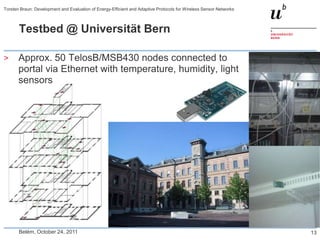
       Testbed @ Universität Bern

>      Approx. 50 TelosB/MSB430 nodes connected to
       portal via Ethernet with temperature, humidity, light
       sensors


       Belém, October 24, 2011                                                                                      13
Torsten Braun: Development and Evaluation of Energy-Efficient and Adaptive Protocols for Wireless Sensor Networks


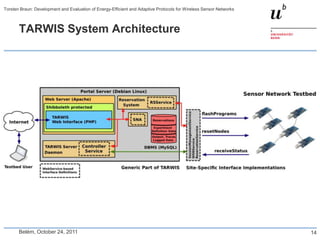
       TARWIS System Architecture


       Belém, October 24, 2011                                                                                      14
Torsten Braun: Development and Evaluation of Energy-Efficient and Adaptive Protocols for Wireless Sensor Networks


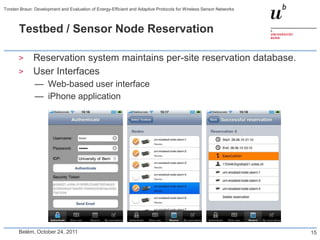
       Testbed / Sensor Node Reservation

       >      Reservation system maintains per-site reservation database.
       >      User Interfaces
               — Web-based user interface
               — iPhone application


       Belém, October 24, 2011                                                                                      15
Torsten Braun: Development and Evaluation of Energy-Efficient and Adaptive Protocols for Wireless Sensor Networks


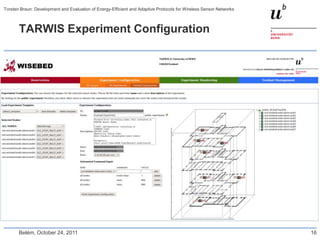
       TARWIS Experiment Configuration


       Belém, October 24, 2011                                                                                      16
Torsten Braun: Development and Evaluation of Energy-Efficient and Adaptive Protocols for Wireless Sensor Networks


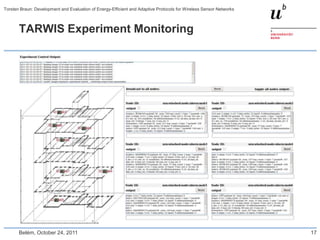
       TARWIS Experiment Monitoring


       Belém, October 24, 2011                                                                                      17
Torsten Braun: Development and Evaluation of Energy-Efficient and Adaptive Protocols for Wireless Sensor Networks


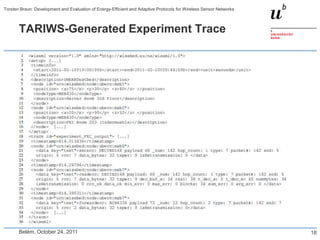
       TARIWS-Generated Experiment Trace


       Belém, October 24, 2011                                                                                      18
Software-Based Estimation of
Energy Consumption
Torsten Braun: Development and Evaluation of Energy-Efficient and Adaptive Protocols for Wireless Sensor Networks


       Software-Based Estimation of
       Energy Consumption
       >      Problem:
              Equipment of sensor nodes with measurement hardware is
               — very expensive.
               — difficult in out-door environments / real-world deployments.
               — not sufficient to support energy awareness.
                       –     Energy awareness: Application / system adapts operation in order
                             to meet energy consumption constraints.
       >      Solution:
              Software-based energy measurement
              (calibration of software-based model using measurement
              hardware)


       Belém, October 24, 2011                                                                                      20
Torsten Braun: Development and Evaluation of Energy-Efficient and Adaptive Protocols for Wireless Sensor Networks


       Hardware-Based Energy Measurements


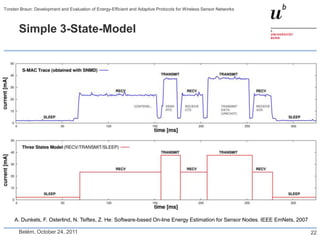
       >      Measurement of current draw and voltage using
              Sensor Network Management Devices (SNMD) from KIT


       Belém, October 24, 2011                                                                                      21
Torsten Braun: Development and Evaluation of Energy-Efficient and Adaptive Protocols for Wireless Sensor Networks


       Simple 3-State-Model


     A. Dunkels, F. Osterlind, N. Tsiftes, Z. He: Software-based On-line Energy Estimation for Sensor Nodes. IEEE EmNets, 2007

       Belém, October 24, 2011                                                                                                   22
Torsten Braun: Development and Evaluation of Energy-Efficient and Adaptive Protocols for Wireless Sensor Networks


       Measured vs. Estimated Energy Consumption

Approach: Measurement of current draw in different states and energy estimation by


       Belém, October 24, 2011                                                                                      23
Torsten Braun: Development and Evaluation of Energy-Efficient and Adaptive Protocols for Wireless Sensor Networks


       3-State-Model with State Transitions


        Revised estimation:
       Belém, October 24, 2011                                                                                      24
Torsten Braun: Development and Evaluation of Energy-Efficient and Adaptive Protocols for Wireless Sensor Networks


       Estimation Accuracy


                                                                            OLS: Ordinary Least Squares Regression Analysis


On the Accuracy of Software-based Energy Estimation Techniques. Philipp Hurni, Torsten Braun, Benjamin Nyffenegger,
Anton Hergenroeder: 8th European Conference on Wireless Sensor Networks (EWSN), Bonn, Germany, February 2011.
       Belém, October 24, 2011                                                                                                25
MaxMAC: Maximally Traffic-Adaptive and
Energy-Efficient WSN MAC Protocol
Torsten Braun: Development and Evaluation of Energy-Efficient and Adaptive Protocols for Wireless Sensor Networks


       MAC Protocols for Wireless Sensor Networks

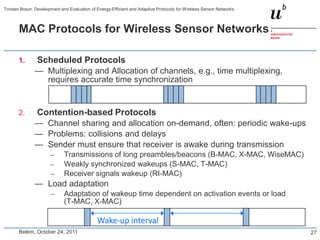
       1.       Scheduled Protocols
               — Multiplexing and Allocation of channels, e.g., time multiplexing,
                 requires accurate time synchronization


       2.       Contention-based Protocols
               — Channel sharing and allocation on-demand, often: periodic wake-ups
               — Problems: collisions and delays
               — Sender must ensure that receiver is awake during transmission
                       –     Transmissions of long preambles/beacons (B-MAC, X-MAC, WiseMAC)
                       –     Weakly synchronized wakeups (S-MAC, T-MAC)
                       –     Receiver signals wakeup (RI-MAC)
               — Load adaptation
                       –     Adaptation of wakeup time dependent on activation events or load
                             (T-MAC, X-MAC)

                                             Wake-up interval
       Belém, October 24, 2011                                                                                      27
Torsten Braun: Development and Evaluation of Energy-Efficient and Adaptive Protocols for Wireless Sensor Networks


       WiseMAC

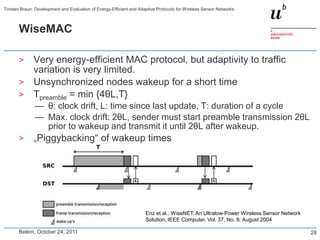
       >      Very energy-efficient MAC protocol, but adaptivity to traffic
              variation is very limited.
       >      Unsynchronized nodes wakeup for a short time
       >      Tpreamble = min {4θL,T}
               — θ: clock drift, L: time since last update, T: duration of a cycle
               — Max. clock drift: 2θL, sender must start preamble transmission 2θL
                 prior to wakeup and transmit it until 2θL after wakeup.
       >      „Piggybacking― of wakeup times


                                                                     Enz et al.: WiseNET: An Ultralow-Power Wireless Sensor Network
                                                                     Solution, IEEE Computer, Vol. 37, No. 8; August 2004

       Belém, October 24, 2011                                                                                                        28
Torsten Braun: Development and Evaluation of Energy-Efficient and Adaptive Protocols for Wireless Sensor Networks


        MaxMAC: a Maximally Traffic-Adaptive
        and Energy-Efficient WSN MAC Protocol
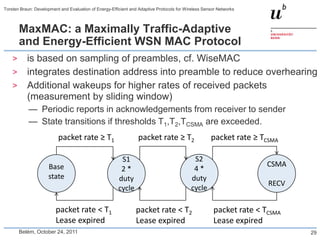
    >      is based on sampling of preambles, cf. WiseMAC
    >      integrates destination address into preamble to reduce overhearing
    >      Additional wakeups for higher rates of received packets
           (measurement by sliding window)
            — Periodic reports in acknowledgements from receiver to sender
            — State transitions if thresholds T1,T2,TCSMA are exceeded.
                          packet rate ≥ T1                       packet rate ≥ T2                    packet rate ≥ TCSMA

                                                         S1                                 S2
                     Base                                                                                            CSMA
                                                         2*                                 4*
                     state                              duty                               duty
                                                                                                                     RECV
                                                        cycle                              cycle

                         packet rate < T1                       packet rate < T2                      packet rate < TCSMA
                         Lease expired                          Lease expired                         Lease expired
        Belém, October 24, 2011                                                                                             29
Torsten Braun: Development and Evaluation of Energy-Efficient and Adaptive Protocols for Wireless Sensor Networks


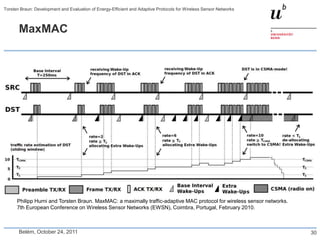
       MaxMAC


                                                                                                                    CSMA


      Philipp Hurni and Torsten Braun. MaxMAC: a maximally traffic-adaptive MAC protocol for wireless sensor networks.
      7th European Conference on Wireless Sensor Networks (EWSN), Coimbra, Portugal, February 2010.


       Belém, October 24, 2011                                                                                             30
Torsten Braun: Development and Evaluation of Energy-Efficient and Adaptive Protocols for Wireless Sensor Networks


       MaxMAC Implementation on MSB430

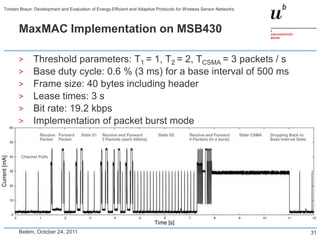
       >      Threshold parameters: T1 = 1, T2 = 2, TCSMA = 3 packets / s
       >      Base duty cycle: 0.6 % (3 ms) for a base interval of 500 ms
       >      Frame size: 40 bytes including header
       >      Lease times: 3 s
       >      Bit rate: 19.2 kbps
       >      Implementation of packet burst mode


       Belém, October 24, 2011                                                                                      31
Torsten Braun: Development and Evaluation of Energy-Efficient and Adaptive Protocols for Wireless Sensor Networks


       Implementation Experiences


       Implementation of MaxMAC on MSB430 using Scatterweb
       operating system raised several problems:
       > Inaccurate execution of timers,
          e.g., because of active event processing at timer expiration
          → somewhat earlier scheduling of timers
       > Overhearing avoidance has not been supported by node
          hardware.


       Belém, October 24, 2011                                                                                      32
Torsten Braun: Development and Evaluation of Energy-Efficient and Adaptive Protocols for Wireless Sensor Networks


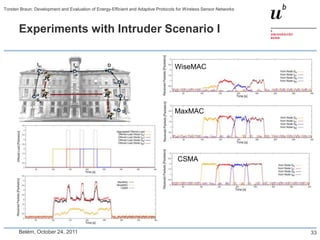
       Experiments with Intruder Scenario I


                                                                                   WiseMAC


                                                                                   MaxMAC


                                                                                     CSMA


       Belém, October 24, 2011                                                                                      33
Torsten Braun: Development and Evaluation of Energy-Efficient and Adaptive Protocols for Wireless Sensor Networks


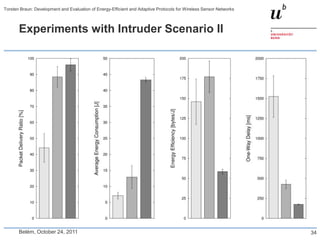
       Experiments with Intruder Scenario II


       Belém, October 24, 2011                                                                                      34
Adaptive Forward Error Correction
Torsten Braun: Development and Evaluation of Energy-Efficient and Adaptive Protocols for Wireless Sensor Networks


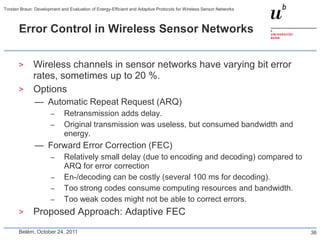
       Error Control in Wireless Sensor Networks


       >      Wireless channels in sensor networks have varying bit error
              rates, sometimes up to 20 %.
       >      Options
               — Automatic Repeat Request (ARQ)
                       –     Retransmission adds delay.
                       –     Original transmission was useless, but consumed bandwidth and
                             energy.
               — Forward Error Correction (FEC)
                       –     Relatively small delay (due to encoding and decoding) compared to
                             ARQ for error correction
                       –     En-/decoding can be costly (several 100 ms for decoding).
                       –     Too strong codes consume computing resources and bandwidth.
                       –     Too weak codes might not be able to correct errors.
       >      Proposed Approach: Adaptive FEC
       Belém, October 24, 2011                                                                                      36
Torsten Braun: Development and Evaluation of Energy-Efficient and Adaptive Protocols for Wireless Sensor Networks


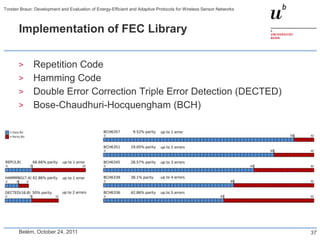
       Implementation of FEC Library


       >      Repetition Code
       >      Hamming Code
       >      Double Error Correction Triple Error Detection (DECTED)
       >      Bose-Chaudhuri-Hocquengham (BCH)


       Belém, October 24, 2011                                                                                      37
Torsten Braun: Development and Evaluation of Energy-Efficient and Adaptive Protocols for Wireless Sensor Networks


       Adaptive FEC

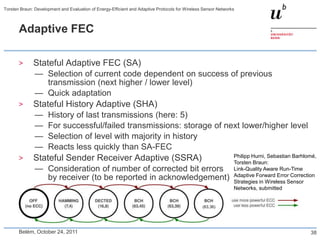
       >      Stateful Adaptive FEC (SA)
               — Selection of current code dependent on success of previous
                 transmission (next higher / lower level)
               — Quick adaptation
       >      Stateful History Adaptive (SHA)
               —     History of last transmissions (here: 5)
               —     For successful/failed transmissions: storage of next lower/higher level
               —     Selection of level with majority in history
               —     Reacts less quickly than SA-FEC
                                                                                                                Philipp Hurni, Sebastian Barhlomé,
       >      Stateful Sender Receiver Adaptive (SSRA)                                                          Torsten Braun:
               — Consideration of number of corrected bit errors                                                Link-Quality Aware Run-Time
                                                                                                                Adaptive Forward Error Correction
                 by receiver (to be reported in acknowledgement)                                                Strategies in Wireless Sensor
                                                                                                                Networks, submitted


                                                                                                 (63,36)


       Belém, October 24, 2011                                                                                                                 38
Torsten Braun: Development and Evaluation of Energy-Efficient and Adaptive Protocols for Wireless Sensor Networks


       Energy Consumption by FEC and ARQ


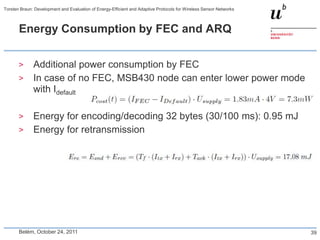
       >      Additional power consumption by FEC
       >      In case of no FEC, MSB430 node can enter lower power mode
              with Idefault

       >      Energy for encoding/decoding 32 bytes (30/100 ms): 0.95 mJ
       >      Energy for retransmission


       Belém, October 24, 2011                                                                                      39
Torsten Braun: Development and Evaluation of Energy-Efficient and Adaptive Protocols for Wireless Sensor Networks


       Wisebed Experiments


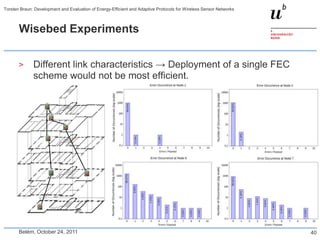
       >      Different link characteristics → Deployment of a single FEC
              scheme would not be most efficient.


       Belém, October 24, 2011                                                                                      40
Torsten Braun: Development and Evaluation of Energy-Efficient and Adaptive Protocols for Wireless Sensor Networks


       Static vs. Adaptive FEC

       >      Better error correction performance of
              adaptive FEC schemes than for static ones.
       >      Adaptive FEC advantages
               — Lower processing and energy costs
               — Lower bandwidth and lower interference
                 in multi-hop scenarios
               — Higher packet delivery rate
               — Adapt automatically to different
                 link characteristics


       Belém, October 24, 2011                                                                                      41
Torsten Braun: Development and Evaluation of Energy-Efficient and Adaptive Protocols for Wireless Sensor Networks


       Conclusions


       >      Contributions
               — Design and experimental evaluation of energy-efficient, reliable, and
                 adaptive protocols
       >      Experiences: Development and use of WSN testbed resulted in
               — More efficient use of hardware resources
               — Testbed experiments as easy as simulations
               — Repeatability and larger number of experiments
                 (statistical significance)
               — Reproducability of experiments and results
       >      Outlook
               — Several experiences (testbeds, protocols) to be applied in other
                 areas, e.g. wireless mesh and ad-hoc networks
               — Mobility support in wireless sensor / mesh network testbeds

       Belém, October 24, 2011                                                                                      42
Torsten Braun: Development and Evaluation of Energy-Efficient and Adaptive Protocols for Wireless Sensor Networks


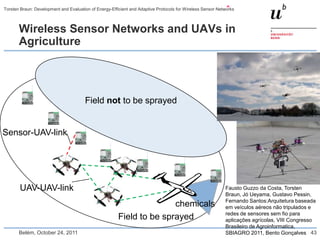
       Wireless Sensor Networks and UAVs in
       Agriculture


                                       Field not to be sprayed


Sensor-UAV-link


       UAV-UAV-link                                                                                         Fausto Guzzo da Costa, Torsten
                                                                                                            Braun, Jó Ueyama, Gustavo Pessin,
                                                                                                            Fernando Santos:Arquitetura baseada
                                                                       chemicals                            em veículos aéreos não tripulados e
                                                                                                            redes de sensores sem fio para
                                                        Field to be sprayed                                 aplicações agrícolas, VIII Congresso
                                                                                                            Brasileiro de Agroinformatica,
       Belém, October 24, 2011                                                                              SBIAGRO 2011, Bento Gonçalves 43
Torsten Braun: Development and Evaluation of Energy-Efficient and Adaptive Protocols for Wireless Sensor Networks


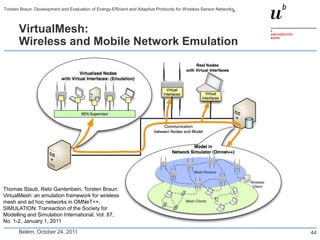
       VirtualMesh:
       Wireless and Mobile Network Emulation


Thomas Staub, Reto Gantenbein, Torsten Braun:
VirtualMesh: an emulation framework for wireless
mesh and ad hoc networks in OMNeT++,
SIMULATION: Transaction of the Society for
Modelling and Simulation International, Vol. 87,
No. 1-2, January 1, 2011

       Belém, October 24, 2011                                                                                      44
Torsten Braun: Development and Evaluation of Energy-Efficient and Adaptive Protocols for Wireless Sensor Networks


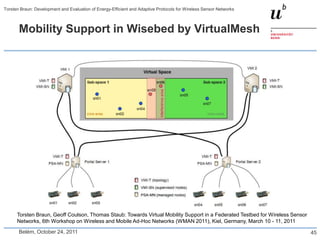
       Mobility Support in Wisebed by VirtualMesh


      Torsten Braun, Geoff Coulson, Thomas Staub: Towards Virtual Mobility Support in a Federated Testbed for Wireless Sensor
      Networks, 6th Workshop on Wireless and Mobile Ad-Hoc Networks (WMAN 2011), Kiel, Germany, March 10 - 11, 2011

       Belém, October 24, 2011                                                                                                  45
Torsten Braun: Development and Evaluation of Energy-Efficient and Adaptive Protocols for Wireless Sensor Networks


       Thanks for your attention !


       >      Contact: braun@iam.unibe.ch
       >      More information: rvs.unibe.ch


       Belém, October 24, 2011                                                                                      46

Development and Evaluation of Energy-Efficient and Adaptive Protocols for Wireless Sensor Networks

  • 1.
    IEEE 3rd Latin-AmericanConference on Communications – LATINCOM 2011 Development and Evaluation of Energy-Efficient and Adaptive Protocols for Wireless Sensor Networks Torsten Braun, Universität Bern, Switzerland braun@iam.unibe.ch, rvs.unibe.ch joint work with many other persons, see publications
  • 2.
    Torsten Braun: Developmentand Evaluation of Energy-Efficient and Adaptive Protocols for Wireless Sensor Networks Overview > Introduction — Wireless Sensor Network Applications and Application Requirements — Design, Implementation, Evaluation of WSN Protocols > Experimentation Platform for WSN Research — Wireless Sensor Network Testbed — Software-Based Estimation of Energy Consumption > WSN Research Experiments — Traffic-Adaptive and Energy-Efficient WSN MAC Protocol — Adaptive Forward Error Control in WSNs > Conclusions > Outlook: Mobility Support Belém, October 24, 2011 2
  • 3.
    Torsten Braun: Developmentand Evaluation of Energy-Efficient and Adaptive Protocols for Wireless Sensor Networks Wireless Sensor Network Applications > REDE (REde de sensores sem fio para Detectar Enchentes) project (USP São Carlos, http://sp-river.blogspot.com) > Outdoor deployment of wireless sensor network to measure water depth and pollution in creeks of the city of São Carlos SP > SunSPOT motes and hydrostatic level and conductivity sensors. Jó Ueyama, Daniel Roy Hughes, Nelson Matthys, Wouter Horré, Wouter Joosen, Christophe Huygens, Sam Michiels: An Event-based Component Model for Wireless Sensor Networks: a Case Study for River Monitoring, XXVIII Simpósio Brasileiro de Redes de Computadores e Sistemas Distribuídos Belém, October 24, 2011 3
  • 4.
    Torsten Braun: Developmentand Evaluation of Energy-Efficient and Adaptive Protocols for Wireless Sensor Networks Wireless Sensor Network Applications > Environmental monitoring (A4-Mesh, a4-mesh.unibe.ch) Thomas Staub, Benjamin Nyffenegger, Desislava Dimitrova, Torsten Braun: Operational Support of Wireless Mesh Networks Deployed for Extending Network Connectivity, 1st International Workshop on Opportunistic Sensing and Processing in Mobile Wireless Sensor and Cellular networks (MobiSense), Bilbao, May 2011 Belém, October 24, 2011 4
  • 5.
    Torsten Braun: Developmentand Evaluation of Energy-Efficient and Adaptive Protocols for Wireless Sensor Networks A4-Mesh Impressions Belém, October 24, 2011 5
  • 6.
    Torsten Braun: Developmentand Evaluation of Energy-Efficient and Adaptive Protocols for Wireless Sensor Networks Wireless Sensor Network Applications > Monitoring and control of buildings using sensor nodes and artificial neural networks Markus Wälchli, Torsten Braun: Building Intrusion Detection with a Wireless Sensor Network, ICST AdHocNets, Niagara Falls, 2009 Belém, October 24, 2011 6
  • 7.
    Torsten Braun: Developmentand Evaluation of Energy-Efficient and Adaptive Protocols for Wireless Sensor Networks Application Requirements > Energy-efficient operation > Low delays > Reliability > Adaptivity to varying link characteristics and traffic load Belém, October 24, 2011 7
  • 8.
    Torsten Braun: Developmentand Evaluation of Energy-Efficient and Adaptive Protocols for Wireless Sensor Networks Design, Implementation, and Evaluation of Wireless Sensor Network Protocols > Simulations are only meaningful with accurate calibration of parameters, e.g., energy consumption, transmission characteristics, traffic models. > Experiments in testbeds give insights about protocol behaviour in more realistic scenarios and system-related issues, but face several problems — Experiment control — Scalability — Reproducability — Energy measurements — Mobility Belém, October 24, 2011 8
  • 9.
  • 10.
    Torsten Braun: Developmentand Evaluation of Energy-Efficient and Adaptive Protocols for Wireless Sensor Networks Wireless Sensor Network Testbed (WISEBED) > Recently finished FP7 Future Internet research project > wisebed.eu > Pan-European federation of 9 WSN testbeds Testbed Testbed Testbed > approx. 1000 deployed nodes > Each partner runs own testbed with different hardware. Testbed > Use of individual testbed or interconnected testbeds Testbed Testbed Belém, October 24, 2011 10
  • 11.
    Torsten Braun: Developmentand Evaluation of Energy-Efficient and Adaptive Protocols for Wireless Sensor Networks General Testbed Infrastructure > Portal WSN Testbed — Gateway between Internet and WSN part of Internet WISEBED — Used for WSN management > Wireless Sensor Network — Sensor nodes communicate with each other. Portal — Backbone used to communicate with DB portal. WSN Backbone Testbed > Internet part of WISEBED — connects all WISEBED testbeds Wireless Sensor Network (WSN) Belém, October 24, 2011 11
  • 12.
    Torsten Braun: Developmentand Evaluation of Energy-Efficient and Adaptive Protocols for Wireless Sensor Networks Testbed @ Universität Bern Mesh Node Internet USB Ethernet LAN wireless Portal (running TARWIS management system) Sensor Node Belém, October 24, 2011 12
  • 13.
    Torsten Braun: Developmentand Evaluation of Energy-Efficient and Adaptive Protocols for Wireless Sensor Networks Testbed @ Universität Bern > Approx. 50 TelosB/MSB430 nodes connected to portal via Ethernet with temperature, humidity, light sensors Belém, October 24, 2011 13
  • 14.
    Torsten Braun: Developmentand Evaluation of Energy-Efficient and Adaptive Protocols for Wireless Sensor Networks TARWIS System Architecture Belém, October 24, 2011 14
  • 15.
    Torsten Braun: Developmentand Evaluation of Energy-Efficient and Adaptive Protocols for Wireless Sensor Networks Testbed / Sensor Node Reservation > Reservation system maintains per-site reservation database. > User Interfaces — Web-based user interface — iPhone application Belém, October 24, 2011 15
  • 16.
    Torsten Braun: Developmentand Evaluation of Energy-Efficient and Adaptive Protocols for Wireless Sensor Networks TARWIS Experiment Configuration Belém, October 24, 2011 16
  • 17.
    Torsten Braun: Developmentand Evaluation of Energy-Efficient and Adaptive Protocols for Wireless Sensor Networks TARWIS Experiment Monitoring Belém, October 24, 2011 17
  • 18.
    Torsten Braun: Developmentand Evaluation of Energy-Efficient and Adaptive Protocols for Wireless Sensor Networks TARIWS-Generated Experiment Trace Belém, October 24, 2011 18
  • 19.
  • 20.
    Torsten Braun: Developmentand Evaluation of Energy-Efficient and Adaptive Protocols for Wireless Sensor Networks Software-Based Estimation of Energy Consumption > Problem: Equipment of sensor nodes with measurement hardware is — very expensive. — difficult in out-door environments / real-world deployments. — not sufficient to support energy awareness. – Energy awareness: Application / system adapts operation in order to meet energy consumption constraints. > Solution: Software-based energy measurement (calibration of software-based model using measurement hardware) Belém, October 24, 2011 20
  • 21.
    Torsten Braun: Developmentand Evaluation of Energy-Efficient and Adaptive Protocols for Wireless Sensor Networks Hardware-Based Energy Measurements > Measurement of current draw and voltage using Sensor Network Management Devices (SNMD) from KIT Belém, October 24, 2011 21
  • 22.
    Torsten Braun: Developmentand Evaluation of Energy-Efficient and Adaptive Protocols for Wireless Sensor Networks Simple 3-State-Model A. Dunkels, F. Osterlind, N. Tsiftes, Z. He: Software-based On-line Energy Estimation for Sensor Nodes. IEEE EmNets, 2007 Belém, October 24, 2011 22
  • 23.
    Torsten Braun: Developmentand Evaluation of Energy-Efficient and Adaptive Protocols for Wireless Sensor Networks Measured vs. Estimated Energy Consumption Approach: Measurement of current draw in different states and energy estimation by Belém, October 24, 2011 23
  • 24.
    Torsten Braun: Developmentand Evaluation of Energy-Efficient and Adaptive Protocols for Wireless Sensor Networks 3-State-Model with State Transitions Revised estimation: Belém, October 24, 2011 24
  • 25.
    Torsten Braun: Developmentand Evaluation of Energy-Efficient and Adaptive Protocols for Wireless Sensor Networks Estimation Accuracy OLS: Ordinary Least Squares Regression Analysis On the Accuracy of Software-based Energy Estimation Techniques. Philipp Hurni, Torsten Braun, Benjamin Nyffenegger, Anton Hergenroeder: 8th European Conference on Wireless Sensor Networks (EWSN), Bonn, Germany, February 2011. Belém, October 24, 2011 25
  • 26.
    MaxMAC: Maximally Traffic-Adaptiveand Energy-Efficient WSN MAC Protocol
  • 27.
    Torsten Braun: Developmentand Evaluation of Energy-Efficient and Adaptive Protocols for Wireless Sensor Networks MAC Protocols for Wireless Sensor Networks 1. Scheduled Protocols — Multiplexing and Allocation of channels, e.g., time multiplexing, requires accurate time synchronization 2. Contention-based Protocols — Channel sharing and allocation on-demand, often: periodic wake-ups — Problems: collisions and delays — Sender must ensure that receiver is awake during transmission – Transmissions of long preambles/beacons (B-MAC, X-MAC, WiseMAC) – Weakly synchronized wakeups (S-MAC, T-MAC) – Receiver signals wakeup (RI-MAC) — Load adaptation – Adaptation of wakeup time dependent on activation events or load (T-MAC, X-MAC) Wake-up interval Belém, October 24, 2011 27
  • 28.
    Torsten Braun: Developmentand Evaluation of Energy-Efficient and Adaptive Protocols for Wireless Sensor Networks WiseMAC > Very energy-efficient MAC protocol, but adaptivity to traffic variation is very limited. > Unsynchronized nodes wakeup for a short time > Tpreamble = min {4θL,T} — θ: clock drift, L: time since last update, T: duration of a cycle — Max. clock drift: 2θL, sender must start preamble transmission 2θL prior to wakeup and transmit it until 2θL after wakeup. > „Piggybacking― of wakeup times Enz et al.: WiseNET: An Ultralow-Power Wireless Sensor Network Solution, IEEE Computer, Vol. 37, No. 8; August 2004 Belém, October 24, 2011 28
  • 29.
    Torsten Braun: Developmentand Evaluation of Energy-Efficient and Adaptive Protocols for Wireless Sensor Networks MaxMAC: a Maximally Traffic-Adaptive and Energy-Efficient WSN MAC Protocol > is based on sampling of preambles, cf. WiseMAC > integrates destination address into preamble to reduce overhearing > Additional wakeups for higher rates of received packets (measurement by sliding window) — Periodic reports in acknowledgements from receiver to sender — State transitions if thresholds T1,T2,TCSMA are exceeded. packet rate ≥ T1 packet rate ≥ T2 packet rate ≥ TCSMA S1 S2 Base CSMA 2* 4* state duty duty RECV cycle cycle packet rate < T1 packet rate < T2 packet rate < TCSMA Lease expired Lease expired Lease expired Belém, October 24, 2011 29
  • 30.
    Torsten Braun: Developmentand Evaluation of Energy-Efficient and Adaptive Protocols for Wireless Sensor Networks MaxMAC CSMA Philipp Hurni and Torsten Braun. MaxMAC: a maximally traffic-adaptive MAC protocol for wireless sensor networks. 7th European Conference on Wireless Sensor Networks (EWSN), Coimbra, Portugal, February 2010. Belém, October 24, 2011 30
  • 31.
    Torsten Braun: Developmentand Evaluation of Energy-Efficient and Adaptive Protocols for Wireless Sensor Networks MaxMAC Implementation on MSB430 > Threshold parameters: T1 = 1, T2 = 2, TCSMA = 3 packets / s > Base duty cycle: 0.6 % (3 ms) for a base interval of 500 ms > Frame size: 40 bytes including header > Lease times: 3 s > Bit rate: 19.2 kbps > Implementation of packet burst mode Belém, October 24, 2011 31
  • 32.
    Torsten Braun: Developmentand Evaluation of Energy-Efficient and Adaptive Protocols for Wireless Sensor Networks Implementation Experiences Implementation of MaxMAC on MSB430 using Scatterweb operating system raised several problems: > Inaccurate execution of timers, e.g., because of active event processing at timer expiration → somewhat earlier scheduling of timers > Overhearing avoidance has not been supported by node hardware. Belém, October 24, 2011 32
  • 33.
    Torsten Braun: Developmentand Evaluation of Energy-Efficient and Adaptive Protocols for Wireless Sensor Networks Experiments with Intruder Scenario I WiseMAC MaxMAC CSMA Belém, October 24, 2011 33
  • 34.
    Torsten Braun: Developmentand Evaluation of Energy-Efficient and Adaptive Protocols for Wireless Sensor Networks Experiments with Intruder Scenario II Belém, October 24, 2011 34
  • 35.
  • 36.
    Torsten Braun: Developmentand Evaluation of Energy-Efficient and Adaptive Protocols for Wireless Sensor Networks Error Control in Wireless Sensor Networks > Wireless channels in sensor networks have varying bit error rates, sometimes up to 20 %. > Options — Automatic Repeat Request (ARQ) – Retransmission adds delay. – Original transmission was useless, but consumed bandwidth and energy. — Forward Error Correction (FEC) – Relatively small delay (due to encoding and decoding) compared to ARQ for error correction – En-/decoding can be costly (several 100 ms for decoding). – Too strong codes consume computing resources and bandwidth. – Too weak codes might not be able to correct errors. > Proposed Approach: Adaptive FEC Belém, October 24, 2011 36
  • 37.
    Torsten Braun: Developmentand Evaluation of Energy-Efficient and Adaptive Protocols for Wireless Sensor Networks Implementation of FEC Library > Repetition Code > Hamming Code > Double Error Correction Triple Error Detection (DECTED) > Bose-Chaudhuri-Hocquengham (BCH) Belém, October 24, 2011 37
  • 38.
    Torsten Braun: Developmentand Evaluation of Energy-Efficient and Adaptive Protocols for Wireless Sensor Networks Adaptive FEC > Stateful Adaptive FEC (SA) — Selection of current code dependent on success of previous transmission (next higher / lower level) — Quick adaptation > Stateful History Adaptive (SHA) — History of last transmissions (here: 5) — For successful/failed transmissions: storage of next lower/higher level — Selection of level with majority in history — Reacts less quickly than SA-FEC Philipp Hurni, Sebastian Barhlomé, > Stateful Sender Receiver Adaptive (SSRA) Torsten Braun: — Consideration of number of corrected bit errors Link-Quality Aware Run-Time Adaptive Forward Error Correction by receiver (to be reported in acknowledgement) Strategies in Wireless Sensor Networks, submitted (63,36) Belém, October 24, 2011 38
  • 39.
    Torsten Braun: Developmentand Evaluation of Energy-Efficient and Adaptive Protocols for Wireless Sensor Networks Energy Consumption by FEC and ARQ > Additional power consumption by FEC > In case of no FEC, MSB430 node can enter lower power mode with Idefault > Energy for encoding/decoding 32 bytes (30/100 ms): 0.95 mJ > Energy for retransmission Belém, October 24, 2011 39
  • 40.
    Torsten Braun: Developmentand Evaluation of Energy-Efficient and Adaptive Protocols for Wireless Sensor Networks Wisebed Experiments > Different link characteristics → Deployment of a single FEC scheme would not be most efficient. Belém, October 24, 2011 40
  • 41.
    Torsten Braun: Developmentand Evaluation of Energy-Efficient and Adaptive Protocols for Wireless Sensor Networks Static vs. Adaptive FEC > Better error correction performance of adaptive FEC schemes than for static ones. > Adaptive FEC advantages — Lower processing and energy costs — Lower bandwidth and lower interference in multi-hop scenarios — Higher packet delivery rate — Adapt automatically to different link characteristics Belém, October 24, 2011 41
  • 42.
    Torsten Braun: Developmentand Evaluation of Energy-Efficient and Adaptive Protocols for Wireless Sensor Networks Conclusions > Contributions — Design and experimental evaluation of energy-efficient, reliable, and adaptive protocols > Experiences: Development and use of WSN testbed resulted in — More efficient use of hardware resources — Testbed experiments as easy as simulations — Repeatability and larger number of experiments (statistical significance) — Reproducability of experiments and results > Outlook — Several experiences (testbeds, protocols) to be applied in other areas, e.g. wireless mesh and ad-hoc networks — Mobility support in wireless sensor / mesh network testbeds Belém, October 24, 2011 42
  • 43.
    Torsten Braun: Developmentand Evaluation of Energy-Efficient and Adaptive Protocols for Wireless Sensor Networks Wireless Sensor Networks and UAVs in Agriculture Field not to be sprayed Sensor-UAV-link UAV-UAV-link Fausto Guzzo da Costa, Torsten Braun, Jó Ueyama, Gustavo Pessin, Fernando Santos:Arquitetura baseada chemicals em veículos aéreos não tripulados e redes de sensores sem fio para Field to be sprayed aplicações agrícolas, VIII Congresso Brasileiro de Agroinformatica, Belém, October 24, 2011 SBIAGRO 2011, Bento Gonçalves 43
  • 44.
    Torsten Braun: Developmentand Evaluation of Energy-Efficient and Adaptive Protocols for Wireless Sensor Networks VirtualMesh: Wireless and Mobile Network Emulation Thomas Staub, Reto Gantenbein, Torsten Braun: VirtualMesh: an emulation framework for wireless mesh and ad hoc networks in OMNeT++, SIMULATION: Transaction of the Society for Modelling and Simulation International, Vol. 87, No. 1-2, January 1, 2011 Belém, October 24, 2011 44
  • 45.
    Torsten Braun: Developmentand Evaluation of Energy-Efficient and Adaptive Protocols for Wireless Sensor Networks Mobility Support in Wisebed by VirtualMesh Torsten Braun, Geoff Coulson, Thomas Staub: Towards Virtual Mobility Support in a Federated Testbed for Wireless Sensor Networks, 6th Workshop on Wireless and Mobile Ad-Hoc Networks (WMAN 2011), Kiel, Germany, March 10 - 11, 2011 Belém, October 24, 2011 45
  • 46.
    Torsten Braun: Developmentand Evaluation of Energy-Efficient and Adaptive Protocols for Wireless Sensor Networks Thanks for your attention ! > Contact: braun@iam.unibe.ch > More information: rvs.unibe.ch Belém, October 24, 2011 46