Developing	a	Problem-Solving	Product	
Many	companies	view	innovation	as	a	cost	with	uncertain	payback.	In	spite	of	this,	a	recent	PWC	survey	shows	
that	CEOs	across	the	country	are	starting	to	see	innovation	as	key	to	their	business’s	success.	Only	3%	of	CEOs	
responded	that	innovation	was	not	a	priority	for	their	particular	market.	Conversely,	75%	of	respondents	viewed	
innovation	 as	 being	 either	 as	 important	 as,	 or	 more	 important	 to	 their	 company’s	 success	 than	 operational	
effectiveness.i
		
We	wanted	to	test	this	emerging	mental	relationship	between	innovation	and	success.	To	do	this	we	reviewed	
the	2015	financial	results	of	the	15	manufacturing	industries	we	explored	in	The	Top-Line	Growth	Imperative		
viewpoint	 last	 year.	 	 We	 examined	 four	 specific	 industries:	 machinery,	 primary	 metals,	 paper	 products,	 and	
furniture.		The	analysis	looked	at	8	mid-cap	and	blue	chip	companies	within	each	of	these	four	industries.	We	
attempted	to	determine	the	top-line	effects	of	how	closely	a	company	focuses	on	innovation	by	measuring	where	
the	company	placed	its	attention	and	resources.		
Our	 examination	 revealed	 no	 discernable	 relationship	 between	 a	 company’s	 focus	 on	 innovation	 and	 actual	
revenue	growth.	This	result	reinforces	the	idea	that	Innovation	is	a	gamble!	There	were	standout	examples	of	
companies	successfully	innovating	and	reaping	the	rewards	while	others	payed	the	cost	with	no	benefit.	Even	still,	
most	CEOs	agree	that	innovation	is	a	gamble	that	plays	an	increasing	role	in	determining	the	winners	and	losers	
in	business.			
The	question	then	becomes	-	how	does	one	innovate	successfully?		
Outside	of	the	various	quantitative	measures	we	collected	in	our	initial	analysis	we	also	noted	various	qualitative	
measures	about	each	firm.	Included	in	these	qualitative	data	was	the	method	of	innovation	each	company	used	
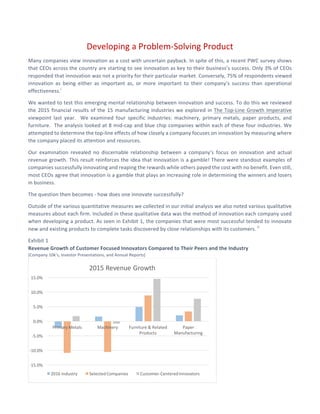
when	developing	a	product.	As	seen	in	Exhibit	1,	the	companies	that	were	most	successful	tended	to	innovate	
new	and	existing	products	to	complete	tasks	discovered	by	close	relationships	with	its	customers.	ii
	
Exhibit	1	
Revenue	Growth	of	Customer	Focused	Innovators	Compared	to	Their	Peers	and	the	Industry	
(Company	10k’s,	Investor	Presentations,	and	Annual	Reports)	
	
-15.0%
-10.0%
-5.0%
0.0%
5.0%
10.0%
15.0%
Primary	Metals Machinery Furniture	&	Related	
Products
Paper	
Manufacturing
2015	Revenue	Growth
2016	Industry Selected	Companies Customer-Centered	Innovators
By	focusing	on	customer	needs	these	companies	were	able	to	develop	products	which	completed	the	jobs	that	
their	customers	needed	done.iii
	This	customer-outward	approach	to	innovation	ensures	that	companies	will	not	
waste	money	developing	a	product	that	no	one	needs.	
Many	firms	lack	the	resources	to	properly	segment	their	market	while	continuing	to	focus	on	the	customer.	This	
inhibits	 them	 from	 maximizing	 the	 revenue	 potential	 of	 innovation	 investments.	 To	 successfully	 innovate	
problem-solving	products	a	company	must	first	understand	the	needs	of	potential	midstream	customers	as	well	
as	the	end	consumer.		By	deploying	this	expertise	beside	data	driven	analysis	firms	can	create	products	that	do	
the	jobs	that	customers	need	done.	
In	today’s	market	it	is	not	enough	for	a	firm	to	simply	place	a	focus	on	innovation.	However,	by	understanding	
and	solving	the	problems	its	customers	face,	a	company	can	beat	the	field	and	begin	to	find	consistent	top-line	
success.		
	
	
*	*	*	
This	white	paper	was	written	by	Zach	Reuss	of	DENTON/NEELY	&	CO.,	LLC.	DENTON/NEELY	&	CO.,	LLC.			is	a	management	consulting	firm	
that	works	with	early-stage	and	B2B	Middle	Market	companies	to	identify	and	address	growth	and	differentiation	opportunities	through	
market	insight,	strategy	development	and	programs	for	commercial	follow-through.
i
	http://www.pwc.com/gx/en/innovationsurvey/files/innovation_full_report.pdf	
ii
	Select	Financial	Data	from	the	32	studied	firms	
iii
	https://hbr.org/2005/12/marketing-malpractice-the-cause-and-the-cure

Developing a Problem-Solving Product