A new competitive edge
strategy as an iterative process
@danto_ma
A new competitive edge
Strategy is probably
one of the most
mystical and mystified
words in the corporate
vocabulary.
@danto_ma
A new competitive edge
Essentially
strategy is (just)
macro-level
problem solving.
And, as with any
‘new product’
aimed at solving a
problem, strategy
can be thought of
as a series of
assumptions
to-be-tested.
?
?!
Other fields such as
product development
or new business
development have
long reaped the fruits
of working iteratively.
The benefits of
shipping small
batches that can be
easily tested are
undebatable.
A new competitive edge
@danto_ma
@danto_ma
A new competitive edge
Iterative Systems that help us respond to change
today: iterative system for
enterprise strategy
2000s: iterative system for
business development
(lean startup)
1980s: iterative system for
software development
(agile)
1960s: iterative system for
manufacturing (lean
manufacturing)
@danto_ma
A new competitive edge
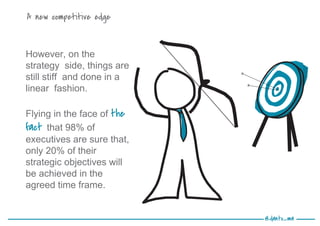
However, on the
strategy side, things are
still stiff and done in a
linear fashion.
Flying in the face of the
fact that 98% of
executives are sure that,
only 20% of their
strategic objectives will
be achieved in the
agreed time frame.
@danto_ma
A new competitive edge
Choosing to accept
the parallel
between new
product
development and
strategy can trigger
a change in the way
strategy is
developed and
deployed.
@danto_ma
A new competitive edge
A new set of strategic
options are put forward
and deployed as
‘probes’ for the new
strategy. The ‘probes’
will be tested with a
specific market segment.
For risk reasons, might
not even be the
company’s core market.
Then, based on the
results and feedback,
improvements or
corrections will be made.
@danto_ma
A new competitive edge
If the ‘probes’ turn up
successful the company
will then double down on
that particular strategy.
If not, all that was lost
was the investment in
‘the probes’ – while at
the same time keeping
‘the residual benefit’ of
the lessons learned.
strategy
@danto_ma
A new competitive edge
The process
As trivial as this
process sounds it’s
quite complicated to put
into play.
On top of that the
technology clock speed
can hold a company
back from launching
‘new probes’ as often
as it likes.
@danto_ma
A new competitive edge
For the process to
succeed the company
also needs a high degree
of discipline. This will
serve in following up with
the probes, monitoring
them and examining
external trends.
@danto_ma
A new competitive edge
Often times
creating a
corporate
strategy is
viewed as a
tedious and
actionless
process sucking
up hundreds of
men-hours.
@danto_ma
A new competitive edge
Creating a corporate
strategy needs to be a
bit less exhausting and
way more actionable.
And the problem lays not
with the tools we have at
our disposal, but with
how we approach the
process.
@danto_ma
A new competitive edge
Approaching
strategy with the
right mindset is
not enough.
One needs to
understand the
actions that need
to be taken too.
@danto_ma
A new competitive edge
OPDCA for
Strategy
formulation
The continuous
improvement loop
OPDCA (observe -
plan - do - check - act)
used in lean
manufacturing can
serve as the basis for
strategy formulation
and deployment.
ADJUST
Do we need
to change
anything?
OBSERVE
Where are
we today?
PLAN
Where do we
want to go?
DO
What do we
need to get
there?
CHECK
How will we
know if we are
making progress?
@danto_ma
A new competitive edge
Strategy formulation
@danto_ma
A new competitive edge
OBSERVE stage
Question to be answered:
where is the company
today?
@danto_ma
A new competitive edge
PLAN stage
Question to be answered:
Where does the company want to go?
And why?
What does the company want to achieve?
Where does the company want to be?
Why does the company wanna be there?
@danto_ma
A new competitive edge
DO stage:
Question to be answered:
How will the company get to
where it wants to be?
What capabilities,
management system and/or
structures does the company
need to fulfil the vision?
@danto_ma
A new competitive edge
CHECK stage
Question to be answered:
How will the company know it’s on
the right track to where it wants to
be?
How will we measure our progress?
What does success look like, short
term, medium term, long term?
How will we measure our progress?
What does success look like, short
term, medium term, long term?
@danto_ma
A new competitive edge
ADJUST stage
Question to be answered:
Is there anything to be
changed or adjusted?
Will the company be able
to continuously transform
using the new
capabilities, management
system and/or
structures?
@danto_ma
A new competitive edge
Strategy deployment
@danto_ma
A new competitive edge
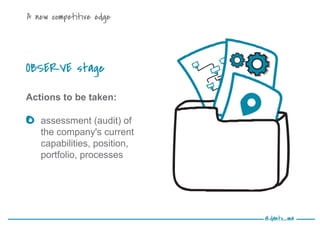
OBSERVE stage
Actions to be taken:
assessment (audit) of
the company's current
capabilities, position,
portfolio, processes
@danto_ma
A new competitive edge
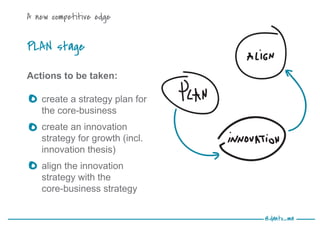
PLAN stage
Actions to be taken:
create a strategy plan for
the core-business
create an innovation
strategy for growth (incl.
innovation thesis)
align the innovation
strategy with the
core-business strategy
@danto_ma
A new competitive edge
DO stage:
Actions to be taken:
prioritize your company’s
idea pipeline to match
your strategy
deploy your strategy
using small market bets
(probes) in form of
product teams
RESUL
T
@danto_ma
A new competitive edge
CHECK stage
Actions to be taken:
deployment of a
clear strategy
performance
dashboard across
the entire company
@danto_ma
A new competitive edge
ADJUST stage
● Actions to be
taken: apply
Hoshin Kanri
@danto_ma
A new competitive edge
With product teams
getting more confident
using the scientific
method for their
decisions, a switch is
needed at corporate
strategy level too.
level 1
level 2
level 3
Email:
me@danto.ma
Website:
www.danto.ma
thecorporatestartupbook.com
LinkedIN:
linkedin.com/in/dantoma/
Twitter:
@danto_ma
Contact

A new competitive edge

  • 1.
    A new competitiveedge strategy as an iterative process
  • 2.
    @danto_ma A new competitiveedge Strategy is probably one of the most mystical and mystified words in the corporate vocabulary.
  • 3.
    @danto_ma A new competitiveedge Essentially strategy is (just) macro-level problem solving. And, as with any ‘new product’ aimed at solving a problem, strategy can be thought of as a series of assumptions to-be-tested. ? ?!
  • 4.
    Other fields suchas product development or new business development have long reaped the fruits of working iteratively. The benefits of shipping small batches that can be easily tested are undebatable. A new competitive edge @danto_ma
  • 5.
    @danto_ma A new competitiveedge Iterative Systems that help us respond to change today: iterative system for enterprise strategy 2000s: iterative system for business development (lean startup) 1980s: iterative system for software development (agile) 1960s: iterative system for manufacturing (lean manufacturing)
  • 6.
    @danto_ma A new competitiveedge However, on the strategy side, things are still stiff and done in a linear fashion. Flying in the face of the fact that 98% of executives are sure that, only 20% of their strategic objectives will be achieved in the agreed time frame.
  • 7.
    @danto_ma A new competitiveedge Choosing to accept the parallel between new product development and strategy can trigger a change in the way strategy is developed and deployed.
  • 8.
    @danto_ma A new competitiveedge A new set of strategic options are put forward and deployed as ‘probes’ for the new strategy. The ‘probes’ will be tested with a specific market segment. For risk reasons, might not even be the company’s core market. Then, based on the results and feedback, improvements or corrections will be made.
  • 9.
    @danto_ma A new competitiveedge If the ‘probes’ turn up successful the company will then double down on that particular strategy. If not, all that was lost was the investment in ‘the probes’ – while at the same time keeping ‘the residual benefit’ of the lessons learned. strategy
  • 10.
    @danto_ma A new competitiveedge The process As trivial as this process sounds it’s quite complicated to put into play. On top of that the technology clock speed can hold a company back from launching ‘new probes’ as often as it likes.
  • 11.
    @danto_ma A new competitiveedge For the process to succeed the company also needs a high degree of discipline. This will serve in following up with the probes, monitoring them and examining external trends.
  • 12.
    @danto_ma A new competitiveedge Often times creating a corporate strategy is viewed as a tedious and actionless process sucking up hundreds of men-hours.
  • 13.
    @danto_ma A new competitiveedge Creating a corporate strategy needs to be a bit less exhausting and way more actionable. And the problem lays not with the tools we have at our disposal, but with how we approach the process.
  • 14.
    @danto_ma A new competitiveedge Approaching strategy with the right mindset is not enough. One needs to understand the actions that need to be taken too.
  • 15.
    @danto_ma A new competitiveedge OPDCA for Strategy formulation The continuous improvement loop OPDCA (observe - plan - do - check - act) used in lean manufacturing can serve as the basis for strategy formulation and deployment. ADJUST Do we need to change anything? OBSERVE Where are we today? PLAN Where do we want to go? DO What do we need to get there? CHECK How will we know if we are making progress?
  • 16.
    @danto_ma A new competitiveedge Strategy formulation
  • 17.
    @danto_ma A new competitiveedge OBSERVE stage Question to be answered: where is the company today?
  • 18.
    @danto_ma A new competitiveedge PLAN stage Question to be answered: Where does the company want to go? And why? What does the company want to achieve? Where does the company want to be? Why does the company wanna be there?
  • 19.
    @danto_ma A new competitiveedge DO stage: Question to be answered: How will the company get to where it wants to be? What capabilities, management system and/or structures does the company need to fulfil the vision?
  • 20.
    @danto_ma A new competitiveedge CHECK stage Question to be answered: How will the company know it’s on the right track to where it wants to be? How will we measure our progress? What does success look like, short term, medium term, long term? How will we measure our progress? What does success look like, short term, medium term, long term?
  • 21.
    @danto_ma A new competitiveedge ADJUST stage Question to be answered: Is there anything to be changed or adjusted? Will the company be able to continuously transform using the new capabilities, management system and/or structures?
  • 22.
    @danto_ma A new competitiveedge Strategy deployment
  • 23.
    @danto_ma A new competitiveedge OBSERVE stage Actions to be taken: assessment (audit) of the company's current capabilities, position, portfolio, processes
  • 24.
    @danto_ma A new competitiveedge PLAN stage Actions to be taken: create a strategy plan for the core-business create an innovation strategy for growth (incl. innovation thesis) align the innovation strategy with the core-business strategy
  • 25.
    @danto_ma A new competitiveedge DO stage: Actions to be taken: prioritize your company’s idea pipeline to match your strategy deploy your strategy using small market bets (probes) in form of product teams RESUL T
  • 26.
    @danto_ma A new competitiveedge CHECK stage Actions to be taken: deployment of a clear strategy performance dashboard across the entire company
  • 27.
    @danto_ma A new competitiveedge ADJUST stage ● Actions to be taken: apply Hoshin Kanri
  • 28.
    @danto_ma A new competitiveedge With product teams getting more confident using the scientific method for their decisions, a switch is needed at corporate strategy level too. level 1 level 2 level 3
  • 29.