International Research Journal of Engineering and Technology (IRJET) e-ISSN: 2395-0056
Volume: 09 Issue: 05 | May 2022 www.irjet.net p-ISSN: 2395-0072
© 2021, IRJET | Impact Factor value: 7.529 | ISO 9001:2008 Certified Journal | Page 373
Object Detection for Autonomous Driving
Shikhar Semwal1, Vibhor Sharma2
1Student, Dept. of Information Technology
2Assistant Professor, Dept. of Information Technology
1,2Maharaja Agrasen Institute of Technology Rohini, Delhi
---------------------------------------------------------------------***---------------------------------------------------------------------
Abstract –The first ever production car came out in 1886
when Carl Benz applied for a patent for his vehicle which
was powered by a gas engine. Ever since then the world has
witnesses tremendous changes in the automotive sector.
Earlier vehicles were handmade – some even to this date –
whereas nowadays manufacturing is automated wherein
vehicles are assembled through robots at the assembly line
of the manufacturing plant. Technology has come a long
way in order to develop intelligent transportation – to make
transportation smart and effective. Some decades ago, who
could have thought that one day cars will be able to drive
themselves without an active driver, but self-driving
technology has made this possible. The paper briefly
discusses various object detection algorithms used
nowadays which may be used in the backend of autonomous
driving technology incorporated into these self-driving
vehicles. The paper also discusses haar features, and the
comparision of haar cascade classifier with YOLO V4 object
detection algorithm with emphasis on specific use cases
which is vehicle and pedestrian detection with varying
accuracy.
Key Words: autonomous driving, intelligent
transportation, self-driving technology, haar
features, YOLO V4, object detection
1. INTRODUCTION
An autonomous vehicle or what we call a self-driving
car is a car that is capable of driving itself without the help
or interference of a driver under general circumstances.
These kinds of cars are equipped with certain other
technologies that assist the driver in optimal driving and
avoiding obstacles on the road. Some of these technologies
are Automatic Brake Assist feature, Lane Keeping
Assistant, Blind Spot Monitoring System, Adaptive Cruise
Control and some with even Auto-Pilot like the Tesla
which is essentially an amalgamation of the different
technologies fused into one.
Self-driving cars have different devices like 360-degree
cameras installed in them for a complete view of their
surroundings, ultrasonic sensors, radar etc. to sense
oncoming vehicles or objects from any direction. Modern
day cars today which may or may not be self-driving, also
come equipped with one or many of these sensors or
technologies, however some pieces of technology may be
unique to these self-driving cars only.
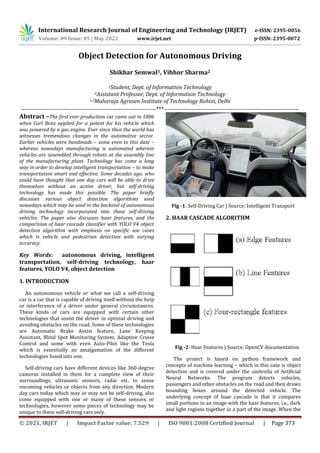
Fig -1: Self-Driving Car | Source: Intelligent Transport
2. HAAR CASCADE ALGORITHM
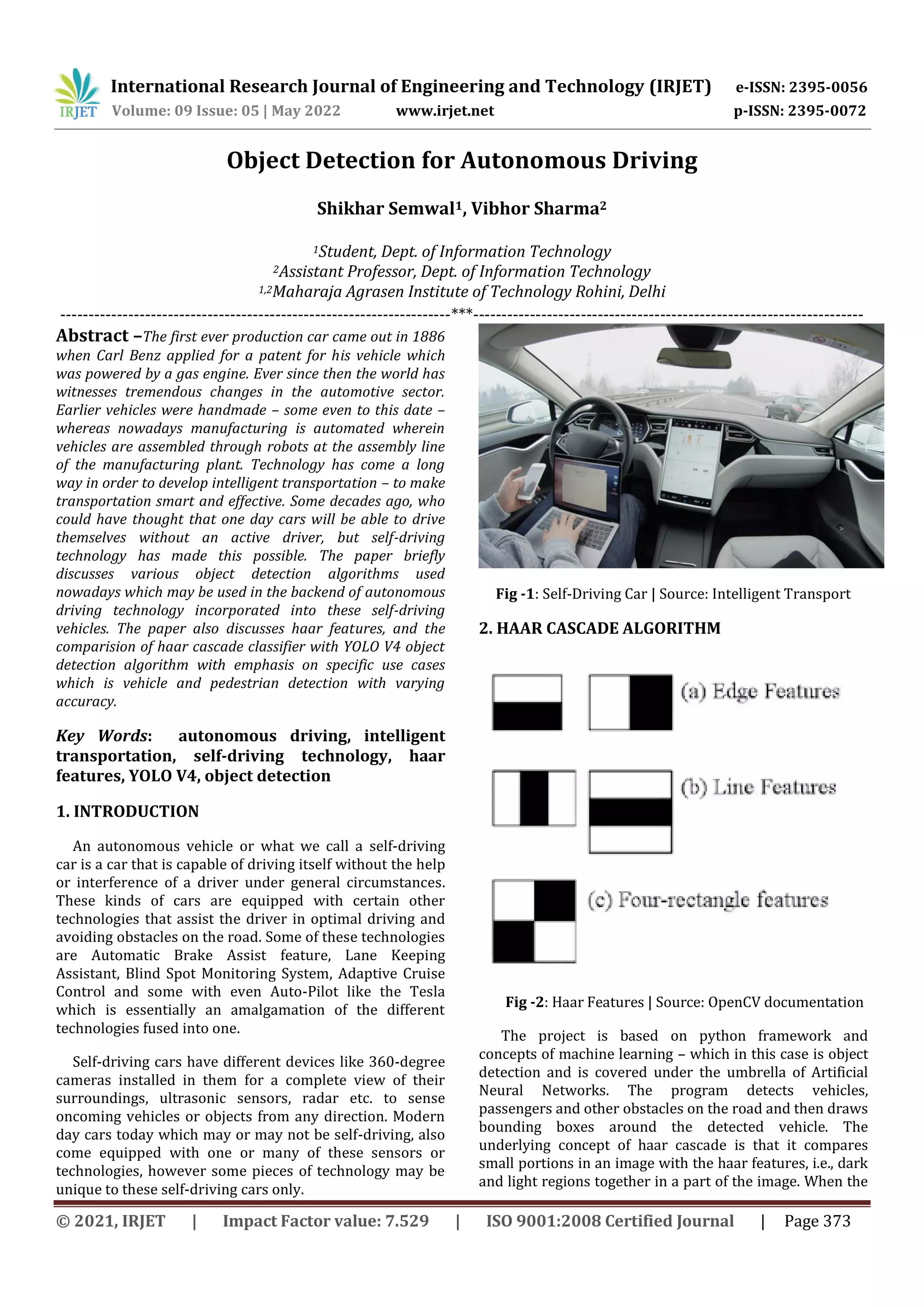
Fig -2: Haar Features | Source: OpenCV documentation
The project is based on python framework and
concepts of machine learning – which in this case is object
detection and is covered under the umbrella of Artificial
Neural Networks. The program detects vehicles,
passengers and other obstacles on the road and then draws
bounding boxes around the detected vehicle. The
underlying concept of haar cascade is that it compares
small portions in an image with the haar features, i.e., dark
and light regions together in a part of the image. When the
International Research Journal of Engineering and Technology (IRJET) e-ISSN: 2395-0056
Volume: 09 Issue: 05 | May 2022 www.irjet.net p-ISSN: 2395-0072
© 2021, IRJET | Impact Factor value: 7.529 | ISO 9001:2008 Certified Journal | Page 374
comparison is successfully completed, it detects the object
in the image. However, this algorithm is not as fast and
accurate as the YOLO V4 and may not detect all the vehicles
on the road. The general idea of haar like features was to
describe an object as a cascade of simple feature classifiers
organized into several stages. [1]
The coloured image has three RGB components namely
red, green and blue with values ranging from 0 to 255.
However, in this case, for ease of comparison, grayscale is
used as there is only one colour component to run through
the classifier. [5]
The algorithm prints a 2D array as the output location of
the detected vehicles in the image. For giving a visual
effect to the output image, we have drawn red squares
around the detections using the output coordinates in the
program.
The steps briefly stated below are:
1. Gather lots of images of vehicles for the algorithm,
which essentially acts as the dataset
2. Read the images and convert these to grayscale
3. Compare the image to haar features using the haar
cascade classifier
4. Train the algorithm with the dataset to detect cars [5]
4. YOLO V4
YOLO stands for “You Only Look Once” and it is a state-
of-the-art real-time object detection framework which
uses Convolutional Neural Network for the detection of
objects in images or videos. The algorithm applies a single
neural network to the entire image and then divides the
image into regions and then predicts the bounding boxes
and probabilities for each region in the image. Videos can
be broken down frame by frame and then the detection
takes place just like that in image. The Version 4 of YOLO
algorithm is very fast, accurate and is capable of
processing any video at 65 frames per second. This is a
very good algorithm when our aim is to do real-time
object detection without the loss of too much accuracy.
Convolutional Neural Networks are well suited for images
therefore YOLO V4 algorithm uses it. The YOLO framework
is very good at detecting not only various classes in an
image but also their location.
Fig -3: Object Detection using YOLO V4 | Susant Achary |
Analytics Vidhya | Source: Medium
There are a huge number of features which are said to
improve Convolutional Neural Network (CNN) accuracy.
Practical testing of combinations of such features on large
datasets, and theoretical justification of the result, is
required. Some features operate on certain models
exclusively and for certain problems exclusively, or only
for small-scale datasets; while some features, such as
batch-normalization and residual-connections, are
applicable to the majority of models, tasks, and datasets.
[6]
Some of the new features added in the YOLO V4 are:-
 Weighted Residual Connections (WRC)
 Cross Stage Partial Connections (CSP)
 Cross mini-Batch Normalization (CmBN)
 Self Adversarial Training (SAT)
 Mish activation
We use new features: WRC, CSP, CmBN, SAT, Mish
activation, Mosaic data augmentation, CmBN, DropBlock
regularization, and CIoU loss, and combine some of them
to achieve state-of-the-art results: 43.5% AP (65.7%
AP50) for the MS COCO dataset at a real-time speed of ~65
FPS on Tesla V100. [6]
5. COMPARISON OF HAAR CASCADE AND YOLO V4
Given below are the outputs obtained upon running the
program using YOLO V4 and haar cascade. Same images
are used for testing both the algorithms as it makes it
easier for us to compare both of them simultaneously.
International Research Journal of Engineering and Technology (IRJET) e-ISSN: 2395-0056
Volume: 09 Issue: 05 | May 2022 www.irjet.net p-ISSN: 2395-0072
© 2021, IRJET | Impact Factor value: 7.529 | ISO 9001:2008 Certified Journal | Page 375
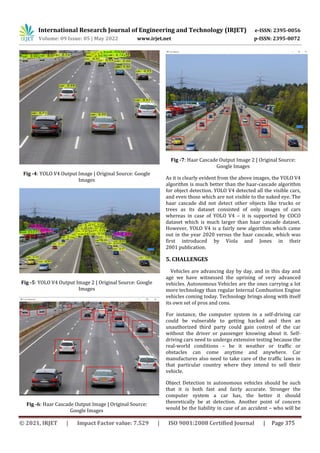
Fig -4: YOLO V4 Output Image | Original Source: Google
Images
Fig -5: YOLO V4 Output Image 2 | Original Source: Google
Images
Fig -6: Haar Cascade Output Image | Original Source:
Google Images
Fig -7: Haar Cascade Output Image 2 | Original Source:
Google Images
As it is clearly evident from the above images, the YOLO V4
algorithm is much better than the haar-cascade algorithm
for object detection. YOLO V4 detected all the visible cars,
and even those which are not visible to the naked eye. The
haar cascade did not detect other objects like trucks or
trees as its dataset consisted of only images of cars
whereas in case of YOLO V4 – it is supported by COCO
dataset which is much larger than haar cascade dataset.
However, YOLO V4 is a fairly new algorithm which came
out in the year 2020 versus the haar cascade, which was
first introduced by Viola and Jones in their
2001 publication.
5. CHALLENGES
Vehicles are advancing day by day, and in this day and
age we have witnessed the uprising of very advanced
vehicles. Autonomous Vehicles are the ones carrying a lot
more technology than regular Internal Combustion Engine
vehicles coming today. Technology brings along with itself
its own set of pros and cons.
For instance, the computer system in a self-driving car
could be vulnerable to getting hacked and then an
unauthorized third party could gain control of the car
without the driver or passenger knowing about it. Self-
driving cars need to undergo extensive testing because the
real-world conditions – be it weather or traffic or
obstacles can come anytime and anywhere. Car
manufactures also need to take care of the traffic laws in
that particular country where they intend to sell their
vehicle.
Object Detection in autonomous vehicles should be such
that it is both fast and fairly accurate. Stronger the
computer system a car has, the better it should
theoretically be at detection. Another point of concern
would be the liability in case of an accident – who will be
International Research Journal of Engineering and Technology (IRJET) e-ISSN: 2395-0056
Volume: 09 Issue: 05 | May 2022 www.irjet.net p-ISSN: 2395-0072
© 2021, IRJET | Impact Factor value: 7.529 | ISO 9001:2008 Certified Journal | Page 376
held responsible if an accident is caused by a self-driving
car. Also, in case of an emergency situation, who would the
car prioritize to save – the passengers or the people
outside the car.
6. CONCLUSION AND FUTURE SCOPE
The automobile industry is the one that has been ever
evolving since the time it first came into existence. Recent
developments in this industry gave birth to the self-
driving cars – under the umbrella of autonomous driving
technology. This being a fairly recent technology, we do
not generally witness self-driving cars around us. But it is
only a matter of one or two decades that majority of the
cars we drive today would be replaced by these. Car
manufacturers are working day and night to launch their
cars into the market. This also involves extensive research
and development on the back-end so that this technology
becomes production ready on a mass scale. And many
people might argue that these vehicles are not safe, or that
they have many disadvantages – but we know that
because of this we won’t entirely scrap the idea of such
cars. Rather these cars will keep on becoming better and
evolving over a period of time. We also need to keep in
mind the number of benefits of having driverless cars –
like reduced travel times, extensive fuel savings, stress
free travel and less traffic jams on the roads. Object
Detection has also come a long way in aiding the
carmakers to develop their own autonomous driving
technologies. All this ultimately leads to advancement and
an unmatched level of convenience to the passengers or
people who will own these vehicles.
REFERENCES
[1] Oliveira, Miguel & Santos, Vitor. (2008). Automatic
Detection of Cars in Real Roads using Haar-like
Features.
[2] Mohsin Raza. (2018). Autonomous Vehicles: Levels,
Technologies, Impacts and Concerns
[3] Self-driving car – Wikipedia
https://en.wikipedia.org/wiki/Self-driving_car
[4] Objects as Points (2019) Xingyi Zhou (UT Austin)
Dequan Wang (UC Berkeley), Philipp Krahenb (UT
Austin)
[5] Shikhar Semwal, Vibhor Sharma. (2021) Collision
Avoidance in Autonomous Vehicles – IRJET
[6] Alexey Bochkovskiy. (2020) arXiv:2004.10934
[cs.CV]
[7] Context R-CNN: Long Term Temporal Context for Per-
Camera Object Detection Sara Beery*† , Guanhang
Wu† , Vivek Rathod† , Ronny Votel† , Jonathan Huang†
California Institute of Technology* Google†
[8] EfficientDet: Scalable and Efficient Object Detection
Mingxing Tan Ruoming Pang Quoc V. Le Google
Research, Brain Team

Object Detection for Autonomous Driving

  • 1.
    International Research Journalof Engineering and Technology (IRJET) e-ISSN: 2395-0056 Volume: 09 Issue: 05 | May 2022 www.irjet.net p-ISSN: 2395-0072 © 2021, IRJET | Impact Factor value: 7.529 | ISO 9001:2008 Certified Journal | Page 373 Object Detection for Autonomous Driving Shikhar Semwal1, Vibhor Sharma2 1Student, Dept. of Information Technology 2Assistant Professor, Dept. of Information Technology 1,2Maharaja Agrasen Institute of Technology Rohini, Delhi ---------------------------------------------------------------------***--------------------------------------------------------------------- Abstract –The first ever production car came out in 1886 when Carl Benz applied for a patent for his vehicle which was powered by a gas engine. Ever since then the world has witnesses tremendous changes in the automotive sector. Earlier vehicles were handmade – some even to this date – whereas nowadays manufacturing is automated wherein vehicles are assembled through robots at the assembly line of the manufacturing plant. Technology has come a long way in order to develop intelligent transportation – to make transportation smart and effective. Some decades ago, who could have thought that one day cars will be able to drive themselves without an active driver, but self-driving technology has made this possible. The paper briefly discusses various object detection algorithms used nowadays which may be used in the backend of autonomous driving technology incorporated into these self-driving vehicles. The paper also discusses haar features, and the comparision of haar cascade classifier with YOLO V4 object detection algorithm with emphasis on specific use cases which is vehicle and pedestrian detection with varying accuracy. Key Words: autonomous driving, intelligent transportation, self-driving technology, haar features, YOLO V4, object detection 1. INTRODUCTION An autonomous vehicle or what we call a self-driving car is a car that is capable of driving itself without the help or interference of a driver under general circumstances. These kinds of cars are equipped with certain other technologies that assist the driver in optimal driving and avoiding obstacles on the road. Some of these technologies are Automatic Brake Assist feature, Lane Keeping Assistant, Blind Spot Monitoring System, Adaptive Cruise Control and some with even Auto-Pilot like the Tesla which is essentially an amalgamation of the different technologies fused into one. Self-driving cars have different devices like 360-degree cameras installed in them for a complete view of their surroundings, ultrasonic sensors, radar etc. to sense oncoming vehicles or objects from any direction. Modern day cars today which may or may not be self-driving, also come equipped with one or many of these sensors or technologies, however some pieces of technology may be unique to these self-driving cars only. Fig -1: Self-Driving Car | Source: Intelligent Transport 2. HAAR CASCADE ALGORITHM Fig -2: Haar Features | Source: OpenCV documentation The project is based on python framework and concepts of machine learning – which in this case is object detection and is covered under the umbrella of Artificial Neural Networks. The program detects vehicles, passengers and other obstacles on the road and then draws bounding boxes around the detected vehicle. The underlying concept of haar cascade is that it compares small portions in an image with the haar features, i.e., dark and light regions together in a part of the image. When the
  • 2.
    International Research Journalof Engineering and Technology (IRJET) e-ISSN: 2395-0056 Volume: 09 Issue: 05 | May 2022 www.irjet.net p-ISSN: 2395-0072 © 2021, IRJET | Impact Factor value: 7.529 | ISO 9001:2008 Certified Journal | Page 374 comparison is successfully completed, it detects the object in the image. However, this algorithm is not as fast and accurate as the YOLO V4 and may not detect all the vehicles on the road. The general idea of haar like features was to describe an object as a cascade of simple feature classifiers organized into several stages. [1] The coloured image has three RGB components namely red, green and blue with values ranging from 0 to 255. However, in this case, for ease of comparison, grayscale is used as there is only one colour component to run through the classifier. [5] The algorithm prints a 2D array as the output location of the detected vehicles in the image. For giving a visual effect to the output image, we have drawn red squares around the detections using the output coordinates in the program. The steps briefly stated below are: 1. Gather lots of images of vehicles for the algorithm, which essentially acts as the dataset 2. Read the images and convert these to grayscale 3. Compare the image to haar features using the haar cascade classifier 4. Train the algorithm with the dataset to detect cars [5] 4. YOLO V4 YOLO stands for “You Only Look Once” and it is a state- of-the-art real-time object detection framework which uses Convolutional Neural Network for the detection of objects in images or videos. The algorithm applies a single neural network to the entire image and then divides the image into regions and then predicts the bounding boxes and probabilities for each region in the image. Videos can be broken down frame by frame and then the detection takes place just like that in image. The Version 4 of YOLO algorithm is very fast, accurate and is capable of processing any video at 65 frames per second. This is a very good algorithm when our aim is to do real-time object detection without the loss of too much accuracy. Convolutional Neural Networks are well suited for images therefore YOLO V4 algorithm uses it. The YOLO framework is very good at detecting not only various classes in an image but also their location. Fig -3: Object Detection using YOLO V4 | Susant Achary | Analytics Vidhya | Source: Medium There are a huge number of features which are said to improve Convolutional Neural Network (CNN) accuracy. Practical testing of combinations of such features on large datasets, and theoretical justification of the result, is required. Some features operate on certain models exclusively and for certain problems exclusively, or only for small-scale datasets; while some features, such as batch-normalization and residual-connections, are applicable to the majority of models, tasks, and datasets. [6] Some of the new features added in the YOLO V4 are:-  Weighted Residual Connections (WRC)  Cross Stage Partial Connections (CSP)  Cross mini-Batch Normalization (CmBN)  Self Adversarial Training (SAT)  Mish activation We use new features: WRC, CSP, CmBN, SAT, Mish activation, Mosaic data augmentation, CmBN, DropBlock regularization, and CIoU loss, and combine some of them to achieve state-of-the-art results: 43.5% AP (65.7% AP50) for the MS COCO dataset at a real-time speed of ~65 FPS on Tesla V100. [6] 5. COMPARISON OF HAAR CASCADE AND YOLO V4 Given below are the outputs obtained upon running the program using YOLO V4 and haar cascade. Same images are used for testing both the algorithms as it makes it easier for us to compare both of them simultaneously.
  • 3.
    International Research Journalof Engineering and Technology (IRJET) e-ISSN: 2395-0056 Volume: 09 Issue: 05 | May 2022 www.irjet.net p-ISSN: 2395-0072 © 2021, IRJET | Impact Factor value: 7.529 | ISO 9001:2008 Certified Journal | Page 375 Fig -4: YOLO V4 Output Image | Original Source: Google Images Fig -5: YOLO V4 Output Image 2 | Original Source: Google Images Fig -6: Haar Cascade Output Image | Original Source: Google Images Fig -7: Haar Cascade Output Image 2 | Original Source: Google Images As it is clearly evident from the above images, the YOLO V4 algorithm is much better than the haar-cascade algorithm for object detection. YOLO V4 detected all the visible cars, and even those which are not visible to the naked eye. The haar cascade did not detect other objects like trucks or trees as its dataset consisted of only images of cars whereas in case of YOLO V4 – it is supported by COCO dataset which is much larger than haar cascade dataset. However, YOLO V4 is a fairly new algorithm which came out in the year 2020 versus the haar cascade, which was first introduced by Viola and Jones in their 2001 publication. 5. CHALLENGES Vehicles are advancing day by day, and in this day and age we have witnessed the uprising of very advanced vehicles. Autonomous Vehicles are the ones carrying a lot more technology than regular Internal Combustion Engine vehicles coming today. Technology brings along with itself its own set of pros and cons. For instance, the computer system in a self-driving car could be vulnerable to getting hacked and then an unauthorized third party could gain control of the car without the driver or passenger knowing about it. Self- driving cars need to undergo extensive testing because the real-world conditions – be it weather or traffic or obstacles can come anytime and anywhere. Car manufactures also need to take care of the traffic laws in that particular country where they intend to sell their vehicle. Object Detection in autonomous vehicles should be such that it is both fast and fairly accurate. Stronger the computer system a car has, the better it should theoretically be at detection. Another point of concern would be the liability in case of an accident – who will be
  • 4.
    International Research Journalof Engineering and Technology (IRJET) e-ISSN: 2395-0056 Volume: 09 Issue: 05 | May 2022 www.irjet.net p-ISSN: 2395-0072 © 2021, IRJET | Impact Factor value: 7.529 | ISO 9001:2008 Certified Journal | Page 376 held responsible if an accident is caused by a self-driving car. Also, in case of an emergency situation, who would the car prioritize to save – the passengers or the people outside the car. 6. CONCLUSION AND FUTURE SCOPE The automobile industry is the one that has been ever evolving since the time it first came into existence. Recent developments in this industry gave birth to the self- driving cars – under the umbrella of autonomous driving technology. This being a fairly recent technology, we do not generally witness self-driving cars around us. But it is only a matter of one or two decades that majority of the cars we drive today would be replaced by these. Car manufacturers are working day and night to launch their cars into the market. This also involves extensive research and development on the back-end so that this technology becomes production ready on a mass scale. And many people might argue that these vehicles are not safe, or that they have many disadvantages – but we know that because of this we won’t entirely scrap the idea of such cars. Rather these cars will keep on becoming better and evolving over a period of time. We also need to keep in mind the number of benefits of having driverless cars – like reduced travel times, extensive fuel savings, stress free travel and less traffic jams on the roads. Object Detection has also come a long way in aiding the carmakers to develop their own autonomous driving technologies. All this ultimately leads to advancement and an unmatched level of convenience to the passengers or people who will own these vehicles. REFERENCES [1] Oliveira, Miguel & Santos, Vitor. (2008). Automatic Detection of Cars in Real Roads using Haar-like Features. [2] Mohsin Raza. (2018). Autonomous Vehicles: Levels, Technologies, Impacts and Concerns [3] Self-driving car – Wikipedia https://en.wikipedia.org/wiki/Self-driving_car [4] Objects as Points (2019) Xingyi Zhou (UT Austin) Dequan Wang (UC Berkeley), Philipp Krahenb (UT Austin) [5] Shikhar Semwal, Vibhor Sharma. (2021) Collision Avoidance in Autonomous Vehicles – IRJET [6] Alexey Bochkovskiy. (2020) arXiv:2004.10934 [cs.CV] [7] Context R-CNN: Long Term Temporal Context for Per- Camera Object Detection Sara Beery*† , Guanhang Wu† , Vivek Rathod† , Ronny Votel† , Jonathan Huang† California Institute of Technology* Google† [8] EfficientDet: Scalable and Efficient Object Detection Mingxing Tan Ruoming Pang Quoc V. Le Google Research, Brain Team