Detailed Risk Assessment
Project Name: 765KV Angul Paradeep TL
Scope of work: The scope of
work includes Erection & Civil
Works covering "Survey; Soil
Investigation, Un-loading, Storage
and Handling at site, Erection of
Towers with Extensions including
Stubs, Stringing, Installation/
Earthing of Towers, Tower
Foundation, Benching, Protection
of Tower Footing, Painting.
Construction of New GIS, Bay
extension including Testing and
Commissioning Complete in all
respect with all Fittings and
Accessories for of 765kV D/C
Transmission line package from
Angul (existing GIS) to Paradeep
(New GIS).
The approx, route length is 180KM
Gas Line and Water Pipeline crossing
Mahanadi Riverbed, Water canal area, waterlogged areas.
National Highway, State highway & Village roads crossing
Live Railway lines
HT, LT & OHE power line crossings
Forest Area, Elephant corridor, Wildlife, snake prone and mosquito prone areas
Public Domain area (village residential, markets, Schools, roads & pathways etc)
Extreme hot & rainy weather conditions
Theft prone areas
Some locations are located far away from emergency facilities.
Major Challenges
Condition/
Challenges
Hazards/Risks involved How does we mitigate the risk/Control
measures to be taken
Gas and Water
Pipeline crossing
• Gas & water
Leaks.
• Gas explosure
• Accidental damage
to gas & water
pipelines may cause
leaks, leading to fire
or explosions.
• Gas pipelines may
release toxic gases,
posing serious fire
or respiratory
hazards.
• Wet surfaces from
water pipeline leaks
or excavation
activities may lead
to slips and falls
• Conduct a thorough utility mapping
before excavation.
• Implement Method statement, HIRA,
SOP, JSA, PTW system to ensure
safety procedures are followed.
• Establish an evacuation plan and
conduct regular drills.
• Conduct regular training on safe work
practices, emergency procedures, and
hazard recognition.
• Place clear signage to mark hazardous
areas, including pipeline locations,
restricted zones, and emergency
exits.
Risk Assessment
Gas and Water Pipeline crossing: Gas & water Leaks, Gas explosure
• Hazards/Risks involved • Mitigation Plan
Condition/
Challenges
Hazards/Risks involved How does we mitigate the risk/Control
measures to be taken
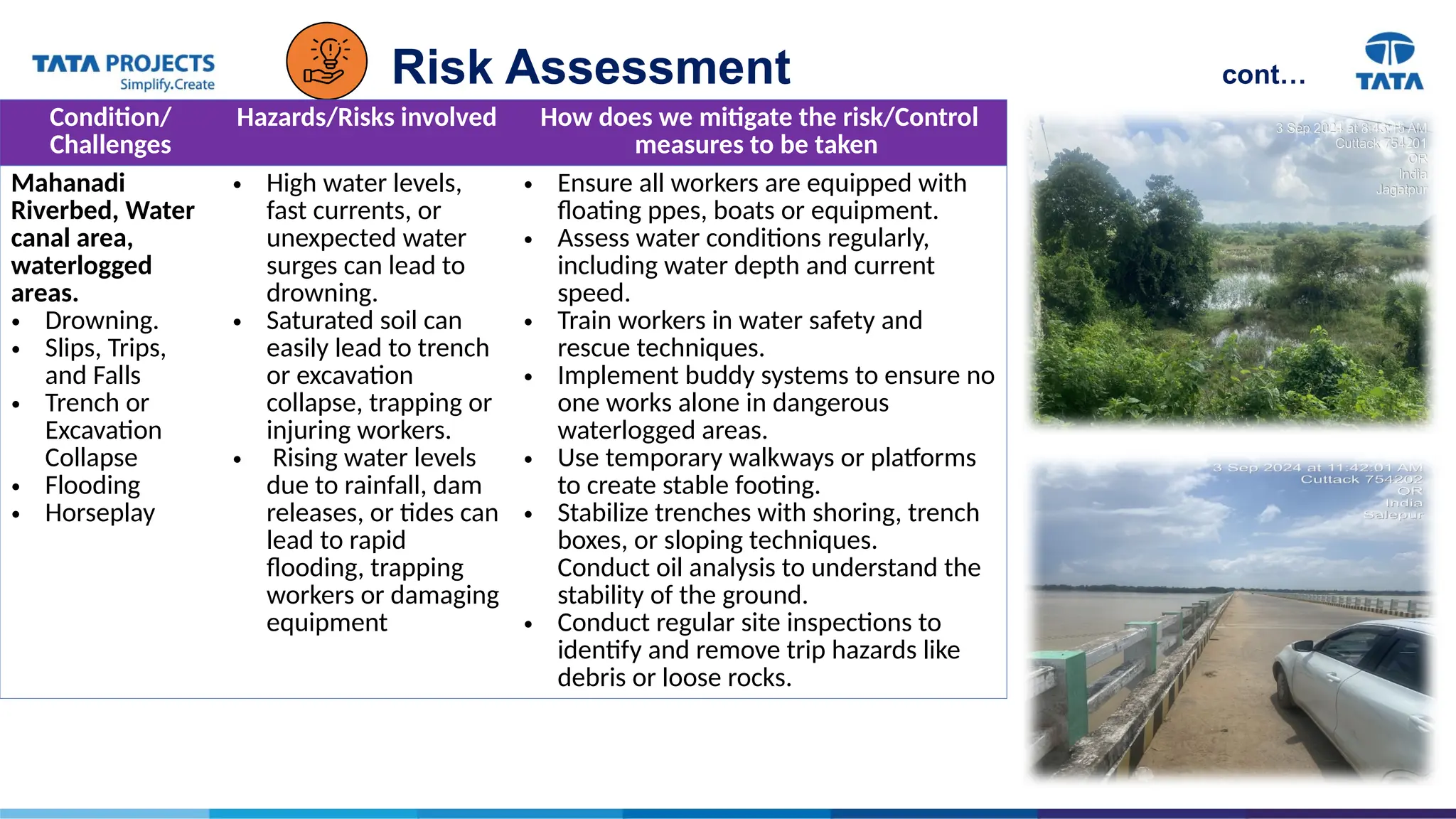
Mahanadi
Riverbed, Water
canal area,
waterlogged
areas.
• Drowning.
• Slips, Trips,
and Falls
• Trench or
Excavation
Collapse
• Flooding
• Horseplay
• High water levels,
fast currents, or
unexpected water
surges can lead to
drowning.
• Saturated soil can
easily lead to trench
or excavation
collapse, trapping or
injuring workers.
• Rising water levels
due to rainfall, dam
releases, or tides can
lead to rapid
flooding, trapping
workers or damaging
equipment
• Ensure all workers are equipped with
floating ppes, boats or equipment.
• Assess water conditions regularly,
including water depth and current
speed.
• Train workers in water safety and
rescue techniques.
• Implement buddy systems to ensure no
one works alone in dangerous
waterlogged areas.
• Use temporary walkways or platforms
to create stable footing.
• Stabilize trenches with shoring, trench
boxes, or sloping techniques.
Conduct oil analysis to understand the
stability of the ground.
• Conduct regular site inspections to
identify and remove trip hazards like
debris or loose rocks.
Risk Assessment cont…
Condition/
Challenges
Hazards/Risks involved How does we mitigate the risk/Control
measures to be taken
Mahanadi
Riverbed, Water
canal area,
waterlogged
areas.
• Soil Erosion
and Unstable
Ground
• Heavy
Equipment
Hazards
• Electrical
hazard
• Environmental
hazard
• Mosquitoes
and
Waterborne
Diseases
• Waterlogged or
saturated soils can
erode quickly,
making the ground
unstable and unsafe
for workers and
equipment
• Operating heavy
machinery in wet
and unstable areas
increases the risk of
equipment instability
• Using electrical tools
or equipment in wet
environments can
lead to electrocution
or short circuits
• Install drainage systems to manage
water flow and reduce soil saturation.
• Avoid operating heavy machinery on
saturated ground unless proper
reinforcement or matting is installed.
• Use waterproof and insulated electrical
tools & keep electrical equipment
elevated above water levels and ensure
proper insulation.
• Implement spill control measures for
fuel, chemicals, cement bags and other
potential contaminants.
• Provide mosquito repellents and PPE
such as gloves, boots, and protective
clothing to minimize direct contact
with water and soil.
Risk Assessment
Condition/
Challenges
Hazards/Risks involved How does we mitigate the risk/Control
measures to be taken
National
Highway, State
highway &
Village roads
crossing.
• Traffic-Related
Accidents
• Pedestrian
Hazards in
Village Roads.
• Fall of
materials on
pedestrian or
public vehicles
• Vehicle, Equipment
of Workers may be
struck by moving
vehicles on highways
or roads, especially
in high-speed areas
or blind spots
• Workers operating
machinery near
roadways are at risk
of collisions with
vehicles or rollovers.
• Village roads often
lack sidewalks or
dedicated pedestrian
paths, putting both
workers &
pedestrians at risk of
accidents
• Use & deploy proper signage, cones,
barriers, traffic marshals with red green
flag/ led batten to create a clear work
zone.
• Establish designated parking and
staging areas for heavy machinery
away from traffic lanes
• Set up temporary pedestrian walkways
or barriers to separate work areas from
public foot traffic.
• Install warning signs for pedestrians
about ongoing construction activities.
Risk Assessment
Condition/
Challenges
Hazards/Risks involved How does we mitigate the risk/Control
measures to be taken
Live Railway lines
• Collision with
Trains
• Electrocution
from
Overhead or
Underground
Line
• Workers or materials
may be struck by
oncoming trains
while working on or
near live tracks
• Railway lines may
carry high-voltage
electrical power in
overhead catenary
lines or third rails,
posing a serious
electrocution risk
• Establish a clear work zone that is
separated from live tracks with barriers
and warning signs.
• Use dedicated lookouts or flaggers to
monitor for oncoming trains and alert
workers.
• Identify the location of overhead lines
and electrical systems before starting
work.
• Ensure all workers are trained on the
minimum safe working distance from
high-voltage equipment Use non-
conductive tools and PPE
• Work in power-isolated conditions
where possible, coordinating with
railway authorities to de-energize lines
if necessary.
• Conduct regular site inspections to
ensure proper electrical safety.
Risk Assessment
Condition/
Challenges
Hazards/Risks involved How does we mitigate the risk/Control
measures to be taken
Live Railway lines
• Slips, Trips,
and Falls
• Noise Hazards
• Railway tracks and
surrounding areas
can be uneven, with
gravel, loose debris,
or wet conditions,
increasing the risk of
slips, trips, and falls.
• The noise generated
by passing trains,
heavy machinery,
and construction
work can lead to
hearing loss or
difficulty in
communication.
• Keep the work area clean and free of
obstructions such as loose cables,
tools, or debris.
• Use warning signs to highlight trip
hazards or changes in elevation.
• Provide workers with hearing
protection such as earplugs or
earmuffs.
• Implement proper communication
methods (e.g., hand signals, flags,
walkie talkie) to maintain clear
communication in high-noise
environments.
• Risk Assessment and Planning: Conduct
a comprehensive risk assessment
before any work begins, in
collaboration with railway authorities.
• Develop and train workers on a
detailed emergency response plan
Risk Assessment
Condition/
Challenges
Hazards/Risks involved How does we mitigate the risk/Control
measures to be taken
HT, LT & OHE
power line
crossings
• Electrocution
and Electrical
Shock
• Arc Flash
• Struck-by
Hazards
• Accidental contact
with live high-
tension or low-
tension power lines
can result in severe
electrical shock,
burns, or
electrocution.
• High Equipment,
vehicles, or materials
may accidentally
encounter overhead
power lines during
transport or
construction, causing
electrocution, arc
flash or equipment
damage
• Conduct a thorough risk assessment
before starting work, identifying the
location of all power lines
• Follow and implement shutdown
procedure with LOTO implementation.
• Have fire extinguishers rated for
electrical fires readily available.
• Ensure proper height clearance/ goal
post arrangement for cranes, trucks,
and other equipment near overhead
lines.
• Use spotters and flaggers to guide
equipment safely around power lines.
• Post warning signs and use physical
barriers to restrict access to live power
lines.
• Use non-conductive tools and
insulated equipment when working
near power lines.
Risk Assessment
Condition/
Challenges
Hazards/Risks involved How does we mitigate the risk/Control
measures to be taken
Forest Areas,
Elephant
corridor, Wildlife,
snake prone and
mosquito prone
areas
• Encounters
with Large
Wildlife
• Injury from
Smaller
Wildlife
(Monkeys,
Wild Boars,
etc.),
• Can lead to injury or
death due to
trampling or
aggressive behavior,
especially in areas
known as elephant
corridors where
animals regularly
move.
• Smaller animals,
such as monkeys,
wild boars, or deer,
can cause injuries
either by aggression
or by accidentally
running into the
worksite.
• Identify and mark wildlife corridors to
avoid disturbing the natural movement
of animals. Maintain safe distance.
• Implement work scheduling to avoid
peak wildlife activity times, such as
dawn, dusk, or nighttime.
• Use warning systems or animal
deterrents, such as lights, fences, or
sound devices, to alert workers of
approaching animals or discourage
their entry into work zones.
• Train workers on wildlife behavior and
escape routes, including what to do
during an animal encounter (e.g.,
keeping a safe distance, not provoking
the animal).
• Avoid leaving food or waste in open
areas, as it can attract animals like
monkeys or wild boars.
Risk Assessment
Condition/
Challenges
Hazards/Risks involved How does we mitigate the risk/Control
measures to be taken
Forest areas,
Elephant
corridor, Wildlife,
snake prone and
mosquito prone
areas
• Snake Bite
• Mosquito-
Borne
Diseases
(Malaria,
Dengue, etc.)
• Areas with stagnant
water or heavy
vegetation,
mosquitoes can
spread diseases such
as malaria, dengue
fever, and
chikungunya, leading
to significant health
risks for workers.
• Clear vegetation & Provide workers
with snake gaiters that covers the legs.
• Educate workers on snake behavior
and how to identify dangerous species
common to the area
• Keep first-aid kits with snakebite
treatment & antivenom on site.
• Ensure workers know the location of
nearby medical facilities and have a
plan for immediate evacuation in case
of a snake bite.
• Implement mosquito control measures,
such as draining stagnant water,
spraying insecticides, and eliminating
breeding grounds.
• Ensure workers wear long-sleeved
clothing and trousers to minimize
exposed skin
Risk Assessment
Condition/
Challenges
Hazards/Risks involved How does we mitigate the
risk/Control measures to be taken
Public Domain
area (village
residential,
markets, Schools,
roads &
pathways etc)
• Pedestrian
and Public
Safety
• Vehicle Traffic
• Narrow
Pathways and
Congested
Areas
• Unstable
Ground or
Excavations
• Risk of injury to
pedestrians, including
children, elderly, and
residents, as they move
through or near the
work area
• Interaction between
work activities and local
vehicle traffic, which
could lead to accidents
or collisions.
• Narrow village pathways
and congested market
areas make it difficult to
manage equipment,
vehicles, and materials,
leading to potential
accidents or property
damage
• Erect barricades, safety signage in
local language, road marshals and
warning tapes to restrict access.
• Provide clear communication with
administration and local residents
to inform them of restricted access.
• Install temporary fencing or hard
barricades around excavations to
prevent unauthorized access.
• Designate certain workers to act as
public safety monitors to watch for
unauthorized access, especially
from children.
• Work with local authorities or
residents to protect nearby
structures by using protective
barriers or avoiding heavy
machinery near sensitive areas.
Risk Assessment
Condition/
Challenges
Hazards/Risks involved How does we mitigate the
risk/Control measures to be taken
Extreme hot &
rainy weather
conditions
• Heat related
illness
• Dehydration
• Slips, Trips,
and Falls
• Lightning
Strikes
• Collapse of pit
• Flooding and
Water
Accumulation
• Exposure to high
temperatures can lead
to heat exhaustion,
heatstroke, heat
cramps, and
dehydration.
• Sweating without
adequate hydration can
lead to dehydration and
reduce worker efficiency
• Heavy rainfall can lead
to flooding, causing
drowning hazards or
equipment damage.
• Heavy rainfall can lead
to slip & trip flooding,
causing drowning
hazards or equipment
damage
• Provide frequent breaks in shaded
or cool areas.
• Ensure access to plenty of drinking
water and electrolytes.
• Educate workers on symptoms of
heat illnesses.
• Implement work-rest cycles to
avoid prolonged heat exposure.
• Monitor weather forecasts and
evacuate flood-prone areas if
necessary.
• Ensure proper drainage systems are
in place.
• Use pumps to clear water from
work sites.
• Avoid working on unstable slopes
during monsoon season & use
retaining walls or sandbags, shoring
, shuttering to stabilize loose soil.
Risk Assessment
Condition/
Challenges
Hazards/Risks involved How does we mitigate the
risk/Control measures to be taken
Theft Zone
• Theft of
Materials or
Equipment
• Unauthorized
Access
• Theft of hard barricades,
back stay ropes may
leads to incidents at
site.
• Unapproved individuals
entering the site can
lead to theft, damage,
or even safety hazards.
• Hire security personnel to guard the
site, especially during off-hours.
• Train workers to report
unauthorized individuals
immediately.
• Increase the frequency of security
patrols during high-risk times, such
as at night or when the site is
closed.
• Train workers to be aware of their
surroundings and report any
unusual activities or strangers on-
site.
Risk Assessment
Condition/
Challenges
Hazards/Risks involved How does we mitigate the
risk/Control measures to be taken
Some locations
are located far
away from
emergency
facilities
• Delayed
Medical
Response
• Lack of Access
to Specialized
Medical Care
• Communicatio
n Barriers
• Difficult
Terrain and
Access Issues
• Workers who suffer
from injuries may not
receive immediate care,
leading to complications
• emote areas may lack
reliable communication
infrastructure, making it
difficult to contact
emergency services
quickly
• Rough or inaccessible
terrain can slow down
the arrival of emergency
responders or the
evacuation of injured
workers.
• Provide first aid training to on-site
personnel to handle medical
emergencies & Ensure a first aid kit
• Establish emergency
communication systems (e.g.,
satellite phones etc) to contact
medical services quickly.
• Develop an emergency evacuation
plan and ensure transport is
available to reach the nearest
medical facility.
• Keep emergency transport vehicles
on standby to transport injured or
sick workers to appropriate
facilities.
• Ensure local healthcare providers
are informed of the project and can
offer support in emergencies.
Risk Assessment
1
Thank You

Detailed Risk Assessment of Angul Paradeep TL.pptx

  • 1.
    Detailed Risk Assessment ProjectName: 765KV Angul Paradeep TL Scope of work: The scope of work includes Erection & Civil Works covering "Survey; Soil Investigation, Un-loading, Storage and Handling at site, Erection of Towers with Extensions including Stubs, Stringing, Installation/ Earthing of Towers, Tower Foundation, Benching, Protection of Tower Footing, Painting. Construction of New GIS, Bay extension including Testing and Commissioning Complete in all respect with all Fittings and Accessories for of 765kV D/C Transmission line package from Angul (existing GIS) to Paradeep (New GIS). The approx, route length is 180KM
  • 2.
    Gas Line andWater Pipeline crossing Mahanadi Riverbed, Water canal area, waterlogged areas. National Highway, State highway & Village roads crossing Live Railway lines HT, LT & OHE power line crossings Forest Area, Elephant corridor, Wildlife, snake prone and mosquito prone areas Public Domain area (village residential, markets, Schools, roads & pathways etc) Extreme hot & rainy weather conditions Theft prone areas Some locations are located far away from emergency facilities. Major Challenges
  • 3.
    Condition/ Challenges Hazards/Risks involved Howdoes we mitigate the risk/Control measures to be taken Gas and Water Pipeline crossing • Gas & water Leaks. • Gas explosure • Accidental damage to gas & water pipelines may cause leaks, leading to fire or explosions. • Gas pipelines may release toxic gases, posing serious fire or respiratory hazards. • Wet surfaces from water pipeline leaks or excavation activities may lead to slips and falls • Conduct a thorough utility mapping before excavation. • Implement Method statement, HIRA, SOP, JSA, PTW system to ensure safety procedures are followed. • Establish an evacuation plan and conduct regular drills. • Conduct regular training on safe work practices, emergency procedures, and hazard recognition. • Place clear signage to mark hazardous areas, including pipeline locations, restricted zones, and emergency exits. Risk Assessment
  • 4.
    Gas and WaterPipeline crossing: Gas & water Leaks, Gas explosure • Hazards/Risks involved • Mitigation Plan
  • 5.
    Condition/ Challenges Hazards/Risks involved Howdoes we mitigate the risk/Control measures to be taken Mahanadi Riverbed, Water canal area, waterlogged areas. • Drowning. • Slips, Trips, and Falls • Trench or Excavation Collapse • Flooding • Horseplay • High water levels, fast currents, or unexpected water surges can lead to drowning. • Saturated soil can easily lead to trench or excavation collapse, trapping or injuring workers. • Rising water levels due to rainfall, dam releases, or tides can lead to rapid flooding, trapping workers or damaging equipment • Ensure all workers are equipped with floating ppes, boats or equipment. • Assess water conditions regularly, including water depth and current speed. • Train workers in water safety and rescue techniques. • Implement buddy systems to ensure no one works alone in dangerous waterlogged areas. • Use temporary walkways or platforms to create stable footing. • Stabilize trenches with shoring, trench boxes, or sloping techniques. Conduct oil analysis to understand the stability of the ground. • Conduct regular site inspections to identify and remove trip hazards like debris or loose rocks. Risk Assessment cont…
  • 6.
    Condition/ Challenges Hazards/Risks involved Howdoes we mitigate the risk/Control measures to be taken Mahanadi Riverbed, Water canal area, waterlogged areas. • Soil Erosion and Unstable Ground • Heavy Equipment Hazards • Electrical hazard • Environmental hazard • Mosquitoes and Waterborne Diseases • Waterlogged or saturated soils can erode quickly, making the ground unstable and unsafe for workers and equipment • Operating heavy machinery in wet and unstable areas increases the risk of equipment instability • Using electrical tools or equipment in wet environments can lead to electrocution or short circuits • Install drainage systems to manage water flow and reduce soil saturation. • Avoid operating heavy machinery on saturated ground unless proper reinforcement or matting is installed. • Use waterproof and insulated electrical tools & keep electrical equipment elevated above water levels and ensure proper insulation. • Implement spill control measures for fuel, chemicals, cement bags and other potential contaminants. • Provide mosquito repellents and PPE such as gloves, boots, and protective clothing to minimize direct contact with water and soil. Risk Assessment
  • 7.
    Condition/ Challenges Hazards/Risks involved Howdoes we mitigate the risk/Control measures to be taken National Highway, State highway & Village roads crossing. • Traffic-Related Accidents • Pedestrian Hazards in Village Roads. • Fall of materials on pedestrian or public vehicles • Vehicle, Equipment of Workers may be struck by moving vehicles on highways or roads, especially in high-speed areas or blind spots • Workers operating machinery near roadways are at risk of collisions with vehicles or rollovers. • Village roads often lack sidewalks or dedicated pedestrian paths, putting both workers & pedestrians at risk of accidents • Use & deploy proper signage, cones, barriers, traffic marshals with red green flag/ led batten to create a clear work zone. • Establish designated parking and staging areas for heavy machinery away from traffic lanes • Set up temporary pedestrian walkways or barriers to separate work areas from public foot traffic. • Install warning signs for pedestrians about ongoing construction activities. Risk Assessment
  • 8.
    Condition/ Challenges Hazards/Risks involved Howdoes we mitigate the risk/Control measures to be taken Live Railway lines • Collision with Trains • Electrocution from Overhead or Underground Line • Workers or materials may be struck by oncoming trains while working on or near live tracks • Railway lines may carry high-voltage electrical power in overhead catenary lines or third rails, posing a serious electrocution risk • Establish a clear work zone that is separated from live tracks with barriers and warning signs. • Use dedicated lookouts or flaggers to monitor for oncoming trains and alert workers. • Identify the location of overhead lines and electrical systems before starting work. • Ensure all workers are trained on the minimum safe working distance from high-voltage equipment Use non- conductive tools and PPE • Work in power-isolated conditions where possible, coordinating with railway authorities to de-energize lines if necessary. • Conduct regular site inspections to ensure proper electrical safety. Risk Assessment
  • 9.
    Condition/ Challenges Hazards/Risks involved Howdoes we mitigate the risk/Control measures to be taken Live Railway lines • Slips, Trips, and Falls • Noise Hazards • Railway tracks and surrounding areas can be uneven, with gravel, loose debris, or wet conditions, increasing the risk of slips, trips, and falls. • The noise generated by passing trains, heavy machinery, and construction work can lead to hearing loss or difficulty in communication. • Keep the work area clean and free of obstructions such as loose cables, tools, or debris. • Use warning signs to highlight trip hazards or changes in elevation. • Provide workers with hearing protection such as earplugs or earmuffs. • Implement proper communication methods (e.g., hand signals, flags, walkie talkie) to maintain clear communication in high-noise environments. • Risk Assessment and Planning: Conduct a comprehensive risk assessment before any work begins, in collaboration with railway authorities. • Develop and train workers on a detailed emergency response plan Risk Assessment
  • 10.
    Condition/ Challenges Hazards/Risks involved Howdoes we mitigate the risk/Control measures to be taken HT, LT & OHE power line crossings • Electrocution and Electrical Shock • Arc Flash • Struck-by Hazards • Accidental contact with live high- tension or low- tension power lines can result in severe electrical shock, burns, or electrocution. • High Equipment, vehicles, or materials may accidentally encounter overhead power lines during transport or construction, causing electrocution, arc flash or equipment damage • Conduct a thorough risk assessment before starting work, identifying the location of all power lines • Follow and implement shutdown procedure with LOTO implementation. • Have fire extinguishers rated for electrical fires readily available. • Ensure proper height clearance/ goal post arrangement for cranes, trucks, and other equipment near overhead lines. • Use spotters and flaggers to guide equipment safely around power lines. • Post warning signs and use physical barriers to restrict access to live power lines. • Use non-conductive tools and insulated equipment when working near power lines. Risk Assessment
  • 11.
    Condition/ Challenges Hazards/Risks involved Howdoes we mitigate the risk/Control measures to be taken Forest Areas, Elephant corridor, Wildlife, snake prone and mosquito prone areas • Encounters with Large Wildlife • Injury from Smaller Wildlife (Monkeys, Wild Boars, etc.), • Can lead to injury or death due to trampling or aggressive behavior, especially in areas known as elephant corridors where animals regularly move. • Smaller animals, such as monkeys, wild boars, or deer, can cause injuries either by aggression or by accidentally running into the worksite. • Identify and mark wildlife corridors to avoid disturbing the natural movement of animals. Maintain safe distance. • Implement work scheduling to avoid peak wildlife activity times, such as dawn, dusk, or nighttime. • Use warning systems or animal deterrents, such as lights, fences, or sound devices, to alert workers of approaching animals or discourage their entry into work zones. • Train workers on wildlife behavior and escape routes, including what to do during an animal encounter (e.g., keeping a safe distance, not provoking the animal). • Avoid leaving food or waste in open areas, as it can attract animals like monkeys or wild boars. Risk Assessment
  • 12.
    Condition/ Challenges Hazards/Risks involved Howdoes we mitigate the risk/Control measures to be taken Forest areas, Elephant corridor, Wildlife, snake prone and mosquito prone areas • Snake Bite • Mosquito- Borne Diseases (Malaria, Dengue, etc.) • Areas with stagnant water or heavy vegetation, mosquitoes can spread diseases such as malaria, dengue fever, and chikungunya, leading to significant health risks for workers. • Clear vegetation & Provide workers with snake gaiters that covers the legs. • Educate workers on snake behavior and how to identify dangerous species common to the area • Keep first-aid kits with snakebite treatment & antivenom on site. • Ensure workers know the location of nearby medical facilities and have a plan for immediate evacuation in case of a snake bite. • Implement mosquito control measures, such as draining stagnant water, spraying insecticides, and eliminating breeding grounds. • Ensure workers wear long-sleeved clothing and trousers to minimize exposed skin Risk Assessment
  • 13.
    Condition/ Challenges Hazards/Risks involved Howdoes we mitigate the risk/Control measures to be taken Public Domain area (village residential, markets, Schools, roads & pathways etc) • Pedestrian and Public Safety • Vehicle Traffic • Narrow Pathways and Congested Areas • Unstable Ground or Excavations • Risk of injury to pedestrians, including children, elderly, and residents, as they move through or near the work area • Interaction between work activities and local vehicle traffic, which could lead to accidents or collisions. • Narrow village pathways and congested market areas make it difficult to manage equipment, vehicles, and materials, leading to potential accidents or property damage • Erect barricades, safety signage in local language, road marshals and warning tapes to restrict access. • Provide clear communication with administration and local residents to inform them of restricted access. • Install temporary fencing or hard barricades around excavations to prevent unauthorized access. • Designate certain workers to act as public safety monitors to watch for unauthorized access, especially from children. • Work with local authorities or residents to protect nearby structures by using protective barriers or avoiding heavy machinery near sensitive areas. Risk Assessment
  • 14.
    Condition/ Challenges Hazards/Risks involved Howdoes we mitigate the risk/Control measures to be taken Extreme hot & rainy weather conditions • Heat related illness • Dehydration • Slips, Trips, and Falls • Lightning Strikes • Collapse of pit • Flooding and Water Accumulation • Exposure to high temperatures can lead to heat exhaustion, heatstroke, heat cramps, and dehydration. • Sweating without adequate hydration can lead to dehydration and reduce worker efficiency • Heavy rainfall can lead to flooding, causing drowning hazards or equipment damage. • Heavy rainfall can lead to slip & trip flooding, causing drowning hazards or equipment damage • Provide frequent breaks in shaded or cool areas. • Ensure access to plenty of drinking water and electrolytes. • Educate workers on symptoms of heat illnesses. • Implement work-rest cycles to avoid prolonged heat exposure. • Monitor weather forecasts and evacuate flood-prone areas if necessary. • Ensure proper drainage systems are in place. • Use pumps to clear water from work sites. • Avoid working on unstable slopes during monsoon season & use retaining walls or sandbags, shoring , shuttering to stabilize loose soil. Risk Assessment
  • 15.
    Condition/ Challenges Hazards/Risks involved Howdoes we mitigate the risk/Control measures to be taken Theft Zone • Theft of Materials or Equipment • Unauthorized Access • Theft of hard barricades, back stay ropes may leads to incidents at site. • Unapproved individuals entering the site can lead to theft, damage, or even safety hazards. • Hire security personnel to guard the site, especially during off-hours. • Train workers to report unauthorized individuals immediately. • Increase the frequency of security patrols during high-risk times, such as at night or when the site is closed. • Train workers to be aware of their surroundings and report any unusual activities or strangers on- site. Risk Assessment
  • 16.
    Condition/ Challenges Hazards/Risks involved Howdoes we mitigate the risk/Control measures to be taken Some locations are located far away from emergency facilities • Delayed Medical Response • Lack of Access to Specialized Medical Care • Communicatio n Barriers • Difficult Terrain and Access Issues • Workers who suffer from injuries may not receive immediate care, leading to complications • emote areas may lack reliable communication infrastructure, making it difficult to contact emergency services quickly • Rough or inaccessible terrain can slow down the arrival of emergency responders or the evacuation of injured workers. • Provide first aid training to on-site personnel to handle medical emergencies & Ensure a first aid kit • Establish emergency communication systems (e.g., satellite phones etc) to contact medical services quickly. • Develop an emergency evacuation plan and ensure transport is available to reach the nearest medical facility. • Keep emergency transport vehicles on standby to transport injured or sick workers to appropriate facilities. • Ensure local healthcare providers are informed of the project and can offer support in emergencies. Risk Assessment
  • 17.