TEST DRIVEN DEVELOPMENT   Presented By:   Nitin Garg   07030244008   MBA(SDM)
TEST-DRIVEN DEVELOPMENT
ORIGIN Test-Driven Development is a core part of the agile process formalized by Kent Beck called eXtreme Programming (XP). XP originally had the rule to test everything that could possibly break. Now, however, the practice of testing in XP has evolved into Test-Driven Development.“ Do not need to adopt XP in order to practice TDD and gain the benefit from it.
INTRODUCTION Traditional Approach Test last Problems with Traditional Errors in production Programmer moves onto other projects Test and code written by different programmers Tests based on outdated information Infrequent testing Fixes that create other problems
COST OF DEVELOPMENT Time Cost Traditional TDD
COST OF FIXING FAULTS
WHAT IS TDD? TDD is a technique whereby you write your test cases  before  you write any implementation code Forces developers to think in terms of  implementer  and  user Tests drive or dictate the code that is developed “ Do the simplest thing that could possibly work” Developers have less choice in what they write An indication of “intent” Tests provide a specification of “what” a piece of code actually does – it goes some way to defining an interface Some might argue that “tests are part of the documentation” Could your customers/clients write tests?
WHAT IS TDD? “ Before you write code, think about what it will do.  Write a  test  that will use the methods you haven’t even written yet.” A  test  is not something you “do”, it is something you “write” and run once, twice, three times, etc. It is a piece of code Testing is therefore “automated” Repeatedly executed, even after small changes “ TDD is risk averse programming, investing work in the  near term to avoid failures later on”
WHAT CAN BE TESTED? Valid Input In-valid Input Exceptions Boundary Conditions Everything that should be possible break.
ASPECTS OF TDD Features High level user requirements User story Customer Tests Customer identified acceptance tests Developer Tests Tests developed during software construction
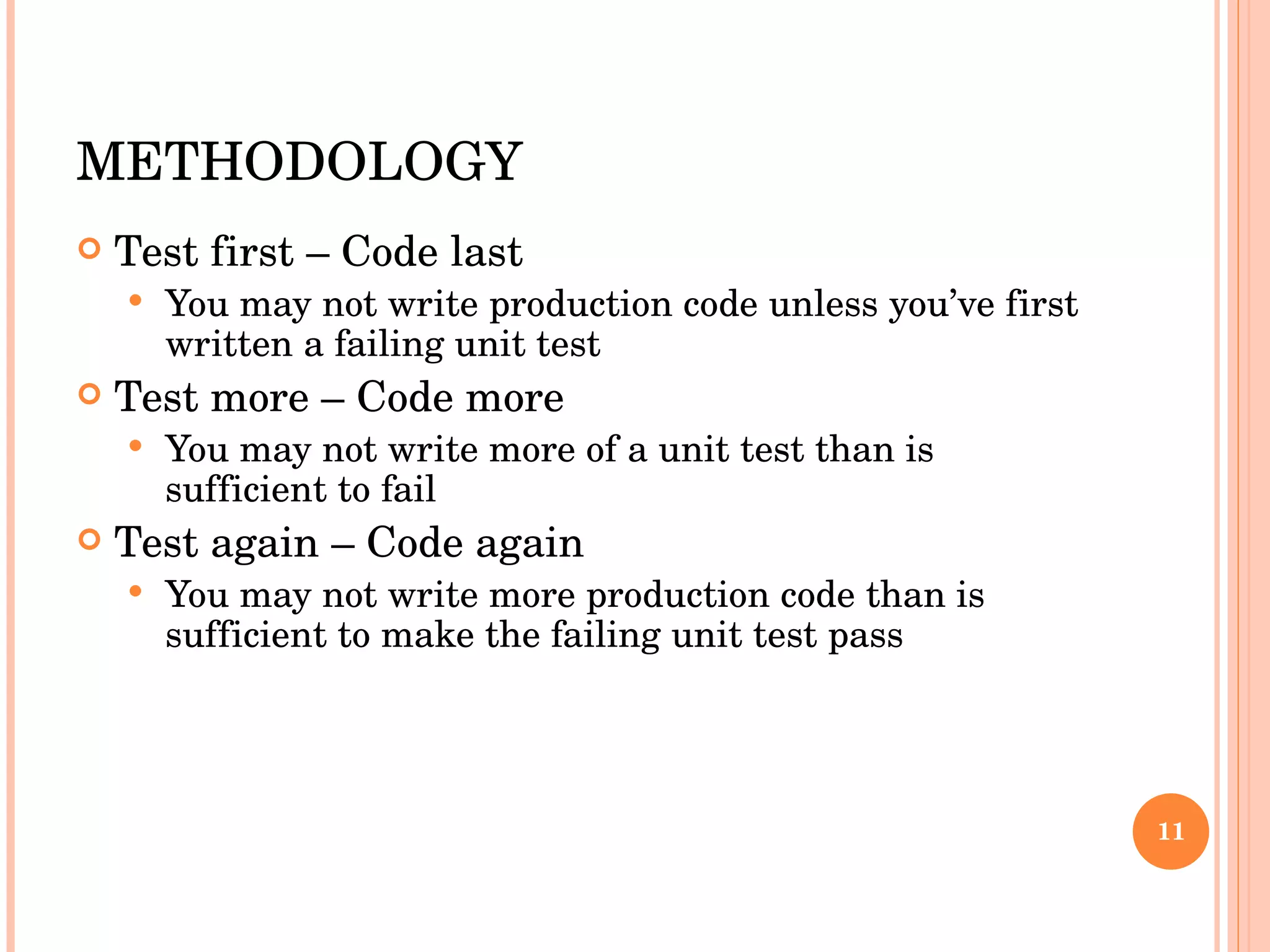
METHODOLOGY Test first – Code last You may not write production code unless you’ve first written a failing unit test Test more – Code more You may not write more of a unit test than is sufficient to fail Test again – Code again You may not write more production code than is sufficient to make the failing unit test pass
TDD STAGES Write a test Compile Fix compile errors Run test, watch it fail Write code Run test,  watch it pass Refactor code (and test)
TDD STAGES The Extreme Programming Explored , Bill Wake describes the test cycle: Write a single test Compile it.  It shouldn’t compile because you’ve not written the implementation code Implement just enough code to get the test to compile Run the test and see it  fail Implement just enough code to get the test to pass Run the test and see it  pass Refactor  for clarity and “once and only once” Repeat
LIFE CYCLE Write Test Compile Run & See the Fail Refactor As Needed
WHY DOES TDD WORK? The (sometimes tedious) routine leads the programmers to think about details they otherwise don’t (because they’ve bitten off more than they can chew) Specifically, test cases are thought through before the programmer is allowed to think about the “interesting part” of how to implement the functionality
WHY DOES TDD WORK? Encourages “divide-and-conquer” Programmers are  never  scared to make a change that might “break” the system The testing time that is often squeezed out of the end of a traditional development cycle  cannot  be squeezed out.
ADVANTAGES OF TDD TDD shortens the programming feedback loop TDD promotes the development of high-quality code User requirements more easily understood Reduced interface misunderstandings TDD provides concrete evidence that your software works  Reduced software defect rates Better Code Less Debug Time.
DISADVANTAGES OF TDD Programmers like to code, not to test Test writing is time consuming Test completeness is difficult to judge TDD may not always work
EXAMPLE We want to develop a method that, given two Integers, returns an Integer that is the sum of parameters.
EXAMPLE (CONT.) Test Integer i =  new Integer(5); Integer j =  new Interger(2); Object o = sum(i,j); Method
EXAMPLE (CONT.) Test Integer i =  new Integer(5); Integer j =  new Interger(2); Object o = sum(i,j); Method public static Object sum(Integer i, Integer j) { return new  Object(); }
EXAMPLE (CONT.) Test Integer i =  new Integer(5); Integer j =  new Interger(2); Object o = sum(i,j); if (o instanceof  Integer)  return true; else return false; Method public static Object sum(Integer i, Integer j) { return new  Object(); }
EXAMPLE (CONT.) Test Integer i =  new Integer(5); Integer j =  new Interger(2); Object o = sum(i,j); if (o instanceof  Integer)  return true; else return false; Method public static Integer sum(Integer i, Integer j) { return new  Integer(); }
EXAMPLE (CONT.) Test Integer i =  new Integer(5); Integer j =  new Interger(2); Object o = sum(i,j); if ((o instanceof  Integer) &&   ((new Integer(7)) .equals(o)) return true; else return false; Method public static Integer sum(Integer i, Integer j) { return new  Integer(); }
EXAMPLE (CONT.) Test Integer i =  new Integer(5); Integer j =  new Interger(2); Object o = sum(i,j); if ((o instanceof  Integer) &&   ((new Integer(7)) .equals(o)) return true; else return false; Method public static Integer sum(Integer i, Integer j) { return new  Integer(   i.intValue() + j.intValue()); }
OTHER TECHNIQUES OF TDD
TECHNIQUE 1 Identify a “smallest possible” change to be made Implement test and (the one line of) code for that change (see previous slide) Run  all  tests Save test and code together in source control system Repeat
TECHNIQUE 2 Test and implement a low-level function (using previous Techniques) Test and implement a higher-level function that invokes the lower-level function Test all the logic in the higher-level function as expected; use as many tests as necessary Include  one  test that convinces you that the higher-level function called the lower-level one
TECHNIQUE 3 Build higher- and higher-level tests Build tests that represent user actions such as entering a piece of data and hitting “OK” Build tests that string together a series of user actions that represent Acceptance Test cases Demonstrate the Acceptance Tests to the user(s) regularly
CONCLUSION More code has to be written using TDD but that isn’t the bottleneck in Software Development Techniques have to be learned by developers and enforced by managers User Interface testing is the hardest Resulting unit tests most valuable when run as part of an automated build process

Test Driven Development

  • 1.
    TEST DRIVEN DEVELOPMENT Presented By: Nitin Garg 07030244008 MBA(SDM)
  • 2.
  • 3.
    ORIGIN Test-Driven Developmentis a core part of the agile process formalized by Kent Beck called eXtreme Programming (XP). XP originally had the rule to test everything that could possibly break. Now, however, the practice of testing in XP has evolved into Test-Driven Development.“ Do not need to adopt XP in order to practice TDD and gain the benefit from it.
  • 4.
    INTRODUCTION Traditional ApproachTest last Problems with Traditional Errors in production Programmer moves onto other projects Test and code written by different programmers Tests based on outdated information Infrequent testing Fixes that create other problems
  • 5.
    COST OF DEVELOPMENTTime Cost Traditional TDD
  • 6.
  • 7.
    WHAT IS TDD?TDD is a technique whereby you write your test cases before you write any implementation code Forces developers to think in terms of implementer and user Tests drive or dictate the code that is developed “ Do the simplest thing that could possibly work” Developers have less choice in what they write An indication of “intent” Tests provide a specification of “what” a piece of code actually does – it goes some way to defining an interface Some might argue that “tests are part of the documentation” Could your customers/clients write tests?
  • 8.
    WHAT IS TDD?“ Before you write code, think about what it will do. Write a test that will use the methods you haven’t even written yet.” A test is not something you “do”, it is something you “write” and run once, twice, three times, etc. It is a piece of code Testing is therefore “automated” Repeatedly executed, even after small changes “ TDD is risk averse programming, investing work in the near term to avoid failures later on”
  • 9.
    WHAT CAN BETESTED? Valid Input In-valid Input Exceptions Boundary Conditions Everything that should be possible break.
  • 10.
    ASPECTS OF TDDFeatures High level user requirements User story Customer Tests Customer identified acceptance tests Developer Tests Tests developed during software construction
  • 11.
    METHODOLOGY Test first– Code last You may not write production code unless you’ve first written a failing unit test Test more – Code more You may not write more of a unit test than is sufficient to fail Test again – Code again You may not write more production code than is sufficient to make the failing unit test pass
  • 12.
    TDD STAGES Writea test Compile Fix compile errors Run test, watch it fail Write code Run test, watch it pass Refactor code (and test)
  • 13.
    TDD STAGES TheExtreme Programming Explored , Bill Wake describes the test cycle: Write a single test Compile it. It shouldn’t compile because you’ve not written the implementation code Implement just enough code to get the test to compile Run the test and see it fail Implement just enough code to get the test to pass Run the test and see it pass Refactor for clarity and “once and only once” Repeat
  • 14.
    LIFE CYCLE WriteTest Compile Run & See the Fail Refactor As Needed
  • 15.
    WHY DOES TDDWORK? The (sometimes tedious) routine leads the programmers to think about details they otherwise don’t (because they’ve bitten off more than they can chew) Specifically, test cases are thought through before the programmer is allowed to think about the “interesting part” of how to implement the functionality
  • 16.
    WHY DOES TDDWORK? Encourages “divide-and-conquer” Programmers are never scared to make a change that might “break” the system The testing time that is often squeezed out of the end of a traditional development cycle cannot be squeezed out.
  • 17.
    ADVANTAGES OF TDDTDD shortens the programming feedback loop TDD promotes the development of high-quality code User requirements more easily understood Reduced interface misunderstandings TDD provides concrete evidence that your software works Reduced software defect rates Better Code Less Debug Time.
  • 18.
    DISADVANTAGES OF TDDProgrammers like to code, not to test Test writing is time consuming Test completeness is difficult to judge TDD may not always work
  • 19.
    EXAMPLE We wantto develop a method that, given two Integers, returns an Integer that is the sum of parameters.
  • 20.
    EXAMPLE (CONT.) TestInteger i = new Integer(5); Integer j = new Interger(2); Object o = sum(i,j); Method
  • 21.
    EXAMPLE (CONT.) TestInteger i = new Integer(5); Integer j = new Interger(2); Object o = sum(i,j); Method public static Object sum(Integer i, Integer j) { return new Object(); }
  • 22.
    EXAMPLE (CONT.) TestInteger i = new Integer(5); Integer j = new Interger(2); Object o = sum(i,j); if (o instanceof Integer) return true; else return false; Method public static Object sum(Integer i, Integer j) { return new Object(); }
  • 23.
    EXAMPLE (CONT.) TestInteger i = new Integer(5); Integer j = new Interger(2); Object o = sum(i,j); if (o instanceof Integer) return true; else return false; Method public static Integer sum(Integer i, Integer j) { return new Integer(); }
  • 24.
    EXAMPLE (CONT.) TestInteger i = new Integer(5); Integer j = new Interger(2); Object o = sum(i,j); if ((o instanceof Integer) && ((new Integer(7)) .equals(o)) return true; else return false; Method public static Integer sum(Integer i, Integer j) { return new Integer(); }
  • 25.
    EXAMPLE (CONT.) TestInteger i = new Integer(5); Integer j = new Interger(2); Object o = sum(i,j); if ((o instanceof Integer) && ((new Integer(7)) .equals(o)) return true; else return false; Method public static Integer sum(Integer i, Integer j) { return new Integer( i.intValue() + j.intValue()); }
  • 26.
  • 27.
    TECHNIQUE 1 Identifya “smallest possible” change to be made Implement test and (the one line of) code for that change (see previous slide) Run all tests Save test and code together in source control system Repeat
  • 28.
    TECHNIQUE 2 Testand implement a low-level function (using previous Techniques) Test and implement a higher-level function that invokes the lower-level function Test all the logic in the higher-level function as expected; use as many tests as necessary Include one test that convinces you that the higher-level function called the lower-level one
  • 29.
    TECHNIQUE 3 Buildhigher- and higher-level tests Build tests that represent user actions such as entering a piece of data and hitting “OK” Build tests that string together a series of user actions that represent Acceptance Test cases Demonstrate the Acceptance Tests to the user(s) regularly
  • 30.
    CONCLUSION More codehas to be written using TDD but that isn’t the bottleneck in Software Development Techniques have to be learned by developers and enforced by managers User Interface testing is the hardest Resulting unit tests most valuable when run as part of an automated build process