UNIT II : Empathize
By
Dr.K.Sengottaiyan
Assoc. Professor, Mech.
Ksn.mech@rmkec.ac.in
22CB005 – Design Thinking
Thanks to and Resource from : Lee Chong Hwa, "Design Thinking The Guidebook", NA Edition, Design Thinking Master Trainers of Bhutan, NA, 2017.
09/01/2025 UNIT II _ EMPATHIZE 2
Unit Wise Syllabus – DT
UNIT I INTRODUCTION 9
Introduction to design thinking - Importance of design thinking for business – Phases of
design thinking – Experiential activity – Case study.
UNIT II EMPATHIZE PHASE 9
Empathize phase - Steps involved - Immersion activity- Questionnaire – Empathy map
for case study
UNIT III DEFINE PHASE 9
Creation of personas in define phase – steps in problem statement creation -problem
statement definition – Examples – Key problem statements.
UNIT IV IDEATION PHASE 9
Ideation phase steps – Ideation games – Ideate to find solutions – Doodling –
Storytelling in presenting ideas and prototypes.
UNIT V PROTOTYPE AND TESTING 9
Importance of prototype in design thinking –Guidelines - Prototyping the idea –Value
proposition statement – Testing in design thinking – Prototype testing –Documentation
– Design thinking in functional work – Mapping design thinking to agile methodologies.
09/01/2025 UNIT II _ EMPATHIZE 3
Unit II : Contents
1. Empathize – Methods and Tools
2. Field Observation
3. Deep User Interview
4. Empathy Map
5. User Journey Map
6. Need Finding
7. User Insights
8. User Persona Development
09/01/2025 UNIT II _ EMPATHIZE 4
Empathize
• Empathize is a mechanism
– to understand and share the feelings of your
users
– to foster deep user understanding and be able to
uncover the deep user insights and needs.
– Empathy is used to uncover the deep user
insights and needs by gaining broader perspective
of the citizens’ life.
09/01/2025 UNIT II _ EMPATHIZE 5
Purpose of Empathize
• to foster empathy and deep understanding of the users in terms of
their life, needs, aspirations and challenges;
• appreciate others as human beings and understand and relate with
their feelings;
• see their world through their eyes and make emotional
connection;
• communicate understanding with others and share their world;
• be in the shoes of your users, experience same and gain fresh
insights and uncover their needs; and
• Develop passion to act and help and inspire us to find new
solutions.
•
09/01/2025 UNIT II _ EMPATHIZE 6
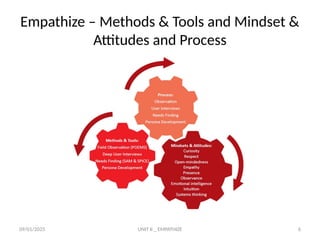
Empathize – Methods & Tools and Mindset &
Attitudes and Process
09/01/2025 UNIT II _ EMPATHIZE 7
Empathize - Methods and Tools
• Four Methods and Tools of Empathize.
– FIELD OBSERVATION (POEMS)
– DEEP USER INTERVIEW (EMPATHY MAP & JOURNEY MAP)
– NEEDS FINDING (SAM & SPICE)
– PERSONA DEVELOPMENT
09/01/2025 UNIT II _ EMPATHIZE 8
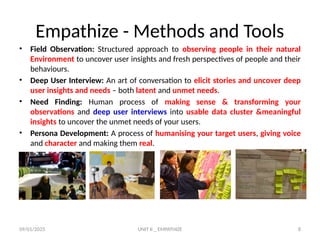
Empathize - Methods and Tools
• Field Observation: Structured approach to observing people in their natural
Environment to uncover user insights and fresh perspectives of people and their
behaviours.
• Deep User Interview: An art of conversation to elicit stories and uncover deep
user insights and needs – both latent and unmet needs.
• Need Finding: Human process of making sense & transforming your
observations and deep user interviews into usable data cluster &meaningful
insights to uncover the unmet needs of your users.
• Persona Development: A process of humanising your target users, giving voice
and character and making them real.
09/01/2025 UNIT II _ EMPATHIZE 9
Field Observation
• It is a structured approach to observing
people in their natural Environment rather
than in a formal research setting.
• It is to uncover user insights and fresh
perspectives of people and behavior.
09/01/2025 UNIT II _ EMPATHIZE 10
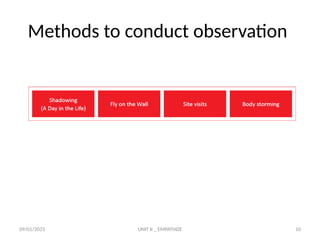
Methods to conduct observation
09/01/2025 UNIT II _ EMPATHIZE 11
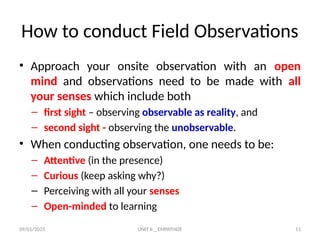
How to conduct Field Observations
• Approach your onsite observation with an open
mind and observations need to be made with all
your senses which include both
– first sight – observing observable as reality, and
– second sight - observing the unobservable.
• When conducting observation, one needs to be:
– Attentive (in the presence)
– Curious (keep asking why?)
– Perceiving with all your senses
– Open-minded to learning
09/01/2025 UNIT II _ EMPATHIZE 12
POEMS Framework
• Use POEMS framework to structure and guide
the observation.
• POEMS Framework Template is used to
record and capture what you have observed.
• Take photos to support and document your
learning as follows in relation to POEMS
framework.
09/01/2025 UNIT II _ EMPATHIZE 13
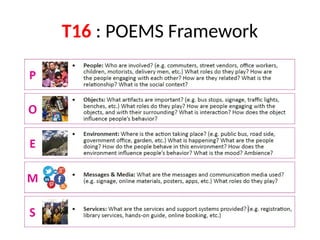
T16 : POEMS Framework
09/01/2025 UNIT II _ EMPATHIZE 14
Outcome of POEMS Framework
• Context: where, when, who and why?
• Insights: what have you learned about your target users.
• Challenges: what are the pain-points, obstacles, gaps.
• Opportunities: What are some opportunities and new
possibilities.
• Perspectives: How would you rethink about your design
challenge project.
09/01/2025 UNIT II _ EMPATHIZE 15
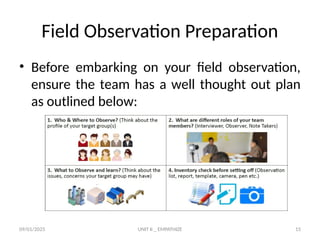
Field Observation Preparation
• Before embarking on your field observation,
ensure the team has a well thought out plan
as outlined below:
09/01/2025 UNIT II _ EMPATHIZE 16
Deep User Interview
• Deep user interview is an art of conversation
– to elicit stories and
– to uncover deep users’ insights and needs – both latent
and unmet needs through understanding of the users’
• Behaviour & feelings,
• Goals,
• Motivations,
• Aspirations,
• Values,
• Beliefs,
• Pains and challenges.
09/01/2025 UNIT II _ EMPATHIZE 17
When to use Deep User Interviews
• A Deep User Interview is conducted when we want
– to understand beliefs, values, challenges, concerns,
frustrations, motivation & behaviours, and
– To uncover user insights, latent needs, and the unmet needs
of the users by listening to their stories and experiences.
• A proper conduct of deep user interview is also
important for theme clustering, insight development,
need findings, and persona development.
• Need findings and persona development depend on the
quality of interviews that we conduct
09/01/2025 UNIT II _ EMPATHIZE 18
How to conduct Deep User Interviews
A. Pre-interview preparation
B. During the Interview
C. Post Interview
09/01/2025 UNIT II _ EMPATHIZE 19
A. Pre-interview preparation
• Being prepared with right questions and other
interview tools and techniques are key to successful
conduct of a deep user interview.
• Prepare your deep user interview by carrying out
following activities:
1. Prepare interview questions
2. Plan and structure your interview
3. Identify interview team and assign roles
4. Prepare your equipment check-list and relevant tools
5. Conduct mock interview
09/01/2025 UNIT II _ EMPATHIZE 20
1. Prepare interview questions
• Be prepared with the rights questions to explore the deep user needs
with use of both
– Type A – closed ended and
– Type B – open-ended probing questions.
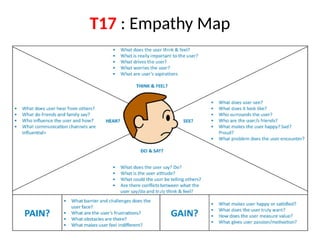
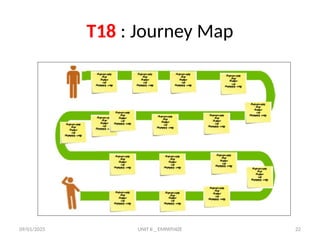
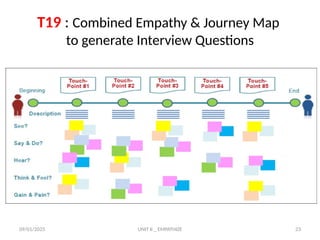
• Use EMPATHY Map and/or JOURNEY Map to generate right questions.
• Empathy Map & User Journey to Generate Interview Questions.
• Use of empathy map helped to generate questions related to
– think & feel,
– see,
– say & do,
– hear,
– pain and
– gain.
09/01/2025 UNIT II _ EMPATHIZE 21
T17 : Empathy Map
09/01/2025 UNIT II _ EMPATHIZE 22
T18 : Journey Map
09/01/2025 UNIT II _ EMPATHIZE 23
T19 : Combined Empathy & Journey Map
to generate Interview Questions
09/01/2025 UNIT II _ EMPATHIZE 24
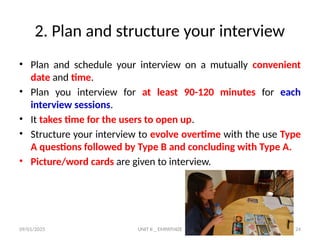
2. Plan and structure your interview
• Plan and schedule your interview on a mutually convenient
date and time.
• Plan you interview for at least 90-120 minutes for each
interview sessions.
• It takes time for the users to open up.
• Structure your interview to evolve overtime with the use Type
A questions followed by Type B and concluding with Type A.
• Picture/word cards are given to interview.
09/01/2025 UNIT II _ EMPATHIZE 25
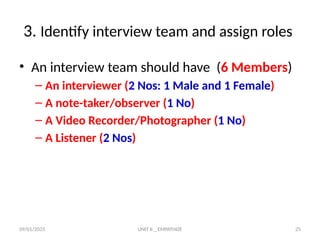
3. Identify interview team and assign roles
• An interview team should have (6 Members)
– An interviewer (2 Nos: 1 Male and 1 Female)
– A note-taker/observer (1 No)
– A Video Recorder/Photographer (1 No)
– A Listener (2 Nos)
09/01/2025 UNIT II _ EMPATHIZE 26
4. Prepare your equipment check-list and
relevant tools
• Simple interview tools such as
– photos and picture cards,
– words cards,
– journey map, and
– 5 Whys will help interviewee to open up.
09/01/2025 UNIT II _ EMPATHIZE 27
5. Conduct mock interview
• The objective is to familiarize team members
with the interview process.
• Conducting deep user interview takes a lot of
practice.
09/01/2025 UNIT II _ EMPATHIZE 28
B. During the Interview
1. Follow your interview structure – use of Type A and Type B questions - and
make it a natural and a causal chat.
2. To begin the interview, use Type A questions relating to the demographics and
habits to build rapport and make interviewee comfortable.
3. To explore, elicit stories and deeper response and gather information on
personal motivation such as aspirations, inspirations, motivations and pain
points use Type B questions.
4. Use Type A questions to gather information related to the project statement.
These questions were prepared to be asked towards the end of the interview to
wrap up.
5. During interview avoid questions that lead to a dead end.
6. Use interview tools and techniques to probe more and evoke stories and
explore emotions.
7. Be comfortable with silence and observe for non-verbal cues and emotions.
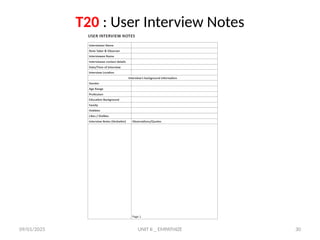
8. Use T20: User Interview Notes Template to record everything in verbatim. Do
not interpret or analyse anything during the interview.
9. Take photo references of the interview process, including activities like
sketching, journey mapping, card sorting, etc.
09/01/2025 UNIT II _ EMPATHIZE 29
Activities of conducting Deep User Interview
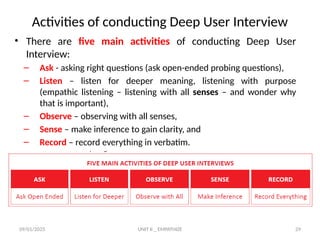
• There are five main activities of conducting Deep User
Interview:
– Ask - asking right questions (ask open-ended probing questions),
– Listen – listen for deeper meaning, listening with purpose
(empathic listening – listening with all senses – and wonder why
that is important),
– Observe – observing with all senses,
– Sense – make inference to gain clarity, and
– Record – record everything in verbatim.
09/01/2025 UNIT II _ EMPATHIZE 30
T20 : User Interview Notes
09/01/2025 UNIT II _ EMPATHIZE 31
C. Post Interview
• Conduct post-interview debrief immediately after each
interview sessions.
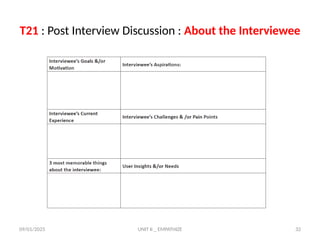
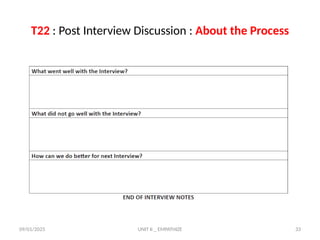
– Use T21 & 22: Post Interview Discussion Template
– to summarize what you heard during the interview and
develop a common understanding about
• the user interviewee and
• the Process.
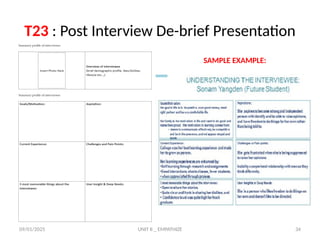
• Conduct post-interview debriefs presentation to the team.
– Use T23: Post Interview De-brief Presentation Templates.
09/01/2025 UNIT II _ EMPATHIZE 32
T21 : Post Interview Discussion : About the Interviewee
09/01/2025 UNIT II _ EMPATHIZE 33
T22 : Post Interview Discussion : About the Process
09/01/2025 UNIT II _ EMPATHIZE 34
T23 : Post Interview De-brief Presentation
SAMPLE EXAMPLE:
09/01/2025 UNIT II _ EMPATHIZE 35
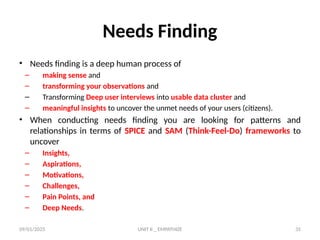
Needs Finding
• Needs finding is a deep human process of
– making sense and
– transforming your observations and
– Transforming Deep user interviews into usable data cluster and
– meaningful insights to uncover the unmet needs of your users (citizens).
• When conducting needs finding you are looking for patterns and
relationships in terms of SPICE and SAM (Think-Feel-Do) frameworks to
uncover
– Insights,
– Aspirations,
– Motivations,
– Challenges,
– Pain Points, and
– Deep Needs.
09/01/2025 UNIT II _ EMPATHIZE 36
When to use Needs Finding
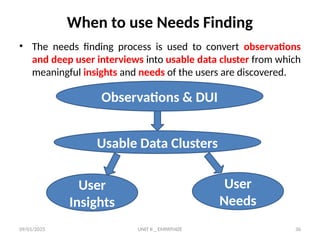
• The needs finding process is used to convert observations
and deep user interviews into usable data cluster from which
meaningful insights and needs of the users are discovered.
Observations & DUI
Usable Data Clusters
User
Insights
User
Needs
09/01/2025 UNIT II _ EMPATHIZE 37
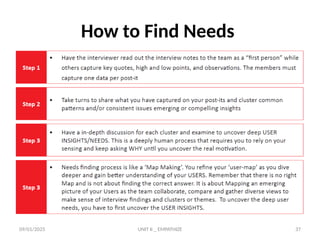
How to Find Needs
09/01/2025 UNIT II _ EMPATHIZE 38
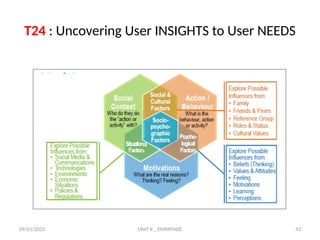
Uncovering USER INSIGHTS
• User insights are not user needs but it helps
to explain it.
• Good user insights reveal a deep discovery
about your user that can be acted upon to
creating new ideas and solution.
• User insight finding takes times and some
serious probing and trying to understand the
real ‘why’ of the behavior.
09/01/2025 UNIT II _ EMPATHIZE 39
5 Principles of uncovering User Insights
1. User insight is a human truth
– A human truth that is moving and relatable. It connects to who we are as humans
and why we feel what we feel.
2. User insight digs deeper than observation
– Help uncover the hidden motivation behind a behavior
3. User insight offers new, untapped understanding
– Offer undiscovered truths of the human complexion, something new, true and
not obvious.
4. User insights shapes new perspectives and challenges old assumptions
– Shape your perspectives and challenge you to question assumptions.
5. User insight serves as a foundation to unlock creative thinking
– Give you the “aha” moment that inspire creative innovation.
09/01/2025 UNIT II _ EMPATHIZE 40
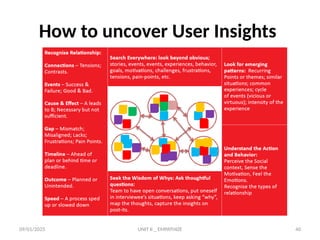
How to uncover User Insights
09/01/2025 UNIT II _ EMPATHIZE 41
Tool to Uncover User Insights
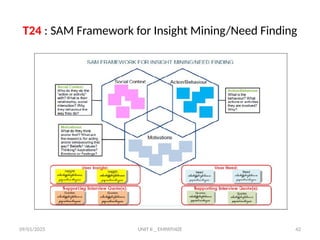
• SAM (Think – Feel – Do) framework
• Social Context: who they do the ‘action or activity’ with? What
is their relationship, social interaction? Why they behave the
way they do?
• Action (Bhaviour): What is the behavior? What actions or
activities they are involved? Why?
• Motivation: what do they think? How do they feel? What are
the reason(s) for actions and/or behaving that way? Belief?
Values? Thinking? Aspirations? Emotions or Feelings?
09/01/2025 UNIT II _ EMPATHIZE 42
T24 : SAM Framework for Insight Mining/Need Finding
09/01/2025 UNIT II _ EMPATHIZE 43
T24 : Uncovering User INSIGHTS to User NEEDS
09/01/2025 UNIT II _ EMPATHIZE 44
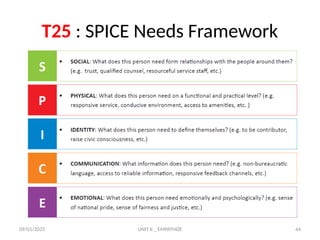
T25 : SPICE Needs Framework
09/01/2025 UNIT II _ EMPATHIZE 45
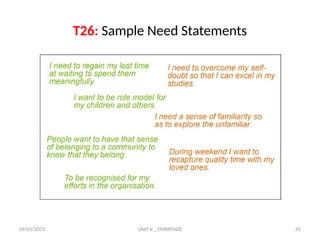
T26: Sample Need Statements
09/01/2025 UNIT II _ EMPATHIZE 46
Documenting User Insights and Needs
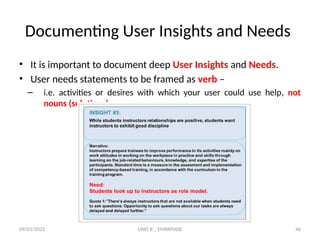
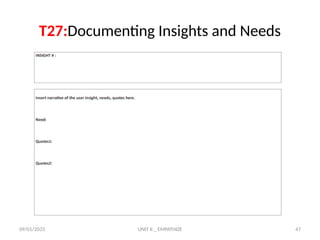
• It is important to document deep User Insights and Needs.
• User needs statements to be framed as verb –
– i.e. activities or desires with which your user could use help, not
nouns (solutions).
09/01/2025 UNIT II _ EMPATHIZE 47
T27:Documenting Insights and Needs
09/01/2025 UNIT II _ EMPATHIZE 48
Persona Development
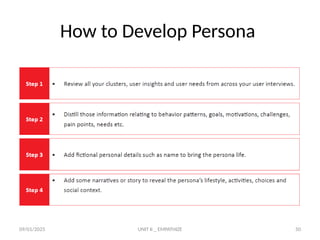
• Persona development is a process of humanizing your
target user, giving voice and character and making them
real.
• Personas are fictional characters created to represent
your group of target users who exhibit similar behaviors,
patterns, motivations and goals.
• A well created persona provide realistic and detail
descriptions, that include
– Behaviors, Patterns, Motivations, Goals, Skills, Attitude,
Challenges, and environment with a few fictional personal
details, including a name, to bring personas to life.
09/01/2025 UNIT II _ EMPATHIZE 49
When to use Persona Development
• Persona development is to create user models – characters
with a clearly defined purpose and characteristics – who
will represent your target users throughout the design
process from brainstorming for solution ideas to designing
ideal user experience journey.
• Development of personas support story-telling, foster user
understanding and evolve design.
• Personas tell stories and stories are part of every
community.
• Stories help organize and convey information in a
compelling manner and evoke emotions and responses.
09/01/2025 UNIT II _ EMPATHIZE 50
How to Develop Persona
09/01/2025 UNIT II _ EMPATHIZE 51
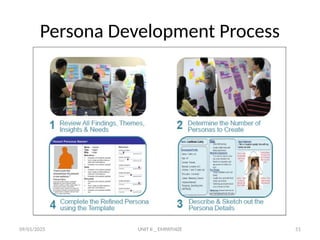
Persona Development Process
09/01/2025 UNIT II _ EMPATHIZE 52
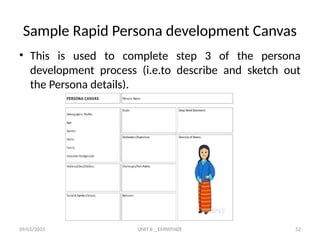
Sample Rapid Persona development Canvas
• This is used to complete step 3 of the persona
development process (i.e.to describe and sketch out
the Persona details).
09/01/2025 UNIT II _ EMPATHIZE 53
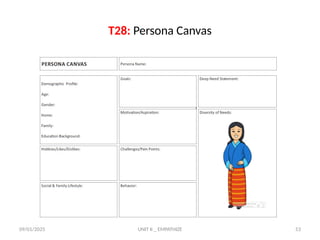
T28: Persona Canvas
09/01/2025 UNIT II _ EMPATHIZE 54
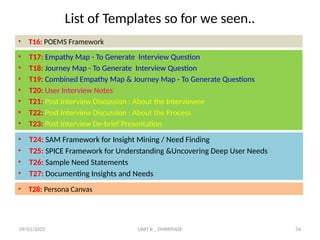
List of Templates so for we seen..
• T16: POEMS Framework
• T24: SAM Framework for Insight Mining / Need Finding
• T25: SPICE Framework for Understanding &Uncovering Deep User Needs
• T26: Sample Need Statements
• T27: Documenting Insights and Needs
• T28: Persona Canvas
• T17: Empathy Map - To Generate Interview Question
• T18: Journey Map - To Generate Interview Question
• T19: Combined Empathy Map & Journey Map - To Generate Questions
• T20: User Interview Notes
• T21: Post Interview Discussion : About the Interviewee
• T22: Post Interview Discussion : About the Process
• T23: Post Interview De-brief Presentation
09/01/2025 UNIT II _ EMPATHIZE 55
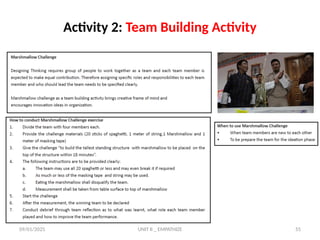
Activity 2: Team Building Activity
09/01/2025 UNIT II _ EMPATHIZE 56
Thank You

Design thinking ppt unit iiempathise.pptx

  • 1.
    UNIT II :Empathize By Dr.K.Sengottaiyan Assoc. Professor, Mech. Ksn.mech@rmkec.ac.in 22CB005 – Design Thinking Thanks to and Resource from : Lee Chong Hwa, "Design Thinking The Guidebook", NA Edition, Design Thinking Master Trainers of Bhutan, NA, 2017.
  • 2.
    09/01/2025 UNIT II_ EMPATHIZE 2 Unit Wise Syllabus – DT UNIT I INTRODUCTION 9 Introduction to design thinking - Importance of design thinking for business – Phases of design thinking – Experiential activity – Case study. UNIT II EMPATHIZE PHASE 9 Empathize phase - Steps involved - Immersion activity- Questionnaire – Empathy map for case study UNIT III DEFINE PHASE 9 Creation of personas in define phase – steps in problem statement creation -problem statement definition – Examples – Key problem statements. UNIT IV IDEATION PHASE 9 Ideation phase steps – Ideation games – Ideate to find solutions – Doodling – Storytelling in presenting ideas and prototypes. UNIT V PROTOTYPE AND TESTING 9 Importance of prototype in design thinking –Guidelines - Prototyping the idea –Value proposition statement – Testing in design thinking – Prototype testing –Documentation – Design thinking in functional work – Mapping design thinking to agile methodologies.
  • 3.
    09/01/2025 UNIT II_ EMPATHIZE 3 Unit II : Contents 1. Empathize – Methods and Tools 2. Field Observation 3. Deep User Interview 4. Empathy Map 5. User Journey Map 6. Need Finding 7. User Insights 8. User Persona Development
  • 4.
    09/01/2025 UNIT II_ EMPATHIZE 4 Empathize • Empathize is a mechanism – to understand and share the feelings of your users – to foster deep user understanding and be able to uncover the deep user insights and needs. – Empathy is used to uncover the deep user insights and needs by gaining broader perspective of the citizens’ life.
  • 5.
    09/01/2025 UNIT II_ EMPATHIZE 5 Purpose of Empathize • to foster empathy and deep understanding of the users in terms of their life, needs, aspirations and challenges; • appreciate others as human beings and understand and relate with their feelings; • see their world through their eyes and make emotional connection; • communicate understanding with others and share their world; • be in the shoes of your users, experience same and gain fresh insights and uncover their needs; and • Develop passion to act and help and inspire us to find new solutions. •
  • 6.
    09/01/2025 UNIT II_ EMPATHIZE 6 Empathize – Methods & Tools and Mindset & Attitudes and Process
  • 7.
    09/01/2025 UNIT II_ EMPATHIZE 7 Empathize - Methods and Tools • Four Methods and Tools of Empathize. – FIELD OBSERVATION (POEMS) – DEEP USER INTERVIEW (EMPATHY MAP & JOURNEY MAP) – NEEDS FINDING (SAM & SPICE) – PERSONA DEVELOPMENT
  • 8.
    09/01/2025 UNIT II_ EMPATHIZE 8 Empathize - Methods and Tools • Field Observation: Structured approach to observing people in their natural Environment to uncover user insights and fresh perspectives of people and their behaviours. • Deep User Interview: An art of conversation to elicit stories and uncover deep user insights and needs – both latent and unmet needs. • Need Finding: Human process of making sense & transforming your observations and deep user interviews into usable data cluster &meaningful insights to uncover the unmet needs of your users. • Persona Development: A process of humanising your target users, giving voice and character and making them real.
  • 9.
    09/01/2025 UNIT II_ EMPATHIZE 9 Field Observation • It is a structured approach to observing people in their natural Environment rather than in a formal research setting. • It is to uncover user insights and fresh perspectives of people and behavior.
  • 10.
    09/01/2025 UNIT II_ EMPATHIZE 10 Methods to conduct observation
  • 11.
    09/01/2025 UNIT II_ EMPATHIZE 11 How to conduct Field Observations • Approach your onsite observation with an open mind and observations need to be made with all your senses which include both – first sight – observing observable as reality, and – second sight - observing the unobservable. • When conducting observation, one needs to be: – Attentive (in the presence) – Curious (keep asking why?) – Perceiving with all your senses – Open-minded to learning
  • 12.
    09/01/2025 UNIT II_ EMPATHIZE 12 POEMS Framework • Use POEMS framework to structure and guide the observation. • POEMS Framework Template is used to record and capture what you have observed. • Take photos to support and document your learning as follows in relation to POEMS framework.
  • 13.
    09/01/2025 UNIT II_ EMPATHIZE 13 T16 : POEMS Framework
  • 14.
    09/01/2025 UNIT II_ EMPATHIZE 14 Outcome of POEMS Framework • Context: where, when, who and why? • Insights: what have you learned about your target users. • Challenges: what are the pain-points, obstacles, gaps. • Opportunities: What are some opportunities and new possibilities. • Perspectives: How would you rethink about your design challenge project.
  • 15.
    09/01/2025 UNIT II_ EMPATHIZE 15 Field Observation Preparation • Before embarking on your field observation, ensure the team has a well thought out plan as outlined below:
  • 16.
    09/01/2025 UNIT II_ EMPATHIZE 16 Deep User Interview • Deep user interview is an art of conversation – to elicit stories and – to uncover deep users’ insights and needs – both latent and unmet needs through understanding of the users’ • Behaviour & feelings, • Goals, • Motivations, • Aspirations, • Values, • Beliefs, • Pains and challenges.
  • 17.
    09/01/2025 UNIT II_ EMPATHIZE 17 When to use Deep User Interviews • A Deep User Interview is conducted when we want – to understand beliefs, values, challenges, concerns, frustrations, motivation & behaviours, and – To uncover user insights, latent needs, and the unmet needs of the users by listening to their stories and experiences. • A proper conduct of deep user interview is also important for theme clustering, insight development, need findings, and persona development. • Need findings and persona development depend on the quality of interviews that we conduct
  • 18.
    09/01/2025 UNIT II_ EMPATHIZE 18 How to conduct Deep User Interviews A. Pre-interview preparation B. During the Interview C. Post Interview
  • 19.
    09/01/2025 UNIT II_ EMPATHIZE 19 A. Pre-interview preparation • Being prepared with right questions and other interview tools and techniques are key to successful conduct of a deep user interview. • Prepare your deep user interview by carrying out following activities: 1. Prepare interview questions 2. Plan and structure your interview 3. Identify interview team and assign roles 4. Prepare your equipment check-list and relevant tools 5. Conduct mock interview
  • 20.
    09/01/2025 UNIT II_ EMPATHIZE 20 1. Prepare interview questions • Be prepared with the rights questions to explore the deep user needs with use of both – Type A – closed ended and – Type B – open-ended probing questions. • Use EMPATHY Map and/or JOURNEY Map to generate right questions. • Empathy Map & User Journey to Generate Interview Questions. • Use of empathy map helped to generate questions related to – think & feel, – see, – say & do, – hear, – pain and – gain.
  • 21.
    09/01/2025 UNIT II_ EMPATHIZE 21 T17 : Empathy Map
  • 22.
    09/01/2025 UNIT II_ EMPATHIZE 22 T18 : Journey Map
  • 23.
    09/01/2025 UNIT II_ EMPATHIZE 23 T19 : Combined Empathy & Journey Map to generate Interview Questions
  • 24.
    09/01/2025 UNIT II_ EMPATHIZE 24 2. Plan and structure your interview • Plan and schedule your interview on a mutually convenient date and time. • Plan you interview for at least 90-120 minutes for each interview sessions. • It takes time for the users to open up. • Structure your interview to evolve overtime with the use Type A questions followed by Type B and concluding with Type A. • Picture/word cards are given to interview.
  • 25.
    09/01/2025 UNIT II_ EMPATHIZE 25 3. Identify interview team and assign roles • An interview team should have (6 Members) – An interviewer (2 Nos: 1 Male and 1 Female) – A note-taker/observer (1 No) – A Video Recorder/Photographer (1 No) – A Listener (2 Nos)
  • 26.
    09/01/2025 UNIT II_ EMPATHIZE 26 4. Prepare your equipment check-list and relevant tools • Simple interview tools such as – photos and picture cards, – words cards, – journey map, and – 5 Whys will help interviewee to open up.
  • 27.
    09/01/2025 UNIT II_ EMPATHIZE 27 5. Conduct mock interview • The objective is to familiarize team members with the interview process. • Conducting deep user interview takes a lot of practice.
  • 28.
    09/01/2025 UNIT II_ EMPATHIZE 28 B. During the Interview 1. Follow your interview structure – use of Type A and Type B questions - and make it a natural and a causal chat. 2. To begin the interview, use Type A questions relating to the demographics and habits to build rapport and make interviewee comfortable. 3. To explore, elicit stories and deeper response and gather information on personal motivation such as aspirations, inspirations, motivations and pain points use Type B questions. 4. Use Type A questions to gather information related to the project statement. These questions were prepared to be asked towards the end of the interview to wrap up. 5. During interview avoid questions that lead to a dead end. 6. Use interview tools and techniques to probe more and evoke stories and explore emotions. 7. Be comfortable with silence and observe for non-verbal cues and emotions. 8. Use T20: User Interview Notes Template to record everything in verbatim. Do not interpret or analyse anything during the interview. 9. Take photo references of the interview process, including activities like sketching, journey mapping, card sorting, etc.
  • 29.
    09/01/2025 UNIT II_ EMPATHIZE 29 Activities of conducting Deep User Interview • There are five main activities of conducting Deep User Interview: – Ask - asking right questions (ask open-ended probing questions), – Listen – listen for deeper meaning, listening with purpose (empathic listening – listening with all senses – and wonder why that is important), – Observe – observing with all senses, – Sense – make inference to gain clarity, and – Record – record everything in verbatim.
  • 30.
    09/01/2025 UNIT II_ EMPATHIZE 30 T20 : User Interview Notes
  • 31.
    09/01/2025 UNIT II_ EMPATHIZE 31 C. Post Interview • Conduct post-interview debrief immediately after each interview sessions. – Use T21 & 22: Post Interview Discussion Template – to summarize what you heard during the interview and develop a common understanding about • the user interviewee and • the Process. • Conduct post-interview debriefs presentation to the team. – Use T23: Post Interview De-brief Presentation Templates.
  • 32.
    09/01/2025 UNIT II_ EMPATHIZE 32 T21 : Post Interview Discussion : About the Interviewee
  • 33.
    09/01/2025 UNIT II_ EMPATHIZE 33 T22 : Post Interview Discussion : About the Process
  • 34.
    09/01/2025 UNIT II_ EMPATHIZE 34 T23 : Post Interview De-brief Presentation SAMPLE EXAMPLE:
  • 35.
    09/01/2025 UNIT II_ EMPATHIZE 35 Needs Finding • Needs finding is a deep human process of – making sense and – transforming your observations and – Transforming Deep user interviews into usable data cluster and – meaningful insights to uncover the unmet needs of your users (citizens). • When conducting needs finding you are looking for patterns and relationships in terms of SPICE and SAM (Think-Feel-Do) frameworks to uncover – Insights, – Aspirations, – Motivations, – Challenges, – Pain Points, and – Deep Needs.
  • 36.
    09/01/2025 UNIT II_ EMPATHIZE 36 When to use Needs Finding • The needs finding process is used to convert observations and deep user interviews into usable data cluster from which meaningful insights and needs of the users are discovered. Observations & DUI Usable Data Clusters User Insights User Needs
  • 37.
    09/01/2025 UNIT II_ EMPATHIZE 37 How to Find Needs
  • 38.
    09/01/2025 UNIT II_ EMPATHIZE 38 Uncovering USER INSIGHTS • User insights are not user needs but it helps to explain it. • Good user insights reveal a deep discovery about your user that can be acted upon to creating new ideas and solution. • User insight finding takes times and some serious probing and trying to understand the real ‘why’ of the behavior.
  • 39.
    09/01/2025 UNIT II_ EMPATHIZE 39 5 Principles of uncovering User Insights 1. User insight is a human truth – A human truth that is moving and relatable. It connects to who we are as humans and why we feel what we feel. 2. User insight digs deeper than observation – Help uncover the hidden motivation behind a behavior 3. User insight offers new, untapped understanding – Offer undiscovered truths of the human complexion, something new, true and not obvious. 4. User insights shapes new perspectives and challenges old assumptions – Shape your perspectives and challenge you to question assumptions. 5. User insight serves as a foundation to unlock creative thinking – Give you the “aha” moment that inspire creative innovation.
  • 40.
    09/01/2025 UNIT II_ EMPATHIZE 40 How to uncover User Insights
  • 41.
    09/01/2025 UNIT II_ EMPATHIZE 41 Tool to Uncover User Insights • SAM (Think – Feel – Do) framework • Social Context: who they do the ‘action or activity’ with? What is their relationship, social interaction? Why they behave the way they do? • Action (Bhaviour): What is the behavior? What actions or activities they are involved? Why? • Motivation: what do they think? How do they feel? What are the reason(s) for actions and/or behaving that way? Belief? Values? Thinking? Aspirations? Emotions or Feelings?
  • 42.
    09/01/2025 UNIT II_ EMPATHIZE 42 T24 : SAM Framework for Insight Mining/Need Finding
  • 43.
    09/01/2025 UNIT II_ EMPATHIZE 43 T24 : Uncovering User INSIGHTS to User NEEDS
  • 44.
    09/01/2025 UNIT II_ EMPATHIZE 44 T25 : SPICE Needs Framework
  • 45.
    09/01/2025 UNIT II_ EMPATHIZE 45 T26: Sample Need Statements
  • 46.
    09/01/2025 UNIT II_ EMPATHIZE 46 Documenting User Insights and Needs • It is important to document deep User Insights and Needs. • User needs statements to be framed as verb – – i.e. activities or desires with which your user could use help, not nouns (solutions).
  • 47.
    09/01/2025 UNIT II_ EMPATHIZE 47 T27:Documenting Insights and Needs
  • 48.
    09/01/2025 UNIT II_ EMPATHIZE 48 Persona Development • Persona development is a process of humanizing your target user, giving voice and character and making them real. • Personas are fictional characters created to represent your group of target users who exhibit similar behaviors, patterns, motivations and goals. • A well created persona provide realistic and detail descriptions, that include – Behaviors, Patterns, Motivations, Goals, Skills, Attitude, Challenges, and environment with a few fictional personal details, including a name, to bring personas to life.
  • 49.
    09/01/2025 UNIT II_ EMPATHIZE 49 When to use Persona Development • Persona development is to create user models – characters with a clearly defined purpose and characteristics – who will represent your target users throughout the design process from brainstorming for solution ideas to designing ideal user experience journey. • Development of personas support story-telling, foster user understanding and evolve design. • Personas tell stories and stories are part of every community. • Stories help organize and convey information in a compelling manner and evoke emotions and responses.
  • 50.
    09/01/2025 UNIT II_ EMPATHIZE 50 How to Develop Persona
  • 51.
    09/01/2025 UNIT II_ EMPATHIZE 51 Persona Development Process
  • 52.
    09/01/2025 UNIT II_ EMPATHIZE 52 Sample Rapid Persona development Canvas • This is used to complete step 3 of the persona development process (i.e.to describe and sketch out the Persona details).
  • 53.
    09/01/2025 UNIT II_ EMPATHIZE 53 T28: Persona Canvas
  • 54.
    09/01/2025 UNIT II_ EMPATHIZE 54 List of Templates so for we seen.. • T16: POEMS Framework • T24: SAM Framework for Insight Mining / Need Finding • T25: SPICE Framework for Understanding &Uncovering Deep User Needs • T26: Sample Need Statements • T27: Documenting Insights and Needs • T28: Persona Canvas • T17: Empathy Map - To Generate Interview Question • T18: Journey Map - To Generate Interview Question • T19: Combined Empathy Map & Journey Map - To Generate Questions • T20: User Interview Notes • T21: Post Interview Discussion : About the Interviewee • T22: Post Interview Discussion : About the Process • T23: Post Interview De-brief Presentation
  • 55.
    09/01/2025 UNIT II_ EMPATHIZE 55 Activity 2: Team Building Activity
  • 56.
    09/01/2025 UNIT II_ EMPATHIZE 56 Thank You