DESIGN
THINKING FOR
PRODUCT
DESIGN
Shristi Shrestha
WHAT WE'LL
DISCUSS
TOPIC OUTLINE
What is Design Thinking?
Why Design Thinking?
How to Practice Design Thinking?
Prompt: Combating Online Dating Abuse
What's Next?
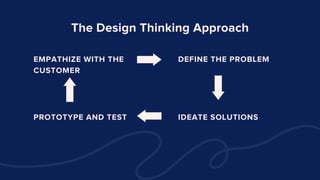
EMPATHIZE WITH THE
CUSTOMER
DEFINE THE PROBLEM
IDEATE SOLUTIONS
PROTOTYPE AND TEST
The Design Thinking Approach
WHY DESIGN THINKING?
Its primary focus is on HUMAN BEINGS i.e. the users.
BEFORE WE
BEGIN
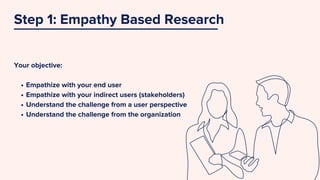
Empathize with your end user
Empathize with your indirect users (stakeholders)
Understand the challenge from a user perspective
Understand the challenge from the organization
Your objective:
Step 1: Empathy Based Research
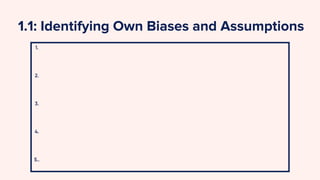
1.1: Identifying Own Biases and Assumptions
1.
2.
3.
4.
5..
1.2: Empathetic Research Guide
“Hi, my name is _________ and I’m doing a project on [insert challenge]. I’m really interested in your experiences
and how you [insert activity]. I was wondering if I could ask you a few questions. It should only take 30-40 minutes.”
Starting questions:
• Can you tell me about the last time you [insert activity}?
• Can you tell me a story about your best __________ experience?
• Can you tell me a story about your worst __________ experience?
• What helped? What hindered?
• Why?
• Tell me more…
Follow up questions:
• Can you tell me more?
• Can you give me an example?
• How did that make you feel?
• What do you wish was different?
1.3: Empathetic Interview Notes
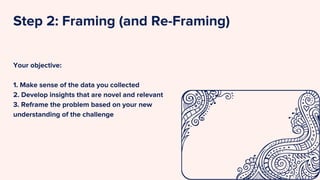
Your objective:
1. Make sense of the data you collected
2. Develop insights that are novel and relevant
3. Reframe the problem based on your new
understanding of the challenge
Step 2: Framing (and Re-Framing)
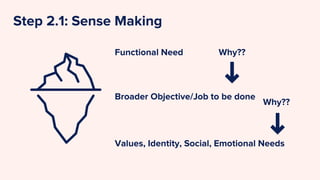
Step 2.1: Sense Making
Functional Need
Broader Objective/Job to be done
Values, Identity, Social, Emotional Needs
Why??
Why??
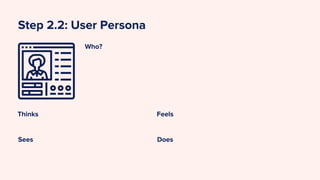
Step 2.2: User Persona
Who?
Thinks
Sees
Feels
Does
Painpoints Opportunities
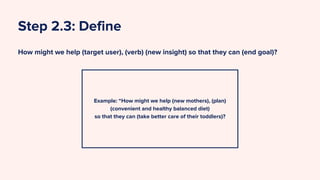
Step 2.3: Define
How might we help (target user), (verb) (new insight) so that they can (end goal)?
Example: “How might we help (new mothers), (plan)
(convenient and healthy balanced diet)
so that they can (take better care of their toddlers)?
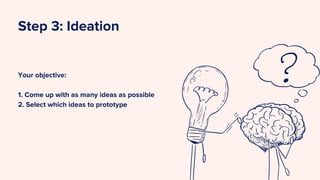
Your objective:
1. Come up with as many ideas as possible
2. Select which ideas to prototype
Step 3: Ideation
1. Crazy 8s - This is a sketching technique that aims to generate a bunch of ideas, quickly. Take a piece of paper,
fold it into 8 squares, set a timer for five minutes, and try to fill as many of the boxes as possible. If you fill in all
8 and still have time left, try for 8 more!
2. Worst Idea - If you or your group is feeling stuck, this is a great way to reignite your energy. Simply ask the
group to create a list of bad, terrible, stupid, or even gross ideas. This will get participants laughing and re-
engaged. Once you have a list, you can challenge yourself to turn those horrible ideas into great ones by either
considering the opposite or finding aspects within the terrible idea that can be used to inspire a good one.
3. Brainstorming - This is a great technique to come up with a lot of ideas, quickly. Starting with a prompt
question, you challenge the group, or yourself, to come up with as many ideas as possible. Write each idea
down - one idea on one post-it.
3.1: Some Ideation Techniques
3.2: Ideation
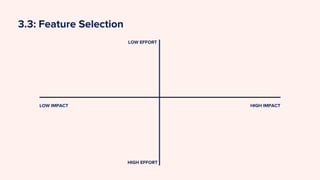
3.3: Feature Selection
LOW IMPACT HIGH IMPACT
HIGH EFFORT
LOW EFFORT
3.4: Feature: User Flow Mapping
Your objective:
1. Build a prototype(s) of your idea(s)
Step 4: Prototype
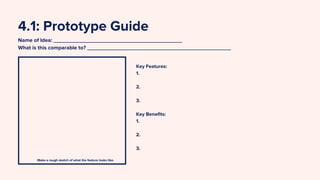
4.1: Prototype Guide
Name of Idea: __________________________________________
What is this comparable to? _______________________________________________
Key Features:
1.
2.
3.
Key Benefits:
1.
2.
3.
Make a rough sketch of what the feature looks like.
Your objective:
1. Capture feedback
2. Apply feedback to make improvements
Step 5: Test (& Iterate)
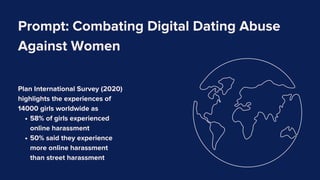
58% of girls experienced
online harassment
50% said they experience
more online harassment
than street harassment
Plan International Survey (2020)
highlights the experiences of
14000 girls worldwide as
Prompt: Combating Digital Dating Abuse
Against Women
● Identity Theft and Online Impersonation
● Sexual Objectification
● Spying
● Stalking and Stalking by Proxy
● Abusive Sexting
● Slut-shaming
Some Forms of Digital Abuse:
Technology advancements have
made it simpler to keep the partner
"captive" even when the abuser is
not around physically.
Constant threats via text messages,
surveillance using the GPS
locations of the victim's digital
footprint, and other control tactics
are some forms of Digital Dating
Abuse.
Digital Dating Abuse
Why we are talking about Digital Dating
Abuse?
In Nepal, "Dating" is still not socially
accepted. If you can not talk openly
about dating, how do you talk about
dating abuse?
While Domestic Abuse (primarily
Physical Abuse) is often discussed
and a criminal act by law, digital
abuse victims are not protected by
constitutional law.
Your thoughts on
Digital Dating
Abuse.
Thank you.

Design Thinking for Product Design Slide.pdf

  • 1.
  • 2.
    WHAT WE'LL DISCUSS TOPIC OUTLINE Whatis Design Thinking? Why Design Thinking? How to Practice Design Thinking? Prompt: Combating Online Dating Abuse What's Next?
  • 3.
    EMPATHIZE WITH THE CUSTOMER DEFINETHE PROBLEM IDEATE SOLUTIONS PROTOTYPE AND TEST The Design Thinking Approach
  • 4.
    WHY DESIGN THINKING? Itsprimary focus is on HUMAN BEINGS i.e. the users. BEFORE WE BEGIN
  • 5.
    Empathize with yourend user Empathize with your indirect users (stakeholders) Understand the challenge from a user perspective Understand the challenge from the organization Your objective: Step 1: Empathy Based Research
  • 6.
    1.1: Identifying OwnBiases and Assumptions 1. 2. 3. 4. 5..
  • 7.
    1.2: Empathetic ResearchGuide “Hi, my name is _________ and I’m doing a project on [insert challenge]. I’m really interested in your experiences and how you [insert activity]. I was wondering if I could ask you a few questions. It should only take 30-40 minutes.” Starting questions: • Can you tell me about the last time you [insert activity}? • Can you tell me a story about your best __________ experience? • Can you tell me a story about your worst __________ experience? • What helped? What hindered? • Why? • Tell me more… Follow up questions: • Can you tell me more? • Can you give me an example? • How did that make you feel? • What do you wish was different?
  • 8.
  • 9.
    Your objective: 1. Makesense of the data you collected 2. Develop insights that are novel and relevant 3. Reframe the problem based on your new understanding of the challenge Step 2: Framing (and Re-Framing)
  • 10.
    Step 2.1: SenseMaking Functional Need Broader Objective/Job to be done Values, Identity, Social, Emotional Needs Why?? Why??
  • 11.
    Step 2.2: UserPersona Who? Thinks Sees Feels Does
  • 12.
  • 13.
    Step 2.3: Define Howmight we help (target user), (verb) (new insight) so that they can (end goal)? Example: “How might we help (new mothers), (plan) (convenient and healthy balanced diet) so that they can (take better care of their toddlers)?
  • 14.
    Your objective: 1. Comeup with as many ideas as possible 2. Select which ideas to prototype Step 3: Ideation
  • 15.
    1. Crazy 8s- This is a sketching technique that aims to generate a bunch of ideas, quickly. Take a piece of paper, fold it into 8 squares, set a timer for five minutes, and try to fill as many of the boxes as possible. If you fill in all 8 and still have time left, try for 8 more! 2. Worst Idea - If you or your group is feeling stuck, this is a great way to reignite your energy. Simply ask the group to create a list of bad, terrible, stupid, or even gross ideas. This will get participants laughing and re- engaged. Once you have a list, you can challenge yourself to turn those horrible ideas into great ones by either considering the opposite or finding aspects within the terrible idea that can be used to inspire a good one. 3. Brainstorming - This is a great technique to come up with a lot of ideas, quickly. Starting with a prompt question, you challenge the group, or yourself, to come up with as many ideas as possible. Write each idea down - one idea on one post-it. 3.1: Some Ideation Techniques
  • 16.
  • 17.
    3.3: Feature Selection LOWIMPACT HIGH IMPACT HIGH EFFORT LOW EFFORT
  • 18.
    3.4: Feature: UserFlow Mapping
  • 19.
    Your objective: 1. Builda prototype(s) of your idea(s) Step 4: Prototype
  • 20.
    4.1: Prototype Guide Nameof Idea: __________________________________________ What is this comparable to? _______________________________________________ Key Features: 1. 2. 3. Key Benefits: 1. 2. 3. Make a rough sketch of what the feature looks like.
  • 21.
    Your objective: 1. Capturefeedback 2. Apply feedback to make improvements Step 5: Test (& Iterate)
  • 22.
    58% of girlsexperienced online harassment 50% said they experience more online harassment than street harassment Plan International Survey (2020) highlights the experiences of 14000 girls worldwide as Prompt: Combating Digital Dating Abuse Against Women
  • 23.
    ● Identity Theftand Online Impersonation ● Sexual Objectification ● Spying ● Stalking and Stalking by Proxy ● Abusive Sexting ● Slut-shaming Some Forms of Digital Abuse:
  • 24.
    Technology advancements have madeit simpler to keep the partner "captive" even when the abuser is not around physically. Constant threats via text messages, surveillance using the GPS locations of the victim's digital footprint, and other control tactics are some forms of Digital Dating Abuse. Digital Dating Abuse
  • 25.
    Why we aretalking about Digital Dating Abuse? In Nepal, "Dating" is still not socially accepted. If you can not talk openly about dating, how do you talk about dating abuse? While Domestic Abuse (primarily Physical Abuse) is often discussed and a criminal act by law, digital abuse victims are not protected by constitutional law.
  • 26.
  • 27.