Design Principles for a High-Performance Smalltalk
Dave Mason
Toronto Metropolitan Universityi
©2022 Dave Mason
Design Principles
Large memories
64-bit and IEEE-768
Multi-core and threading
Fast execution
Design Principles
Large memories
64-bit and IEEE-768
Multi-core and threading
Fast execution
Design Principles
Large memories
64-bit and IEEE-768
Multi-core and threading
Fast execution
Design Principles
Large memories
64-bit and IEEE-768
Multi-core and threading
Fast execution
Zag Smalltalk
from-scratch implementation
low-level is implemented in Zig
goal is to support existing OpenSmalltalk systems
don’t want to rewrite userland!
Zag Smalltalk
from-scratch implementation
low-level is implemented in Zig
goal is to support existing OpenSmalltalk systems
don’t want to rewrite userland!
Zag Smalltalk
from-scratch implementation
low-level is implemented in Zig
goal is to support existing OpenSmalltalk systems
don’t want to rewrite userland!
Zag Smalltalk
from-scratch implementation
low-level is implemented in Zig
goal is to support existing OpenSmalltalk systems
don’t want to rewrite userland!
Immediate Values
64 bit
NaN-boxing
double-floats, 51-bit SmallInteger, Booleans, nil, Unicode
characters, Symbols
room for instances of any type with single 32-bit value
Immediate Values
64 bit
NaN-boxing
double-floats, 51-bit SmallInteger, Booleans, nil, Unicode
characters, Symbols
room for instances of any type with single 32-bit value
Immediate Values
64 bit
NaN-boxing
double-floats, 51-bit SmallInteger, Booleans, nil, Unicode
characters, Symbols
room for instances of any type with single 32-bit value
Immediate Values
64 bit
NaN-boxing
double-floats, 51-bit SmallInteger, Booleans, nil, Unicode
characters, Symbols
room for instances of any type with single 32-bit value
S+E F F F Type
0000 0000 0000 0000 double +0
0000-7FEF xxxx xxxx xxxx double (positive)
7FF0 0000 0000 0000 +inf
7FF0-F xxxx xxxx xxxx NaN (unused)
8000 0000 0000 0000 double -0
8000-FFEF xxxx xxxx xxxx double (negative)
FFF0 0000 0000 0000 -inf
FFF0-5 xxxx xxxx xxxx NaN (currently unused)
FFF6 xxxx xxxx xxxx heap object
FFF7 0001 xxxx xxxx reserved (tag = Object)
FFF7 0002 xxxx xxxx reserved (tag = SmallInteger)
FFF7 0003 xxxx xxxx reserved (tag = Double)
FFF7 0004 0001 0000 False
FFF7 0005 0010 0001 True
FFF7 0006 0100 0002 UndefinedObject
FFF7 0007 aaxx xxxx Symbol
FFF7 0008 00xx xxxx Character
FFF8-F xxxx xxxx xxxx SmallInteger
FFF8 0000 0000 0000 SmallInteger minVal
FFFC 0000 0000 0000 SmallInteger 0
FFFF FFFF FFFF FFFF SmallInteger maxVal
Multi-core support
only way to speed up applications
minimal blocking
computational/mutator threads - typically 1 per core
I/O threads - one per open “file”
global collector thread
Multi-core support
only way to speed up applications
minimal blocking
computational/mutator threads - typically 1 per core
I/O threads - one per open “file”
global collector thread
Multi-core support
only way to speed up applications
minimal blocking
computational/mutator threads - typically 1 per core
I/O threads - one per open “file”
global collector thread
Multi-core support
only way to speed up applications
minimal blocking
computational/mutator threads - typically 1 per core
I/O threads - one per open “file”
global collector thread
Multi-core support
only way to speed up applications
minimal blocking
computational/mutator threads - typically 1 per core
I/O threads - one per open “file”
global collector thread
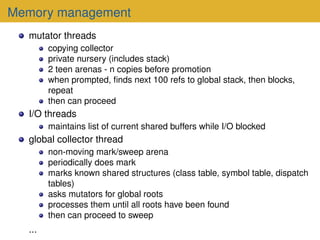
Memory management
mutator threads
copying collector
private nursery (includes stack)
2 teen arenas - n copies before promotion
when prompted, finds next 100 refs to global stack, then blocks,
repeat
then can proceed
I/O threads
maintains list of current shared buffers while I/O blocked
global collector thread
non-moving mark/sweep arena
periodically does mark
marks known shared structures (class table, symbol table, dispatch
tables)
asks mutators for global roots
processes them until all roots have been found
then can proceed to sweep
...
Memory management
mutator threads
copying collector
private nursery (includes stack)
2 teen arenas - n copies before promotion
when prompted, finds next 100 refs to global stack, then blocks,
repeat
then can proceed
I/O threads
maintains list of current shared buffers while I/O blocked
global collector thread
non-moving mark/sweep arena
periodically does mark
marks known shared structures (class table, symbol table, dispatch
tables)
asks mutators for global roots
processes them until all roots have been found
then can proceed to sweep
...
Memory management
mutator threads
copying collector
private nursery (includes stack)
2 teen arenas - n copies before promotion
when prompted, finds next 100 refs to global stack, then blocks,
repeat
then can proceed
I/O threads
maintains list of current shared buffers while I/O blocked
global collector thread
non-moving mark/sweep arena
periodically does mark
marks known shared structures (class table, symbol table, dispatch
tables)
asks mutators for global roots
processes them until all roots have been found
then can proceed to sweep
...
Memory management
mutator threads
copying collector
private nursery (includes stack)
2 teen arenas - n copies before promotion
when prompted, finds next 100 refs to global stack, then blocks,
repeat
then can proceed
I/O threads
maintains list of current shared buffers while I/O blocked
global collector thread
non-moving mark/sweep arena
periodically does mark
marks known shared structures (class table, symbol table, dispatch
tables)
asks mutators for global roots
processes them until all roots have been found
then can proceed to sweep
...
Memory management
mutator threads
copying collector
private nursery (includes stack)
2 teen arenas - n copies before promotion
when prompted, finds next 100 refs to global stack, then blocks,
repeat
then can proceed
I/O threads
maintains list of current shared buffers while I/O blocked
global collector thread
non-moving mark/sweep arena
periodically does mark
marks known shared structures (class table, symbol table, dispatch
tables)
asks mutators for global roots
processes them until all roots have been found
then can proceed to sweep
...
Memory management
mutator threads
copying collector
private nursery (includes stack)
2 teen arenas - n copies before promotion
when prompted, finds next 100 refs to global stack, then blocks,
repeat
then can proceed
I/O threads
maintains list of current shared buffers while I/O blocked
global collector thread
non-moving mark/sweep arena
periodically does mark
marks known shared structures (class table, symbol table, dispatch
tables)
asks mutators for global roots
processes them until all roots have been found
then can proceed to sweep
...
Memory management
mutator threads
copying collector
private nursery (includes stack)
2 teen arenas - n copies before promotion
when prompted, finds next 100 refs to global stack, then blocks,
repeat
then can proceed
I/O threads
maintains list of current shared buffers while I/O blocked
global collector thread
non-moving mark/sweep arena
periodically does mark
marks known shared structures (class table, symbol table, dispatch
tables)
asks mutators for global roots
processes them until all roots have been found
then can proceed to sweep
...
Memory management
mutator threads
copying collector
private nursery (includes stack)
2 teen arenas - n copies before promotion
when prompted, finds next 100 refs to global stack, then blocks,
repeat
then can proceed
I/O threads
maintains list of current shared buffers while I/O blocked
global collector thread
non-moving mark/sweep arena
periodically does mark
marks known shared structures (class table, symbol table, dispatch
tables)
asks mutators for global roots
processes them until all roots have been found
then can proceed to sweep
...
Memory management
mutator threads
copying collector
private nursery (includes stack)
2 teen arenas - n copies before promotion
when prompted, finds next 100 refs to global stack, then blocks,
repeat
then can proceed
I/O threads
maintains list of current shared buffers while I/O blocked
global collector thread
non-moving mark/sweep arena
periodically does mark
marks known shared structures (class table, symbol table, dispatch
tables)
asks mutators for global roots
processes them until all roots have been found
then can proceed to sweep
...
Memory management
mutator threads
copying collector
private nursery (includes stack)
2 teen arenas - n copies before promotion
when prompted, finds next 100 refs to global stack, then blocks,
repeat
then can proceed
I/O threads
maintains list of current shared buffers while I/O blocked
global collector thread
non-moving mark/sweep arena
periodically does mark
marks known shared structures (class table, symbol table, dispatch
tables)
asks mutators for global roots
processes them until all roots have been found
then can proceed to sweep
...
Memory management
mutator threads
copying collector
private nursery (includes stack)
2 teen arenas - n copies before promotion
when prompted, finds next 100 refs to global stack, then blocks,
repeat
then can proceed
I/O threads
maintains list of current shared buffers while I/O blocked
global collector thread
non-moving mark/sweep arena
periodically does mark
marks known shared structures (class table, symbol table, dispatch
tables)
asks mutators for global roots
processes them until all roots have been found
then can proceed to sweep
...
Memory management
mutator threads
copying collector
private nursery (includes stack)
2 teen arenas - n copies before promotion
when prompted, finds next 100 refs to global stack, then blocks,
repeat
then can proceed
I/O threads
maintains list of current shared buffers while I/O blocked
global collector thread
non-moving mark/sweep arena
periodically does mark
marks known shared structures (class table, symbol table, dispatch
tables)
asks mutators for global roots
processes them until all roots have been found
then can proceed to sweep
...
Memory management
mutator threads
copying collector
private nursery (includes stack)
2 teen arenas - n copies before promotion
when prompted, finds next 100 refs to global stack, then blocks,
repeat
then can proceed
I/O threads
maintains list of current shared buffers while I/O blocked
global collector thread
non-moving mark/sweep arena
periodically does mark
marks known shared structures (class table, symbol table, dispatch
tables)
asks mutators for global roots
processes them until all roots have been found
then can proceed to sweep
...
Memory management
mutator threads
copying collector
private nursery (includes stack)
2 teen arenas - n copies before promotion
when prompted, finds next 100 refs to global stack, then blocks,
repeat
then can proceed
I/O threads
maintains list of current shared buffers while I/O blocked
global collector thread
non-moving mark/sweep arena
periodically does mark
marks known shared structures (class table, symbol table, dispatch
tables)
asks mutators for global roots
processes them until all roots have been found
then can proceed to sweep
...
Memory management
mutator threads
copying collector
private nursery (includes stack)
2 teen arenas - n copies before promotion
when prompted, finds next 100 refs to global stack, then blocks,
repeat
then can proceed
I/O threads
maintains list of current shared buffers while I/O blocked
global collector thread
non-moving mark/sweep arena
periodically does mark
marks known shared structures (class table, symbol table, dispatch
tables)
asks mutators for global roots
processes them until all roots have been found
then can proceed to sweep
...
Memory management
mutator threads
copying collector
private nursery (includes stack)
2 teen arenas - n copies before promotion
when prompted, finds next 100 refs to global stack, then blocks,
repeat
then can proceed
I/O threads
maintains list of current shared buffers while I/O blocked
global collector thread
non-moving mark/sweep arena
periodically does mark
marks known shared structures (class table, symbol table, dispatch
tables)
asks mutators for global roots
processes them until all roots have been found
then can proceed to sweep
...
... Memory management
global collector for non-moving mark-&-sweep
uses Fibonacci heap (similar to Mist)
large objects (e.g. 16Kib) have separately mapped pages (allows
mmap of large files) to minimize memory creep
... Memory management
global collector for non-moving mark-&-sweep
uses Fibonacci heap (similar to Mist)
large objects (e.g. 16Kib) have separately mapped pages (allows
mmap of large files) to minimize memory creep
... Memory management
global collector for non-moving mark-&-sweep
uses Fibonacci heap (similar to Mist)
large objects (e.g. 16Kib) have separately mapped pages (allows
mmap of large files) to minimize memory creep
Heap objects
header
Bits What Characteristics
12 length number of long-words beyond the header
4 age 0 - nursery, 1-7 teen, 8+ global
8 format
24 identityHash
16 classIndex LSB
recognize pointer-free instance variables and arrays separately
length of 4095 - forwarding pointer - copying, become:, promoted
format is somewhat similar to SPUR encoding - various-sized
non-object arrays
strings stored in UTF-8
Heap objects
header
Bits What Characteristics
12 length number of long-words beyond the header
4 age 0 - nursery, 1-7 teen, 8+ global
8 format
24 identityHash
16 classIndex LSB
recognize pointer-free instance variables and arrays separately
length of 4095 - forwarding pointer - copying, become:, promoted
format is somewhat similar to SPUR encoding - various-sized
non-object arrays
strings stored in UTF-8
Heap objects
header
Bits What Characteristics
12 length number of long-words beyond the header
4 age 0 - nursery, 1-7 teen, 8+ global
8 format
24 identityHash
16 classIndex LSB
recognize pointer-free instance variables and arrays separately
length of 4095 - forwarding pointer - copying, become:, promoted
format is somewhat similar to SPUR encoding - various-sized
non-object arrays
strings stored in UTF-8
Heap objects
header
Bits What Characteristics
12 length number of long-words beyond the header
4 age 0 - nursery, 1-7 teen, 8+ global
8 format
24 identityHash
16 classIndex LSB
recognize pointer-free instance variables and arrays separately
length of 4095 - forwarding pointer - copying, become:, promoted
format is somewhat similar to SPUR encoding - various-sized
non-object arrays
strings stored in UTF-8
Heap objects
header
Bits What Characteristics
12 length number of long-words beyond the header
4 age 0 - nursery, 1-7 teen, 8+ global
8 format
24 identityHash
16 classIndex LSB
recognize pointer-free instance variables and arrays separately
length of 4095 - forwarding pointer - copying, become:, promoted
format is somewhat similar to SPUR encoding - various-sized
non-object arrays
strings stored in UTF-8
Unified dispatch
single level of hashing for method dispatch
each class dispatch table has entry for every method it has been
sent - regardless of place in hierarchy
near-perfect hash using Φ hashing
standard SPUR/OpenVM optimizations don’t work well in
multi-core environments
Unified dispatch
single level of hashing for method dispatch
each class dispatch table has entry for every method it has been
sent - regardless of place in hierarchy
near-perfect hash using Φ hashing
standard SPUR/OpenVM optimizations don’t work well in
multi-core environments
Unified dispatch
single level of hashing for method dispatch
each class dispatch table has entry for every method it has been
sent - regardless of place in hierarchy
near-perfect hash using Φ hashing
standard SPUR/OpenVM optimizations don’t work well in
multi-core environments
Unified dispatch
single level of hashing for method dispatch
each class dispatch table has entry for every method it has been
sent - regardless of place in hierarchy
near-perfect hash using Φ hashing
standard SPUR/OpenVM optimizations don’t work well in
multi-core environments
High performance Inlining
references to self / super code are inlined
methods with small number of implementations are inlined - rather
than heuristic
prevents creation of many blocks
provides large compilation units for optimization
High performance Inlining
references to self / super code are inlined
methods with small number of implementations are inlined - rather
than heuristic
prevents creation of many blocks
provides large compilation units for optimization
High performance Inlining
references to self / super code are inlined
methods with small number of implementations are inlined - rather
than heuristic
prevents creation of many blocks
provides large compilation units for optimization
High performance Inlining
references to self / super code are inlined
methods with small number of implementations are inlined - rather
than heuristic
prevents creation of many blocks
provides large compilation units for optimization
Code Generation
no interpreter, 3 code generation models
threaded-execution
method is sequence of Zig function addresses
uses Zig tail-call-elimination - passes pc, sp, hp, thread, context
primitives and control implementations
stand-alone generator
generates Zig code for methods
depends on Zig inlining and excellent code generation
JIT
future
LLVM jitter
Code Generation
no interpreter, 3 code generation models
threaded-execution
method is sequence of Zig function addresses
uses Zig tail-call-elimination - passes pc, sp, hp, thread, context
primitives and control implementations
stand-alone generator
generates Zig code for methods
depends on Zig inlining and excellent code generation
JIT
future
LLVM jitter
Code Generation
no interpreter, 3 code generation models
threaded-execution
method is sequence of Zig function addresses
uses Zig tail-call-elimination - passes pc, sp, hp, thread, context
primitives and control implementations
stand-alone generator
generates Zig code for methods
depends on Zig inlining and excellent code generation
JIT
future
LLVM jitter
Code Generation
no interpreter, 3 code generation models
threaded-execution
method is sequence of Zig function addresses
uses Zig tail-call-elimination - passes pc, sp, hp, thread, context
primitives and control implementations
stand-alone generator
generates Zig code for methods
depends on Zig inlining and excellent code generation
JIT
future
LLVM jitter
Code Generation
no interpreter, 3 code generation models
threaded-execution
method is sequence of Zig function addresses
uses Zig tail-call-elimination - passes pc, sp, hp, thread, context
primitives and control implementations
stand-alone generator
generates Zig code for methods
depends on Zig inlining and excellent code generation
JIT
future
LLVM jitter
Code Generation
no interpreter, 3 code generation models
threaded-execution
method is sequence of Zig function addresses
uses Zig tail-call-elimination - passes pc, sp, hp, thread, context
primitives and control implementations
stand-alone generator
generates Zig code for methods
depends on Zig inlining and excellent code generation
JIT
future
LLVM jitter
Code Generation
no interpreter, 3 code generation models
threaded-execution
method is sequence of Zig function addresses
uses Zig tail-call-elimination - passes pc, sp, hp, thread, context
primitives and control implementations
stand-alone generator
generates Zig code for methods
depends on Zig inlining and excellent code generation
JIT
future
LLVM jitter
Code Generation
no interpreter, 3 code generation models
threaded-execution
method is sequence of Zig function addresses
uses Zig tail-call-elimination - passes pc, sp, hp, thread, context
primitives and control implementations
stand-alone generator
generates Zig code for methods
depends on Zig inlining and excellent code generation
JIT
future
LLVM jitter
Code Generation
no interpreter, 3 code generation models
threaded-execution
method is sequence of Zig function addresses
uses Zig tail-call-elimination - passes pc, sp, hp, thread, context
primitives and control implementations
stand-alone generator
generates Zig code for methods
depends on Zig inlining and excellent code generation
JIT
future
LLVM jitter
Code Generation
no interpreter, 3 code generation models
threaded-execution
method is sequence of Zig function addresses
uses Zig tail-call-elimination - passes pc, sp, hp, thread, context
primitives and control implementations
stand-alone generator
generates Zig code for methods
depends on Zig inlining and excellent code generation
JIT
future
LLVM jitter
Code Generation
no interpreter, 3 code generation models
threaded-execution
method is sequence of Zig function addresses
uses Zig tail-call-elimination - passes pc, sp, hp, thread, context
primitives and control implementations
stand-alone generator
generates Zig code for methods
depends on Zig inlining and excellent code generation
JIT
future
LLVM jitter
Conclusions
while the intent of this paper is to provide design principles, also
described some implementation
this is preliminary work, so some open questions
many experiments to run to validate my intuitions
Conclusions
while the intent of this paper is to provide design principles, also
described some implementation
this is preliminary work, so some open questions
many experiments to run to validate my intuitions
Conclusions
while the intent of this paper is to provide design principles, also
described some implementation
this is preliminary work, so some open questions
many experiments to run to validate my intuitions
Questions?
@DrDaveMason dmason@ryerson.ca
https://github.com/dvmason/Zag-Smalltalk

Design Principles for a High-Performance Smalltalk

  • 1.
    Design Principles fora High-Performance Smalltalk Dave Mason Toronto Metropolitan Universityi ©2022 Dave Mason
  • 2.
    Design Principles Large memories 64-bitand IEEE-768 Multi-core and threading Fast execution
  • 3.
    Design Principles Large memories 64-bitand IEEE-768 Multi-core and threading Fast execution
  • 4.
    Design Principles Large memories 64-bitand IEEE-768 Multi-core and threading Fast execution
  • 5.
    Design Principles Large memories 64-bitand IEEE-768 Multi-core and threading Fast execution
  • 6.
    Zag Smalltalk from-scratch implementation low-levelis implemented in Zig goal is to support existing OpenSmalltalk systems don’t want to rewrite userland!
  • 7.
    Zag Smalltalk from-scratch implementation low-levelis implemented in Zig goal is to support existing OpenSmalltalk systems don’t want to rewrite userland!
  • 8.
    Zag Smalltalk from-scratch implementation low-levelis implemented in Zig goal is to support existing OpenSmalltalk systems don’t want to rewrite userland!
  • 9.
    Zag Smalltalk from-scratch implementation low-levelis implemented in Zig goal is to support existing OpenSmalltalk systems don’t want to rewrite userland!
  • 10.
    Immediate Values 64 bit NaN-boxing double-floats,51-bit SmallInteger, Booleans, nil, Unicode characters, Symbols room for instances of any type with single 32-bit value
  • 11.
    Immediate Values 64 bit NaN-boxing double-floats,51-bit SmallInteger, Booleans, nil, Unicode characters, Symbols room for instances of any type with single 32-bit value
  • 12.
    Immediate Values 64 bit NaN-boxing double-floats,51-bit SmallInteger, Booleans, nil, Unicode characters, Symbols room for instances of any type with single 32-bit value
  • 13.
    Immediate Values 64 bit NaN-boxing double-floats,51-bit SmallInteger, Booleans, nil, Unicode characters, Symbols room for instances of any type with single 32-bit value
  • 14.
    S+E F FF Type 0000 0000 0000 0000 double +0 0000-7FEF xxxx xxxx xxxx double (positive) 7FF0 0000 0000 0000 +inf 7FF0-F xxxx xxxx xxxx NaN (unused) 8000 0000 0000 0000 double -0 8000-FFEF xxxx xxxx xxxx double (negative) FFF0 0000 0000 0000 -inf FFF0-5 xxxx xxxx xxxx NaN (currently unused) FFF6 xxxx xxxx xxxx heap object FFF7 0001 xxxx xxxx reserved (tag = Object) FFF7 0002 xxxx xxxx reserved (tag = SmallInteger) FFF7 0003 xxxx xxxx reserved (tag = Double) FFF7 0004 0001 0000 False FFF7 0005 0010 0001 True FFF7 0006 0100 0002 UndefinedObject FFF7 0007 aaxx xxxx Symbol FFF7 0008 00xx xxxx Character FFF8-F xxxx xxxx xxxx SmallInteger FFF8 0000 0000 0000 SmallInteger minVal FFFC 0000 0000 0000 SmallInteger 0 FFFF FFFF FFFF FFFF SmallInteger maxVal
  • 15.
    Multi-core support only wayto speed up applications minimal blocking computational/mutator threads - typically 1 per core I/O threads - one per open “file” global collector thread
  • 16.
    Multi-core support only wayto speed up applications minimal blocking computational/mutator threads - typically 1 per core I/O threads - one per open “file” global collector thread
  • 17.
    Multi-core support only wayto speed up applications minimal blocking computational/mutator threads - typically 1 per core I/O threads - one per open “file” global collector thread
  • 18.
    Multi-core support only wayto speed up applications minimal blocking computational/mutator threads - typically 1 per core I/O threads - one per open “file” global collector thread
  • 19.
    Multi-core support only wayto speed up applications minimal blocking computational/mutator threads - typically 1 per core I/O threads - one per open “file” global collector thread
  • 20.
    Memory management mutator threads copyingcollector private nursery (includes stack) 2 teen arenas - n copies before promotion when prompted, finds next 100 refs to global stack, then blocks, repeat then can proceed I/O threads maintains list of current shared buffers while I/O blocked global collector thread non-moving mark/sweep arena periodically does mark marks known shared structures (class table, symbol table, dispatch tables) asks mutators for global roots processes them until all roots have been found then can proceed to sweep ...
  • 21.
    Memory management mutator threads copyingcollector private nursery (includes stack) 2 teen arenas - n copies before promotion when prompted, finds next 100 refs to global stack, then blocks, repeat then can proceed I/O threads maintains list of current shared buffers while I/O blocked global collector thread non-moving mark/sweep arena periodically does mark marks known shared structures (class table, symbol table, dispatch tables) asks mutators for global roots processes them until all roots have been found then can proceed to sweep ...
  • 22.
    Memory management mutator threads copyingcollector private nursery (includes stack) 2 teen arenas - n copies before promotion when prompted, finds next 100 refs to global stack, then blocks, repeat then can proceed I/O threads maintains list of current shared buffers while I/O blocked global collector thread non-moving mark/sweep arena periodically does mark marks known shared structures (class table, symbol table, dispatch tables) asks mutators for global roots processes them until all roots have been found then can proceed to sweep ...
  • 23.
    Memory management mutator threads copyingcollector private nursery (includes stack) 2 teen arenas - n copies before promotion when prompted, finds next 100 refs to global stack, then blocks, repeat then can proceed I/O threads maintains list of current shared buffers while I/O blocked global collector thread non-moving mark/sweep arena periodically does mark marks known shared structures (class table, symbol table, dispatch tables) asks mutators for global roots processes them until all roots have been found then can proceed to sweep ...
  • 24.
    Memory management mutator threads copyingcollector private nursery (includes stack) 2 teen arenas - n copies before promotion when prompted, finds next 100 refs to global stack, then blocks, repeat then can proceed I/O threads maintains list of current shared buffers while I/O blocked global collector thread non-moving mark/sweep arena periodically does mark marks known shared structures (class table, symbol table, dispatch tables) asks mutators for global roots processes them until all roots have been found then can proceed to sweep ...
  • 25.
    Memory management mutator threads copyingcollector private nursery (includes stack) 2 teen arenas - n copies before promotion when prompted, finds next 100 refs to global stack, then blocks, repeat then can proceed I/O threads maintains list of current shared buffers while I/O blocked global collector thread non-moving mark/sweep arena periodically does mark marks known shared structures (class table, symbol table, dispatch tables) asks mutators for global roots processes them until all roots have been found then can proceed to sweep ...
  • 26.
    Memory management mutator threads copyingcollector private nursery (includes stack) 2 teen arenas - n copies before promotion when prompted, finds next 100 refs to global stack, then blocks, repeat then can proceed I/O threads maintains list of current shared buffers while I/O blocked global collector thread non-moving mark/sweep arena periodically does mark marks known shared structures (class table, symbol table, dispatch tables) asks mutators for global roots processes them until all roots have been found then can proceed to sweep ...
  • 27.
    Memory management mutator threads copyingcollector private nursery (includes stack) 2 teen arenas - n copies before promotion when prompted, finds next 100 refs to global stack, then blocks, repeat then can proceed I/O threads maintains list of current shared buffers while I/O blocked global collector thread non-moving mark/sweep arena periodically does mark marks known shared structures (class table, symbol table, dispatch tables) asks mutators for global roots processes them until all roots have been found then can proceed to sweep ...
  • 28.
    Memory management mutator threads copyingcollector private nursery (includes stack) 2 teen arenas - n copies before promotion when prompted, finds next 100 refs to global stack, then blocks, repeat then can proceed I/O threads maintains list of current shared buffers while I/O blocked global collector thread non-moving mark/sweep arena periodically does mark marks known shared structures (class table, symbol table, dispatch tables) asks mutators for global roots processes them until all roots have been found then can proceed to sweep ...
  • 29.
    Memory management mutator threads copyingcollector private nursery (includes stack) 2 teen arenas - n copies before promotion when prompted, finds next 100 refs to global stack, then blocks, repeat then can proceed I/O threads maintains list of current shared buffers while I/O blocked global collector thread non-moving mark/sweep arena periodically does mark marks known shared structures (class table, symbol table, dispatch tables) asks mutators for global roots processes them until all roots have been found then can proceed to sweep ...
  • 30.
    Memory management mutator threads copyingcollector private nursery (includes stack) 2 teen arenas - n copies before promotion when prompted, finds next 100 refs to global stack, then blocks, repeat then can proceed I/O threads maintains list of current shared buffers while I/O blocked global collector thread non-moving mark/sweep arena periodically does mark marks known shared structures (class table, symbol table, dispatch tables) asks mutators for global roots processes them until all roots have been found then can proceed to sweep ...
  • 31.
    Memory management mutator threads copyingcollector private nursery (includes stack) 2 teen arenas - n copies before promotion when prompted, finds next 100 refs to global stack, then blocks, repeat then can proceed I/O threads maintains list of current shared buffers while I/O blocked global collector thread non-moving mark/sweep arena periodically does mark marks known shared structures (class table, symbol table, dispatch tables) asks mutators for global roots processes them until all roots have been found then can proceed to sweep ...
  • 32.
    Memory management mutator threads copyingcollector private nursery (includes stack) 2 teen arenas - n copies before promotion when prompted, finds next 100 refs to global stack, then blocks, repeat then can proceed I/O threads maintains list of current shared buffers while I/O blocked global collector thread non-moving mark/sweep arena periodically does mark marks known shared structures (class table, symbol table, dispatch tables) asks mutators for global roots processes them until all roots have been found then can proceed to sweep ...
  • 33.
    Memory management mutator threads copyingcollector private nursery (includes stack) 2 teen arenas - n copies before promotion when prompted, finds next 100 refs to global stack, then blocks, repeat then can proceed I/O threads maintains list of current shared buffers while I/O blocked global collector thread non-moving mark/sweep arena periodically does mark marks known shared structures (class table, symbol table, dispatch tables) asks mutators for global roots processes them until all roots have been found then can proceed to sweep ...
  • 34.
    Memory management mutator threads copyingcollector private nursery (includes stack) 2 teen arenas - n copies before promotion when prompted, finds next 100 refs to global stack, then blocks, repeat then can proceed I/O threads maintains list of current shared buffers while I/O blocked global collector thread non-moving mark/sweep arena periodically does mark marks known shared structures (class table, symbol table, dispatch tables) asks mutators for global roots processes them until all roots have been found then can proceed to sweep ...
  • 35.
    Memory management mutator threads copyingcollector private nursery (includes stack) 2 teen arenas - n copies before promotion when prompted, finds next 100 refs to global stack, then blocks, repeat then can proceed I/O threads maintains list of current shared buffers while I/O blocked global collector thread non-moving mark/sweep arena periodically does mark marks known shared structures (class table, symbol table, dispatch tables) asks mutators for global roots processes them until all roots have been found then can proceed to sweep ...
  • 36.
    ... Memory management globalcollector for non-moving mark-&-sweep uses Fibonacci heap (similar to Mist) large objects (e.g. 16Kib) have separately mapped pages (allows mmap of large files) to minimize memory creep
  • 37.
    ... Memory management globalcollector for non-moving mark-&-sweep uses Fibonacci heap (similar to Mist) large objects (e.g. 16Kib) have separately mapped pages (allows mmap of large files) to minimize memory creep
  • 38.
    ... Memory management globalcollector for non-moving mark-&-sweep uses Fibonacci heap (similar to Mist) large objects (e.g. 16Kib) have separately mapped pages (allows mmap of large files) to minimize memory creep
  • 39.
    Heap objects header Bits WhatCharacteristics 12 length number of long-words beyond the header 4 age 0 - nursery, 1-7 teen, 8+ global 8 format 24 identityHash 16 classIndex LSB recognize pointer-free instance variables and arrays separately length of 4095 - forwarding pointer - copying, become:, promoted format is somewhat similar to SPUR encoding - various-sized non-object arrays strings stored in UTF-8
  • 40.
    Heap objects header Bits WhatCharacteristics 12 length number of long-words beyond the header 4 age 0 - nursery, 1-7 teen, 8+ global 8 format 24 identityHash 16 classIndex LSB recognize pointer-free instance variables and arrays separately length of 4095 - forwarding pointer - copying, become:, promoted format is somewhat similar to SPUR encoding - various-sized non-object arrays strings stored in UTF-8
  • 41.
    Heap objects header Bits WhatCharacteristics 12 length number of long-words beyond the header 4 age 0 - nursery, 1-7 teen, 8+ global 8 format 24 identityHash 16 classIndex LSB recognize pointer-free instance variables and arrays separately length of 4095 - forwarding pointer - copying, become:, promoted format is somewhat similar to SPUR encoding - various-sized non-object arrays strings stored in UTF-8
  • 42.
    Heap objects header Bits WhatCharacteristics 12 length number of long-words beyond the header 4 age 0 - nursery, 1-7 teen, 8+ global 8 format 24 identityHash 16 classIndex LSB recognize pointer-free instance variables and arrays separately length of 4095 - forwarding pointer - copying, become:, promoted format is somewhat similar to SPUR encoding - various-sized non-object arrays strings stored in UTF-8
  • 43.
    Heap objects header Bits WhatCharacteristics 12 length number of long-words beyond the header 4 age 0 - nursery, 1-7 teen, 8+ global 8 format 24 identityHash 16 classIndex LSB recognize pointer-free instance variables and arrays separately length of 4095 - forwarding pointer - copying, become:, promoted format is somewhat similar to SPUR encoding - various-sized non-object arrays strings stored in UTF-8
  • 44.
    Unified dispatch single levelof hashing for method dispatch each class dispatch table has entry for every method it has been sent - regardless of place in hierarchy near-perfect hash using Φ hashing standard SPUR/OpenVM optimizations don’t work well in multi-core environments
  • 45.
    Unified dispatch single levelof hashing for method dispatch each class dispatch table has entry for every method it has been sent - regardless of place in hierarchy near-perfect hash using Φ hashing standard SPUR/OpenVM optimizations don’t work well in multi-core environments
  • 46.
    Unified dispatch single levelof hashing for method dispatch each class dispatch table has entry for every method it has been sent - regardless of place in hierarchy near-perfect hash using Φ hashing standard SPUR/OpenVM optimizations don’t work well in multi-core environments
  • 47.
    Unified dispatch single levelof hashing for method dispatch each class dispatch table has entry for every method it has been sent - regardless of place in hierarchy near-perfect hash using Φ hashing standard SPUR/OpenVM optimizations don’t work well in multi-core environments
  • 48.
    High performance Inlining referencesto self / super code are inlined methods with small number of implementations are inlined - rather than heuristic prevents creation of many blocks provides large compilation units for optimization
  • 49.
    High performance Inlining referencesto self / super code are inlined methods with small number of implementations are inlined - rather than heuristic prevents creation of many blocks provides large compilation units for optimization
  • 50.
    High performance Inlining referencesto self / super code are inlined methods with small number of implementations are inlined - rather than heuristic prevents creation of many blocks provides large compilation units for optimization
  • 51.
    High performance Inlining referencesto self / super code are inlined methods with small number of implementations are inlined - rather than heuristic prevents creation of many blocks provides large compilation units for optimization
  • 52.
    Code Generation no interpreter,3 code generation models threaded-execution method is sequence of Zig function addresses uses Zig tail-call-elimination - passes pc, sp, hp, thread, context primitives and control implementations stand-alone generator generates Zig code for methods depends on Zig inlining and excellent code generation JIT future LLVM jitter
  • 53.
    Code Generation no interpreter,3 code generation models threaded-execution method is sequence of Zig function addresses uses Zig tail-call-elimination - passes pc, sp, hp, thread, context primitives and control implementations stand-alone generator generates Zig code for methods depends on Zig inlining and excellent code generation JIT future LLVM jitter
  • 54.
    Code Generation no interpreter,3 code generation models threaded-execution method is sequence of Zig function addresses uses Zig tail-call-elimination - passes pc, sp, hp, thread, context primitives and control implementations stand-alone generator generates Zig code for methods depends on Zig inlining and excellent code generation JIT future LLVM jitter
  • 55.
    Code Generation no interpreter,3 code generation models threaded-execution method is sequence of Zig function addresses uses Zig tail-call-elimination - passes pc, sp, hp, thread, context primitives and control implementations stand-alone generator generates Zig code for methods depends on Zig inlining and excellent code generation JIT future LLVM jitter
  • 56.
    Code Generation no interpreter,3 code generation models threaded-execution method is sequence of Zig function addresses uses Zig tail-call-elimination - passes pc, sp, hp, thread, context primitives and control implementations stand-alone generator generates Zig code for methods depends on Zig inlining and excellent code generation JIT future LLVM jitter
  • 57.
    Code Generation no interpreter,3 code generation models threaded-execution method is sequence of Zig function addresses uses Zig tail-call-elimination - passes pc, sp, hp, thread, context primitives and control implementations stand-alone generator generates Zig code for methods depends on Zig inlining and excellent code generation JIT future LLVM jitter
  • 58.
    Code Generation no interpreter,3 code generation models threaded-execution method is sequence of Zig function addresses uses Zig tail-call-elimination - passes pc, sp, hp, thread, context primitives and control implementations stand-alone generator generates Zig code for methods depends on Zig inlining and excellent code generation JIT future LLVM jitter
  • 59.
    Code Generation no interpreter,3 code generation models threaded-execution method is sequence of Zig function addresses uses Zig tail-call-elimination - passes pc, sp, hp, thread, context primitives and control implementations stand-alone generator generates Zig code for methods depends on Zig inlining and excellent code generation JIT future LLVM jitter
  • 60.
    Code Generation no interpreter,3 code generation models threaded-execution method is sequence of Zig function addresses uses Zig tail-call-elimination - passes pc, sp, hp, thread, context primitives and control implementations stand-alone generator generates Zig code for methods depends on Zig inlining and excellent code generation JIT future LLVM jitter
  • 61.
    Code Generation no interpreter,3 code generation models threaded-execution method is sequence of Zig function addresses uses Zig tail-call-elimination - passes pc, sp, hp, thread, context primitives and control implementations stand-alone generator generates Zig code for methods depends on Zig inlining and excellent code generation JIT future LLVM jitter
  • 62.
    Code Generation no interpreter,3 code generation models threaded-execution method is sequence of Zig function addresses uses Zig tail-call-elimination - passes pc, sp, hp, thread, context primitives and control implementations stand-alone generator generates Zig code for methods depends on Zig inlining and excellent code generation JIT future LLVM jitter
  • 63.
    Conclusions while the intentof this paper is to provide design principles, also described some implementation this is preliminary work, so some open questions many experiments to run to validate my intuitions
  • 64.
    Conclusions while the intentof this paper is to provide design principles, also described some implementation this is preliminary work, so some open questions many experiments to run to validate my intuitions
  • 65.
    Conclusions while the intentof this paper is to provide design principles, also described some implementation this is preliminary work, so some open questions many experiments to run to validate my intuitions
  • 66.