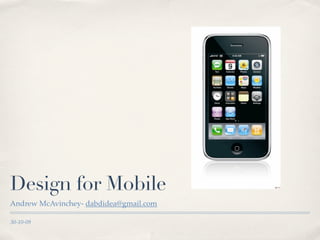
Design for Mobile
Andrew McAvinchey- dabdidea@gmail.com

30-10-09
Mind Map of Mobile Product
Development
User Experience Design


✤   Understand the technology

✤   Don’t let technology rule the design

✤   The web vs. mobile design- What works?

✤   How does the user feel? What does the user do? Who is the user?
The Adaptive Path model for
design

✤   http://adaptivepath.com/events/training/complete/files.php

✤   Steps for design:

1. Discovery

2. Stakeholder interviews

3. Deliverables

4. User Research: You ARE NOT YOUR AUDIENCE
User Research for design
Three Types of User Research for Design


•! Conceptual – what users need


•! Preference – what users want


•! Ability – what users can do


✤   What does the user need, like, do? In that order.

✤   Outcomes: design that is useful, appealing, innovative.
Personas

✤   What is a Persona?

    A fictitious person for whom you are designing

    Represents the archetypal qualities of your
    audience

    They are stereotypes, design targets, tools for
    thinking about features and functions

    Task oriented
How to design Information Flow


1. Figure out what users need: develop a mental model

2. Figure out what you have: develop a content model

3. Match them up
Mental Model: tasks and how
users think about doing them


                 Example: purchasing IT solutions
Mental Model + Content =
Task based design
                              Mental Model


                 User Task      Task Data     Mental Model
                 Interviews      Analysis       Diagram


    Define the                                               Align MM &
     Audience                                                 Content


                              Content Model
Match content to mental model
Architecture for the design

     Surface architecture    Deep architecture comes
   comes from Mental Model   from the Content Model
Mobile Design: CONTENT IS CLOSE AND EASY

iPhone ads: emphasise the ease of access to content

http://www.youtube.com/watch?v=lceoOOg4ZB4
User Generated Content
✤   Case Study: Flixster movie app

✤   28th October 09: Movie service Flixster
    revealed that it now has more than 8
    million users of its mobile applications,
    across iPhone, Android, BlackBerry and
    Palm platforms.

✤   Three quarters of those users have accessed
    the app within the last 90 days

✤   In the mobile apps alone, users are
    currently rating one movie every 5 seconds,
    whilst watching approximately 140 trailers
    per minute, 24 hours a day.
Prosumers propelling the Industry


✤   Prosumers both produce and consume, creating new business
    opportunities around user generated content (U.G.C.)

✤   Facilitate feedback and participation: People are keen to recommend
    and participate in any capacity if the facility is there to do so and
    there is some reward.
U.G.C. guidelines
✤   1. You don't have to participate. The level you contribute is up to you.

✤   2. Tagging of content is carried out by the user, not the provider.

✤   3. Users have unique identifiers, so we know who they are.

✤   4. Users can be rewarded or applauded for their contributions.

    The reward for participation is up to the provider of the service but it has to be
    meaningful in some way. For example, in Flixster users are rewarded by the
    fact that their user profiles are associated with recommendations.
Mobile Content, Advertising and
its ‘Long Tail’
•
     Broadcast media has the reach of a “one to many” relationship. The internet has the
broader reach of “many to many”. The mobile in its capacity as a social device has even further
reach, as it communicates information “one-to-many”, “group-to-group”, and “many-to-many”.

•
    Longtail advertising allows us to target our customers individually, as well as in groups,
on a very personal basis.

•
    Targeted advertising is carried out by putting ads next to relevant content for the user.

•
   Targeted advertising solutions are being developed based on personalisation, data
mining, click-throughs, localisation, mobile internet usage.

Mobile applications that provide content relevant to the user in a personalised way provides a
rich and enjoyable experience.

This can be linked with mobile advertising.
Participation (U.G.C.)

 "Whereas a key metric for the WEB IS SPACE model is number of
 visitors (the more people who come to your location, the better), the
 WEB AS NETWORK model would spin this differently, looking at
 level of participation. With many Web 2.0 sites looking to appeal to
 "edge" communities, quantifying participation is more interesting
 because they are going after smaller and smaller populations."


 Mobile applications provide opportunities for feedback, sharing and
 user participation, which has commercial value beyond the Web.
Basecamp

✤   http://basecamphq.com

Design for Mobile

  • 1.
    Design for Mobile AndrewMcAvinchey- dabdidea@gmail.com 30-10-09
  • 2.
    Mind Map ofMobile Product Development
  • 3.
    User Experience Design ✤ Understand the technology ✤ Don’t let technology rule the design ✤ The web vs. mobile design- What works? ✤ How does the user feel? What does the user do? Who is the user?
  • 4.
    The Adaptive Pathmodel for design ✤ http://adaptivepath.com/events/training/complete/files.php ✤ Steps for design: 1. Discovery 2. Stakeholder interviews 3. Deliverables 4. User Research: You ARE NOT YOUR AUDIENCE
  • 5.
    User Research fordesign Three Types of User Research for Design •! Conceptual – what users need •! Preference – what users want •! Ability – what users can do ✤ What does the user need, like, do? In that order. ✤ Outcomes: design that is useful, appealing, innovative.
  • 6.
    Personas ✤ What is a Persona? A fictitious person for whom you are designing Represents the archetypal qualities of your audience They are stereotypes, design targets, tools for thinking about features and functions Task oriented
  • 7.
    How to designInformation Flow 1. Figure out what users need: develop a mental model 2. Figure out what you have: develop a content model 3. Match them up
  • 8.
    Mental Model: tasksand how users think about doing them Example: purchasing IT solutions
  • 9.
    Mental Model +Content = Task based design Mental Model User Task Task Data Mental Model Interviews Analysis Diagram Define the Align MM & Audience Content Content Model
  • 10.
    Match content tomental model
  • 11.
    Architecture for thedesign Surface architecture Deep architecture comes comes from Mental Model from the Content Model
  • 12.
    Mobile Design: CONTENTIS CLOSE AND EASY iPhone ads: emphasise the ease of access to content http://www.youtube.com/watch?v=lceoOOg4ZB4
  • 13.
    User Generated Content ✤ Case Study: Flixster movie app ✤ 28th October 09: Movie service Flixster revealed that it now has more than 8 million users of its mobile applications, across iPhone, Android, BlackBerry and Palm platforms. ✤ Three quarters of those users have accessed the app within the last 90 days ✤ In the mobile apps alone, users are currently rating one movie every 5 seconds, whilst watching approximately 140 trailers per minute, 24 hours a day.
  • 14.
    Prosumers propelling theIndustry ✤ Prosumers both produce and consume, creating new business opportunities around user generated content (U.G.C.) ✤ Facilitate feedback and participation: People are keen to recommend and participate in any capacity if the facility is there to do so and there is some reward.
  • 15.
    U.G.C. guidelines ✤ 1. You don't have to participate. The level you contribute is up to you. ✤ 2. Tagging of content is carried out by the user, not the provider. ✤ 3. Users have unique identifiers, so we know who they are. ✤ 4. Users can be rewarded or applauded for their contributions. The reward for participation is up to the provider of the service but it has to be meaningful in some way. For example, in Flixster users are rewarded by the fact that their user profiles are associated with recommendations.
  • 16.
    Mobile Content, Advertisingand its ‘Long Tail’ • Broadcast media has the reach of a “one to many” relationship. The internet has the broader reach of “many to many”. The mobile in its capacity as a social device has even further reach, as it communicates information “one-to-many”, “group-to-group”, and “many-to-many”. • Longtail advertising allows us to target our customers individually, as well as in groups, on a very personal basis. • Targeted advertising is carried out by putting ads next to relevant content for the user. • Targeted advertising solutions are being developed based on personalisation, data mining, click-throughs, localisation, mobile internet usage. Mobile applications that provide content relevant to the user in a personalised way provides a rich and enjoyable experience. This can be linked with mobile advertising.
  • 17.
    Participation (U.G.C.) "Whereasa key metric for the WEB IS SPACE model is number of visitors (the more people who come to your location, the better), the WEB AS NETWORK model would spin this differently, looking at level of participation. With many Web 2.0 sites looking to appeal to "edge" communities, quantifying participation is more interesting because they are going after smaller and smaller populations." Mobile applications provide opportunities for feedback, sharing and user participation, which has commercial value beyond the Web.
  • 18.
    Basecamp ✤ http://basecamphq.com