International Journal of Power Electronics and Drive Systems (IJPEDS)
Vol. 13, No. 4, December 2022, pp. 2305~2312
ISSN: 2088-8694, DOI: 10.11591/ijpeds.v13.i4.pp2305-2312  2305
Journal homepage: http://ijpeds.iaescore.com
Design and building of a battery charging system using hybrid
solar tracker and electric trip based on FPAO-FLC
Imam Abadi1
, Ali Musyafa’1
, Kevin Gica Erwandha1
, Dwi Nur Fitriyanah2
1
Department of Engineering Physics, Institut Teknologi Sepuluh Nopember, Surabaya, Indonesia
2
Department of Instrumentation Engineering, Institut Teknologi Sepuluh Nopember, Surabaya, Indonesia
Article Info ABSTRACT
Article history:
Received Jul 7, 2022
Revised May 23, 2022
Accepted Jun 14, 2022
The proposed system is a hybrid charging system between a solar tracker
and an electric grid using two converter types. The photovoltaic (PV)-based
solar tracker has powerful tools, but its weakness is when the absence of
sunlight. With a combination of two resources, the weakness can overcome.
The control so good is needed so that it can overcome those weaknesses too.
This study uses the flower pollination algorithm optimization-fuzzy logic
controller (FPAO-FLC). Results of control using FPAO-FLC has a value of
a rising time of 0.0123 seconds, settling time of 2.1099 seconds, maximum
overshoot of 6.08%, a peak time of 0.9246 seconds, and steady-state error of
3.43%. The efficiency of the ZETA converter using FPAO-FLC control in
the tracking condition PV compared to the fixed condition has increased 43,
24%, and the state of charge (SOC) of the battery reaches 39.08%. The
advantage of this hybrid system is that it has two modes of operation, which
are automatic, including simultaneous and individual operating modes. The
data collection results show that the energy obtained by the individual grid
mode dan the individually solar tracker mode is 92.62 Wh and 310.38 Wh.
The total energy obtained was 479.81 Wh.
Keywords:
FPAO-FLC
Hybrid system
SEPIC converter
Solar tracker
ZETA converter
This is an open access article under the CC BY-SA license.
Corresponding Author:
Imam Abadi
Department of Engineering Physics, Institut Teknologi Sepuluh Nopember
Teknik Kimia St., Keputih, Sukolilo, Surabaya, Indonesia
Email: imamabadi02@gmail.com
1. INTRODUCTION
The use of fossil-based energy or oil, gas and coal play an important role in human life. The energy
demand from year to year has increased along with the increasing population in a country. One source of
energy that is currently widely used is electrical energy. Electrical energy is the main source of human life
both for daily life and the needs of companies or industries. According to data obtained average solar
radiation intensity of about 4.8 kWh/m2
/day [1]. Thus, the supply of electrical energy is expected to meet all
aspects of community needs. But on the other hand, the need for electrical energy which continues to
increase has resulted in a reduction in non-renewable energy sources. This condition causes the basic
electricity tariff to continue to increase sharply. Thus, in order to decrease pollution, it is necessary to either
use electricity in a more efficient way for current processes or have alternative sources that are
environmentally friendly and also reliable [2].
One of the alternative sources to produce the most potential electrical energy is solar power. The
advantage of solar energy from many renewable energy sources is that it is non-polluting and inexhaustible.
Indonesia is a tropical country that has the potential for solar energy with an average insolation of
4.5-4.8 kWh/m2
per day [3]. This useful innovation to take advantage of this energy potential presents a
 ISSN: 2088-8694
Int J Pow Elec & Dri Syst, Vol. 13, No. 4, December 2022: 2305-2312
2306
technology that has been developed as a conversion of solar energy into electrical energy, namely
photovoltaic (PV).
In operation, the performance of PV depends on temperature and exposure to irradiation, so these
two parameters are the main factors affecting the power yield obtained [4]. In the next development, PV
which was added by electronic devices presented a more sophisticated technology, namely the solar tracker
[5]. The system configuration uses a light dependent resistor (LDR) sensor and an actuator in the form of a
DC motor [6], [7]. The resulting efficiency can reach 47% for a single axis solar tracker when compared to
fixed-based PV [8]. Thus, this efficiency shows the high electrical energy generated from the solar tracker
device.
Then, the electrical energy obtained will be stored in the battery and can be used to meet electricity
needs [9]−[11]. In fact, the output power obtained from the solar tracker fluctuates before being stored in the
battery [12]. This condition requires a conditioning system to deal with these weaknesses. In 2017, Bachrowi
designed a stand-alone PV charging system based on a solar tracker with an efficiency increase of 36.15%
and the charging time of 8.5 hours [12].
Research that has been carried out for a battery charging system with a source only from PV based
tracking is still not reliable enough due to the long charging time that the system can provide. So that new
technology is needed to solve this problem and can support the charging process with a high capacity
battery [13]. One of these technologies is the hybrid system technology. There is research on the design of
hybrid power control from the integration of AC/DC-DC converter.
The proposed system on the AC-grid uses a SWISS power factor correction (PFC) converter, while
the PV source is a Cuk converter. The integration of the hybrid converter can provide high voltage and power
[14]. Subsequent research is improvement of SOC estimation in battery [15]. No less important than the
system above, the flower pollination algorithm optimization (FPAO) can be used to optimize the controller of
the hybrid system.
This algorithm produces a low overshoot response, and the settling time is faster in two studies,
namely the permanent magnet synchronous motor [16] and in wind turbines to optimize the proportional
integral derivative (PID) parameters for controlling blade pitch angle. The flower pollination algorithm
(FPA) shows better response results when compared to particle swarm optimization (PSO) and manual tuning
to optimize power conversion [17], [18].
Research on the application of the converter using the FPAO has been widely carried out. In 2017,
Purwanto researched the comparison of methods between the modified PSO algorithm, FPA, and gray wolf
optimization using the maximum power point tracking (MPPT) single-ended primary-inductor converter
(SEPIC) converter. The results obtained indicate that the FPA method has an advantage over other methods,
namely the achievement of responses to reach convergent situations more quickly [19]−[21]. In the same
year, Shahin, researching about tuning fuzzy logic controllers with FPA on synchronous buck converters for
waves systems obtained a small performance index value, so the smaller the value, the more optimal the
response will be [22].
Referring to the problems above, a new innovation is needed that can minimize the amount of
electricity costs and the use of PV which is limited by time and weather conditions. On cloudy days, in the
morning and at night, the charging system sourced from PV is still not reliable enough. Thus, in this study, a
battery charging hybrid system design between tracker-based PV and electric grids is carried out to cover
each other's shortcomings. This research is expected to produce optimal efficiency by using the flower
pollination algorithm optimization-fuzzy logic controller (FPAO-FLC) as a controller of the system.
2. RESEARCH METHOD
2.1. FPAO-FLC design
In designing the FPAO-FLC system, first created a fuzzy control system that includes 4 parts,
namely fuzzification, inference system, rule base, and defuzzification. Figure 1 is the membership function of
the fuzzy logic controller before the optimization. The input for this fuzzy control is voltage error
Figure 1(a) and delta error (change in error) Figure 1(b), while the resulting output is a duty cycle. The
membership function of the input in the form of error, delta error, and output, namely the duty cycle. The
membership function used from the input error and delta error is 3 triangles and 2 trapezoidal. Furthermore,
the crisp input number declared by the membership function in Table 1 will be processed by the inference
system with the rule base as shown in Table 2, were:
e : error
de : delta error
NB : negative big membership function (trapezoid) = [-1.72; -0.8; -0.5]
N : negative small membership function (triangle) = [-1; -0.5; 0]
Int J Pow Elec & Dri Syst ISSN: 2088-8694 
Design and building of a battery charging system using hybrid solar tracker and electric … (Imam Abadi)
2307
Z : zero membership function (triangle) = [-0.5; 0; 0.5]
P : positive small membership function (triangle) = [0; 0.5; 1]
PB : positive big membership function (trapezoid) = [0.5; 0.8; 2.8]
(a) (b)
Figure 1. Membership functions input of (a) error and (b) delta error
Table 1. Input parameters before optimization Table 2. Lookup table rule base FLC
Fuzzy number Error Delta error
NB [-1.72; -1.08; -0.8; -0.5] [-1.72; -1.08; -0.3; -0.5]
N [-1; -0.5; 0] [-0.3; -0.15; 0]
Z [-0.5; 0; 0.5] [-0.2; 0; 0.2]
P [0; 0.5; 1] [0; 0.15; 0.3]
PB [0.5; 0.8; 1.2; 2.8] [0.2; 0.3; 1.2; 2.8]
e de NB N Z P PB
NB NB NB NB NS Z
N NB NB NS Z PS
Z NB NS Z PS PB
P NS Z PS PB PB
PB Z PS PB PB PB
An explanation of the optimization of the fuzzy logic controller membership function, FPAO-FLC
do with defining the initial parameters of the fuzzy logic control membership function that been created [23]
[24]. Initial parameters: i) Number of insects = 30; ii) Probability of moving to another interest = 0.8; and
iii) Maximum number of iterations = 1000.
After defining the initial parameters, then initiating a random number value, when the random
number value is smaller than the probability of moving to another flower, global pollination is carried out.
Firstly the levy flight is calculated as the power to pollinate with the following calculations [23]:
𝑅𝑎𝑛𝑑 = 0.7416
𝐿(𝜆) =
λΓ(λ) sin (λπ/2)
𝜋
1
𝑆1+𝜆
=
1.5 .0.8862.0.0411
3.14
1
1.0742.5
𝐿(𝜆) = 0.01455
𝑋𝑖
𝑡+1
= 𝑋𝑖
𝑡
+ 𝐿(𝜆)(𝐺∗ - 𝑋𝑖
𝑡
)
= 0.1208 + 0.0145 (2.4424 − 0.1208)
𝑋𝑖
𝑡+1
= 0.15457
The best position produces the lower boundary membership function of NB is -1.1642 and -0.54205,
while the lower limit of N is -1 and -0.13635, then the lower limit of Z is -0.42903 and 0.45314, then the
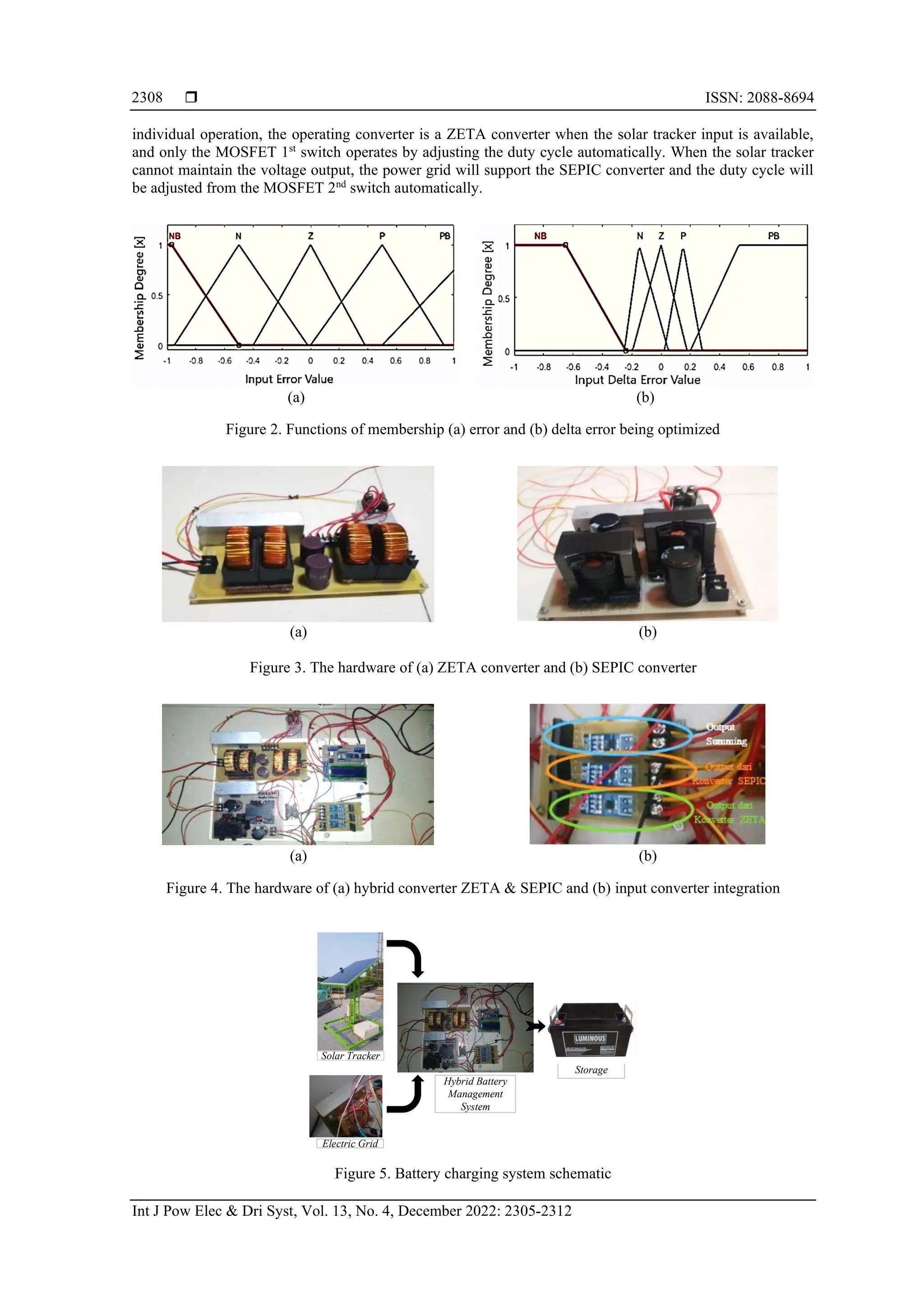
limit under P is 0 and 1, the lower bound PB yields a yield of 0.53153 and 1.6893. Figures 2(a) and 2(b) are
the results of the optimization membership function error and delta error (change in error) carried out by the
FPA optimization to obtain the new membership function. The Figure 2 is the membership function used for
the ZETA converter control process.
2.2. Hardware realization
There are two converters used in this hybrid converter shown as Figure 3, Figure 3(a) namely the
ZETA converter and Figure 3(b) namely the SEPIC converter. Both of these converters require 2 capacitors,
2 inductors, 1 MOSFET, and 1 diode. The Figure 3 shows the hardware of the two converters.
Hardware of hybrid converter ZETA and SEPIC overall shown as Figure 4(a). The integration of the
dual input hybrid converter will be done by adding a 3 MOSFET component to be able to increase the power
in the output summing, that shows Figure 4(b). This summing output will charge the battery for energy
storage. Figure 5 shows a hybrid schematic that has several modes of operation. In simultaneous operation,
two input sources will produce a combined output with the integration part of the two converters. In
 ISSN: 2088-8694
Int J Pow Elec & Dri Syst, Vol. 13, No. 4, December 2022: 2305-2312
2308
individual operation, the operating converter is a ZETA converter when the solar tracker input is available,
and only the MOSFET 1st
switch operates by adjusting the duty cycle automatically. When the solar tracker
cannot maintain the voltage output, the power grid will support the SEPIC converter and the duty cycle will
be adjusted from the MOSFET 2nd
switch automatically.
(a) (b)
Figure 2. Functions of membership (a) error and (b) delta error being optimized
(a) (b)
Figure 3. The hardware of (a) ZETA converter and (b) SEPIC converter
(a) (b)
Figure 4. The hardware of (a) hybrid converter ZETA & SEPIC and (b) input converter integration
Solar Tracker
Electric Grid
Storage
Hybrid Battery
Management
System
Figure 5. Battery charging system schematic
Int J Pow Elec & Dri Syst ISSN: 2088-8694 
Design and building of a battery charging system using hybrid solar tracker and electric … (Imam Abadi)
2309
3. RESULTS AND DISCUSSION
3.1. Testing the charging process hardware from the solar tracker
Data were collected continuously with a PV based tracker with a capacity of 250 Wp for fixed PV
conditions and tracking on 28, 30 May and 19, 21, 22, 24 June 2019. The controller used is the FPAO-FLC
controller on the ZETA converter to achieve the set voltage point 13.2 V. With this voltage the charging
process takes place.
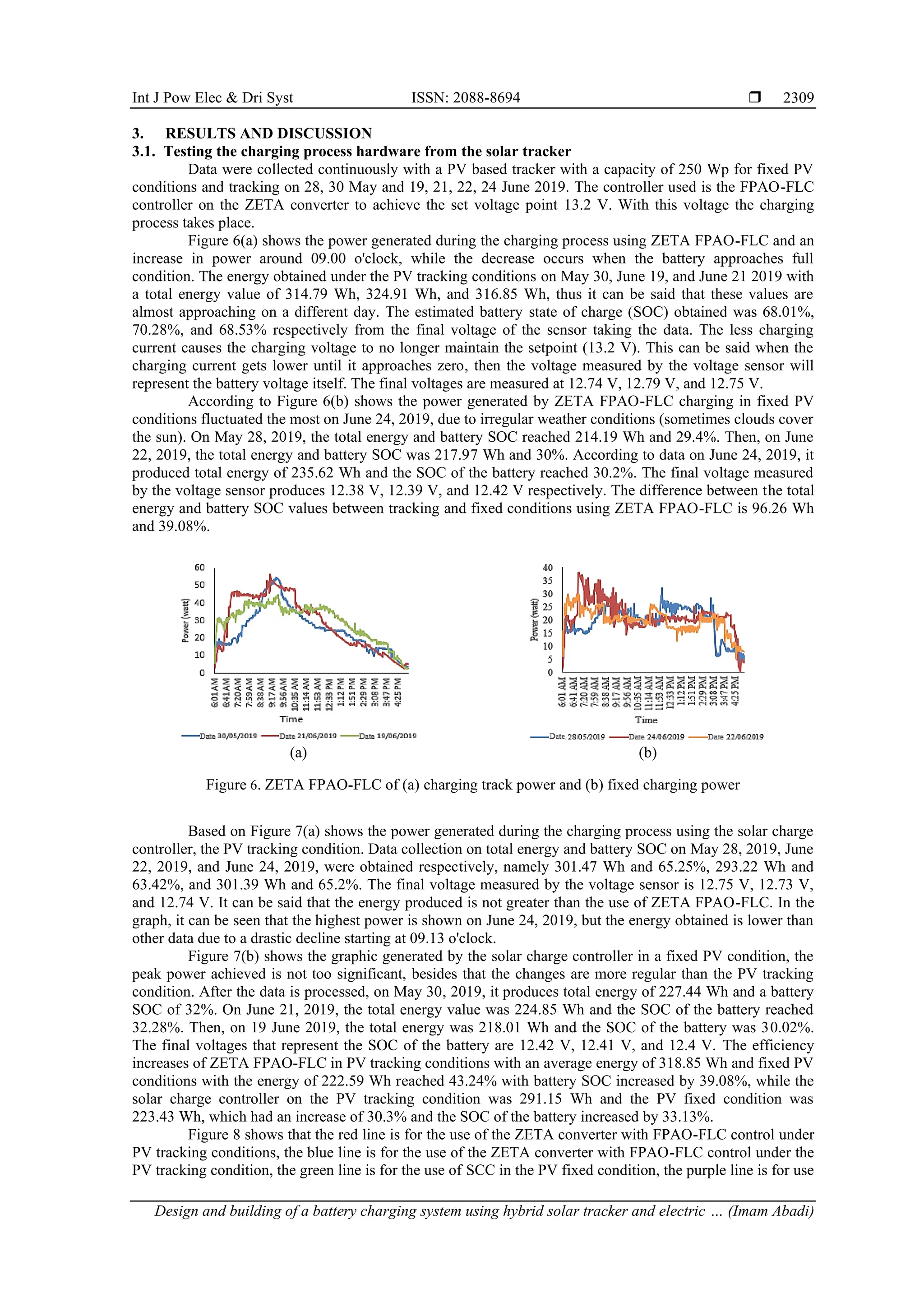
Figure 6(a) shows the power generated during the charging process using ZETA FPAO-FLC and an
increase in power around 09.00 o'clock, while the decrease occurs when the battery approaches full
condition. The energy obtained under the PV tracking conditions on May 30, June 19, and June 21 2019 with
a total energy value of 314.79 Wh, 324.91 Wh, and 316.85 Wh, thus it can be said that these values are
almost approaching on a different day. The estimated battery state of charge (SOC) obtained was 68.01%,
70.28%, and 68.53% respectively from the final voltage of the sensor taking the data. The less charging
current causes the charging voltage to no longer maintain the setpoint (13.2 V). This can be said when the
charging current gets lower until it approaches zero, then the voltage measured by the voltage sensor will
represent the battery voltage itself. The final voltages are measured at 12.74 V, 12.79 V, and 12.75 V.
According to Figure 6(b) shows the power generated by ZETA FPAO-FLC charging in fixed PV
conditions fluctuated the most on June 24, 2019, due to irregular weather conditions (sometimes clouds cover
the sun). On May 28, 2019, the total energy and battery SOC reached 214.19 Wh and 29.4%. Then, on June
22, 2019, the total energy and battery SOC was 217.97 Wh and 30%. According to data on June 24, 2019, it
produced total energy of 235.62 Wh and the SOC of the battery reached 30.2%. The final voltage measured
by the voltage sensor produces 12.38 V, 12.39 V, and 12.42 V respectively. The difference between the total
energy and battery SOC values between tracking and fixed conditions using ZETA FPAO-FLC is 96.26 Wh
and 39.08%.
(a) (b)
Figure 6. ZETA FPAO-FLC of (a) charging track power and (b) fixed charging power
Based on Figure 7(a) shows the power generated during the charging process using the solar charge
controller, the PV tracking condition. Data collection on total energy and battery SOC on May 28, 2019, June
22, 2019, and June 24, 2019, were obtained respectively, namely 301.47 Wh and 65.25%, 293.22 Wh and
63.42%, and 301.39 Wh and 65.2%. The final voltage measured by the voltage sensor is 12.75 V, 12.73 V,
and 12.74 V. It can be said that the energy produced is not greater than the use of ZETA FPAO-FLC. In the
graph, it can be seen that the highest power is shown on June 24, 2019, but the energy obtained is lower than
other data due to a drastic decline starting at 09.13 o'clock.
Figure 7(b) shows the graphic generated by the solar charge controller in a fixed PV condition, the
peak power achieved is not too significant, besides that the changes are more regular than the PV tracking
condition. After the data is processed, on May 30, 2019, it produces total energy of 227.44 Wh and a battery
SOC of 32%. On June 21, 2019, the total energy value was 224.85 Wh and the SOC of the battery reached
32.28%. Then, on 19 June 2019, the total energy was 218.01 Wh and the SOC of the battery was 30.02%.
The final voltages that represent the SOC of the battery are 12.42 V, 12.41 V, and 12.4 V. The efficiency
increases of ZETA FPAO-FLC in PV tracking conditions with an average energy of 318.85 Wh and fixed PV
conditions with the energy of 222.59 Wh reached 43.24% with battery SOC increased by 39.08%, while the
solar charge controller on the PV tracking condition was 291.15 Wh and the PV fixed condition was
223.43 Wh, which had an increase of 30.3% and the SOC of the battery increased by 33.13%.
Figure 8 shows that the red line is for the use of the ZETA converter with FPAO-FLC control under
PV tracking conditions, the blue line is for the use of the ZETA converter with FPAO-FLC control under the
PV tracking condition, the green line is for the use of SCC in the PV fixed condition, the purple line is for use
 ISSN: 2088-8694
Int J Pow Elec & Dri Syst, Vol. 13, No. 4, December 2022: 2305-2312
2310
SCC PV tracking conditions. The graph shows that the charging current using ZETA FPAO-FLC with PV
tracking conditions is greater than other conditions or tools.
(a) (b)
Figure 7. Charging power of (a) solar tracker and (b) fixed solar charge controller
Figure 8. Current charging of battery
The comparison of the average battery charging current in the six-day data collection above between
the use of a ZETA converter with FPAO-FLC control and a solar charge controller resulted in an increase in
PV tracking conditions reaching 16.45% with a peak current of 3.75 A, while the increase obtained in fixed
PV conditions reached 2.43% with a peak current of 2.11 A. PV using FPSO-FLC control has a SOC greater
than using PI control [25].
3.2. Dual input power source backup system
In this hybrid system, there are two modes, namely individual mode and simultaneous mode.
Individual mode occurs when the source generated by the solar tracker is available, the operating converter is
a ZETA converter, and in another case, the source from the solar tracker is not available, the operating
converter is a SEPIC converter with a grid source. Simultaneous mode occurs when the source obtained from
the solar tracker is still available but less than 13 V, then the source from the grid will summing the source
from the solar tracker to produce this voltage.
Based on Figure 9(a), there is an exchange of charging voltages between the solar tracker and the
power grid. This voltage exchange is useful for hybrid systems when one of the supplies starts to decline. The
graph shows that the peak charging voltage of the ZETA converter is 15.11 V, the SEPIC converter's peak
charging voltage is 15.96 V, the peak voltage obtained after the integration section is 14.04 V. The input is
automatically generated graph in Figure 9(b).
Figure 9(b) shows that the greatest power supplied is from the power grid because when the battery
is not full or near empty, it makes the power flow bigger. Experimental data dated 05/29/2019 show that the
individual mode of the electric grid that has been rectified by the full-bridge rectifier produces energy of
88.38 Wh. Then, the individual mode of the solar tracker gets energy of 304.39 Wh. The simultaneous mode
that works from the solar tracker and the grid produces energy of 90.09 Wh. The total energy obtained from
this automatic dual supply mode charging process is 482.86 Wh with the SOC battery reaching 83.9%.
Int J Pow Elec & Dri Syst ISSN: 2088-8694 
Design and building of a battery charging system using hybrid solar tracker and electric … (Imam Abadi)
2311
(a) (b)
Figure 9. Results of (a) backup system testing and (b) battery charging power auto mode dual supply
4. CONCLUSION
The efficiency increase of ZETA FPAO-FLC in tracking and fixed conditions is 43.24% with an
average energy of 318.85 Wh and 222.59 Wh and battery SOC of around 39.08%, while the solar charge
controller experiences an increase of 30.3% with an average energy of 291.15 Wh and 223.43 Wh and the
SOC of the battery respectively reaching 33.13%. The average energy from the experimental data that has
been carried out shows the individual mode of the grid, the individual mode of the solar tracker, the
simultaneous mode of the solar tracker, and the grid produces energy of 92.62 Wh, 310.38 Wh, and 76.8 Wh
respectively, so that the total average energy generated from the automatic dual supply mode charging
process is 479.81 Wh with the battery SOC reaching 82.27%. The FLC control has a rise time of 0.0108
seconds, a settling time of 3,0007 seconds, a maximum overshoot of 34.28% (17.46 V), a peak time of
1.2661 seconds, and a steady-state error of 32.31%. (17.20 V), while the FPAO-FLC control has a value of
rising time, settling time, peak time, maximum overshoot, and steady-state error, respectively 0.0123
seconds; 2.1099 seconds; 0.9246 seconds; 6.08% (13.79 V) and 3.43% (13.45 V). It hopes the future research
can use other renewable energy in the hybrid system and add an internet of things (IoT) system in hardware.
REFERENCES
[1] I. Abadi, D. N. Fitriyanah, and A. U. Umam, “Design of maximum power point tracking (MPPT) on two axes solar tracker based
on particle swarm fuzzy,” in AIP Conference Proceedings, 2019, pp. 1–10. doi: 10.1063/1.5095293.
[2] M. Foumani and K. Smith-Miles, “The impact of various carbon reduction policies on green flowshop scheduling,” Appl. Energy,
vol. 249, no. March, pp. 300–315, 2019, doi: 10.1016/j.apenergy.2019.04.155.
[3] A. J. Veldhuis and A. H. M. E. Reinders, “Reviewing the potential and cost-effectiveness of off-grid PV systems in Indonesia on a
provincial level,” Renew. Sustain. Energy Rev., vol. 52, pp. 757–769, 2015, doi: 10.1016/j.rser.2015.07.126.
[4] D. N. Fitriyanah and I. Abadi, “Fuzzy logic control design of mobile PV using bacterial foraging optimization,” Proceeding - 2018
Int. Semin. Intell. Technol. Its Appl. ISITIA 2018, pp. 215–220, 2018, doi: 10.1109/ISITIA.2018.8711161.
[5] I. Abadi, Q. Uyuniyah, D. Nur Fitriyanah, Y. Jani, and K. Abdullah, “Performance study of maximum power point tracking
(MPPT) based on type-2 fuzzy logic controller on active dual axis solar tracker,” E3S Web Conf., vol. 190, pp. 1–16, 2020, doi:
10.1051/e3sconf/202019000016.
[6] S. Hong and R. E. Stamper, “Discrete-position solar tracking for photovoltaic system,” Rose-Hulman Institute of Technology,
2019.
[7] Y. A. Almatheel and A. Abdelrahman, “Speed control of DC motor using fuzzy logic controller,” in Proceedings - 2017
International Conference on Communication, Control, Computing and Electronics Engineering, ICCCCEE 2017, 2017, no.
January. doi: 10.1109/ICCCCEE.2017.7867673.
[8] I. Abadi, A. Soeprijanto, and A. Musyafa, “Design of single axis solar tracking system at photovoltaic panel using fuzzy logic
controller,” 2014.
[9] R. Hidalgo-León et al., “Modeling battery under discharge using improved Thévenin-Shepherd electrical battery model,” 2018
IEEE Veh. Power Propuls. Conf. VPPC 2018 - Proc., no. 1, pp. 1–5, 2019, doi: 10.1109/VPPC.2018.8604958.
[10] R. Hidalgo-Leon et al., “A survey of battery energy storage system (BESS), applications and environmental impacts in power
systems,” 2017 IEEE 2nd Ecuador Tech. Chapters Meet. ETCM 2017, vol. 2017-Janua, pp. 1–6, 2018, doi:
10.1109/ETCM.2017.8247485.
[11] S. Padhee, U. C. Pati, and K. Mahapatra, “Design of photovoltaic MPPT based charger for lead-acid batteries,” in 2016 IEEE
International Conference on Emerging Technologies and Innovative Business Practices for the Transformation of Societies,
EmergiTech 2016, 2016, pp. 351–356. doi: 10.1109/EmergiTech.2016.7737365.
[12] I. Abadi, C. Imron, M. Musa Bachrowi, and D. Nur Fitriyanah, “Design and implementation of battery charging system on solar
tracker based stand alone PV using fuzzy modified particle swarm optimization,” AIMS Energy, vol. 8, no. 1, pp. 142–155, 2020,
doi: 10.3934/energy.2020.1.142.
[13] R. Hidalgo-Leon, J. Urquizo, J. Litardo, Y. Munoz-Jadan, P. Singh, and J. Wu, “Simulation of battery discharge emulator using
power electronics device with cascaded P-I control,” Proc. IEEE Int. Conf. Ind. Technol., vol. 2020-Febru, no. i, pp. 959–964,
2020, doi: 10.1109/ICIT45562.2020.9067170.
[14] D. Saravanan and M. Kumaresan, “A hybrid power control AC / DC-DC converter systems for high power and high voltage gain
appliction,” Indian J. Sci. Technol., vol. 10924, 2017, doi: 10.17485 / ijst / 2017 / v10i24 / 114641.
[15] M. H. A. Jamlouie, “Accuracy improvement of SOC estimation in lithium-ion batteries by anfis vs ANN modeling of nonlinear
 ISSN: 2088-8694
Int J Pow Elec & Dri Syst, Vol. 13, No. 4, December 2022: 2305-2312
2312
cell characteristics,” Ryerson University, Thesis, 2018.
[16] M. Djalal, M. Ali, A. Imran, and H. Setiadi, “Modification of PID controller design on permanent magnet synchronous motor with
flower pollination algorithm,” J. Tek. Elektro, vol. 6, no. 2, 2017.
[17] D. Lastomo and I. Robandi, “Simulation of pitch blade angle control on a wind turbine with flower pollination algorithm (FPA) to
optimize electrical power conversion,” Institut Teknologi Sepuluh Nopember, 2016.
[18] J. Brownlee, Clever Algorithms. 2011. doi: 10.1017/CBO9781107415324.004.
[19] F. Murdianto, R. Setiawan, M. Efendi, and A. Laili, “Comparison Method of MPSO, FPA, and GWO Algorithm in MPPT Sepic
Converter Under Dynamic Partial Shading Condition,” 2017 International Conference on Advanced Mechatronics, Intelligent
Manufacture, and Industrial Automation (ICAMIMIA), 2017, pp. 315-320, doi: 10.1109/ICAMIMIA.2017.8387609.
[20] S. Khadarvali, V. Madhusudhan, and R. Kiranmayi, “Differential game theory with FPA optimization in multi-area power system,”
Int. J. Power Electron. Drive Syst., vol. 11, no. 1, pp. 302–308, 2020, doi: 10.11591/ijpeds.v11.i1.pp302-308.
[21] D. S. Morales, “Maximum power point tracking algorithms for photovoltaic applications faculty,” Energy Harvesting and Energy
Efficiency, pp. 205–234, 2010, doi: 10.1007/978-3-319-49875-1_8.
[22] E. Sahin and I. Altas, “FPA tuned fuzzy logic controlled synchronous buck converter for a wave / SC energy system,” Turkey Adv.
Electr. Comput. Eng., vol. 17, no. 1, 2017.
[23] J. Gálvez, E. Cuevas, and O. Avalos, “Flower pollination algorithm for multimodal optimization,” Int. J. Comput. Intell. Syst., vol.
10, no. 1, pp. 627–646, 2017, doi: 10.2991/ijcis.2017.10.1.42.
[24] L. Valenzuela, F. Valdez, and P. Melin, “Flower pollination algorithm with fuzzy approach for solving optimization problems,”
Stud. Comput. Intell., vol. 667, pp. 357–369, 2017, doi: 10.1007/978-3-319-47054-2_24.
[25] S. Barcellona, D. De Simone, and L. Piegari, “Simple control strategy for a PV‐battery system,” J. Eng., vol. 2019, no. 18, pp.
4809–4812, 2019, doi: 10.1049/joe.2018.9269.
BIOGRAPHIES OF AUTHORS
Imam Abadi is currently a lecturer at Sepuluh Nopember Institute of Technology
(ITS). He received his Ph.D. degree in electrical engineering at ITS and MSc in
Instrumentation and Control Engineering from Bandung Institute of Technology, 2016 and
2005. His Ph.D. research is in the field of power system. His research interest lies in the areas
of grid connected photovoltaic systems, PV system modelling, power control system,
instrumentation system and renewable energy. He can be contacted at email:
imamabadi02@gmail.com.
Ali Musyafa’ was born in Indonesia in 1960. He received B.Sc., M.Sc. and Ph.D.
degree in 1985, 2000, and 2012. He is currently a senior lecturer and also a head of department
representative commision of engineering physic, Sepuluh Nopember Institute of Technology
(ITS). He has been involved in major projects in ITS and national company. He has many
publications in international journals and conferences in the field of power system and
renewable energy. His research interests include power system, renewable energy,
instrumentation and automation. He can be contacted at email: musyafa@ep.its.ac.id.
Kevin Gica Erwandha graduated from Engineering Physics Sepuluh Nopember
Institute of Technology (ITS) in 2019. The author actively organizes in ITS Physics
Engineering Association (HMTF ITS) and Physical Measurement Laboratory of ITS
Engineering Department. The author has a focus on the field of interest in instrumentation and
control engineering. He can be contacted at email: kevingicaerwandha22@gmail.com.
Dwi Nur Fitriyanah received the M.T. degree (Master of Engineering) in
Engineering Physics from Institut Teknologi Sepuluh Nopember, Indonesia, with the Research
“Type-2 fuzzy logic control design based on BFO on hybrid PV solar tracker-ocean wave
energy converter (OWEC)”. She is currently lecturing in the department of Instrumentation
Engineering at Institut Teknologi Sepuluh Nopember, Indonesia. Her research interests are the
fields of control, renewable energy, and its application. She can be contacted at email:
fitriyanah@its.ac.id.

Design and building of a battery charging system using hybrid solar tracker and electric trip based on FPAO-FLC

  • 1.
    International Journal ofPower Electronics and Drive Systems (IJPEDS) Vol. 13, No. 4, December 2022, pp. 2305~2312 ISSN: 2088-8694, DOI: 10.11591/ijpeds.v13.i4.pp2305-2312  2305 Journal homepage: http://ijpeds.iaescore.com Design and building of a battery charging system using hybrid solar tracker and electric trip based on FPAO-FLC Imam Abadi1 , Ali Musyafa’1 , Kevin Gica Erwandha1 , Dwi Nur Fitriyanah2 1 Department of Engineering Physics, Institut Teknologi Sepuluh Nopember, Surabaya, Indonesia 2 Department of Instrumentation Engineering, Institut Teknologi Sepuluh Nopember, Surabaya, Indonesia Article Info ABSTRACT Article history: Received Jul 7, 2022 Revised May 23, 2022 Accepted Jun 14, 2022 The proposed system is a hybrid charging system between a solar tracker and an electric grid using two converter types. The photovoltaic (PV)-based solar tracker has powerful tools, but its weakness is when the absence of sunlight. With a combination of two resources, the weakness can overcome. The control so good is needed so that it can overcome those weaknesses too. This study uses the flower pollination algorithm optimization-fuzzy logic controller (FPAO-FLC). Results of control using FPAO-FLC has a value of a rising time of 0.0123 seconds, settling time of 2.1099 seconds, maximum overshoot of 6.08%, a peak time of 0.9246 seconds, and steady-state error of 3.43%. The efficiency of the ZETA converter using FPAO-FLC control in the tracking condition PV compared to the fixed condition has increased 43, 24%, and the state of charge (SOC) of the battery reaches 39.08%. The advantage of this hybrid system is that it has two modes of operation, which are automatic, including simultaneous and individual operating modes. The data collection results show that the energy obtained by the individual grid mode dan the individually solar tracker mode is 92.62 Wh and 310.38 Wh. The total energy obtained was 479.81 Wh. Keywords: FPAO-FLC Hybrid system SEPIC converter Solar tracker ZETA converter This is an open access article under the CC BY-SA license. Corresponding Author: Imam Abadi Department of Engineering Physics, Institut Teknologi Sepuluh Nopember Teknik Kimia St., Keputih, Sukolilo, Surabaya, Indonesia Email: imamabadi02@gmail.com 1. INTRODUCTION The use of fossil-based energy or oil, gas and coal play an important role in human life. The energy demand from year to year has increased along with the increasing population in a country. One source of energy that is currently widely used is electrical energy. Electrical energy is the main source of human life both for daily life and the needs of companies or industries. According to data obtained average solar radiation intensity of about 4.8 kWh/m2 /day [1]. Thus, the supply of electrical energy is expected to meet all aspects of community needs. But on the other hand, the need for electrical energy which continues to increase has resulted in a reduction in non-renewable energy sources. This condition causes the basic electricity tariff to continue to increase sharply. Thus, in order to decrease pollution, it is necessary to either use electricity in a more efficient way for current processes or have alternative sources that are environmentally friendly and also reliable [2]. One of the alternative sources to produce the most potential electrical energy is solar power. The advantage of solar energy from many renewable energy sources is that it is non-polluting and inexhaustible. Indonesia is a tropical country that has the potential for solar energy with an average insolation of 4.5-4.8 kWh/m2 per day [3]. This useful innovation to take advantage of this energy potential presents a
  • 2.
     ISSN: 2088-8694 IntJ Pow Elec & Dri Syst, Vol. 13, No. 4, December 2022: 2305-2312 2306 technology that has been developed as a conversion of solar energy into electrical energy, namely photovoltaic (PV). In operation, the performance of PV depends on temperature and exposure to irradiation, so these two parameters are the main factors affecting the power yield obtained [4]. In the next development, PV which was added by electronic devices presented a more sophisticated technology, namely the solar tracker [5]. The system configuration uses a light dependent resistor (LDR) sensor and an actuator in the form of a DC motor [6], [7]. The resulting efficiency can reach 47% for a single axis solar tracker when compared to fixed-based PV [8]. Thus, this efficiency shows the high electrical energy generated from the solar tracker device. Then, the electrical energy obtained will be stored in the battery and can be used to meet electricity needs [9]−[11]. In fact, the output power obtained from the solar tracker fluctuates before being stored in the battery [12]. This condition requires a conditioning system to deal with these weaknesses. In 2017, Bachrowi designed a stand-alone PV charging system based on a solar tracker with an efficiency increase of 36.15% and the charging time of 8.5 hours [12]. Research that has been carried out for a battery charging system with a source only from PV based tracking is still not reliable enough due to the long charging time that the system can provide. So that new technology is needed to solve this problem and can support the charging process with a high capacity battery [13]. One of these technologies is the hybrid system technology. There is research on the design of hybrid power control from the integration of AC/DC-DC converter. The proposed system on the AC-grid uses a SWISS power factor correction (PFC) converter, while the PV source is a Cuk converter. The integration of the hybrid converter can provide high voltage and power [14]. Subsequent research is improvement of SOC estimation in battery [15]. No less important than the system above, the flower pollination algorithm optimization (FPAO) can be used to optimize the controller of the hybrid system. This algorithm produces a low overshoot response, and the settling time is faster in two studies, namely the permanent magnet synchronous motor [16] and in wind turbines to optimize the proportional integral derivative (PID) parameters for controlling blade pitch angle. The flower pollination algorithm (FPA) shows better response results when compared to particle swarm optimization (PSO) and manual tuning to optimize power conversion [17], [18]. Research on the application of the converter using the FPAO has been widely carried out. In 2017, Purwanto researched the comparison of methods between the modified PSO algorithm, FPA, and gray wolf optimization using the maximum power point tracking (MPPT) single-ended primary-inductor converter (SEPIC) converter. The results obtained indicate that the FPA method has an advantage over other methods, namely the achievement of responses to reach convergent situations more quickly [19]−[21]. In the same year, Shahin, researching about tuning fuzzy logic controllers with FPA on synchronous buck converters for waves systems obtained a small performance index value, so the smaller the value, the more optimal the response will be [22]. Referring to the problems above, a new innovation is needed that can minimize the amount of electricity costs and the use of PV which is limited by time and weather conditions. On cloudy days, in the morning and at night, the charging system sourced from PV is still not reliable enough. Thus, in this study, a battery charging hybrid system design between tracker-based PV and electric grids is carried out to cover each other's shortcomings. This research is expected to produce optimal efficiency by using the flower pollination algorithm optimization-fuzzy logic controller (FPAO-FLC) as a controller of the system. 2. RESEARCH METHOD 2.1. FPAO-FLC design In designing the FPAO-FLC system, first created a fuzzy control system that includes 4 parts, namely fuzzification, inference system, rule base, and defuzzification. Figure 1 is the membership function of the fuzzy logic controller before the optimization. The input for this fuzzy control is voltage error Figure 1(a) and delta error (change in error) Figure 1(b), while the resulting output is a duty cycle. The membership function of the input in the form of error, delta error, and output, namely the duty cycle. The membership function used from the input error and delta error is 3 triangles and 2 trapezoidal. Furthermore, the crisp input number declared by the membership function in Table 1 will be processed by the inference system with the rule base as shown in Table 2, were: e : error de : delta error NB : negative big membership function (trapezoid) = [-1.72; -0.8; -0.5] N : negative small membership function (triangle) = [-1; -0.5; 0]
  • 3.
    Int J PowElec & Dri Syst ISSN: 2088-8694  Design and building of a battery charging system using hybrid solar tracker and electric … (Imam Abadi) 2307 Z : zero membership function (triangle) = [-0.5; 0; 0.5] P : positive small membership function (triangle) = [0; 0.5; 1] PB : positive big membership function (trapezoid) = [0.5; 0.8; 2.8] (a) (b) Figure 1. Membership functions input of (a) error and (b) delta error Table 1. Input parameters before optimization Table 2. Lookup table rule base FLC Fuzzy number Error Delta error NB [-1.72; -1.08; -0.8; -0.5] [-1.72; -1.08; -0.3; -0.5] N [-1; -0.5; 0] [-0.3; -0.15; 0] Z [-0.5; 0; 0.5] [-0.2; 0; 0.2] P [0; 0.5; 1] [0; 0.15; 0.3] PB [0.5; 0.8; 1.2; 2.8] [0.2; 0.3; 1.2; 2.8] e de NB N Z P PB NB NB NB NB NS Z N NB NB NS Z PS Z NB NS Z PS PB P NS Z PS PB PB PB Z PS PB PB PB An explanation of the optimization of the fuzzy logic controller membership function, FPAO-FLC do with defining the initial parameters of the fuzzy logic control membership function that been created [23] [24]. Initial parameters: i) Number of insects = 30; ii) Probability of moving to another interest = 0.8; and iii) Maximum number of iterations = 1000. After defining the initial parameters, then initiating a random number value, when the random number value is smaller than the probability of moving to another flower, global pollination is carried out. Firstly the levy flight is calculated as the power to pollinate with the following calculations [23]: 𝑅𝑎𝑛𝑑 = 0.7416 𝐿(𝜆) = λΓ(λ) sin (λπ/2) 𝜋 1 𝑆1+𝜆 = 1.5 .0.8862.0.0411 3.14 1 1.0742.5 𝐿(𝜆) = 0.01455 𝑋𝑖 𝑡+1 = 𝑋𝑖 𝑡 + 𝐿(𝜆)(𝐺∗ - 𝑋𝑖 𝑡 ) = 0.1208 + 0.0145 (2.4424 − 0.1208) 𝑋𝑖 𝑡+1 = 0.15457 The best position produces the lower boundary membership function of NB is -1.1642 and -0.54205, while the lower limit of N is -1 and -0.13635, then the lower limit of Z is -0.42903 and 0.45314, then the limit under P is 0 and 1, the lower bound PB yields a yield of 0.53153 and 1.6893. Figures 2(a) and 2(b) are the results of the optimization membership function error and delta error (change in error) carried out by the FPA optimization to obtain the new membership function. The Figure 2 is the membership function used for the ZETA converter control process. 2.2. Hardware realization There are two converters used in this hybrid converter shown as Figure 3, Figure 3(a) namely the ZETA converter and Figure 3(b) namely the SEPIC converter. Both of these converters require 2 capacitors, 2 inductors, 1 MOSFET, and 1 diode. The Figure 3 shows the hardware of the two converters. Hardware of hybrid converter ZETA and SEPIC overall shown as Figure 4(a). The integration of the dual input hybrid converter will be done by adding a 3 MOSFET component to be able to increase the power in the output summing, that shows Figure 4(b). This summing output will charge the battery for energy storage. Figure 5 shows a hybrid schematic that has several modes of operation. In simultaneous operation, two input sources will produce a combined output with the integration part of the two converters. In
  • 4.
     ISSN: 2088-8694 IntJ Pow Elec & Dri Syst, Vol. 13, No. 4, December 2022: 2305-2312 2308 individual operation, the operating converter is a ZETA converter when the solar tracker input is available, and only the MOSFET 1st switch operates by adjusting the duty cycle automatically. When the solar tracker cannot maintain the voltage output, the power grid will support the SEPIC converter and the duty cycle will be adjusted from the MOSFET 2nd switch automatically. (a) (b) Figure 2. Functions of membership (a) error and (b) delta error being optimized (a) (b) Figure 3. The hardware of (a) ZETA converter and (b) SEPIC converter (a) (b) Figure 4. The hardware of (a) hybrid converter ZETA & SEPIC and (b) input converter integration Solar Tracker Electric Grid Storage Hybrid Battery Management System Figure 5. Battery charging system schematic
  • 5.
    Int J PowElec & Dri Syst ISSN: 2088-8694  Design and building of a battery charging system using hybrid solar tracker and electric … (Imam Abadi) 2309 3. RESULTS AND DISCUSSION 3.1. Testing the charging process hardware from the solar tracker Data were collected continuously with a PV based tracker with a capacity of 250 Wp for fixed PV conditions and tracking on 28, 30 May and 19, 21, 22, 24 June 2019. The controller used is the FPAO-FLC controller on the ZETA converter to achieve the set voltage point 13.2 V. With this voltage the charging process takes place. Figure 6(a) shows the power generated during the charging process using ZETA FPAO-FLC and an increase in power around 09.00 o'clock, while the decrease occurs when the battery approaches full condition. The energy obtained under the PV tracking conditions on May 30, June 19, and June 21 2019 with a total energy value of 314.79 Wh, 324.91 Wh, and 316.85 Wh, thus it can be said that these values are almost approaching on a different day. The estimated battery state of charge (SOC) obtained was 68.01%, 70.28%, and 68.53% respectively from the final voltage of the sensor taking the data. The less charging current causes the charging voltage to no longer maintain the setpoint (13.2 V). This can be said when the charging current gets lower until it approaches zero, then the voltage measured by the voltage sensor will represent the battery voltage itself. The final voltages are measured at 12.74 V, 12.79 V, and 12.75 V. According to Figure 6(b) shows the power generated by ZETA FPAO-FLC charging in fixed PV conditions fluctuated the most on June 24, 2019, due to irregular weather conditions (sometimes clouds cover the sun). On May 28, 2019, the total energy and battery SOC reached 214.19 Wh and 29.4%. Then, on June 22, 2019, the total energy and battery SOC was 217.97 Wh and 30%. According to data on June 24, 2019, it produced total energy of 235.62 Wh and the SOC of the battery reached 30.2%. The final voltage measured by the voltage sensor produces 12.38 V, 12.39 V, and 12.42 V respectively. The difference between the total energy and battery SOC values between tracking and fixed conditions using ZETA FPAO-FLC is 96.26 Wh and 39.08%. (a) (b) Figure 6. ZETA FPAO-FLC of (a) charging track power and (b) fixed charging power Based on Figure 7(a) shows the power generated during the charging process using the solar charge controller, the PV tracking condition. Data collection on total energy and battery SOC on May 28, 2019, June 22, 2019, and June 24, 2019, were obtained respectively, namely 301.47 Wh and 65.25%, 293.22 Wh and 63.42%, and 301.39 Wh and 65.2%. The final voltage measured by the voltage sensor is 12.75 V, 12.73 V, and 12.74 V. It can be said that the energy produced is not greater than the use of ZETA FPAO-FLC. In the graph, it can be seen that the highest power is shown on June 24, 2019, but the energy obtained is lower than other data due to a drastic decline starting at 09.13 o'clock. Figure 7(b) shows the graphic generated by the solar charge controller in a fixed PV condition, the peak power achieved is not too significant, besides that the changes are more regular than the PV tracking condition. After the data is processed, on May 30, 2019, it produces total energy of 227.44 Wh and a battery SOC of 32%. On June 21, 2019, the total energy value was 224.85 Wh and the SOC of the battery reached 32.28%. Then, on 19 June 2019, the total energy was 218.01 Wh and the SOC of the battery was 30.02%. The final voltages that represent the SOC of the battery are 12.42 V, 12.41 V, and 12.4 V. The efficiency increases of ZETA FPAO-FLC in PV tracking conditions with an average energy of 318.85 Wh and fixed PV conditions with the energy of 222.59 Wh reached 43.24% with battery SOC increased by 39.08%, while the solar charge controller on the PV tracking condition was 291.15 Wh and the PV fixed condition was 223.43 Wh, which had an increase of 30.3% and the SOC of the battery increased by 33.13%. Figure 8 shows that the red line is for the use of the ZETA converter with FPAO-FLC control under PV tracking conditions, the blue line is for the use of the ZETA converter with FPAO-FLC control under the PV tracking condition, the green line is for the use of SCC in the PV fixed condition, the purple line is for use
  • 6.
     ISSN: 2088-8694 IntJ Pow Elec & Dri Syst, Vol. 13, No. 4, December 2022: 2305-2312 2310 SCC PV tracking conditions. The graph shows that the charging current using ZETA FPAO-FLC with PV tracking conditions is greater than other conditions or tools. (a) (b) Figure 7. Charging power of (a) solar tracker and (b) fixed solar charge controller Figure 8. Current charging of battery The comparison of the average battery charging current in the six-day data collection above between the use of a ZETA converter with FPAO-FLC control and a solar charge controller resulted in an increase in PV tracking conditions reaching 16.45% with a peak current of 3.75 A, while the increase obtained in fixed PV conditions reached 2.43% with a peak current of 2.11 A. PV using FPSO-FLC control has a SOC greater than using PI control [25]. 3.2. Dual input power source backup system In this hybrid system, there are two modes, namely individual mode and simultaneous mode. Individual mode occurs when the source generated by the solar tracker is available, the operating converter is a ZETA converter, and in another case, the source from the solar tracker is not available, the operating converter is a SEPIC converter with a grid source. Simultaneous mode occurs when the source obtained from the solar tracker is still available but less than 13 V, then the source from the grid will summing the source from the solar tracker to produce this voltage. Based on Figure 9(a), there is an exchange of charging voltages between the solar tracker and the power grid. This voltage exchange is useful for hybrid systems when one of the supplies starts to decline. The graph shows that the peak charging voltage of the ZETA converter is 15.11 V, the SEPIC converter's peak charging voltage is 15.96 V, the peak voltage obtained after the integration section is 14.04 V. The input is automatically generated graph in Figure 9(b). Figure 9(b) shows that the greatest power supplied is from the power grid because when the battery is not full or near empty, it makes the power flow bigger. Experimental data dated 05/29/2019 show that the individual mode of the electric grid that has been rectified by the full-bridge rectifier produces energy of 88.38 Wh. Then, the individual mode of the solar tracker gets energy of 304.39 Wh. The simultaneous mode that works from the solar tracker and the grid produces energy of 90.09 Wh. The total energy obtained from this automatic dual supply mode charging process is 482.86 Wh with the SOC battery reaching 83.9%.
  • 7.
    Int J PowElec & Dri Syst ISSN: 2088-8694  Design and building of a battery charging system using hybrid solar tracker and electric … (Imam Abadi) 2311 (a) (b) Figure 9. Results of (a) backup system testing and (b) battery charging power auto mode dual supply 4. CONCLUSION The efficiency increase of ZETA FPAO-FLC in tracking and fixed conditions is 43.24% with an average energy of 318.85 Wh and 222.59 Wh and battery SOC of around 39.08%, while the solar charge controller experiences an increase of 30.3% with an average energy of 291.15 Wh and 223.43 Wh and the SOC of the battery respectively reaching 33.13%. The average energy from the experimental data that has been carried out shows the individual mode of the grid, the individual mode of the solar tracker, the simultaneous mode of the solar tracker, and the grid produces energy of 92.62 Wh, 310.38 Wh, and 76.8 Wh respectively, so that the total average energy generated from the automatic dual supply mode charging process is 479.81 Wh with the battery SOC reaching 82.27%. The FLC control has a rise time of 0.0108 seconds, a settling time of 3,0007 seconds, a maximum overshoot of 34.28% (17.46 V), a peak time of 1.2661 seconds, and a steady-state error of 32.31%. (17.20 V), while the FPAO-FLC control has a value of rising time, settling time, peak time, maximum overshoot, and steady-state error, respectively 0.0123 seconds; 2.1099 seconds; 0.9246 seconds; 6.08% (13.79 V) and 3.43% (13.45 V). It hopes the future research can use other renewable energy in the hybrid system and add an internet of things (IoT) system in hardware. REFERENCES [1] I. Abadi, D. N. Fitriyanah, and A. U. Umam, “Design of maximum power point tracking (MPPT) on two axes solar tracker based on particle swarm fuzzy,” in AIP Conference Proceedings, 2019, pp. 1–10. doi: 10.1063/1.5095293. [2] M. Foumani and K. Smith-Miles, “The impact of various carbon reduction policies on green flowshop scheduling,” Appl. Energy, vol. 249, no. March, pp. 300–315, 2019, doi: 10.1016/j.apenergy.2019.04.155. [3] A. J. Veldhuis and A. H. M. E. Reinders, “Reviewing the potential and cost-effectiveness of off-grid PV systems in Indonesia on a provincial level,” Renew. Sustain. Energy Rev., vol. 52, pp. 757–769, 2015, doi: 10.1016/j.rser.2015.07.126. [4] D. N. Fitriyanah and I. Abadi, “Fuzzy logic control design of mobile PV using bacterial foraging optimization,” Proceeding - 2018 Int. Semin. Intell. Technol. Its Appl. ISITIA 2018, pp. 215–220, 2018, doi: 10.1109/ISITIA.2018.8711161. [5] I. Abadi, Q. Uyuniyah, D. Nur Fitriyanah, Y. Jani, and K. Abdullah, “Performance study of maximum power point tracking (MPPT) based on type-2 fuzzy logic controller on active dual axis solar tracker,” E3S Web Conf., vol. 190, pp. 1–16, 2020, doi: 10.1051/e3sconf/202019000016. [6] S. Hong and R. E. Stamper, “Discrete-position solar tracking for photovoltaic system,” Rose-Hulman Institute of Technology, 2019. [7] Y. A. Almatheel and A. Abdelrahman, “Speed control of DC motor using fuzzy logic controller,” in Proceedings - 2017 International Conference on Communication, Control, Computing and Electronics Engineering, ICCCCEE 2017, 2017, no. January. doi: 10.1109/ICCCCEE.2017.7867673. [8] I. Abadi, A. Soeprijanto, and A. Musyafa, “Design of single axis solar tracking system at photovoltaic panel using fuzzy logic controller,” 2014. [9] R. Hidalgo-León et al., “Modeling battery under discharge using improved Thévenin-Shepherd electrical battery model,” 2018 IEEE Veh. Power Propuls. Conf. VPPC 2018 - Proc., no. 1, pp. 1–5, 2019, doi: 10.1109/VPPC.2018.8604958. [10] R. Hidalgo-Leon et al., “A survey of battery energy storage system (BESS), applications and environmental impacts in power systems,” 2017 IEEE 2nd Ecuador Tech. Chapters Meet. ETCM 2017, vol. 2017-Janua, pp. 1–6, 2018, doi: 10.1109/ETCM.2017.8247485. [11] S. Padhee, U. C. Pati, and K. Mahapatra, “Design of photovoltaic MPPT based charger for lead-acid batteries,” in 2016 IEEE International Conference on Emerging Technologies and Innovative Business Practices for the Transformation of Societies, EmergiTech 2016, 2016, pp. 351–356. doi: 10.1109/EmergiTech.2016.7737365. [12] I. Abadi, C. Imron, M. Musa Bachrowi, and D. Nur Fitriyanah, “Design and implementation of battery charging system on solar tracker based stand alone PV using fuzzy modified particle swarm optimization,” AIMS Energy, vol. 8, no. 1, pp. 142–155, 2020, doi: 10.3934/energy.2020.1.142. [13] R. Hidalgo-Leon, J. Urquizo, J. Litardo, Y. Munoz-Jadan, P. Singh, and J. Wu, “Simulation of battery discharge emulator using power electronics device with cascaded P-I control,” Proc. IEEE Int. Conf. Ind. Technol., vol. 2020-Febru, no. i, pp. 959–964, 2020, doi: 10.1109/ICIT45562.2020.9067170. [14] D. Saravanan and M. Kumaresan, “A hybrid power control AC / DC-DC converter systems for high power and high voltage gain appliction,” Indian J. Sci. Technol., vol. 10924, 2017, doi: 10.17485 / ijst / 2017 / v10i24 / 114641. [15] M. H. A. Jamlouie, “Accuracy improvement of SOC estimation in lithium-ion batteries by anfis vs ANN modeling of nonlinear
  • 8.
     ISSN: 2088-8694 IntJ Pow Elec & Dri Syst, Vol. 13, No. 4, December 2022: 2305-2312 2312 cell characteristics,” Ryerson University, Thesis, 2018. [16] M. Djalal, M. Ali, A. Imran, and H. Setiadi, “Modification of PID controller design on permanent magnet synchronous motor with flower pollination algorithm,” J. Tek. Elektro, vol. 6, no. 2, 2017. [17] D. Lastomo and I. Robandi, “Simulation of pitch blade angle control on a wind turbine with flower pollination algorithm (FPA) to optimize electrical power conversion,” Institut Teknologi Sepuluh Nopember, 2016. [18] J. Brownlee, Clever Algorithms. 2011. doi: 10.1017/CBO9781107415324.004. [19] F. Murdianto, R. Setiawan, M. Efendi, and A. Laili, “Comparison Method of MPSO, FPA, and GWO Algorithm in MPPT Sepic Converter Under Dynamic Partial Shading Condition,” 2017 International Conference on Advanced Mechatronics, Intelligent Manufacture, and Industrial Automation (ICAMIMIA), 2017, pp. 315-320, doi: 10.1109/ICAMIMIA.2017.8387609. [20] S. Khadarvali, V. Madhusudhan, and R. Kiranmayi, “Differential game theory with FPA optimization in multi-area power system,” Int. J. Power Electron. Drive Syst., vol. 11, no. 1, pp. 302–308, 2020, doi: 10.11591/ijpeds.v11.i1.pp302-308. [21] D. S. Morales, “Maximum power point tracking algorithms for photovoltaic applications faculty,” Energy Harvesting and Energy Efficiency, pp. 205–234, 2010, doi: 10.1007/978-3-319-49875-1_8. [22] E. Sahin and I. Altas, “FPA tuned fuzzy logic controlled synchronous buck converter for a wave / SC energy system,” Turkey Adv. Electr. Comput. Eng., vol. 17, no. 1, 2017. [23] J. Gálvez, E. Cuevas, and O. Avalos, “Flower pollination algorithm for multimodal optimization,” Int. J. Comput. Intell. Syst., vol. 10, no. 1, pp. 627–646, 2017, doi: 10.2991/ijcis.2017.10.1.42. [24] L. Valenzuela, F. Valdez, and P. Melin, “Flower pollination algorithm with fuzzy approach for solving optimization problems,” Stud. Comput. Intell., vol. 667, pp. 357–369, 2017, doi: 10.1007/978-3-319-47054-2_24. [25] S. Barcellona, D. De Simone, and L. Piegari, “Simple control strategy for a PV‐battery system,” J. Eng., vol. 2019, no. 18, pp. 4809–4812, 2019, doi: 10.1049/joe.2018.9269. BIOGRAPHIES OF AUTHORS Imam Abadi is currently a lecturer at Sepuluh Nopember Institute of Technology (ITS). He received his Ph.D. degree in electrical engineering at ITS and MSc in Instrumentation and Control Engineering from Bandung Institute of Technology, 2016 and 2005. His Ph.D. research is in the field of power system. His research interest lies in the areas of grid connected photovoltaic systems, PV system modelling, power control system, instrumentation system and renewable energy. He can be contacted at email: imamabadi02@gmail.com. Ali Musyafa’ was born in Indonesia in 1960. He received B.Sc., M.Sc. and Ph.D. degree in 1985, 2000, and 2012. He is currently a senior lecturer and also a head of department representative commision of engineering physic, Sepuluh Nopember Institute of Technology (ITS). He has been involved in major projects in ITS and national company. He has many publications in international journals and conferences in the field of power system and renewable energy. His research interests include power system, renewable energy, instrumentation and automation. He can be contacted at email: musyafa@ep.its.ac.id. Kevin Gica Erwandha graduated from Engineering Physics Sepuluh Nopember Institute of Technology (ITS) in 2019. The author actively organizes in ITS Physics Engineering Association (HMTF ITS) and Physical Measurement Laboratory of ITS Engineering Department. The author has a focus on the field of interest in instrumentation and control engineering. He can be contacted at email: kevingicaerwandha22@gmail.com. Dwi Nur Fitriyanah received the M.T. degree (Master of Engineering) in Engineering Physics from Institut Teknologi Sepuluh Nopember, Indonesia, with the Research “Type-2 fuzzy logic control design based on BFO on hybrid PV solar tracker-ocean wave energy converter (OWEC)”. She is currently lecturing in the department of Instrumentation Engineering at Institut Teknologi Sepuluh Nopember, Indonesia. Her research interests are the fields of control, renewable energy, and its application. She can be contacted at email: fitriyanah@its.ac.id.