© 2023, IRJET | Impact Factor value: 8.226 | ISO 9001:2008 Certified Journal | Page 369
IS: 3370-2009 Section (I-IV) takes on Breaking point State
Plan Technique with safety measures. It embraces the
standards for restricting break width when the designs are
planned by considering extreme cutoff state and confines
the burdens to 130MPa in steel so that breaking width isn't
surpassed. These safeguard guarantees breaking width to be
under 0.2 mm for example fit for fluid capacity. This likewise
Limit State Strategy additionally checks for functionality.
Limit State Plan Technique considers the heap as indicated
by their tendency.
Limit State Plan Technique considers the materials as
indicated by their properties.
Restricted breaking in the construction planned by working
pressure technique was the principal motivation behind
why the Indian Standard IS: 3370 (1965) didn't embrace the
cutoff state plan strategy even after reception by IS; 456
1978.However, with the accompanying benefits of Cutoff
State Plan strategy, IS:3370 took on Breaking point State
Plan Technique in 2009.
2.METHODOLOGY
in nature and can be made sealed. By and large, no breaks
are permitted to occur in any piece of the construction of
fluid holding R.C.C tanks and they made water tight by
utilizing more extravagant blend (at the very least M20) of
cement. Furthermore, once in a while water sealing
materials are likewise used to make tanks water tight.
Porousness of cement is straightforwardly relative to water
concrete proportion. Legitimate compaction utilizing
vibrators ought to be finished to accomplish impenetrability.
Concrete substance running spillage issue. Utilization of
high strength twisted bars of level 415 are suggested for the
development of fluid holding structures. Anyway, gentle
steel bars are additionally utilized. Right setting of support,
utilization of little estimated and utilization of twisted bars
lead to differential breaks. A break width of 0.1mm has been
acknowledged as reasonable worth in fluid holding
structures.
Capacity repositories and above tank are utilized to store
water, fluid oil, oil-based commodities and comparable
fluids. These designs are made of stone work, steel, built up
concrete and pre pushed concrete. Out of these,
workmanship and steel tanks are utilized for more modest
limits. The expense of steel tanks is high and consequently
they are seldom utilized for water stockpiles. Supported
substantial tank is high and subsequently they are seldom
utilized for water stockpiles. Built up substantial tanks are
exceptionally famous in light of the fact that, other than the
development and plans being basic, they are modest, solid
1.INTRODUCTION
Abstract: As of now a Water tank are genuinely significant
for a public help, attractive area and furthermore for the
counterfeit construction. The plan and development styles
utilized in substantiated concrete are told by the overall
development rehearses, the actual property of the material
and the climatic circumstances. Prior to taking up the plan,
the most reasonable sort of arranging of tanks and right
assessment of burdens including statically balance of design
especially in regards to overturning of overhanging
individuals are made. The plan is made considering the
absolute worst mix of burdens, minutes and shears emerging
from opposite burdens and vertical burdens acting toward
any path when the tank is full as well as unfilled. In this plan
by playing out the examination of water tank. Water tank
are authentically valuable for storage facility of water to
include the utilization of water we want to clutch the limit of
water as significant required. Presently a day's storage
facility tank is reasonable for a wide range of environmental
factors we live as old as developed style. Water is the normal
requirement for every one of the living organic entities to get
by. portable water is basic for good strength of mortal
creatures. It means quite a bit to supply mobile water to
each existent and everyone; subsequently it's genuinely
needful to store water. A circuitous tank is physically
planned. It's additionally dissected utilizing the introduction
examination programming StaadPro.
Key words – Population Forecasting, StaadPro Software,
Water Storage Capacity, Risk Assessment, ESR.
6
Assistant Professor Civil Engineering Department, Government College of Engineering Jalgaon-425001[MS] India
------------------------------------------------------------------------***---------------------------------------------------------------------------
Fourth year Civil Engineering Department, Government College of Engineering Jalgaon-425001[MS] India
1,2,3,4,5
Sonawane Sumital Gulabrao (4) Mohammeed Ameer Mohammed Shabbir (5) Prof Vilas T Patil (6)
Shafin Sheikh (1) Tamboli Sohel Salim (2) Malge Kiran Rajendra (3)
Design & Analysis of Circular Water Tank by Using Staad Pro Software
International Research Journal of Engineering and Technology (IRJET) e-ISSN: 2395-0056
Volume: 10 Issue: 03 | Mar 2023 www.irjet.net p-ISSN: 2395-0072
© 2023, IRJET | Impact Factor value: 8.226 | ISO 9001:2008 Certified Journal | Page 370
determines plainly the way in which a fluid stockpiling
structure contrasts with different designs.
2.1Details of Design of Water Tank
A water tank is a compartment for putting away water. The
requirement for a water tank is pretty much as old as
civilization, stockpiling of water for use in numerous
applications, drinking water, water system horticulture,
fire concealment, rural cultivating, both for plants and
animals, substance producing, food planning as well as
numerous different purposes. Water tank boundaries
incorporate the general plan of tank, and decision of
development materials, linings. Different materials are
utilized for making a water tank: plastics (polyethylene,
polypropylene), fiberglass, cement, and stone, steel
(welded or catapulted, carbon, or pure).
3.DESIGN CALCULATION
3.1 Design of Over Head Water Tank
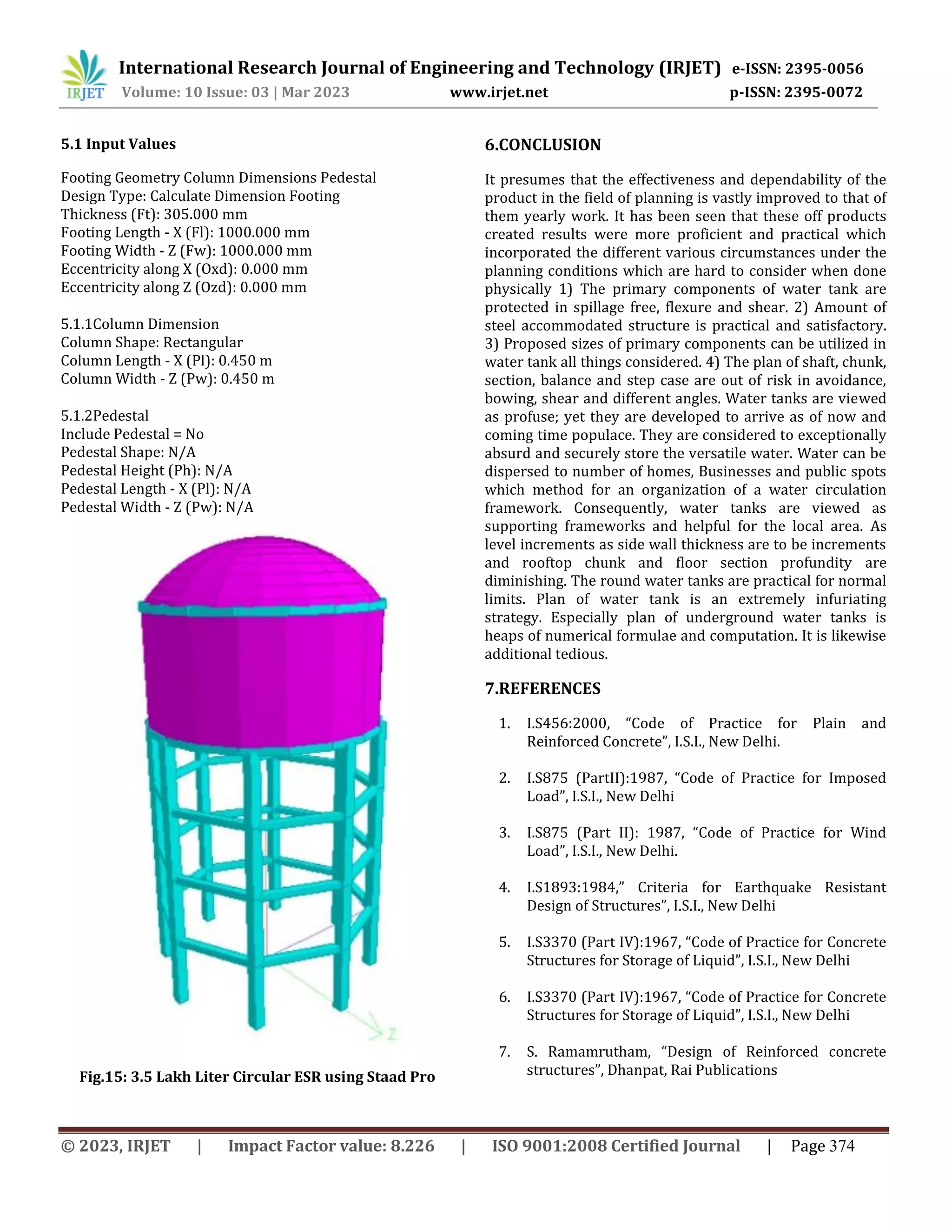
The water tank is designed for 3000 or more people. Based
on the per capita demand for institutional buildings the
capacity of the water tank is reached as 3.5 Lakh Liter. The
salient features of the overhead water tank are as
tabulated below.
3.2 Salient features of water tank
Grade of Concrete: M30
Capacity of water Tank: 3.5Lakhs Liter
Staging of overhead tank: 19m
Number of columns: 8
Number of braces:3
Inner diameter of tank:7 m
Height of cylindrical walls :5 m
Rise of dome: 1.5 m
Thickness of dome: 0.12 m
Thickness of cylindrical walls: 0.18 m
Dimensions of columns:0.45 x 0.45m
Dimensions of braces:0.40 x 0.35m
Top ring beam size:0.2 x .2 m
Bottom ring beam size:0.3 x 0.2 m
Thickness of floor slab :0.1 m
SBC of soil:100KN/M2
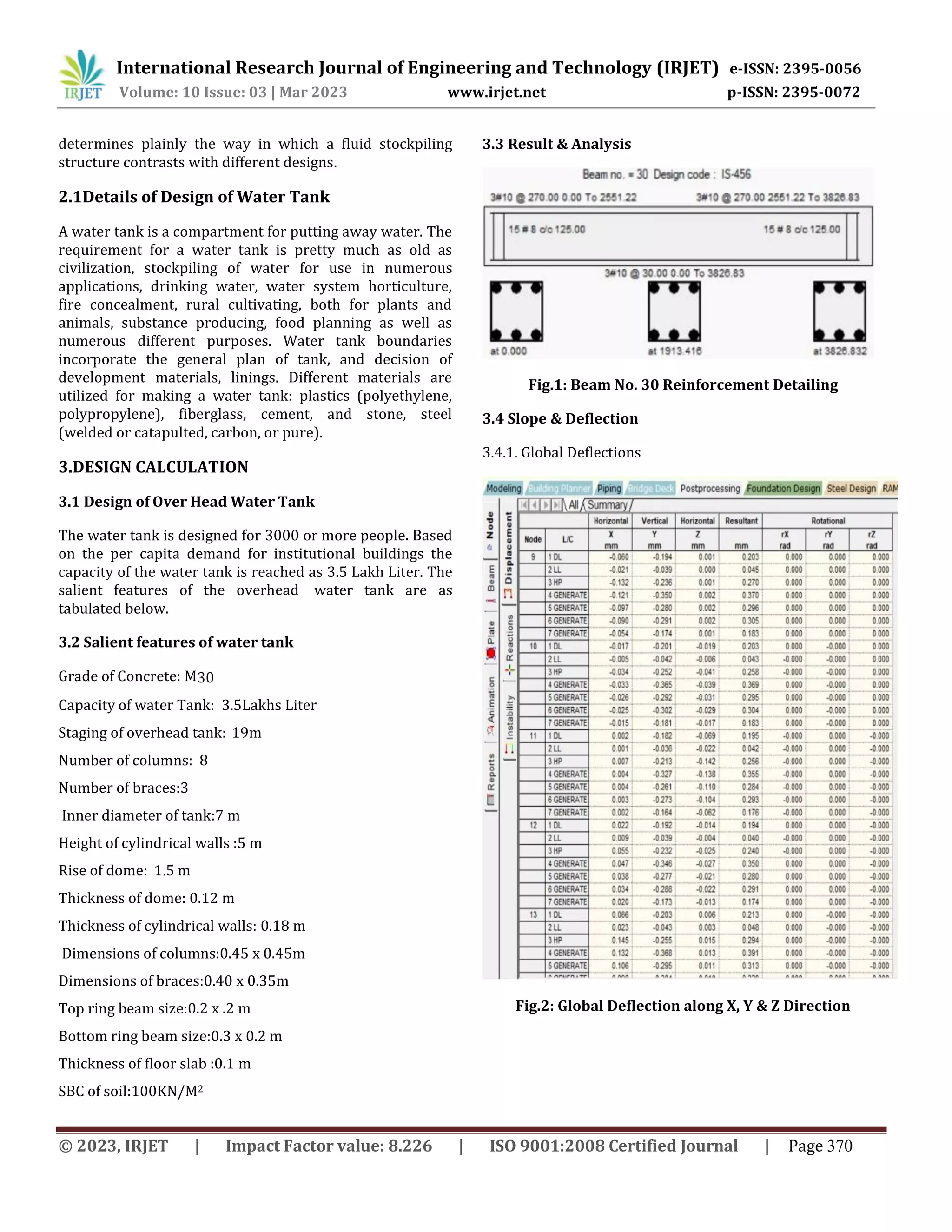
3.3 Result & Analysis
Fig.1: Beam No. 30 Reinforcement Detailing
3.4 Slope & Deflection
3.4.1. Global Deflections
Fig.2: Global Deflection along X, Y & Z Direction
International Research Journal of Engineering and Technology (IRJET) e-ISSN: 2395-0056
Volume: 10 Issue: 03 | Mar 2023 www.irjet.net p-ISSN: 2395-0072
International Research Journal of Engineering and Technology (IRJET) e-ISSN: 2395-0056
Volume: 10 Issue: 03 | Mar 2023 www.irjet.net p-ISSN: 2395-0072
© 2023, IRJET | Impact Factor value: 8.226 | ISO 9001:2008 Certified Journal | Page 371
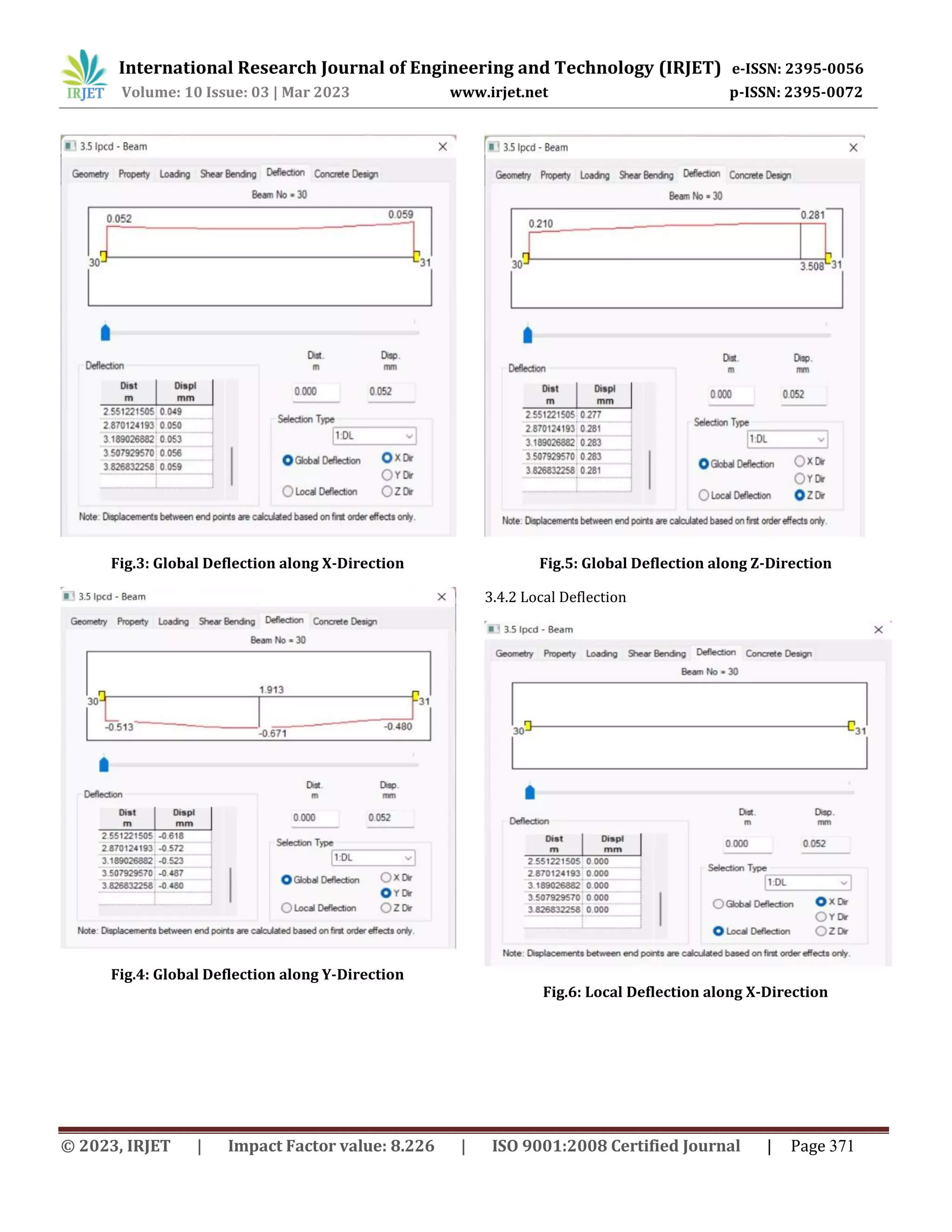
Fig.3: Global Deflection along X-Direction
Fig.4: Global Deflection along Y-Direction
Fig.5: Global Deflection along Z-Direction
3.4.2 Local Deflection
Fig.6: Local Deflection along X-Direction
International Research Journal of Engineering and Technology (IRJET) e-ISSN: 2395-0056
Volume: 10 Issue: 03 | Mar 2023 www.irjet.net p-ISSN: 2395-0072
© 2023, IRJET | Impact Factor value: 8.226 | ISO 9001:2008 Certified Journal | Page 372
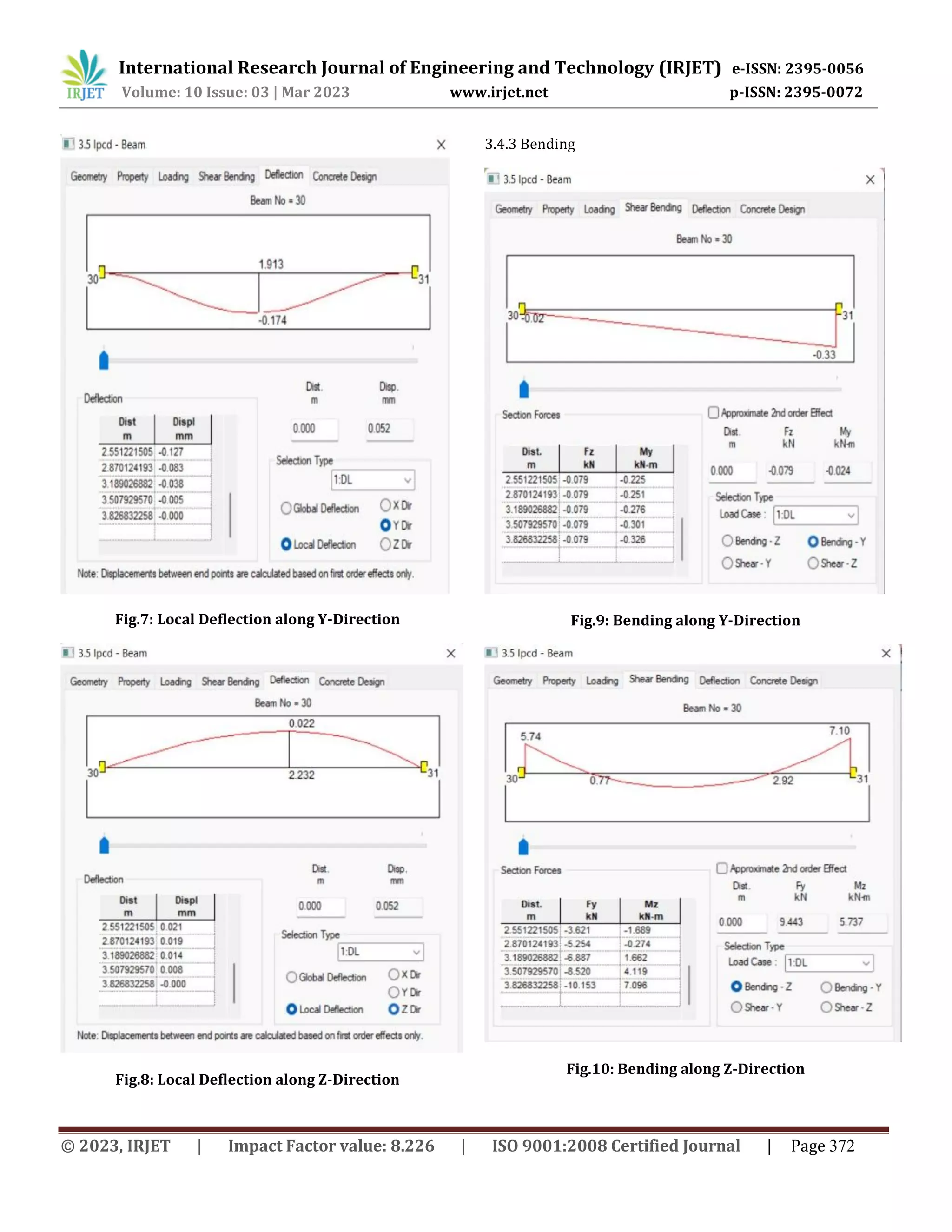
Fig.7: Local Deflection along Y-Direction
Fig.8: Local Deflection along Z-Direction
3.4.3 Bending
Fig.9: Bending along Y-Direction
Fig.10: Bending along Z-Direction
International Research Journal of Engineering and Technology (IRJET) e-ISSN: 2395-0056
Volume: 10 Issue: 03 | Mar 2023 www.irjet.net p-ISSN: 2395-0072
© 2023, IRJET | Impact Factor value: 8.226 | ISO 9001:2008 Certified Journal | Page 373
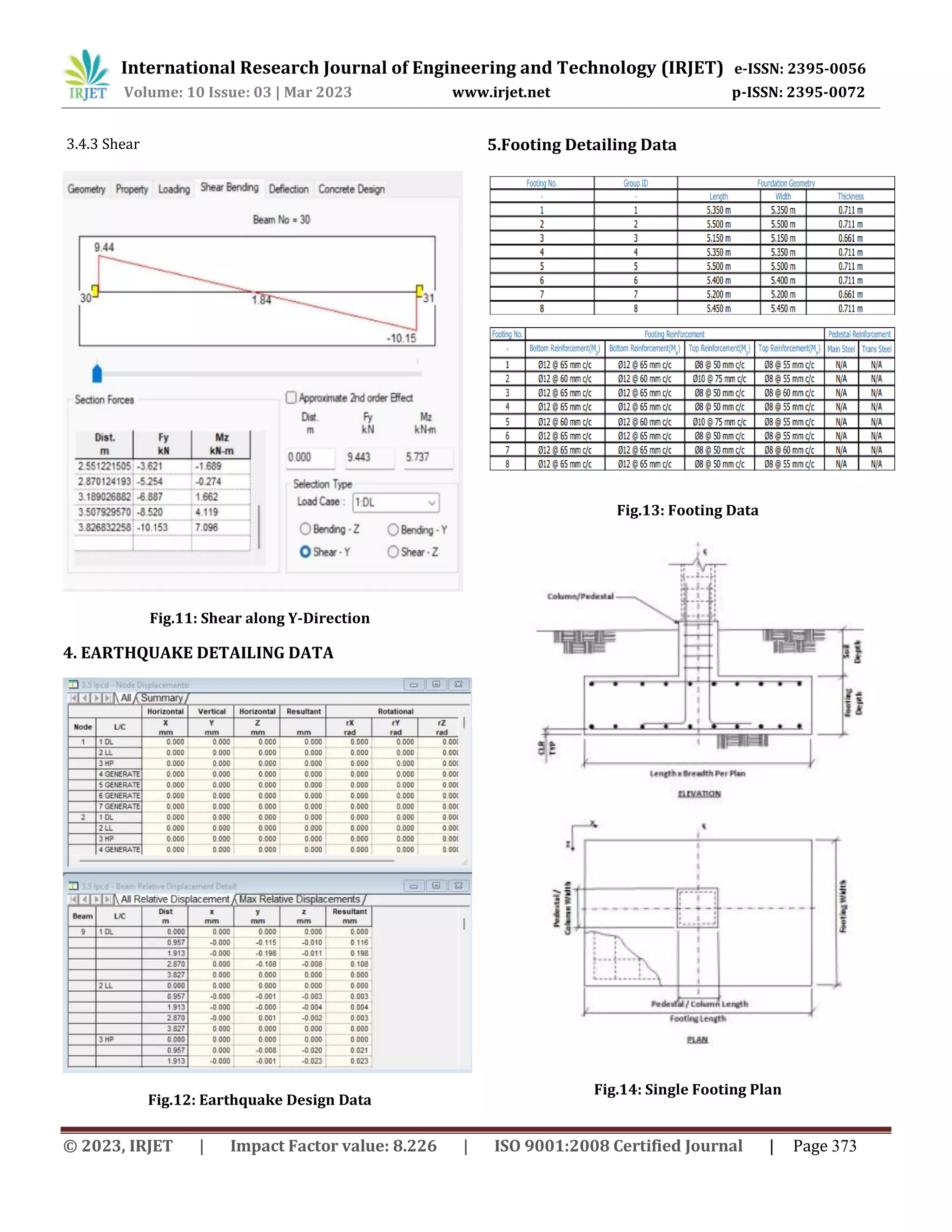
3.4.3 Shear
Fig.11: Shear along Y-Direction
4. EARTHQUAKE DETAILING DATA
Fig.12: Earthquake Design Data
5.Footing Detailing Data
Fig.13: Footing Data
Fig.14: Single Footing Plan
International Research Journal of Engineering and Technology (IRJET) e-ISSN: 2395-0056
Volume: 10 Issue: 03 | Mar 2023 www.irjet.net p-ISSN: 2395-0072
© 2023, IRJET | Impact Factor value: 8.226 | ISO 9001:2008 Certified Journal | Page 374
5.1 Input Values
Footing Geometry Column Dimensions Pedestal
Design Type: Calculate Dimension Footing
Thickness (Ft): 305.000 mm
Footing Length - X (Fl): 1000.000 mm
Footing Width - Z (Fw): 1000.000 mm
Eccentricity along X (Oxd): 0.000 mm
Eccentricity along Z (Ozd): 0.000 mm
5.1.1Column Dimension
Column Shape: Rectangular
Column Length - X (Pl): 0.450 m
Column Width - Z (Pw): 0.450 m
5.1.2Pedestal
Include Pedestal = No
Pedestal Shape: N/A
Pedestal Height (Ph): N/A
Pedestal Length - X (Pl): N/A
Pedestal Width - Z (Pw): N/A
Fig.15: 3.5 Lakh Liter Circular ESR using Staad Pro
6.CONCLUSION
It presumes that the effectiveness and dependability of the
product in the field of planning is vastly improved to that of
them yearly work. It has been seen that these off products
created results were more proficient and practical which
incorporated the different various circumstances under the
planning conditions which are hard to consider when done
physically 1) The primary components of water tank are
protected in spillage free, flexure and shear. 2) Amount of
steel accommodated structure is practical and satisfactory.
3) Proposed sizes of primary components can be utilized in
water tank all things considered. 4) The plan of shaft, chunk,
section, balance and step case are out of risk in avoidance,
bowing, shear and different angles. Water tanks are viewed
as profuse; yet they are developed to arrive as of now and
coming time populace. They are considered to exceptionally
absurd and securely store the versatile water. Water can be
dispersed to number of homes, Businesses and public spots
which method for an organization of a water circulation
framework. Consequently, water tanks are viewed as
supporting frameworks and helpful for the local area. As
level increments as side wall thickness are to be increments
and rooftop chunk and floor section profundity are
diminishing. The round water tanks are practical for normal
limits. Plan of water tank is an extremely infuriating
strategy. Especially plan of underground water tanks is
heaps of numerical formulae and computation. It is likewise
additional tedious.
7.REFERENCES
1. I.S456:2000, “Code of Practice for Plain and
Reinforced Concrete”, I.S.I., New Delhi.
2. I.S875 (PartII):1987, “Code of Practice for Imposed
Load”, I.S.I., New Delhi
3. I.S875 (Part II): 1987, “Code of Practice for Wind
Load”, I.S.I., New Delhi.
4. I.S1893:1984,” Criteria for Earthquake Resistant
Design of Structures”, I.S.I., New Delhi
5. I.S3370 (Part IV):1967, “Code of Practice for Concrete
Structures for Storage of Liquid”, I.S.I., New Delhi
6. I.S3370 (Part IV):1967, “Code of Practice for Concrete
Structures for Storage of Liquid”, I.S.I., New Delhi
7. S. Ramamrutham, “Design of Reinforced concrete
structures”, Dhanpat, Rai Publications

Design & Analysis of Circular Water Tank by Using Staad Pro Software

  • 1.
    © 2023, IRJET| Impact Factor value: 8.226 | ISO 9001:2008 Certified Journal | Page 369 IS: 3370-2009 Section (I-IV) takes on Breaking point State Plan Technique with safety measures. It embraces the standards for restricting break width when the designs are planned by considering extreme cutoff state and confines the burdens to 130MPa in steel so that breaking width isn't surpassed. These safeguard guarantees breaking width to be under 0.2 mm for example fit for fluid capacity. This likewise Limit State Strategy additionally checks for functionality. Limit State Plan Technique considers the heap as indicated by their tendency. Limit State Plan Technique considers the materials as indicated by their properties. Restricted breaking in the construction planned by working pressure technique was the principal motivation behind why the Indian Standard IS: 3370 (1965) didn't embrace the cutoff state plan strategy even after reception by IS; 456 1978.However, with the accompanying benefits of Cutoff State Plan strategy, IS:3370 took on Breaking point State Plan Technique in 2009. 2.METHODOLOGY in nature and can be made sealed. By and large, no breaks are permitted to occur in any piece of the construction of fluid holding R.C.C tanks and they made water tight by utilizing more extravagant blend (at the very least M20) of cement. Furthermore, once in a while water sealing materials are likewise used to make tanks water tight. Porousness of cement is straightforwardly relative to water concrete proportion. Legitimate compaction utilizing vibrators ought to be finished to accomplish impenetrability. Concrete substance running spillage issue. Utilization of high strength twisted bars of level 415 are suggested for the development of fluid holding structures. Anyway, gentle steel bars are additionally utilized. Right setting of support, utilization of little estimated and utilization of twisted bars lead to differential breaks. A break width of 0.1mm has been acknowledged as reasonable worth in fluid holding structures. Capacity repositories and above tank are utilized to store water, fluid oil, oil-based commodities and comparable fluids. These designs are made of stone work, steel, built up concrete and pre pushed concrete. Out of these, workmanship and steel tanks are utilized for more modest limits. The expense of steel tanks is high and consequently they are seldom utilized for water stockpiles. Supported substantial tank is high and subsequently they are seldom utilized for water stockpiles. Built up substantial tanks are exceptionally famous in light of the fact that, other than the development and plans being basic, they are modest, solid 1.INTRODUCTION Abstract: As of now a Water tank are genuinely significant for a public help, attractive area and furthermore for the counterfeit construction. The plan and development styles utilized in substantiated concrete are told by the overall development rehearses, the actual property of the material and the climatic circumstances. Prior to taking up the plan, the most reasonable sort of arranging of tanks and right assessment of burdens including statically balance of design especially in regards to overturning of overhanging individuals are made. The plan is made considering the absolute worst mix of burdens, minutes and shears emerging from opposite burdens and vertical burdens acting toward any path when the tank is full as well as unfilled. In this plan by playing out the examination of water tank. Water tank are authentically valuable for storage facility of water to include the utilization of water we want to clutch the limit of water as significant required. Presently a day's storage facility tank is reasonable for a wide range of environmental factors we live as old as developed style. Water is the normal requirement for every one of the living organic entities to get by. portable water is basic for good strength of mortal creatures. It means quite a bit to supply mobile water to each existent and everyone; subsequently it's genuinely needful to store water. A circuitous tank is physically planned. It's additionally dissected utilizing the introduction examination programming StaadPro. Key words – Population Forecasting, StaadPro Software, Water Storage Capacity, Risk Assessment, ESR. 6 Assistant Professor Civil Engineering Department, Government College of Engineering Jalgaon-425001[MS] India ------------------------------------------------------------------------***--------------------------------------------------------------------------- Fourth year Civil Engineering Department, Government College of Engineering Jalgaon-425001[MS] India 1,2,3,4,5 Sonawane Sumital Gulabrao (4) Mohammeed Ameer Mohammed Shabbir (5) Prof Vilas T Patil (6) Shafin Sheikh (1) Tamboli Sohel Salim (2) Malge Kiran Rajendra (3) Design & Analysis of Circular Water Tank by Using Staad Pro Software International Research Journal of Engineering and Technology (IRJET) e-ISSN: 2395-0056 Volume: 10 Issue: 03 | Mar 2023 www.irjet.net p-ISSN: 2395-0072
  • 2.
    © 2023, IRJET| Impact Factor value: 8.226 | ISO 9001:2008 Certified Journal | Page 370 determines plainly the way in which a fluid stockpiling structure contrasts with different designs. 2.1Details of Design of Water Tank A water tank is a compartment for putting away water. The requirement for a water tank is pretty much as old as civilization, stockpiling of water for use in numerous applications, drinking water, water system horticulture, fire concealment, rural cultivating, both for plants and animals, substance producing, food planning as well as numerous different purposes. Water tank boundaries incorporate the general plan of tank, and decision of development materials, linings. Different materials are utilized for making a water tank: plastics (polyethylene, polypropylene), fiberglass, cement, and stone, steel (welded or catapulted, carbon, or pure). 3.DESIGN CALCULATION 3.1 Design of Over Head Water Tank The water tank is designed for 3000 or more people. Based on the per capita demand for institutional buildings the capacity of the water tank is reached as 3.5 Lakh Liter. The salient features of the overhead water tank are as tabulated below. 3.2 Salient features of water tank Grade of Concrete: M30 Capacity of water Tank: 3.5Lakhs Liter Staging of overhead tank: 19m Number of columns: 8 Number of braces:3 Inner diameter of tank:7 m Height of cylindrical walls :5 m Rise of dome: 1.5 m Thickness of dome: 0.12 m Thickness of cylindrical walls: 0.18 m Dimensions of columns:0.45 x 0.45m Dimensions of braces:0.40 x 0.35m Top ring beam size:0.2 x .2 m Bottom ring beam size:0.3 x 0.2 m Thickness of floor slab :0.1 m SBC of soil:100KN/M2 3.3 Result & Analysis Fig.1: Beam No. 30 Reinforcement Detailing 3.4 Slope & Deflection 3.4.1. Global Deflections Fig.2: Global Deflection along X, Y & Z Direction International Research Journal of Engineering and Technology (IRJET) e-ISSN: 2395-0056 Volume: 10 Issue: 03 | Mar 2023 www.irjet.net p-ISSN: 2395-0072
  • 3.
    International Research Journalof Engineering and Technology (IRJET) e-ISSN: 2395-0056 Volume: 10 Issue: 03 | Mar 2023 www.irjet.net p-ISSN: 2395-0072 © 2023, IRJET | Impact Factor value: 8.226 | ISO 9001:2008 Certified Journal | Page 371 Fig.3: Global Deflection along X-Direction Fig.4: Global Deflection along Y-Direction Fig.5: Global Deflection along Z-Direction 3.4.2 Local Deflection Fig.6: Local Deflection along X-Direction
  • 4.
    International Research Journalof Engineering and Technology (IRJET) e-ISSN: 2395-0056 Volume: 10 Issue: 03 | Mar 2023 www.irjet.net p-ISSN: 2395-0072 © 2023, IRJET | Impact Factor value: 8.226 | ISO 9001:2008 Certified Journal | Page 372 Fig.7: Local Deflection along Y-Direction Fig.8: Local Deflection along Z-Direction 3.4.3 Bending Fig.9: Bending along Y-Direction Fig.10: Bending along Z-Direction
  • 5.
    International Research Journalof Engineering and Technology (IRJET) e-ISSN: 2395-0056 Volume: 10 Issue: 03 | Mar 2023 www.irjet.net p-ISSN: 2395-0072 © 2023, IRJET | Impact Factor value: 8.226 | ISO 9001:2008 Certified Journal | Page 373 3.4.3 Shear Fig.11: Shear along Y-Direction 4. EARTHQUAKE DETAILING DATA Fig.12: Earthquake Design Data 5.Footing Detailing Data Fig.13: Footing Data Fig.14: Single Footing Plan
  • 6.
    International Research Journalof Engineering and Technology (IRJET) e-ISSN: 2395-0056 Volume: 10 Issue: 03 | Mar 2023 www.irjet.net p-ISSN: 2395-0072 © 2023, IRJET | Impact Factor value: 8.226 | ISO 9001:2008 Certified Journal | Page 374 5.1 Input Values Footing Geometry Column Dimensions Pedestal Design Type: Calculate Dimension Footing Thickness (Ft): 305.000 mm Footing Length - X (Fl): 1000.000 mm Footing Width - Z (Fw): 1000.000 mm Eccentricity along X (Oxd): 0.000 mm Eccentricity along Z (Ozd): 0.000 mm 5.1.1Column Dimension Column Shape: Rectangular Column Length - X (Pl): 0.450 m Column Width - Z (Pw): 0.450 m 5.1.2Pedestal Include Pedestal = No Pedestal Shape: N/A Pedestal Height (Ph): N/A Pedestal Length - X (Pl): N/A Pedestal Width - Z (Pw): N/A Fig.15: 3.5 Lakh Liter Circular ESR using Staad Pro 6.CONCLUSION It presumes that the effectiveness and dependability of the product in the field of planning is vastly improved to that of them yearly work. It has been seen that these off products created results were more proficient and practical which incorporated the different various circumstances under the planning conditions which are hard to consider when done physically 1) The primary components of water tank are protected in spillage free, flexure and shear. 2) Amount of steel accommodated structure is practical and satisfactory. 3) Proposed sizes of primary components can be utilized in water tank all things considered. 4) The plan of shaft, chunk, section, balance and step case are out of risk in avoidance, bowing, shear and different angles. Water tanks are viewed as profuse; yet they are developed to arrive as of now and coming time populace. They are considered to exceptionally absurd and securely store the versatile water. Water can be dispersed to number of homes, Businesses and public spots which method for an organization of a water circulation framework. Consequently, water tanks are viewed as supporting frameworks and helpful for the local area. As level increments as side wall thickness are to be increments and rooftop chunk and floor section profundity are diminishing. The round water tanks are practical for normal limits. Plan of water tank is an extremely infuriating strategy. Especially plan of underground water tanks is heaps of numerical formulae and computation. It is likewise additional tedious. 7.REFERENCES 1. I.S456:2000, “Code of Practice for Plain and Reinforced Concrete”, I.S.I., New Delhi. 2. I.S875 (PartII):1987, “Code of Practice for Imposed Load”, I.S.I., New Delhi 3. I.S875 (Part II): 1987, “Code of Practice for Wind Load”, I.S.I., New Delhi. 4. I.S1893:1984,” Criteria for Earthquake Resistant Design of Structures”, I.S.I., New Delhi 5. I.S3370 (Part IV):1967, “Code of Practice for Concrete Structures for Storage of Liquid”, I.S.I., New Delhi 6. I.S3370 (Part IV):1967, “Code of Practice for Concrete Structures for Storage of Liquid”, I.S.I., New Delhi 7. S. Ramamrutham, “Design of Reinforced concrete structures”, Dhanpat, Rai Publications