ENHANCING SOFTWARE MODULARITY
THROUGH FLEXIBLE COMPONENT DESIGN
DEPENDENCY INJECTION
UNDERSTANDING
DEPENDENCY
INJECTION
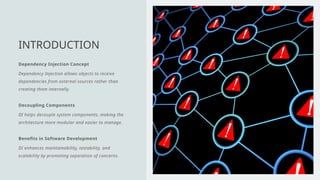
Dependency Injection Concept
Dependency Injection allows objects to receive
dependencies from external sources rather than
creating them internally.
Decoupling Components
DI helps decouple system components, making the
architecture more modular and easier to manage.
Benefits in Software Development
DI enhances maintainability, testability, and
scalability by promoting separation of concerns.
INTRODUCTION
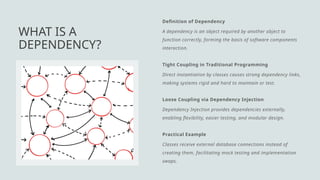
Definition of Dependency
A dependency is an object required by another object to
function correctly, forming the basis of software components
interaction.
Tight Coupling in Traditional Programming
Direct instantiation by classes causes strong dependency links,
making systems rigid and hard to maintain or test.
Loose Coupling via Dependency Injection
Dependency Injection provides dependencies externally,
enabling flexibility, easier testing, and modular design.
Practical Example
Classes receive external database connections instead of
creating them, facilitating mock testing and implementation
swaps.
WHAT IS A
DEPENDENCY?
TYPES OF
DEPENDENCY
INJECTION
Constructor Injection
Dependencies are passed through the class constructor,
ensuring they are available at object creation and
promoting immutability.
Setter Injection
Dependencies are set via public setter methods,
allowing flexibility and optional dependencies after
object creation.
Interface Injection
An interface defines an injector method to inject
dependencies into the client, useful in specific design
scenarios.
CONSTRUCTOR, SETTER,
AND INTERFACE
INJECTION
ADVANTAGES AND
CHALLENGES
Loose Coupling
Dependency Injection promotes loose coupling, making systems modular and
easier to maintain.
Facilitates Testing
DI enables easier testing by allowing dependencies to be mocked for isolated
unit tests.
Enhances Code Reusability
Components are reusable as they are not tightly bound to specific
implementations.
Improves Maintainability
DI reduces impact of changes, improving overall maintainability of the software
system.
Provides Flexibility
Developers can switch implementations easily with minimal code changes using
Dependency Injection.
BENEFITS OF
DEPENDENCY
INJECTION
Learning Curve Challenges
Understanding DI concepts and configuring frameworks
requires significant learning and can slow down initial
development.
Performance Overhead
DI frameworks can introduce performance overhead and
increased complexity, impacting large-scale applications.
Debugging Difficulties
Debugging becomes harder due to indirection from DI
containers, complicating dependency tracing in code.
Configuration Complexity
Managing dependencies and lifecycles in DI frameworks can be
cumbersome and error-prone for developers.
DRAWBACKS OF
DEPENDENCY
INJECTION
TOOLS AND
IMPLEMENTATION
Java Dependency Injection
Java frameworks like Spring, Google Guice, and Dagger provide
strong DI support for dependency management and configuration.
.NET Dependency Injection
In .NET, frameworks such as
Microsoft.Extensions.DependencyInjection, Autofac, and Ninject
enable efficient dependency resolution and lifecycle management.
Python Dependency Injection
Python libraries like dependency-injector and injector facilitate
standardized and efficient dependency injection in Python projects.
JavaScript and TypeScript DI
JavaScript and TypeScript use frameworks such as InversifyJS and
Angular’s DI system for automatic dependency resolution and
configuration.
DEPENDENCY
INJECTION
FRAMEWORKS
Dependency Injection Concept
Dependency Injection allows external
objects to be passed into a class rather
than created inside it, promoting flexibility.
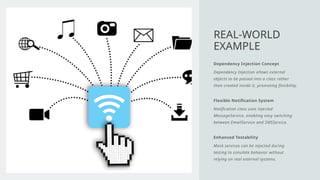
Flexible Notification System
Notification class uses injected
MessageService, enabling easy switching
between EmailService and SMSService.
Enhanced Testability
Mock services can be injected during
testing to simulate behavior without
relying on real external systems.
REAL-WORLD
EXAMPLE
BEST PRACTICES
AND SUMMARY
Constructor Injection Preference
Favor constructor injection for mandatory dependencies to
maintain object integrity and ensure reliable initialization.
Use Interfaces for Abstraction
Abstract dependencies using interfaces to enhance flexibility
and decouple components effectively.
Avoid Service Locators
Avoid service locators as they hide dependencies and reduce
code transparency and maintainability.
Centralize Configuration
Centralize configuration settings to improve visibility and
manageability of dependencies across the application.
BEST PRACTICES
Enhances Software Architecture
Dependency Injection promotes clean, maintainable,
and testable code by decoupling components effectively.
Supports Scalability and Flexibility
DI enables flexible and scalable application design by
managing dependencies externally and facilitating
component reuse.
Facilitates Agile Development
Applying DI improves testability and separation of
concerns, supporting agile development practices and
rapid iteration.
CONCLUSION

Dependency Injection (DI): A Comprehensive Overview

  • 1.
    ENHANCING SOFTWARE MODULARITY THROUGHFLEXIBLE COMPONENT DESIGN DEPENDENCY INJECTION
  • 2.
  • 3.
    Dependency Injection Concept DependencyInjection allows objects to receive dependencies from external sources rather than creating them internally. Decoupling Components DI helps decouple system components, making the architecture more modular and easier to manage. Benefits in Software Development DI enhances maintainability, testability, and scalability by promoting separation of concerns. INTRODUCTION
  • 4.
    Definition of Dependency Adependency is an object required by another object to function correctly, forming the basis of software components interaction. Tight Coupling in Traditional Programming Direct instantiation by classes causes strong dependency links, making systems rigid and hard to maintain or test. Loose Coupling via Dependency Injection Dependency Injection provides dependencies externally, enabling flexibility, easier testing, and modular design. Practical Example Classes receive external database connections instead of creating them, facilitating mock testing and implementation swaps. WHAT IS A DEPENDENCY?
  • 5.
  • 6.
    Constructor Injection Dependencies arepassed through the class constructor, ensuring they are available at object creation and promoting immutability. Setter Injection Dependencies are set via public setter methods, allowing flexibility and optional dependencies after object creation. Interface Injection An interface defines an injector method to inject dependencies into the client, useful in specific design scenarios. CONSTRUCTOR, SETTER, AND INTERFACE INJECTION
  • 7.
  • 8.
    Loose Coupling Dependency Injectionpromotes loose coupling, making systems modular and easier to maintain. Facilitates Testing DI enables easier testing by allowing dependencies to be mocked for isolated unit tests. Enhances Code Reusability Components are reusable as they are not tightly bound to specific implementations. Improves Maintainability DI reduces impact of changes, improving overall maintainability of the software system. Provides Flexibility Developers can switch implementations easily with minimal code changes using Dependency Injection. BENEFITS OF DEPENDENCY INJECTION
  • 9.
    Learning Curve Challenges UnderstandingDI concepts and configuring frameworks requires significant learning and can slow down initial development. Performance Overhead DI frameworks can introduce performance overhead and increased complexity, impacting large-scale applications. Debugging Difficulties Debugging becomes harder due to indirection from DI containers, complicating dependency tracing in code. Configuration Complexity Managing dependencies and lifecycles in DI frameworks can be cumbersome and error-prone for developers. DRAWBACKS OF DEPENDENCY INJECTION
  • 10.
  • 11.
    Java Dependency Injection Javaframeworks like Spring, Google Guice, and Dagger provide strong DI support for dependency management and configuration. .NET Dependency Injection In .NET, frameworks such as Microsoft.Extensions.DependencyInjection, Autofac, and Ninject enable efficient dependency resolution and lifecycle management. Python Dependency Injection Python libraries like dependency-injector and injector facilitate standardized and efficient dependency injection in Python projects. JavaScript and TypeScript DI JavaScript and TypeScript use frameworks such as InversifyJS and Angular’s DI system for automatic dependency resolution and configuration. DEPENDENCY INJECTION FRAMEWORKS
  • 12.
    Dependency Injection Concept DependencyInjection allows external objects to be passed into a class rather than created inside it, promoting flexibility. Flexible Notification System Notification class uses injected MessageService, enabling easy switching between EmailService and SMSService. Enhanced Testability Mock services can be injected during testing to simulate behavior without relying on real external systems. REAL-WORLD EXAMPLE
  • 13.
  • 14.
    Constructor Injection Preference Favorconstructor injection for mandatory dependencies to maintain object integrity and ensure reliable initialization. Use Interfaces for Abstraction Abstract dependencies using interfaces to enhance flexibility and decouple components effectively. Avoid Service Locators Avoid service locators as they hide dependencies and reduce code transparency and maintainability. Centralize Configuration Centralize configuration settings to improve visibility and manageability of dependencies across the application. BEST PRACTICES
  • 15.
    Enhances Software Architecture DependencyInjection promotes clean, maintainable, and testable code by decoupling components effectively. Supports Scalability and Flexibility DI enables flexible and scalable application design by managing dependencies externally and facilitating component reuse. Facilitates Agile Development Applying DI improves testability and separation of concerns, supporting agile development practices and rapid iteration. CONCLUSION

Editor's Notes

  • #1 AI-generated content may be incorrect. ---
  • #2 Introduction, What is a Dependency?
  • #3  Dependency Injection (DI) is a design pattern used to implement Inversion of Control (IoC), allowing objects to receive their dependencies from an external source rather than creating them internally. This approach helps in decoupling the components of a system, making it more modular and easier to manage. DI is widely used in modern software development to enhance code maintainability, testability, and scalability. By shifting the responsibility of dependency creation to an external entity, DI facilitates better separation of concerns and promotes cleaner architecture.
  • #4  A dependency is any object that another object requires to function properly. In traditional programming, classes often instantiate their dependencies directly, leading to tight coupling. This tight coupling makes the system rigid and difficult to modify or test. Dependency Injection addresses this issue by allowing dependencies to be provided externally, thus promoting loose coupling. For example, instead of a class creating its own database connection, it receives one from an external source, making it easier to swap implementations or mock dependencies during testing.
  • #5 Constructor, Setter, and Interface Injection
  • #6  There are three primary types of Dependency Injection: Constructor Injection, Setter Injection, and Interface Injection. Constructor Injection involves passing dependencies through a class constructor, ensuring that all required dependencies are provided at the time of object creation. This method promotes immutability and is widely preferred. Setter Injection allows dependencies to be set via public setter methods, offering flexibility and enabling optional dependencies. Interface Injection involves defining an interface with an injector method that injects the dependency into the client. Although less common, Interface Injection can be useful in specific scenarios. Each type has its own advantages and is chosen based on the design requirements and constraints of the application.
  • #7 Benefits of Dependency Injection, Drawbacks of Dependency Injection
  • #8  Dependency Injection offers several benefits that contribute to better software design. Firstly, it promotes loose coupling between components, making the system more modular and easier to maintain. Secondly, it facilitates easier testing by allowing dependencies to be mocked or stubbed, enabling isolated unit tests. Thirdly, DI enhances code reusability as components are not tightly bound to specific implementations. Additionally, it improves maintainability by reducing the impact of changes in one component on others. Lastly, DI provides enhanced flexibility, allowing developers to switch between different implementations of a dependency with minimal changes to the codebase.
  • #9  Despite its advantages, Dependency Injection also has some drawbacks. One of the main challenges is the learning curve associated with understanding DI concepts and configuring DI frameworks. Additionally, using DI frameworks can introduce performance overhead and complexity, especially in large applications. Debugging can become more difficult due to the indirection introduced by DI containers, making it harder to trace the flow of dependencies. Configuration complexity is another concern, as managing dependencies and their lifecycles can be cumbersome. Developers need to carefully balance the benefits of DI with its potential downsides to ensure effective implementation.
  • #10 Dependency Injection Frameworks, Real-World Example
  • #11  Various frameworks and libraries support Dependency Injection across different programming languages. In Java, popular DI frameworks include Spring, Google Guice, and Dagger. These frameworks provide robust features for dependency management and configuration. In the .NET ecosystem, Microsoft.Extensions.DependencyInjection, Autofac, and Ninject are commonly used. Python developers can utilize libraries like dependency-injector and injector. For JavaScript and TypeScript, InversifyJS and Angular’s built-in DI system are widely adopted. These frameworks offer capabilities such as automatic dependency resolution, lifecycle management, and configuration via annotations or external files, making DI implementation more efficient and standardized.
  • #12  A practical example of Dependency Injection can be seen in a notification system. Consider a MessageService interface implemented by an EmailService class. The Notification class depends on MessageService to send messages. Instead of instantiating EmailService within Notification, the dependency is injected via the constructor. This setup allows for easy substitution of EmailService with another implementation like SMSService without modifying the Notification class. Such design promotes flexibility and testability, as different implementations can be injected based on the context, and mock services can be used during testing to simulate behavior without relying on actual external systems.
  • #13 Best Practices, Conclusion
  • #14  To effectively implement Dependency Injection, developers should follow several best practices. Constructor Injection should be favored for mandatory dependencies to ensure object integrity. Interfaces should be used to abstract dependencies, promoting flexibility and decoupling. Service locators should be avoided as they obscure dependencies and reduce transparency. Configuration should be centralized to improve visibility and manageability. DI containers should be used judiciously, avoiding unnecessary complexity in small projects. By adhering to these practices, developers can leverage the full benefits of DI while minimizing potential pitfalls, resulting in cleaner and more maintainable codebases.
  • #15  Dependency Injection is a powerful design pattern that enhances software architecture by promoting clean, maintainable, and testable code. It enables flexible and scalable application design by decoupling components and managing dependencies externally. While DI introduces some complexity, especially when using frameworks, its long-term benefits in large-scale systems are substantial. Understanding and applying DI is essential for modern software development, as it facilitates better separation of concerns, improves testability, and supports agile development practices. Developers are encouraged to integrate DI into their projects to build robust and adaptable software solutions.