All through the history of the making of dentures,we find
a constant struggle of the dentist to find a suitable
denture base material
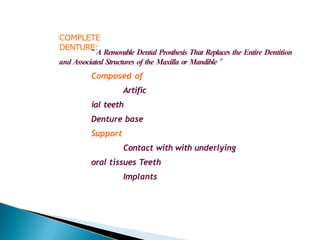
COMPLETE
DENTURE:
“ A Removable Dental Prosthesis That Replaces the Entire Dentition
and Associated Structures of the Maxilla or Mandible ”
Composed of
Artific
ial teeth
Denture base
Support
Contact with with underlying
oral tissues Teeth
Implants
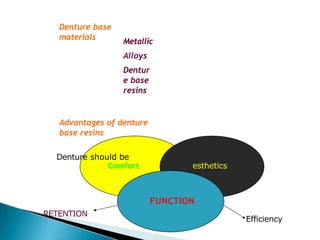
Denture base
materials
Metallic
Alloys
Dentur
e base
resins
Advantages of denture
base resins
Denture should be
FUNCTION
esthetics
Comfort
RETENTION
Efficiency
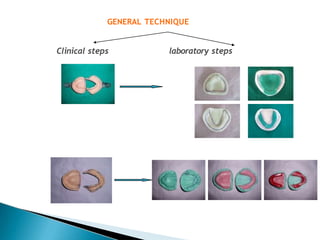
GENERAL TECHNIQUE
Clinical steps laboratory steps
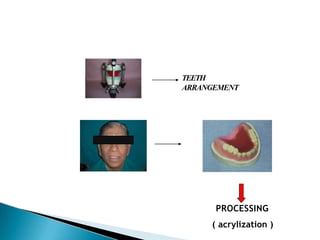
PROCESSING
( acrylization )
TEETH
ARRANGEMENT
🞂​ Definition : According to GPT - VI,
Denture Base is defined as the part of
Denture that rests on the foundation
tissue and to which teeth are attached.
Denture Base Material is any substance of
which denture base may be made
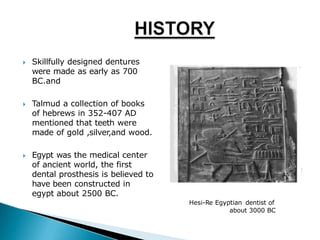
🞂​ Skillfully designed dentures
were made as early as 700
BC.and
🞂​ Talmud a collection of books
of hebrews in 352-407 AD
mentioned that teeth were
made of gold ,silver,and wood.
🞂​ Egypt was the medical center
of ancient world, the first
dental prosthesis is believed to
have been constructed in
egypt about 2500 BC.
Hesi-Re Egyptian dentist of
about 3000 BC
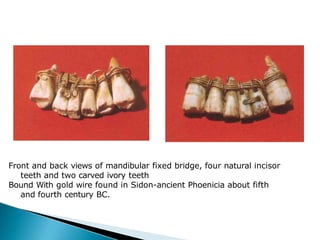
Front and back views of mandibular fixed bridge, four natural incisor
teeth and two carved ivory teeth
Bound With gold wire found in Sidon-ancient Phoenicia about fifth
and fourth century BC.
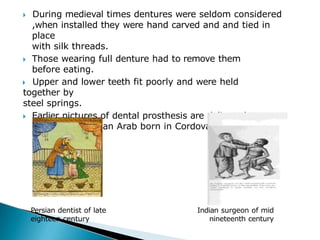
🞂​ During medieval times dentures were seldom considered
,when installed they were hand carved and and tied in
place
with silk threads.
🞂​ Those wearing full denture had to remove them
before eating.
🞂​ Upper and lower teeth fit poorly and were held
together by
steel springs.
🞂​ Earlier pictures of dental prosthesis are delivered to us
by ABUL-CASIM an Arab born in Cordova Spain.
Persian dentist of late
eighteen century
Indian surgeon of mid
nineteenth century
WOOD
🞂​ For years, dentures were fashioned from wood
.
🞂​ Wood was chosen
-readily available
-relatively inexpensive
-can be carved to desired shape
🞂​ Disadvantages
-warped and cracked in moisture
-esthetic and hygienic challenges
-degradation in oral environment
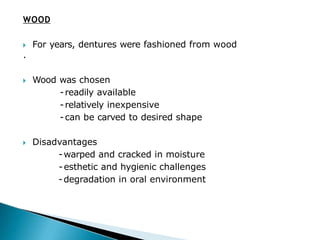
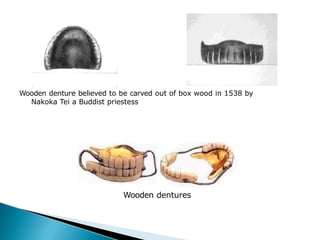
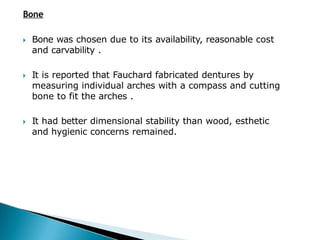
Wooden denture believed to be carved out of box wood in 1538 by
Nakoka Tei a Buddist priestess
Wooden dentures
Bone
🞂​ Bone was chosen due to its availability, reasonable cost
and carvability .
🞂​ It is reported that Fauchard fabricated dentures by
measuring individual arches with a compass and cutting
bone to fit the arches .
🞂​ It had better dimensional stability than wood, esthetic
and hygienic concerns remained.
IVORY
🞂​ Denture bases and prosthetic teeth were fashioned by carving this
material to desired shape
🞂​ Ivory was not available readily and was relatively expensive.
🞂​ Denture bases fashioned from ivory were relatively stable in the
oral environment
🞂​ They offered esthetic and hygienic advantage in comparison with
denture bases carved from wood or bone.
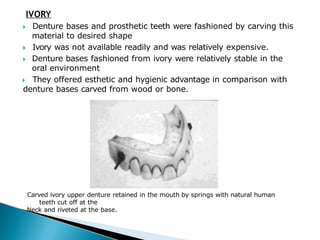
Carved ivory upper denture retained in the mouth by springs with natural human
teeth cut off at the
Neck and riveted at the base.
🞂​ Since ancient times the most
common material for false
teeth were animal bone or
ivory,especially from elephants
or hippopotomus.
🞂​ Human teeth were also
used,pulled from the
deceased or sold by poor
people from their own
mouths.
🞂​ Waterloo dentures
🞂​ 1788 A.D. Improvement and
development of porcelain dentures by
DeChemant.
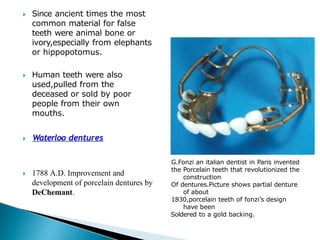
G.Fonzi an italian dentist in Paris invented
the Porcelain teeth that revolutionized the
construction
Of dentures.Picture shows partial denture
of about
1830,porcelain teeth of fonzi’s design
have been
Soldered to a gold backing.
CERAMICS
🞂​ Porcelain denture bases were relatively expensive
🞂​ During subsequent years secrets of porcelain denture
became known and it became common and inexpensive.
🞂​ ADVANTAGES over wood, bone , ivory were
-Could be shaped using additive technique rather than
subtractive (carving).
-Additive technique facilitated correction of denture
base surface.
-this permitted more intimate contact with
underlying soft tissues.
-Could be tinted to simulate the colors of teeth
and oral
soft tissues.
-stable in oral environment.
-Minimal water sorption, porosity, and solubility.
-Smooth surface provided hygienic properties.
🞂​ Among the drawbacks BRITTLENESS was most
significant,
fractures were common, often irreparable.
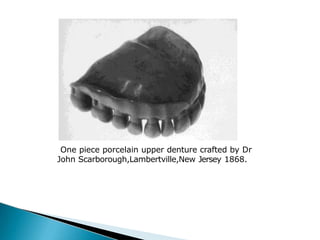
One piece porcelain upper denture crafted by Dr
John Scarborough,Lambertville,New Jersey 1868.
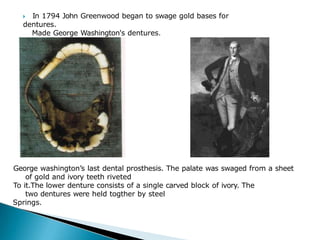
🞂​ In 1794 John Greenwood began to swage gold bases for
dentures.
Made George Washington's dentures.
George washington’s last dental prosthesis. The palate was swaged from a sheet
of gold and ivory teeth riveted
To it.The lower denture consists of a single carved block of ivory. The
two dentures were held togther by steel
Springs.
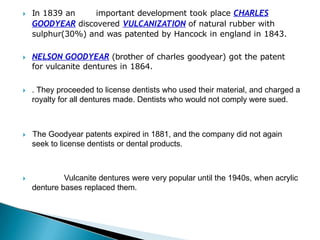
🞂​ In 1839 an important development took place CHARLES
GOODYEAR discovered VULCANIZATION of natural rubber with
sulphur(30%) and was patented by Hancock in england in 1843.
🞂​ NELSON GOODYEAR (brother of charles goodyear) got the patent
for vulcanite dentures in 1864.
🞂​ . They proceeded to license dentists who used their material, and charged a
royalty for all dentures made. Dentists who would not comply were sued.
🞂​ The Goodyear patents expired in 1881, and the company did not again
seek to license dentists or dental products.
🞂​ Vulcanite dentures were very popular until the 1940s, when acrylic
denture bases replaced them.
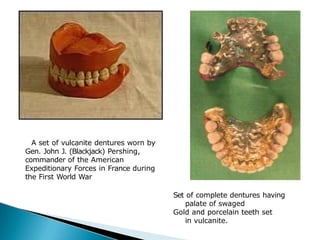
A set of vulcanite dentures worn by
Gen. John J. (Blackjack) Pershing,
commander of the American
Expeditionary Forces in France during
the First World War
Set of complete dentures having
palate of swaged
Gold and porcelain teeth set
in vulcanite.
🞂​ In 1868 John Hyatt, A US
Printer, discovered the first
plastic molding compound,
called celluloid. He made it by
dissolving nitrocellulose
under pressure
🞂​ In 1909, another promising
organic compound was found.
This was phenol
formaldehyde resin
discovered by Dr. Leo
Backeland .
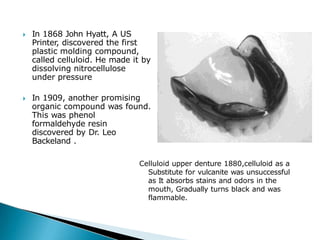
Celluloid upper denture 1880,celluloid as a
Substitute for vulcanite was unsuccessful
as It absorbs stains and odors in the
mouth, Gradually turns black and was
flammable.
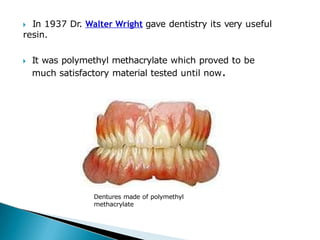
🞂​ In 1937 Dr. Walter Wright gave dentistry its very useful
resin.
🞂​ It was polymethyl methacrylate which proved to be
much satisfactory material tested until now.
Dentures made of polymethyl
methacrylate
🞂​ 1. Vulcanite :
In 1839 Vulcanized rubber was discovered
and introduced as a Vulcanite and Ebonite.
For the next 75 years Vulcanite rubber was the
principal Denture base Material. But failed
because of following reasons :
Disadvantages
🞂​It absorbs Saliva and becomes unhygienic due to
bacterial proliferation.
🞂​Esthetics were poor.
🞂​Dimensionally unstable.
🞂​Objectionable taste and odor
2. Celluloid
Although it was having tissue like
color but having principal
disadvantages like
Disadvantages
🞂​ Lack of stability
🞂​ Unpleasant taste
🞂​ Unpleasant odor
🞂​ Stainability
🞂​ Flammable
3. Bakelite
It was formed by heating and compressing
a mixture of phenol and formaldehyde.
Disadvantages
🞂​ Lack of uniform quality
🞂​ Variable strength
🞂​ Variable color
🞂​ Dimensional unstability.
Chronology of events
🞂​ Charles Goodyear discovery of vulcanized rubber in 1839.
🞂​ John hyatt discovered celluloid in 1868
🞂​ Dr Leo Bakeland discovered phenol-formaldehyde resin
(Bakelite).
🞂​ In the 1930’s Dr Walter Wright and the Vernon brothers working at
the Rohn and Haas company in Philadelphia developed
Polymethylmethacrylate (PMMA), a hard plastic.
🞂​ Although other materials were used for dental prosthesis, none
could come close to PMMA and by the 1940;s 95% of all
dentures were made from this acrylic polymer.
🞂​ Natural polymers include:
 Proteins (polyamides or polypeptides) containing the
chemical group (-Co-NH-); this is known as an amide
or peptide link.
 Polyesoprenes such as rubber and gutta percha.
 Polysaccharides, such as starch, cellulose, agar and
alginates.
 Polynucleic acids, such as deoxyribonuclei acids (DNA)
and ribonucleic acids (RNA).
🞂​ Synthetic polymers are produced
industrially or in the laboratory, by chemical
reaction.
Synthetic polymer : Defined as a non metallic
compound synthetically produced (usually from organic
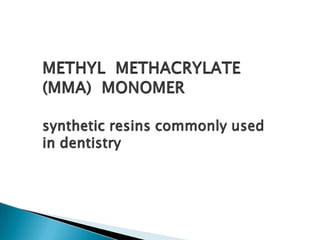
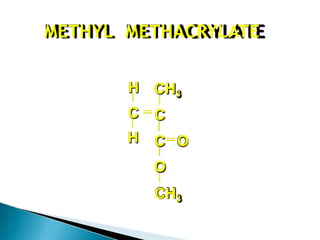
METHYL METHACRYLATE
CH3
C
C O
O
CH3
H
C
H
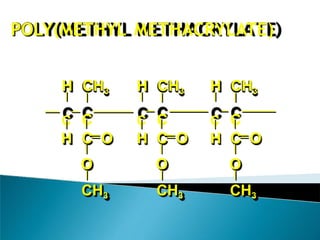
POLY(METHYL METHACRYLATE)
H CH3
C C
CH3
O
H CH3
C C
CH3
O
H CH3
C C
CH3
H C O H C O H C O
O
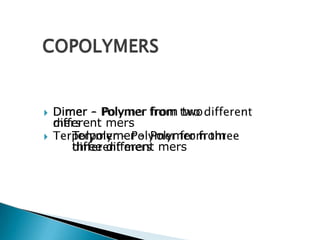
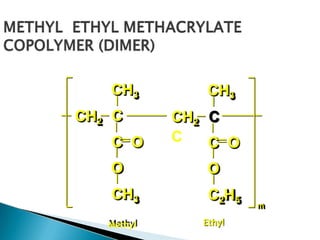
🞂​ Dimer - Polymer from two
different mers
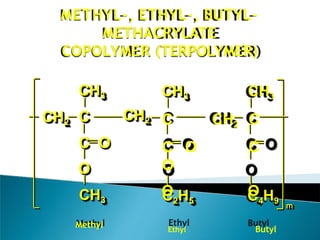
🞂​ Terpolymer - Polymer from
three different mers
CH3
C
C O
O
CH2
CH3
C2H5
C O
O
CH2
C
m
CH3
Methyl Ethyl
CH3
C
C O
O
CH2
CH2
m
CH3 CH3
C CH2 C
C O C
O
O O
METHYL-, ETHYL-, BUTYL-
METHACRYLATE
COPOLYMER (TERPOLYMER)
CH3
Methyl
C2H5 C4H9
Ethyl Butyl
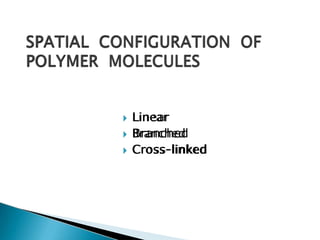
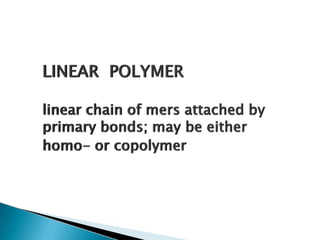
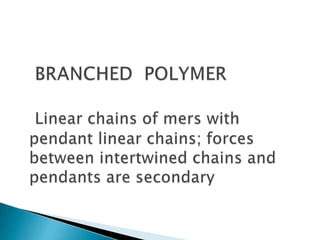
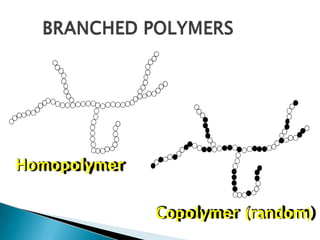
🞂​ Linear
🞂​ Branched
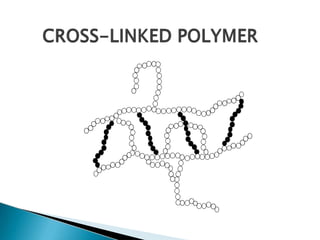
🞂​ Cross-linked
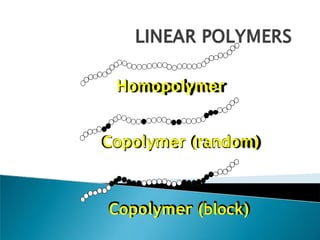
Homopolymer
Copolymer (random)
Copolymer (block)
Homopolymer
Copolymer (random)
C
O
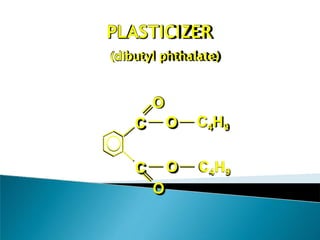
O C4H9
C O C4H9
PLASTICIZER
(dibutyl phthalate)
O
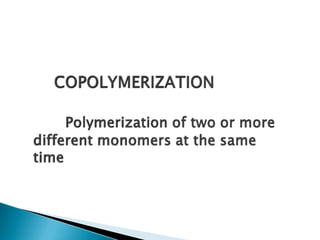
DEFINITION: A polymer is a long chain organic molecule .It
is produced by the reaction of many smaller molecules
called monomers,or mers.
🞂​ If reaction occurs between two different but compatible
monomers the polymeric product is called a COPOLYMER.
🞂​ Resin : A broad term used to describe natural or synthetic
substances that form plastic materials after polymerization (GPT-
7th edition).
USES IN DENTISTRY
🞂​ Denture bases and artificial teeth.
🞂​ Denture liners and tissue conditioners.
🞂​ composite restorative and pit and fissure sealent.
🞂​ Impression materials
🞂​ Custom trays for impression
🞂​ Temporary restoratives.
🞂​ Mouth-guards.
🞂​ Maxillofacial prosthesis.
🞂​ Space maintainers.
🞂​ Veneers.
🞂​ Cements and adhesives.
CHEMISTRY OF POLYMERIZATION
🞂​ Monomers react to form polymer by a chemical reaction called
polymerization.
🞂​ The most common polymerization reaction for polymers used
in dentistry is addition polymerization.
ADDITION POLYMERIZATION
🞂​ INDUCTION
🞂​ PROPOGATION
🞂​ CHAIN TRANSFER
🞂​ TERMINATION
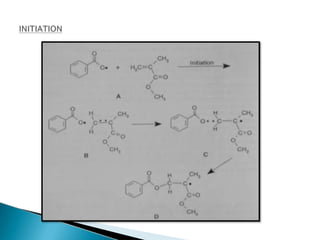
INDUCTION
1)ACTIVATION
2)INITIATION
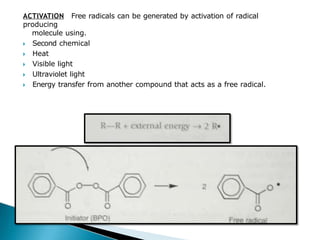
ACTIVATION Free radicals can be generated by activation of radical
producing
molecule using.
🞂​ Second chemical
🞂​ Heat
🞂​ Visible light
🞂​ Ultraviolet light
🞂​ Energy transfer from another compound that acts as a free radical.
🞂 Commonly employed initiator is Benzoyl peroxide which is
activated rapidly between 50 degree and 100 degree C to
release two free radicals per benzoyl peroxide molecule.
🞂​ Second type is chemically activated ,consists of two reactants when
mixed undergo reaction eg tertiary amine (the activator) and
benzoyl peroxide (the initiator). Amine forms a complex with
benzoyl peroxide which reduces the thermal energy (and thus the
temperature) needed to split it into free radicals.
🞂​ Third type is light activated .The visible light light cured
dental restoratives,camphorquinone and an organic amine
(dimethylaminoethylmethacrylate) generate free radicals when
irradiated by light in the blue to violet region.
🞂​ Light with a wavelength of about 470nm is needed to trigger
this reaction.
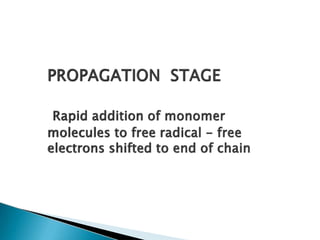
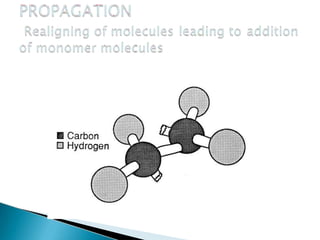
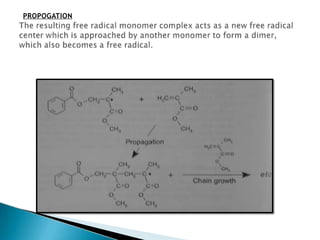
PROPOGATION
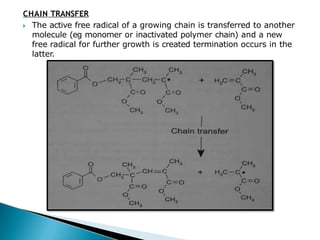
CHAIN TRANSFER
🞂​ The active free radical of a growing chain is transferred to another
molecule (eg monomer or inactivated polymer chain) and a new
free radical for further growth is created termination occurs in the
latter.
Reaction terminates when
insufficient free radicals
exist.
Reaction also may be stopped
by any material that will react
with
free radical, decreasing the rate
of initiation, or increasing rate
of
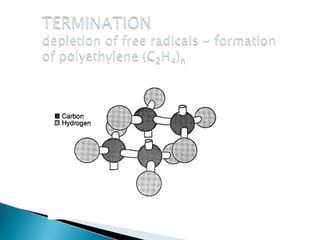
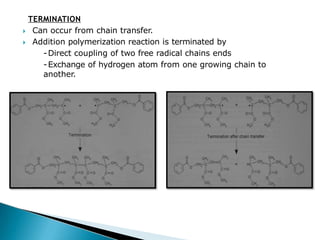
TERMINATION
🞂​ Can occur from chain transfer.
🞂​ Addition polymerization reaction is terminated by
-Direct coupling of two free radical chains ends
-Exchange of hydrogen atom from one growing chain to
another.
INHIBITION OF ADDITION REACTION
🞂​ Addition of small amount of Hydroquinone to the monomer inhibits
spontaneous polymerization if no initiator is present and retards
the polymerization in the presence of an initiator.
🞂​ Amount added is 0.006% or less
🞂​ Methyl ether of hydroquinone is generally present.
COPOLYMERIZATION
🞂​ When two or more chemically different monomers each with
desirable properties can be combined to yield specific physical
property of a polymer .eg small amount of ethyl acrylate may be
co- polymerized with methyl methacrylate to alter the flexibility
and fracture resistance of a denture.
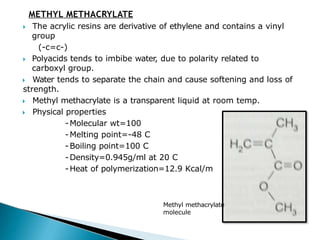
METHYL METHACRYLATE
🞂​ The acrylic resins are derivative of ethylene and contains a vinyl
group
(-c=c-)
🞂​ Polyacids tends to imbibe water, due to polarity related to
carboxyl group.
🞂​ Water tends to separate the chain and cause softening and loss of
strength.
🞂​ Methyl methacrylate is a transparent liquid at room temp.
🞂​ Physical properties
-Molecular wt=100
-Melting point=-48 C
-Boiling point=100 C
-Density=0.945g/ml at 20 C
-Heat of polymerization=12.9 Kcal/m ol
Methyl methacrylate
molecule
POLYMETHYL METHACRYLATE
🞂​ Transparent resin, transmits light in uv range to a
wavelength
of 250 nm.
it has got remarkable clarity.
🞂​ Hard resin ,knoop hardness no of 18 to 20.
🞂​ Tensile strength is 60 MPa
🞂​ Density is 1.19 g/cm cube.
🞂​ Modulus of elasticity 2.4 GPa(2400 MPa)
🞂​ It is chemically stable and softens at 1250C
🞂​ It can be molded as a thermoplastic material between 125
and 200 C
🞂​ Depolarization takes place at approx 450 C .
🞂​ Absorbs water by imbibition
🞂​ Non crystalline structure possess high internal energy.
🞂​ Polar carboxyl group can form hydrogen bridge to a limited
extent with water.
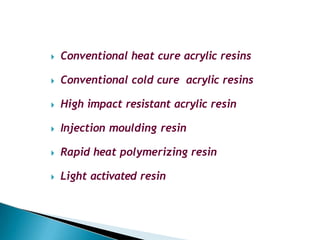
🞂​ Conventional heat cure acrylic resins
🞂​ Conventional cold cure acrylic resins
🞂​ High impact resistant acrylic resin
🞂​ Injection moulding resin
🞂​ Rapid heat polymerizing resin
🞂​ Light activated resin
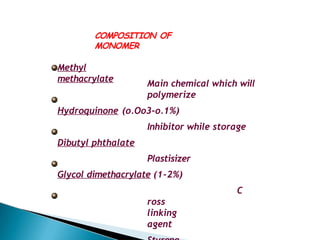
COMPOSITION OF
MONOMER
Methyl
methacrylate
Main chemical which will
polymerize
Hydroquinone (o.Oo3-o.1%)
Inhibitor while storage
Dibutyl phthalate
Plastisizer
Glycol dimethacrylate (1-2%)
C
ross
linking
agent
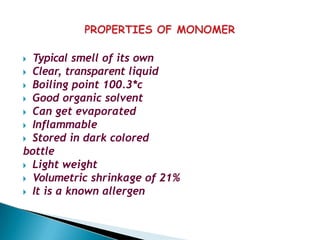
🞂​ Typical smell of its own
🞂​ Clear, transparent liquid
🞂​ Boiling point 100.3*c
🞂​ Good organic solvent
🞂​ Can get evaporated
🞂​ Inflammable
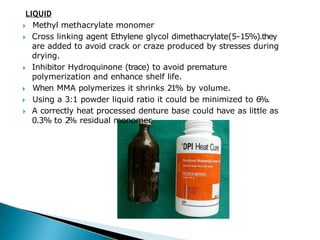
🞂​ Stored in dark colored
bottle
🞂​ Light weight
🞂​ Volumetric shrinkage of 21%
🞂​ It is a known allergen
LIQUID
🞂​ Methyl methacrylate monomer
🞂​ Cross linking agent Ethylene glycol dimethacrylate(5-15%).they
are added to avoid crack or craze produced by stresses during
drying.
🞂​ Inhibitor Hydroquinone (trace) to avoid premature
polymerization and enhance shelf life.
🞂​ When MMA polymerizes it shrinks 21% by volume.
🞂​ Using a 3:1 powder liquid ratio it could be minimized to 6%.
🞂​ A correctly heat processed denture base could have as little as
0.3% to 2
% residual monomer.
🞂​ Cyanide method
Acetone and hydrocynic acid
🞂​ Phosgene method
Petroleum propylene and
phosgene
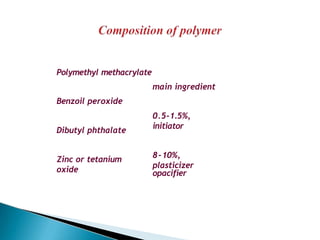
Polymethyl methacrylate
main ingredient
0.5-1.5%,
initiator
8-10%,
plasticizer
Benzoil peroxide
Dibutyl phthalate
Zinc or tetanium
oxide opacifier
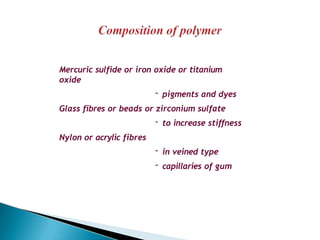
Mercuric sulfide or iron oxide or titanium
oxide
- pigments and dyes
Glass fibres or beads or zirconium sulfate
- to increase stiffness
Nylon or acrylic fibres
- in veined type
- capillaries of gum
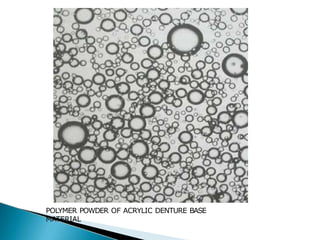
POLYMER POWDER OF ACRYLIC DENTURE BASE
MATERIAL
Normal pink
- which resembles the normal
pink color of gum
Clear polymer
- no coloring agents are added
-indicated in palatal
area Translucent
Veined or deep veined
Stable at room temperature
- has long shelf life
Softening temperature
- 125 * c
- 125*-200*c
depolymerization occurs
- 450 *c
converted back to monomer
Absorbs water and soluble in chloroform
Tensile strength
-600 kg/sq
cm Appearance
- shiny
- transparent
-slippery
Produced in two
shapes
- spherical
- granular
Control of particle size
- no.52 sieve mesh
-300
micrometer If particle
size is smaller
- softening will
be quicker
- granular shape
softens faster
Spherical particles
By suspension polymerization
- monomer and water are mixed with an
emulsifier
i.e, powder talc.
- then the mixture is heated and stirred
- at the end talc is washed off to
get polymerized polymer particles
Granular particles
- solid block
- then it is grinded or milled
CURING CYLES EMPLOYED IN THE STUDY
A Recommended curing
cycles overnight water-
bath cures:
1) 7hr at 70 C
2) 14hr at 70 C
3) 7hr at 70 C +1hr at 100C
4)14hr at 70C + 1hr at
100C Short and reverse cures:
5)Boil water,insert flask , remove heat for 20 min return to boil for
10 min.
6)Boil water ,insert flask ,return to boil, boil for 10
min. Dry heat cure:
7)temp in excess of 100C using dry heat
system B Short curing cycles
8) 7hr at 60C
9) 7hr at 60C +1 hr at 90C
10) Boil water, insert flask remove heat for 20 min return to 90 C hold
at 90C for 5 min
11) Boil water insert flask return to 90C hold at 90C for 5min.
(II)PHYSICAL PROPERTIES
🞂 Should possess adequate strength and resiliency and
resistance to biting and chewing forces impact forces and
excessive wear in oral cavity.
Should be dimensionally stable under all conditions of
service including thermal changes and variations in loading.
🞂
I
)
Specific gravity: It should have low value of specific gravity in
order that dentures should be as light as possible.
II
)
Thermal conductivity: It is defined as the number of calories
per second flowing through an area of 1cm2 in which
the temperature drop along the length of the specimen is 1
C/cm.
🞂 It should have high value of thermal
conductivity
🞂
🞂
Radiopacity: It is the inhibition of passage of radiant
energy. It should be ideally radiopaque
🞂​ Glass transition temperature:
🞂​ It is the temperature at
which
molecular motions
become
such that whole chains are able to move. It is close
to softening temperature. At this temperature sudden
change in elastic modulus occurs.
🞂​ Amorphous polymer below Tg behave as rigid solids while
above Tg they behave as viscous liquids, flexible solids or
rubbers.
🞂​ Increased chain branching  Decreased Tg.
Increased number of cross links  Increased
Tg
Effect of molecular weight on properties
In many polymers the chains are held together
by secondary, or
Vander Waals forces and molecular entanglement. Materials of high
molecular weight have a greater degree of molecular
entanglement, and have greater rigidity and strength and higher
values of Tg and melting temperature than low molecular weight
polymers.
Effect of plasticizers
🞂​ Plasticizers penetrate between the randomly oriented
chains of polymer as a result of which molecules are
further apart and forces between them are less. They
soften the material and make it more flexible by lowering
its Tg. They lubricate the movements of polymer chains
and are sometimes added to help molding characteristics.
This principle is used in producing acrylic soft lining
materials.
🞂​ Effect of fillers
 Modulus of elasticity and strength are generally
increased.
🞂​ A degree of anisotropy exist, that is the strength depends
on the orientation of fibres in the polymers.
🞂​ Viscoelasticity : Polymers show viscoelastic behavior. Elastic
behavior is caused by uncoiling of polymer molecules.
Plastic behavior is caused by breaking of intermolecular
Vander Waals forces
(III) MANIPULATION
🞂​ Should not produce toxic fumes or dust
🞂​ Easy to mix, insert, shape and cure and short setting time
🞂​ Oxygen inhibition, saliva and blood contamination should have
little or no effect.
🞂​ Final product should be easy to polish and easy to repair in case
of
breakage.
(IV) AESTHETIC PROPERTIES
🞂​ Should be translucent to match oral tissues
🞂​ Capable of pigmentation
🞂​ No change in color after fabrication.
(v)ECONOMIC CONSIDERATION
🞂​ Cost should be low
🞂​ Processing should not require complex and expensive instruments.
(VI) CHEMICAL STABILITY
🞂​ Conditions in mouth are demanding and only the most
chemically stable and inert materials can withstand such
conditions without deterioration.
“No resin has yet met all of these ideal criteria”.
Methacrylate polymers fulfill the aforementioned
requirement reasonably well.
2)AUTOPOLYMERIZING/COLD CURE POLYMETHYL
METHACRYLATE (POUR RESIN)
🞂​ Composition same as the heat cure version with
following differences
1)The powder contains beads of polymer that have a lower
molecular wt. and benzoyl proxide (initiator)
2) The liquid contains a chemical activator ,tertiary amine
such as dimethyl-para-toluidine.
🞂​ Upon mixing tertiary amine causes decomposition of
benzoyl
peroxide.
🞂​ Dentures processed have more residual monomer (1-
4%),but lower dimensional change.
🞂​ Decreased transverse strength (residual monomer act
as plastisizer).
🞂​ Compromised biocompatibility (residual monomer)
🞂​ Color stability inferior (teriaty amine susceptible
to oxidation), stabilizing agents should be added
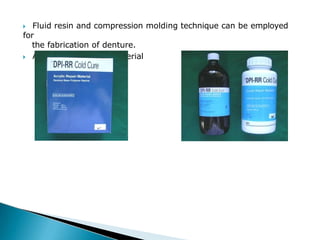
🞂​ Fluid resin and compression molding technique can be employed
for
the fabrication of denture.
🞂​ Also used as repair material
3)HIGH IMPACT RESISTANT ACRYLIC
🞂​ Similar to heat cured material but less likely to be broken if
dropped.
🞂​ Produced by substituting the PMMA in the powder with a
copolymer.
🞂​ Copolymer of butadiene with styrene or methyl methacrylate
are incorporated into the beads.
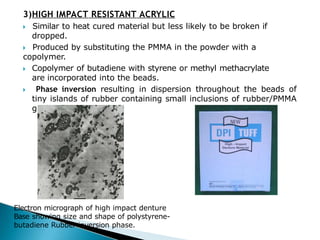
🞂​ Phase inversion resulting in dispersion throughout the beads of
tiny islands of rubber containing small inclusions of rubber/PMMA
graft polymer.
Electron micrograph of high impact denture
Base showing size and shape of polystyrene-
butadiene Rubber inversion phase.
4) Injection molded polymers
🞂​ These are made of Nylon or Polycarbonate.
🞂​ The material is supplied as a gel in the form of a putty
.
🞂​ It has to be heated and injected into a mold
🞂​ Equipment is expensive.
🞂​ Craze resistance is low .
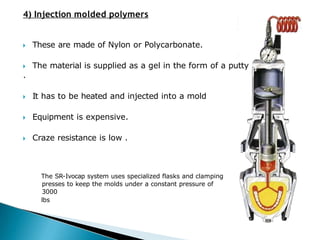
The SR-Ivocap system uses specialized flasks and clamping
presses to keep the molds under a constant pressure of
3000
lbs
5) RAPID HEAT POLYMERIZED POLYMER
🞂​ Same as conventional material except that they
contain altered initiation system.
🞂​ These initiator allow them to be processed in boiling
water
for 20 min.
🞂​ A problem with these is that areas of the base thicker
than approx.6mm have a high level of porosity.
🞂​ Short duration of heating also leaves a higher level of
residual monomer,3-7 times greater than conventional heat
cured denture base.
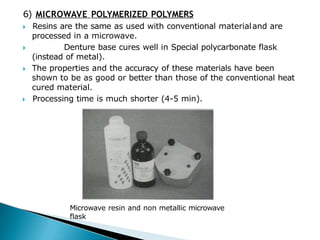
6) MICROWAVE POLYMERIZED POLYMERS
🞂​ Resins are the same as used with conventional materialand are
processed in a microwave.
🞂​ Denture base cures well in Special polycarbonate flask
(instead of metal).
🞂​ The properties and the accuracy of these materials have been
shown to be as good or better than those of the conventional heat
cured material.
🞂​ Processing time is much shorter (4-5 min).
Microwave resin and non metallic microwave
flask
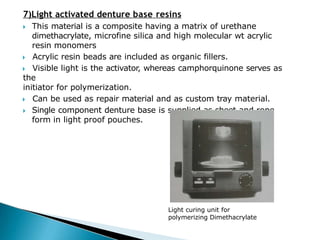
7)Light activated denture base resins
🞂​ This material is a composite having a matrix of urethane
dimethacrylate, microfine silica and high molecular wt acrylic
resin monomers
🞂​ Acrylic resin beads are included as organic fillers.
🞂​ Visible light is the activator, whereas camphorquinone serves as
the
initiator for polymerization.
🞂​ Can be used as repair material and as custom tray material.
🞂​ Single component denture base is supplied as sheet and rope
form in light proof pouches.
Light curing unit for
polymerizing Dimethacrylate
8) FIBER –REINFORCED POLYMER
🞂​ Glass, carbon/graphite, aramid and ultrahigh molecular
wt polyethylene have been used as fiber reinforcing
agents.
🞂​ Metal wires like graphite has minimal esthetic qualities.
🞂​ Fibers are stronger than matrix polymer thus their
inclusion strengthens the composite structure.
🞂​ The reinforcing agent can be in the form of
unidirectional, straight fiber or multidirectional weaves.
COMPRESSION MOLD TECHNIQUE
INJECTION MOULD TECHNIQUE
FLUID RESIN TECHNIQUE
MICROWAVE PROCESSING
LIGHT ACTIVATED DENTURE BASE RESINS
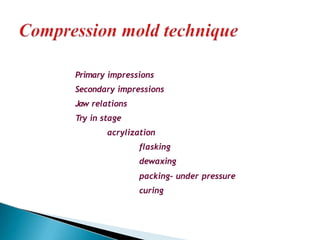
Primary impressions
Secondary impressions
Jaw relations
Try in stage
acrylization
flasking
dewaxing
packing- under pressure
curing
🞂​ Acceptance before demounting
🞂​ Proper finishing
🞂​ Periphery is sealed
🞂​ Petroleum jelly
🞂​ inner surface of the flask
🞂​ Casts
🞂​ Adjustment of the plaster model
🞂​ Plaster molels are wetted
🞂​ Wax dentures with casts are soaked
with slurry water
“ The Art of Investing in a Flask
”
- GPT 99
“ The Process of Investing the Cast With the
Waxed Denture in a Flask to Make a
Sectional
Mol
d
Used to Form the Acrylic Resin Denture Base
”
- HEARTWELL
“ The process of investing the cast and a wax
replica
of the desired form in a flask preparatory to
molding the restorative material into the desired
surround or
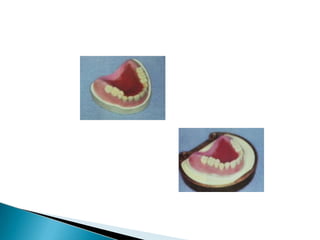
invest
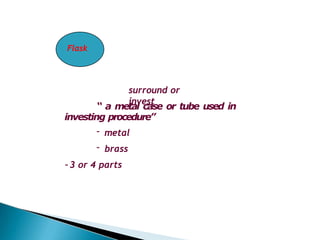
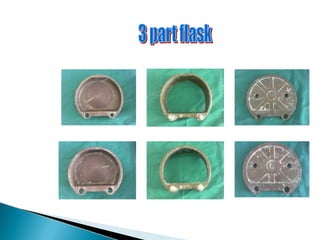
“ a metal case or tube used in
investing procedure”
- metal
- brass
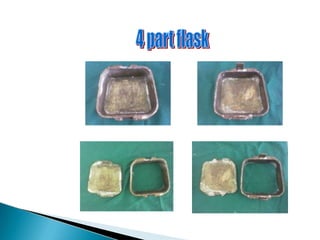
-3 or 4 parts
Flask
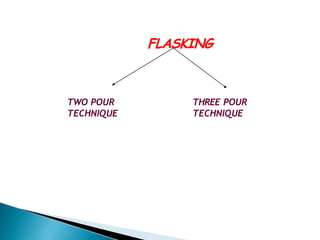
FLASKING
TWO POUR
TECHNIQUE
THREE POUR
TECHNIQUE
🞂​ Selection of flask
🞂​ Petroleum jelly lubrication
🞂​ Demounting done
🞂​ Preparation of the waxed denture with
the stone cast
🞂​ Soaking of the cast – slurry water
🞂​ Artificial stone is mixed
🞂​ Stone mix is placed in flask and wax
denture and casts are settled in to the
mix
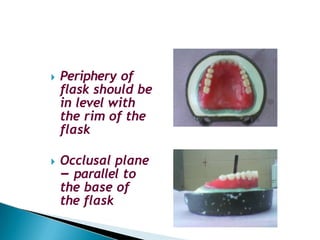
🞂​ Periphery of
flask should be
in level with
the rim of the
flask
🞂​ Occlusal plane
– parallel to
the base of
the flask
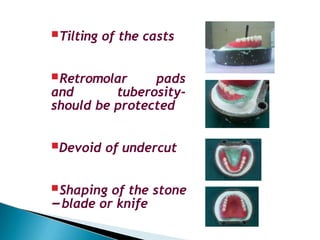
Tilting of the casts
Retromolar pads
and tuberosity-
should be protected
Devoid of undercut
Shaping of the stone
–blade or knife
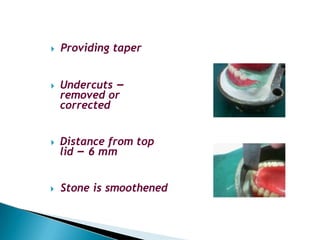
🞂​ Providing taper
🞂​ Undercuts –
removed or
corrected
🞂​ Distance from top
lid – 6 mm
🞂​ Stone is smoothened
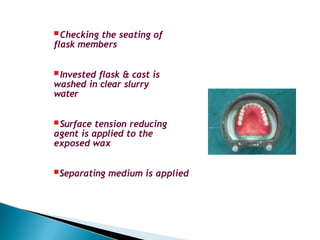
Checking the seating of
flask members
Invested flask & cast is
washed in clear slurry
water
Surface tension reducing
agent is applied to the
exposed wax
Separating medium is applied
🞂​ Second mix is mixed
🞂​ Hand spatulation
🞂​ Mechanical spatulation
- Under reduced atmospheric
pressure
- Minimum air inclusion
- Reduces finishing time
🞂​ Stone is coated in occlusal &
inter- Proximal areas with stiff
brush
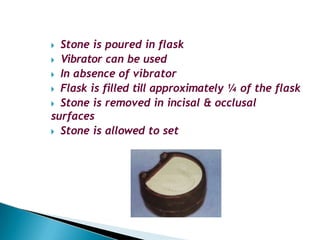
🞂​ Stone is poured in flask
🞂​ Vibrator can be used
🞂​ In absence of vibrator
🞂​ Flask is filled till approximately ¼ of the flask
🞂​ Stone is removed in incisal & occlusal
surfaces
🞂​ Stone is allowed to set
🞂​ After the stone is set separating
medium is coated
🞂​ Occlusal & incisal surfaces shouldn’t
be coated with the separating medium
🞂​ Clear slurry is poured till the stone
is mixed
🞂​ Slurry is poured off, flask is filled
with the stone
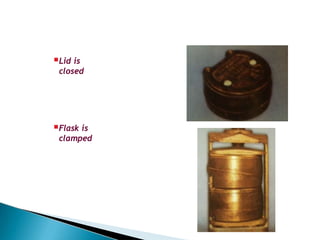
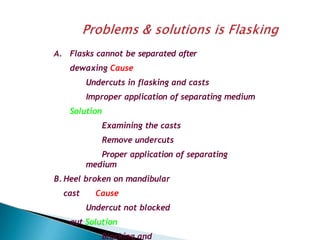
Lid is
closed
Flask is
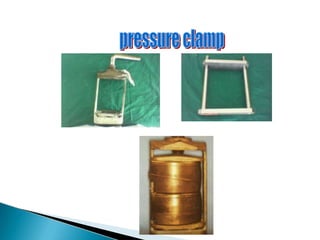
clamped
A. Flasks cannot be separated after
dewaxing Cause
Undercuts in flasking and casts
Improper application of separating medium
Solution
Examining the casts
Remove undercuts
Proper application of separating
medium
B. Heel broken on mandibular
cast Cause
Undercut not blocked
out Solution
Blocking and
C. Denture with acrylic
blubs Cause
- Investing stone not painted
Properly on waxed denture
During flasking
-Improper investing stone
mix Solution
- Paint investing stone on
teeth With brush
- Use of mechanical spatulator
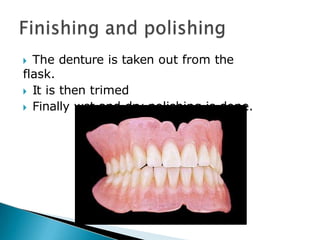
🞂​ The denture is taken out from the
flask.
🞂​ It is then trimed
🞂​ Finally wet and dry polishing is done.
🞂​ Porosity
🞂​ Crazing
🞂​ Warpage
🞂​ Fracture
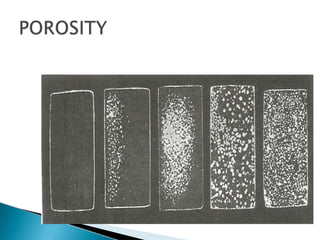
🞂​ Presence of voids within structure of resin
🞂​ Porosity can be of two types
◦Internal
◦External
🞂​ Internal porosity is due to voids within
the structure usually at thicker portion
🞂​ Cause – due to vaporization of the
monomer (100.8C)
🞂​ Solution- long low temperature curing
cycle is recommended.
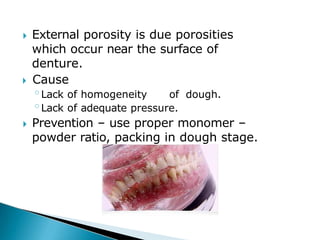
🞂​ External porosity is due porosities
which occur near the surface of
denture.
🞂​ Cause
◦Lack of homogeneity of dough.
◦Lack of adequate pressure.
🞂​ Prevention – use proper monomer –
powder ratio, packing in dough stage.
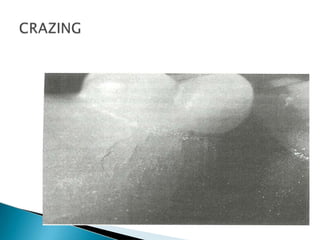
🞂​ Crazing is formation of surface cracks
on denture base resin.
🞂​ Causes –
◦Incorportion of stress
◦Attack by solvent (alcohol)
◦Incorporation of water during processing.
🞂​ Prevention
◦Avoidance of solvent
◦Proper use of separating media
◦Metal moulds
◦Use of cross linked acrylic
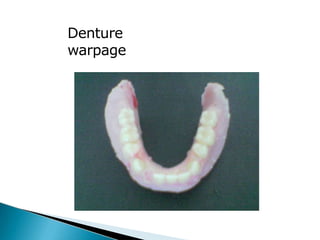
🞂​ Denture warpage is change in shape or fit
of denture.
🞂​ Cause is incorporation of stress in deture
◦Packing in late dough or rubbery stage.
◦Stress induced during curing
◦Improper deflasking
◦Rise in temp while polishing
◦Immersion of processed denture in hot water.
Denture
warpage
🞂​ Improper deflasking
🞂​ Denture base excessively thin
🞂​ Accidental dropping at time of
polishing
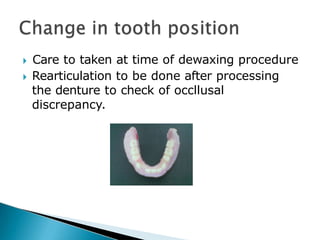
🞂​ Care to taken at time of dewaxing procedure
🞂​ Rearticulation to be done after processing
the denture to check of occllusal
discrepancy.
denture base resin 3.pptxfghjklhgsdfghfj

denture base resin 3.pptxfghjklhgsdfghfj

  • 2.
    All through thehistory of the making of dentures,we find a constant struggle of the dentist to find a suitable denture base material
  • 3.
    COMPLETE DENTURE: “ A RemovableDental Prosthesis That Replaces the Entire Dentition and Associated Structures of the Maxilla or Mandible ” Composed of Artific ial teeth Denture base Support Contact with with underlying oral tissues Teeth Implants
  • 4.
    Denture base materials Metallic Alloys Dentur e base resins Advantagesof denture base resins Denture should be FUNCTION esthetics Comfort RETENTION Efficiency
  • 6.
  • 7.
  • 9.
    🞂​ Definition :According to GPT - VI, Denture Base is defined as the part of Denture that rests on the foundation tissue and to which teeth are attached. Denture Base Material is any substance of which denture base may be made
  • 10.
    🞂​ Skillfully designeddentures were made as early as 700 BC.and 🞂​ Talmud a collection of books of hebrews in 352-407 AD mentioned that teeth were made of gold ,silver,and wood. 🞂​ Egypt was the medical center of ancient world, the first dental prosthesis is believed to have been constructed in egypt about 2500 BC. Hesi-Re Egyptian dentist of about 3000 BC
  • 11.
    Front and backviews of mandibular fixed bridge, four natural incisor teeth and two carved ivory teeth Bound With gold wire found in Sidon-ancient Phoenicia about fifth and fourth century BC.
  • 12.
    🞂​ During medievaltimes dentures were seldom considered ,when installed they were hand carved and and tied in place with silk threads. 🞂​ Those wearing full denture had to remove them before eating. 🞂​ Upper and lower teeth fit poorly and were held together by steel springs. 🞂​ Earlier pictures of dental prosthesis are delivered to us by ABUL-CASIM an Arab born in Cordova Spain. Persian dentist of late eighteen century Indian surgeon of mid nineteenth century
  • 13.
    WOOD 🞂​ For years,dentures were fashioned from wood . 🞂​ Wood was chosen -readily available -relatively inexpensive -can be carved to desired shape 🞂​ Disadvantages -warped and cracked in moisture -esthetic and hygienic challenges -degradation in oral environment
  • 14.
    Wooden denture believedto be carved out of box wood in 1538 by Nakoka Tei a Buddist priestess Wooden dentures
  • 15.
    Bone 🞂​ Bone waschosen due to its availability, reasonable cost and carvability . 🞂​ It is reported that Fauchard fabricated dentures by measuring individual arches with a compass and cutting bone to fit the arches . 🞂​ It had better dimensional stability than wood, esthetic and hygienic concerns remained.
  • 16.
    IVORY 🞂​ Denture basesand prosthetic teeth were fashioned by carving this material to desired shape 🞂​ Ivory was not available readily and was relatively expensive. 🞂​ Denture bases fashioned from ivory were relatively stable in the oral environment 🞂​ They offered esthetic and hygienic advantage in comparison with denture bases carved from wood or bone. Carved ivory upper denture retained in the mouth by springs with natural human teeth cut off at the Neck and riveted at the base.
  • 17.
    🞂​ Since ancienttimes the most common material for false teeth were animal bone or ivory,especially from elephants or hippopotomus. 🞂​ Human teeth were also used,pulled from the deceased or sold by poor people from their own mouths. 🞂​ Waterloo dentures 🞂​ 1788 A.D. Improvement and development of porcelain dentures by DeChemant. G.Fonzi an italian dentist in Paris invented the Porcelain teeth that revolutionized the construction Of dentures.Picture shows partial denture of about 1830,porcelain teeth of fonzi’s design have been Soldered to a gold backing.
  • 18.
    CERAMICS 🞂​ Porcelain denturebases were relatively expensive 🞂​ During subsequent years secrets of porcelain denture became known and it became common and inexpensive. 🞂​ ADVANTAGES over wood, bone , ivory were -Could be shaped using additive technique rather than subtractive (carving). -Additive technique facilitated correction of denture base surface. -this permitted more intimate contact with underlying soft tissues. -Could be tinted to simulate the colors of teeth and oral soft tissues. -stable in oral environment. -Minimal water sorption, porosity, and solubility. -Smooth surface provided hygienic properties. 🞂​ Among the drawbacks BRITTLENESS was most significant, fractures were common, often irreparable.
  • 19.
    One piece porcelainupper denture crafted by Dr John Scarborough,Lambertville,New Jersey 1868.
  • 20.
    🞂​ In 1794John Greenwood began to swage gold bases for dentures. Made George Washington's dentures. George washington’s last dental prosthesis. The palate was swaged from a sheet of gold and ivory teeth riveted To it.The lower denture consists of a single carved block of ivory. The two dentures were held togther by steel Springs.
  • 21.
    🞂​ In 1839an important development took place CHARLES GOODYEAR discovered VULCANIZATION of natural rubber with sulphur(30%) and was patented by Hancock in england in 1843. 🞂​ NELSON GOODYEAR (brother of charles goodyear) got the patent for vulcanite dentures in 1864. 🞂​ . They proceeded to license dentists who used their material, and charged a royalty for all dentures made. Dentists who would not comply were sued. 🞂​ The Goodyear patents expired in 1881, and the company did not again seek to license dentists or dental products. 🞂​ Vulcanite dentures were very popular until the 1940s, when acrylic denture bases replaced them.
  • 22.
    A set ofvulcanite dentures worn by Gen. John J. (Blackjack) Pershing, commander of the American Expeditionary Forces in France during the First World War Set of complete dentures having palate of swaged Gold and porcelain teeth set in vulcanite.
  • 23.
    🞂​ In 1868John Hyatt, A US Printer, discovered the first plastic molding compound, called celluloid. He made it by dissolving nitrocellulose under pressure 🞂​ In 1909, another promising organic compound was found. This was phenol formaldehyde resin discovered by Dr. Leo Backeland . Celluloid upper denture 1880,celluloid as a Substitute for vulcanite was unsuccessful as It absorbs stains and odors in the mouth, Gradually turns black and was flammable.
  • 24.
    🞂​ In 1937Dr. Walter Wright gave dentistry its very useful resin. 🞂​ It was polymethyl methacrylate which proved to be much satisfactory material tested until now. Dentures made of polymethyl methacrylate
  • 25.
    🞂​ 1. Vulcanite: In 1839 Vulcanized rubber was discovered and introduced as a Vulcanite and Ebonite. For the next 75 years Vulcanite rubber was the principal Denture base Material. But failed because of following reasons : Disadvantages 🞂​It absorbs Saliva and becomes unhygienic due to bacterial proliferation. 🞂​Esthetics were poor. 🞂​Dimensionally unstable. 🞂​Objectionable taste and odor
  • 26.
    2. Celluloid Although itwas having tissue like color but having principal disadvantages like Disadvantages 🞂​ Lack of stability 🞂​ Unpleasant taste 🞂​ Unpleasant odor 🞂​ Stainability 🞂​ Flammable
  • 27.
    3. Bakelite It wasformed by heating and compressing a mixture of phenol and formaldehyde. Disadvantages 🞂​ Lack of uniform quality 🞂​ Variable strength 🞂​ Variable color 🞂​ Dimensional unstability.
  • 28.
    Chronology of events 🞂​Charles Goodyear discovery of vulcanized rubber in 1839. 🞂​ John hyatt discovered celluloid in 1868 🞂​ Dr Leo Bakeland discovered phenol-formaldehyde resin (Bakelite). 🞂​ In the 1930’s Dr Walter Wright and the Vernon brothers working at the Rohn and Haas company in Philadelphia developed Polymethylmethacrylate (PMMA), a hard plastic. 🞂​ Although other materials were used for dental prosthesis, none could come close to PMMA and by the 1940;s 95% of all dentures were made from this acrylic polymer.
  • 29.
    🞂​ Natural polymersinclude:  Proteins (polyamides or polypeptides) containing the chemical group (-Co-NH-); this is known as an amide or peptide link.  Polyesoprenes such as rubber and gutta percha.  Polysaccharides, such as starch, cellulose, agar and alginates.  Polynucleic acids, such as deoxyribonuclei acids (DNA) and ribonucleic acids (RNA). 🞂​ Synthetic polymers are produced industrially or in the laboratory, by chemical reaction. Synthetic polymer : Defined as a non metallic compound synthetically produced (usually from organic
  • 32.
  • 35.
    POLY(METHYL METHACRYLATE) H CH3 CC CH3 O H CH3 C C CH3 O H CH3 C C CH3 H C O H C O H C O O
  • 37.
    🞂​ Dimer -Polymer from two different mers 🞂​ Terpolymer - Polymer from three different mers
  • 38.
  • 39.
    CH3 C C O O CH2 CH2 m CH3 CH3 CCH2 C C O C O O O METHYL-, ETHYL-, BUTYL- METHACRYLATE COPOLYMER (TERPOLYMER) CH3 Methyl C2H5 C4H9 Ethyl Butyl
  • 40.
  • 42.
  • 44.
  • 48.
    C O O C4H9 C OC4H9 PLASTICIZER (dibutyl phthalate) O
  • 49.
    DEFINITION: A polymeris a long chain organic molecule .It is produced by the reaction of many smaller molecules called monomers,or mers. 🞂​ If reaction occurs between two different but compatible monomers the polymeric product is called a COPOLYMER. 🞂​ Resin : A broad term used to describe natural or synthetic substances that form plastic materials after polymerization (GPT- 7th edition). USES IN DENTISTRY 🞂​ Denture bases and artificial teeth. 🞂​ Denture liners and tissue conditioners. 🞂​ composite restorative and pit and fissure sealent. 🞂​ Impression materials 🞂​ Custom trays for impression 🞂​ Temporary restoratives. 🞂​ Mouth-guards. 🞂​ Maxillofacial prosthesis. 🞂​ Space maintainers. 🞂​ Veneers. 🞂​ Cements and adhesives.

  • 50.
    CHEMISTRY OF POLYMERIZATION 🞂​Monomers react to form polymer by a chemical reaction called polymerization. 🞂​ The most common polymerization reaction for polymers used in dentistry is addition polymerization. ADDITION POLYMERIZATION 🞂​ INDUCTION 🞂​ PROPOGATION 🞂​ CHAIN TRANSFER 🞂​ TERMINATION INDUCTION 1)ACTIVATION 2)INITIATION
  • 51.
    ACTIVATION Free radicalscan be generated by activation of radical producing molecule using. 🞂​ Second chemical 🞂​ Heat 🞂​ Visible light 🞂​ Ultraviolet light 🞂​ Energy transfer from another compound that acts as a free radical.
  • 52.
    🞂 Commonly employedinitiator is Benzoyl peroxide which is activated rapidly between 50 degree and 100 degree C to release two free radicals per benzoyl peroxide molecule. 🞂​ Second type is chemically activated ,consists of two reactants when mixed undergo reaction eg tertiary amine (the activator) and benzoyl peroxide (the initiator). Amine forms a complex with benzoyl peroxide which reduces the thermal energy (and thus the temperature) needed to split it into free radicals. 🞂​ Third type is light activated .The visible light light cured dental restoratives,camphorquinone and an organic amine (dimethylaminoethylmethacrylate) generate free radicals when irradiated by light in the blue to violet region. 🞂​ Light with a wavelength of about 470nm is needed to trigger this reaction.
  • 59.
  • 60.
    CHAIN TRANSFER 🞂​ Theactive free radical of a growing chain is transferred to another molecule (eg monomer or inactivated polymer chain) and a new free radical for further growth is created termination occurs in the latter.
  • 61.
    Reaction terminates when insufficientfree radicals exist. Reaction also may be stopped by any material that will react with free radical, decreasing the rate of initiation, or increasing rate of
  • 63.
    TERMINATION 🞂​ Can occurfrom chain transfer. 🞂​ Addition polymerization reaction is terminated by -Direct coupling of two free radical chains ends -Exchange of hydrogen atom from one growing chain to another.
  • 64.
    INHIBITION OF ADDITIONREACTION 🞂​ Addition of small amount of Hydroquinone to the monomer inhibits spontaneous polymerization if no initiator is present and retards the polymerization in the presence of an initiator. 🞂​ Amount added is 0.006% or less 🞂​ Methyl ether of hydroquinone is generally present. COPOLYMERIZATION 🞂​ When two or more chemically different monomers each with desirable properties can be combined to yield specific physical property of a polymer .eg small amount of ethyl acrylate may be co- polymerized with methyl methacrylate to alter the flexibility and fracture resistance of a denture.
  • 65.
    METHYL METHACRYLATE 🞂​ Theacrylic resins are derivative of ethylene and contains a vinyl group (-c=c-) 🞂​ Polyacids tends to imbibe water, due to polarity related to carboxyl group. 🞂​ Water tends to separate the chain and cause softening and loss of strength. 🞂​ Methyl methacrylate is a transparent liquid at room temp. 🞂​ Physical properties -Molecular wt=100 -Melting point=-48 C -Boiling point=100 C -Density=0.945g/ml at 20 C -Heat of polymerization=12.9 Kcal/m ol Methyl methacrylate molecule
  • 66.
    POLYMETHYL METHACRYLATE 🞂​ Transparentresin, transmits light in uv range to a wavelength of 250 nm. it has got remarkable clarity. 🞂​ Hard resin ,knoop hardness no of 18 to 20. 🞂​ Tensile strength is 60 MPa 🞂​ Density is 1.19 g/cm cube. 🞂​ Modulus of elasticity 2.4 GPa(2400 MPa) 🞂​ It is chemically stable and softens at 1250C 🞂​ It can be molded as a thermoplastic material between 125 and 200 C 🞂​ Depolarization takes place at approx 450 C . 🞂​ Absorbs water by imbibition 🞂​ Non crystalline structure possess high internal energy. 🞂​ Polar carboxyl group can form hydrogen bridge to a limited extent with water.
  • 68.
    🞂​ Conventional heatcure acrylic resins 🞂​ Conventional cold cure acrylic resins 🞂​ High impact resistant acrylic resin 🞂​ Injection moulding resin 🞂​ Rapid heat polymerizing resin 🞂​ Light activated resin
  • 70.
    COMPOSITION OF MONOMER Methyl methacrylate Main chemicalwhich will polymerize Hydroquinone (o.Oo3-o.1%) Inhibitor while storage Dibutyl phthalate Plastisizer Glycol dimethacrylate (1-2%) C ross linking agent
  • 71.
    🞂​ Typical smellof its own 🞂​ Clear, transparent liquid 🞂​ Boiling point 100.3*c 🞂​ Good organic solvent 🞂​ Can get evaporated 🞂​ Inflammable 🞂​ Stored in dark colored bottle 🞂​ Light weight 🞂​ Volumetric shrinkage of 21% 🞂​ It is a known allergen
  • 72.
    LIQUID 🞂​ Methyl methacrylatemonomer 🞂​ Cross linking agent Ethylene glycol dimethacrylate(5-15%).they are added to avoid crack or craze produced by stresses during drying. 🞂​ Inhibitor Hydroquinone (trace) to avoid premature polymerization and enhance shelf life. 🞂​ When MMA polymerizes it shrinks 21% by volume. 🞂​ Using a 3:1 powder liquid ratio it could be minimized to 6%. 🞂​ A correctly heat processed denture base could have as little as 0.3% to 2 % residual monomer.
  • 73.
    🞂​ Cyanide method Acetoneand hydrocynic acid 🞂​ Phosgene method Petroleum propylene and phosgene
  • 74.
    Polymethyl methacrylate main ingredient 0.5-1.5%, initiator 8-10%, plasticizer Benzoilperoxide Dibutyl phthalate Zinc or tetanium oxide opacifier
  • 75.
    Mercuric sulfide oriron oxide or titanium oxide - pigments and dyes Glass fibres or beads or zirconium sulfate - to increase stiffness Nylon or acrylic fibres - in veined type - capillaries of gum
  • 76.
    POLYMER POWDER OFACRYLIC DENTURE BASE MATERIAL
  • 77.
    Normal pink - whichresembles the normal pink color of gum Clear polymer - no coloring agents are added -indicated in palatal area Translucent Veined or deep veined
  • 78.
    Stable at roomtemperature - has long shelf life Softening temperature - 125 * c - 125*-200*c depolymerization occurs - 450 *c converted back to monomer Absorbs water and soluble in chloroform
  • 79.
    Tensile strength -600 kg/sq cmAppearance - shiny - transparent -slippery Produced in two shapes - spherical - granular
  • 80.
    Control of particlesize - no.52 sieve mesh -300 micrometer If particle size is smaller - softening will be quicker - granular shape softens faster
  • 81.
    Spherical particles By suspensionpolymerization - monomer and water are mixed with an emulsifier i.e, powder talc. - then the mixture is heated and stirred - at the end talc is washed off to get polymerized polymer particles Granular particles - solid block - then it is grinded or milled
  • 82.
    CURING CYLES EMPLOYEDIN THE STUDY A Recommended curing cycles overnight water- bath cures: 1) 7hr at 70 C 2) 14hr at 70 C 3) 7hr at 70 C +1hr at 100C 4)14hr at 70C + 1hr at 100C Short and reverse cures: 5)Boil water,insert flask , remove heat for 20 min return to boil for 10 min. 6)Boil water ,insert flask ,return to boil, boil for 10 min. Dry heat cure: 7)temp in excess of 100C using dry heat system B Short curing cycles 8) 7hr at 60C 9) 7hr at 60C +1 hr at 90C 10) Boil water, insert flask remove heat for 20 min return to 90 C hold at 90C for 5 min 11) Boil water insert flask return to 90C hold at 90C for 5min.
  • 83.
    (II)PHYSICAL PROPERTIES 🞂 Shouldpossess adequate strength and resiliency and resistance to biting and chewing forces impact forces and excessive wear in oral cavity. Should be dimensionally stable under all conditions of service including thermal changes and variations in loading. 🞂 I ) Specific gravity: It should have low value of specific gravity in order that dentures should be as light as possible. II ) Thermal conductivity: It is defined as the number of calories per second flowing through an area of 1cm2 in which the temperature drop along the length of the specimen is 1 C/cm. 🞂 It should have high value of thermal conductivity 🞂 🞂 Radiopacity: It is the inhibition of passage of radiant energy. It should be ideally radiopaque
  • 84.
    🞂​ Glass transitiontemperature: 🞂​ It is the temperature at which molecular motions become such that whole chains are able to move. It is close to softening temperature. At this temperature sudden change in elastic modulus occurs. 🞂​ Amorphous polymer below Tg behave as rigid solids while above Tg they behave as viscous liquids, flexible solids or rubbers. 🞂​ Increased chain branching  Decreased Tg. Increased number of cross links  Increased Tg Effect of molecular weight on properties In many polymers the chains are held together by secondary, or Vander Waals forces and molecular entanglement. Materials of high molecular weight have a greater degree of molecular entanglement, and have greater rigidity and strength and higher values of Tg and melting temperature than low molecular weight polymers.
  • 85.
    Effect of plasticizers 🞂​Plasticizers penetrate between the randomly oriented chains of polymer as a result of which molecules are further apart and forces between them are less. They soften the material and make it more flexible by lowering its Tg. They lubricate the movements of polymer chains and are sometimes added to help molding characteristics. This principle is used in producing acrylic soft lining materials. 🞂​ Effect of fillers  Modulus of elasticity and strength are generally increased. 🞂​ A degree of anisotropy exist, that is the strength depends on the orientation of fibres in the polymers. 🞂​ Viscoelasticity : Polymers show viscoelastic behavior. Elastic behavior is caused by uncoiling of polymer molecules. Plastic behavior is caused by breaking of intermolecular Vander Waals forces
  • 86.
    (III) MANIPULATION 🞂​ Shouldnot produce toxic fumes or dust 🞂​ Easy to mix, insert, shape and cure and short setting time 🞂​ Oxygen inhibition, saliva and blood contamination should have little or no effect. 🞂​ Final product should be easy to polish and easy to repair in case of breakage. (IV) AESTHETIC PROPERTIES 🞂​ Should be translucent to match oral tissues 🞂​ Capable of pigmentation 🞂​ No change in color after fabrication. (v)ECONOMIC CONSIDERATION 🞂​ Cost should be low 🞂​ Processing should not require complex and expensive instruments.
  • 87.
    (VI) CHEMICAL STABILITY 🞂​Conditions in mouth are demanding and only the most chemically stable and inert materials can withstand such conditions without deterioration. “No resin has yet met all of these ideal criteria”. Methacrylate polymers fulfill the aforementioned requirement reasonably well.
  • 88.
    2)AUTOPOLYMERIZING/COLD CURE POLYMETHYL METHACRYLATE(POUR RESIN) 🞂​ Composition same as the heat cure version with following differences 1)The powder contains beads of polymer that have a lower molecular wt. and benzoyl proxide (initiator) 2) The liquid contains a chemical activator ,tertiary amine such as dimethyl-para-toluidine. 🞂​ Upon mixing tertiary amine causes decomposition of benzoyl peroxide. 🞂​ Dentures processed have more residual monomer (1- 4%),but lower dimensional change. 🞂​ Decreased transverse strength (residual monomer act as plastisizer). 🞂​ Compromised biocompatibility (residual monomer) 🞂​ Color stability inferior (teriaty amine susceptible to oxidation), stabilizing agents should be added
  • 89.
    🞂​ Fluid resinand compression molding technique can be employed for the fabrication of denture. 🞂​ Also used as repair material
  • 90.
    3)HIGH IMPACT RESISTANTACRYLIC 🞂​ Similar to heat cured material but less likely to be broken if dropped. 🞂​ Produced by substituting the PMMA in the powder with a copolymer. 🞂​ Copolymer of butadiene with styrene or methyl methacrylate are incorporated into the beads. 🞂​ Phase inversion resulting in dispersion throughout the beads of tiny islands of rubber containing small inclusions of rubber/PMMA graft polymer. Electron micrograph of high impact denture Base showing size and shape of polystyrene- butadiene Rubber inversion phase.
  • 91.
    4) Injection moldedpolymers 🞂​ These are made of Nylon or Polycarbonate. 🞂​ The material is supplied as a gel in the form of a putty . 🞂​ It has to be heated and injected into a mold 🞂​ Equipment is expensive. 🞂​ Craze resistance is low . The SR-Ivocap system uses specialized flasks and clamping presses to keep the molds under a constant pressure of 3000 lbs
  • 92.
    5) RAPID HEATPOLYMERIZED POLYMER 🞂​ Same as conventional material except that they contain altered initiation system. 🞂​ These initiator allow them to be processed in boiling water for 20 min. 🞂​ A problem with these is that areas of the base thicker than approx.6mm have a high level of porosity. 🞂​ Short duration of heating also leaves a higher level of residual monomer,3-7 times greater than conventional heat cured denture base.
  • 93.
    6) MICROWAVE POLYMERIZEDPOLYMERS 🞂​ Resins are the same as used with conventional materialand are processed in a microwave. 🞂​ Denture base cures well in Special polycarbonate flask (instead of metal). 🞂​ The properties and the accuracy of these materials have been shown to be as good or better than those of the conventional heat cured material. 🞂​ Processing time is much shorter (4-5 min). Microwave resin and non metallic microwave flask
  • 94.
    7)Light activated denturebase resins 🞂​ This material is a composite having a matrix of urethane dimethacrylate, microfine silica and high molecular wt acrylic resin monomers 🞂​ Acrylic resin beads are included as organic fillers. 🞂​ Visible light is the activator, whereas camphorquinone serves as the initiator for polymerization. 🞂​ Can be used as repair material and as custom tray material. 🞂​ Single component denture base is supplied as sheet and rope form in light proof pouches. Light curing unit for polymerizing Dimethacrylate
  • 95.
    8) FIBER –REINFORCEDPOLYMER 🞂​ Glass, carbon/graphite, aramid and ultrahigh molecular wt polyethylene have been used as fiber reinforcing agents. 🞂​ Metal wires like graphite has minimal esthetic qualities. 🞂​ Fibers are stronger than matrix polymer thus their inclusion strengthens the composite structure. 🞂​ The reinforcing agent can be in the form of unidirectional, straight fiber or multidirectional weaves.
  • 97.
    COMPRESSION MOLD TECHNIQUE INJECTIONMOULD TECHNIQUE FLUID RESIN TECHNIQUE MICROWAVE PROCESSING LIGHT ACTIVATED DENTURE BASE RESINS
  • 98.
    Primary impressions Secondary impressions Jawrelations Try in stage acrylization flasking dewaxing packing- under pressure curing
  • 99.
    🞂​ Acceptance beforedemounting 🞂​ Proper finishing 🞂​ Periphery is sealed 🞂​ Petroleum jelly 🞂​ inner surface of the flask 🞂​ Casts 🞂​ Adjustment of the plaster model 🞂​ Plaster molels are wetted 🞂​ Wax dentures with casts are soaked with slurry water
  • 100.
    “ The Artof Investing in a Flask ” - GPT 99 “ The Process of Investing the Cast With the Waxed Denture in a Flask to Make a Sectional Mol d Used to Form the Acrylic Resin Denture Base ” - HEARTWELL “ The process of investing the cast and a wax replica of the desired form in a flask preparatory to molding the restorative material into the desired
  • 101.
    surround or invest “ ametal case or tube used in investing procedure” - metal - brass -3 or 4 parts Flask
  • 105.
  • 106.
    🞂​ Selection offlask 🞂​ Petroleum jelly lubrication 🞂​ Demounting done 🞂​ Preparation of the waxed denture with the stone cast 🞂​ Soaking of the cast – slurry water 🞂​ Artificial stone is mixed 🞂​ Stone mix is placed in flask and wax denture and casts are settled in to the mix
  • 108.
    🞂​ Periphery of flaskshould be in level with the rim of the flask 🞂​ Occlusal plane – parallel to the base of the flask
  • 109.
    Tilting of thecasts Retromolar pads and tuberosity- should be protected Devoid of undercut Shaping of the stone –blade or knife
  • 110.
    🞂​ Providing taper 🞂​Undercuts – removed or corrected 🞂​ Distance from top lid – 6 mm 🞂​ Stone is smoothened
  • 111.
    Checking the seatingof flask members Invested flask & cast is washed in clear slurry water Surface tension reducing agent is applied to the exposed wax Separating medium is applied
  • 112.
    🞂​ Second mixis mixed 🞂​ Hand spatulation 🞂​ Mechanical spatulation - Under reduced atmospheric pressure - Minimum air inclusion - Reduces finishing time 🞂​ Stone is coated in occlusal & inter- Proximal areas with stiff brush
  • 113.
    🞂​ Stone ispoured in flask 🞂​ Vibrator can be used 🞂​ In absence of vibrator 🞂​ Flask is filled till approximately ¼ of the flask 🞂​ Stone is removed in incisal & occlusal surfaces 🞂​ Stone is allowed to set
  • 114.
    🞂​ After thestone is set separating medium is coated 🞂​ Occlusal & incisal surfaces shouldn’t be coated with the separating medium 🞂​ Clear slurry is poured till the stone is mixed 🞂​ Slurry is poured off, flask is filled with the stone
  • 115.
  • 116.
    A. Flasks cannotbe separated after dewaxing Cause Undercuts in flasking and casts Improper application of separating medium Solution Examining the casts Remove undercuts Proper application of separating medium B. Heel broken on mandibular cast Cause Undercut not blocked out Solution Blocking and
  • 117.
    C. Denture withacrylic blubs Cause - Investing stone not painted Properly on waxed denture During flasking -Improper investing stone mix Solution - Paint investing stone on teeth With brush - Use of mechanical spatulator
  • 118.
    🞂​ The dentureis taken out from the flask. 🞂​ It is then trimed 🞂​ Finally wet and dry polishing is done.
  • 119.
  • 120.
    🞂​ Presence ofvoids within structure of resin 🞂​ Porosity can be of two types ◦Internal ◦External 🞂​ Internal porosity is due to voids within the structure usually at thicker portion 🞂​ Cause – due to vaporization of the monomer (100.8C) 🞂​ Solution- long low temperature curing cycle is recommended.
  • 122.
    🞂​ External porosityis due porosities which occur near the surface of denture. 🞂​ Cause ◦Lack of homogeneity of dough. ◦Lack of adequate pressure. 🞂​ Prevention – use proper monomer – powder ratio, packing in dough stage.
  • 123.
    🞂​ Crazing isformation of surface cracks on denture base resin. 🞂​ Causes – ◦Incorportion of stress ◦Attack by solvent (alcohol) ◦Incorporation of water during processing. 🞂​ Prevention ◦Avoidance of solvent ◦Proper use of separating media ◦Metal moulds ◦Use of cross linked acrylic
  • 125.
    🞂​ Denture warpageis change in shape or fit of denture. 🞂​ Cause is incorporation of stress in deture ◦Packing in late dough or rubbery stage. ◦Stress induced during curing ◦Improper deflasking ◦Rise in temp while polishing ◦Immersion of processed denture in hot water.
  • 126.
  • 127.
    🞂​ Improper deflasking 🞂​Denture base excessively thin 🞂​ Accidental dropping at time of polishing
  • 128.
    🞂​ Care totaken at time of dewaxing procedure 🞂​ Rearticulation to be done after processing the denture to check of occllusal discrepancy.