International Business
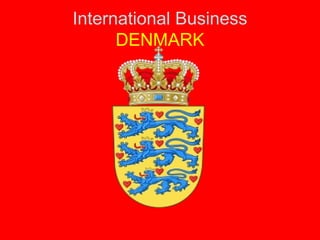
DENMARK
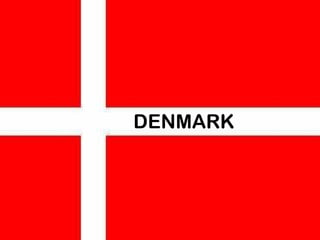
DENMARK
On the map!
Search
Finished !
Searching.....
Brief Overview
• Facts and Statistics
• Location: Northern Europe bordering
Germany 68 km
• Capital: Copenhagen
• Climate: temperate; humid and overcast;
mild, windy winters and cool summers
• Population: 5,413,392
• Religions: Evangelical Lutheran 95%,
other Protestant and Roman Catholic 3%,
Muslim 2%
Government:
Type: Constitutional monarchy.
• Constitution: June 5, 1953.
• Branches: Executive--queen (chief of
state), prime minister (head of
government), cabinet. Legislative--
unicameral parliament (Folketing).
• Political parties (represented in
parliament): Venstre (Liberal), Social
Democratic, Conservatives, Socialist
People's, Social Liberal, Unity List, Danish
People's, New Alliance.
CULTURE
LITERATURE
PAINTING – SCULPTURE
FILM
DESIGN- ARCHITECTURE
CULTURE AND LIFESTYLE:
• Highly developed society,
• Very proud people in relation to their
life styles.
• Environmentally friendly, recycling
their trash and sewage
• Denmark is an egalitarian society.
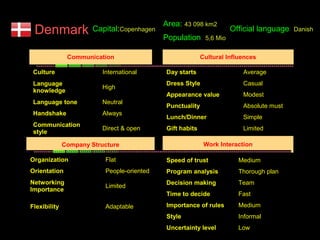
Denmark
Area: 43 098 km2
Population: 5,6 Mio
Official language: DanishCapital:Copenhagen
Communication
Culture International
Language
knowledge
High
Language tone Neutral
Handshake Always
Communication
style
Direct & open
Cultural Influences
Day starts Average
Dress Style Casual
Appearance value Modest
Punctuality Absolute must
Lunch/Dinner Simple
Gift habits Limited
Company Structure
Organization Flat
Orientation People-oriented
Networking
Importance
Limited
Flexibility Adaptable
Work Interaction
Speed of trust Medium
Program analysis Thorough plan
Decision making Team
Time to decide Fast
Importance of rules Medium
Style Informal
Uncertainty level Low
MULTINATIONALS AT
DENMARK
MULTINATIONALS AT Denmark
• Breweries
– Carlsberg Group
• Biotechnology
– Novozymes A/S
• Children’s Toys
– Lego Group
• Energy
– Vestas Wind Systems
• Shipping
– A. P. Moller-Maersk Group (Maersk)
PAST AND PRESENT ECONOMY:
• AGRARIAN SOCIETY
• A thousand-year old farming and
fishing country was thus rapidly
changing into a fully developed
industrial nation
• From milk, sugar beets, eggs and meat
from the farms to a production of
powdered milk, sugar, cakes, tinned
meat, etc.
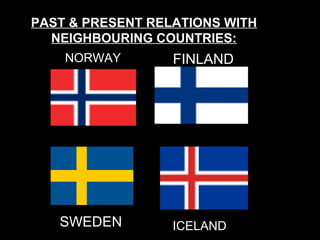
PAST & PRESENT RELATIONS WITH
NEIGHBOURING COUNTRIES:
NORWAY
ICELANDSWEDEN
FINLAND
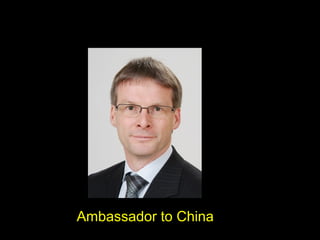
Ambassador to China
Ambassador to China
• Denmark was among the very first countries to
establish diplomatic relations with the People’s
Republic of China in 1950
• Economic and people-to-people contacts have
become steadily stronger.
• Strengthening relations between China and
Denmark is in mutual interest
• Many Danish companies are present here in
China and many Danes are living here.
Ambassador Stig Barlyng to
Ghana
• The Danish embassy located precisely on
dr. Isert road,
• Cooperation with Ghana is a humanistic
and pragmatic approach,
• Principles together and respect each other
• Strategy for poverty reduction.
The Danish Ambassador to
Vietnam,
Peter Lysholt Hansen
• Vietnam's strongest ally in the fight
against climate change
• Building up the efforts to mutual
cooperation
• Promotion of tourism
Foreign Trade policy
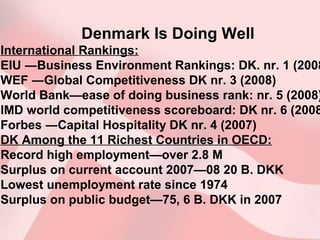
Denmark Is Doing Well
International Rankings:
EIU ―Business Environment Rankings: DK. nr. 1 (2008
WEF ―Global Competitiveness DK nr. 3 (2008)
World Bank—ease of doing business rank: nr. 5 (2008)
IMD world competitiveness scoreboard: DK nr. 6 (2008
Forbes ―Capital Hospitality DK nr. 4 (2007)
DK Among the 11 Richest Countries in OECD:
Record high employment—over 2.8 M
Surplus on current account 2007—08 20 B. DKK
Lowest unemployment rate since 1974
Surplus on public budget—75, 6 B. DKK in 2007
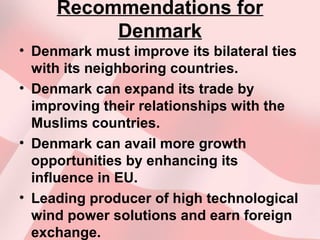
Recommendations for
Denmark
• Denmark must improve its bilateral ties
with its neighboring countries.
• Denmark can expand its trade by
improving their relationships with the
Muslims countries.
• Denmark can avail more growth
opportunities by enhancing its
influence in EU.
• Leading producer of high technological
wind power solutions and earn foreign
exchange.

Denmark International Business

  • 1.
  • 2.
  • 3.
  • 4.
    Brief Overview • Factsand Statistics • Location: Northern Europe bordering Germany 68 km • Capital: Copenhagen • Climate: temperate; humid and overcast; mild, windy winters and cool summers • Population: 5,413,392 • Religions: Evangelical Lutheran 95%, other Protestant and Roman Catholic 3%, Muslim 2%
  • 5.
    Government: Type: Constitutional monarchy. •Constitution: June 5, 1953. • Branches: Executive--queen (chief of state), prime minister (head of government), cabinet. Legislative-- unicameral parliament (Folketing). • Political parties (represented in parliament): Venstre (Liberal), Social Democratic, Conservatives, Socialist People's, Social Liberal, Unity List, Danish People's, New Alliance.
  • 6.
  • 7.
    CULTURE AND LIFESTYLE: •Highly developed society, • Very proud people in relation to their life styles. • Environmentally friendly, recycling their trash and sewage • Denmark is an egalitarian society.
  • 8.
    Denmark Area: 43 098km2 Population: 5,6 Mio Official language: DanishCapital:Copenhagen Communication Culture International Language knowledge High Language tone Neutral Handshake Always Communication style Direct & open Cultural Influences Day starts Average Dress Style Casual Appearance value Modest Punctuality Absolute must Lunch/Dinner Simple Gift habits Limited Company Structure Organization Flat Orientation People-oriented Networking Importance Limited Flexibility Adaptable Work Interaction Speed of trust Medium Program analysis Thorough plan Decision making Team Time to decide Fast Importance of rules Medium Style Informal Uncertainty level Low
  • 9.
  • 10.
    MULTINATIONALS AT Denmark •Breweries – Carlsberg Group • Biotechnology – Novozymes A/S • Children’s Toys – Lego Group • Energy – Vestas Wind Systems • Shipping – A. P. Moller-Maersk Group (Maersk)
  • 11.
    PAST AND PRESENTECONOMY: • AGRARIAN SOCIETY • A thousand-year old farming and fishing country was thus rapidly changing into a fully developed industrial nation • From milk, sugar beets, eggs and meat from the farms to a production of powdered milk, sugar, cakes, tinned meat, etc.
  • 12.
    PAST & PRESENTRELATIONS WITH NEIGHBOURING COUNTRIES: NORWAY ICELANDSWEDEN FINLAND
  • 13.
  • 14.
    Ambassador to China •Denmark was among the very first countries to establish diplomatic relations with the People’s Republic of China in 1950 • Economic and people-to-people contacts have become steadily stronger. • Strengthening relations between China and Denmark is in mutual interest • Many Danish companies are present here in China and many Danes are living here.
  • 15.
    Ambassador Stig Barlyngto Ghana • The Danish embassy located precisely on dr. Isert road, • Cooperation with Ghana is a humanistic and pragmatic approach, • Principles together and respect each other • Strategy for poverty reduction.
  • 16.
    The Danish Ambassadorto Vietnam, Peter Lysholt Hansen • Vietnam's strongest ally in the fight against climate change • Building up the efforts to mutual cooperation • Promotion of tourism
  • 17.
  • 18.
    Denmark Is DoingWell International Rankings: EIU ―Business Environment Rankings: DK. nr. 1 (2008 WEF ―Global Competitiveness DK nr. 3 (2008) World Bank—ease of doing business rank: nr. 5 (2008) IMD world competitiveness scoreboard: DK nr. 6 (2008 Forbes ―Capital Hospitality DK nr. 4 (2007) DK Among the 11 Richest Countries in OECD: Record high employment—over 2.8 M Surplus on current account 2007—08 20 B. DKK Lowest unemployment rate since 1974 Surplus on public budget—75, 6 B. DKK in 2007
  • 19.
    Recommendations for Denmark • Denmarkmust improve its bilateral ties with its neighboring countries. • Denmark can expand its trade by improving their relationships with the Muslims countries. • Denmark can avail more growth opportunities by enhancing its influence in EU. • Leading producer of high technological wind power solutions and earn foreign exchange.