
Countries
Group 1
What is scandinavia…?
Scandinavia is a group
of culturally related countries in northern
Europe.
•
Scandinavia is a historical and
geographical region in Northern Europe.
•
There are 3 main countries
which are called scandinavian countries.
•
Scandinavia and other lands
are called Nordic countries.
•
Countries
Norway

Finland

Sweden

Iceland

Denmark
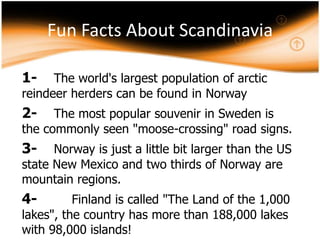
Fun Facts About Scandinavia
1-

The world's largest population of arctic
reindeer herders can be found in Norway

2-

The most popular souvenir in Sweden is
the commonly seen "moose-crossing" road signs.

3-

Norway is just a little bit larger than the US
state New Mexico and two thirds of Norway are
mountain regions.

4-

Finland is called "The Land of the 1,000
lakes", the country has more than 188,000 lakes
with 98,000 islands!
Fun Facts About Scandinavia
5During Easter in Sweden, which is a
well-known holiday here, children dress up and
go from home to home asking for candy.
6Sweden is known for innovation and
inventions. e.g mouse, fridge, heart pace maker
, marine propeller
7Rekjavik, the capital of Iceland, has
sidewalks that are heated by geothermal heat in
the winter.
9In Denmark, a flag is flown outside when
Fun Facts About Scandinavia
10If you're not married when you turn
30, you will get a pepper shaker as a gift and
male is called a Pepperman. And female is called
Peppermaid .
11In Norway's dark winter during the
Polar Nights, the sun is up for only 3 hours a day
in some parts (and in others, doesn't come up at
all).
12The NRK reports that there are more
births in Norway in April than in any other month
Continue…
• The main bond uniting Scandinavia is the
fact that the languages — Danish,
Norwegian and Swedish — are mutually
intelligible after a bit of exposure.
• There is a passport union which allows
the citizen to travel with out passport.
• There used to be a currency union, but it
broke up in 1914.
Denmark
• Location
It is located to the north of
Germany and to the south/southwest of Norway
and Sweden in Northern Europe.
•
It has coastlines which cover
4,545 miles (7,314 km) that are along the
Baltic and North Seas.

• Area
The total land area of Denmark is
16,638 square miles (43,094 sq km).
Denmark
• Geography
It consists of the peninsula,
Jutland and 474 islands, of which Zealand,
Funen, Lolland, Falster and Bornholm are the
largest.

• Capital
The capital city of Denmark is
Copenhagen, located on the island of Zealand.

• Population
Denmark is a small country
Denmark
Birth rate: 10.22 births/1,000

population

Death rate: 10.12 deaths/1,000

population.

Population Growth Rate: 0.4%

Dialing code
Its dialing code is 45.

• Currency
The currency is the Danish krone.
Denmark
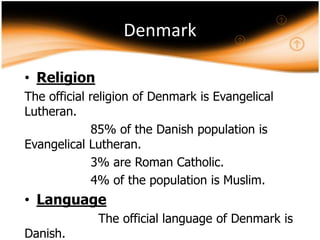
• Religion
The official religion of Denmark is Evangelical
Lutheran.
85% of the Danish population is
Evangelical Lutheran.
3% are Roman Catholic.
4% of the population is Muslim.

• Language
Danish.

The official language of Denmark is
Denmark
• Topography:
The topography of Denmark
consists mostly of low and flat plains.
The highest point in Denmark is
Mollehojat 561 feet (171 m).
The lowest point is Lammefjord
at -23 feet (-7 m).

Literacy Rate:
99% for both men and women.
Denmark
• Climate:
The weather in Denmark is defined by 4
seasons:
1- It rarely gets freezing cold
during winter, which lasts from November to
February, with an average temperature of 0.5
degrees Celsius (33 Fahrenheit)
2- March to May are the months
of spring and this season is quite unpredictable
3- Early fall is usually warm and
Denmark
Holidays:
1New Year's Day
Palm Sunday
3- Maundy Thursday
Good Friday
5- Easter Sunday
6- Easter Monday
7- Common Prayer Day
Ascension Day
9- Whitsun Sunday

24-

8-
Denmark
Traditional Foods:
1- Traditional meats include veal,
duck, cod, shrimp, pork, and goose.
2- Vegetables are an integral part of
a meal, especially red cabbage (slowly simmered)
and potatoes.
3- Soups are varied (with split pea
and ham a popular choice) and are good winter
time dishes.
4- Danes like their alcohol. "Akvavit"
is very popular. Non-alcoholic drinks include Ruby-
Denmark
Economy:
1- GDP(growth rate): -0.4%
2- Labor force: 2.848 million.
3- Unemployment rate: 6.4%.

Budget:
12-

revenues: $176.5 billion .
expenditures: $188.9 billion
Denmark
Inflation rate :

2.6%
Industrial Production Growth Rate:
1.9%
Exports :
$110.8 billion
Exports – Commodities:
Machinery and
Instruments, Meat and Meat Products, Dairy
Products, Fish, Pharmaceuticals, Furniture,
Windmills.
Denmark
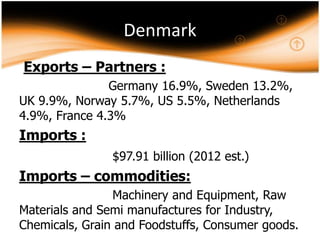
Exports – Partners :
Germany 16.9%, Sweden 13.2%,
UK 9.9%, Norway 5.7%, US 5.5%, Netherlands
4.9%, France 4.3%

Imports :
$97.91 billion (2012 est.)

Imports – commodities:
Machinery and Equipment, Raw
Materials and Semi manufactures for Industry,
Chemicals, Grain and Foodstuffs, Consumer goods.
Denmark
Imports – partners:
Germany 20.8%, Sweden
13.5%, Netherlands 7.2%, UK 6.3%, China 6.2%,
Norway

Principle Govt. Officials:

THORNING-SCHMIDT

Queen : MARGRETHE II
Prime Minister : Helle
Denmark
Political System:
1Denmark is a constitutional
monarchy and parliamentary democracy both.
2Norway has a unicameral
Parliament.
3The Prime Minister of
Denmark is the head of government in
the Kingdom of Denmark.
4- State power is formally
distributed between three institutions: the
Parliament (the legislative power), the Government
Denmark
Some facts about Denmark:
1- Denmark was the first European
country to abolish slavery.
2- The "Dannebrog" is the oldest national
flag in the world
3- The average tax rate in Denmark is
49%.
4- Danes eat more pasta than any other
people
5- There is not a single mountain in
Denmark

6- Denmark has been a member of the EU
since 1973 and of NATO since 1949
7- Denmark is the fifth largest exporter of
food in the world.
8- Only three Danish films have sold more
than one million tickets.
9- Denmark has been inhabited since
about 12,500 BC.
Norway
Location:
located in Northern Europe on the
Scandinavian Peninsula between the North Sea
and the North Atlantic Ocean.

Area:
1- It has an area of 125,020 square miles
(323,802 sq km).
2- It is slightly larger than New Mexico.
3- Nearly 70% of Norway is uninhabitable
Norway
Capital:
Its capital city is Oslo.
Population:
1- A population of a little above 5
million. It is the 2nd least densely populated
country in Europe.
2- Birth rate: 10.8 births/1,000
population
3- Death rate: 9.22 deaths/1,000
Norway
Literacy Rate:
100 % for both men and women.

Currency:
The “Norwegian Krone” is the currency
of Norway.
The currency symbol is “ kr “.

Religions:
85.7%.

Evangelical Lutheran (official)
Norway
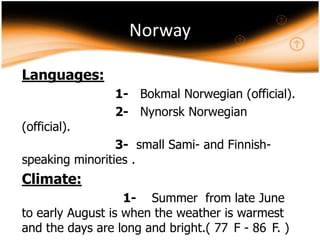
Languages:

(official).

1- Bokmal Norwegian (official).
2- Nynorsk Norwegian

3- small Sami- and Finnishspeaking minorities .

Climate:
1- Summer from late June
to early August is when the weather is warmest
and the days are long and bright.( 77 F - 86 F. )
Norway
4- In winter much of Norway is
usually transformed into a snow-clad paradise.
5- Spring from May to midJune is when the scenery in Norway is at its most
spectacular, with trees and flowers waking to life.
Norway
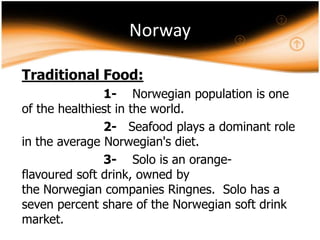
Traditional Food:
1- Norwegian population is one
of the healthiest in the world.
2- Seafood plays a dominant role
in the average Norwegian's diet.
3- Solo is an orangeflavoured soft drink, owned by
the Norwegian companies Ringnes. Solo has a
seven percent share of the Norwegian soft drink
market.
Norway
Economy:
GDP Growth Rate: 3.1%
Labor force: 2.645 million
Unemployment rate : 3.1%
Inflation rate : 0.6%

Budget:
revenues:$282.9
billion
expenditures:$206.7 billion
Exports: $ 162.7 billion
Imports:$86.78 billion
Norway
Exports Commodities:
Petroleum and
Petroleum products, Machinery and Equipment,
Metals, Chemicals, Ships, Fish.
Industrial production growth
rate: - 4.3%

Exports – Partners :
Germany 16.9%, Sweden
13.2%, UK 9.9%, Norway 5.7%, US 5.5%,
Netherlands 4.9%, France 4.3% .
Norway
Imports – commodities:
Machinery and
Equipment, Raw Materials and Semi manufactures
for Industry, Chemicals, Grain and Foodstuffs,
Consumer goods.

Imports – partners:
Germany 20.8%, Sweden 13.5%,
Netherlands 7.2%, UK 6.3%, China 6.2%,
Norway.
Norway
Political System:
1Denmark is a
constitutional monarchy and parliamentary
democracy both.
2Norway has a unicameral
Parliament.
3The Prime Minister of
Denmark is the head of government in
the Kingdom of Denmark.
4- State power is formally
Norway
Principle Govt. Officials:
II

THORNING-SCHMIDT

1- Queen : MARGRETHE
2- Prime Minister : Helle
Sweden
Location:
1- Sweden is located in
Northern Europe on the Scandinavian Peninsula.
2- It is bordered by
Norway and Finland and is connected to Denmark
by a bridge tunnel.

Area:

1- Spread At 450,295 square

kilometres (173,860 sq mi).
2- It is the 5th largest in Europe
Sweden
Capital:
Sweden's capital city is ”Stockholm”
which is also the largest city.

Population:
million.

population.

1- Total population is about 9.5
2- Birth rate: 10.24 births/1,000

3- Death rate10.21
deaths/1,000 population.
Sweden
Literacy Rate:
99% in both men and women.

Currency:
The “Swedish Krona” is the
currency of Sweden.
The currency symbol is “kr”.

Religion:
Lutheran: 87%.
Other (includes Roman Catholic,
Sweden
Languages:
1- Swedish (official).
2- Small Sami- and Finnishspeaking minorities.
Principle Govt. Officials:
1King: CARL XVI GUSTAF
2- Prime Minister: Fredrik
REINFELDT
Sweden
Climate:
1Autumn brings colder
weather and quite a bit of rain, but the trees
undergo beautiful color changes.
2During the winter the
number of daylight hours decreases but the snow
brightens up the city.
3Spring arrives sometime in
April/May, the snow melts and the days get
longer.
Sweden
Traditional Foods:
1- A limited range of fish
and other seafood is an important part of the
Swedish foods.
2- Sweden is one of the top
10 heaviest coffee drinking countries in the
world. Milk consumption in Sweden is also very
high.
3- On the fast
food, pizza and hot dogs have been a ubiquitous
part of Swedish culture.
Sweden
Economy:

million

GDP Growth Rate: 0.9%
Labor force: 5.032

Unemployment Rate: 8%
Budget:

billion

revenues: $287.9 billion
expenditures: $289.3
Inflation rate :1.4%
Sweden
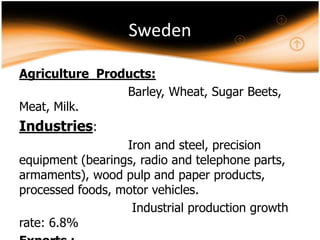
Agriculture Products:
Barley, Wheat, Sugar Beets,
Meat, Milk.

Industries:
Iron and steel, precision
equipment (bearings, radio and telephone parts,
armaments), wood pulp and paper products,
processed foods, motor vehicles.
Industrial production growth
rate: 6.8%
Sweden
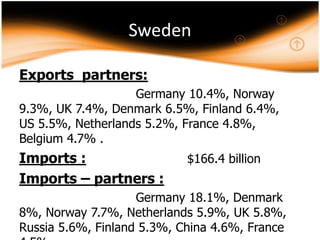
Exports partners:
Germany 10.4%, Norway
9.3%, UK 7.4%, Denmark 6.5%, Finland 6.4%,
US 5.5%, Netherlands 5.2%, France 4.8%,
Belgium 4.7% .

Imports :
Imports – partners :

$166.4 billion

Germany 18.1%, Denmark
8%, Norway 7.7%, Netherlands 5.9%, UK 5.8%,
Russia 5.6%, Finland 5.3%, China 4.6%, France
Sweden
Political System:
1- Constitutional monarchy
with a parliamentary system.
2- The Swedish government is
formed by ministers and a Prime minister
called State minister.
3- Prime Minister is called the
Head of the State while king is called Chief of the
State.
4- State power is formally
Scandianavian Countries

Scandianavian Countries

  • 1.
  • 2.
  • 3.
  • 4.
    What is scandinavia…? Scandinaviais a group of culturally related countries in northern Europe. • Scandinavia is a historical and geographical region in Northern Europe. • There are 3 main countries which are called scandinavian countries. • Scandinavia and other lands are called Nordic countries. •
  • 5.
  • 6.
    Fun Facts AboutScandinavia 1- The world's largest population of arctic reindeer herders can be found in Norway 2- The most popular souvenir in Sweden is the commonly seen "moose-crossing" road signs. 3- Norway is just a little bit larger than the US state New Mexico and two thirds of Norway are mountain regions. 4- Finland is called "The Land of the 1,000 lakes", the country has more than 188,000 lakes with 98,000 islands!
  • 7.
    Fun Facts AboutScandinavia 5During Easter in Sweden, which is a well-known holiday here, children dress up and go from home to home asking for candy. 6Sweden is known for innovation and inventions. e.g mouse, fridge, heart pace maker , marine propeller 7Rekjavik, the capital of Iceland, has sidewalks that are heated by geothermal heat in the winter. 9In Denmark, a flag is flown outside when
  • 8.
    Fun Facts AboutScandinavia 10If you're not married when you turn 30, you will get a pepper shaker as a gift and male is called a Pepperman. And female is called Peppermaid . 11In Norway's dark winter during the Polar Nights, the sun is up for only 3 hours a day in some parts (and in others, doesn't come up at all). 12The NRK reports that there are more births in Norway in April than in any other month
  • 9.
    Continue… • The mainbond uniting Scandinavia is the fact that the languages — Danish, Norwegian and Swedish — are mutually intelligible after a bit of exposure. • There is a passport union which allows the citizen to travel with out passport. • There used to be a currency union, but it broke up in 1914.
  • 10.
    Denmark • Location It islocated to the north of Germany and to the south/southwest of Norway and Sweden in Northern Europe. • It has coastlines which cover 4,545 miles (7,314 km) that are along the Baltic and North Seas. • Area The total land area of Denmark is 16,638 square miles (43,094 sq km).
  • 11.
    Denmark • Geography It consistsof the peninsula, Jutland and 474 islands, of which Zealand, Funen, Lolland, Falster and Bornholm are the largest. • Capital The capital city of Denmark is Copenhagen, located on the island of Zealand. • Population Denmark is a small country
  • 12.
    Denmark Birth rate: 10.22births/1,000 population Death rate: 10.12 deaths/1,000 population. Population Growth Rate: 0.4% Dialing code Its dialing code is 45. • Currency The currency is the Danish krone.
  • 13.
    Denmark • Religion The officialreligion of Denmark is Evangelical Lutheran. 85% of the Danish population is Evangelical Lutheran. 3% are Roman Catholic. 4% of the population is Muslim. • Language Danish. The official language of Denmark is
  • 14.
    Denmark • Topography: The topographyof Denmark consists mostly of low and flat plains. The highest point in Denmark is Mollehojat 561 feet (171 m). The lowest point is Lammefjord at -23 feet (-7 m). Literacy Rate: 99% for both men and women.
  • 15.
    Denmark • Climate: The weatherin Denmark is defined by 4 seasons: 1- It rarely gets freezing cold during winter, which lasts from November to February, with an average temperature of 0.5 degrees Celsius (33 Fahrenheit) 2- March to May are the months of spring and this season is quite unpredictable 3- Early fall is usually warm and
  • 16.
    Denmark Holidays: 1New Year's Day PalmSunday 3- Maundy Thursday Good Friday 5- Easter Sunday 6- Easter Monday 7- Common Prayer Day Ascension Day 9- Whitsun Sunday 24- 8-
  • 17.
    Denmark Traditional Foods: 1- Traditionalmeats include veal, duck, cod, shrimp, pork, and goose. 2- Vegetables are an integral part of a meal, especially red cabbage (slowly simmered) and potatoes. 3- Soups are varied (with split pea and ham a popular choice) and are good winter time dishes. 4- Danes like their alcohol. "Akvavit" is very popular. Non-alcoholic drinks include Ruby-
  • 18.
    Denmark Economy: 1- GDP(growth rate):-0.4% 2- Labor force: 2.848 million. 3- Unemployment rate: 6.4%. Budget: 12- revenues: $176.5 billion . expenditures: $188.9 billion
  • 19.
    Denmark Inflation rate : 2.6% IndustrialProduction Growth Rate: 1.9% Exports : $110.8 billion Exports – Commodities: Machinery and Instruments, Meat and Meat Products, Dairy Products, Fish, Pharmaceuticals, Furniture, Windmills.
  • 20.
    Denmark Exports – Partners: Germany 16.9%, Sweden 13.2%, UK 9.9%, Norway 5.7%, US 5.5%, Netherlands 4.9%, France 4.3% Imports : $97.91 billion (2012 est.) Imports – commodities: Machinery and Equipment, Raw Materials and Semi manufactures for Industry, Chemicals, Grain and Foodstuffs, Consumer goods.
  • 21.
    Denmark Imports – partners: Germany20.8%, Sweden 13.5%, Netherlands 7.2%, UK 6.3%, China 6.2%, Norway Principle Govt. Officials: THORNING-SCHMIDT Queen : MARGRETHE II Prime Minister : Helle
  • 22.
    Denmark Political System: 1Denmark isa constitutional monarchy and parliamentary democracy both. 2Norway has a unicameral Parliament. 3The Prime Minister of Denmark is the head of government in the Kingdom of Denmark. 4- State power is formally distributed between three institutions: the Parliament (the legislative power), the Government
  • 23.
    Denmark Some facts aboutDenmark: 1- Denmark was the first European country to abolish slavery. 2- The "Dannebrog" is the oldest national flag in the world 3- The average tax rate in Denmark is 49%. 4- Danes eat more pasta than any other people 5- There is not a single mountain in
  • 24.
    Denmark 6- Denmark hasbeen a member of the EU since 1973 and of NATO since 1949 7- Denmark is the fifth largest exporter of food in the world. 8- Only three Danish films have sold more than one million tickets. 9- Denmark has been inhabited since about 12,500 BC.
  • 25.
    Norway Location: located in NorthernEurope on the Scandinavian Peninsula between the North Sea and the North Atlantic Ocean. Area: 1- It has an area of 125,020 square miles (323,802 sq km). 2- It is slightly larger than New Mexico. 3- Nearly 70% of Norway is uninhabitable
  • 26.
    Norway Capital: Its capital cityis Oslo. Population: 1- A population of a little above 5 million. It is the 2nd least densely populated country in Europe. 2- Birth rate: 10.8 births/1,000 population 3- Death rate: 9.22 deaths/1,000
  • 27.
    Norway Literacy Rate: 100 %for both men and women. Currency: The “Norwegian Krone” is the currency of Norway. The currency symbol is “ kr “. Religions: 85.7%. Evangelical Lutheran (official)
  • 28.
    Norway Languages: (official). 1- Bokmal Norwegian(official). 2- Nynorsk Norwegian 3- small Sami- and Finnishspeaking minorities . Climate: 1- Summer from late June to early August is when the weather is warmest and the days are long and bright.( 77 F - 86 F. )
  • 29.
    Norway 4- In wintermuch of Norway is usually transformed into a snow-clad paradise. 5- Spring from May to midJune is when the scenery in Norway is at its most spectacular, with trees and flowers waking to life.
  • 30.
    Norway Traditional Food: 1- Norwegianpopulation is one of the healthiest in the world. 2- Seafood plays a dominant role in the average Norwegian's diet. 3- Solo is an orangeflavoured soft drink, owned by the Norwegian companies Ringnes. Solo has a seven percent share of the Norwegian soft drink market.
  • 31.
    Norway Economy: GDP Growth Rate:3.1% Labor force: 2.645 million Unemployment rate : 3.1% Inflation rate : 0.6% Budget: revenues:$282.9 billion expenditures:$206.7 billion Exports: $ 162.7 billion Imports:$86.78 billion
  • 32.
    Norway Exports Commodities: Petroleum and Petroleumproducts, Machinery and Equipment, Metals, Chemicals, Ships, Fish. Industrial production growth rate: - 4.3% Exports – Partners : Germany 16.9%, Sweden 13.2%, UK 9.9%, Norway 5.7%, US 5.5%, Netherlands 4.9%, France 4.3% .
  • 33.
    Norway Imports – commodities: Machineryand Equipment, Raw Materials and Semi manufactures for Industry, Chemicals, Grain and Foodstuffs, Consumer goods. Imports – partners: Germany 20.8%, Sweden 13.5%, Netherlands 7.2%, UK 6.3%, China 6.2%, Norway.
  • 34.
    Norway Political System: 1Denmark isa constitutional monarchy and parliamentary democracy both. 2Norway has a unicameral Parliament. 3The Prime Minister of Denmark is the head of government in the Kingdom of Denmark. 4- State power is formally
  • 35.
    Norway Principle Govt. Officials: II THORNING-SCHMIDT 1-Queen : MARGRETHE 2- Prime Minister : Helle
  • 36.
    Sweden Location: 1- Sweden islocated in Northern Europe on the Scandinavian Peninsula. 2- It is bordered by Norway and Finland and is connected to Denmark by a bridge tunnel. Area: 1- Spread At 450,295 square kilometres (173,860 sq mi). 2- It is the 5th largest in Europe
  • 38.
    Sweden Capital: Sweden's capital cityis ”Stockholm” which is also the largest city. Population: million. population. 1- Total population is about 9.5 2- Birth rate: 10.24 births/1,000 3- Death rate10.21 deaths/1,000 population.
  • 39.
    Sweden Literacy Rate: 99% inboth men and women. Currency: The “Swedish Krona” is the currency of Sweden. The currency symbol is “kr”. Religion: Lutheran: 87%. Other (includes Roman Catholic,
  • 40.
    Sweden Languages: 1- Swedish (official). 2-Small Sami- and Finnishspeaking minorities. Principle Govt. Officials: 1King: CARL XVI GUSTAF 2- Prime Minister: Fredrik REINFELDT
  • 41.
    Sweden Climate: 1Autumn brings colder weatherand quite a bit of rain, but the trees undergo beautiful color changes. 2During the winter the number of daylight hours decreases but the snow brightens up the city. 3Spring arrives sometime in April/May, the snow melts and the days get longer.
  • 42.
    Sweden Traditional Foods: 1- Alimited range of fish and other seafood is an important part of the Swedish foods. 2- Sweden is one of the top 10 heaviest coffee drinking countries in the world. Milk consumption in Sweden is also very high. 3- On the fast food, pizza and hot dogs have been a ubiquitous part of Swedish culture.
  • 43.
    Sweden Economy: million GDP Growth Rate:0.9% Labor force: 5.032 Unemployment Rate: 8% Budget: billion revenues: $287.9 billion expenditures: $289.3 Inflation rate :1.4%
  • 44.
    Sweden Agriculture Products: Barley, Wheat,Sugar Beets, Meat, Milk. Industries: Iron and steel, precision equipment (bearings, radio and telephone parts, armaments), wood pulp and paper products, processed foods, motor vehicles. Industrial production growth rate: 6.8%
  • 45.
    Sweden Exports partners: Germany 10.4%,Norway 9.3%, UK 7.4%, Denmark 6.5%, Finland 6.4%, US 5.5%, Netherlands 5.2%, France 4.8%, Belgium 4.7% . Imports : Imports – partners : $166.4 billion Germany 18.1%, Denmark 8%, Norway 7.7%, Netherlands 5.9%, UK 5.8%, Russia 5.6%, Finland 5.3%, China 4.6%, France
  • 46.
    Sweden Political System: 1- Constitutionalmonarchy with a parliamentary system. 2- The Swedish government is formed by ministers and a Prime minister called State minister. 3- Prime Minister is called the Head of the State while king is called Chief of the State. 4- State power is formally

Editor's Notes

  • #5 1- The word “Scandinavia” originated from the word “Scania” that means "south end of Sweden". 2- It was adopted and introduced in the eighteenth century. Before this, the term Scandinavia was familiar mainly to classical scholars through writings.
  • #13 . Even though Denmark is a member of the EU, Denmark has not adopted the euro, therefore Danish stores are not obliged to accept payments in euro.
  • #29 Sami is official in six municipalities.
  • #30 Sami is official in six municipalities.
  • #31 Sami is official in six municipalities.
  • #32 Sami is official in six municipalities.
  • #33 Sami is official in six municipalities.
  • #34 Sami is official in six municipalities.
  • #35 Sami is official in six municipalities.
  • #36 Sami is official in six municipalities.
  • #37 Sami is official in six municipalities.
  • #39 Sami is official in six municipalities.
  • #40 Sami is official in six municipalities.
  • #41 Sami is official in six municipalities.
  • #42 Sami is official in six municipalities.
  • #43 Sami is official in six municipalities.
  • #44 Sami is official in six municipalities.
  • #45 Sami is official in six municipalities.
  • #46 Sami is official in six municipalities.
  • #47 Sami is official in six municipalities.
  • #48 Sami is official in six municipalities.