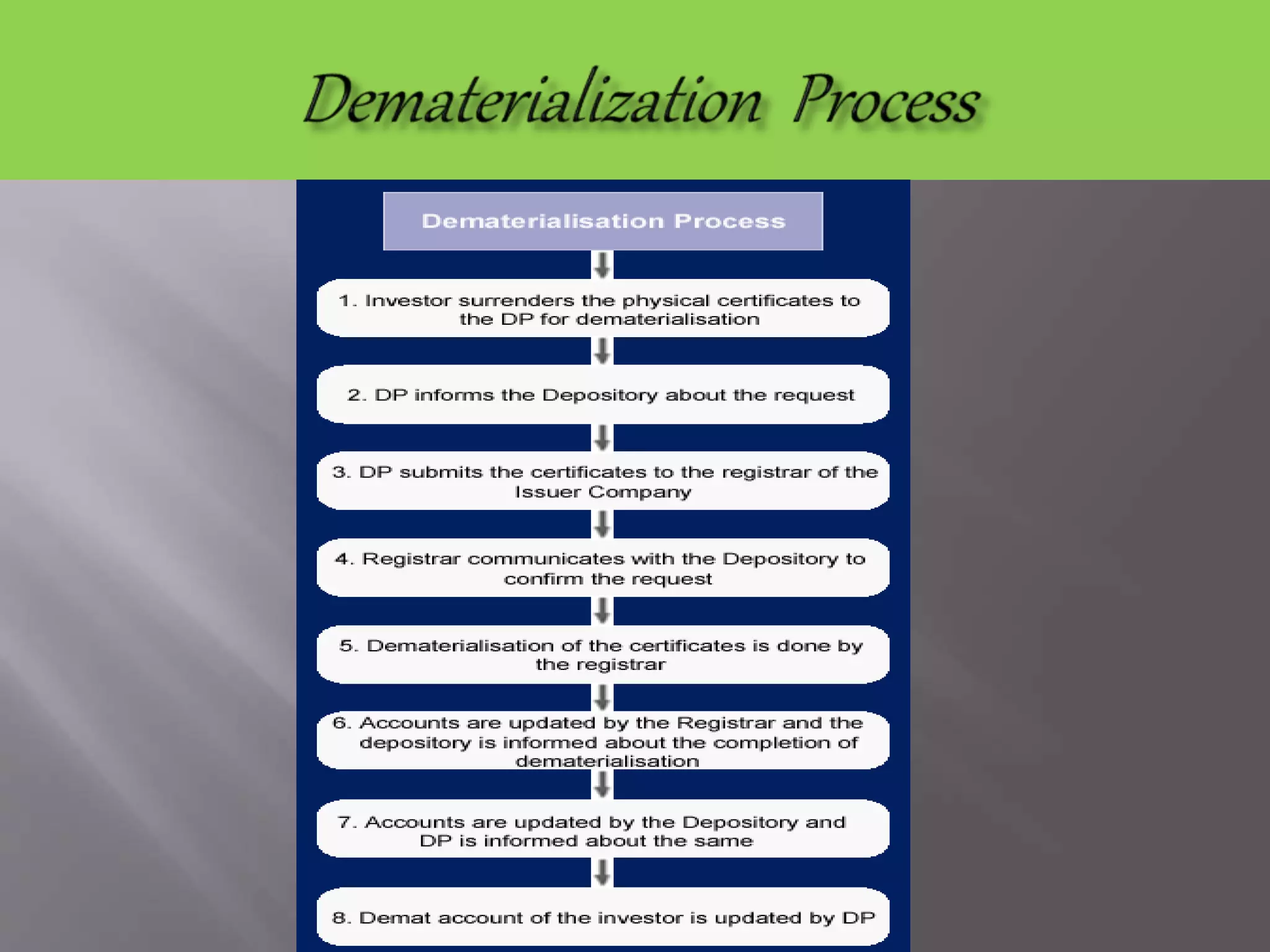
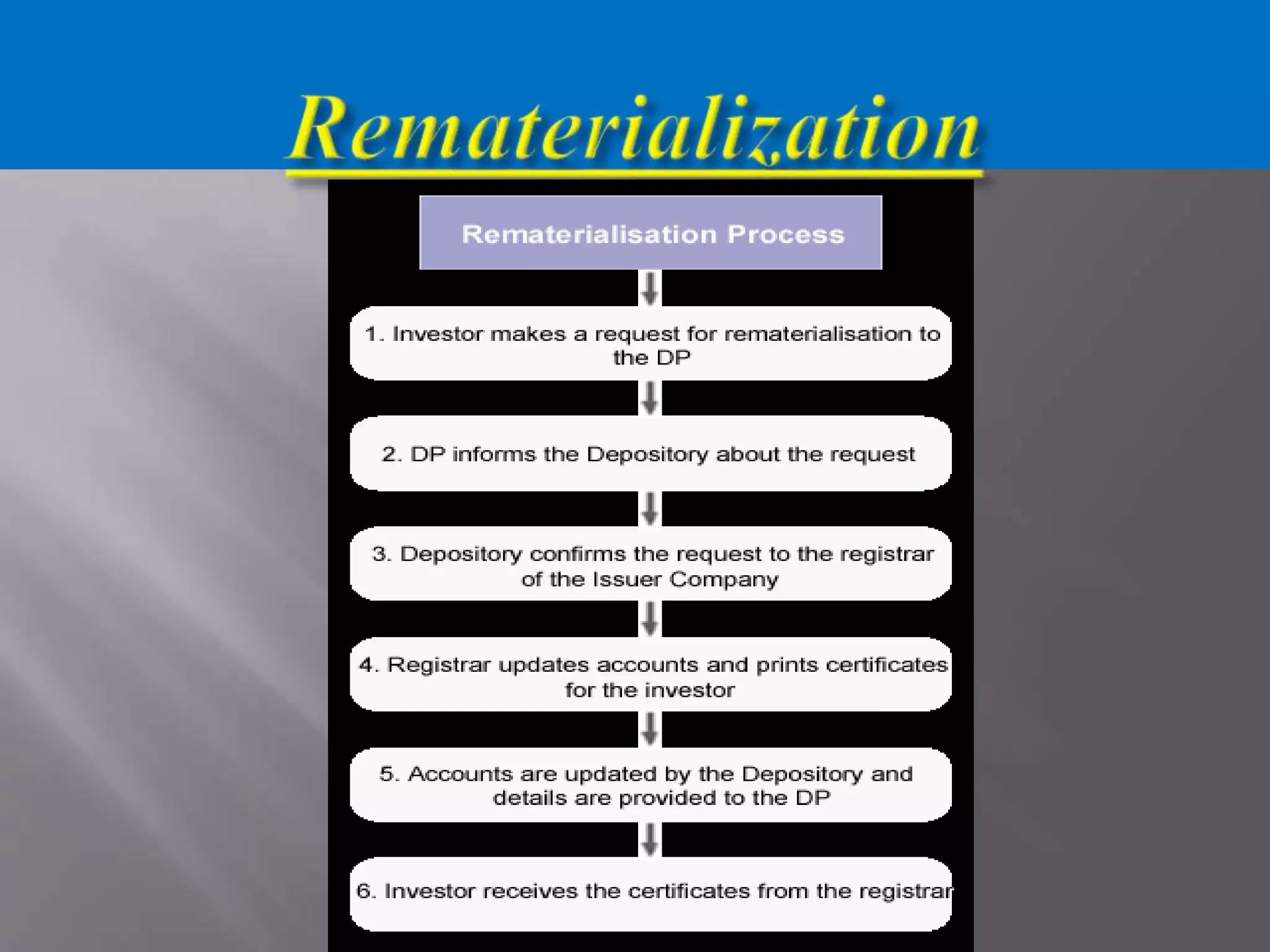
 Dematerialization is the process of converting
physical shares into an electronic form. Shares
once converted into dematerialized form are
held in a Demat account.
 What Does Dematerialization-DEMAT Mean?
The move efrom physical certificates to lectronic
book keeping. Actual stock certificates are slowly
being removed and retired from circulation in
exchange for electronic recording.
 New era of Indian Capital Market.
 How to dematerialize your shares?
Fill up a dematerialization request form,
which is available with your DP;
Submit your share certificates along with the
form; Receive credit for the dematerialized
shares into your account in 15 days.
 In finance and financial law,
dematerialization refers to the
substitution of paper-form securities by
book entry securities.
 dematerialized securities are often
referred as intermediated securities , in
particular by the Unidroit convention on
substantive rules for intermediated
securities .
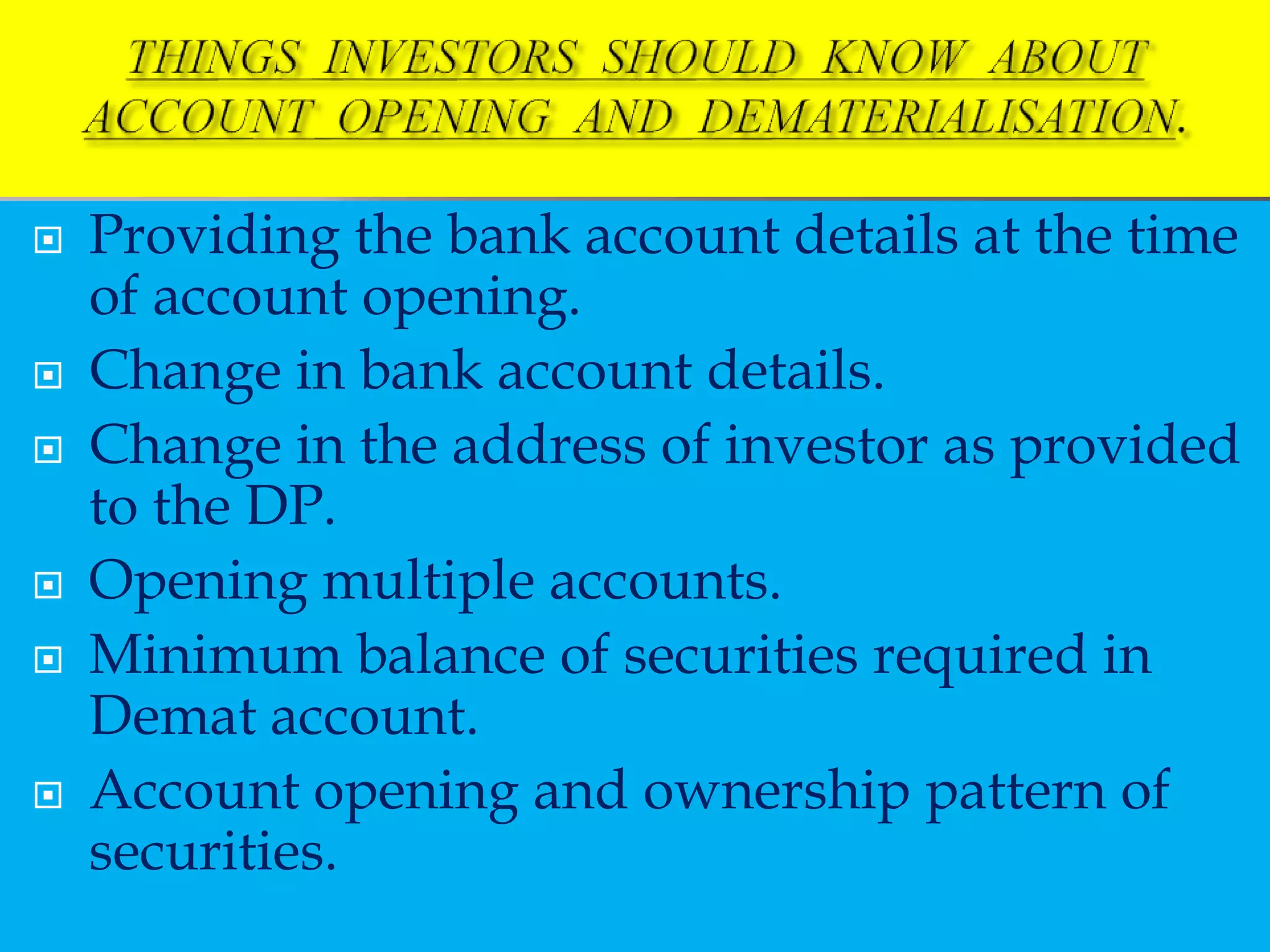
 Providing the bank account details at the time
of account opening.
 Change in bank account details.
 Change in the address of investor as provided
to the DP.
 Opening multiple accounts.
 Minimum balance of securities required in
Demat account.
 Account opening and ownership pattern of
securities.
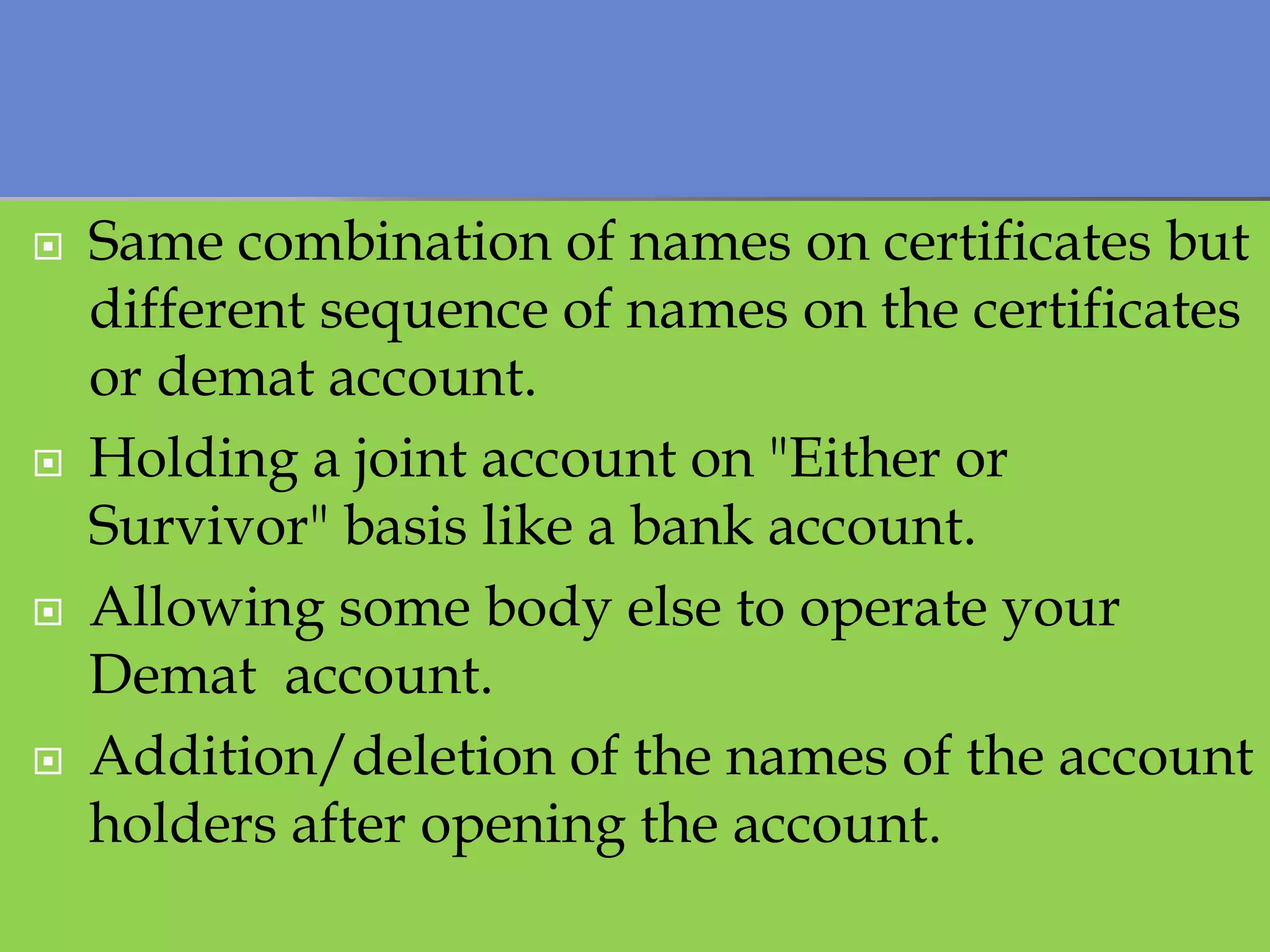
 Same combination of names on certificates but
different sequence of names on the certificates
or demat account.
 Holding a joint account on "Either or
Survivor" basis like a bank account.
 Allowing some body else to operate your
Demat account.
 Addition/deletion of the names of the account
holders after opening the account.
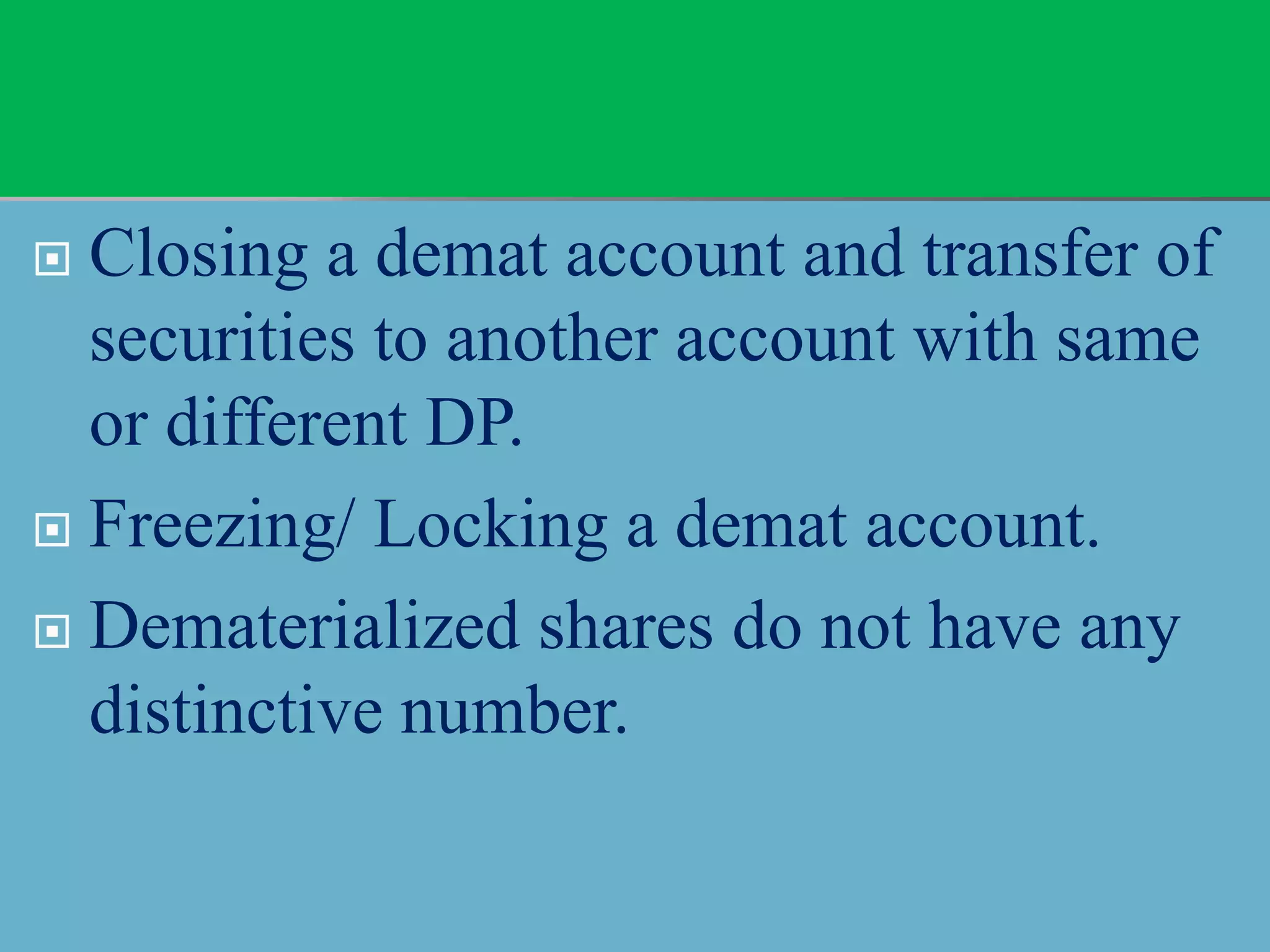
 Closing a demat account and transfer of
securities to another account with same
or different DP.
 Freezing/ Locking a demat account.
 Dematerialized shares do not have any
distinctive number.
 Depository-
S.
No.
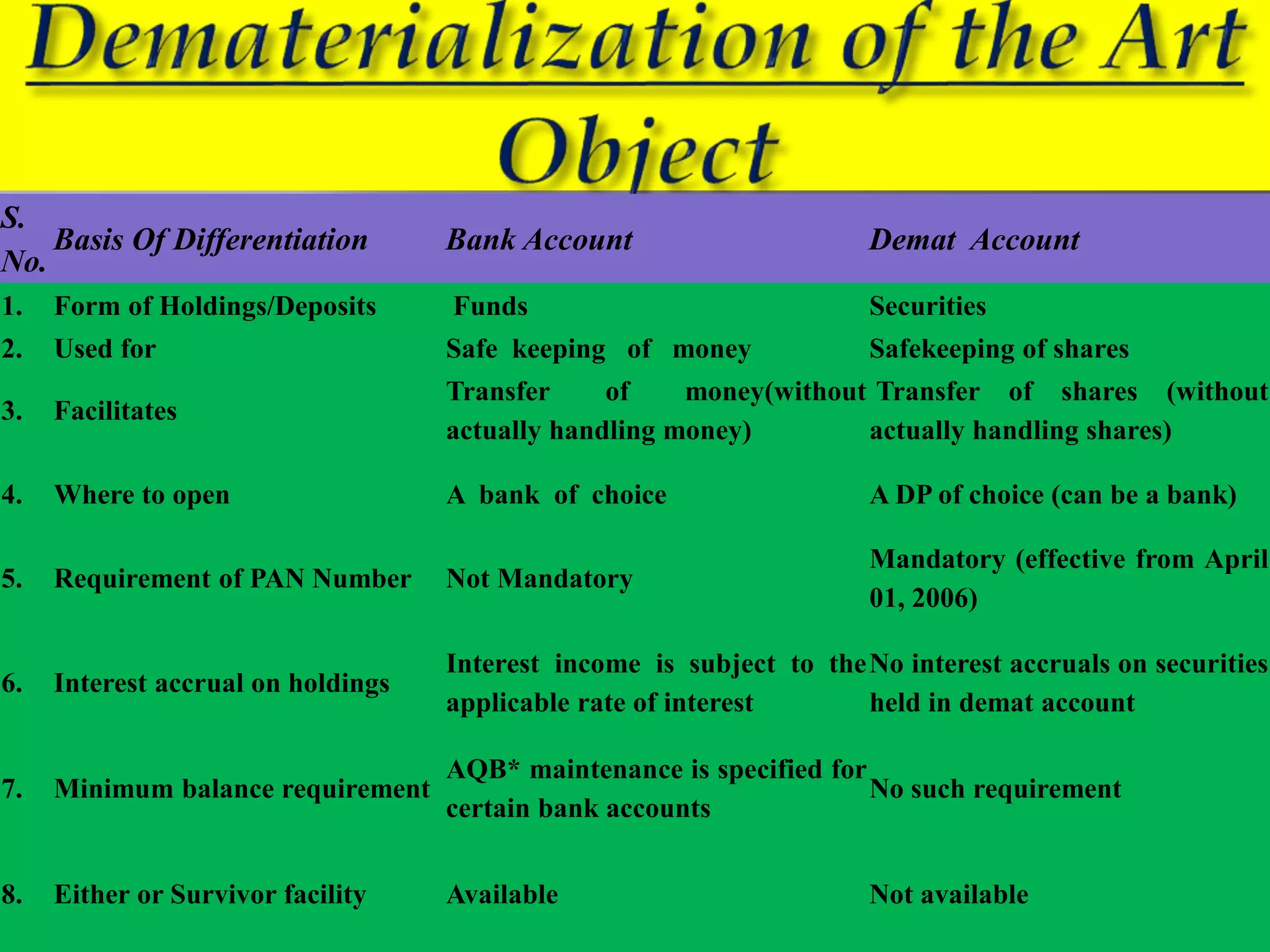
Basis Of Differentiation Bank Account Demat Account
1. Form of Holdings/Deposits Funds Securities
2. Used for Safe keeping of money Safekeeping of shares
3. Facilitates
Transfer of money(without
actually handling money)
Transfer of shares (without
actually handling shares)
4. Where to open A bank of choice A DP of choice (can be a bank)
5. Requirement of PAN Number Not Mandatory
Mandatory (effective from April
01, 2006)
6. Interest accrual on holdings
Interest income is subject to the
applicable rate of interest
No interest accruals on securities
held in demat account
7. Minimum balance requirement
AQB* maintenance is specified for
certain bank accounts
No such requirement
8. Either or Survivor facility Available Not available
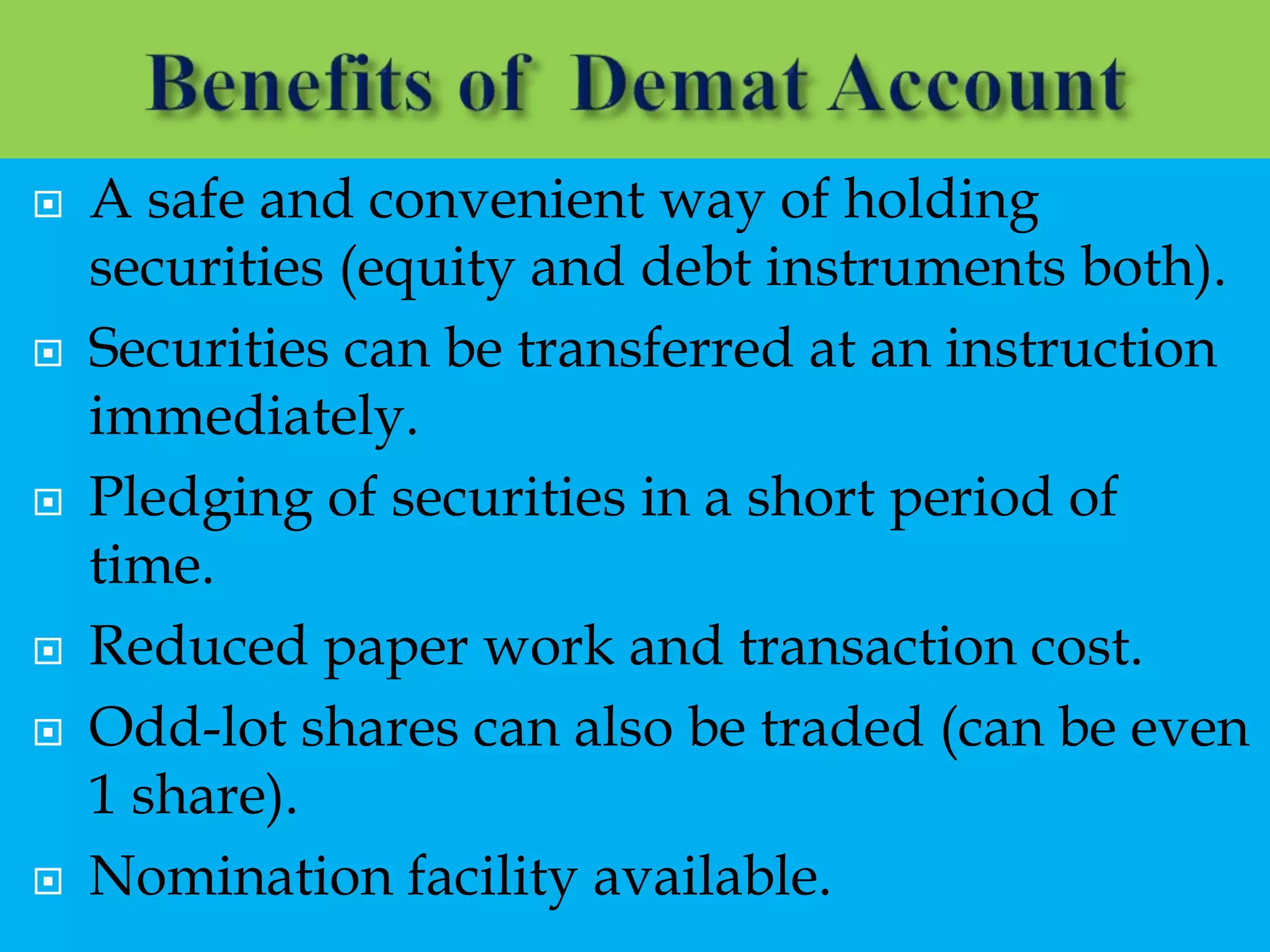
 A safe and convenient way of holding
securities (equity and debt instruments both).
 Securities can be transferred at an instruction
immediately.
 Pledging of securities in a short period of
time.
 Reduced paper work and transaction cost.
 Odd-lot shares can also be traded (can be even
1 share).
 Nomination facility available.
 Separate dematerialization requests will have to be
filled for locked-in and free holdings.
 Separate dematerialization requests will have to be
filled for holdings locked-in for different reasons.
 Separate dematerialization requests will have to be
filled for fully paid up and partly paid-up holdings.
 Separate dematerialization requests will have to be
filled for holdings in the different ISINs of a
company.
 Dematted shares can be converted
back into physical shares.
 One may open accounts with several
DPs.
 Dematerialization of shares can be
canceled automatically. This takes
place if a company is declared
bankrupt in the so-called liquidation
path .
 Demat account is more or less an essential
requirement for all the investors who invest in
equities, bonds and debentures.
 . Despite various efforts by the regulators to make
electronic transactions as cheap as possible for the
ordinary investors, the charges for Demat accounts
continue to remain on higher side.
 Depending upon the individual profile,
requirements and suitability, different investors
open DP accounts with major banks, big online
broking houses or local brokers.
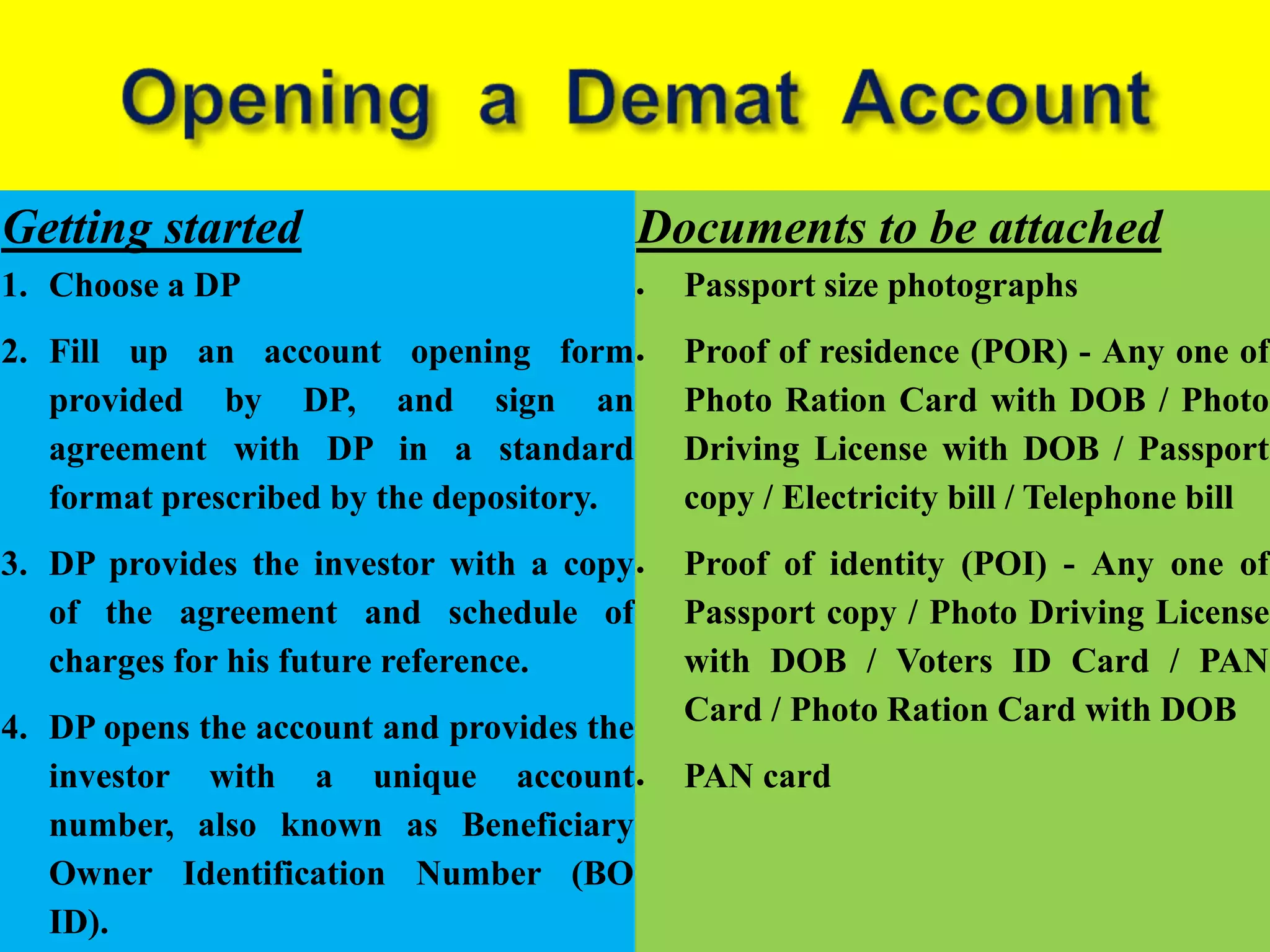
Getting started
1. Choose a DP
2. Fill up an account opening form
provided by DP, and sign an
agreement with DP in a standard
format prescribed by the depository.
3. DP provides the investor with a copy
of the agreement and schedule of
charges for his future reference.
4. DP opens the account and provides the
investor with a unique account
number, also known as Beneficiary
Owner Identification Number (BO
ID).
Documents to be attached
 Passport size photographs
 Proof of residence (POR) - Any one of
Photo Ration Card with DOB / Photo
Driving License with DOB / Passport
copy / Electricity bill / Telephone bill
 Proof of identity (POI) - Any one of
Passport copy / Photo Driving License
with DOB / Voters ID Card / PAN
Card / Photo Ration Card with DOB
 PAN card
 A Depository NSDL is an organization like a
Central Bank where at the request of a
shareholder his securities are held in the
electronic form through the medium of a
Depository Participant.
 Meaning of a depository participant-
A depository participant is one with whom
an account has to be opened to trade in the
electronic form.
 The depository system operates
in the lines of a banking system.
A bank holds funds in its
accounts and transfers funds
between accounts whereas a
depository holds securities in
accounts and transfers securities
between accounts.
Lack of control.
Need for greater supervision.
Complexity of the system.
dematerialization of shares

dematerialization of shares

  • 2.
     Dematerialization isthe process of converting physical shares into an electronic form. Shares once converted into dematerialized form are held in a Demat account.  What Does Dematerialization-DEMAT Mean? The move efrom physical certificates to lectronic book keeping. Actual stock certificates are slowly being removed and retired from circulation in exchange for electronic recording.
  • 3.
     New eraof Indian Capital Market.  How to dematerialize your shares? Fill up a dematerialization request form, which is available with your DP; Submit your share certificates along with the form; Receive credit for the dematerialized shares into your account in 15 days.
  • 4.
     In financeand financial law, dematerialization refers to the substitution of paper-form securities by book entry securities.  dematerialized securities are often referred as intermediated securities , in particular by the Unidroit convention on substantive rules for intermediated securities .
  • 6.
     Providing thebank account details at the time of account opening.  Change in bank account details.  Change in the address of investor as provided to the DP.  Opening multiple accounts.  Minimum balance of securities required in Demat account.  Account opening and ownership pattern of securities.
  • 7.
     Same combinationof names on certificates but different sequence of names on the certificates or demat account.  Holding a joint account on "Either or Survivor" basis like a bank account.  Allowing some body else to operate your Demat account.  Addition/deletion of the names of the account holders after opening the account.
  • 8.
     Closing ademat account and transfer of securities to another account with same or different DP.  Freezing/ Locking a demat account.  Dematerialized shares do not have any distinctive number.
  • 10.
  • 11.
    S. No. Basis Of DifferentiationBank Account Demat Account 1. Form of Holdings/Deposits Funds Securities 2. Used for Safe keeping of money Safekeeping of shares 3. Facilitates Transfer of money(without actually handling money) Transfer of shares (without actually handling shares) 4. Where to open A bank of choice A DP of choice (can be a bank) 5. Requirement of PAN Number Not Mandatory Mandatory (effective from April 01, 2006) 6. Interest accrual on holdings Interest income is subject to the applicable rate of interest No interest accruals on securities held in demat account 7. Minimum balance requirement AQB* maintenance is specified for certain bank accounts No such requirement 8. Either or Survivor facility Available Not available
  • 12.
     A safeand convenient way of holding securities (equity and debt instruments both).  Securities can be transferred at an instruction immediately.  Pledging of securities in a short period of time.  Reduced paper work and transaction cost.  Odd-lot shares can also be traded (can be even 1 share).  Nomination facility available.
  • 14.
     Separate dematerializationrequests will have to be filled for locked-in and free holdings.  Separate dematerialization requests will have to be filled for holdings locked-in for different reasons.  Separate dematerialization requests will have to be filled for fully paid up and partly paid-up holdings.  Separate dematerialization requests will have to be filled for holdings in the different ISINs of a company.
  • 15.
     Dematted sharescan be converted back into physical shares.  One may open accounts with several DPs.  Dematerialization of shares can be canceled automatically. This takes place if a company is declared bankrupt in the so-called liquidation path .
  • 16.
     Demat accountis more or less an essential requirement for all the investors who invest in equities, bonds and debentures.  . Despite various efforts by the regulators to make electronic transactions as cheap as possible for the ordinary investors, the charges for Demat accounts continue to remain on higher side.  Depending upon the individual profile, requirements and suitability, different investors open DP accounts with major banks, big online broking houses or local brokers.
  • 17.
    Getting started 1. Choosea DP 2. Fill up an account opening form provided by DP, and sign an agreement with DP in a standard format prescribed by the depository. 3. DP provides the investor with a copy of the agreement and schedule of charges for his future reference. 4. DP opens the account and provides the investor with a unique account number, also known as Beneficiary Owner Identification Number (BO ID). Documents to be attached  Passport size photographs  Proof of residence (POR) - Any one of Photo Ration Card with DOB / Photo Driving License with DOB / Passport copy / Electricity bill / Telephone bill  Proof of identity (POI) - Any one of Passport copy / Photo Driving License with DOB / Voters ID Card / PAN Card / Photo Ration Card with DOB  PAN card
  • 18.
     A DepositoryNSDL is an organization like a Central Bank where at the request of a shareholder his securities are held in the electronic form through the medium of a Depository Participant.  Meaning of a depository participant- A depository participant is one with whom an account has to be opened to trade in the electronic form.
  • 19.
     The depositorysystem operates in the lines of a banking system. A bank holds funds in its accounts and transfers funds between accounts whereas a depository holds securities in accounts and transfers securities between accounts.
  • 20.
    Lack of control. Needfor greater supervision. Complexity of the system.