Trusts
&
Wills
1www.fpgindia.org
Definition
As per Section 3 of Indian Trust Act,1882:
A “Trust” is an obligation annexed to the ownership of
property, and arising out of a confidence reposed in and
accepted by the owners, or declared and accepted by
him, for the benefit of another and the owner.
2www.fpgindia.org
Parties in Trust
 Author/Settlor
 Trustee
 Beneficiary
3www.fpgindia.org
Terms Related to Trust
 Trust property/Trust Money
 Beneficial Interest
 Instrument of Trust
4www.fpgindia.org
Important Aspects:
 Mere Transfer of Income alone is not
sufficient
 Transfer should be irrevocable
 For Movable property, Ownership
should be transferred
 For Immovable property, writing and
registeration is mandatory*
5www.fpgindia.org
For Valid Trust
 Author must Indicate:
 His Intention to Create Trust
 The Purpose of Trust
 The Beneficiary
 The Trust Property
 Transfer of property to Trust
6www.fpgindia.org
Types Of Trusts (1)
 Specific Trust
 Discretionary Trust
7www.fpgindia.org
Types Of Trusts (2)
 Public Trust
 Private Trust
8www.fpgindia.org
Types Of Trusts (3)
 Executed Trust
 Constructive Trust
 Resulting Trust
 Simple Trust
 Special Trust
9www.fpgindia.org
Settlor of a Trust:
 A person who is competent to contract
as per Indian Contract Act,1882 and is
the legal owner of the property
concerned.
 A Limited Company can be a Settlor
 A karta can be a Settlor on Behalf of
HUF.
10www.fpgindia.org
Trustees:
 Anyone can become a Trustee. A
Settlor himself can become a sole
trustee or one of the Trustee.
Note:
The Clubbing provision is Governed by the Relationship between
the settlor and the Beneficiary and not that between the Trustee
and Beneficiary
11www.fpgindia.org
Tax Planning Tips
 It is Advantageous to have specific Trust for a Living
beneficiary and a Discretionary Trust for Unborn
persons
 Trust should be in writing and Registered. Income of
Oral Trust is subject to Maximum Marginal rate
 Spouse should not be Settlor for the benefit of
his/her spouse.
 Father/Mother/Grand Parents should not Settle any
Property for the benefit of minor
child/Children/Grand Children
 Inturn Maternal GrandParents may open a trust for
Minor Grand Childrens
 Also Brother in Law may Settle for Sister in Law and
Vice Versa
12www.fpgindia.org
Trusts for Relatives
 Private Trust for Spouse
 Private Trust for Minor
Son/Daughter
 Private Trust for Major Son
 Private Trust for Married Daughter
 Private Trust for Daughter-in-law
 Private Trust for Parents
13www.fpgindia.org
Private Trust For Spouse
 When spouse’s in reciept of Regular Gifts.
 Why:
1.) Where Spouse is Illiterate or Less
Educated.
2.) Where one doesn’t have faith in Spouse’s
Financial management .
14www.fpgindia.org
Private Trust For Spouse
 Settler Should not be:
1. Husband
2. Father/Mother –in-Law
 No Restriction on Trustees
15www.fpgindia.org
Private Trust For Minor
Income of Minor to be clubbed with parent
with higher Income
Exception:
1. Where earning is from some specialised skill
2. In case of Physically Disabled Child.
16www.fpgindia.org
Private Trust For Minor
Tax Planning Tips:
1. Create 100% Specific Beneficiary Trust and
make it a Partner in Partnership Firm
2. Create 100% Specific beneficiary trust with
the provision of deferment of the benefit
during the minority.
17www.fpgindia.org
Private Trust for Major Son
 Benefits:
To teach Financial Management.
 No restriction on Settler
 No risk of Clubbing of Income.
 Mentioning of share of each son is required in
case of joint trust.
18www.fpgindia.org
Private Trust for Married Daughter
 Benefits:
To avoid the money belonging to daughter,
given through gifts to be used by In laws in
case of Financial Crisis
19www.fpgindia.org
Private Trust for Daughter-in Law
Helps to create separate Income tax file
 Before Marriage:
Any one can settle the Trust
 After Marriage:
Spouse and father/mother in law should avoid
become settler
20www.fpgindia.org
Private Trust for Aged parents
 To Support Old Parents with no sizeable
Income.
 No Clubbing
 No Restriction on Investments.
21www.fpgindia.org
100% Specific Beneficiary Trust
For Senior Citizens
22www.fpgindia.org
Features
 Advantageous for Ailing Senior Citizens
 S.C can transfer all existing arrangement to
this Trust.
 Tax Treatment of Gifts will be same as in case
of Individual and HUF.
 The Trust Deed should thus Specifically
mention the method of distribution of assets
after demise or it should be mentioned through
will.
23www.fpgindia.org
Tax Planning through
Discretionary Trust
24www.fpgindia.org
Taxation on Discretionary Trust
 Assessable to Income tax at maximum Marginal
rate of Income tax
 Maximum Marginal rate means the rate of
Income Tax applicable in Relation to the
highest slab of Income in the case of an
Individual.
25www.fpgindia.org
Exceptions
 Where Discretionary Trust Created Through
Will
 Where DT is mainly created for the benefit of
relatives in unfortunate circumstances e.g.
orphans or Physically or mentally retarded.
26www.fpgindia.org
Discretionary Family Trust
 This is created for the Holistic Safety of
Family members
 It is to provide future Safety and Security for
existing and Future family members.
 It can be created by a living person and which
can become immidiately Operational
27www.fpgindia.org
Taxation
Discretionary Family Trust
28www.fpgindia.org
Taxation
 In case DFT is created by living person , it will
be taxed at Maximum marginal rate.
 If Created through Will, then at normal Slab
rates of Individuals.
 No tax liability on Receiving Gifts more than Rs
50k from Non Relatives( Reason being the
provisions of IT does not apply to DFT)
29www.fpgindia.org
Wills &
Succession Planning
30www.fpgindia.org
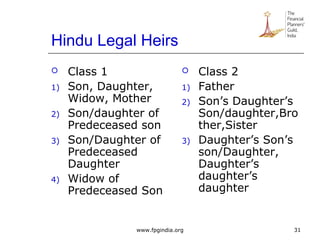
Hindu Legal Heirs
 Class 1
1) Son, Daughter,
Widow, Mother
2) Son/daughter of
Predeceased son
3) Son/Daughter of
Predeceased
Daughter
4) Widow of
Predeceased Son
 Class 2
1) Father
2) Son’s Daughter’s
Son/daughter,Bro
ther,Sister
3) Daughter’s Son’s
son/Daughter,
Daughter’s
daughter’s
daughter
31www.fpgindia.org
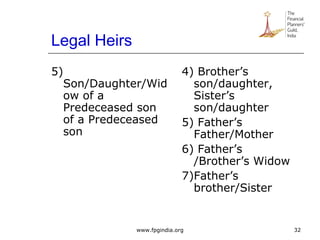
Legal Heirs
5)
Son/Daughter/Wid
ow of a
Predeceased son
of a Predeceased
son
4) Brother’s
son/daughter,
Sister’s
son/daughter
5) Father’s
Father/Mother
6) Father’s
/Brother’s Widow
7)Father’s
brother/Sister
32www.fpgindia.org
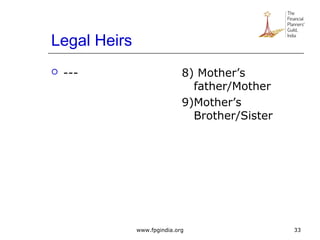
Legal Heirs
 --- 8) Mother’s
father/Mother
9)Mother’s
Brother/Sister
33www.fpgindia.org
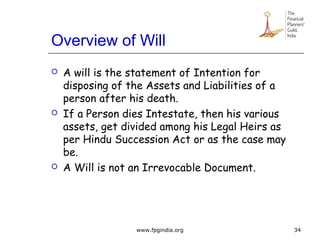
Overview of Will
 A will is the statement of Intention for
disposing of the Assets and Liabilities of a
person after his death.
 If a Person dies Intestate, then his various
assets, get divided among his Legal Heirs as
per Hindu Succession Act or as the case may
be.
 A Will is not an Irrevocable Document.
34www.fpgindia.org
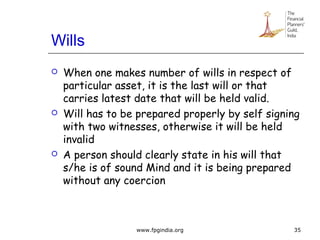
Wills
 When one makes number of wills in respect of
particular asset, it is the last will or that
carries latest date that will be held valid.
 Will has to be prepared properly by self signing
with two witnesses, otherwise it will be held
invalid
 A person should clearly state in his will that
s/he is of sound Mind and it is being prepared
without any coercion
35www.fpgindia.org
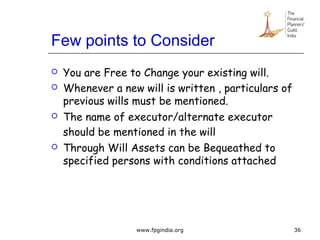
Few points to Consider
 You are Free to Change your existing will.
 Whenever a new will is written , particulars of
previous wills must be mentioned.
 The name of executor/alternate executor
should be mentioned in the will
 Through Will Assets can be Bequeathed to
specified persons with conditions attached
36www.fpgindia.org
Few Points to consider
 A will generally make mention of all the
existing assets and how the future assets ( If
any) to be distributed.
 It is fine if you do not give details of
distribution of each and every item
37www.fpgindia.org
Advantages of Will
“ Making a will leads not only to more
efficient, easy and quick distribution
of wealth among your Successors; it
will also pre empt lengthy and
expensive legal disputes.”
38www.fpgindia.org
Advantages
 It provides you with Freedom in Bequeathing
your assets
 It is easy to reward and provide monetary
benefits to relatives, friends.
 It helps you to bridge a gap between Rich and
poor Legal Heirs
 You can Create a Annual Charge through Will
which cannot otherwise be created.
39www.fpgindia.org
Some Terms Associated
 Executor/Executrix
 Witnesses
 Annual Charge
 Probate
 Registration
 Codicils
40www.fpgindia.org
Drafting a Valid Will
 Write down all your
Assets/Liabilities
 Prepare a List of all those to whom
you wish to bequeath something.
 Match Both the above
 Select Executor
 Select Witnesses
41www.fpgindia.org
Drafting a Will
 If Trust is to be created through will
then full details must b mentioned
 If HUF to be opened through will Full
details must be mentioned
42www.fpgindia.org
Tax Planning Through Will
 Create HUF though Will
 Bequest to Minor Children
 Transfer of Funds to Wife
 Transfer of Funds to Daughter in Law
 Through Discretionary Trust.
43www.fpgindia.org
Thanks
---
44www.fpgindia.org

Trusts and wills India

  • 1.
  • 2.
    Definition As per Section3 of Indian Trust Act,1882: A “Trust” is an obligation annexed to the ownership of property, and arising out of a confidence reposed in and accepted by the owners, or declared and accepted by him, for the benefit of another and the owner. 2www.fpgindia.org
  • 3.
    Parties in Trust Author/Settlor  Trustee  Beneficiary 3www.fpgindia.org
  • 4.
    Terms Related toTrust  Trust property/Trust Money  Beneficial Interest  Instrument of Trust 4www.fpgindia.org
  • 5.
    Important Aspects:  MereTransfer of Income alone is not sufficient  Transfer should be irrevocable  For Movable property, Ownership should be transferred  For Immovable property, writing and registeration is mandatory* 5www.fpgindia.org
  • 6.
    For Valid Trust Author must Indicate:  His Intention to Create Trust  The Purpose of Trust  The Beneficiary  The Trust Property  Transfer of property to Trust 6www.fpgindia.org
  • 7.
    Types Of Trusts(1)  Specific Trust  Discretionary Trust 7www.fpgindia.org
  • 8.
    Types Of Trusts(2)  Public Trust  Private Trust 8www.fpgindia.org
  • 9.
    Types Of Trusts(3)  Executed Trust  Constructive Trust  Resulting Trust  Simple Trust  Special Trust 9www.fpgindia.org
  • 10.
    Settlor of aTrust:  A person who is competent to contract as per Indian Contract Act,1882 and is the legal owner of the property concerned.  A Limited Company can be a Settlor  A karta can be a Settlor on Behalf of HUF. 10www.fpgindia.org
  • 11.
    Trustees:  Anyone canbecome a Trustee. A Settlor himself can become a sole trustee or one of the Trustee. Note: The Clubbing provision is Governed by the Relationship between the settlor and the Beneficiary and not that between the Trustee and Beneficiary 11www.fpgindia.org
  • 12.
    Tax Planning Tips It is Advantageous to have specific Trust for a Living beneficiary and a Discretionary Trust for Unborn persons  Trust should be in writing and Registered. Income of Oral Trust is subject to Maximum Marginal rate  Spouse should not be Settlor for the benefit of his/her spouse.  Father/Mother/Grand Parents should not Settle any Property for the benefit of minor child/Children/Grand Children  Inturn Maternal GrandParents may open a trust for Minor Grand Childrens  Also Brother in Law may Settle for Sister in Law and Vice Versa 12www.fpgindia.org
  • 13.
    Trusts for Relatives Private Trust for Spouse  Private Trust for Minor Son/Daughter  Private Trust for Major Son  Private Trust for Married Daughter  Private Trust for Daughter-in-law  Private Trust for Parents 13www.fpgindia.org
  • 14.
    Private Trust ForSpouse  When spouse’s in reciept of Regular Gifts.  Why: 1.) Where Spouse is Illiterate or Less Educated. 2.) Where one doesn’t have faith in Spouse’s Financial management . 14www.fpgindia.org
  • 15.
    Private Trust ForSpouse  Settler Should not be: 1. Husband 2. Father/Mother –in-Law  No Restriction on Trustees 15www.fpgindia.org
  • 16.
    Private Trust ForMinor Income of Minor to be clubbed with parent with higher Income Exception: 1. Where earning is from some specialised skill 2. In case of Physically Disabled Child. 16www.fpgindia.org
  • 17.
    Private Trust ForMinor Tax Planning Tips: 1. Create 100% Specific Beneficiary Trust and make it a Partner in Partnership Firm 2. Create 100% Specific beneficiary trust with the provision of deferment of the benefit during the minority. 17www.fpgindia.org
  • 18.
    Private Trust forMajor Son  Benefits: To teach Financial Management.  No restriction on Settler  No risk of Clubbing of Income.  Mentioning of share of each son is required in case of joint trust. 18www.fpgindia.org
  • 19.
    Private Trust forMarried Daughter  Benefits: To avoid the money belonging to daughter, given through gifts to be used by In laws in case of Financial Crisis 19www.fpgindia.org
  • 20.
    Private Trust forDaughter-in Law Helps to create separate Income tax file  Before Marriage: Any one can settle the Trust  After Marriage: Spouse and father/mother in law should avoid become settler 20www.fpgindia.org
  • 21.
    Private Trust forAged parents  To Support Old Parents with no sizeable Income.  No Clubbing  No Restriction on Investments. 21www.fpgindia.org
  • 22.
    100% Specific BeneficiaryTrust For Senior Citizens 22www.fpgindia.org
  • 23.
    Features  Advantageous forAiling Senior Citizens  S.C can transfer all existing arrangement to this Trust.  Tax Treatment of Gifts will be same as in case of Individual and HUF.  The Trust Deed should thus Specifically mention the method of distribution of assets after demise or it should be mentioned through will. 23www.fpgindia.org
  • 24.
    Tax Planning through DiscretionaryTrust 24www.fpgindia.org
  • 25.
    Taxation on DiscretionaryTrust  Assessable to Income tax at maximum Marginal rate of Income tax  Maximum Marginal rate means the rate of Income Tax applicable in Relation to the highest slab of Income in the case of an Individual. 25www.fpgindia.org
  • 26.
    Exceptions  Where DiscretionaryTrust Created Through Will  Where DT is mainly created for the benefit of relatives in unfortunate circumstances e.g. orphans or Physically or mentally retarded. 26www.fpgindia.org
  • 27.
    Discretionary Family Trust This is created for the Holistic Safety of Family members  It is to provide future Safety and Security for existing and Future family members.  It can be created by a living person and which can become immidiately Operational 27www.fpgindia.org
  • 28.
  • 29.
    Taxation  In caseDFT is created by living person , it will be taxed at Maximum marginal rate.  If Created through Will, then at normal Slab rates of Individuals.  No tax liability on Receiving Gifts more than Rs 50k from Non Relatives( Reason being the provisions of IT does not apply to DFT) 29www.fpgindia.org
  • 30.
  • 31.
    Hindu Legal Heirs Class 1 1) Son, Daughter, Widow, Mother 2) Son/daughter of Predeceased son 3) Son/Daughter of Predeceased Daughter 4) Widow of Predeceased Son  Class 2 1) Father 2) Son’s Daughter’s Son/daughter,Bro ther,Sister 3) Daughter’s Son’s son/Daughter, Daughter’s daughter’s daughter 31www.fpgindia.org
  • 32.
    Legal Heirs 5) Son/Daughter/Wid ow ofa Predeceased son of a Predeceased son 4) Brother’s son/daughter, Sister’s son/daughter 5) Father’s Father/Mother 6) Father’s /Brother’s Widow 7)Father’s brother/Sister 32www.fpgindia.org
  • 33.
    Legal Heirs  ---8) Mother’s father/Mother 9)Mother’s Brother/Sister 33www.fpgindia.org
  • 34.
    Overview of Will A will is the statement of Intention for disposing of the Assets and Liabilities of a person after his death.  If a Person dies Intestate, then his various assets, get divided among his Legal Heirs as per Hindu Succession Act or as the case may be.  A Will is not an Irrevocable Document. 34www.fpgindia.org
  • 35.
    Wills  When onemakes number of wills in respect of particular asset, it is the last will or that carries latest date that will be held valid.  Will has to be prepared properly by self signing with two witnesses, otherwise it will be held invalid  A person should clearly state in his will that s/he is of sound Mind and it is being prepared without any coercion 35www.fpgindia.org
  • 36.
    Few points toConsider  You are Free to Change your existing will.  Whenever a new will is written , particulars of previous wills must be mentioned.  The name of executor/alternate executor should be mentioned in the will  Through Will Assets can be Bequeathed to specified persons with conditions attached 36www.fpgindia.org
  • 37.
    Few Points toconsider  A will generally make mention of all the existing assets and how the future assets ( If any) to be distributed.  It is fine if you do not give details of distribution of each and every item 37www.fpgindia.org
  • 38.
    Advantages of Will “Making a will leads not only to more efficient, easy and quick distribution of wealth among your Successors; it will also pre empt lengthy and expensive legal disputes.” 38www.fpgindia.org
  • 39.
    Advantages  It providesyou with Freedom in Bequeathing your assets  It is easy to reward and provide monetary benefits to relatives, friends.  It helps you to bridge a gap between Rich and poor Legal Heirs  You can Create a Annual Charge through Will which cannot otherwise be created. 39www.fpgindia.org
  • 40.
    Some Terms Associated Executor/Executrix  Witnesses  Annual Charge  Probate  Registration  Codicils 40www.fpgindia.org
  • 41.
    Drafting a ValidWill  Write down all your Assets/Liabilities  Prepare a List of all those to whom you wish to bequeath something.  Match Both the above  Select Executor  Select Witnesses 41www.fpgindia.org
  • 42.
    Drafting a Will If Trust is to be created through will then full details must b mentioned  If HUF to be opened through will Full details must be mentioned 42www.fpgindia.org
  • 43.
    Tax Planning ThroughWill  Create HUF though Will  Bequest to Minor Children  Transfer of Funds to Wife  Transfer of Funds to Daughter in Law  Through Discretionary Trust. 43www.fpgindia.org
  • 44.

Editor's Notes

  • #6 Section 5 f Indian Trust Act says As regards Immovable property Trust is not valid unless it is registered. The only Exception Is in the case of will where Registeration is not Necessary. In Relation to Movable property no trust is valid unless the ownership of property is transferred to Trustee.
  • #8 Specific Trust is one which provides for specific beneficiary whose share is naturally specified in the Trust Deed. There can be 2 or more specific beneficiary.The Trustees of Sucha trust do not have any discretion apportioning The income of the trust for the benefit of beneficiary. A Discretionary trust on the other hand is a trust where beneficiaries are specific and ascertained , do not have Specified shares in the income or property of thetrust. The manner of enjoyment of the trust fund is left to the Discretion of trustees
  • #9 Public Trust is normally made for Charitable and Religious Purposes Private Trust or Family Trust is intended to provide for family, relatives, friends and others