Teaching Arts in the
Elementary Grades
Opening Prayer
Student's Prayer
(By St. Thomas Aquinas)
Creator of all things, true source of light and wisdom, origin of all being,
graciously let a ray of your light penetrate the darkness of my
understanding. Take from me the double darkness in which I have been
born, an obscurity of sin and ignorance. Give me a keen understanding,
a retentive memory, and the ability to grasp things correctly and
fundamentally. Grant me the talent of being exact in my explanations and
the ability to express myself with thoroughness and charm. Point out the
beginning, direct the progress, and help in the completion. I ask this
through Christ our Lord. Amen.
Read more at: https://www.lords-prayer-words.com/prayers_before/prayers_for_students.html
Topics:
Teaching Strategies in Teaching Arts
• Physical Environment and Play
• Brainstorming
• Conference
• Cooperative learning
• Discussion
• Experimenting
• Focused Exploration
Prepared by: Arjane De Lunas
Objectives
At the end of the discussion, the students are able to:
Define physical environment and play as strategies to teach
arts
Understand the importance of physical environment and play
Deepen knowledge about the other strategies in teaching
arts
Physical Environment and Play
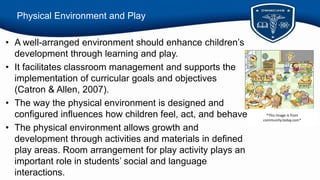
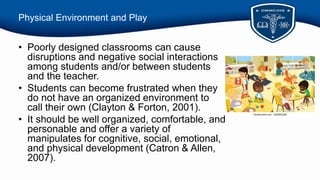
• A well-arranged environment should enhance children’s
development through learning and play.
• It facilitates classroom management and supports the
implementation of curricular goals and objectives
(Catron & Allen, 2007).
• The way the physical environment is designed and
configured influences how children feel, act, and behave.
• The physical environment allows growth and
development through activities and materials in defined
play areas. Room arrangement for play activity plays an
important role in students’ social and language
interactions.
*This Image is from
community.today.com*
Physical Environment and Play
• Poorly designed classrooms can cause
disruptions and negative social interactions
among students and/or between students
and the teacher.
• Students can become frustrated when they
do not have an organized environment to
call their own (Clayton & Forton, 2001).
• It should be well organized, comfortable, and
personable and offer a variety of
manipulates for cognitive, social, emotional,
and physical development (Catron & Allen,
2007).
Physical Environment and Play
• To understand play, we first must understand the importance of
the environment in the eyes of children and adults.
• Some people may see the environment as insignificant, but for
teachers, parents, and educators it is something that needs to be
considered a high priority.
• Environment is defined as the physical environment, its
surroundings, and a specific setting (Vickerius & Sandberg, 2006).
• The physical environment will vary depending on the age and
number of children in the classroom, as well as the goals of
programs and specific activities in the classroom.
Physical Environment and Play
• Art educator Stacey Salazar discussed the relationship between
play and art, saying, “Creativity and play can overlap when playful
states encourage new possibilities, connections, and ideas—that
is, play invites creative thought” (Salazar, 2015, p. 33).
• George Szekely said, “As a working artist, I’ve discovered that my
own ability to play is an important component of my ability to
create art.”
• Play brings out their individuality and allows their imaginations to
thrive. Szekely also said that all of his classroom lessons are
introduced through play. “This, I believe, is the most valuable
teaching I can give.” he added.
Physical Environment and Play
• When art instruction is planned around the experience of play,
children can draw ideas from their own experiences instead of
strictly following the teacher’s lead.
• Teaching art should not be reduced to the teacher’s conception of
what is good for children, or what should be learned.
• If play is to be essential component of the school curriculum, the
art class is a logical place for it. A playful attitude is the perfect
frame of mind for the experimental ventures of art requires.
• Art lessons should be active experiences, journeys of the body
and mind to fantasies reaching far beyond the classroom.
• If art is to have value as a means of expression, children must be
encouraged to use the medium in their own way.
Physical Environment and Play
• Skezely’s personal research has shown that, when play rather
than art is emphasized in the classroom, there is less
preoccupation with talent or fear of failure.
• Art teaching should strive to capture the fun. Having fun is a prime
motivation for making art.
• The act of playing is less burdened with pretensions, traditions,
and preconceived ideas than any other human activity.
• In art, play is the experimental part of the process, the portion that
frames ideas and rehearses them.
• Through play, child-artists learn to value their own ideas about art
and find pleasure in the search.
Brainstorming
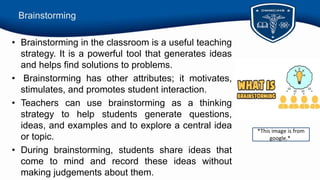
• Brainstorming in the classroom is a useful teaching
strategy. It is a powerful tool that generates ideas
and helps find solutions to problems.
• Brainstorming has other attributes; it motivates,
stimulates, and promotes student interaction.
• Teachers can use brainstorming as a thinking
strategy to help students generate questions,
ideas, and examples and to explore a central idea
or topic.
• During brainstorming, students share ideas that
come to mind and record these ideas without
making judgements about them.
*This image is from
google.*f
Brainstorming
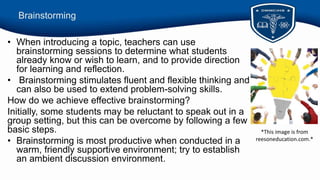
• When introducing a topic, teachers can use
brainstorming sessions to determine what students
already know or wish to learn, and to provide direction
for learning and reflection.
• Brainstorming stimulates fluent and flexible thinking and
can also be used to extend problem-solving skills.
How do we achieve effective brainstorming?
Initially, some students may be reluctant to speak out in a
group setting, but this can be overcome by following a few
basic steps.
• Brainstorming is most productive when conducted in a
warm, friendly supportive environment; try to establish
an ambient discussion environment.
*This image is from
reesoneducation.com.*
Brainstorming
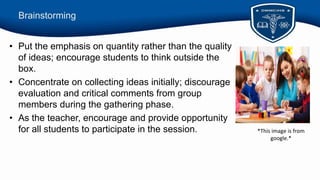
• Put the emphasis on quantity rather than the quality
of ideas; encourage students to think outside the
box.
• Concentrate on collecting ideas initially; discourage
evaluation and critical comments from group
members during the gathering phase.
• As the teacher, encourage and provide opportunity
for all students to participate in the session. *This image is from
google.*
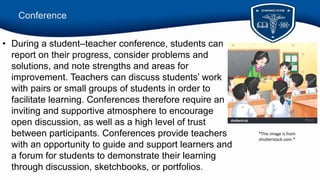
Conference
• During a student–teacher conference, students can
report on their progress, consider problems and
solutions, and note strengths and areas for
improvement. Teachers can discuss students’ work
with pairs or small groups of students in order to
facilitate learning. Conferences therefore require an
inviting and supportive atmosphere to encourage
open discussion, as well as a high level of trust
between participants. Conferences provide teachers
with an opportunity to guide and support learners and
a forum for students to demonstrate their learning
through discussion, sketchbooks, or portfolios.
*This image is from
shutterstock.com.*
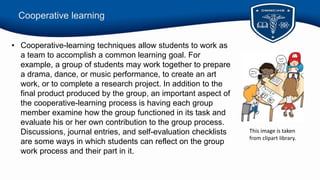
Cooperative learning
• Cooperative-learning techniques allow students to work as
a team to accomplish a common learning goal. For
example, a group of students may work together to prepare
a drama, dance, or music performance, to create an art
work, or to complete a research project. In addition to the
final product produced by the group, an important aspect of
the cooperative-learning process is having each group
member examine how the group functioned in its task and
evaluate his or her own contribution to the group process.
Discussions, journal entries, and self-evaluation checklists
are some ways in which students can reflect on the group
work process and their part in it.
This image is taken
from clipart library.
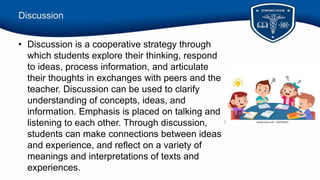
Discussion
• Discussion is a cooperative strategy through
which students explore their thinking, respond
to ideas, process information, and articulate
their thoughts in exchanges with peers and the
teacher. Discussion can be used to clarify
understanding of concepts, ideas, and
information. Emphasis is placed on talking and
listening to each other. Through discussion,
students can make connections between ideas
and experience, and reflect on a variety of
meanings and interpretations of texts and
experiences.
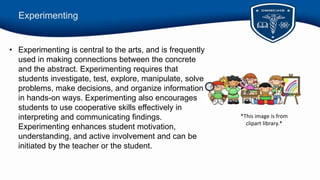
Experimenting
• Experimenting is central to the arts, and is frequently
used in making connections between the concrete
and the abstract. Experimenting requires that
students investigate, test, explore, manipulate, solve
problems, make decisions, and organize information
in hands-on ways. Experimenting also encourages
students to use cooperative skills effectively in
interpreting and communicating findings.
Experimenting enhances student motivation,
understanding, and active involvement and can be
initiated by the teacher or the student.
*This image is from
clipart library.*
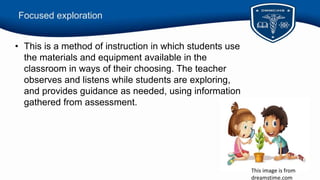
Focused exploration
• This is a method of instruction in which students use
the materials and equipment available in the
classroom in ways of their choosing. The teacher
observes and listens while students are exploring,
and provides guidance as needed, using information
gathered from assessment.
This image is from
dreamstime.com
Generalization
• The way the physical environment is designed and configured
influences how children feel, act, and behave.
• Students can become frustrated when they do not have an
organized environment to call their own (Clayton & Forton,
2001).
• Environment is defined as the physical environment, its
surroundings, and a specific setting (Vickerius & Sandberg,
2006).
• Teaching art should not be reduced to the teacher’s conception
of what is good for children, or what should be learned.
Generalization
• Brainstorming has other attributes; it motivates, stimulates, and
promotes student interaction.
• Conferences provide teachers with an opportunity to guide and
support learners and a forum for students to demonstrate their
learning through discussion, sketchbooks, or portfolios.
• Cooperative-learning techniques allow students to work as a team
to accomplish a common learning goal.
• Discussion can be used to clarify understanding of concepts,
ideas, and information.
Generalization
• Experimenting is central to the arts, and is frequently used in
making connections between the concrete and the abstract.
• This is a method of instruction in which students use the
materials and equipment available in the classroom in ways of
their choosing.
References
1. [archiveorg fromplaytoart00szek width=560 height=384
frameborder=0 webkitallowfullscreen=true
mozallowfullscreen=true]
2. https://www.studocu.com/row/document/mount-kenya-
university/intro-education-psychology/bec4216-methods-of-
teaching-art-and-craft/16536033
3. https://www.reesoneducation.com/blog/2020/07/brainstorming-in-
the-classroom
4. https://www.sagepub.com/sites/default/files/upm-
binaries/53567_ch_10.pdf
Quiz
Instruction: Answer the question below.
1. Why do we have to consider the place or the physical
environment when teaching the Arts subject in elementary
grades?
2. Among the methods/ strategies of teaching arts that has been
mention earlier, which do you think is the most important to
consider as a future educator?
THANK YOU FOR
LISTENING!
Image is from
pinterest.
DELUNAS, ARJANE REPORT#2 (ARTS).pptx

DELUNAS, ARJANE REPORT#2 (ARTS).pptx

  • 1.
    Teaching Arts inthe Elementary Grades
  • 2.
    Opening Prayer Student's Prayer (BySt. Thomas Aquinas) Creator of all things, true source of light and wisdom, origin of all being, graciously let a ray of your light penetrate the darkness of my understanding. Take from me the double darkness in which I have been born, an obscurity of sin and ignorance. Give me a keen understanding, a retentive memory, and the ability to grasp things correctly and fundamentally. Grant me the talent of being exact in my explanations and the ability to express myself with thoroughness and charm. Point out the beginning, direct the progress, and help in the completion. I ask this through Christ our Lord. Amen. Read more at: https://www.lords-prayer-words.com/prayers_before/prayers_for_students.html
  • 3.
    Topics: Teaching Strategies inTeaching Arts • Physical Environment and Play • Brainstorming • Conference • Cooperative learning • Discussion • Experimenting • Focused Exploration Prepared by: Arjane De Lunas
  • 4.
    Objectives At the endof the discussion, the students are able to: Define physical environment and play as strategies to teach arts Understand the importance of physical environment and play Deepen knowledge about the other strategies in teaching arts
  • 5.
    Physical Environment andPlay • A well-arranged environment should enhance children’s development through learning and play. • It facilitates classroom management and supports the implementation of curricular goals and objectives (Catron & Allen, 2007). • The way the physical environment is designed and configured influences how children feel, act, and behave. • The physical environment allows growth and development through activities and materials in defined play areas. Room arrangement for play activity plays an important role in students’ social and language interactions. *This Image is from community.today.com*
  • 6.
    Physical Environment andPlay • Poorly designed classrooms can cause disruptions and negative social interactions among students and/or between students and the teacher. • Students can become frustrated when they do not have an organized environment to call their own (Clayton & Forton, 2001). • It should be well organized, comfortable, and personable and offer a variety of manipulates for cognitive, social, emotional, and physical development (Catron & Allen, 2007).
  • 7.
    Physical Environment andPlay • To understand play, we first must understand the importance of the environment in the eyes of children and adults. • Some people may see the environment as insignificant, but for teachers, parents, and educators it is something that needs to be considered a high priority. • Environment is defined as the physical environment, its surroundings, and a specific setting (Vickerius & Sandberg, 2006). • The physical environment will vary depending on the age and number of children in the classroom, as well as the goals of programs and specific activities in the classroom.
  • 8.
    Physical Environment andPlay • Art educator Stacey Salazar discussed the relationship between play and art, saying, “Creativity and play can overlap when playful states encourage new possibilities, connections, and ideas—that is, play invites creative thought” (Salazar, 2015, p. 33). • George Szekely said, “As a working artist, I’ve discovered that my own ability to play is an important component of my ability to create art.” • Play brings out their individuality and allows their imaginations to thrive. Szekely also said that all of his classroom lessons are introduced through play. “This, I believe, is the most valuable teaching I can give.” he added.
  • 9.
    Physical Environment andPlay • When art instruction is planned around the experience of play, children can draw ideas from their own experiences instead of strictly following the teacher’s lead. • Teaching art should not be reduced to the teacher’s conception of what is good for children, or what should be learned. • If play is to be essential component of the school curriculum, the art class is a logical place for it. A playful attitude is the perfect frame of mind for the experimental ventures of art requires. • Art lessons should be active experiences, journeys of the body and mind to fantasies reaching far beyond the classroom. • If art is to have value as a means of expression, children must be encouraged to use the medium in their own way.
  • 10.
    Physical Environment andPlay • Skezely’s personal research has shown that, when play rather than art is emphasized in the classroom, there is less preoccupation with talent or fear of failure. • Art teaching should strive to capture the fun. Having fun is a prime motivation for making art. • The act of playing is less burdened with pretensions, traditions, and preconceived ideas than any other human activity. • In art, play is the experimental part of the process, the portion that frames ideas and rehearses them. • Through play, child-artists learn to value their own ideas about art and find pleasure in the search.
  • 11.
    Brainstorming • Brainstorming inthe classroom is a useful teaching strategy. It is a powerful tool that generates ideas and helps find solutions to problems. • Brainstorming has other attributes; it motivates, stimulates, and promotes student interaction. • Teachers can use brainstorming as a thinking strategy to help students generate questions, ideas, and examples and to explore a central idea or topic. • During brainstorming, students share ideas that come to mind and record these ideas without making judgements about them. *This image is from google.*f
  • 12.
    Brainstorming • When introducinga topic, teachers can use brainstorming sessions to determine what students already know or wish to learn, and to provide direction for learning and reflection. • Brainstorming stimulates fluent and flexible thinking and can also be used to extend problem-solving skills. How do we achieve effective brainstorming? Initially, some students may be reluctant to speak out in a group setting, but this can be overcome by following a few basic steps. • Brainstorming is most productive when conducted in a warm, friendly supportive environment; try to establish an ambient discussion environment. *This image is from reesoneducation.com.*
  • 13.
    Brainstorming • Put theemphasis on quantity rather than the quality of ideas; encourage students to think outside the box. • Concentrate on collecting ideas initially; discourage evaluation and critical comments from group members during the gathering phase. • As the teacher, encourage and provide opportunity for all students to participate in the session. *This image is from google.*
  • 14.
    Conference • During astudent–teacher conference, students can report on their progress, consider problems and solutions, and note strengths and areas for improvement. Teachers can discuss students’ work with pairs or small groups of students in order to facilitate learning. Conferences therefore require an inviting and supportive atmosphere to encourage open discussion, as well as a high level of trust between participants. Conferences provide teachers with an opportunity to guide and support learners and a forum for students to demonstrate their learning through discussion, sketchbooks, or portfolios. *This image is from shutterstock.com.*
  • 15.
    Cooperative learning • Cooperative-learningtechniques allow students to work as a team to accomplish a common learning goal. For example, a group of students may work together to prepare a drama, dance, or music performance, to create an art work, or to complete a research project. In addition to the final product produced by the group, an important aspect of the cooperative-learning process is having each group member examine how the group functioned in its task and evaluate his or her own contribution to the group process. Discussions, journal entries, and self-evaluation checklists are some ways in which students can reflect on the group work process and their part in it. This image is taken from clipart library.
  • 16.
    Discussion • Discussion isa cooperative strategy through which students explore their thinking, respond to ideas, process information, and articulate their thoughts in exchanges with peers and the teacher. Discussion can be used to clarify understanding of concepts, ideas, and information. Emphasis is placed on talking and listening to each other. Through discussion, students can make connections between ideas and experience, and reflect on a variety of meanings and interpretations of texts and experiences.
  • 17.
    Experimenting • Experimenting iscentral to the arts, and is frequently used in making connections between the concrete and the abstract. Experimenting requires that students investigate, test, explore, manipulate, solve problems, make decisions, and organize information in hands-on ways. Experimenting also encourages students to use cooperative skills effectively in interpreting and communicating findings. Experimenting enhances student motivation, understanding, and active involvement and can be initiated by the teacher or the student. *This image is from clipart library.*
  • 18.
    Focused exploration • Thisis a method of instruction in which students use the materials and equipment available in the classroom in ways of their choosing. The teacher observes and listens while students are exploring, and provides guidance as needed, using information gathered from assessment. This image is from dreamstime.com
  • 19.
    Generalization • The waythe physical environment is designed and configured influences how children feel, act, and behave. • Students can become frustrated when they do not have an organized environment to call their own (Clayton & Forton, 2001). • Environment is defined as the physical environment, its surroundings, and a specific setting (Vickerius & Sandberg, 2006). • Teaching art should not be reduced to the teacher’s conception of what is good for children, or what should be learned.
  • 20.
    Generalization • Brainstorming hasother attributes; it motivates, stimulates, and promotes student interaction. • Conferences provide teachers with an opportunity to guide and support learners and a forum for students to demonstrate their learning through discussion, sketchbooks, or portfolios. • Cooperative-learning techniques allow students to work as a team to accomplish a common learning goal. • Discussion can be used to clarify understanding of concepts, ideas, and information.
  • 21.
    Generalization • Experimenting iscentral to the arts, and is frequently used in making connections between the concrete and the abstract. • This is a method of instruction in which students use the materials and equipment available in the classroom in ways of their choosing.
  • 22.
    References 1. [archiveorg fromplaytoart00szekwidth=560 height=384 frameborder=0 webkitallowfullscreen=true mozallowfullscreen=true] 2. https://www.studocu.com/row/document/mount-kenya- university/intro-education-psychology/bec4216-methods-of- teaching-art-and-craft/16536033 3. https://www.reesoneducation.com/blog/2020/07/brainstorming-in- the-classroom 4. https://www.sagepub.com/sites/default/files/upm- binaries/53567_ch_10.pdf
  • 23.
    Quiz Instruction: Answer thequestion below. 1. Why do we have to consider the place or the physical environment when teaching the Arts subject in elementary grades? 2. Among the methods/ strategies of teaching arts that has been mention earlier, which do you think is the most important to consider as a future educator?
  • 24.