2 Art and science
Is there a relationship between them?
Can they work together for the sake of
education and students?
Can they make STEM lessons more
interesting for both students and teachers?
3 The relationship
between art and science
The relationship between the arts and the sciences
is neither new nor unknown.
We are reminding you, the mechanisms in ancient
Greek theater, the machines and inventions of
Leonardo da Vinci, etc.
In the past, many efforts have been made to link and
create a collaboration between art and education.
The goal has always been to achieve more creativity,
imagination and innovation in the training process
4
Theater and education
It has been shown that the theater and its techniques
can be very useful, functional and applicable to
education.
There are many techniques in the elementary school
courses.
•Drama in education
•Creative learning
•Role playing etc
It has also been proved that theatrical techniques are
very effective for team building in the classroom among
students.
5
Theater and education
But how do they apply to high school and
adolescents?
How do they apply on lessons of the
scientific field ?
And how do they apply into multicultural
classes?
6
Benefits
In addition, theater develops skills useful in their lives
Critical Thinking = Children develop their crisis and critical thinking,
learn the importance of feedback, and not only for the lesson but for
their whole social life.
Cooperation = Theater requires discipline that encourages teamwork
whether it is written, theoretical process or is an action.
Creativity = Through creative actions children understand the world
in a unique way, preparing them for the challenges of the future
Communication = The sociality of children and communication
between them accelerate and is completed through art and
especially through theater.
Expressive Media Development = Students learn to use verbal and
non -verbal techniques in new ways to deliver their message.
Body language evolves, vocabulary develops
7
Creative stem project
Creative STEM Project aims to integrate the use of theater and
art techniques in secondary education through the
development of appropriate tools..
Develops a methodology of applying theater in secondary
education that is oriented to cover science courses.
The method includes both the theory and the practice.
With training scenarios and case studies
that the teacher can use in his teaching.
8 Science is art
The principle on which this study is based and the
proposals we make, are based on the poetic belief that
real, inspired, scientific research is art. The pioneer
scientist uses personal imagination and inspiration .
9
The IF
If :
it is the beginning of everything in art.
It is the power that activates the imagination.
Imagination and logic work together ideally for
the scientist to come to a conclusion.
10 Imagination, image,
experiment, result/conclusion
Art is based on the image and the virtual representation of reality.
A key element of art is also the discovery and the joy of discovering
new things, emotions and experiences.
When viewing a work of art, a "dialogue" within is created by the
viewer, where impressions (from the work of art) talk to each other
and employ his critical thinking.
Introducing art into teaching, by turning Stem into Steam we seek
exactly the same things.
11 The game
A key element of both the child and the scientist.
The child plays by making different things with Lego blocks, simple
bricks or whatelse he finds.
The scientist plays with materials, numbers and actions, with
substances.
The fact that the adult has some other materials in his "play" , than
Lego blocks. a little difference makes nature in itself.
12
Entering Steam's territory
At this point it is advisable to give a definition of Steam.
“STEAM is an educational approach to learning, that uses
Science, Technology,
Engineering, the Arts and Mathematics as access points for
guiding student inquiry,
dialogue, and critical thinking. The end results are students who
take thoughtful risks, engage in experiential learning, persist in
problem-solving, embrace collaboration, and work through the
creative process.»
13
Passport to get into Steam's territory
The introduction of art into STEM lessons is not a simple
process. A more general adaptation of the entire school, the
educational processes on the part of the state.
14
I Create-you create
I play -you play
Performing arts, the game in the classroom must be shifted
to the creative educational game.
This art has to offer a field of action full of stimuli different
from those we have known so far in the conventional
"teacher-centered" teaching methods.
15
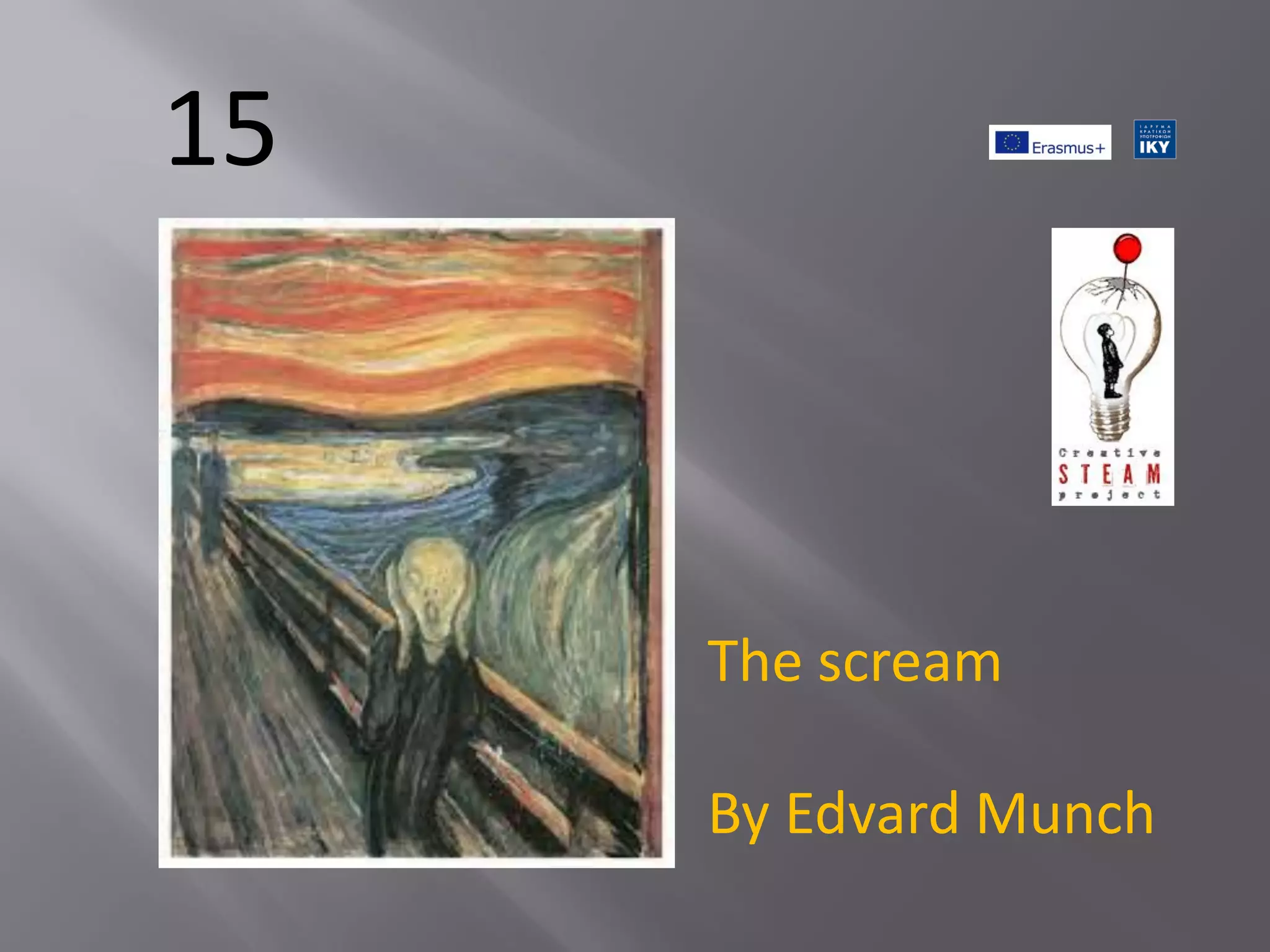
The scream
By Edvard Munch
16
• Very good knowledge of the scientific subject
• Imagination and inspiration
• Expanded horizons and interest in areas such as the arts
• Concentration
• Accurate design of the course structure
• Concentration of the materials we need for the lesson.
The necessary steps for the teacher
17
1st level of approach
the starting point
We start (most of the time) from the artistic
event we chose
The professor presents e.g. the table and talks
about him. His reason must allow students to
be discussed and participating, with questions
and comments.
18
References to the tables are important but
our subject is the lesson.
Step by step we come to our subject. From
the table we reach the lesson and the
conclusions we want. Characteristics and
in their nature, composition and behavior
2o level of approach
Adrian Chesterman -London in 1955,
19
3rd level of approach
Movement action, participation-cooperation
We always seek to involve children in some
action. This action can be a improvisation
with or without reason, a real dance or
invented for the lesson, a construction, a
visual painting action, a pylon sculpture, a
collage, an activity of making a material that
may look like cooking etc.
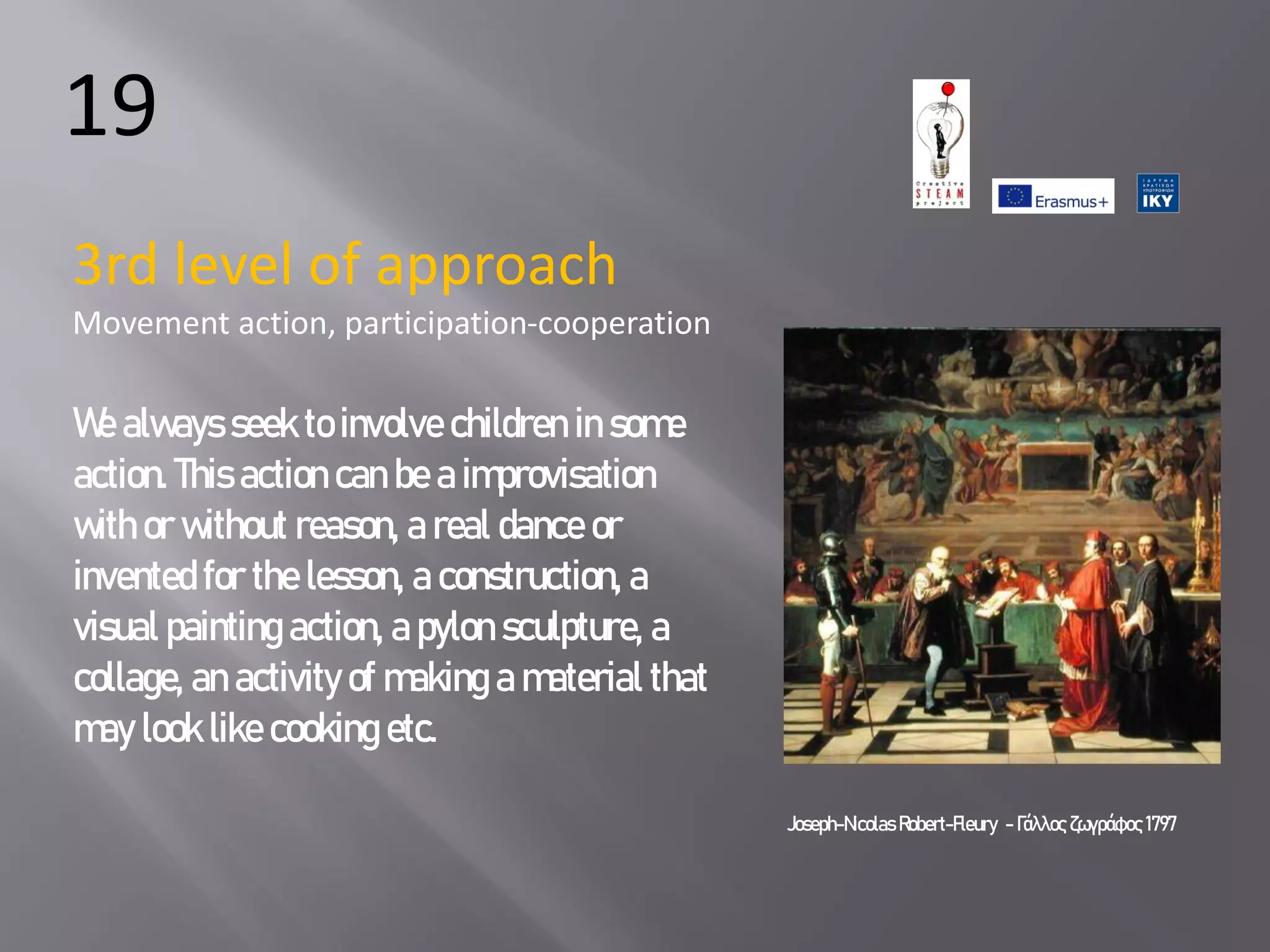
Joseph-Nicolas Robert-Fleury - Γάλλος ζωγράφος 1797
20
The action-theatrical activity
Action is the key for the lesson to:
Be experiential,
To maintain its team-working character
To cultivate critical thinking,
To open new horizons to children,
To develop their imagination and their sensitivity,
To make them (through dialogue) to express themselves freely,
To express their view whatever it is and that will arise from their
critical thinking.
To chat and 'confront' with the views of other students and thus to
develop their relationships and sociality.
21
4th level of approach Observations
conclusions from action
We are gradually returning to the "rigor" of the
lesson. We concentrate on the subject and specify
the conclusions that came from previous levels of
approach. The experiential process, images and
performances created during the action must be
summarized and left in the memory and experience
of students as knowledge.
22
Final results & conclusions
• We started from the field of Art
• We talked about a work of art
• We analyzed its details
• We focused in its individual elements
• We concluded and assumed things that are beyond the
artist's depiction
• We created actions and games with movement and
dramatic energy.
• And finally we came to scientific conclusions abandoning
the artistic environment and atmosphere.
23
The A between E and M
The areas in which such a process are many and
necessary for the integrated development of the
young man.
Learning becomes knowledge and experience
and the role of the school escapes specialization
and training
and arrives to provide education with all the
meaning of the word and in -depth cultivation.
24
We depicted the learning process
we created experiences in the process of
transferring knowledge from the teacher to
students
We were carried awaybypassivity to participation
Teaching the close descriptions of a cognitive
subject was transferred to a vast horizon. The
horizon of art
25
The official
Domain/website
stemproject.eu
26

Creative STEM project-Methodology.pdf

  • 2.
    2 Art andscience Is there a relationship between them? Can they work together for the sake of education and students? Can they make STEM lessons more interesting for both students and teachers?
  • 3.
    3 The relationship betweenart and science The relationship between the arts and the sciences is neither new nor unknown. We are reminding you, the mechanisms in ancient Greek theater, the machines and inventions of Leonardo da Vinci, etc. In the past, many efforts have been made to link and create a collaboration between art and education. The goal has always been to achieve more creativity, imagination and innovation in the training process
  • 4.
    4 Theater and education Ithas been shown that the theater and its techniques can be very useful, functional and applicable to education. There are many techniques in the elementary school courses. •Drama in education •Creative learning •Role playing etc It has also been proved that theatrical techniques are very effective for team building in the classroom among students.
  • 5.
    5 Theater and education Buthow do they apply to high school and adolescents? How do they apply on lessons of the scientific field ? And how do they apply into multicultural classes?
  • 6.
    6 Benefits In addition, theaterdevelops skills useful in their lives Critical Thinking = Children develop their crisis and critical thinking, learn the importance of feedback, and not only for the lesson but for their whole social life. Cooperation = Theater requires discipline that encourages teamwork whether it is written, theoretical process or is an action. Creativity = Through creative actions children understand the world in a unique way, preparing them for the challenges of the future Communication = The sociality of children and communication between them accelerate and is completed through art and especially through theater. Expressive Media Development = Students learn to use verbal and non -verbal techniques in new ways to deliver their message. Body language evolves, vocabulary develops
  • 7.
    7 Creative stem project CreativeSTEM Project aims to integrate the use of theater and art techniques in secondary education through the development of appropriate tools.. Develops a methodology of applying theater in secondary education that is oriented to cover science courses. The method includes both the theory and the practice. With training scenarios and case studies that the teacher can use in his teaching.
  • 8.
    8 Science isart The principle on which this study is based and the proposals we make, are based on the poetic belief that real, inspired, scientific research is art. The pioneer scientist uses personal imagination and inspiration .
  • 9.
    9 The IF If : itis the beginning of everything in art. It is the power that activates the imagination. Imagination and logic work together ideally for the scientist to come to a conclusion.
  • 10.
    10 Imagination, image, experiment,result/conclusion Art is based on the image and the virtual representation of reality. A key element of art is also the discovery and the joy of discovering new things, emotions and experiences. When viewing a work of art, a "dialogue" within is created by the viewer, where impressions (from the work of art) talk to each other and employ his critical thinking. Introducing art into teaching, by turning Stem into Steam we seek exactly the same things.
  • 11.
    11 The game Akey element of both the child and the scientist. The child plays by making different things with Lego blocks, simple bricks or whatelse he finds. The scientist plays with materials, numbers and actions, with substances. The fact that the adult has some other materials in his "play" , than Lego blocks. a little difference makes nature in itself.
  • 12.
    12 Entering Steam's territory Atthis point it is advisable to give a definition of Steam. “STEAM is an educational approach to learning, that uses Science, Technology, Engineering, the Arts and Mathematics as access points for guiding student inquiry, dialogue, and critical thinking. The end results are students who take thoughtful risks, engage in experiential learning, persist in problem-solving, embrace collaboration, and work through the creative process.»
  • 13.
    13 Passport to getinto Steam's territory The introduction of art into STEM lessons is not a simple process. A more general adaptation of the entire school, the educational processes on the part of the state.
  • 14.
    14 I Create-you create Iplay -you play Performing arts, the game in the classroom must be shifted to the creative educational game. This art has to offer a field of action full of stimuli different from those we have known so far in the conventional "teacher-centered" teaching methods.
  • 15.
  • 16.
    16 • Very goodknowledge of the scientific subject • Imagination and inspiration • Expanded horizons and interest in areas such as the arts • Concentration • Accurate design of the course structure • Concentration of the materials we need for the lesson. The necessary steps for the teacher
  • 17.
    17 1st level ofapproach the starting point We start (most of the time) from the artistic event we chose The professor presents e.g. the table and talks about him. His reason must allow students to be discussed and participating, with questions and comments.
  • 18.
    18 References to thetables are important but our subject is the lesson. Step by step we come to our subject. From the table we reach the lesson and the conclusions we want. Characteristics and in their nature, composition and behavior 2o level of approach Adrian Chesterman -London in 1955,
  • 19.
    19 3rd level ofapproach Movement action, participation-cooperation We always seek to involve children in some action. This action can be a improvisation with or without reason, a real dance or invented for the lesson, a construction, a visual painting action, a pylon sculpture, a collage, an activity of making a material that may look like cooking etc. Joseph-Nicolas Robert-Fleury - Γάλλος ζωγράφος 1797
  • 20.
    20 The action-theatrical activity Actionis the key for the lesson to: Be experiential, To maintain its team-working character To cultivate critical thinking, To open new horizons to children, To develop their imagination and their sensitivity, To make them (through dialogue) to express themselves freely, To express their view whatever it is and that will arise from their critical thinking. To chat and 'confront' with the views of other students and thus to develop their relationships and sociality.
  • 21.
    21 4th level ofapproach Observations conclusions from action We are gradually returning to the "rigor" of the lesson. We concentrate on the subject and specify the conclusions that came from previous levels of approach. The experiential process, images and performances created during the action must be summarized and left in the memory and experience of students as knowledge.
  • 22.
    22 Final results &conclusions • We started from the field of Art • We talked about a work of art • We analyzed its details • We focused in its individual elements • We concluded and assumed things that are beyond the artist's depiction • We created actions and games with movement and dramatic energy. • And finally we came to scientific conclusions abandoning the artistic environment and atmosphere.
  • 23.
    23 The A betweenE and M The areas in which such a process are many and necessary for the integrated development of the young man. Learning becomes knowledge and experience and the role of the school escapes specialization and training and arrives to provide education with all the meaning of the word and in -depth cultivation.
  • 24.
    24 We depicted thelearning process we created experiences in the process of transferring knowledge from the teacher to students We were carried awaybypassivity to participation Teaching the close descriptions of a cognitive subject was transferred to a vast horizon. The horizon of art
  • 25.
  • 26.