August 2020
Automotive IT Strategy
Three Major Success Factors for Automotive CIOs to
Shape a Future-Proof IT Organization
Automotive IT Strategy 20202020 Deloitte 2
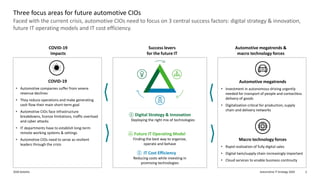
Faced with the current crisis, automotive CIOs need to focus on 3 central success factors: digital strategy & innovation,
future IT operating models and IT cost efficiency.
Three focus areas for future automotive CIOs
Automotive megatrends &
macro technology forces
IT Cost Efficiency
Reducing costs while investing in
promising technologies
Digital Strategy & Innovation
Deploying the right mix of technologies
Future IT Operating Model
Finding the best way to organize,
operate and behave
Success levers
for the future IT
COVID-19
impacts
Automotive megatrends
• Investment in autonomous driving urgently
needed for transport of people and contactless
delivery of goods
• Digitalization critical for production, supply
chain and delivery networks
Macro technology forces
• Rapid realization of fully digital sales
• Digital twin/supply chain increasingly important
• Cloud services to enable business continuity
COVID-19
• Automotive companies suffer from severe
revenue declines
• They reduce operations and make generating
cash flow their main short-term goal
• Automotive CIOs face infrastructure
breakdowns, license limitations, traffic overload
and cyber attacks
• IT departments have to establish long-term
remote working systems & settings
• Automotive CIOs need to serve as resilient
leaders through the crisis
Automotive IT Strategy 20202020 Deloitte 3
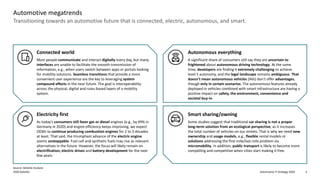
Transitioning towards an automotive future that is connected, electric, autonomous, and smart.
Automotive megatrends
Connected world
Most people communicate and interact digitally every day, but many
interfaces are unable to facilitate the smooth transmission of
information, e.g., when users switch between apps or portals looking
for mobility solutions. Seamless transitions that provide a more
convenient user experience are the key to leveraging system
compound effects in the near future. The goal is interoperability
across the physical, digital and rules-based layers of a mobility
system.
Autonomous everything
A significant share of consumers still say they are uncertain to
frightened about autonomous driving technology. At the same
time, developers are finding it extremely challenging to achieve
level 5 autonomy, and the legal landscape remains ambiguous. That
doesn’t mean autonomous vehicles (AVs) don’t offer advantages,
though only in certain scenarios. The autonomous features already
deployed in vehicles combined with smart infrastructure are having a
positive impact on safety, the environment, convenience and
societal buy-in.
Smart sharing/owning
Some studies suggest that traditional car sharing is not a proper
long-term solution from an ecological perspective, as it increases
the total number of vehicles on our streets. That is why we need new
ownership and usage models, e.g., flexible rental models or
solutions addressing the first-mile/last-mile problem via
micromobility. In addition, public transport is likely to become more
compelling and competitive when cities start making it free.
Electricity first
As today’s consumers still favor gas or diesel engines (e.g., by 49% in
Germany in 2020) and engine efficiency keeps improving, we expect
OEMs to continue producing combustion engines for 2 to 3 decades
at least. That said, the triumphant advance of the electric engine
seems unstoppable. Fuel cell and synthetic fuels may rise as relevant
alternatives in the future. However, the focus will likely remain on
electrification, electric drives and battery development for the next
few years.
Source: Deloitte Analysis
Automotive IT Strategy 20202020 Deloitte 4
Digital
reality
Cognitive
Blockchain
Business of
technology
RiskAnalytics
Cloud
Digital
experience
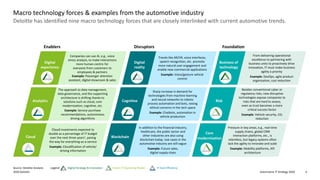
Deloitte has identified nine macro technology forces that are closely interlinked with current automotive trends.
Macro technology forces & examples from the automotive industry
Enablers Disruptors Foundation
Companies can use AI, e.g., voice
stress analysis, to make interactions
more human-centric for
everyone from customers to
employees & partners
Example: Passenger attention
assistant, digital showroom & sales
The approach to data management,
data governance, and the supporting
architecture is shifting thanks to
solutions such as cloud, core
modernization, cognitive, etc.
Example: Service purchase
recommendations, autonomous
driving algorithms
Cloud investments expected to
double as a percentage of IT budget
over the next three years1, paving
the way for everything-as-a-service
Example: Cloudification of vehicle/
driving information
Trends like AR/VR, voice interfaces,
speech recognition, etc. promote
more natural user engagement and
enable new commercial applications
Example: Voice/gesture vehicle
control
Sharp increase in demand for
technologies from machine learning
and neural networks to robotic
process automation and bots, raising
ethical concerns in the tech space
Example: Chatbots, automation in
vehicle production
In addition to the financial industry,
healthcare, the public sector and
other industries are also using
blockchain today. Use cases in the
automotive industry are still vague
Example: Future sales,
digital supply chain
From delivering operational
excellence to partnering with
business units to proactively drive
innovation, IT must make business
agility a priority
Example: DevOps, agile product
organization, cost reduction
Besides conventional cyber or
regulatory risks, new disruptive
technologies expose companies to
risks that are hard to assess,
even as trust becomes a more
critical success factor
Example: Vehicle security, CO²
reduction
Pressure in key areas, e.g., real-time
supply chains, global CRM
interaction platforms, etc., is
relentless, but legacy systems often
lack the agility to innovate and scale
Example: Mobility platforms, API
architecture
Core
modernization
Legend: Digital Strategy & Innovation Future IT Operating Model IT Cost-EfficiencySource: Deloitte Analysis
Automotive IT Strategy 20202020 Deloitte 5
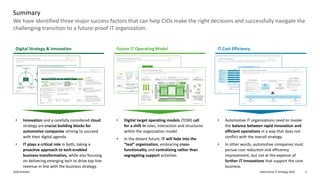
We have identified three major success factors that can help CIOs make the right decisions and successfully navigate the
challenging transition to a future-proof IT organization.
Summary
• Innovation and a carefully considered cloud
strategy are crucial building blocks for
automotive companies striving to succeed
with their digital agenda.
• IT plays a critical role in both, taking a
proactive approach to tech-enabled
business transformation, while also focusing
on delivering emerging tech to drive top-line
revenue in line with the business strategy.
• Digital target operating models (TOM) call
for a shift in roles, interaction and structures
within the organization model.
• In the distant future, IT will fade into the
“teal” organization, embracing cross-
functionality and centralizing rather than
segregating support activities.
• Automotive IT organizations need to master
the balance between rapid innovation and
efficient operations in a way that does not
conflict with the overall strategy.
• In other words, automotive companies must
pursue cost reduction and efficiency
improvement, but not at the expense of
further IT innovations that support the core
business.
Digital Strategy & Innovation IT Cost EfficiencyFuture IT Operating Model
Automotive IT Strategy 20202020 Deloitte 6
We encourage you to reach out to us on how to position your IT organization and strategic agenda in a way that best
addresses today’s macro technological forces and automotive megatrends as well as COVID-19 mitigation actions.
Contacts
Contacts
Christian Pfeifer
Consultant
Technology Strategy&
Transformation
Thomas Demel
Senior Consultant
Technology Strategy&
Transformation
David Haslach
SeniorConsultant
Technology Strategy&
Transformation
Jonas Glade
SeniorConsultant
TechnologyStrategy&
Transformation
With the contribution of:
Markus  Schmidthuysen
SeniorManager
Tech Strategy& Transformation
mschmidthuysen@deloitte.de
Uwe Strauss
Partner
Tech Strategy& Transformation
ustrauss@deloitte.de
Director
Tech Strategy& Transformation
anklein@deloitte.de
Andreas Klein
This presentation contains general information only, and none of Deloitte Consulting GmbH or Deloitte Touche Tohmatsu Limited (“DTTL”), any of DTTL’s member firms, or any of the
foregoing’s affiliates (collectively, the “Deloitte Network”) are, by means of this presentation, rendering professional advice or services. In particular this presentation cannot be used as
a substitute for such professional advice. No entity in the Deloitte Network shall be responsible for any loss whatsoever sustained by any person who relies on this presentation. This
presentation is to be treated confidential. Any disclosure to third parties – in whole or in part – is subject to our prior written consent.
Deloitte refers to one or more of Deloitte Touche Tohmatsu Limited, a UK private company limited by guarantee (“DTTL”), its network of member firms, and their related entities. DTTL
and each of its member firms are legally separate and independent entities. DTTL (also referred to as “Deloitte Global”) does not provide services to clients. Please see
www.deloitte.com/de/UeberUns for a more detailed description of DTTL and its member firms.
Deloitte provides audit, risk advisory, tax, financial advisory and consulting services to public and private clients spanning multiple industries; legal advisory services in Germany are
provided by Deloitte Legal. With a globally connected network of member firms in more than 150 countries, Deloitte brings world-class capabilities and high-quality service to clients,
delivering the insights they need to address their most complex business challenges. Deloitte’s approximately 312,000 professionals are committed to making an impact that matters.

Deloitte Automotive IT Strategy Teaser Slides

  • 1.
    August 2020 Automotive ITStrategy Three Major Success Factors for Automotive CIOs to Shape a Future-Proof IT Organization
  • 2.
    Automotive IT Strategy20202020 Deloitte 2 Faced with the current crisis, automotive CIOs need to focus on 3 central success factors: digital strategy & innovation, future IT operating models and IT cost efficiency. Three focus areas for future automotive CIOs Automotive megatrends & macro technology forces IT Cost Efficiency Reducing costs while investing in promising technologies Digital Strategy & Innovation Deploying the right mix of technologies Future IT Operating Model Finding the best way to organize, operate and behave Success levers for the future IT COVID-19 impacts Automotive megatrends • Investment in autonomous driving urgently needed for transport of people and contactless delivery of goods • Digitalization critical for production, supply chain and delivery networks Macro technology forces • Rapid realization of fully digital sales • Digital twin/supply chain increasingly important • Cloud services to enable business continuity COVID-19 • Automotive companies suffer from severe revenue declines • They reduce operations and make generating cash flow their main short-term goal • Automotive CIOs face infrastructure breakdowns, license limitations, traffic overload and cyber attacks • IT departments have to establish long-term remote working systems & settings • Automotive CIOs need to serve as resilient leaders through the crisis
  • 3.
    Automotive IT Strategy20202020 Deloitte 3 Transitioning towards an automotive future that is connected, electric, autonomous, and smart. Automotive megatrends Connected world Most people communicate and interact digitally every day, but many interfaces are unable to facilitate the smooth transmission of information, e.g., when users switch between apps or portals looking for mobility solutions. Seamless transitions that provide a more convenient user experience are the key to leveraging system compound effects in the near future. The goal is interoperability across the physical, digital and rules-based layers of a mobility system. Autonomous everything A significant share of consumers still say they are uncertain to frightened about autonomous driving technology. At the same time, developers are finding it extremely challenging to achieve level 5 autonomy, and the legal landscape remains ambiguous. That doesn’t mean autonomous vehicles (AVs) don’t offer advantages, though only in certain scenarios. The autonomous features already deployed in vehicles combined with smart infrastructure are having a positive impact on safety, the environment, convenience and societal buy-in. Smart sharing/owning Some studies suggest that traditional car sharing is not a proper long-term solution from an ecological perspective, as it increases the total number of vehicles on our streets. That is why we need new ownership and usage models, e.g., flexible rental models or solutions addressing the first-mile/last-mile problem via micromobility. In addition, public transport is likely to become more compelling and competitive when cities start making it free. Electricity first As today’s consumers still favor gas or diesel engines (e.g., by 49% in Germany in 2020) and engine efficiency keeps improving, we expect OEMs to continue producing combustion engines for 2 to 3 decades at least. That said, the triumphant advance of the electric engine seems unstoppable. Fuel cell and synthetic fuels may rise as relevant alternatives in the future. However, the focus will likely remain on electrification, electric drives and battery development for the next few years. Source: Deloitte Analysis
  • 4.
    Automotive IT Strategy20202020 Deloitte 4 Digital reality Cognitive Blockchain Business of technology RiskAnalytics Cloud Digital experience Deloitte has identified nine macro technology forces that are closely interlinked with current automotive trends. Macro technology forces & examples from the automotive industry Enablers Disruptors Foundation Companies can use AI, e.g., voice stress analysis, to make interactions more human-centric for everyone from customers to employees & partners Example: Passenger attention assistant, digital showroom & sales The approach to data management, data governance, and the supporting architecture is shifting thanks to solutions such as cloud, core modernization, cognitive, etc. Example: Service purchase recommendations, autonomous driving algorithms Cloud investments expected to double as a percentage of IT budget over the next three years1, paving the way for everything-as-a-service Example: Cloudification of vehicle/ driving information Trends like AR/VR, voice interfaces, speech recognition, etc. promote more natural user engagement and enable new commercial applications Example: Voice/gesture vehicle control Sharp increase in demand for technologies from machine learning and neural networks to robotic process automation and bots, raising ethical concerns in the tech space Example: Chatbots, automation in vehicle production In addition to the financial industry, healthcare, the public sector and other industries are also using blockchain today. Use cases in the automotive industry are still vague Example: Future sales, digital supply chain From delivering operational excellence to partnering with business units to proactively drive innovation, IT must make business agility a priority Example: DevOps, agile product organization, cost reduction Besides conventional cyber or regulatory risks, new disruptive technologies expose companies to risks that are hard to assess, even as trust becomes a more critical success factor Example: Vehicle security, CO² reduction Pressure in key areas, e.g., real-time supply chains, global CRM interaction platforms, etc., is relentless, but legacy systems often lack the agility to innovate and scale Example: Mobility platforms, API architecture Core modernization Legend: Digital Strategy & Innovation Future IT Operating Model IT Cost-EfficiencySource: Deloitte Analysis
  • 5.
    Automotive IT Strategy20202020 Deloitte 5 We have identified three major success factors that can help CIOs make the right decisions and successfully navigate the challenging transition to a future-proof IT organization. Summary • Innovation and a carefully considered cloud strategy are crucial building blocks for automotive companies striving to succeed with their digital agenda. • IT plays a critical role in both, taking a proactive approach to tech-enabled business transformation, while also focusing on delivering emerging tech to drive top-line revenue in line with the business strategy. • Digital target operating models (TOM) call for a shift in roles, interaction and structures within the organization model. • In the distant future, IT will fade into the “teal” organization, embracing cross- functionality and centralizing rather than segregating support activities. • Automotive IT organizations need to master the balance between rapid innovation and efficient operations in a way that does not conflict with the overall strategy. • In other words, automotive companies must pursue cost reduction and efficiency improvement, but not at the expense of further IT innovations that support the core business. Digital Strategy & Innovation IT Cost EfficiencyFuture IT Operating Model
  • 6.
    Automotive IT Strategy20202020 Deloitte 6 We encourage you to reach out to us on how to position your IT organization and strategic agenda in a way that best addresses today’s macro technological forces and automotive megatrends as well as COVID-19 mitigation actions. Contacts Contacts Christian Pfeifer Consultant Technology Strategy& Transformation Thomas Demel Senior Consultant Technology Strategy& Transformation David Haslach SeniorConsultant Technology Strategy& Transformation Jonas Glade SeniorConsultant TechnologyStrategy& Transformation With the contribution of: Markus  Schmidthuysen SeniorManager Tech Strategy& Transformation mschmidthuysen@deloitte.de Uwe Strauss Partner Tech Strategy& Transformation ustrauss@deloitte.de Director Tech Strategy& Transformation anklein@deloitte.de Andreas Klein
  • 7.
    This presentation containsgeneral information only, and none of Deloitte Consulting GmbH or Deloitte Touche Tohmatsu Limited (“DTTL”), any of DTTL’s member firms, or any of the foregoing’s affiliates (collectively, the “Deloitte Network”) are, by means of this presentation, rendering professional advice or services. In particular this presentation cannot be used as a substitute for such professional advice. No entity in the Deloitte Network shall be responsible for any loss whatsoever sustained by any person who relies on this presentation. This presentation is to be treated confidential. Any disclosure to third parties – in whole or in part – is subject to our prior written consent. Deloitte refers to one or more of Deloitte Touche Tohmatsu Limited, a UK private company limited by guarantee (“DTTL”), its network of member firms, and their related entities. DTTL and each of its member firms are legally separate and independent entities. DTTL (also referred to as “Deloitte Global”) does not provide services to clients. Please see www.deloitte.com/de/UeberUns for a more detailed description of DTTL and its member firms. Deloitte provides audit, risk advisory, tax, financial advisory and consulting services to public and private clients spanning multiple industries; legal advisory services in Germany are provided by Deloitte Legal. With a globally connected network of member firms in more than 150 countries, Deloitte brings world-class capabilities and high-quality service to clients, delivering the insights they need to address their most complex business challenges. Deloitte’s approximately 312,000 professionals are committed to making an impact that matters.