Delivering
Development
Resultsat
Scale
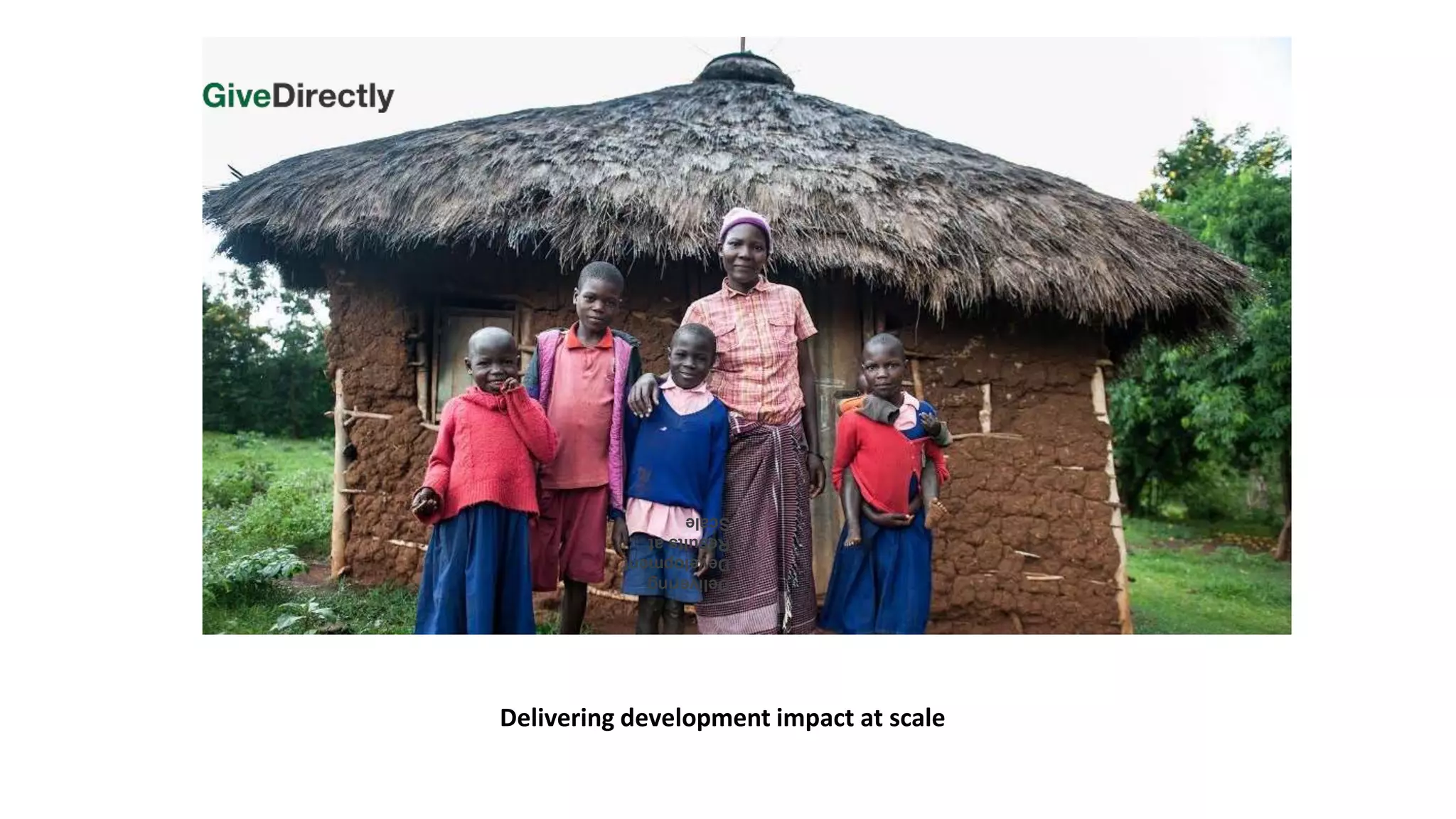
Delivering development impact at scale
Why This
Matters
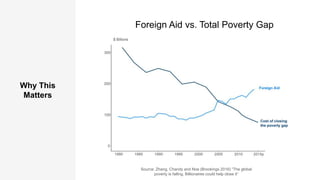
Source: Zhang, Chandy and Noe (Brookings 2016) “The global
poverty is falling. Billionaires could help close it”
Foreign Aid vs. Total Poverty Gap
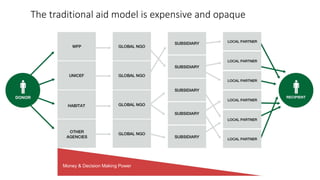
The traditional aid model is expensive and opaque
Money & Decision Making Power
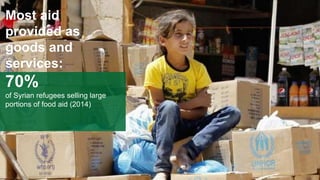
Most aid
provided as
goods and
services:
70%
of Syrian refugees selling large
portions of food aid (2014)
A new, scalable model for aidGiveDirectly
1
1
2
1
1
1
1
7
4
4
2
1
1
1
1
2
3
1
1
1
5
Unconditional or both
Conditional
Unconditional or both
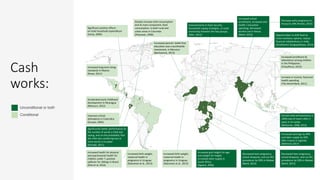
Greatly increase total consumption
and its main component, food
consumption, in both rural and
urban areas in Columbia
(Attanasio, 2006)
Increased parents' belief that
education was a worthwhile
investment, in Morocco
(Benhassine, 2013)
Decrease early pregnancy in
Kenya by 34% (Handa, 2015)
Opportunities to shift food to
more nutritious options, reduce
financial indebtedness in India.
(Shubhashis Gangopadhyay, 2013)
Increase in income, food and
health spending
(The World Bank, 2011)
Increased enrollment &
attendance among children
in the Philippines.
(Chaudhury, 2013)
Earned male entrepreneurs a
100% rate of return after 5
years in Sri Lanka.
(McKenzie, 2008, 2012)
Increased earnings by 40%
and labor supply by 20%
after 4 years in Uganda.
(Blattman,2013)
Decreased teen pregnancy,
school dropouts, and cut HIV
prevalence by 50% in Malawi
(Baird, 2013)
Decreased teen pregnancy,
school dropouts, and cut HIV
prevalence by 50% in Malawi
(Baird, 2013)
Increased girls height-for-age
and weight-for-height,
increased labor supply in
South Africa.
(Aguero, 2006)
Increased birth weight,
maternal health in
pregnancy in Uruguay
(Glassman et al., 2013)
Increased health for physical
and psychosocial health for
children under 7, positive
spillover for siblings in Brazil.
(Shei et al, 2014)
Significantly better performance on
the number of words a child was
saying, and on the probability that
the child was combining two or
more words in Ecuador
(Fernald, 2011)
Improves school
attendance in Costa Rica
(Duryea, 2004)
Accelerated early childhood
development in Nicaragua
(Macours, 2012)
Increased long-term living
standards in Mexico
(Rowe, 2011)
Significant positive effects
on total household expenditure
(Leroy, 2009)
Increased school
enrollment, increased and
health / education
spending, decreased
alcohol use in Kenya.
(Baird, 2013)
Improvements in food security,
household coping strategies, or asset
ownership between the two groups.
(Aker, 2013)
2
Increased birth weight,
maternal health in
pregnancy in Uruguay
(Glassman et al., 2013)
1
Conditional
Cash
works:
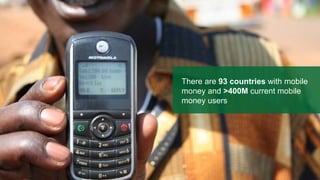
There are 93 countries with mobile
money and >400M current mobile
money users
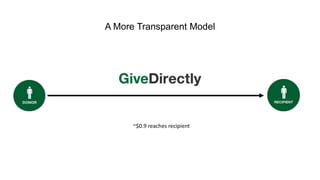
A More Transparent Model
~$0.9 reaches recipient
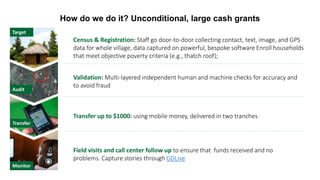
How do we do it? Unconditional, large cash grants
Target
Transfer
Monitor
Audit
Census & Registration: Staff go door-to-door collecting contact, text, image, and GPS
data for whole village, data captured on powerful, bespoke software Enroll households
that meet objective poverty criteria (e.g., thatch roof);
Validation: Multi-layered independent human and machine checks for accuracy and
to avoid fraud
Transfer up to $1000: using mobile money, delivered in two tranches
Field visits and call center follow up to ensure that funds received and no
problems. Capture stories through GDLive
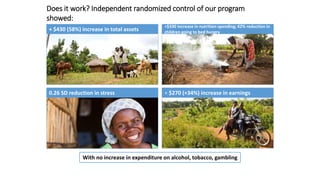
Does it work? Independent randomized control of our program
showed:
+ $430 (58%) increase in total assets
+$330 increase in nutrition spending; 42% reduction in
children going to bed hungry
0.26 SD reduction in stress + $270 (+34%) increase in earnings
With no increase in expenditure on alcohol, tobacco, gambling
Key lessons
Scaling a
new model
of aid
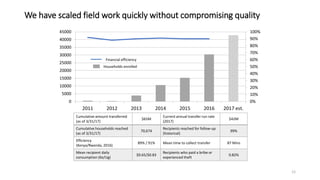
We have scaled field work quickly without compromising quality
12
0%
10%
20%
30%
40%
50%
60%
70%
80%
90%
100%
0
5000
10000
15000
20000
25000
30000
35000
40000
45000
2011 2012 2013 2014 2015 2016 2017 est.
Financial efficiency
Households enrolled
Cumulative amount transferred
(as of 3/31/17)
$65M
Current annual transfer run rate
(2017)
$42M
Cumulative households reached
(as of 3/31/17)
70,674
Recipients reached for follow-up
(historical)
99%
Efficiency
(Kenya/Rwanda, 2016)
89% / 91% Mean time to collect transfer 87 Mins
Mean recipient daily
consumption (Ke/Ug)
$0.65/$0.83
Recipients who paid a bribe or
experienced theft
0.82%
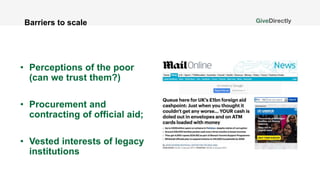
Barriers to scale
• Perceptions of the poor
(can we trust them?)
• Procurement and
contracting of official aid;
• Vested interests of legacy
institutions
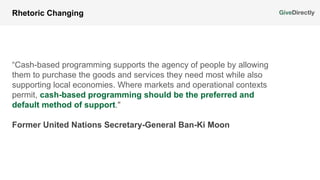
“Cash-based programming supports the agency of people by allowing
them to purchase the goods and services they need most while also
supporting local economies. Where markets and operational contexts
permit, cash-based programming should be the preferred and
default method of support."
Rhetoric Changing
Former United Nations Secretary-General Ban-Ki Moon
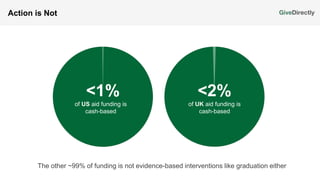
Action is Not
<1%
of US aid funding is
cash-based
The other ~99% of funding is not evidence-based interventions like graduation either
<2%
of UK aid funding is
cash-based
• Invest – Size matters
• Challenge: How are aid resources being allocated?
• German aid budget - $17.6 billion
• Private philanthropy
Accelerating scale: How can you help?

Delivering Development Impact at Scale

  • 1.
  • 2.
    Why This Matters Source: Zhang,Chandy and Noe (Brookings 2016) “The global poverty is falling. Billionaires could help close it” Foreign Aid vs. Total Poverty Gap
  • 3.
    The traditional aidmodel is expensive and opaque Money & Decision Making Power
  • 4.
    Most aid provided as goodsand services: 70% of Syrian refugees selling large portions of food aid (2014)
  • 5.
    A new, scalablemodel for aidGiveDirectly
  • 6.
    1 1 2 1 1 1 1 7 4 4 2 1 1 1 1 2 3 1 1 1 5 Unconditional or both Conditional Unconditionalor both Greatly increase total consumption and its main component, food consumption, in both rural and urban areas in Columbia (Attanasio, 2006) Increased parents' belief that education was a worthwhile investment, in Morocco (Benhassine, 2013) Decrease early pregnancy in Kenya by 34% (Handa, 2015) Opportunities to shift food to more nutritious options, reduce financial indebtedness in India. (Shubhashis Gangopadhyay, 2013) Increase in income, food and health spending (The World Bank, 2011) Increased enrollment & attendance among children in the Philippines. (Chaudhury, 2013) Earned male entrepreneurs a 100% rate of return after 5 years in Sri Lanka. (McKenzie, 2008, 2012) Increased earnings by 40% and labor supply by 20% after 4 years in Uganda. (Blattman,2013) Decreased teen pregnancy, school dropouts, and cut HIV prevalence by 50% in Malawi (Baird, 2013) Decreased teen pregnancy, school dropouts, and cut HIV prevalence by 50% in Malawi (Baird, 2013) Increased girls height-for-age and weight-for-height, increased labor supply in South Africa. (Aguero, 2006) Increased birth weight, maternal health in pregnancy in Uruguay (Glassman et al., 2013) Increased health for physical and psychosocial health for children under 7, positive spillover for siblings in Brazil. (Shei et al, 2014) Significantly better performance on the number of words a child was saying, and on the probability that the child was combining two or more words in Ecuador (Fernald, 2011) Improves school attendance in Costa Rica (Duryea, 2004) Accelerated early childhood development in Nicaragua (Macours, 2012) Increased long-term living standards in Mexico (Rowe, 2011) Significant positive effects on total household expenditure (Leroy, 2009) Increased school enrollment, increased and health / education spending, decreased alcohol use in Kenya. (Baird, 2013) Improvements in food security, household coping strategies, or asset ownership between the two groups. (Aker, 2013) 2 Increased birth weight, maternal health in pregnancy in Uruguay (Glassman et al., 2013) 1 Conditional Cash works:
  • 7.
    There are 93countries with mobile money and >400M current mobile money users
  • 8.
    A More TransparentModel ~$0.9 reaches recipient
  • 9.
    How do wedo it? Unconditional, large cash grants Target Transfer Monitor Audit Census & Registration: Staff go door-to-door collecting contact, text, image, and GPS data for whole village, data captured on powerful, bespoke software Enroll households that meet objective poverty criteria (e.g., thatch roof); Validation: Multi-layered independent human and machine checks for accuracy and to avoid fraud Transfer up to $1000: using mobile money, delivered in two tranches Field visits and call center follow up to ensure that funds received and no problems. Capture stories through GDLive
  • 10.
    Does it work?Independent randomized control of our program showed: + $430 (58%) increase in total assets +$330 increase in nutrition spending; 42% reduction in children going to bed hungry 0.26 SD reduction in stress + $270 (+34%) increase in earnings With no increase in expenditure on alcohol, tobacco, gambling
  • 11.
  • 12.
    We have scaledfield work quickly without compromising quality 12 0% 10% 20% 30% 40% 50% 60% 70% 80% 90% 100% 0 5000 10000 15000 20000 25000 30000 35000 40000 45000 2011 2012 2013 2014 2015 2016 2017 est. Financial efficiency Households enrolled Cumulative amount transferred (as of 3/31/17) $65M Current annual transfer run rate (2017) $42M Cumulative households reached (as of 3/31/17) 70,674 Recipients reached for follow-up (historical) 99% Efficiency (Kenya/Rwanda, 2016) 89% / 91% Mean time to collect transfer 87 Mins Mean recipient daily consumption (Ke/Ug) $0.65/$0.83 Recipients who paid a bribe or experienced theft 0.82%
  • 13.
    Barriers to scale •Perceptions of the poor (can we trust them?) • Procurement and contracting of official aid; • Vested interests of legacy institutions
  • 14.
    “Cash-based programming supportsthe agency of people by allowing them to purchase the goods and services they need most while also supporting local economies. Where markets and operational contexts permit, cash-based programming should be the preferred and default method of support." Rhetoric Changing Former United Nations Secretary-General Ban-Ki Moon
  • 15.
    Action is Not <1% ofUS aid funding is cash-based The other ~99% of funding is not evidence-based interventions like graduation either <2% of UK aid funding is cash-based
  • 16.
    • Invest –Size matters • Challenge: How are aid resources being allocated? • German aid budget - $17.6 billion • Private philanthropy Accelerating scale: How can you help?

Editor's Notes

  • #2 Sm
  • #5 The other thing to note about the way that aid is spent at the moment, is that usually gives people things, such as food, shelter, or does thing for them, for example provides training. Some of this is great – for example, we need aid to support public goods such as large scale vaccination campaigns, energy infrastructure etc. But other things are more problematic. For example, in 2015 the major donors spent in the region of $3 billion on food aid, yet we know that the majority of recipients sell food aid (at a lower value than it costs to supply it). About $1 billion was spent on training programmes, but we know too that all too often these fail to deliver the effect Providing goods and services is also complex. They take lots of people, and process to deliver. Again, this limits the ability to scale quickly. That is why a lot of NGO projects are quite small, covering only tiny fractions of the population.
  • #6 Two things are happening which offer an alternative to the old model of aid. First, the advent of cash programming Second, the use of technology to deliver cash programmes.
  • #7 In the past decade there has been growing evidence that giving people cash – rather than giving people things or services, is a very efficient and effective. This evidence base is global, high quality, and consistent.
  • #8 In the same decade, we have seen the rapid rise of digital payments systems, particularly mobile money which provides a way of delivering that highly effective intervention at low cost, including in remote, rural areas.
  • #9 GiveDirectly is harnessing the power of cash and technology to strip out the complexity (and inefficiency) of much conventional aid. We have developed a model that can be scaled without a loss in quality. We provide unconditional cash transfers. Usually these are quite large amounts – in the region of $1000 per household. These amounts are designed to be transformative, allowing those living in extreme poverty to make invest in new assets and in improving their livelihoods.
  • #10 Very simple 4 stage process, underpinned by digital platform that helps to drive efficient and transparent operations and helps to track impact.
  • #12 Two things are happening which offer an alternative to the old model of aid. First, the advent of cash programming Second, the use of technology to deliver cash programmes.
  • #13 We’ve been able to scale quickly in 6 years, such that we aim to deliver over $40 miillion in transfers in 2017 in three countries. Efficiency tends to increase with scale. As signalled above, what has enabled us to scale so quickly is: Clear, simple product to deliver Lean delivery systems Highly skilled teams managed for productivity Technology underpins all of these…