Definition Paper
ESSAY 1 – COMP II – DUE DATE: THURSDAY, MARCH 3
Definition Paper – What is it?
 In a definition paper, you are simply defining the problem or the issue
within your topic. This should be fairly simple for because you have chosen
this topic, so you must understand some of the complexities.
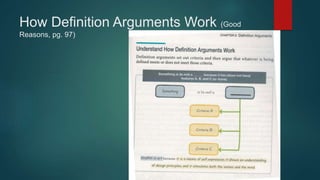
 Definition Arguments set out criteria and then argue for whatever is being
defined (your topic) and how it “meets or does not meet those criteria.” ***
 Equation: Something is (is not) a X because it has (does not have)
features A, B, and C.
 You are arguing for a specific definition or understanding of your topic.
How Definition Arguments Work (Good
Reasons, pg. 97)
Definition Paper
 A definition essay will share your special understanding about some idea
or thing (your topic).
 One way of looking at a definition paper is being able to say what your
topic is not. Breaking down logical fallacies and misperceptions on your
topic.
 Definition paper can place your topic into a certain category, either by
definition or through comparison or resemblance. You should produce a
definition paper when a particular person, thing or act (your topic) should
be identified in a certain category.
Definition Paper Approaches
 Historical spin (process paper) (Helping your audience understand a
concept, its inception and implementation (examples, predictions)
 Formal definition – Categorizing a topic into a classification system and
providing the criteria that distinguishes the topic from other items:
 Example:
 Graffiti: Art of Vandalism?
 Contemporary Universities: Building Character/Workplace Skills or Big Business?
 Commercial Whaling: Defining Whales as “sacred animals” or “a renewable food
source”
 WHERE DO WE PLACE OUR SUBJECT – THE POINT OF A DEFINITION PAPER
Definition Paper Approaches
 Operational definitions (Good Reasons, pg. 99): Researchers arguing that
the particular definition is the one that suits the concept (Studies being
conducted about a topic determine the definitive point). The need for
precise definitions that are measured scientifically.
 (A measureable definition of aggression (while studying the effects of television
on children).
Definition Paper – Rhetorical Do’s &
Don’t’s
 Within a definition paper..
 Try to come up with your own definition of your topic (single statement)
 Avoid the phrases “is where” and “is when” in your definition
 Avoid circular definitions (repeating the defined term (“A computer virus is a
virus that destroys software..”)
 Avoid narrow definitions
Definition Paper Structure: Criteria-
Match
 One approach to composing a definition paper is the Criteria-Match
Structure (Writing Arguments, p. 229)
 Two-part structure 1. A definition part that tries to establish the boundaries of
the category (What do we mean by X?) 2. A match part that argues whether a
given case meets that definition.
 YOUR CLAIM: The Hercules Shoe Company is not a socially responsible
company
 REASON: Evidence of unjust treatment (provide proof) / What criteria must be
met for a company to be deemed “socially responsible”?
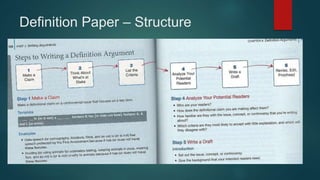
Definition Paper – Structure
Definition Paper – Why?
 Avoid misunderstandings with your audience.
 Writer vs. Intended Audience issues
 Your topic, your point of view!
 Context of a final portfolio
Definition Paper > Evaluative Paper
 If a definition paper does not apply to your topic (wildly popular topic—
perhaps you do not need to define the influence of music/mass media,
what the sport of dancing entails), perhaps you need to compose an
evaluative paper.
 Identify a controversy in your topic that involves deciding if something is
effective or ineffective, good or bad
 Pose one question within your topic frame and discuss it in depth. (EX: Are
video games a good way for young people to socialize? Should we censor
music/movies?)
Evaluative Paper Option
 Evaluate claims argue that something is GOOD/BAD/RIGHT/WRONG
because it meets a certain criteria
 Posing a question about your topic and formulating a response.
 Within your research
 “Google Maps is the best mapping program because it is easy to use, it is
accurate and it provides entertaining and educational features (i.e. Google
Earth)” (Good Reasons, pg. 139) DISCUSS IN DEPTH
 The difference between a definition paper and evaluative paper: A
definition paper wants to place something in the correct ‘light’ by
observing features. An evaluative paper focuses on what is valued. If the
criteria does not appeal to the value of your audience, your readers will
not feel your evaluation is accurate. (Disconnect from rhetorical
situation)
Whatever you decide to do…
 Take a look at some examples in our book:
 Definition Papers: Michael Pollan’s “Eat Food” (Good Reasons, pg. 106),
“Flagrant Foul: The NCAA’s Definition of Student Athletes of Amateurs” (Good
Reasons, pg. 112), Arthur Knopf “Is Milk a Health Food?” (Writing Arguments,
pg. 247).
 Evaluative Papers: Glenn Loury’s “A Nation of Jailers” (Good Reasons, pg.
146), “Organic Foods Should Come Clean” (Good Reasons, pg. 155), Sam
Isaacson’s “Would Legalization of Gay Marriage Be Good for the Gay
Community?” (Writing Arguments, pg. 301)
Whatever you decide to do…
Do not discuss solutions or
resolutions about your topic! Save
for a later date. (Proposal, Rebuttal
Arguments)
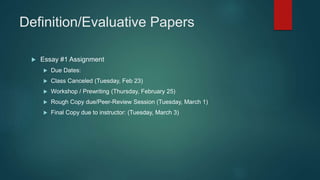
Definition/Evaluative Papers
 Essay #1 Assignment
 Due Dates:
 Class Canceled (Tuesday, Feb 23)
 Workshop / Prewriting (Thursday, February 25)
 Rough Copy due/Peer-Review Session (Tuesday, March 1)
 Final Copy due to instructor: (Tuesday, March 3)

Definition paper

  • 1.
    Definition Paper ESSAY 1– COMP II – DUE DATE: THURSDAY, MARCH 3
  • 2.
    Definition Paper –What is it?  In a definition paper, you are simply defining the problem or the issue within your topic. This should be fairly simple for because you have chosen this topic, so you must understand some of the complexities.  Definition Arguments set out criteria and then argue for whatever is being defined (your topic) and how it “meets or does not meet those criteria.” ***  Equation: Something is (is not) a X because it has (does not have) features A, B, and C.  You are arguing for a specific definition or understanding of your topic.
  • 3.
    How Definition ArgumentsWork (Good Reasons, pg. 97)
  • 4.
    Definition Paper  Adefinition essay will share your special understanding about some idea or thing (your topic).  One way of looking at a definition paper is being able to say what your topic is not. Breaking down logical fallacies and misperceptions on your topic.  Definition paper can place your topic into a certain category, either by definition or through comparison or resemblance. You should produce a definition paper when a particular person, thing or act (your topic) should be identified in a certain category.
  • 5.
    Definition Paper Approaches Historical spin (process paper) (Helping your audience understand a concept, its inception and implementation (examples, predictions)  Formal definition – Categorizing a topic into a classification system and providing the criteria that distinguishes the topic from other items:  Example:  Graffiti: Art of Vandalism?  Contemporary Universities: Building Character/Workplace Skills or Big Business?  Commercial Whaling: Defining Whales as “sacred animals” or “a renewable food source”  WHERE DO WE PLACE OUR SUBJECT – THE POINT OF A DEFINITION PAPER
  • 6.
    Definition Paper Approaches Operational definitions (Good Reasons, pg. 99): Researchers arguing that the particular definition is the one that suits the concept (Studies being conducted about a topic determine the definitive point). The need for precise definitions that are measured scientifically.  (A measureable definition of aggression (while studying the effects of television on children).
  • 7.
    Definition Paper –Rhetorical Do’s & Don’t’s  Within a definition paper..  Try to come up with your own definition of your topic (single statement)  Avoid the phrases “is where” and “is when” in your definition  Avoid circular definitions (repeating the defined term (“A computer virus is a virus that destroys software..”)  Avoid narrow definitions
  • 8.
    Definition Paper Structure:Criteria- Match  One approach to composing a definition paper is the Criteria-Match Structure (Writing Arguments, p. 229)  Two-part structure 1. A definition part that tries to establish the boundaries of the category (What do we mean by X?) 2. A match part that argues whether a given case meets that definition.  YOUR CLAIM: The Hercules Shoe Company is not a socially responsible company  REASON: Evidence of unjust treatment (provide proof) / What criteria must be met for a company to be deemed “socially responsible”?
  • 9.
  • 10.
    Definition Paper –Why?  Avoid misunderstandings with your audience.  Writer vs. Intended Audience issues  Your topic, your point of view!  Context of a final portfolio
  • 11.
    Definition Paper >Evaluative Paper  If a definition paper does not apply to your topic (wildly popular topic— perhaps you do not need to define the influence of music/mass media, what the sport of dancing entails), perhaps you need to compose an evaluative paper.  Identify a controversy in your topic that involves deciding if something is effective or ineffective, good or bad  Pose one question within your topic frame and discuss it in depth. (EX: Are video games a good way for young people to socialize? Should we censor music/movies?)
  • 12.
    Evaluative Paper Option Evaluate claims argue that something is GOOD/BAD/RIGHT/WRONG because it meets a certain criteria  Posing a question about your topic and formulating a response.  Within your research  “Google Maps is the best mapping program because it is easy to use, it is accurate and it provides entertaining and educational features (i.e. Google Earth)” (Good Reasons, pg. 139) DISCUSS IN DEPTH  The difference between a definition paper and evaluative paper: A definition paper wants to place something in the correct ‘light’ by observing features. An evaluative paper focuses on what is valued. If the criteria does not appeal to the value of your audience, your readers will not feel your evaluation is accurate. (Disconnect from rhetorical situation)
  • 13.
    Whatever you decideto do…  Take a look at some examples in our book:  Definition Papers: Michael Pollan’s “Eat Food” (Good Reasons, pg. 106), “Flagrant Foul: The NCAA’s Definition of Student Athletes of Amateurs” (Good Reasons, pg. 112), Arthur Knopf “Is Milk a Health Food?” (Writing Arguments, pg. 247).  Evaluative Papers: Glenn Loury’s “A Nation of Jailers” (Good Reasons, pg. 146), “Organic Foods Should Come Clean” (Good Reasons, pg. 155), Sam Isaacson’s “Would Legalization of Gay Marriage Be Good for the Gay Community?” (Writing Arguments, pg. 301)
  • 14.
    Whatever you decideto do… Do not discuss solutions or resolutions about your topic! Save for a later date. (Proposal, Rebuttal Arguments)
  • 15.
    Definition/Evaluative Papers  Essay#1 Assignment  Due Dates:  Class Canceled (Tuesday, Feb 23)  Workshop / Prewriting (Thursday, February 25)  Rough Copy due/Peer-Review Session (Tuesday, March 1)  Final Copy due to instructor: (Tuesday, March 3)