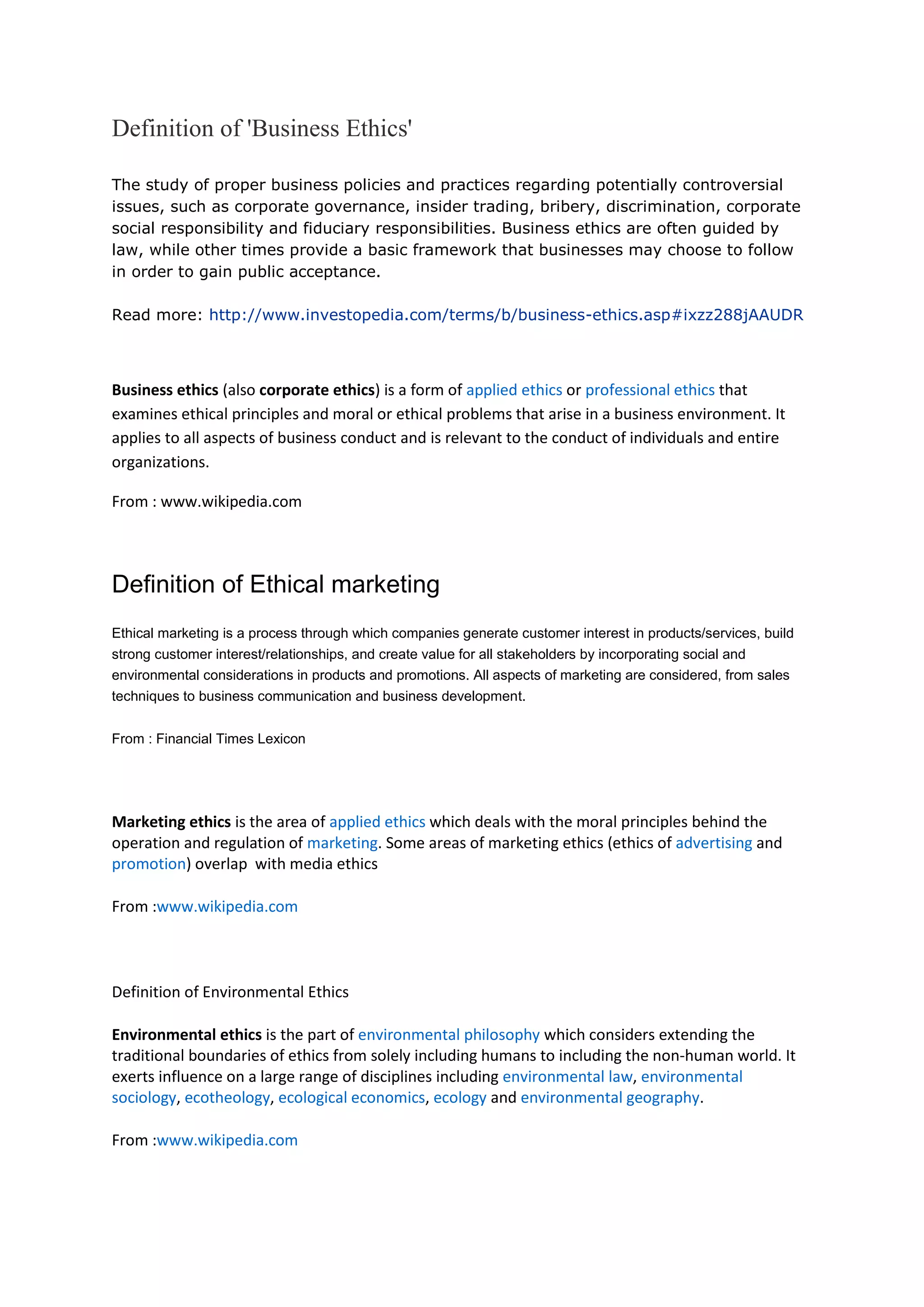
Definition of 'Business Ethics'

The study of proper business policies and practices regarding potentially controversial
issues, such as corporate governance, insider trading, bribery, discrimination, corporate
social responsibility and fiduciary responsibilities. Business ethics are often guided by
law, while other times provide a basic framework that businesses may choose to follow
in order to gain public acceptance.

Read more: http://www.investopedia.com/terms/b/business-ethics.asp#ixzz288jAAUDR


Business ethics (also corporate ethics) is a form of applied ethics or professional ethics that
examines ethical principles and moral or ethical problems that arise in a business environment. It
applies to all aspects of business conduct and is relevant to the conduct of individuals and entire
organizations.

From : www.wikipedia.com


Definition of Ethical marketing
Ethical marketing is a process through which companies generate customer interest in products/services, build
strong customer interest/relationships, and create value for all stakeholders by incorporating social and
environmental considerations in products and promotions. All aspects of marketing are considered, from sales
techniques to business communication and business development.


From : Financial Times Lexicon


Marketing ethics is the area of applied ethics which deals with the moral principles behind the
operation and regulation of marketing. Some areas of marketing ethics (ethics of advertising and
promotion) overlap with media ethics

From :www.wikipedia.com


Definition of Environmental Ethics

Environmental ethics is the part of environmental philosophy which considers extending the
traditional boundaries of ethics from solely including humans to including the non-human world. It
exerts influence on a large range of disciplines including environmental law, environmental
sociology, ecotheology, ecological economics, ecology and environmental geography.

From :www.wikipedia.com
Environmental ethics is operating a business or personal practices, that should take into consideration
the effects on the environment

Source: http://answers.ask.com/Society/Philosophy/what_is_environmental_e...


Financial definition of Ethics:

The study and practice of appropriate behavior, regardless of the behavior's legality. Certain
industries have professional organizations setting and promoting certain ethical standards. For
example, an accountant may be required to refrain from engaging in aggressive accounting, even
when a particular type of aggressive accounting is not illegal. Professional organizations may censure
or revoke the licenses of those professionals who are found to have violated the ethical standards of
their fields.

Source :financial-dictionary.thefreedictionary.com/Ethics


Informational Technology ethics:

Computer Ethics is a branch of practical philosophy which deals with how computing
professionals should make decisions regarding professional and social conduct.[1] Margaret
Anne Pierce, a professor in the Department of Mathematics and Computers at Georgia
Southern University has categorized the ethical decisions related to computer technology and
usage into 3 primary influences:

        1. The individual's own personal code.
        2. Any informal code of ethical behavior that exists in the work place.
        3. Exposure to formal codes of ethics.[2]

Source :en.wikipedia.org/wiki/Computer_ethics


Ethics is a set of moral principles that govern the behavior of a group or individual.
Therefore, computer ethics is set of moral principles that regulate the use of
computers. Some common issues of computer ethics include intellectual property
rights (such as copyrighted electronic content), privacy concerns, and how
computers affect society.

For example, while it is easy to duplicate copyrighted electronic (or digital) content,
computer ethics would suggest that it is wrong to do so without the author's
approval. And while it may be possible to access someone's personal information
on a computer system, computer ethics would advise that such an action is
unethical.
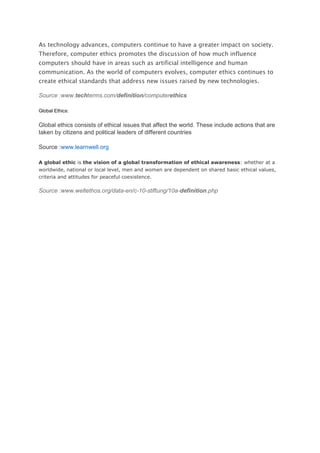
As technology advances, computers continue to have a greater impact on society.
Therefore, computer ethics promotes the discussion of how much influence
computers should have in areas such as artificial intelligence and human
communication. As the world of computers evolves, computer ethics continues to
create ethical standards that address new issues raised by new technologies.

Source :www.techterms.com/definition/computerethics

Global Ethics:


Global ethics consists of ethical issues that affect the world. These include actions that are
taken by citizens and political leaders of different countries

Source :www.learnwell.org

A global ethic is the vision of a global transformation of ethical awareness: whether at a
worldwide, national or local level, men and women are dependent on shared basic ethical values,
criteria and attitudes for peaceful coexistence.

Source :www.weltethos.org/data-en/c-10-stiftung/10a-definition.php

Definition of ethics

  • 1.
    Definition of 'BusinessEthics' The study of proper business policies and practices regarding potentially controversial issues, such as corporate governance, insider trading, bribery, discrimination, corporate social responsibility and fiduciary responsibilities. Business ethics are often guided by law, while other times provide a basic framework that businesses may choose to follow in order to gain public acceptance. Read more: http://www.investopedia.com/terms/b/business-ethics.asp#ixzz288jAAUDR Business ethics (also corporate ethics) is a form of applied ethics or professional ethics that examines ethical principles and moral or ethical problems that arise in a business environment. It applies to all aspects of business conduct and is relevant to the conduct of individuals and entire organizations. From : www.wikipedia.com Definition of Ethical marketing Ethical marketing is a process through which companies generate customer interest in products/services, build strong customer interest/relationships, and create value for all stakeholders by incorporating social and environmental considerations in products and promotions. All aspects of marketing are considered, from sales techniques to business communication and business development. From : Financial Times Lexicon Marketing ethics is the area of applied ethics which deals with the moral principles behind the operation and regulation of marketing. Some areas of marketing ethics (ethics of advertising and promotion) overlap with media ethics From :www.wikipedia.com Definition of Environmental Ethics Environmental ethics is the part of environmental philosophy which considers extending the traditional boundaries of ethics from solely including humans to including the non-human world. It exerts influence on a large range of disciplines including environmental law, environmental sociology, ecotheology, ecological economics, ecology and environmental geography. From :www.wikipedia.com
  • 2.
    Environmental ethics isoperating a business or personal practices, that should take into consideration the effects on the environment Source: http://answers.ask.com/Society/Philosophy/what_is_environmental_e... Financial definition of Ethics: The study and practice of appropriate behavior, regardless of the behavior's legality. Certain industries have professional organizations setting and promoting certain ethical standards. For example, an accountant may be required to refrain from engaging in aggressive accounting, even when a particular type of aggressive accounting is not illegal. Professional organizations may censure or revoke the licenses of those professionals who are found to have violated the ethical standards of their fields. Source :financial-dictionary.thefreedictionary.com/Ethics Informational Technology ethics: Computer Ethics is a branch of practical philosophy which deals with how computing professionals should make decisions regarding professional and social conduct.[1] Margaret Anne Pierce, a professor in the Department of Mathematics and Computers at Georgia Southern University has categorized the ethical decisions related to computer technology and usage into 3 primary influences: 1. The individual's own personal code. 2. Any informal code of ethical behavior that exists in the work place. 3. Exposure to formal codes of ethics.[2] Source :en.wikipedia.org/wiki/Computer_ethics Ethics is a set of moral principles that govern the behavior of a group or individual. Therefore, computer ethics is set of moral principles that regulate the use of computers. Some common issues of computer ethics include intellectual property rights (such as copyrighted electronic content), privacy concerns, and how computers affect society. For example, while it is easy to duplicate copyrighted electronic (or digital) content, computer ethics would suggest that it is wrong to do so without the author's approval. And while it may be possible to access someone's personal information on a computer system, computer ethics would advise that such an action is unethical.
  • 3.
    As technology advances,computers continue to have a greater impact on society. Therefore, computer ethics promotes the discussion of how much influence computers should have in areas such as artificial intelligence and human communication. As the world of computers evolves, computer ethics continues to create ethical standards that address new issues raised by new technologies. Source :www.techterms.com/definition/computerethics Global Ethics: Global ethics consists of ethical issues that affect the world. These include actions that are taken by citizens and political leaders of different countries Source :www.learnwell.org A global ethic is the vision of a global transformation of ethical awareness: whether at a worldwide, national or local level, men and women are dependent on shared basic ethical values, criteria and attitudes for peaceful coexistence. Source :www.weltethos.org/data-en/c-10-stiftung/10a-definition.php