Defining Digital Humanities A Reader New Edition Melissa M Terras
Defining Digital Humanities A Reader New Edition Melissa M Terras
Defining Digital Humanities A Reader New Edition Melissa M Terras
Defining Digital Humanities A Reader New Edition Melissa M Terras
Defining Digital Humanities A Reader New Edition Melissa M Terras
1.
Defining Digital HumanitiesA Reader New Edition
Melissa M Terras download
https://ebookbell.com/product/defining-digital-humanities-a-
reader-new-edition-melissa-m-terras-5228284
Explore and download more ebooks at ebookbell.com
2.
Here are somerecommended products that we believe you will be
interested in. You can click the link to download.
Defining Democracy In A Digital Age Political Support On Social Media
Barend Lutz
https://ebookbell.com/product/defining-democracy-in-a-digital-age-
political-support-on-social-media-barend-lutz-5382352
Defining Enterprise Data And Analytics Strategy Pragmatic Guidance On
Defining Strategy Based On Successful Digital Transformation
Experience Of Multiple Fortune 500 And Other Global Companies Prakash
Sah
https://ebookbell.com/product/defining-enterprise-data-and-analytics-
strategy-pragmatic-guidance-on-defining-strategy-based-on-successful-
digital-transformation-experience-of-multiple-fortune-500-and-other-
global-companies-prakash-sah-47201378
Designing Digital Systems With Systemverilog V21 21 Brent E Nelson
https://ebookbell.com/product/designing-digital-systems-with-
systemverilog-v21-21-brent-e-nelson-34395010
Designing Digital Games Derek Breen
https://ebookbell.com/product/designing-digital-games-derek-
breen-44771490
3.
Designing Digital MusicalInstruments Using Probatio A Physical
Prototyping Toolkit 1st Ed Filipe Calegario
https://ebookbell.com/product/designing-digital-musical-instruments-
using-probatio-a-physical-prototyping-toolkit-1st-ed-filipe-
calegario-7321082
Designing Digital Work Concepts And Methods For Humancentered
Digitization 1st Ed Stefan Oppl Christian Stary
https://ebookbell.com/product/designing-digital-work-concepts-and-
methods-for-humancentered-digitization-1st-ed-stefan-oppl-christian-
stary-10485858
Designing Digital Systems With Systemverilog Brent E Nelson
https://ebookbell.com/product/designing-digital-systems-with-
systemverilog-brent-e-nelson-11059332
Designing Digital Products For Kids Deliver User Experiences That
Delight Kids Parents And Teachers Rubens Cantuni
https://ebookbell.com/product/designing-digital-products-for-kids-
deliver-user-experiences-that-delight-kids-parents-and-teachers-
rubens-cantuni-12300364
Designing Digital Computer Systems With Verilog David J Lilja
https://ebookbell.com/product/designing-digital-computer-systems-with-
verilog-david-j-lilja-1555582
Contents
Acknowledgements ix
Notes onContributors xi
Introduction 1
Julianne Nyhan, Melissa Terras and Edward Vanhoutte
Section I: Humanities Computing
1 Is Humanities Computing an Academic Discipline? 13
Geoffrey Rockwell
2 What is Humanities Computing and What is Not? 35
John Unsworth
3 Information Technology and the Troubled Humanities 49
Jerome McGann
4 Disciplined: Using Educational Studies to Analyse
‘Humanities Computing’ 67
Melissa Terras
5 Tree, Turf, Centre, Archipelago – or Wild Acre? Metaphors
and Stories for Humanities Computing 97
Willard McCarty
6 The Gates of Hell: History and Definition of Digital |
Humanities | Computing 119
Edward Vanhoutte
Section II: Digital Humanities
7 Humanities Computing as Digital Humanities 159
Patrik Svensson
11.
Defining Digital Humanities
vi
8Something Called Digital Humanities 187
Wendell Piez
9 What Is Digital Humanities and What’s It Doing in English
Departments? 195
Matthew G. Kirschenbaum
10 The Productive Unease of 21st-century Digital ~
Scholarship 205
Julia Flanders
11 Toward a Conceptual Framework for the Digital
Humanities 219
Paul Rosenbloom
Section III: From the Blogosphere
12 Digital Humanities is a Spectrum, or “We’re All Digital
Humanists Now” 237
Lincoln Mullen
13 Who’s In and Who’s Out 239
Stephen Ramsay
14 On Building 243
Stephen Ramsay
15 Inclusion in the Digital Humanities 247
Geoffrey Rockwell
16 The Digital Humanities is not about Building, it’s
about Sharing 255
Mark Sample
17 I’m Chris, Where Am I Wrong? 259
Chris Forster
18 Peering Inside the Big Tent 263
Melissa Terras
19 ADHO, On Love and Money 271
Bethany Nowviskie
12.
Contents vii
Section IV:Voices from the Community
20 Selected Definitions from the Day of Digital Humanities: 2009–
2012 279
21 Digital Humanities Definitions by Type 289
Fred Gibbs
Section V: Further Materials
22 Selected Further Reading 301
23 Questions for Discussion 305
Index 307
Acknowledgements
The editors andpublishers wish to thank the following for permission to
use copyright and previously published material.
The Alliance of Digital Humanities Organizations and the authors for the
articles: Julia Flanders (2009), ‘The Productive Unease of 21st-century
Digital Scholarship’, Digital Humanities Quarterly, 3 (3). Wendell Piez
(2008), ‘Something Called Digital Humanities’, Digital Humanities
Quarterly, 2 (1). Paul S. Rosenbloom (2012), ‘Toward a Conceptual
Framework for the Digital Humanities’, Digital Humanities Quarterly,
6 (2). Patrick Svensson (2009), ‘Humanities Computing as Digital
Humanities’, Digital Humanities Quarterly, 3 (3).
Chris Forster for the blog post: ‘I’m Chris, Where Am I Wrong?’
Fred Gibbs for the article: ‘Digital Humanities Definitions by Type’.
Mentis for the article: John Unsworth (2002), ‘What is Humanities
Computing and What is Not?’, Jahrbuch für Computerphilologie, 4.
Lincoln Mullen for the blog post: ‘Digital Humanities is a Spectrum, or
“We’re All Digital Humanists Now”’.
Bethany Nowviskie for the blog post: ‘ADHO, On Love and Money’.
Oxford Journals and the authors for the articles: Willard McCarty (2006),
‘Tree, Turf, Centre, Archipelago – or Wild Acre? Metaphors and Stories
for Humanities Computing’, Literary and Linguistic Computing, 21 (1).
Melissa Terras (2006), ‘Disciplined: Using Educational Studies to Analyse
“Humanities Computing”’, Literary and Linguistic Computing, 21 (2).
Stephen Ramsay for the blog posts: ‘Who’s In and Who’s Out’ and ‘On
Building’.
Geoffrey Rockwell for the article: (1999), ‘Is Humanities Computing an
Academic Discipline?’ originally published at http://www.iath.virginia.
15.
Defining Digital Humanities
x
edu/hcs/rockwell.htmland for the blog post ‘Inclusion in the Digital
Humanities’.
Mark Sample for the blog post: ‘The Digital Humanities is not about
Building, it’s about Sharing’.
Melissa Terras for the blog post: ‘Peering Inside the Big Tent’.
TEXT Technology and the author for the article: Jerome J. McGann
(2005), ‘Information Technology and the Troubled Humanities’, TEXT
Technology, 14 (2).
The Modern Language Association of America for the article: Matthew
Kirschenbaum (2010), ‘What is Digital Humanities and What’s it Doing in
English Departments’, ADE Bulletin, 150.
Every effort has been made to trace all the copyright holders, but if any
have been inadvertently overlooked the publishers will be pleased to make
the necessary arrangement at the first opportunity.
16.
Notes on Contributors
JuliaFlanders is the Director of the Brown University Women Writers
Project and co-founder and editor-in-chief of Digital Humanities Quarterly.
Her research focuses on text encoding, digital scholarly editing, and the
politics of digital scholarship.
Chris Forster is Assistant Professor of Twentieth-Century British Literature
at Syracuse University. His current research focuses on modernist literature
and the history of obscenity. He also has interests extending into digital
humanities. He sometimes blogs about such matters at cforster.com.
Fred Gibbs is Director of Digital Scholarship at the Roy Rosenzweig
Center for History and New Media, and Assistant Professor in the
History and Art History Department at George Mason University. He
explores the application of new digital technologies and methodologies to
historical research, and how to employ theories of new media in service of
transforming scholarly publishing.
Matthew G. Kirschenbaum is Associate Professor in the Department
of English at the University of Maryland and Associate Director of the
Maryland Institute for Technology in the Humanities (MITH). He is a
2011 Guggenheim Fellow and a member of the teaching faculty at the
Rare Book School. His current book project is entitled Track-Changes: A
Literary History of Word Processing, and is under contract to Harvard
University Press. See http://www.mkirschenbaum.net or follow him on
Twitter as @mkirschenbaum for more.
Willard McCarty is Professor of Humanities Computing, King’s College
London; Professor, University of Western Sydney; Fellow of the Royal
Anthropological Institute; Editor of the on-line seminar Humanist and of
the British Journal Interdisciplinary Science Reviews. In 2005 he received
the Canadian Award for Outstanding Achievement, Computing in the Arts
and Humanities, in 2006 the Richard W. Lyman Award and in 2013 the
Roberto Busa Award. His current book project, Machines of Demanding
Grace, argues for the human as a central concern of the digital humanities.
See www.mccarty.org.uk.
17.
Defining Digital Humanities
xii
JeromeMcGann is the John Stewart Bryan University Professor, University
of Virginia. He was co-founder of IATH (Institute for Advanced Technology
in the Humanities) and the founding director of NINES (Networked
Infrastructure for Nineteenth-century Electronic Scholarship). His book
Radiant Textuality. Literature after the Worldwide Web was awarded the
MLA’s 2002 James Russell Lowell Prize. He is the editor of the online
Complete Writings and Pictures of Dante Gabriel Rossetti. A Hypermedia
Research Archive (1992–2008) and Online Humanities Scholarship. The
Shape of Things to Come (2010). A new book, Memory Now. Philology
in a New Key is in press and he has begun to collaborate on a new online
project, The American World of James Fenimore Cooper.
Lincoln Mullen is a PhD candidate in the Department of History at
Brandeis University, and a historian of American religion. He is writing a
dissertation on converts between religion in the nineteenth-century United
States. He is also the web editor of The Journal of Southern Religion, an
open-access scholarly journal.
Bethany Nowviskie is Director of the Scholars’ Lab and Department of
Digital Research and Scholarship at the University of Virginia Library,
where she also serves as associate director of the Scholarly Communication
Institute. Nowviskie is President of the Association for Computers and
the Humanities and a long-time digital humanities practitioner, focusing
on textual materiality, humanities interpretation, and academic labour.
Her projects include Neatline, NINES/Collex, the Rossetti Archive, #Alt-
Academy, Digital Humanities Questions and Answers, Juxta, the Ivanhoe
Game, and Temporal Modelling. See http://nowviskie.org and follow on
Twitter @nowviskie.
Julianne Nyhan is lecturer in Digital Information Studies in the Department
of Information Studies, University College London. Her research interests
include the history of computing in the humanities and most aspects of
digital humanities with special emphasis on meta-markup languages and
digital lexicography. Most recently she has co-edited Digital Humanities in
Practice (Facet 2012 http://www.facetpublishing.co.uk/title.php?id=7661).
Among other things, she is a member of AHRC’s Peer Review College,
a member of the European Science Foundation’s expert working group
on Research Infrastructures in the Humanities and European Liaison
manager in the UCL Centre for Digital Humanities. She is at work on an
Oral History of Computing in the Humanities. Read her blog at http://
archelogos.hypotheses.org/ and follow her on Twitter @juliannenyhan.
18.
Notes on Contributorsxiii
Wendell Piez is a designer and builder of electronic publishing systems,
a leading practitioner of XSLT, and has developed XML tag sets and
applications for both documentary publishing (such as journals and
conference proceedings) and for more highly structured information
processing systems. Piez has a PhD in English, and has worked at the
Center for Electronic Texts in the Humanities (Rutgers and Princeton
Universities) and Mulberry Technologies Inc. Since 2008 he has served
as adjunct faculty at the Graduate School for Library and Information
Science (GSLIS) at the University of Illinois. Piez has published widely and
is co-founder and General Editor of Digital Humanities Quarterly. See
http://www.wendellpiez.com.
Stephen Ramsay is Susan J. Rosowski University Associate Professor of
English and a Fellow at the Center for Digital Research in the Humanities
at the University of Nebraska-Lincoln. He is the author of Reading
Machines: Toward an Algorithmic Criticism (University of Illinois Press,
2011).
Geoffrey Martin Rockwell is a Professor of Philosophy and Humanities
Computing at the University of Alberta, Canada. He has published and
presented papers in the area of philosophical dialogue, textual visualization
and analysis, humanities computing, instructional technology, computer
games and multimedia including a book, Defining Dialogue: From
Socrates to the Internet. He is currently the Interim Director of the Kule
Institute for Advanced Studies and a network investigator in the GRAND
Network of Centres of Excellence that is studying gaming, animation and
new media. He is collaborating with Stéfan Sinclair on Voyant, a suite of
text analysis tools at http://voyant-tools.org and Hermeneutica, a book/
website about text analysis.
Paul S. Rosenbloom is Professor of Computer Science at the University of
Southern California and a project leader at USC’s Institute for Creative
Technologies. He was a key member of USC’s Information Sciences
Institute for two decades, leading new directions activities over the second
decade, and finishing his time there as Deputy Director. Earlier he was
on the faculty at Carnegie Mellon University (where he also received his
PhD) and Stanford University (where he also received his BS). His research
concentrates on cognitive architectures – models of the fixed structure
underlying minds, whether natural or artificial – and on understanding
the nature, structure and stature of computing as a scientific domain. He is
the author of On Computing: The Fourth Great Scientific Domain (MIT
Press, 2012).
19.
Defining Digital Humanities
xiv
MarkL. Sample is associate professor of English at George Mason
University, where he teaches and researches contemporary literature
and new media. Mark is also an affiliated faculty member with Mason’s
Honors College, its Cultural Studies programme, and the Center for
History and New Media. Mark’s most recent project is 10 PRINT
CHR$(205.5+RND(1)); : GOTO 10, a collaboratively written book
about creative computing and the Commodore 64, which was published
by MIT Press in November 2012. See http://www.samplereality.com or
follow him on Twitter as @samplereality.
Patrik Svensson is a Professor in the Humanities and Information
Technology, and director of HUMlab at Umeå University, Sweden. As
the director of HUMlab, Svensson is deeply engaged in facilitating cross-
sectional meetings and innovation, in the future of the humanities and
the university, and in the intersection of the humanities, culture and
information technology. Svensson’s research interests span information
technology and learning, research infrastructure, screen cultures, and the
digital humanities as an emerging field.
Melissa Terras is Director of University College London Centre for Digital
Humanities and Professor of Digital Humanities in UCL’s Department
of Information Studies. With a background in Classical Art History,
English Literature, and Computing Science, her doctorate (Engineering,
University of Oxford) examined how to use advanced information
engineering technologies to interpret and read Roman texts. Publications
include Image to Interpretation: Intelligent Systems to Aid Historians in
the Reading of the Vindolanda Texts (2006, Oxford University Press),
Digital Images for the Information Professional (2008, Ashgate) and
Digital Humanities in Practice (2012, Facet). She is the co-founder and
General Editor of Digital Humanities Quarterly journal, the secretary of
The European Association of Digital Humanities, and on the board of
the Alliance of Digital Humanities Organizations. Her research focuses
on the use of computational techniques to enable research in the Arts and
Humanities that would otherwise be impossible. You can generally find
her on Twitter @melissaterras.
John Unsworth is Vice-Provost for Library and Technology Services and
Chief Information Officer at Brandeis University. From 2003 to 2012 he was
Dean of the Graduate School of Library and Information Science (GSLIS)
at the University of Illinois, Urbana-Champaign. In addition to being a
Professor in GSLIS, at Illinois he also held appointments in the department
of English and on the Library faculty; also, from 2008 to 2011, he served
as Director of the Illinois Informatics Institute. From 1993 to 2003, he
20.
Notes on Contributorsxv
served as the first Director of the Institute for Advanced Technology in
the Humanities, and a faculty member in the English Department, at the
University of Virginia. For his work at IATH, he received the 2005 Richard
W. Lyman Award from the National Humanities Center. His first faculty
appointment was in English, at North Carolina State University, from
1989 to 1993. He attended Princeton University and Amherst College
as an undergraduate, graduating from Amherst in 1981. He received a
Master’s degree in English from Boston University in 1982 and a PhD in
English from the University of Virginia in 1988. In 1990, at NCSU, he
co-founded the first peer-reviewed electronic journal in the humanities,
Postmodern Culture (now published by Johns Hopkins University Press,
as part of Project Muse). He also organised, incorporated and chaired the
Text Encoding Initiative Consortium, co-chaired the Modern Language
Association’s Committee on Scholarly Editions, and served as President of
the Association for Computers and the Humanities and later as chair of the
steering committee for the Alliance of Digital Humanities Organizations,
as well as serving on many other editorial and advisory boards. More
information is available at http://www3.isrl.uiuc.edu/~unsworth.
Edward Vanhoutte is currently Director of Research and Publications in
the Royal Academy of Dutch Language and Literature – KANTL (Gent,
Belgium), Editor-in-Chief of LLC: The Journal of Digital Scholarship in
the Humanities, and a Research Associate of the University College of
London Centre for Digital Humanities (UCLDH). He is the editor of ten
(digital) scholarly editions, the co-editor of the DALF Guidelines for the
Description and Encoding of Modern Correspondence Material, and the
co-author of TEI by Example, http://www.teibyexample.org. His research
interests include textual scholarship, (digital) scholarly editing, genetic
editing, text encoding and the markup of modern manuscript material
next to his overall interest in the history of the field now called the Digital
Humanities. He publishes, lectures and blogs widely on these subjects. See
http://www.edwardvanhoutte.org or follow him on Twitter @evanhoutte.
Introduction
Julianne Nyhan andMelissa Terras
University College London, UK
Edward Vanhoutte
Royal Academy of Dutch Language Literature, Belgium
University College London, UK
Searchinge out a holiday gifte for yower academic frendes? Thei maye
enjoye a definicioun of the digital humanities.
(Chaucer Doth Tweet (@LeVostreGC), 8 December 2012
https://twitter.com/LeVostreGC/status/277501777182613504)
Much has been written about how digital humanities might be defined but,
for those new to the discipline, where does one start in tackling this issue?
The aim of this volume is to bring together, in one teaching-focused text,
core historical and contemporary reading on the act of defining ‘digital
humanities’ to demonstrate aspects of the history of the field, to indicate
the range of opinions that exist and to encourage others to articulate what
it is we think we do when we do digital humanities.
Why would one define an academic field? From one perspective such
definitions have an obvious practical and utilitarian purpose: we must
be able to define and describe what it is that we are doing not only to
colleagues and students but to university management, funding agencies
and the general public. Nevertheless, we should not view such work from
this practical perspective alone. The ways that digital humanities are being
(and have been) defined can reveal much about the implicit assumptions
that we as a community hold. So too the act of defining can reveal much
about the identities that we are in the process of forging for ourselves, how
we view ourselves in relation to other disciplines and the internal tensions
that exist within the digital humanities community as a whole. In short
the ever growing literature on defining digital humanities can offer us an
important insight into the dynamics of disciplinary formation. A condensed
selection of this literature is presented in this volume, which features the
most popular items listed as set reading within Digital Humanities courses,
as ascertained from a content analysis of the syllabi of a range of courses
23.
Defining Digital Humanities
2
aroundthe world.1
There is core material, of course, that does not appear
in this volume due to harsh editorial choices that had to be made, or
copyright and licensing issues. As well as the core material presented here,
we therefore give a list of suggested further reading: we hope that any
student or practitioner in digital humanities who becomes conversant with
this literature will understand the many facets to the question: how do you
define the digital humanities?
Defining the remit and scope of our discipline seems to be a central
concern to many in the field. Aspects of this literature (which could not
in all cases be included in this volume) will now be presented and some
pertinent themes pointed to. For convenience the term ‘digital humanities’
will be used throughout, even though, as will be made clear (particularly
in Chapter 6, written for this volume), many other terms were used to refer
to this field before 2005.
Nomenclature and Boundaries
Over the past years, the field that we now refer to as digital humanities has
been known by many terms: humanities computing, humanist informatics,
literary and linguistic computing and digital resources in the humanities,
to name but a few. Most recently it has predominantly been known as
digital humanities, though other variations such as eHumanities are
occasionally to be found in literature emanating from continental Europe
(see, for example, Neuroth et al., 2009 though agreement on the synonymy
of these terms is not universal. Matthew G. Kirschenbaum has noted that
‘the rapid and remarkable rise of digital humanities as a term can be traced
to a set of surprisingly specific circumstances’ (Kirschenbaum, 2010, p.
2). These he identifies as the 2005 publication of Blackwell’s Companion
to Digital Humanities, the name that was chosen at the end of 2005 for
the organisation that arose out of the amalgamation of the Association
for Computers in the Humanities and the Association for Literary
and Linguistic Computing (that is, the Alliance of Digital Humanities
Organizations, ADHO) and the 2006 launch of the National Endowment
for the Humanities (NEH) digital humanities programme (Kirschenbaum,
2010, p. 3). Though digital humanities has had its ‘own’ journals since
Computers and the Humanities was first published in 1966, it is clear
that one important effect of the rise of the term ‘digital humanities’ is in
the practicality of enabling scholars to self-identify as digital humanities
scholars. The importance of this seemingly obvious advantage is reflected
1
Syllabi of different courses in Digital Humanities have been collected by Lisa Spiro
and are available at http://www.zotero.org/groups/digital_humanities_education.
24.
Introduction 3
in WillardMcCarty’s discussion of the difficulties of compiling a
comprehensive bibliography of the field. Discussing the bibliographies that
were published in Literary and Linguistic Computing Journal (LLC) from
1986 until 1994 he observed that by 1994:
finding and gathering relevant publications exhaustively had become
impractical: too many of them, in too many disciplines, appearing in minor,
as well as major places in many languages. The assimilation of computing into
the older disciplines meant that, increasingly, much of the relevant work, when
mentioned at all, had become subsumed in articles and books whose titles
might give no clue. (McCarty, 2003a, p. 1226)
Indeed, it seems likely that the increasing currency of the term digital
humanities will play an important role in helping to consolidate the
community. Nevertheless, scholars such as Svensson (2009), Unsworth
(2010), Terras (2011) and Rockwell (2011) have reflected on the issues
of inclusion and exclusion in digital humanities, while Galina and Priana
(2011) have examined the internationalisation of the community from the
perspective of South America. According to Rockwell, ‘We are a point
of disciplinary evolution that calls for reflection, grace, and a renewed
commitment to inclusion. Above all we need to critically review our history
and our narrative of exclusion and inclusion lest it blind us to needs of the
next generation’ (Rockwell, 2011).
What DH is and is not
Judging by the 1966 foreword to Computers and the Humanities (the
field’s first journal) at that time digital humanities was not considered as
being distinct from traditional humanities:
We define humanities as broadly as possible. Our interests include literature of
all times and countries, music, the visual arts, folklore, the non-mathematical
aspects of linguistics, and all phases of the social sciences that stress the
humane. When, for example, the archaeologist is concerned with fine arts of
the past, when the sociologist studies the non-material facets of culture, when
the linguist analyzes poetry, we may define their intentions as humanistic; if
they employ computers, we wish to encourage them and to learn from them.
(Prospect, 1966, p. 1)
A number of the writings that were published between 1980 and 2000
focused on defining the field in terms of how it might be taught. For
example, between 1996 and 2000 a consortium of European universities
25.
Defining Digital Humanities
4
participatedin a project called Advanced Computing in the Humanities
(ACO*HUM). The book that resulted from the network explores how
digital humanities might be taught, thus implicitly exploring what it was
then considered to be:
Computer technology has mediated in the development of formal methods in
humanities scholarship. Such methods are often much more powerful than
traditional research with pencil and paper. They include, for instance, parsing
techniques in computational linguistics, the calculus for expressive timing in
music, the use of exploratory statistics in formal stylistics, visual search in art
history, and data mining in history. Although scientific progress is in the first
place due to better methods, rather than solely due to better computers, new
advanced methods strongly rely on computers for their validation and effective
use. Put in a different way, if you are going to compare two texts, you can do
it with traditional pencil and paper; but if you are going to compare fifty texts
with each other, you need sound computational methods. (de Smedt et al.,
1999, chapter 1)
Terras (2006, p. 230–1) has given a comprehensive overview of relevant
literature from this educational perspective. A persistent theme has been the
question of the interrelatedness of the traditional and digital humanities.
On the one hand, many scholars have emphasised the many ways that
digital humanities furthers, or at least allows us to reconnect with, age-
old concerns of the humanities. Katz (2005, p. 108) has written that, ‘For
the humanist perhaps nothing is more important than the capacity to
organise and search large bodies of information’. Turkel has reflected on
how the seemingly age-old distinction between thinking and doing in the
humanities is not as old as some like to think:
Just because the separation between thinking and making is long-standing
and well-entrenched doesn’t make it a good idea. At various times in the
past, humanists have been deeply involved in making stuff: Archimedes, the
Banu Musa brothers, da Vinci, Vaucanson, the Lunar Men, Bauhaus, W. Grey
Walter, Gordon Mumma. The list could easily be multiplied into every time and
place. (Turkel, 2008, par. 5)
Recently Moulin et al. (2011) have argued that, as unlikely as it may seem,
it was the humanities that brought the earliest research infrastructures into
being (p. 3).
Setting boundary lines between digital humanities, what it is and is not
has also concerned many. In 2002, for example, Unsworth reflected that
the mere use of the computer in humanities research does not make that
research digital humanities:
26.
Introduction 5
One ofthe many things you can do with computers is something that I
would call humanities computing, in which the computer is used as tool for
modelling humanities data and our understanding of it, and that activity is
entirely distinct from using the computer when it models the typewriter, or
the telephone, or the phonograph, or any of the many other things it can be.
(Unsworth, 2002)
This is a point that is echoed by both Orlandi (2002) and de Smedt (2002),
choosing the evocative analogy that
The telescope was invented in 1608 and was initially thought useful in war.
Galileo obtained one, improved it a little, and used it to challenge existing
ideas about the Solar System. Although a magnificent new technology in itself,
the telescope was hardly a scientific tool until Galileo used it to create new
knowledge. (de Smedt, 2002, p. 99)
Orlandi (2002), while not denying the potential of the computer to
fundamentally change humanities, argued that ‘part of the humanities was
“computed” well before computers were used’. Willard McCarty, one of
the most prolific contributors to the questions of what digital humanities
is, meanwhile stated, ‘I celebrate computing as one of our most potent
speculative instruments, for its enabling of competent hands to force us all
to rethink what we trusted that we knew’ (2009; see also McCarty, 1998,
1999, 2002a, 2002b, 2003a, 2003b, 2004, 2006 and 2008; McCarty and
Kirschenbaum, 2003a; and McCarty and Short, 2002).
Since 2009, when William Pannapacker described digital humanities
as ‘the next big thing’ in the Chronicle of Higher Education, a number
of articles, blog posts (and even a Downfall detournement2
) have been
appearing, with increased alacrity, exploring and defining what digital
humanities is and is not.
Alvarado (2011) argues that the term digital humanities is ‘a social
category, not an ontological one’. At the time of writing a common theme
is whether one must programme or not in order to be a digital humanist.
At one end of the spectrum is Stephen Ramsay, who wrote, ‘If you are
not making anything, you are not … a digital humanist’ (Ramsay, 2011a,
further sketched out in his blog post featured in this volume). At the other
end is Marc Sample (2011) who argues that, ‘The digital humanities is
not about building, it’s about sharing’. Another important theme is the
perceived lack of theory in digital humanities, which has been explored by,
among others, Liu (2011) and Rockwell (2011).
2
http://www.criticalcommons.org/Members/ccManager/clips/5-ccdownfall.mov/view.
27.
Defining Digital Humanities
6
Answeringthe question ‘What is digital humanities?’ continues to be a
rich source of intellectual debate for scholars. In addition to the blog posts
and articles discussed above the question has also been explored over the
past three years as part of the ‘Day in the life of the Digital Humanities’
community publication project that brought together digital humanists
from around the world to document their activities on that day.3
Gibbs
(2011) has proposed a categorisation of these definitions in a useful post
that reveals the many differing interpretations that are current. Indeed,
at the current time, not only does a comprehensive definition appear to
be impossible to formulate, when the breadth of work that is covered
by a number of recent and forthcoming companions is considered (e.g.
Crawford, 2009; Deegan and Sutherland, 2009; Greengrass and Hughes,
2008; Schreibman and Siemens, 2008; Schreibman et al., 2004; Siemens and
Moorman, 2006; Sutherland, 1997; also see the Further Reading section
in this volume), it might ultimately prove unproductive, by fossilising an
emerging field and constraining new, boundary-pushing work. Terras
(2006, p. 242) has asked whether a definition of the field is essential
and reflected that such an absence may offer its practitioners additional
freedom when deciding their research and career paths. This seems to hold
true in Sinclair and Gouglas and their discussion of the establishment of the
Humanities Computing MA programme at the University of Alberta. In
the context of designing the MA, they choose not to ask what humanities
computing is, but rather ‘what do we want humanities computing to be?’
(2002, p. 168). McCarty has argued for the fundamental importance of the
self-reflection that appears so prominently in the literature of the field, and
comments: ‘What is humanities computing? This, for the humanities, is a
question not to be answered but continually to be explored and refined’
(2003a, p. 1233).
It is with this in mind that we wished to publish Defining Digital
Humanities: a Reader. By capturing a selection of the various journal
articles and blog postings, many of which respond to one another, we can
provide in one volume the core necessary readings of our discipline and, in
doing so, provide a set text for students beginning to engage in this field,
and a volume for others to refer to in order to discuss how we wended to
the place we are at today, where everyone defines digital humanities, but
there is not a definition we all adhere to. We have chosen the contents of
this volume based on their popularity within the discipline, the core themes
that they highlight, and the relationships between the different pieces. As
well as reprinting key articles and blog posts (some of which are re-edited
and updated for this volume), we provide an introduction from the editors
3
http://tapor.ualberta.ca/taporwiki/index.php/Day_in_the_Life_of_the_Digital_
Humanities.
28.
Introduction 7
to placeand explain the importance of journal articles, and an addendum
from most authors, to provide a contemporary review of their piece. We
also provide a new chapter by Edward Vanhoutte, explaining the historical
shift from humanities computing to digital humanities, a selected further
reading list, and a list of questions to aid a discussion about this topic in
class. We will expand, maintain, and explore our reading list and point to
other media which tackle the definition of digital humanities, including
posters, images, manifestos and book cover art, at the companion website
to the volume.4
We do not try to define digital humanities ourselves: our editorial
perspective is to highlight the range of discussions that attempt to
scope out the limits and purview of the discipline. We hope that this
volume is of interest both to those new to the discipline and established
scholars in the field, to frame the debate on how best to define digital
humanities.
Bibliography
Aarseth, E.J. (1997). ‘The Field of Humanistic Informatics and its Relation
to the Humanities’, Human IT, 4 (97), pp. 7–13.
Alvarado, R. (2011). ‘The Digital Humanities Situation’, The Transducer,
11 May (accessed 12 May 2011).
Crawford, T. (2009). Modern Methods for Musicology: Prospects,
Proposals and Realities, UK: Ashgate.
Deegan, M. and Sutherland, K. (2009). Text Editing, Print, and the Digital
World, UK: Ashgate.
de Smedt, K. (2002). ‘Some Reflections on Studies in Humanities
Computing’, Literary and Linguistic Computing, 17 (1), pp. 89–101.
de Smedt, K. et al. (1999). Computing in Humanities Education: A
European Perspective, SOCRATES/ERASMUS thematic network
project on Advanced Computing in the Humanities (ACO*HUM),
Bergen: University of Bergen.
Galina, Isabel and Ernesto Priani (2011) ‘Is There Anybody out There?
Discovering New DH Practitioners in other Countries’. Digital
Humanities 2011: Conference Abstracts. p.135–137
Gibbs, F.W. (2011) ‘Digital Humanities Definitions by Type’ (accessed 19
September 2011).
Greengrass, M. and Hughes, L. (2008). Virtual Representations of the
Past, UK: Ashgate.
4
http://blogs.ucl.ac.uk/definingdh and on Twitter @DefiningDH.
29.
Defining Digital Humanities
8
Hockey,S. (2004). ‘The History of Humanities Computing’, in S.
Schreibman, R. Siemens and J. Unsworth (eds), A Companion to
Digital Humanities, Malden: Blackwell, pp. 3–19.
Katz, S.N., 2005. Why technology matters: the humanities in the twenty-
first century. Interdisciplinary Science Reviews, 30(2), pp.105–118.
Kirschenbaum, M.G. (2010). ‘What is Digital Humanities and What’s it
Doing in English Departments?’ ADE Bulletin, 150, pp. 1–7 (online
pagination, accessed 9 May 2011).
Liu, A. (2011). ‘Where is Cultural Criticism in the Digital Humanities’,
Paper delivered at MLA Conference, Los Angeles.
McCarty, W. (1998). ‘What Is Humanities Computing? Toward a
Definition of the Field’, Liverpool, 20 February 1998, Reed College
(Portland, Oregon, US) and Stanford University (Palo Alto, California,
US), March 1998 and Würzburg (Germany), July 1998.
McCarty, W. (1999). ‘Humanities Computing as Interdiscipline’, part
of the ‘Is Humanities Computing an Academic Discipline?’ series,
University of Virginia: IATH.
McCarty, W. (2002a). ‘Humanities Computing: Essential Problems,
Experimental Practice’, Literary and Linguistic Computing, 17 (1), pp.
103–25.
McCarty, W. (2002b). ‘New Splashings in the Old Pond: The Cohesibility
of Humanities Computing’, in G. Braungart, K. Eibl and F. Jannidis
(eds), Jahrbuch für Computerphilologie, 4, Paderborn: Mentis Verlag,
pp. 9–18.
McCarty, W. (2003a). ‘Humanities Computing’, in Encyclopedia of Library
and Information Science, New York: Marcel Dekker, pp. 1224–35.
McCarty, W. (2003b). ‘“Knowing true things by what their mockeries be”:
Modelling in the Humanities’, Computing in the Humanities Working
Papers, A.24, jointly published with TEXT Technology, 12 (1).
McCarty, W. (2004). ‘As It Almost Was: Historiography of Recent Things’,
Literary and Linguistic Computing, 19 (2), pp. 161–80.
McCarty, W. (2006). ‘Tree, Turf, Centre, Archipelago – or Wild Acre?
Metaphors and Stories for Humanities Computing’, Literary and
Linguistic Computing, 21 (1), pp. 1–13.
McCarty, W. (2008). ‘What’s Going On?’, Literary and Linguistic
Computing, 23 (3), pp. 253–61.
McCarty, W., 2010. Inaugural lecture: Attending from and to the machine.
King’s College London.
McCarty, W. and Kirschenbaum, M. (2003). ‘Institutional Models for
Humanities Computing’, Literary and Linguistic Computing, 18 (4),
pp. 465–89.
McCarty, W. and Short, H. (2002). ‘A Roadmap for Humanities
Computing’, http://www.allc.org/reports/map.
30.
Introduction 9
McGann, J.(2005). ‘Culture and Technology: The Way We Live Now,
What Is To Be Done?’, Interdisciplinary Science Reviews, 30 (2), pp.
179–88.
Moulin, C., Nyhan, J. and Ciula, A. (2011). ESF Science Policy Briefing
43: Research Infrastructures in the Humanities. European Science
Foundation.
Neuroth, H., Jannidis, F., Rapp, A. and Lohmeier, F. (2009). ‘Virtuelle
Forschungsumgebungen für e-Humanities. Maβssnahmen zur
optimalen Unterstützung von Forschungsprozessen in den Geistes-
wissenschaften’, BIBLIOTHEK Forschung und Praxis, 33 (2), pp.
161–69.
Orlandi,T.(2002).‘IsHumanitiesComputingaDiscipline?’inG.Braungart,
K. Eibl and F. Jannidis (eds), Jahrbuch für Computerphilologie, 4,
Paderborn: Mentis Verlag, pp. 51–8.
Pannapacker, W. (2009). ‘The MLA and the Digital Humanities’, Chronicle
of Higher Education, 28 December.
‘Prospect’ (1966). Computers and the Humanities: a newsletter. I(1) p. 1–2.
Ramsay, S. (2011a). ‘Who’s In and Who’s Out’ (accessed 22 November
2011) further sketched out in http://lenz.unl.edu/papers/2011/01/11/
on-building.html.
Ramsay, S. (2011b). ‘On Building’ (accessed 22 November 2011).
Rockwell, G. (2011). ‘Inclusion in the Digital Humanities’, philosophi.ca
(accessed 20 January 2011).
Sample, M. (2011). ‘The Digital Humanities is not about Building, it’s
about Sharing’, Sample Reality, 25 May (accessed 19 September 2011).
Schreibman, S. and Siemens, R. (2008). ‘A Companion to Digital Literary
Studies’, Oxford: Blackwell.
Schreibman, S., Siemens, R. and Unsworth, J. (eds) (2004). A Companion
to Digital Humanities, Malden: Blackwell.
Short, H. (2006), ‘The Role of Humanities Computing: Experiences and
Challenges’, Literary and Linguistic Computing, 21 (1), pp. 15–27.
Siemens, R. and Moorman, D. (2006). Mind Technologies. Humanities
Computing and the Canadian Academic Community, Calgary:
University of Calgary Press.
Sinclair, S. and Gouglas, W. (2002). ‘A Theory into Practice: A Case
Study of the Humanities Computing Master of Arts Programme at the
University of Alberta’, Arts and Humanities in Higher Education, 1
(2), pp. 167–83.
Sutherland, K. (ed.) (1997). Electronic Text: Investigations in Method and
Theory, Oxford: Clarendon Press, pp. 107–26.
Svensson, P. (2009). ‘Humanities Computing as Digital Humanities’,
Digital Humanities Quarterly, 3 (3) (accessed 9 February 2010).
31.
Defining Digital Humanities
10
Terras,M. (2006). ‘Disciplined: Using Educational Studies to Analyse
“Humanities Computing”’, Literary and Linguistic Computing, 21 (2),
pp. 229–46.
Terras, M. (2011). ‘Peering Inside the Big Tent: Digital Humanities and
the Crisis of Inclusion’, Melissa Terras’ Blog, 26 July (accessed 19
September 2011).
Turkel, W.J. (2008). ‘A Few Arguments for Humanistic Fabrication’
[Webblog entry 21 November] Digital History Hacks: Methodology
for the Infinite Archive (2005–08) (accessed 20 August 2010).
Unsworth, J. (1997). ‘Documenting the Reinvention of Text. The
Importance of Failure’, The Journal of Electronic Publishing, 3 (2).
Unsworth, J. (2000). Scholarly Primitives: What methods do humanities
researchers have in common, and how might our tools reflect this?,
Paper read at the symposium on ‘Humanities Computing; formal
methods, experimental practice’, London: King’s College, 13 May.
Unsworth, J. (2002). ‘What is Humanities Computing, and What is
it Not?’, in G. Braungart, K. Eibl and F. Jannidis (eds) Jahrbuch für
Computerphilologie, 4, Paderborn: Mentis Verlag, pp. 71–84.
Unsworth, J. (2010). ‘The State of Digital Humanities’, Lecture at the
Digital Humanities Summer Institute.
Chapter 1
Is HumanitiesComputing an
Academic Discipline?
Geoffrey Rockwell
University of Alberta
Geoffrey Rockwell (1999). Originally published online after being
presented at “Is Humanities Computing an Academic Discipline?”,
An Interdisciplinary Seminar Series, November 12, 1999, Institute for
Advanced Technology in the Humanities, University of Virginia.
Note from the Editors:
During the late 1990s, a significant theme in the ‘What is Humanities
Computing’literature was whether the field could be defined and categorised
as an academic discipline. Rockwell presented this paper, published in 1999,
to a seminar held on this topic in the Institute for Advanced Technology in
the Humanities at the University of Virginia (other papers presented at this
seminar by leading figures in humanities computing remain available1
). In
it he argues that the ontological questions of what the discipline ‘is’ may
never be satisfactorily settled; therefore, he argues for the importance and
value of considering this question from an administrative and institutional
perspective. In order to do this he discusses at length his experience of setting
up a ‘Combined Honours in Multimedia and Another Subject’ programme at
McMaster University. He also explains the decision to use the term multimedia
as opposed to that of humanities computing to describe the programme. In
essence, the term multimedia could be used to communicate to prospective
students and colleagues (especially those of the senior, administrative and
budget-approving persuasion) what the programme would entail and the
traditions it would draw on. However, the term humanities computing was,
he argued‘a liability and confusion’.
1
See http//www.iath.virginia.edu/hcs/papers.html.
35.
Defining Digital Humanities
14
Iwish either my father or my mother, or indeed both of them, as they were
in duty both equally bound to it, had minded what they were about when
the begot me.
(Sterne, Tristram Shandy, p. 35)
I propose in this paper to tackle the question of whether humanities
computing is an academic discipline from an administrative and
instructional perspective by recasting is thus, “Who should humanities
computing benefit and how should it be administered and taught to benefit
them?” I would have you think concretely about the child you will beget
by concentrating less on the issue of what humanities computing is than
on questions about its administrative and instructional details. I have two
reasons for begging your indulgence as I digress from the original question.
The first is that woven into the purpose of this seminar are questions about
the administrative and instructional potential of humanities computing.
To ask if humanities computing is an academic discipline is anticipated
by the question of whether it can be administered and taught as other
disciplines are in the academy. This precedence can be seen, for example,
in the purpose page for this seminar where the author sets up a hierarchy
of questions proceeding from the instructional question to the ontological.
This seems a good time to ask whether we should be offering such a degree—
but before we can answer that question, we need to have a clear idea of what
the field is, and whether it is, in fact, a field of scholarly inquiry. (http://www.
iath.virginia.edu/hcs/purpose.html, accessed on October 27, 1999)
While I sympathize with the view that we need to know what humanities
computing is before we can ask whether it can be taught, I can’t help
suspecting that the ontological question will never be answered to
your satisfaction, especially in a seminar which could be argued is an
administrative form designed more for appreciating questions than
answering them. Rather, the ontological question could become the subject
of the teachable discipline. Therefore at some point you will have to
confront the administrative question and confront it without the certainty
of knowing what humanities computing is.
My second reason for digressing, and I should warn you that this
paper will be nothing but digressions, is that what little I have to offer
after the excellent presentations you have already heard lies in the area
of administrative and instructional experience, namely the experience
of setting up a Combined Honours in Multimedia and Another Subject
program at McMaster University. Thus these digressions will attempt to
abstract from the experience of those of us who conceived and carried this
program to term in a fashion that will eventually lead to an answer to the
question you should have asked.
36.
Is Humanities Computingan Academic Discipline? 15
The Place of Administration
In a well known passage in Plato’s Phaedrus Socrates discusses the
invention of writing by telling a story that has come down from the
forefathers about the invention of writing: Theuth, an Egyptian god,
brought his inventions including writing before the king Thamus who
made it his business to evaluate the inventions before passing them on to
the Egyptians. Theuth is excited about writing; it “will make the people of
Egypt wiser and improve their memories; my discovery provides a recipe
for memory and wisdom.” Thamus like any good philosopher king is not
so enthusiastic. He first distinguishes the role of the god as inventor from
his role as legislator. Theuth is so enamored with his offspring writing
that he can’t see whether it will really profit or harm the citizens. Thamus
answers Theuth’s enthusiasm thus,
O man full of arts, to one it is given to create the things of art, and to another to
judge what measure of harm and of profit they have for those that shall employ
them. ... And it is no true wisdom that you offer your disciples, but only its
semblance, for by telling them of many things without teaching them you will
make them seem to know much, while for the most part they know nothing,
and as men filled, not with wisdom, but with the conceit of wisdom, they will
be a burden to their fellows. (Plato, Phaedrus, 274e–275b)
This story of Socrates’ has become an important text in the current
discussion about the place of technologies of information in society. Neil
Postman in Technopoly turns to it in his first chapter to remind us of
the importance of technological criticism and judgment. I have my own
reading of this story.
One of the first points I would make about Socrates’ myth of writing
is that it is presented as a short dialogue between Theuth (often known as
Thoth) and Thamus. (Phaedrus actually questions Socrates about the place
of such stories in their dialogue, but that is another story.) Your seminar
might likewise end up being such a formative dialogue if it is open to
questions around the administration and instruction of technology. What
story will be told about this symposium?
Second, Socrates’ story connects the ontological issue of what a thing
is, in our case humanities computing, with the administrative question of
whether it will be of benefit or not to others. Socrates does this dramatically
by distinguishing characters and introducing the role of the administrator
Thamus who asks about the implementation of the invention. He wants
to know what good the technology will do, and I would argue a discipline
is an administrative technology. That is my challenge to you; you aren’t
really asking only what humanities computing is, but you are also asking
37.
Defining Digital Humanities
16
whatit would be like at UVA and who would it serve, however distasteful
such administrative questions are. (Our distaste for administration in
academia is another issue.) Bring them out into the open; play another
role for a moment.
Third, Socrates distinguishes between a technology that helps tell about
wisdom from the teaching of wisdom. (Much of the Phaedrus can be read
as a demonstration by Socrates of this difference.) He provides us thus
with a clue as to what would constitute an administratively appropriate
implementation—one that does not fill us with the conceit of wisdom, but
one which is pedagogically appropriate. Which is why I have recast the
question, to ask what might be taught.
Fourth, Socrates’ criticism of writing could very well be updated to
sound like current criticism of computers in the humanities, namely that
they are not devices (or methods) for acquiring deeper wisdom about texts
but a recipe for forgetting about books. To put it more generally, any
new technology, especially those that are supposed to assist us with the
study of other things, can also hide that which they are meant to reveal.
This is a danger we are all struggling with in humanities computing—to
what extent does it hide or distract us from that which it was supposed
to compute. This danger reveals itself in the different tacks we take to
the administration of humanities computing. Willard McCarty is trying
to keep it connected to the humanities by advocating interdisciplinarity.
Others, myself included, are trying to identify a new subject area which
humanities computing can reveal through humanistic inquiry. McCarty
wants to bring computing methods to traditional objects of study, I want
to argue for bringing the culture of the humanities to new objects, those
that surround us on CD-ROMs and the WWW.
Let me summarize this section with a collection of questions I will
attempt to answer in the rest of the paper. Who is humanities computing
for? How can it be administered to benefit others? How can it teach rather
than tell? What should be taught and to whom? How can we create a
community that will continue to ask about computing in the humanities?
How can we create a community of research? I propose to answer these
questions by wandering off along the path of humanities computing at
McMaster.
A Brief History of Humanities Computing at McMaster
In 1986 the Humanities Computing Centre was founded out of the
existing Language Labs. Dr. Samuel Cioran, who was the Assistant to
the Dean for Computing and director of the Language Labs at the time,
began moving the courses from traditional audio instructional technology
38.
Is Humanities Computingan Academic Discipline? 17
to computer-based instruction by developing a series of language modules
built around the mcBOOKmaster authoring system. He also took the
Faculty of Humanities out of a system of central computer labs when they
were unwilling to upgrade their computers with CD-ROMs and sound
cards. He negotiated an arrangement with the central Computing and
Information Services whereby the Faculty took over the computer labs for
humanities students and merged them with the Language Labs to create
a hybrid set of labs and media classrooms that could serve our purposes
better. This arrangement still exists so that, while our labs are partially
funded by the central administration, we manage them and adapt them
to our purposes. I cannot stress how important it has been to have in
place a set of labs and staff under the academic control of the Faculty and
therefore responsive to our instructional needs. Reading Susan Hockey’s
description of the problems she faced putting on a single course I am
thankful for Dr. Cioran’s foresight. To put it bluntly, you need labs under
the academic control of the discipline if you are going to mount courses
on a regular basis and especially if you are going to mount a program with
any multimedia courses. Do not count on resources that do not answer to
the needs of the unit. I know of too many humanities computing courses
that stumble along fighting for time in labs and appropriate configurations
of tools to believe a program can be mounted with good intentions.
When I was hired to replace Dr. Cioran in 1994 I was asked to
introduce courses in Humanities Computing almost as an afterthought.
The first course, “Introduction to Humanities Computing,” was taught
in the winter term of 1995. Three courses were introduced at that time,
including “Introduction to Multimedia in the Humanities” and a course
on electronic texts and computational linguistics. These courses were
to be courses for all humanities students to provide them with suitable
introductions to information technology in an academic context. In
1998 as a result of donations and internal competitions two new faculty
members were hired and we introduced six new courses in multimedia
and communication. In effect, the creation of a Humanities Computing
Centre and the introduction of courses in the area was due to a series
of administrative decisions that had little to do with questions about
the existence of any such discipline. The Faculty got their labs (and
hence a Centre) partly because multimedia language titles could not be
developed for central labs that at the time were aimed at computer science
and statistics students. Courses were introduced because faculty were
brought on board to help administer the facilities and because funding
was available only for positions connected to technology. I am, of course,
exaggerating, but my point is that humanities computing at McMaster
(and I imagine at many other places) evolved along faculty lines and out of
existing administrative structures. If we didn’t have faculties of humanities
39.
Defining Digital Humanities
18
wouldwe have humanities computing? That is not to say that one should
be ashamed of such lineage, rather it is a series of often inconsequential
administrative decisions combined with stubborn personalities which can
put one in a position to make bold initiatives. Has it been any different at
Virginia?
In the summer of 1998 we were alerted that the Province of
Ontario had created the Access to Opportunities Program (ATOP) to
encourage the expansion of programs that prepare students for careers
in the advanced technology sector, specifically Computer Engineering,
Software Engineering, and Computer Science. We held discussions with
the Ministry of Education officer responsible for the program in order
to determine if a proposal for a program based in the Humanities would
be acceptable and were encouraged to submit a draft of the proposal in
August to get clearance for the submission of a full proposal. Once we
received clearance in late August we had to put together a full proposal
with courses and get it through the relevant committees so that it could
be approved by the University and submitted in December of 1998.
The program was subsequently approved for funding and started in
1999 with a target enrollment of 30 students a year for a steady state
of approximately 110 students over four years.2
The demand we have
experienced for the first year courses has been such that we are planning
to expand the program to accommodate 50 students a year for a steady
state of just under 200 students.
In a province where base budget funding to universities has been
declining ATOP was one of the first opportunities to compete for an
increase in ongoing funds, which explains the support we got from
the administration in designing a program so quickly and moving it
through committees. This is not only true of Ontario, governments
and administrations are increasingly targeting new funding instead of
providing across the board increases. We are constantly told that one
cannot simply argue for funds to do the same (old) things and that
therefore when framing any funding request we need to be a) innovative,
b) interdisciplinary, c) inter-institutional where it is appropriate, and d)
relevant to the information age economy. This puts the humanities in
the unfortunate position where it can only get funds to try new things,
sometimes at the expense of excellence already established in traditional
areas. We are forced either to dig in our heels and fight the trend or to
try to pour our well aged wine into digital bottles. This is an unfortunate
state of affairs if you believe (as I do) in the excellence of a humanities
education even without computing. It puts those of us in Humanities
Computing who can propose new programs in the position of proposing
2
See http://www.humanities.mcmaster.ca/~macmedia for details.
40.
Is Humanities Computingan Academic Discipline? 19
things in the face of a lack of appreciation for exactly the programs we
came from and respect. We struggle with our colleagues who think we
have sold out to business and we struggle with the danger that what we
do may hide the traditions we were taught to love. Administratively and
concretely we have to struggle to make sure new programs do not come
at the expense of existing ones but enhance them creatively. Whatever
else we do we should bring new resources in, not steal from the already
strained departments.
While in a perfect world one could plan new programs carefully, the
reality of most funding opportunities is that they open unexpectedly
and disappear quickly. If you want to create something new without
stealing from existing programs you need to be able to move quickly. To
be more precise, you need to have most of the work done in anticipation
of support and then you have to listen, lobby, and wait until the right
opportunity arises. If you have developed a preliminary consensus about
the administrative structure and developed a tentative program you can
then start circulating it for discussion and try to attract the funding needed.
In our case we had in place a lab structure, we had done a substantial
amount of work designing courses, we had hired faculty and were even
preparing a Certificate proposal when the opportunity for a full program
arose so it was not a great leap to design the full program. This gets
back to administration and Socrates. Don’t just ask whether Humanities
Computing is a discipline, ask what the discipline and a program would
look like? What will it cost? What sorts of resources will be needed
and who will provide them? What would you have taught? What will
your students look like? You should not be afraid of the concrete or the
administrative, it is an application of the ontological. Which is why I will
turn now to the particular program we designed and our reasons for not
mounting a humanities computing program.
The Name of the Discipline
The ATOP proposal guidelines that we had to follow were typical of the
administrative questions new programs face today in Ontario. We were
asked to show that there was student demand, to show that there was a
societal need, to secure industry and community support, to show that
the program was in the area of computing and to show that we had the
resources to implement the proposed program. We started with a name,
Multimedia. Why Multimedia and not Humanities Computing? The
following are some of the reasons we had for choosing to propose a
Multimedia program.
41.
Defining Digital Humanities
20
•The name of a program should communicate clearly to prospective
students and other stakeholders. Humanities Computing is
meaningless to people outside its traditions and the program was
unlikely to be approved with such an awkward name. Multimedia
has the virtue that it is the name of the object of creation and
study for the program. Multimedia, if one is generous about the
media subsumed, includes in our case the study of electronic texts
too, which are often what humanities computing courses turn out
to be.
• We wanted to design a program that would enhance all the
humanities including the creative, fine, and performing arts. Too
often humanities computing is focused exclusively on textual
computing and is therefore only of interest to students in textual
disciplines like English, Linguistics, and Comparative Literature. If
one is serious about connecting with all the disciplines generally
contained within the humanities one needs to address the needs
not only of the critical disciplines but also the creative ones where
students are not only asked to discuss media, but are taught to
create it. Thus the challenge is to develop a program that combines
the critical with instruction in the creative and performing aspects
of computer-based media. Multimedia is the best title we could find
for such a program.
• Further, our experience is that what students want is to learn to
participate fully in the field of information technology. They don’t
want to just read and write about new media, they want to build
it so that they can choose careers other than further graduate
studies. They want to be artists, musicians, designers, and writers
not just teachers. The courses that are invariably the most popular
(alas) are those that weave concrete creative skills into academic
contexts not the electronic text courses (that I teach.) The demand
is in multimedia not electronic text encoding and text-analysis
methodologies.
• The information we could find about societal need pointed to a
need, especially in Canada, for multimedia designers not humanities
computing specialists. Most of what others have argued is central
to humanities computing, namely methods and presentation of
information, is taught adequately by Information Science programs.
What is not taught in universities in Ontario is multimedia creation,
communication and criticism. No doubt programs in media studies
and communications will ramp up to handle new media and meet
this need, but we felt there was a place for a program connected to
the arts and humanities.
42.
Is Humanities Computingan Academic Discipline? 21
What is Multimedia?
Having chosen a name and taken the position that we wanted the program
to connect to the arts and therefore include design courses, we set about
to try to define multimedia not humanities computing. (To be honest none
of what follows was put on paper before this seminar, but I am trying to
make it sound like a rational process.) Here are some definitions I have
found for multimedia.
A multimedia computer system is one that is capable of input or output of
more than one medium. Typically, the term is applied to systems that support
more than one physical output medium, such as a computer display, video, and
audio. Occasionally, multimedia is used to refer to the combination of text and
images on a computer display terminal. Although text and images are in fact
distinct carriers of information, hence media, this usage of multimedia is not
preferred. After all, newspapers with text and images are not considered to be
multimedia publications!
The term medium can also refer to an input device such as a keyboard, mouse,
microphone, camera, or other sensor. Regarding computer input, multimedia
then refers to the capability of using multiple input devices to interact with a
computer system. (Blattner and Dannenberg, 1992, p. xxiii)
Blattner and Dannenberg also make the observation that “Multimedia
systems strive to take the best advantage of human senses in order to
facilitate communication” (Blattner and Dannenberg, 1992, p. xix). The
Encyclopædia Britannica Online defines Interactive Multimedia thus:
any computer-delivered electronic system that allows the user to control,
combine, and manipulate different types of media, such as text, sound, video,
computer graphics, and animation. Interactive multimedia integrate computer,
memory storage, digital (binary) data, telephone, television, and other
information technologies. Their most common applications include training
programs, video games, electronic encyclopedias, and travel guides. Interactive
multimedia shift the user’s role from observer to participant and are considered
the next generation of electronic information systems.
In the book Multimedia Demystified it is defined in this fashion:
In its most basic definition, multimedia can be thought of as applications that
bring together multiple types of media: text, illustrations, photos, sounds, voice,
animations, and video. A combination of three or more of these with some
measure of user interactivity is usually thought of as multimedia computing.
(Haykin, 1994, p. 3)
43.
Defining Digital Humanities
22
Oneof the interesting features of these definitions is what they are
defining. The first defines a “multimedia system”, the second “interactive
multimedia” while the third defines multimedia applications. I have settled
on the following definition that combines many of the features in the others
with a focus on multimedia as a genre of artistic work.
A multimedia work is a computer-based rhetorical artifact in which multiple
media are integrated into an interactive artistic whole.
Let me go through the parts of the definition.
Computer-Based: The word multimedia has been used synonymously with
“mixed-media” to refer to works of art that combine traditional artistic
media like paint, found objects, metal, and so on. Only since the 1980s has
it come to mean exclusively those works that are computer-based, which is
the way I take it. In this definition I am therefore excluding mixed-media
works if they were not created to be accessed through a computer. This
also excludes works that might have been created on a computer like a
desktop publishing file, but were intended to be accessed through print. A
multimedia work proper is one that is viewed or browsed on the computer.
Thus the computer in this view of what humanities computing should deal
with is not just a tool for study of other objects, it is the delivery vehicle
for content. This raises interesting questions about the limitations and
possibilities afforded by the computer as form which I take to be one of
the theoretical issues in multimedia.
Rhetorical: A multimedia work is one designed to convince, delight, or
instruct. It is not a work designed for administrative purposes or solely
for communicating information. Nor is it a solely technological artifact
from the perspective of the multimedia student. Technical questions about
bandwidth and compression algorithms are for computer scientists and
engineers. Multimedia is about the computer as a rhetorical performance.
Artifact: A multimedia work is a work of human creation or art. I am not
defining what multimedia is in general or what a multimedia computer is,
but focusing on multimedia works.
Multiple Media: Central to all definitions of multimedia is the idea that
multimedia combines types of information that have traditionally been
considered distinct because they had different means of production
and distribution. This combination or convergence is made possible by
the computer that through digitization stores all information, whatever
its original form, as binary digital data. Thus the computer allows the
44.
Is Humanities Computingan Academic Discipline? 23
combination of media because they are on the computer all stored in
the same fashion and accessible to the same procedures. In particular,
multimedia works can bring together media that are incompatible in other
formats like audio (which is time-dependent) and text (which is not). The
possibilities for design when one can combine media and the problems
of interpretation of works that do so are the central problems of the
field. I believe these problems subsume those traditionally articulated for
humanities computing.
Integration ... Artistic Whole: A multimedia work is not just a collection of
different types of media concatenated into a collection. By this definition
the integration of media is the result of deliberate artistic imagination
aimed at producing a work that has integrity. My hard drive has multiple
media encoded on it, but it is not a multimedia work because those
different media were not consciously integrated into a single work for
rhetorical purposes. That said, one of the interesting features hypertext
theorists find in hypermedia is a blurring of the boundaries of the artistic
work. My colleagues are trying to get me to back down on this point and
agree that we do not expect unity in a multimedia work, that hypertextual
links outside the work are an important difference to multimedia. What
do you think?
Interactive: One of the new media integrated into a multimedia work is the
interactivity or the programming that provides for the viewer’s experience.
Some level of interactivity is assumed in any computer-based work, but
by this definition interactivity becomes part of the palette of media being
woven into a whole. The type of interactivity is thus important to the
artistic performance. We might go further and say that interactivity is the
dominant media that integrates the others and that the computer is what
bears interactive possibilities to the creative arts. Multimedia is therefore
about computing in that it is about the possibilities for interactive
integration and performance.
Implementation of a Multimedia Program
Thisdefiningchoiceandthetrajectorysetbytheadministrativeguidelinesthat
constrained us led to a particular implementation of a humanities computing
program in the form of a multimedia program. This implementation has the
following advantages from an administrative point of view.
• We were able to create a program that connected to the various
disciplines within the humanities by having elective courses that
45.
Defining Digital Humanities
24
dealtwith particular media in digital form. Thus we have courses
on “Writing in the Electronic Age”, “Electronic Texts and Their
Study”, “Technical Writing” to connect with the textual disciplines.
We have courses on “Introduction to MIDI and Computer Music”
for music majors. We have courses on computer graphics and
animation for art students. With the umbrella of multimedia
we could argue the case for teaching courses on different media
including text thus weaving the traditional text-oriented tradition
of humanities computing into a more comprehensive whole.
• While the elective courses dealt with the intersections with
particular media and their disciplines, the core courses dealt with
the integration of media into multimedia. Thus we steered between
a program that was simply a service program for other programs
and one that was isolated unto itself with its own methods. The
core courses provide a unity to the program which would be lacking
in a program made up of service courses with a few methods
courses tacked on. The multimedia work as an object of study and
creation provides a focus to the program that can be explained and
demonstrated.
• We designed the program to be a Combined Honours program
that had to be taken with another program as a double major. The
program thus avoids hiding the humanities by being designed so
that it can only be taken if in conjunction with another.
• The program is of interest to prospective students and can be
explained to senior administrators, something I could never do
with humanities computing. To put it crudely it can be sold to
the stakeholders outside the unit which in a fiscally stressful
environment is a prerequisite to the creation of any program.
I do not believe this is at the expense of what should be done,
because I do not think there is anything that we cannot do under
the banner of multimedia which humanities computing could do.
By contrast humanities computing as a name is a liability and a
confusion.
• The program, despite its new media flavor, could still be reasonably
placed in the existing administrative structure by becoming a
program within the School of Art, Drama and Music. This placed
the program in a congenial setting within a unit already committed
to interdisciplinary programs, creative and performing arts, and
capable of dealing with faculty positions that are not assessed
solely in terms of paper publications. The last feature of the School
was especially important if we were going to be able to attract
people doing things in humanities computing other than writing
about it.
46.
Is Humanities Computingan Academic Discipline? 25
As we brought the Multimedia program proposal through the various
committees we were asked a number of questions which I suspect any
program in this area has to face. Most of these questions came from our
colleagues, especially those in administrative positions who understood
the dangers of new programs. In fact humanists were the most skeptical of
the program, which is a sign of health, I believe. I have summarized them
here along with the answers that were offered.
What evidence do you have that this is a discipline? Are there similar
programs elsewhere? Are there journals in the area? Are there books that
one can point to as original research in the area?
It is interesting that they did not ask if it was a discipline, but we were
asked to provide evidence that others thought it was a discipline.
In order to answer this we gathered a number of different types of
evidence that multimedia was a viable discipline. We prepared a dossier
of WWW sites of similar programs and courses elsewhere. Harold
Short and others at King’s College London were particularly helpful
with information about their “Humanities with Applied Computing”
BA minor which like ours is meant to be combined with a traditional
discipline. We also compiled a list of sample books in the discipline,
journals, conferences, and graduate programs to which students apply.
Should a program with a strong technical component be in the humanities?
Should university programs have technical components?
Questions about the place of technical instruction in the humanities were
the most difficult to answer. On the one hand we pointed out that in
art, drama, and language courses techniques are taught. A printmaking
course, for example, is partly about the craft of printmaking. Language
classes teach practical language skills which only with practice lead to
critical application. On the other hand we designed the program and each
course so that the technical skills were always taught in a communicative
context. This manifests itself at different levels. First, the program, like
the King’s program, is a Combined Honours program which means it
has to be combined with another program. As I have mentioned above,
central to the design of the program was the idea that it was not to
be a stand-alone degree, but one which would enhance traditional
humanities degrees and hence students could not escape untutored in
criticism or theory. Second, the courses were all designed so that they
would have readings and critical assignments that complemented the
technical skills acquired. Mastery of a technique is not sufficient in
any course; student assignments ask that students apply techniques to
communicative, creative, and critical problems. Thus it is not enough to
be able to create a WWW site for a course; building the site is like being
47.
Defining Digital Humanities
26
ableto type a paper, it is the threshold of participation. The WWW site,
like a paper, is assessed in terms of the issues dealt with in the course as
a creative contribution. Third, we made sure there were courses in the
program that would focus on philosophical, critical, and communicative
aspects of multimedia independent of technology. Finally we made sure
that none of the courses were about a particular and therefore time-
dependent technology. There is no course on Macromedia Director as
you would find in a college program. There is a course on Advanced
Multimedia where students currently learn Director this year, but the
technical skills taught will change as the industry changes.
My colleague Andrew Mactavish in a paper we coauthored for
the 1999 ACH/ALLC at UVA went further and asked What are the
assumptions about technology, technical skill, and intellectual skill
that underlie the anxieties expressed in objections to our program? In
that paper, which I will not digress too far to summarize, he raises
the possibility that such objections are based on an unexamined and
essentialist view “which supports the division of technical skill and
intellectually enriched knowledge, gets played out in a host of symbolic
social divisions, including those that structure and intersect with
education, class, and culture” (Mactavish, Rockwell, and Buckley,
1999, p. 11). Needless to say, we did not accuse our colleagues in
public of such anxieties, but the very place of technical skill in the
humanities which the introduction of such a program raises needs to
be worked out further.
Why isn’t this a stream in computer science? Why don’t we leave this to
the community colleges?
The question of which type of institution or which department is best
suited to teach multimedia and humanities computing gets to the heart
of the Socratic legislative question. In Canada there is a hierarchy of
institutions and degrees from college certificates that generally take
a year to complete to honours BAs that take four years. Generally
speaking technical skills like carpentry and graphic design are taught in
community colleges while universities offer bachelor degrees that focus
more on the [academic aspects].
Aren’t students likely to start coming who already have the technical
expertise in multimedia? Do we therefore need to have a program that
teaches skills that will soon be universally taught in high school?
This is like asking if we should ditch our English program if students
came to university able to write. Regardless of their technical skill
level the university should be a place where they can study multimedia
further and in an academic fashion. I also doubt we will see this mythical
student who knows everything there is to know about computing.
48.
Is Humanities Computingan Academic Discipline? 27
Are we just doing this to get money and recruit students?
No, it should not be done simply because it can be funded. It should
be done because we are interested in creating a community that studies
multimedia.
What evidence is there that this program would be successful? How can
we be sure students would enroll in such a program instead of just taking
a course or two?
To answer this question we gathered statistics not only from existing
courses but also from other programs in related fields.
What would students do with such a degree? Are there graduate programs
that they could apply to?
As I mentioned above we gathered lists of possible careers and graduate
programs that such a program would prepare a student for. The ATOP
guidelines also forced us to get letters of support from industry, in our
case multimedia design firms and computer firms. These letters, while
solicited, provided the perspective of people in the position to hire
graduates. The short answer is that the multimedia content industry
is expected to need more and more technically skilled and articulate
designers, writers, animators, and artists.
What are the hidden costs to such a program? Will this program compete
with others in the humanities and steal students from traditional programs?
Essential to taking this program through various, often antagonistic,
bodies was a clear accounting of the costs so that humanists could see
that its concrete implementation would not draw on their resources.
The spreadsheet in this case spoke better than the word. To imagine
the concrete financial consequences of a particular implementation of
a new discipline should not be left to the last moment, but should be
part of initial planning even when funding opportunities don’t exist. I
have often found that if I can put a price to an activity it is much easier
to find the opportunity than if I leave it a vague academic wish. As for
competition, the program was designed to be combined with others not
to replace them in a fashion that would attract students that otherwise
would not consider the humanities.
Competencies
While answering questions in committees is one of the administrative
challenges to designing a healthy program it is important to keep in mind
who the program is for and how it will meet your objectives. At the
suggestion of the Instructional Development Centre we also embarked on
a more comprehensive diagnostic process which was one of the most useful
49.
Defining Digital Humanities
28
thingswe did in terms of the final outcome. What we did first was to try
to describe in concrete terms what our students would be able to do once
they graduated. What would they know and how would that manifest
itself? What aptitudes and attitudes might they have? What would they be
able to discuss? We were encouraged to describe the outcomes in details
like, “Students should enjoy reading computer magazines in the bookstore
like Wired.” We decided to abstract our expectations into a spreadsheet
of competencies charted against courses. Competency was chosen as the
term to cover both skills and knowledge. We boiled down what we wanted
students to know into a series of competencies and then looked at our
courses to see if these competencies were properly introduced, properly
developed, and then reinforced. The competencies are of three types:
• Core Technical Competencies like the ability to code HTML
• Core Intellectual Competencies like the knowledge of and ability to
discuss the history of multimedia
• Other Competencies like the ability to work in groups.
When you take the time to ask whether your combination of courses called
a program actually does what you want it to do you discover courses that
are overloaded, competencies that are not taught or not reinforced, and
you discover things that are missing. You can link out to a slow loading
HTML version of the spreadsheet at http://www.iath.virginia.edu/hcs/
mmcomp.html.
Conclusions
I can finally now, in the concluding section of this paper, survey all these
digressions and plot a course back to your problem. I therefore place a
Table of Digressions here rather than where it should be in a well-formed
paper.
Is humanities computing an academic discipline?
It is if it can be taught and administered as a discipline within the
academy. No discipline can exist in theory. The theory of the discipline
should be one of the questions discussed by practitioners within an
appropriate administrative and instructional context.
Is humanities computing a teachable discipline?
That depends on who you think your audience is and what you think
you can teach them. The problem is what would benefit students in the
humanities and how to best implement such instruction.
50.
Is Humanities Computingan Academic Discipline? 29
Who do you think will benefit from instruction in computing within the
humanities?
Students who want to participate in the creation and criticism of
multimedia. Students who want to be the artists, designers, writers,
and critics of computer-based multimedia works.
How can we be of benefit to them?
By introducing teaching them the creative skills within the context of
the traditions of interpretation of the humanities. By teaching them to
apply the critical and theoretical learning that comes with a humanities
education to new media and its culture.
Why should we worry about the administration of humanities computing?
Because the health of a discipline lies in the administrative details. A
discipline exists in implementations for which reason you have to ask
what implementation would foster a healthy community of inquiry at
your institution.
OK, how should humanities computing be administered?
It should be funded appropriately without endangering the disciplines
with which it connects. It should be integrated appropriately into
the administrative structure of the humanities. It should be taught. It
should have spaces at its disposal where students, faculty, and staff can
pursue their studies and gather.
Is it a field of scholarly inquiry?
It is if the structures are put in place to encourage people to
inquire into it, but that inquiry should be more than the activities
associated with textual disciplines. Inquiry in the humanities should
include performance, artistic creation, and musical interpretation.
Administrative structures in a field where the object of study is evolving
before our eyes should encourage the creation of multimedia, not just
its criticism. Scholarly inquiry should not be only about computing, it
should be in computing.
There is another story of the creation of technology which is probably
more appropriate to this age and that is Mary Shelley’s story of
Frankenstein and his daemon. Let me take you back to the “dreary
night of November,” not unlike this coming evening, when Frankenstein
animates his creation.
With an anxiety that almost amounted to agony, I collected the instruments of
life around me, that I might infuse a spark of being into the lifeless thing that
51.
Defining Digital Humanities
30
layat my feet. It was already one in the morning; the rain pattered dismally
against the panes, and my candle was nearly burnt out, when by the glimmer
of the half-extinguished light, I saw the dull yellow eye of the creature open; it
breathed hard, and convulsive motion agitated its limbs.
How can I describe my emotions at this catastrophe, or how delineate the
wretch whom with such infinite pains and care I had endeavored to form?
... Unable to endure the aspect of the being I had created, I rushed out of the
room. (Shelley, Frankenstein, p. 52)
Frankenstein at the moment of creation is appalled by his child. I am not
the first to comment that for Mary Shelley it is not so much the creation
of artificial life that is the animating sin of this story as the abandonment
of one’s creation. When Frankenstein’s wretch finally has a chance to talk
to him he says, “Yet you, my creator, detest and spurn me, thy creature,
to whom thou art bound by ties only dissoluble by the annihilation of one
of us” (Shelley, Frankenstein, p. 101). Socrates in his unrealistic Platonic
way would have us be philosopher-midwives who judge the health of the
children of our thought and abandon those found wanting. Mary Shelley
confronts us with a technologist who does just that and is haunted by his
abandoned creation. In her story the question is not what do we make, but
how do we respond and care for our inventions. Computing is here in the
humanities, the problem is what to do with it once we have overcome our
anxieties. Our students want to participate in the discovery of raising this
invention to an unforeseeable maturity. We can ignore the call to play with
computing and leave it to its own horrific devices or we can pay attention
to it and care for it in the ways we care for other artifacts, through study,
through artistic interpretation, through dialogue, and through teaching. I
ask you who are reconceiving humanities computing with a view to giving
birth to a discipline and program, will you take responsibility for this
creation or will you judge it a catastrophe and abandon it? Will you ever
know what it is before you care for it?
Bibliography
Blattner, M.M. and Dannenberg, R.B. (eds) (1992). Multimedia Interface
Design, New York: ACM Press.
Campbell, B. (1994). The Information Highway: Avenues for Expanding
Canada’s Economy, Employment and Productivity, Ottawa:
Information Technology Industry and Industry Canada.
Centre for Educational Research and Innovation (1995). Knowledge Bases
for Education Policies, Maastricht, The Netherlands: Organisation for
Economic Co-operation and Development.
52.
Is Humanities Computingan Academic Discipline? 31
Encyclopædia Britannica Online, http://search.eb.com/bol/topic?eu=
1461sctn=1 (accessed 25 October 1999).
Foray, D. and Lundvall, B-A. (1996). “The Knowledge-Based Economy:
From the Economics of Knowledge to the Learning Economy,”
Employment and Growth in the Knowledge-based Economy, Paris:
Organisation for Economic Co-operation and Development, pp.
11–34.
Gera, S. and Massé, P. (1996). Employment Performance in the Knowledge-
Based Economy, Ottawa: Industry Canada, Human Resources
Development Canada.
Haykin, R. (ed.) (1994). Multimedia Demystified, New York: Random
House.
Immen, W. (1998). “High-tech Talent on Fast Track,” The Globe and
Mail, 14 July, A10.
Information Highway Advisory Council (1996). Building the Information
Society: Moving Canada into the 21st Century, Ottawa: Information
Highway Advisory Council.
Information Highway Advisory Council (1997). Preparing Canada for a
Digital World, Ottawa: Information Highway Advisory Council.
Learning and Training Working Group (1995). Making It Happen:
Final Report of the Learning and Training Working Group, Ottawa:
Information Highway Advisory Council.
Lee, F. and Has, H. (1996). “A Quantitative Assessment of High-
Knowledge Industries versus Low-Knowledge Industries,” in P. Howitt
(ed.) The Implications of Knowledge-Based Growth for Micro-
Economic Policies, Calgary: University of Calgary Press, pp. 39–82.
Mactavish, A., Rockwell, G. and Buckley, J. (1999). “Whisperings in the
Hall: Building a Place for Multimedia Studies in the Humanities,”
presented at the ACH-ALLC 1999 conference in Virginia.
Newell, E. (1996). “Business and Education Partnership must Tackle
Dilemma of both Work and Worker Shortages,” Canadian Speeches,
10 (5), pp. 23–9.
NORTEL (1998). The Supply of High-Technology Professionals: An Issue
for Ontario’s and Canada’s Future, Brampton: NORTEL.
Ontario College Application Services, CommuniCAAT 1998–99; Your
Guide to Ontario’s Colleges, Guelph, Ontario.
Organisation for Economic Co-operation and Development (1989).
Information Technology and New Growth Opportunities, Paris:
OECD.
Organisation for Economic Co-operation and Development (1996).
Information Infrastructure Policies in OECD Countries, Paris: OECD.
Plato (1989). The Collected Dialogues of Plato, E. Hamilton and H.
Cairns (eds), Princeton: Princeton University Press.
53.
Defining Digital Humanities
32
Postman,N. (1993). Technopoly: The Surrender of Culture to Technology,
New York: Vintage Books.
SECOR (1997). The Multimedia Industry in Canada: An Analysis of
Development Options.
Senn, J. (1995). Information Technology in Business: Principles, Practices,
and Opportunities, Englewood Cliffs: Prentice Hall.
Shelley, M. (1995). Frankenstein; or, the Modern Prometheus, New York:
Washington Square Press.
Sterne, L. (1985). The Life and Opinions of Tristram Shandy, London:
Penguin.
Woodall, P. (1996). “The World Economy: The Hitchhiker’s Guide to
Cybernomics,” The Economist, September 28, pp. 1–46.
Note from the author:
This essay was written for a seminar on the question of disciplinarity at the
University of Virginia (UVA) that was run in November 1999 a millennium
ago before we started calling the field the “digital humanities”.3
In this essay
I was addressing the folk associated with the UVA’s Institute for Advanced
Technology in the Humanities (IATH) who were taking the first steps in
developing a humanities computing degree. As it turns out they did develop
a proposal for a Master’s degree in Digital Humanities, though that degree
program was never implemented. Something happened between all the
years of work developing the program and its implementation, and that is an
administrative story, though not for this volume.
At the time we were still fascinated by the ontological question as
to what the discipline was, if it was indeed a discipline. I was on the side
of disciplinarity and opposed to Willard McCarty’s view that humanities
computing was an interdisciplinary methods commons,4
but what I really
wanted to do was to shift the discussion to another form of creative work,
namely the administrative work of creating a degree that those before me
were embarking on. The act of developing degree programs was one way of
administratively answering the question of disciplinarity through building. If
you can create a program then the digital humanities becomes a discipline
in the sense of being able to reproduce itself through the preparation of
students (disciples.)
A second move I made was to claim a student focus for the paper. Who
is this discipline for? How will we take care of it over time? Few students
3
See the website at http://www.iath.virginia.edu/hcs. On the site are a number of other
interventions on this question by people like Susan Hockey, Willard McCarty, Lou Burnard,
Espen Aarseth and Stuart Moulthrop.
4
This was worked out in detail in Willard McCarty (2005), Humanities Computing,
New York: Palgrave.
54.
Is Humanities Computingan Academic Discipline? 33
understand or care what the humanities are. They want to learn to think
about and participate in the creation of new media works which is why terms
like “humanities computing” and now “digital humanities” don’t capture the
breadth of what we can do in a discipline. I was arguing for a long-term
engagement with students as partners that goes beyond the different
names for this emerging field like information studies, media studies, cultural
informatics, software studies, interactive arts, game design, and multimedia.
The opportunities are so rich I no longer think there will be one digital
humanities, instead digital practices will flourish both in existing fields and in
fluid new ones. Perhaps McCarty was right—perhaps humanities computing
is only the thread that brings together the humanists in these emerging
disciplines. Personally I prefer to include the arts and call this thread the
“digital arts,”but that’s another story.
Geoffrey Rockwell, November 2012
This ebook isfor the use of anyone anywhere in the United
States and most other parts of the world at no cost and with
almost no restrictions whatsoever. You may copy it, give it away
or re-use it under the terms of the Project Gutenberg License
included with this ebook or online at www.gutenberg.org. If you
are not located in the United States, you will have to check the
laws of the country where you are located before using this
eBook.
Title: Fires - Book 2: The Ovens, and Other Tales
Creator: Wilfrid Wilson Gibson
Release date: May 9, 2013 [eBook #42678]
Language: English
Credits: Produced by Al Haines
*** START OF THE PROJECT GUTENBERG EBOOK FIRES - BOOK 2:
THE OVENS, AND OTHER TALES ***
61.
FIRES
BOOK II
THE OVENS,AND OTHER TALES
BY
WILFRID WILSON GIBSON
LONDON
ELKIN MATHEWS, VIGO STREET
M CM XII
BY THE SAME WRITER
WOMENKIND (1912)
DAILY BREAD (1910)
THE STONEFOLDS (1907)
ON THE THRESHOLD (1907)
CONTENTS
The Crane
The Lighthouse
The Money
The Snow
62.
Red Fox
The Ovens
Thanksare due to the editors of THE ENGLISH REVIEW, RHYTHM
and THE NATION for leave to reprint some of these tales.
FIRES
THE CRANE
The biggest crane on earth, it lifts
Two hundred ton more easily
Than I can lift my heavy head:
And when it swings, the whole world shifts,
Or so, at least, it seems to me,
As, day and night, adream I lie
Upon my crippled back in bed,
And watch it up against the sky.
My mother, hunching in her chair,
Day-long, and stitching trousers there--
At three-and-three the dozen pair...
She'd sit all night, and stitch for me,
63.
Her son, ifI could only wear...
She never lifts her eyes to see
The big crane swinging through the air.
But, though she has no time to talk,
She always cleans the window-pane,
That I may see it, clear and plain:
And, as I watch it move, I walk
Who never walked in all my days...
And, often, as I dream agaze,
I'm up and out: and it is I
Who swing the crane across the sky.
Right up above the wharf I stand,
And touch a lever with my hand,
To lift a bunch of girders high,
A truck of coal, a field of grain
In sacks, a bundle of big trees,
Or beasts, too frightened in my grip
To wonder at their skiey trip:
And then I let the long arm dip
Without a hitch, without a slip,
To set them safely in the ship
That waits to take them overseas.
My mother little dreams it's I,
Up there, as tiny as a fly,
Who stand above the biggest crane,
And swing the ship-loads through the sky;
64.
While she sits,hunching in her chair,
Day-long, and stitching trousers there--
At three-and-three the dozen pair.
And sometimes when it turns me dizzy,
I lie and watch her, ever busy;
And wonder at a lot of things
I never speak to her about:
I wonder why she never sings
Like other people on the stair...
And why, whenever she goes out
Upon a windy day, the air
Makes her sad eyes so strangely bright...
And if the colour of her hair
Was brown like mine, or always white...
And why, when through the noise of feet
Of people passing in the street,
She hears a dog yelp or sheep bleat,
She always starts up in her chair,
And looks before her with strange stare,
Yet, seeing nothing anywhere:
Though, right before her, through the sky,
The biggest crane goes swinging by.
But, it's a lucky day and rare
When she's the time to talk with me...
Though, only yesterday, when night
Shut out, at last, the crane from sight...
65.
She, in herbed, and thinking I
Was sleeping--though I watch the sky,
At times, till it is morning-light,
And ships are waiting to unload--
I heard her murmur drowsily:
The pit-pat-pattering of feet,
All night, along the moonlit road...
A yelp, a whistle, and a bleat...
The bracken's deep and soft and dry...
And safe and snug, and no one near...
The little burn sings low and sweet,
The little burn sings shrill and clear...
And loud all night the cock-grouse talks...
There's naught in heaven or earth to fear...
The pit-pat-pattering of feet...
A yelp, a whistle, and a bleat...
And then, she started up in bed:
I felt her staring, as she said:
I wonder if he ever hears
The pit-pat-pattering of sheep,
Or smells the broken bracken stalks...
While she is lying sound-asleep
Beside him ... after all these years--
Just nineteen years, this very night--
Remembering? ... and now, his son,
A man ... and never stood upright!
And then, I heard a sound of tears;
66.
But dared notspeak, or let her know
I'd caught a single whisper, though
I wondered long what she had done
That she should fear the pattering feet:
And when those queer words in the night
Had fretted me half-dead with fright,
And set my throbbing head abeat...
Out of the darkness, suddenly,
The crane's long arm swung over me,
Among the stars, high overhead...
And then it dipped, and clutched my bed
And I had not a breath to cry,
Before it swung me through the sky,
Above the sleeping city high,
Where blinding stars went blazing by...
My mother, hunching in her chair,
Day-long, and stitching trousers there,
At three-and-three the dozen pair,
With quiet eyes and smooth white hair...
You'd little think a yelp or bleat
Could start her; or that she was weeping
So sorely, when she thought me sleeping.
She never tells me why she fears
The pit-pat-pattering of feet
All night along the moonlit road...
Or what's the wrong that she has done...
I wonder if 'twould bring her tears,
67.
If she couldknow that I, her son--
A man, who never stood upright,
But all the livelong day must lie,
And watch, beyond the window-pane
The swaying of the biggest crane--
That I, within its clutch, last night,
Went whirling through the starry sky.
THE LIGHTHOUSE
Just as my watch was done, the fog had lifted;
And we could see the flashing of our light;
And see, once more, the reef beyond the Head,
O'er which, six days and nights, the mist had drifted-
-
Six days and nights in thick white mist had drifted,
Until it seemed all time to mist had drifted,
And day and night were but one blind white night.
But on the seventh midnight the wind shifted:
And I was glad to tumble into bed,
Thankful to hear no more the blaring horn,
That ceaselessly had sounded, night and morn,
With moaning echoes through the mist, to warn
The blind, bewildered ships at sea:
68.
Yet, though astired as any dog,
I lay awhile, and seemed to feel
Fog lying on my eyes still heavily;
And still, the horn unceasingly
Sang through my head, till gradually
Through night's strange stillness, over me
Sweet sleep began to steal,
Sleep, blind and thick and fleecy as the fog.
For all I knew, I might have slept
A moment, or eternity;
When, startled by a crash,
I waked to find I'd leapt
Upright on the floor:
And stood there, listening to the smash
Of falling glass ... and then a thud
Of something heavy tumbling
Into the next room...
A pad of naked feet...
A moan ... a sound of stumbling ...
A heavier thud ... and then no more.
And I stood shivering in the gloom,
With creeping flesh, and tingling blood,
Until I gave myself a shake
To bring my wits more wide awake;
And lit a lantern, and flung wide the door.
Half-dazed, and dazzled by the light,
At first it seemed I'd only find
69.
A broken pane,a flapping blind:
But when I raised the lantern o'er my head,
I saw a naked boy upon the bed,
Who crouched and shuddered on the folded sheet;
And, on his face, before my feet,
A naked man, who lay as if quite dead,
Though on his broken knuckles blood was red:
And all my wits awakened at the sight.
I set the lantern down; and took the child,
Who looked at me, with piteous eyes and wild;
And chafed his chill, wet body, till it glowed;
And forcing spirit 'twixt his chattering teeth,
I tucked him snugly in beneath
The blankets, and soon left him warmly stowed:
And stooped to tend the man, who lay
Still senseless on the floor.
I turned him off his face;
And laid him on the other bed;
And washed and staunched his wound.
And yet for all that I could do,
I could not bring him to,
Or see a trace
Of life returning to that heavy head.
It seemed he'd swooned,
When through the window he'd made way,
70.
Just having strengthto lay
The boy in safety. Still as death,
He lay, without a breath:
And seeing I could do no more
To help him in the fight for life;
I turned again to tend the lad;
And, as I looked on him, was glad
To find him sleeping quietly.
So, fetching fuel, I lit a fire:
And quickly had as big a blaze
As any housewife could desire:
Then, 'twixt the beds, I set a chair,
That I might watch until they stirred:
And as I saw them lying there--
The sleeping boy, and him who lay
In that strange stiller sleep, 'twas plain
That they were son and father, now
I'd time to look, and wonder how,
In such a desperate plight,
Without a stitch or rag,
They'd taken refuge from the night.
And, as I wondered drowsily,
It seemed yet queerer and more queer;
For round the Head the rocks are sheer,
With scarce a foothold for a bird;
And it seemed quite beyond belief
That any wrecked upon the reef,
71.
Could swim ashore,and scale the crag,
By daylight, let alone by night
But, they who live beside the sea
Know naught's too wonderful to be:
And, as I sat, and heard
The quiet breathing of the child,
Great weariness came over me;
And, in a kind of daze,
I watched the blaze,
With nodding head:
And must have slept, for, presently,
I found the man was sitting up in bed:
And talking to himself, with wide, unseeing eyes.
At first, I hardly made out what he said:
But soon his voice, so hoarse and wild,
Grew calm: and, straining, I could hear
The broken words, that came with many sighs.
Yes, lad: she's going: but, there's naught to fear:
For I can swim: and tow you in the belt.
Come, let's join hands together; and leap clear...
Aye, son: it's dark and cold ... but you have felt
The cold and dark before...
And you should scorn...
And we must be near shore...
For, hark the horn!
Think of your mother, and your home, and leap...
72.
She thinks ofus, lad, waking or asleep...
You would not leave her lonely?
Nay! ... then ... go! ...
Well done, lad! ... Nay! I'm here...
Aye, son, it's cold: but you're too big to fear.
Now then, you're snug: I've got you safe in tow:
The worst is over: and we've only
To make for land ... we've naught ... to do ... but
steer...
But steer ... but steer...
He paused; and sank down in the bed, quite done:
And lay a moment silent, while his son
Still slumbered in the other bed,
And on his quiet face the firelight shone.
Then, once again, the father raised his head,
And rambled on...
Say, lad, what cheer?
I thought you'd dropped asleep: but you're all right.
We'll rest a moment ... I'm quite out of breath...
It's further than ... Nay, son! there's naught to fear...
The land must be quite near...
The horn is loud enough!
Aye, lad, it's cold:
But, you're too old
To cry for cold.
Now ... keep ... tight hold:
And we'll be off again.
73.
I've got mybreath...
He sank, once more, as still as death,
With hands that clutched the counterpane:
But still the boy was sleeping quietly.
And then, the father sat up suddenly:
And cried: See! See!
The land! the land!
It's near ... I touch it with my hand.
And now, Oh God! he moaned.
Small wonder, when he saw what lay before--
The black, unbroken crags, so grim and high,
That must have seemed to him to soar
Sheer from the sea's edge to the sky.
But, soon, he plucked up heart, once more:
We're safe, lad--safe ashore!
A narrow ledge, but land, firm land.
We'll soon be high and dry.
Nay, son: we can't stay here:
The waves would have us back;
Or we should perish of the cold.
Come, lad: there's naught to fear...
You must be brave and bold.
Perhaps, we'll strike a track.
Aye, son: it's steep, and black,
And slimy to the hold:
But we must climb, and see! the mist is gone.
The stars are shining clear...
74.
Think, son, yourmother's at the top;
And you'll be up in no time. See, that star,
The brightest star that ever shone,
Just think it's she who watches you;
And knows that you'll be brave and true.
Come, lad: we may not stop...
Or, else, the cold...
Give me your hand...
Your foot there, now ... just room to stand.
It cannot be so far...
We'll soon be up ... this work should make us warm.
Thank God, it's not a storm,
Or we should scarce ... your foot, here, firm...
Nay, lad! you must not squirm.
Come, be a man: you shall not fall:
I'll hold you tight.
There: now, you are my own son, after all!
Your mother, lad,
Her star burns bright...
And we're already half-way up the height...
Your mother will be glad,
Aye, she'll be glad to hear
Of her brave boy who had no fear.
Your foot ... your hand ... 'twas but a bird
You startled out of bed:
'Twould think it queer
To wake up, suddenly, and see your head!
75.
And, when youstirred...
Nay! steady, lad!
Or you will send your dad...
Your hand ... your foot ... we'll rest upon this
ledge...
Why, son, we're at the top! I feel the edge,
And grass, soft, dewy grass!
Let go, one moment; and I'll draw you up...
Now, lad! ... Thank God! that's past...
And you are safe, at last:
You're safe, you're safe ... and now, my precious lass
Will see her son, her little son, again.
I never thought to reach the top, to-night.
God! What a height!
Nay! but you must not look: 'twould turn your head
And we must not stand shivering here...
And see ... a flashing light...
It's sweeping towards us: and now you stand bright.
Ah, your poor, bleeding hands and feet!
My little son, my sweet!
There's nothing more to fear.
A lighthouse, lad! And we must make for it.
You're tired; I'll carry you a bit.
Nay, son: 'twill warm me up...
And there will be a fire and bed;
And ev'n perhaps a cup
Of something hot to drink,
76.
And something goodto eat.
And think, son, only think,
Your home ... and mother ... once again.
Once more, the weary head
Sank back upon the bed:
And, for a while, he hardly stirred;
But only muttered, now and then,
A broken word,
As though to cheer
His son, who still slept quietly,
Upon the other side of me.
And then, my blood ran cold to hear
A sudden cry of fear:
My son! My son!
Ah, God, he's done!
I thought I'd laid him on the bed...
I've laid him on white mist, instead:
He's fallen sheer...
Then, I sprang up; and cried: Your son is here!
And, taking up the sleeping boy,
I bore him to his father's arms:
And, as he nestled to his breast,
Kind life came back to those wild eyes;
And filled them with deep joy:
And, free of all alarms,
77.
The son andfather lay,
Together, in sweet rest,
While through the window stole the strange, clear
light of day.
THE MONEY
They found her cold upon the bed.
The cause of death, the doctor said,
Was nothing save the lack of bread.
Her clothes were but a sorry rag
That barely hid the nakedness
Of her poor body's piteous wreck:
Yet, when they stripped her of her dress,
They found she was not penniless;
For, in a little silken bag,
Tied with red ribbon round her neck,
Was four-pound-seventeen-and-five.
It seems a strange and shameful thing
That she should starve herself to death,
While she'd the means to keep alive.
Why, such a sum would keep the breath
Within her body till she'd found
78.
A livelihood; andit would bring...
But, there is very little doubt
She'd set her heart upon a grand
And foolish funeral--for the pride
Of poor folk, who can understand!--
And so, because she was too proud
To meet death penniless, she died.
And talking, talking, they trooped out:
And, as they went, I turned about
To look upon her in her shroud;
And saw again the quiet face
That filled with light that shameful place,
Touched with the tender, youthful grace
Death brings the broken and outworn
To comfort kind hearts left to mourn.
And as I stood, the sum they'd found
Rang with a queer, familiar ring
Of some uncouth, uncanny sound
Heard in dark ages underground;
And four-pound-seventeen-and-five
Through all my body seemed to sing,
Without recalling anything
To help me, strive as I might strive.
But, as I stumbled down the stairs
Into the alley's gloom and stench--
79.
A whiff ofburning oil
That took me unawares--
And I knew all there was to tell.
And, though the rain in torrents fell,
I walked on, heedless, through the drench
And, all the while, I seemed to sit
Upon a tub in Lansel pit;
And in the candle-light to see
John Askerton, a deputy,
Who paused awhile to talk with me,
His kind face glistening black with toil.
'Twas here I found him dead, beside
His engine. All the other men
Were up--for things were slack just then--
And I'd one foot upon the cage;
When, all at once, I caught the smell
Of burning. Even as I turned
To see what it could be that burned,
The seam behind was choked with stife.
And so I dropped on hands and knees,
And crawled along the gallery,
Beneath the smoke, that I might see
What ailed: and as I crept, half-blind,
With smarting eyes, and breath awheeze,
I scarcely knew what I should find.
At times, I thought I'd never know...
And 'twas already quite an age
80.
Since I setout ... I felt as though
I had been crawling all my life
Beneath the stifling cloud of smoke
That clung about me fit to choke:
And when, at last, I'd struggled here,
'Twas long ere I could see things clear...
That he was lying here ... and he
Was dead ... and burning like a tree...
A tree-trunk soaked in oil ... No doubt,
The engine had caught fire, somehow;
And when he tried to put it out,
His greasy clothes had caught ... and now
As fine a lad as you could see...
And such a lad for singing ... I
Had heard him when I worked hard by;
And often quiet I would sit
To hear him, singing in the pit,
As though his heart knew naught of it,
And life was nothing but a song.
He'd not been working with us long:
And little of his ways I knew:
But, when I'd got him up, at last;
And he was lying in the shed,
The sweet song silent in his breast;
And there was nothing more to do:
The notion came into my head
That he had always been well-dressed;
81.
And seemed aneat and thrifty lad...
And lived in lodgings ... so, maybe,
Would carry on him all he had.
So, back into the cage I stepped:
And, when it reached the bottom, crept
Along the gallery again
And, in the dust where he had lain,
I rummaged, until I found all
That from his burning pockets fell.
And when it seemed there was no more,
I thought how, happy and alive,
And recking naught what might befall,
He, too, for all that I could tell,
Just where I stood, had reckoned o'er
That four-pound-seventeen-and-five.
Aye, like enough ... for soon we heard
That in a week he'd looked to wed.
He'd meant to give the girl that night
The money to buy furniture.
She came, and watched till morning-light
Beside the body in the shed:
Then rose: and took, without a word,
The money he had left for her.
* * * * *
82.
Then, as Iwandered through the rain,
I seemed to stand in awe again
Beside that lonely garret-bed.
And it was good to think the dead
Had known the wealth she would not spend
To keep a little while alive--
His four-pound-seventeen-and-five--
Would buy her houseroom in the end.
THE SNOW
Just as the school came out,
The first white flakes were drifting round about:
And all the children shouted with delight
To see such flakes, so big, so white,
Tumbling from a cloud so black,
And whirling helter-skelter
Across the windy moor:
And as they saw the light flakes race,
Started off in headlong chase,
Swooping on them with a shout,
When they seemed to drop for shelter
Underneath the dry-stone wall.
And then the master, at the schoolhouse door,
83.
Called out tothem to hurry home, before
The storm should come on worse: and watched till
all
Had started off by road or moorland track:
When, turning to his wife, he said:
It looked like dirty weather overhead:
He thought 'twould be a heavy fall,
And threatened for a roughish night;
But they would all reach home in broad daylight.
'Twas early, yet; he'd let the school out soon;
As it had looked so lowering since forenoon;
And many had a goodish step to go:
And it was but ill-travelling in the snow.
Then by the fire he settled down to read;
And to the weather paid no further heed.
And, on their road home, full three miles away,
John, and his little sister, Janey, started;
And, at the setting out, were happy-hearted
To be let loose into a world so gay,
With jolly winds and frisking flakes at play
That flicked your cheek, and whistled in your teeth:
And now hard on each other's heels they darted
To catch a flake that floated like a feather,
Then dropt to nestle in a clump of heather;
And often tumbled both together
Into a deep delicious bed
Of brown and springy heath.
84.
But, when thesky grew blacker overhead,
As if it were the coming on of night,
And every little hill, well-known to sight,
Looked big and strange in its new fleece of white;
And as yet faster and more thickly
The big flakes fell,
To John the thought came that it might be well
To hurry home; so, striding on before,
He set a steady face across the moor;
And called to Janey she must come more quickly.
The wind soon dropped: and fine and dry the snow
Came whispering down about them, as they trudged
And, when they'd travelled for a mile or so,
They found it ankle-deep: for here the storm
Had started long before it reached the school:
And, as he felt the dry flakes tingling warm
Upon his cheek, and set him all aglow,
John in his manly pride, a little grudged
That now and then he had to wait awhile
For Janey, lagging like a little fool:
But, when they'd covered near another mile
Through that bewildering white without a sound,
Save rustling, rustling, rustling all around;
And all his well-known world, so queer and dim,
He waited until she caught up to him;
And felt quite glad that he was not alone.
85.
And when theyreached the low, half-buried stone
That marked where some old shepherd had been
found,
Lost in the snow in seeking his lost sheep,
One wild March night, full forty years ago,
He wished, and wished, that they were safe and
sound
In their own house: and as the snow got deeper,
And every little bank seemed strangely steeper,
He thought, and thought of that lost sleeper;
And saw him lying in the snow,
Till every fleecy clump of heath
Seemed to shroud a man beneath;
And now his blood went hot and cold
Through very fear of that dread sight;
And then he felt that, in sheer fright,
He must take to his heels in flight,
He cared not whither, so that it might be
Where there were no more bundles, cold and white,
Like sheeted bodies, plain to see.
And, all on edge, he turned to chide
His sister, dragging at his side:
But, when he found that she was crying,
Because her feet and hands were cold,
He quite forgot to scold:
And spoke kind words of cheer to her:
And saw no more dead shepherds lying
In any snowy clump of heather.
86.
So, hand inhand, they trudged together,
Through that strange world of drifting gloam,
Sharp-set and longing sore for home.
And John remembered how that morning,
When they set out the sky was blue--
Clean, cloudless blue; and gave no warning;
And how through air as clear as glass,
The far-off hills he knew
Looked strangely near; and glittered brightly;
Each sprig of heath and blade of grass
In the cold wind blowing lightly,
Each clump of green and crimson moss
Sparkling in the wintry sun.
But now, as they toiled home, across
These unfamiliar fells, nigh done,
The wind again began to blow;
And thicker, thicker fell the snow:
Till Janey sank, too numb to stir:
When John stooped down, and lifted her,
To carry her upon his back.
And then his head began to tire:
And soon he seemed to lose the track...
And now the world was all afire...
Now dazzling white, now dazzling black...
And then, through some strange land of light,
Where clouds of butterflies all white,
87.
Welcome to ourwebsite – the perfect destination for book lovers and
knowledge seekers. We believe that every book holds a new world,
offering opportunities for learning, discovery, and personal growth.
That’s why we are dedicated to bringing you a diverse collection of
books, ranging from classic literature and specialized publications to
self-development guides and children's books.
More than just a book-buying platform, we strive to be a bridge
connecting you with timeless cultural and intellectual values. With an
elegant, user-friendly interface and a smart search system, you can
quickly find the books that best suit your interests. Additionally,
our special promotions and home delivery services help you save time
and fully enjoy the joy of reading.
Join us on a journey of knowledge exploration, passion nurturing, and
personal growth every day!
ebookbell.com

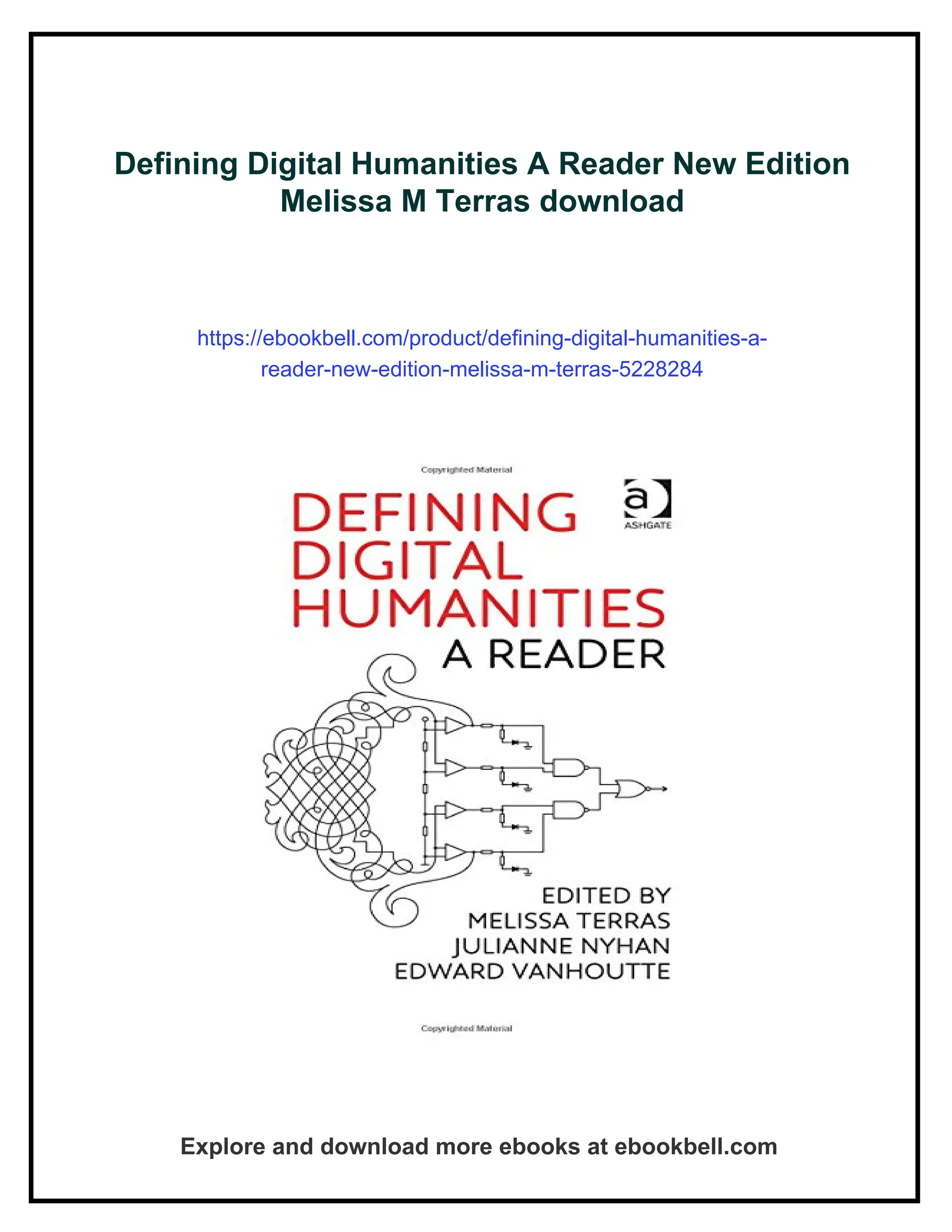

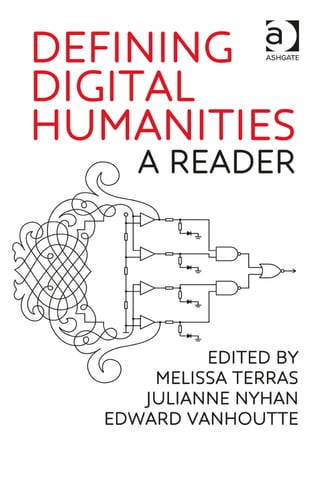
![V
Printed in the United Kingdom by Henry Ling Limited,
at the Dorset Press, Dorchester, DT1 1HD
© Melissa Terras, Julianne Nyhan, Edward Vanhoutte and all individual authors 2013
All rights reserved. No part of this publication may be reproduced, stored
in a retrieval system or transmitted in any form or by any means, electronic,
mechanical, photocopying, recording or otherwise without the prior permission
of the publisher.
Melissa Terras, Julianne Nyhan and Edward Vanhoutte have asserted their right
under the Copyright, Designs and Patents Act, 1988, to be identified as the editors
of this work.
Published by
Ashgate Publishing Limited Ashgate Publishing Company
Wey Court East 110 Cherry Street
Union Road Suite 3-1
Farnham Burlington, VT 05401-3818
Surrey, GU9 7PT USA
England
www.ashgate.com
British Library Cataloguing in Publication Data
A catalogue record for this book is available from the British Library
The Library of Congress has cataloged the printed edition as follows:
Defining digital humanities : a reader / [edited] by Melissa Terras, Julianne Nyhan,
and Edward Vanhoutte.
pages cm
Includes bibliographical references and index.
ISBN 978-1-4094-6962-9 (hardback) – ISBN 978-1-4094-6963-6 (pbk) –
ISBN 978-1-4094-6964-3 (epub) 1. Humanities–Data processing.
2. Humanities–Research–Data processing. 3. Information storage and retrieval
systems–Humanities. 4. Humanities–Electronic information resources.
I. Terras, Melissa M. II. Nyhan, Julianne. III. Vanhoutte, Edward.
AZ105.D44 2013
001.30285–dc23
2013020285
ISBN 9781409469629 (hbk)
ISBN 9781409469636 (pbk)
ISBN 9781409469643 (ebk – PDF)
ISBN 9781409469650 (ebk – ePUB)](https://image.slidesharecdn.com/2614142-250517235818-aa5d2b8a/85/Defining-Digital-Humanities-A-Reader-New-Edition-Melissa-M-Terras-9-320.jpg)
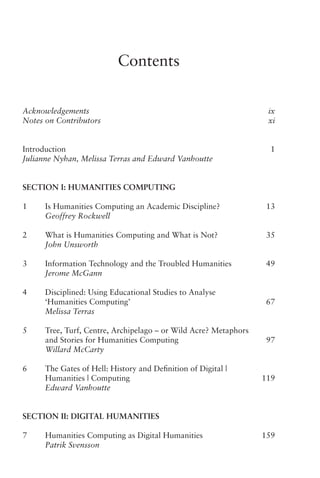
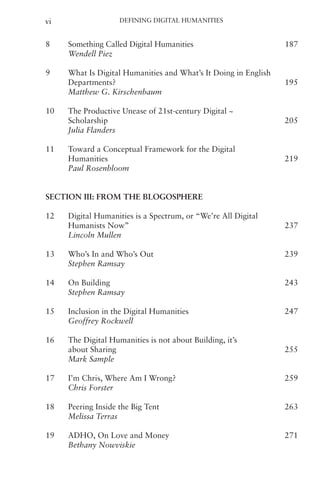
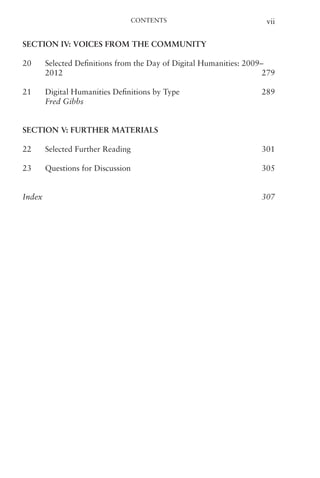


![Defining Digital Humanities
10
Terras, M. (2006). ‘Disciplined: Using Educational Studies to Analyse
“Humanities Computing”’, Literary and Linguistic Computing, 21 (2),
pp. 229–46.
Terras, M. (2011). ‘Peering Inside the Big Tent: Digital Humanities and
the Crisis of Inclusion’, Melissa Terras’ Blog, 26 July (accessed 19
September 2011).
Turkel, W.J. (2008). ‘A Few Arguments for Humanistic Fabrication’
[Webblog entry 21 November] Digital History Hacks: Methodology
for the Infinite Archive (2005–08) (accessed 20 August 2010).
Unsworth, J. (1997). ‘Documenting the Reinvention of Text. The
Importance of Failure’, The Journal of Electronic Publishing, 3 (2).
Unsworth, J. (2000). Scholarly Primitives: What methods do humanities
researchers have in common, and how might our tools reflect this?,
Paper read at the symposium on ‘Humanities Computing; formal
methods, experimental practice’, London: King’s College, 13 May.
Unsworth, J. (2002). ‘What is Humanities Computing, and What is
it Not?’, in G. Braungart, K. Eibl and F. Jannidis (eds) Jahrbuch für
Computerphilologie, 4, Paderborn: Mentis Verlag, pp. 71–84.
Unsworth, J. (2010). ‘The State of Digital Humanities’, Lecture at the
Digital Humanities Summer Institute.](https://image.slidesharecdn.com/2614142-250517235818-aa5d2b8a/85/Defining-Digital-Humanities-A-Reader-New-Edition-Melissa-M-Terras-31-320.jpg)

![Defining Digital Humanities
26
able to type a paper, it is the threshold of participation. The WWW site,
like a paper, is assessed in terms of the issues dealt with in the course as
a creative contribution. Third, we made sure there were courses in the
program that would focus on philosophical, critical, and communicative
aspects of multimedia independent of technology. Finally we made sure
that none of the courses were about a particular and therefore time-
dependent technology. There is no course on Macromedia Director as
you would find in a college program. There is a course on Advanced
Multimedia where students currently learn Director this year, but the
technical skills taught will change as the industry changes.
My colleague Andrew Mactavish in a paper we coauthored for
the 1999 ACH/ALLC at UVA went further and asked What are the
assumptions about technology, technical skill, and intellectual skill
that underlie the anxieties expressed in objections to our program? In
that paper, which I will not digress too far to summarize, he raises
the possibility that such objections are based on an unexamined and
essentialist view “which supports the division of technical skill and
intellectually enriched knowledge, gets played out in a host of symbolic
social divisions, including those that structure and intersect with
education, class, and culture” (Mactavish, Rockwell, and Buckley,
1999, p. 11). Needless to say, we did not accuse our colleagues in
public of such anxieties, but the very place of technical skill in the
humanities which the introduction of such a program raises needs to
be worked out further.
Why isn’t this a stream in computer science? Why don’t we leave this to
the community colleges?
The question of which type of institution or which department is best
suited to teach multimedia and humanities computing gets to the heart
of the Socratic legislative question. In Canada there is a hierarchy of
institutions and degrees from college certificates that generally take
a year to complete to honours BAs that take four years. Generally
speaking technical skills like carpentry and graphic design are taught in
community colleges while universities offer bachelor degrees that focus
more on the [academic aspects].
Aren’t students likely to start coming who already have the technical
expertise in multimedia? Do we therefore need to have a program that
teaches skills that will soon be universally taught in high school?
This is like asking if we should ditch our English program if students
came to university able to write. Regardless of their technical skill
level the university should be a place where they can study multimedia
further and in an academic fashion. I also doubt we will see this mythical
student who knows everything there is to know about computing.](https://image.slidesharecdn.com/2614142-250517235818-aa5d2b8a/85/Defining-Digital-Humanities-A-Reader-New-Edition-Melissa-M-Terras-47-320.jpg)


![This ebook is for the use of anyone anywhere in the United
States and most other parts of the world at no cost and with
almost no restrictions whatsoever. You may copy it, give it away
or re-use it under the terms of the Project Gutenberg License
included with this ebook or online at www.gutenberg.org. If you
are not located in the United States, you will have to check the
laws of the country where you are located before using this
eBook.
Title: Fires - Book 2: The Ovens, and Other Tales
Creator: Wilfrid Wilson Gibson
Release date: May 9, 2013 [eBook #42678]
Language: English
Credits: Produced by Al Haines
*** START OF THE PROJECT GUTENBERG EBOOK FIRES - BOOK 2:
THE OVENS, AND OTHER TALES ***](https://image.slidesharecdn.com/2614142-250517235818-aa5d2b8a/85/Defining-Digital-Humanities-A-Reader-New-Edition-Melissa-M-Terras-60-320.jpg)