Defending Against Application
        Level DoS Attacks


                   Roberto Suggi Liverani
                   Security-Assessment.com


OWASP New
Zealand Day
   2010       Copyright © The OWASP Foundation
              Permission is granted to copy, distribute and/or modify this document
              under the terms of the OWASP License.


              The OWASP Foundation
                            OWASP
              http://www.owasp.org
Who am I?
 Roberto Suggi Liverani
 Senior Security Consultant - Security-Assessment.com
    roberto.suggi@security-assessment.com
    http://www.security-assessment.com
 OWASP New Zealand Chapter Leader
    robertosl@owasp.org
    http://owasp.org/index.php/owasp_new_zealand
 Previous research:
    Black SEO
    Firefox Extensions
 Personal site:
    http://malerisch.net


                                                   OWASP   2
Agenda
 Layer 7 DoS Overview
    Implications
    Root Causes
 Attacks and Defenses
    Web Application
    Web Server
    Web Services
    Database
 Dealing with DDoS HTTP Attack
    Before
    During
    Post - attack
 Conclusion

                                  OWASP   3
Introduction
 Definition: ... an attack designed to render a computer or network
  incapable of providing normal services.

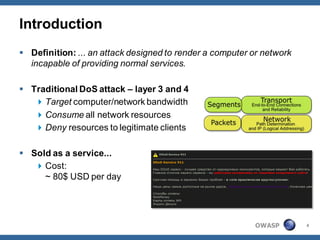
 Traditional DoS attack – layer 3 and 4
    Target computer/network bandwidth
    Consume all network resources
    Deny resources to legitimate clients

 Sold as a service...
    Cost:
     ~ 80$ USD per day


                                                          OWASP        4
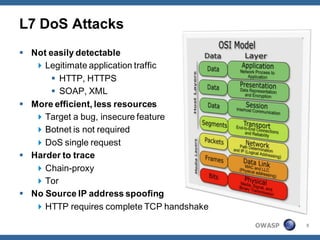
L7 DoS Attacks
 Not easily detectable
    Legitimate application traffic
        HTTP, HTTPS
        SOAP, XML
 More efficient, less resources
    Target a bug, insecure feature
    Botnet is not required
    DoS single request
 Harder to trace
    Chain-proxy
    Tor
 No Source IP address spoofing
    HTTP requires complete TCP handshake

                                            OWASP   5
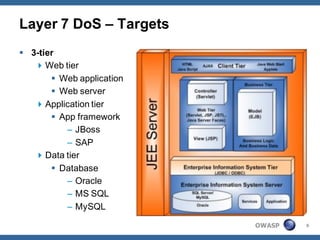
Layer 7 DoS – Targets
 3-tier
    Web tier
        Web application
        Web server
    Application tier
        App framework
          – JBoss
          – SAP
    Data tier
        Database
          – Oracle
          – MS SQL
          – MySQL

                           OWASP   6
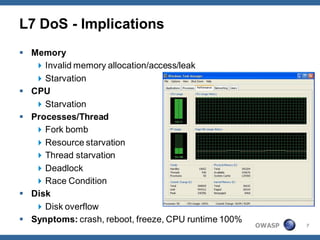
L7 DoS - Implications
 Memory
    Invalid memory allocation/access/leak
    Starvation
 CPU
    Starvation
 Processes/Thread
    Fork bomb
    Resource starvation
    Thread starvation
    Deadlock
    Race Condition
 Disk
    Disk overflow
 Synptoms: crash, reboot, freeze, CPU runtime 100%
                                                      OWASP   7
Layer 7 DoS – Root Causes
 Insecure feature/reasonable use expectation
    Trusted input / action sequence
    Human actions expected
 Bug/implementation flaw
    Poor input filtering and validation
    Failing to supply required element/object
 Application logic/environment
    Application logic open to abuse
    Time degrading application actions
    Bottlenecks in application framework/environment
 Session management
    Limited connection pool
    Expensive session generation/login process

                                                        OWASP   8
L7 DoS Attacks And Defenses
      Web Application


                          OWASP   9
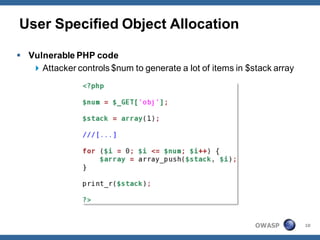
User Specified Object Allocation

 Vulnerable PHP code
    Attacker controls $num to generate a lot of items in $stack array


                                                            OWASP        10
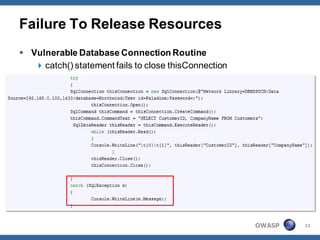
Failure To Release Resources
 Vulnerable Database Connection Routine
    catch() statement fails to close thisConnection


                                                       OWASP   11
Session Related DoS
    Storing lot of session objects for
     caching/performance instead of re-querying
     data from other sources (e.g. database)
    Consuming session token/login process

 Examples
    Web tracking, multiple session parameters in use
    Large database records are stored in user session for later use
    Session created even if user did not register
    Session created following user login but registration open to
     everyone


                                                          OWASP        12
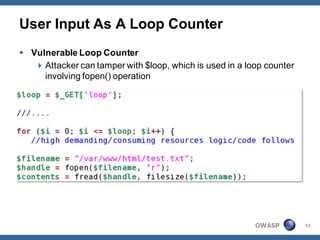
User Input As A Loop Counter
 Vulnerable Loop Counter
    Attacker can tamper with $loop, which is used in a loop counter
     involving fopen() operation


                                                          OWASP        13
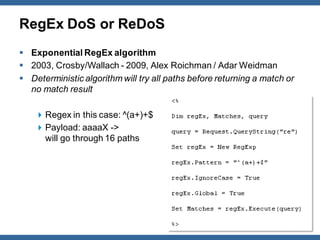
RegEx DoS or ReDoS
 Exponential RegEx algorithm
 2003, Crosby/Wallach - 2009, Alex Roichman / Adar Weidman
 Deterministic algorithm will try all paths before returning a match or
  no match result

     Regex in this case: ^(a+)+$
     Payload: aaaaX ->
      will go through 16 paths


                                                             OWASP         14
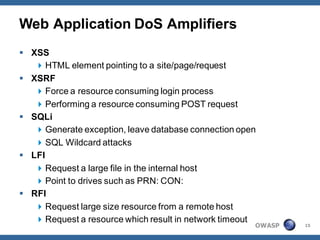
Web Application DoS Amplifiers
 XSS
    HTML element pointing to a site/page/request
 XSRF
    Force a resource consuming login process
    Performing a resource consuming POST request
 SQLi
    Generate exception, leave database connection open
    SQL Wildcard attacks
 LFI
    Request a large file in the internal host
    Point to drives such as PRN: CON:
 RFI
    Request large size resource from a remote host
    Request a resource which result in network timeout
                                                      OWASP   15
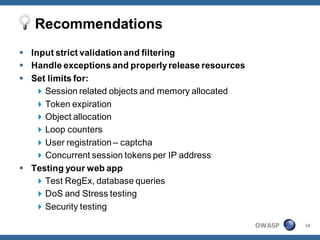
Recommendations
 Input strict validation and filtering
 Handle exceptions and properly release resources
 Set limits for:
    Session related objects and memory allocated
    Token expiration
    Object allocation
    Loop counters
    User registration – captcha
    Concurrent session tokens per IP address
 Testing your web app
    Test RegEx, database queries
    DoS and Stress testing
    Security testing

                                                     OWASP   16
L7 DoS Attacks And Defenses
       Web Services


                          OWASP   17
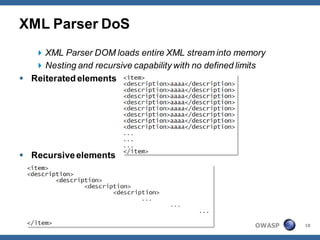
XML Parser DoS
    XML Parser DOM loads entire XML stream into memory
    Nesting and recursive capability with no defined limits
 Reiterated elements


 Recursive elements


                                                         OWASP   18
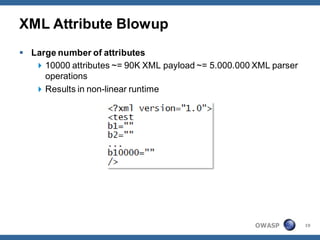
XML Attribute Blowup
 Large number of attributes
    10000 attributes ~= 90K XML payload ~= 5.000.000 XML parser
     operations
    Results in non-linear runtime


                                                      OWASP        19
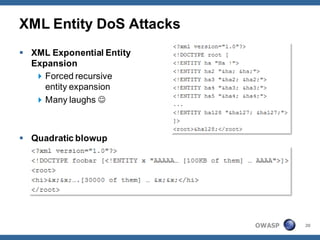
XML Entity DoS Attacks
 XML Exponential Entity
  Expansion
    Forced recursive
     entity expansion
    Many laughs 


 Quadratic blowup


                           OWASP   20
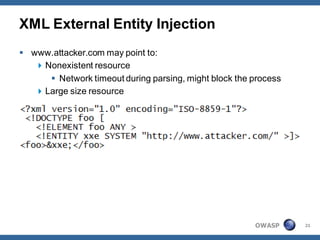
XML External Entity Injection
 www.attacker.com may point to:
    Nonexistent resource
       Network timeout during parsing, might block the process
    Large size resource


                                                        OWASP     21
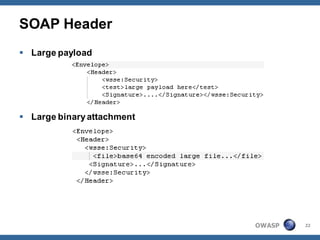
SOAP Header
 Large payload


 Large binary attachment


                            OWASP   22
SOAP Other attacks
 SOAP Body
    Valid, but very large SOAP body request matching web service
     schema
 SOAP Attachment
    Over sized SOAP attachment referred from the SOAP body

 SOAP request resulting in heavy database query

 Amplifiers
    HTTP/1.1 pipeline
    Multiple fragmented SOAP requests


                                                        OWASP       23
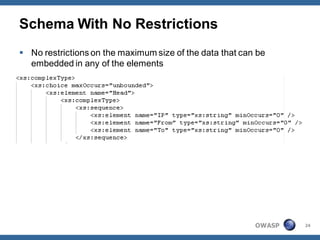
Schema With No Restrictions
 No restrictions on the maximum size of the data that can be
  embedded in any of the elements


                                                          OWASP   24
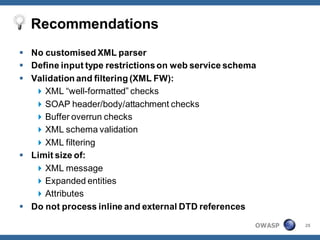
Recommendations
 No customised XML parser
 Define input type restrictions on web service schema
 Validation and filtering (XML FW):
    XML “well-formatted” checks
    SOAP header/body/attachment checks
    Buffer overrun checks
    XML schema validation
    XML filtering
 Limit size of:
    XML message
    Expanded entities
    Attributes
 Do not process inline and external DTD references

                                                     OWASP   25
L7 DoS Attacks And Defenses
        Web Server


                          OWASP   26
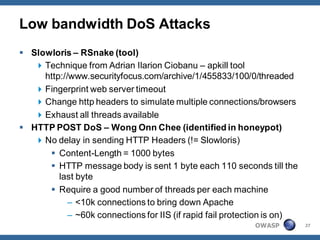
Low bandwidth DoS Attacks
 Slowloris – RSnake (tool)
    Technique from Adrian Ilarion Ciobanu – apkill tool
     http://www.securityfocus.com/archive/1/455833/100/0/threaded
    Fingerprint web server timeout
    Change http headers to simulate multiple connections/browsers
    Exhaust all threads available
 HTTP POST DoS – Wong Onn Chee (identified in honeypot)
    No delay in sending HTTP Headers (!= Slowloris)
       Content-Length = 1000 bytes
       HTTP message body is sent 1 byte each 110 seconds till the
         last byte
       Require a good number of threads per each machine
            – <10k connections to bring down Apache
            – ~60k connections for IIS (if rapid fail protection is on)
                                                            OWASP         27
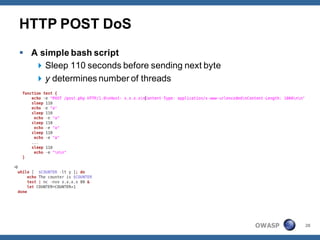
HTTP POST DoS
 A simple bash script
    Sleep 110 seconds before sending next byte
    y determines number of threads


                                                  OWASP   28
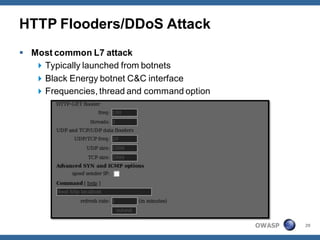
HTTP Flooders/DDoS Attack
 Most common L7 attack
    Typically launched from botnets
    Black Energy botnet C&C interface
    Frequencies, thread and command option


                                              OWASP   29
Apache - Recommendations
 Key Directives
    Maxclients, Timeout, KeepAlive and KeepAlive Timeout
 Traffic Shaping
    mod_throttle - limit the frequency of requests allowed from a
     single client within a window of time
    mod_bwshare - bandwidth throttling by HTTP client IP address
    mod_limitipconn - limit the number of simultaneous downloads
     permitted from a single IP address
    mod_dosevasive - detects too many connections and
     temporaribly block offending IP address
    mod_security – WAF, filtering, monitoring, logging
 Load/Stressing testing
    http_load
    Jmeter
    Slowloris + DoS tools                                  OWASP    30
IIS - Recommendations
 IIS Extensions:
     URLScan or Webknight
         MaxAllowedContentLength, MaxUrl and MaxQueryString
          attributes
     Dynamic IP Restrictions
         Dynamically blocking of requests from IP address based on:
            – The number of concurrent requests
            – The number of requests over a period of time
 ISA Server Network Protection
     Act as load balancer and WAF at the same time
     Multiple options for HTTP DoS attacks
         HTTP requests per minute, per IP address
 Check Application pool health monitoring
     IIS worker threads status
                                                          OWASP        31
L7 DoS Attacks And Defenses
         Database


                          OWASP   32
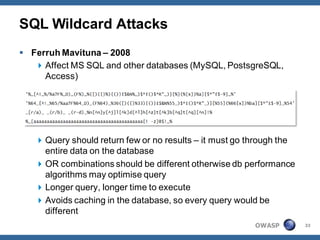
SQL Wildcard Attacks
 Ferruh Mavituna – 2008
    Affect MS SQL and other databases (MySQL, PostsgreSQL,
     Access)


    Query should return few or no results – it must go through the
     entire data on the database
    OR combinations should be different otherwise db performance
     algorithms may optimise query
    Longer query, longer time to execute
    Avoids caching in the database, so every query would be
     different
                                                         OWASP        33
Recommendations
 Perform input validation and filtering based on whitelist
    Discard wildcards and other potential characters
    Limit number of characters on the query
    Input type strict validation (e.g. number must be a number)
 Implement CAPTCHA for advanced searches/queries
 Search/Query Limits
    Set limit of searches/queries per user per day
    Only authenticated users can run consuming search/queries
    Limit SQL query execution time
 Limit number of records/rows returned by database
 Memcached
    High performance, memory object caching system


                                                         OWASP     34
Dealing with an HTTP DDoS Attack
     Part I - Before the Attack


                            OWASP   35
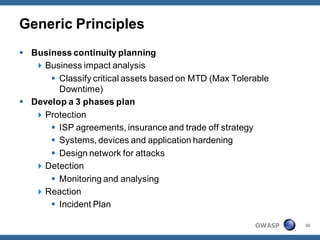
Generic Principles
 Business continuity planning
    Business impact analysis
       Classify critical assets based on MTD (Max Tolerable
        Downtime)
 Develop a 3 phases plan
    Protection
       ISP agreements, insurance and trade off strategy
       Systems, devices and application hardening
       Design network for attacks
    Detection
       Monitoring and analysing
    Reaction
       Incident Plan

                                                        OWASP   36
Protection And Prevention
 ISP agreements
    DoS protection included in agreements
 Insurance policy
 Establish trade-off strategies/tactics
    Absorbe attack
    Degrade service
    Shut down service
 Systems Hardening
    Perform regular host reviews against CIS and NIST standards
    Perform application reviews
 Network Hardening
    Load and stress testing network


                                                       OWASP       37
Segmentation And Overprovision
 Segmentation
    Redundancy for critical services
    Critical services with dedicated server
 Overprovision
    Hardware and network
 Monitoring
    Host and Network Intrusion Detection System
    Centralised log system
 Incident planning
    What to do during in incident
    Escalation line
    Action items
 Test your incident plan regularly!

                                                   OWASP   38
Dealing with an HTTP DDoS Attack
    Part II – During the attack


                            OWASP   39
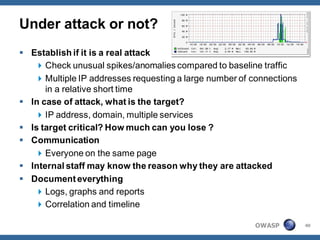
Under attack or not?
 Establish if it is a real attack
    Check unusual spikes/anomalies compared to baseline traffic
    Multiple IP addresses requesting a large number of connections
      in a relative short time
 In case of attack, what is the target?
    IP address, domain, multiple services
 Is target critical? How much can you lose ?
 Communication
    Everyone on the same page
 Internal staff may know the reason why they are attacked
 Document everything
    Logs, graphs and reports
    Correlation and timeline

                                                        OWASP         40
External collaboration
 Contact ISPs
    Provide detailed information
    Triangulation software helps
     identifying botnet C&C server

 Uncooperative hosting providers can be declared to press

 Security Community/Botnet Researcher
    Attack fingerprint may help in detecting type of botnet and C&C

 Contact Law Enforcement – CCIP, NZCERT

 Set a “we are down” web page

                                                          OWASP        41
Reacting
 Slowing the attack
    Tarpitting
        Delays incoming connections for as long as possible
 Deflection
    IP Hopping: IP address changed at “random” intervals within a
     specified set of IP addresses range
 Dropping
    Dropping connections for a determined time
 Escalation (law/legal implications)
    Identify C&C and track down botnet C&C server
        Report C&C to authorities
        …
    Look at the botnet
        …
                                                         OWASP       42
Dealing with an HTTP DDoS Attack
      Part III – The day after


                            OWASP   43
Recovering
 Lesson learnt analysis
    Meet the day after (everything still fresh)
    Go over what worked and what didn’t
    Update incident plan
 Root causes
    Was attack targeting a specific and vulnerable system?
    Was just a standard flooding attack?
 What if it happens again?
 Business Recovery
    Recover services as soon as possible
    Provide incident data to law enforcement agencies


                                                         OWASP   44
Conclusions
 No generic anti-DoS solution
    Each organisation = different environment
    Harden systems, applications and networks
    Perform regular DoS testing and audits
    Continuous monitoring and alerting

 Don’t trust anti-DDoS vendors
    Carefully evaluate anti-DDoS related products/services

 Networking and cooperation
    Good relationships with security community, ISP and law
     enforcement agencies


                                                         OWASP   45
Questions?
 Thanks! ;-)


                OWASP   46
References
 Slowloris - http://ha.ckers.org/slowloris/
 Apache HTTP DoS tool mitigation -
  http://isc.sans.edu/diary.html?storyid=6613
 Mitigating the Slowloris HTTP DoS Attack -
  http://threatpost.com/en_us/blogs/mitigating-slowloris-http-
  dos-attack-062209
 Regular Expression DoS -
  http://www.owasp.org/index.php/Regular_expression_Denial_of
  _Service_-_ReDoS
 Testing for Storing too much data in session -
  http://www.owasp.org/index.php/Testing_for_Storing_too_Muc
  h_Data_in_Session_(OWASP-DS-008)
 Testing for writing user provided data to disk -
  http://www.owasp.org/index.php/Testing_for_Writing_User_Pro
  vided_Data_to_Disk_(OWASP-DS-006)
                                                   OWASP         47
References
 Testing for user input as loop counter -
  http://www.owasp.org/index.php/Testing_for_User_Input_as_a_
  Loop_Counter_(OWASP-DS-005)
 Testing for DoS User Specified Object allocation -
  http://www.owasp.org/index.php/Testing_for_DoS_User_Specifi
  ed_Object_Allocation_(OWASP-DS-004)
 Testing for Denial of Service -
  http://www.owasp.org/index.php/Testing_for_Denial_of_Service
 HTTP DDoS Attack mitigation using tarpitting -
  http://www.secureworks.com/research/threats/ddos/
 Guest Blog: Defending against DDoS -
  http://www.sectechno.com/2009/12/06/guest-blog-defending-
  against-ddos/
 A cheesy Apache / IIS DoS vul (+a question) -
  http://www.securityfocus.com/archive/1/456339/30/0/threaded
                                                   OWASP         48
References
 The top 10 things to do while under ddos attack -
  http://www.blyon.com/blog/index.php/2010/01/24/ddos_top_10/
 Apache httpd server denial of service attack example -
  http://pub.mud.ro/~cia/computing/apache-httpd-denial-of-
  service-example.html
 Distributed Denial of Service (DDoS) attack tools -
  http://staff.washington.edu/dittrich/misc/ddos/
 Help defeat distributed denial of service attacks: steps by steps
  - http://www.sans.org/dosstep/
 Intentando detener un DDoS -
  http://foro.elhacker.net/tutoriales_documentacion/intentando_d
  etener_un_ddos-t137442.0.html
 Using squid to fight ddos -
  http://www.blyon.com/blog/index.php/2009/07/24/using-squid-
  proxy-to-fight-ddos/
                                                        OWASP         49
References
 Surviving DDoS Attacks -
  http://research.corsaire.com/whitepapers/040211-surviving-
  ddos-attacks.pdf
 Application Denial of Service attacks -
  http://research.corsaire.com/whitepapers/040405-application-
  level-dos-attacks.pdf
 Denial of service attack – wikipedia -
  http://en.wikipedia.org/wiki/Denial-of-service_attack
 DDoS A&D International Workshop on DDoS Attacks and
  Defenses - http://caislab.kaist.ac.kr/77ddos/Program.html
 DDoS Self Defense -
  http://caislab.kaist.ac.kr/77ddos/DDoS%20Self-Defense.pdf
 DDoS Traceback and Beyond -
  http://caislab.kaist.ac.kr/77ddos/DDoS%20Attack%20Traceback
  %20and%20Beyond.pdf
                                                    OWASP        50
References
 DoS Attacks Using Sql Wildcards - http://www.portcullis-
  security.com/uplds/wildcard_attacks.pdf
 Anyone interested in the details of latest HTTP POST DDOS
  attack technique? - https://lists.owasp.org/pipermail/owasp-
  leaders/attachments/20100308/bc2a1777/attachment-0001.pdf
 CERT – Managing the threat of denial-of-service attacks -
  http://www.cert.org/archive/pdf/Managing_DoS.pdf
 O’Reilly, 2005 - Apache SecurityBy Ivan Ristic
 OWASP Guide 2.0, denial of service attacks
 RESPONDING TO A DISTRIBUTED DENIAL OF SERVICE
  ATTACK WITH A SELECTIVE TARPIT
  http://psifertex.com/download/Jordan_Wiens_GCIH.pdf
 Attacking Web Services -
  http://www.owasp.org/index.php/File:AppSec2005DC-
  Alex_Stamos-Attacking_Web_Services.ppt
                                                     OWASP       51

Defending Against Application DoS attacks

  • 1.
    Defending Against Application Level DoS Attacks Roberto Suggi Liverani Security-Assessment.com OWASP New Zealand Day 2010 Copyright © The OWASP Foundation Permission is granted to copy, distribute and/or modify this document under the terms of the OWASP License. The OWASP Foundation OWASP http://www.owasp.org
  • 2.
    Who am I? Roberto Suggi Liverani  Senior Security Consultant - Security-Assessment.com  roberto.suggi@security-assessment.com  http://www.security-assessment.com  OWASP New Zealand Chapter Leader  robertosl@owasp.org  http://owasp.org/index.php/owasp_new_zealand  Previous research:  Black SEO  Firefox Extensions  Personal site:  http://malerisch.net OWASP 2
  • 3.
    Agenda  Layer 7DoS Overview  Implications  Root Causes  Attacks and Defenses  Web Application  Web Server  Web Services  Database  Dealing with DDoS HTTP Attack  Before  During  Post - attack  Conclusion OWASP 3
  • 4.
    Introduction  Definition: ...an attack designed to render a computer or network incapable of providing normal services.  Traditional DoS attack – layer 3 and 4  Target computer/network bandwidth  Consume all network resources  Deny resources to legitimate clients  Sold as a service...  Cost: ~ 80$ USD per day OWASP 4
  • 5.
    L7 DoS Attacks Not easily detectable  Legitimate application traffic  HTTP, HTTPS  SOAP, XML  More efficient, less resources  Target a bug, insecure feature  Botnet is not required  DoS single request  Harder to trace  Chain-proxy  Tor  No Source IP address spoofing  HTTP requires complete TCP handshake OWASP 5
  • 6.
    Layer 7 DoS– Targets  3-tier  Web tier  Web application  Web server  Application tier  App framework – JBoss – SAP  Data tier  Database – Oracle – MS SQL – MySQL OWASP 6
  • 7.
    L7 DoS -Implications  Memory  Invalid memory allocation/access/leak  Starvation  CPU  Starvation  Processes/Thread  Fork bomb  Resource starvation  Thread starvation  Deadlock  Race Condition  Disk  Disk overflow  Synptoms: crash, reboot, freeze, CPU runtime 100% OWASP 7
  • 8.
    Layer 7 DoS– Root Causes  Insecure feature/reasonable use expectation  Trusted input / action sequence  Human actions expected  Bug/implementation flaw  Poor input filtering and validation  Failing to supply required element/object  Application logic/environment  Application logic open to abuse  Time degrading application actions  Bottlenecks in application framework/environment  Session management  Limited connection pool  Expensive session generation/login process OWASP 8
  • 9.
    L7 DoS AttacksAnd Defenses Web Application OWASP 9
  • 10.
    User Specified ObjectAllocation  Vulnerable PHP code  Attacker controls $num to generate a lot of items in $stack array OWASP 10
  • 11.
    Failure To ReleaseResources  Vulnerable Database Connection Routine  catch() statement fails to close thisConnection OWASP 11
  • 12.
    Session Related DoS  Storing lot of session objects for caching/performance instead of re-querying data from other sources (e.g. database)  Consuming session token/login process  Examples  Web tracking, multiple session parameters in use  Large database records are stored in user session for later use  Session created even if user did not register  Session created following user login but registration open to everyone OWASP 12
  • 13.
    User Input AsA Loop Counter  Vulnerable Loop Counter  Attacker can tamper with $loop, which is used in a loop counter involving fopen() operation OWASP 13
  • 14.
    RegEx DoS orReDoS  Exponential RegEx algorithm  2003, Crosby/Wallach - 2009, Alex Roichman / Adar Weidman  Deterministic algorithm will try all paths before returning a match or no match result  Regex in this case: ^(a+)+$  Payload: aaaaX -> will go through 16 paths OWASP 14
  • 15.
    Web Application DoSAmplifiers  XSS  HTML element pointing to a site/page/request  XSRF  Force a resource consuming login process  Performing a resource consuming POST request  SQLi  Generate exception, leave database connection open  SQL Wildcard attacks  LFI  Request a large file in the internal host  Point to drives such as PRN: CON:  RFI  Request large size resource from a remote host  Request a resource which result in network timeout OWASP 15
  • 16.
    Recommendations  Input strictvalidation and filtering  Handle exceptions and properly release resources  Set limits for:  Session related objects and memory allocated  Token expiration  Object allocation  Loop counters  User registration – captcha  Concurrent session tokens per IP address  Testing your web app  Test RegEx, database queries  DoS and Stress testing  Security testing OWASP 16
  • 17.
    L7 DoS AttacksAnd Defenses Web Services OWASP 17
  • 18.
    XML Parser DoS  XML Parser DOM loads entire XML stream into memory  Nesting and recursive capability with no defined limits  Reiterated elements  Recursive elements OWASP 18
  • 19.
    XML Attribute Blowup Large number of attributes  10000 attributes ~= 90K XML payload ~= 5.000.000 XML parser operations  Results in non-linear runtime OWASP 19
  • 20.
    XML Entity DoSAttacks  XML Exponential Entity Expansion  Forced recursive entity expansion  Many laughs   Quadratic blowup OWASP 20
  • 21.
    XML External EntityInjection  www.attacker.com may point to:  Nonexistent resource  Network timeout during parsing, might block the process  Large size resource OWASP 21
  • 22.
    SOAP Header  Largepayload  Large binary attachment OWASP 22
  • 23.
    SOAP Other attacks SOAP Body  Valid, but very large SOAP body request matching web service schema  SOAP Attachment  Over sized SOAP attachment referred from the SOAP body  SOAP request resulting in heavy database query  Amplifiers  HTTP/1.1 pipeline  Multiple fragmented SOAP requests OWASP 23
  • 24.
    Schema With NoRestrictions  No restrictions on the maximum size of the data that can be embedded in any of the elements OWASP 24
  • 25.
    Recommendations  No customisedXML parser  Define input type restrictions on web service schema  Validation and filtering (XML FW):  XML “well-formatted” checks  SOAP header/body/attachment checks  Buffer overrun checks  XML schema validation  XML filtering  Limit size of:  XML message  Expanded entities  Attributes  Do not process inline and external DTD references OWASP 25
  • 26.
    L7 DoS AttacksAnd Defenses Web Server OWASP 26
  • 27.
    Low bandwidth DoSAttacks  Slowloris – RSnake (tool)  Technique from Adrian Ilarion Ciobanu – apkill tool http://www.securityfocus.com/archive/1/455833/100/0/threaded  Fingerprint web server timeout  Change http headers to simulate multiple connections/browsers  Exhaust all threads available  HTTP POST DoS – Wong Onn Chee (identified in honeypot)  No delay in sending HTTP Headers (!= Slowloris)  Content-Length = 1000 bytes  HTTP message body is sent 1 byte each 110 seconds till the last byte  Require a good number of threads per each machine – <10k connections to bring down Apache – ~60k connections for IIS (if rapid fail protection is on) OWASP 27
  • 28.
    HTTP POST DoS A simple bash script  Sleep 110 seconds before sending next byte  y determines number of threads OWASP 28
  • 29.
    HTTP Flooders/DDoS Attack Most common L7 attack  Typically launched from botnets  Black Energy botnet C&C interface  Frequencies, thread and command option OWASP 29
  • 30.
    Apache - Recommendations Key Directives  Maxclients, Timeout, KeepAlive and KeepAlive Timeout  Traffic Shaping  mod_throttle - limit the frequency of requests allowed from a single client within a window of time  mod_bwshare - bandwidth throttling by HTTP client IP address  mod_limitipconn - limit the number of simultaneous downloads permitted from a single IP address  mod_dosevasive - detects too many connections and temporaribly block offending IP address  mod_security – WAF, filtering, monitoring, logging  Load/Stressing testing  http_load  Jmeter  Slowloris + DoS tools OWASP 30
  • 31.
    IIS - Recommendations IIS Extensions:  URLScan or Webknight  MaxAllowedContentLength, MaxUrl and MaxQueryString attributes  Dynamic IP Restrictions  Dynamically blocking of requests from IP address based on: – The number of concurrent requests – The number of requests over a period of time  ISA Server Network Protection  Act as load balancer and WAF at the same time  Multiple options for HTTP DoS attacks  HTTP requests per minute, per IP address  Check Application pool health monitoring  IIS worker threads status OWASP 31
  • 32.
    L7 DoS AttacksAnd Defenses Database OWASP 32
  • 33.
    SQL Wildcard Attacks Ferruh Mavituna – 2008  Affect MS SQL and other databases (MySQL, PostsgreSQL, Access)  Query should return few or no results – it must go through the entire data on the database  OR combinations should be different otherwise db performance algorithms may optimise query  Longer query, longer time to execute  Avoids caching in the database, so every query would be different OWASP 33
  • 34.
    Recommendations  Perform inputvalidation and filtering based on whitelist  Discard wildcards and other potential characters  Limit number of characters on the query  Input type strict validation (e.g. number must be a number)  Implement CAPTCHA for advanced searches/queries  Search/Query Limits  Set limit of searches/queries per user per day  Only authenticated users can run consuming search/queries  Limit SQL query execution time  Limit number of records/rows returned by database  Memcached  High performance, memory object caching system OWASP 34
  • 35.
    Dealing with anHTTP DDoS Attack Part I - Before the Attack OWASP 35
  • 36.
    Generic Principles  Businesscontinuity planning  Business impact analysis  Classify critical assets based on MTD (Max Tolerable Downtime)  Develop a 3 phases plan  Protection  ISP agreements, insurance and trade off strategy  Systems, devices and application hardening  Design network for attacks  Detection  Monitoring and analysing  Reaction  Incident Plan OWASP 36
  • 37.
    Protection And Prevention ISP agreements  DoS protection included in agreements  Insurance policy  Establish trade-off strategies/tactics  Absorbe attack  Degrade service  Shut down service  Systems Hardening  Perform regular host reviews against CIS and NIST standards  Perform application reviews  Network Hardening  Load and stress testing network OWASP 37
  • 38.
    Segmentation And Overprovision Segmentation  Redundancy for critical services  Critical services with dedicated server  Overprovision  Hardware and network  Monitoring  Host and Network Intrusion Detection System  Centralised log system  Incident planning  What to do during in incident  Escalation line  Action items  Test your incident plan regularly! OWASP 38
  • 39.
    Dealing with anHTTP DDoS Attack Part II – During the attack OWASP 39
  • 40.
    Under attack ornot?  Establish if it is a real attack  Check unusual spikes/anomalies compared to baseline traffic  Multiple IP addresses requesting a large number of connections in a relative short time  In case of attack, what is the target?  IP address, domain, multiple services  Is target critical? How much can you lose ?  Communication  Everyone on the same page  Internal staff may know the reason why they are attacked  Document everything  Logs, graphs and reports  Correlation and timeline OWASP 40
  • 41.
    External collaboration  ContactISPs  Provide detailed information  Triangulation software helps identifying botnet C&C server  Uncooperative hosting providers can be declared to press  Security Community/Botnet Researcher  Attack fingerprint may help in detecting type of botnet and C&C  Contact Law Enforcement – CCIP, NZCERT  Set a “we are down” web page OWASP 41
  • 42.
    Reacting  Slowing theattack  Tarpitting  Delays incoming connections for as long as possible  Deflection  IP Hopping: IP address changed at “random” intervals within a specified set of IP addresses range  Dropping  Dropping connections for a determined time  Escalation (law/legal implications)  Identify C&C and track down botnet C&C server  Report C&C to authorities  …  Look at the botnet  … OWASP 42
  • 43.
    Dealing with anHTTP DDoS Attack Part III – The day after OWASP 43
  • 44.
    Recovering  Lesson learntanalysis  Meet the day after (everything still fresh)  Go over what worked and what didn’t  Update incident plan  Root causes  Was attack targeting a specific and vulnerable system?  Was just a standard flooding attack?  What if it happens again?  Business Recovery  Recover services as soon as possible  Provide incident data to law enforcement agencies OWASP 44
  • 45.
    Conclusions  No genericanti-DoS solution  Each organisation = different environment  Harden systems, applications and networks  Perform regular DoS testing and audits  Continuous monitoring and alerting  Don’t trust anti-DDoS vendors  Carefully evaluate anti-DDoS related products/services  Networking and cooperation  Good relationships with security community, ISP and law enforcement agencies OWASP 45
  • 46.
  • 47.
    References  Slowloris -http://ha.ckers.org/slowloris/  Apache HTTP DoS tool mitigation - http://isc.sans.edu/diary.html?storyid=6613  Mitigating the Slowloris HTTP DoS Attack - http://threatpost.com/en_us/blogs/mitigating-slowloris-http- dos-attack-062209  Regular Expression DoS - http://www.owasp.org/index.php/Regular_expression_Denial_of _Service_-_ReDoS  Testing for Storing too much data in session - http://www.owasp.org/index.php/Testing_for_Storing_too_Muc h_Data_in_Session_(OWASP-DS-008)  Testing for writing user provided data to disk - http://www.owasp.org/index.php/Testing_for_Writing_User_Pro vided_Data_to_Disk_(OWASP-DS-006) OWASP 47
  • 48.
    References  Testing foruser input as loop counter - http://www.owasp.org/index.php/Testing_for_User_Input_as_a_ Loop_Counter_(OWASP-DS-005)  Testing for DoS User Specified Object allocation - http://www.owasp.org/index.php/Testing_for_DoS_User_Specifi ed_Object_Allocation_(OWASP-DS-004)  Testing for Denial of Service - http://www.owasp.org/index.php/Testing_for_Denial_of_Service  HTTP DDoS Attack mitigation using tarpitting - http://www.secureworks.com/research/threats/ddos/  Guest Blog: Defending against DDoS - http://www.sectechno.com/2009/12/06/guest-blog-defending- against-ddos/  A cheesy Apache / IIS DoS vul (+a question) - http://www.securityfocus.com/archive/1/456339/30/0/threaded OWASP 48
  • 49.
    References  The top10 things to do while under ddos attack - http://www.blyon.com/blog/index.php/2010/01/24/ddos_top_10/  Apache httpd server denial of service attack example - http://pub.mud.ro/~cia/computing/apache-httpd-denial-of- service-example.html  Distributed Denial of Service (DDoS) attack tools - http://staff.washington.edu/dittrich/misc/ddos/  Help defeat distributed denial of service attacks: steps by steps - http://www.sans.org/dosstep/  Intentando detener un DDoS - http://foro.elhacker.net/tutoriales_documentacion/intentando_d etener_un_ddos-t137442.0.html  Using squid to fight ddos - http://www.blyon.com/blog/index.php/2009/07/24/using-squid- proxy-to-fight-ddos/ OWASP 49
  • 50.
    References  Surviving DDoSAttacks - http://research.corsaire.com/whitepapers/040211-surviving- ddos-attacks.pdf  Application Denial of Service attacks - http://research.corsaire.com/whitepapers/040405-application- level-dos-attacks.pdf  Denial of service attack – wikipedia - http://en.wikipedia.org/wiki/Denial-of-service_attack  DDoS A&D International Workshop on DDoS Attacks and Defenses - http://caislab.kaist.ac.kr/77ddos/Program.html  DDoS Self Defense - http://caislab.kaist.ac.kr/77ddos/DDoS%20Self-Defense.pdf  DDoS Traceback and Beyond - http://caislab.kaist.ac.kr/77ddos/DDoS%20Attack%20Traceback %20and%20Beyond.pdf OWASP 50
  • 51.
    References  DoS AttacksUsing Sql Wildcards - http://www.portcullis- security.com/uplds/wildcard_attacks.pdf  Anyone interested in the details of latest HTTP POST DDOS attack technique? - https://lists.owasp.org/pipermail/owasp- leaders/attachments/20100308/bc2a1777/attachment-0001.pdf  CERT – Managing the threat of denial-of-service attacks - http://www.cert.org/archive/pdf/Managing_DoS.pdf  O’Reilly, 2005 - Apache SecurityBy Ivan Ristic  OWASP Guide 2.0, denial of service attacks  RESPONDING TO A DISTRIBUTED DENIAL OF SERVICE ATTACK WITH A SELECTIVE TARPIT http://psifertex.com/download/Jordan_Wiens_GCIH.pdf  Attacking Web Services - http://www.owasp.org/index.php/File:AppSec2005DC- Alex_Stamos-Attacking_Web_Services.ppt OWASP 51