Escalations Team
Training, August
2013
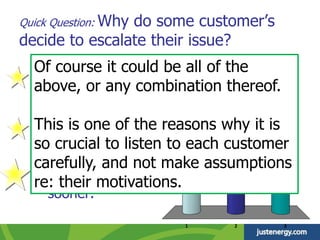
Quick Question: Why do some customer’s
decide to escalate their issue?
1 2 3
33% 33%33%
1. A lack of
confidence in first
point of contact.
2. A desire to be
taken seriously.
3. An attempt to
resolve their issue
sooner.
Of course it could be all of the
above, or any combination thereof.
This is one of the reasons why it is
so crucial to listen to each customer
carefully, and not make assumptions
re: their motivations.
How well do you handle irate callers?
(From Dee, David, Tough Customers: How to Keep Them Smiling…And Yourself Sane!, Dartnell Corp., c. 1994)
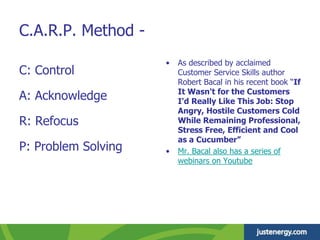
• As described by acclaimed
Customer Service Skills author
Robert Bacal in his recent book “If
It Wasn't for the Customers
I'd Really Like This Job: Stop
Angry, Hostile Customers Cold
While Remaining Professional,
Stress Free, Efficient and Cool
as a Cucumber”
• Mr. Bacal also has a series of
webinars on Youtube
C.A.R.P. Method -
C: Control
A: Acknowledge
R: Refocus
P: Problem Solving
Sample Escalation Call, Disputed
Enrollment
• Let’s listen in to a recent call in which the
customer was threatening escalation to a
regulatory body.
• First, the initial contact with an Inbound CSR;
• In your view, what were the key strengths and
opportunities demonstrated?
• Now, the remainder of the call with the CSR who
handled the escalation;
• Once again, take note of any strengths and
opportunities.
Let’s Discuss…
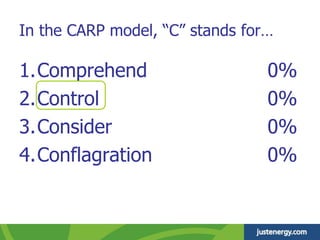
In the CARP model, “C” stands for…
1.Comprehend
2.Control
3.Consider
4.Conflagration
0%
0%
0%
0%
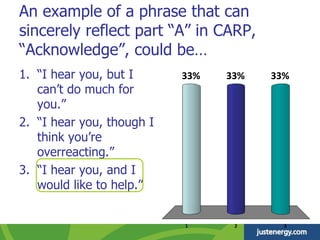
An example of a phrase that can
sincerely reflect part “A” in CARP,
“Acknowledge”, could be…
1 2 3
33% 33%33%1. “I hear you, but I
can’t do much for
you.”
2. “I hear you, though I
think you’re
overreacting.”
3. “I hear you, and I
would like to help.”
Win-win Solutions Work for Customers
(From Dee, David, Tough Customers: How to Keep Them Smiling…And Yourself Sane!, Dartnell Corp., c. 1994)
Once you’ve acknowledged the customer’s issue effectively,
it’s time to re-focus the conversation on what can be
achieved. What is one way of determining if the customer
is ready for this step?
1. He/she begins to respond to your probing
questions.
2. He/she continues to repeat the same
information.
3. He/she is no longer personally insulting or
abusive.
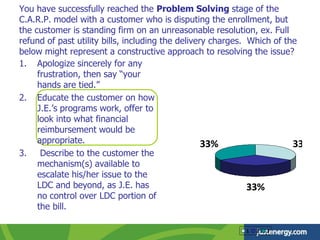
You have successfully reached the Problem Solving stage of the
C.A.R.P. model with a customer who is disputing the enrollment, but
the customer is standing firm on an unreasonable resolution, ex. Full
refund of past utility bills, including the delivery charges. Which of the
below might represent a constructive approach to resolving the issue?
33%
33%
33%
1 2 3
1. Apologize sincerely for any
frustration, then say “your
hands are tied.”
2. Educate the customer on how
J.E.’s programs work, offer to
look into what financial
reimbursement would be
appropriate.
3. Describe to the customer the
mechanism(s) available to
escalate his/her issue to the
LDC and beyond, as J.E. has
no control over LDC portion of
the bill.
ROLE PLAYS
So…ready to negotiate?

Deescalation Training_Presentation

  • 1.
  • 2.
    Quick Question: Whydo some customer’s decide to escalate their issue? 1 2 3 33% 33%33% 1. A lack of confidence in first point of contact. 2. A desire to be taken seriously. 3. An attempt to resolve their issue sooner. Of course it could be all of the above, or any combination thereof. This is one of the reasons why it is so crucial to listen to each customer carefully, and not make assumptions re: their motivations.
  • 3.
    How well doyou handle irate callers? (From Dee, David, Tough Customers: How to Keep Them Smiling…And Yourself Sane!, Dartnell Corp., c. 1994)
  • 4.
    • As describedby acclaimed Customer Service Skills author Robert Bacal in his recent book “If It Wasn't for the Customers I'd Really Like This Job: Stop Angry, Hostile Customers Cold While Remaining Professional, Stress Free, Efficient and Cool as a Cucumber” • Mr. Bacal also has a series of webinars on Youtube C.A.R.P. Method - C: Control A: Acknowledge R: Refocus P: Problem Solving
  • 5.
    Sample Escalation Call,Disputed Enrollment • Let’s listen in to a recent call in which the customer was threatening escalation to a regulatory body. • First, the initial contact with an Inbound CSR; • In your view, what were the key strengths and opportunities demonstrated? • Now, the remainder of the call with the CSR who handled the escalation; • Once again, take note of any strengths and opportunities.
  • 6.
  • 7.
    In the CARPmodel, “C” stands for… 1.Comprehend 2.Control 3.Consider 4.Conflagration 0% 0% 0% 0%
  • 8.
    An example ofa phrase that can sincerely reflect part “A” in CARP, “Acknowledge”, could be… 1 2 3 33% 33%33%1. “I hear you, but I can’t do much for you.” 2. “I hear you, though I think you’re overreacting.” 3. “I hear you, and I would like to help.”
  • 9.
    Win-win Solutions Workfor Customers (From Dee, David, Tough Customers: How to Keep Them Smiling…And Yourself Sane!, Dartnell Corp., c. 1994)
  • 10.
    Once you’ve acknowledgedthe customer’s issue effectively, it’s time to re-focus the conversation on what can be achieved. What is one way of determining if the customer is ready for this step? 1. He/she begins to respond to your probing questions. 2. He/she continues to repeat the same information. 3. He/she is no longer personally insulting or abusive.
  • 11.
    You have successfullyreached the Problem Solving stage of the C.A.R.P. model with a customer who is disputing the enrollment, but the customer is standing firm on an unreasonable resolution, ex. Full refund of past utility bills, including the delivery charges. Which of the below might represent a constructive approach to resolving the issue? 33% 33% 33% 1 2 3 1. Apologize sincerely for any frustration, then say “your hands are tied.” 2. Educate the customer on how J.E.’s programs work, offer to look into what financial reimbursement would be appropriate. 3. Describe to the customer the mechanism(s) available to escalate his/her issue to the LDC and beyond, as J.E. has no control over LDC portion of the bill.
  • 12.
  • 13.

Editor's Notes

  • #4 Provide handout: C:\Users\rnease\Documents\Call De-escalation Training
  • #10 Provide handout 2: C:\Users\rnease\Documents\Call De-escalation Training
  • #13 Role Play #1: Cx is calling to complain about sales visits despite “No Solicitation” sign on premises, initially states that the reason he is calling is just as a courtesy as the very next call will be to the PSC. Role Play #2: Cx is calling to dispute enrollment. Cx initially refuses to provide name, address, or phone number, repeatedly states that he feels he has been the victim of criminal fraud and will not hesitate to involve the authorities. Role Play #3: Cx is alleging misrepresentation by IC, states that he understood that “going green” might cost “a few more dollars a month”, but that according to his calculations he has paid approx. $50 “extra” to J.E. compared to what he would have paid the utility over the past two months, and that is “way more than a few dollars.” He says he wants all his money back or he’s calling his nephew who is an associate producer on the local newscast so he can show the world what a dishonest company J.E. actually is.
  • #14 You Tube clip (optional): http://youtu.be/GtARiQO8ljE - 2mins24secs *** Warning: Contains Coarse Language ***